




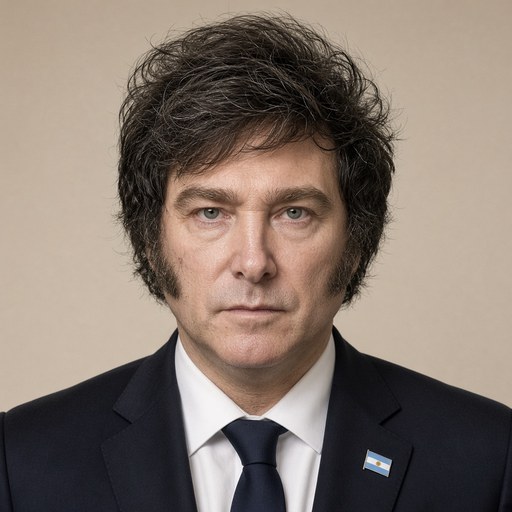
Speech by President Javier Milei at the Summit of Heads of State of Mercosur and Associated States, in Foz de Iguazú.
 Javier Milei · President of Argentina
- Context
- Milei addressed the Mercosur Heads of State Summit in Foz de Iguazú on December 20, 2025, calling for bloc reform, tariff reduction, and democratic accountability.
- Main themes
- Mercosur reform and modernization, trade liberalization and tariff reduction, institutional flexibility, strategic assets (energy, critical minerals, food), transnational crime and security, Venezuela crisis and democracy, political prisoners, EU-Mercosur trade agreement, economic growth and innovation, Bolivia's incorporation
- Duration
- ~10 min
- Words
- 1,146
- Sentences
- 60
- Readability
- 40
- Grade
- 12.4
- Syntax
- 2.87
- Vocabulary
- 2.33
Translated from Spanish
The broad sphere of national life a sentence belongs to. Every sentence has an Arena, so it is the denominator the other indices are read against.
Other60 sentences in 20 paragraphs
Gentlemen, reality is not discussed, it is measured. According to the block's own documentation, intrazone trade, as a proportion of total trade, is currently well below its historical levels. And this happens despite the fact that Mercosur's external tariffs are among the highest in the world.
Such a tariff does not protect jobs; it destroys them. That is why, during our pro tempore presidency, we promoted and achieved an expansion of the exceptions to the common external tariff, so that our companies can access more competitive goods and so that consumers pay more reasonable prices. This is just a first step.
The region needs a modern, simple, competitive tariff aligned with the practices of the dynamic blocks of the 21st century. Otherwise, we will continue to be condemned to grow below the world. Furthermore, now more than ever, the block needs a comprehensive institutional reform that reduces the economic cost of Mercosur. Integration must serve trade, not bureaucracy.
But just as we must correct what does not work, we must also enhance what does have a future. Our countries possess a set of extraordinary strategic assets: energy, critical minerals, and food. They have always been there, and at least in the case of Argentina, we have not been able to turn them into wealth. What we need is to stop putting internal obstacles and allow that potential to unfold at once. Energy coordination, the articulation of value chains, and the reduction of real barriers are the tools that can transform the economic geography of our countries.
We must also recognize something we have learned over these years. Flexibility is an asset, not a threat. The latest Nobel Prize in Economics attests to this. It has been demonstrated that what truly drives economic growth is innovation and creativity. And this can only flourish in contexts of flexibility. Rigidity can only bring stagnation.
In this sense, the block has advanced under different modalities of flexibilization: joint negotiations, macro agreements, bilateral preferences, and even individual agreements made by member states. To attempt to freeze that dynamic would condemn the block to anachronism.
We need clear rules, yes, but we also need the capacity for each country to position itself with the speed demanded by its international insertion. This flexibility we propose is not an abstract concept, but a concrete tool to adapt to an international environment that evolves much faster than our collective response capacity. Experience shows that when Mercosur tries to advance in a monolithic manner, processes are prolonged and opportunities are lost. The relationship with the European Union is a witness case of that slowness, because after decades of negotiations we have not been able to finalize a trade agreement. The size and complexity of the blocks and the existence of veto-wielding actors opposed to competition prolong a relationship that should have been established years ago due to the complementarity of our markets.
Our countries do not have 10 more years to waste on administrative discussions. The time it has taken us to reach these agreements does not respond to the challenges we face ahead and does not meet the economic needs of our nations. The time for economic opportunity is always brief and cannot be subordinated to the eternity of bureaucracy and politics.
On the other hand, we cannot ignore the dimension of security; transnational crime, drug trafficking, and human trafficking know no territorial limits. From day one, we warned about the situation in the triple border area. That is why Argentina promoted the creation of the Mercosur Commission against Transnational Organized Crime, which is now a reality.
In this context, I also want to refer to the regional democratic situation. Venezuela, suspended from Mercosur for violating the Ushuaia Protocol, continues to suffer a devastating political, humanitarian, and social crisis. The atrocious and inhumane dictatorship of the narco-terrorist Nicolás Maduro casts a dark shadow over our region. This danger and this shame cannot continue to exist on the continent or it will end up dragging us all down with it. Argentina welcomes the pressure from the United States and Donald Trump to free the Venezuelan people. The time for a timid approach on this matter has run out. We also urge all other members of the block to support this position and to condemn this authoritarian experiment unequivocally.
We also demand once again the release of all political prisoners and will not cease to call in all international forums for the freedom of the Argentine Nahuel Gallo, who is illegally detained.
We welcome the international recognition of the courage of María Corina Machado, Nobel Peace Prize 2025, and reiterate our call for the will of the Venezuelan people to be respected.
Furthermore, I want to highlight the importance of Bolivia's incorporation into Mercosur. Argentina has conveyed to President Paz Pereira that we are fully willing to support his accession process with technical seriousness and political clarity.
Before concluding, I want once again to express the permanent and solid support of Mercosur for the sovereign rights of the Argentine Republic over the Malvinas Islands, South Georgia, South Sandwich Islands, and the surrounding maritime spaces illegally occupied by the United Kingdom since 1833.
And, to conclude, I want to say to you, esteemed colleagues, if experience has shown anything, it is that protectionism, bureaucracy, and complacency have sunk us into stagnation.
Argentina has already decided to break with that failed model and move towards a country where producing, trading, and competing do not depend on the whim of the State or absurd regulations. If we truly want prosperity, we need the courage to leave behind failed recipes, cut with the mistakes of the past, and move towards an open, efficient scheme capable of integrating without fear of global reality.
In this line, recent events in the region confirm that this change of course is not isolated. The victory of José Antonio Kast in Chile expresses a clear social demand for more competitive, open, and flexible economies capable of generating genuine growth from work, investment, and economic freedom. This political shift in Latin America must be interpreted as a clear signal for Mercosur. Either the block begins to accompany this new reality or it will remain trapped in an inertia that the world has already left behind. Regional integration will only be achievable if it is based on dynamic, open economies committed to efficiency and market competition.
The question we must ask ourselves today is simple: do we want Mercosur to be a growth engine or a brake on the future? Argentina has already answered that question.
Let us unleash the productive forces that have been contained for decades, let us give our citizens the right to prosper. This is a debt that Mercosur and all its beneficiaries owe to our citizens. Let us not turn a deaf ear to the justice of these demands.
Thank you very much.
The original Spanish. The tags above are read on the English translation's sentences.
Señores, la realidad no se discute, se mide. Según la propia documentación del bloque, el comercio intrazona, como proporción del comercio total, se encuentra hoy muy por debajo de sus niveles históricos. Y esto ocurre a pesar de que los aranceles externos del Mercosur están entre los más altos del mundo.
Un arancel así no protege el empleo, lo destruye. Es por eso que, durante nuestra presidencia pro témpore, impulsamos y logramos una ampliación de las excepciones al arancel externo común, para que nuestras empresas puedan acceder a bienes más competitivos y para que los consumidores paguen precios más razonables. Esto es sólo un primer paso.
La región necesita un arancel moderno, simple, competitivo y alineado con las prácticas de los bloques dinámicos del siglo XXI. De lo contrario, seguiremos condenados a crecer por debajo del mundo. Además, hoy más que nunca, el bloque necesita una reforma institucional integral, que reduzca el costo económico del Mercosur. La integración debe estar al servicio del comercio, no al servicio de la burocracia.
Pero, así como debemos corregir lo que no funciona, también debemos potenciar lo que sí tiene futuro. Nuestros países poseen un conjunto de activos estratégicos extraordinarios: energía, minerales, críticos y alimentos. Siempre han estado ahí y, al menos en el caso argentino, no hemos sido capaces de convertirlos en riqueza. Lo que necesitamos es dejar de poner obstáculos internos y permitir que ese potencial se despliegue de una vez. La coordinación energética, la articulación de cadenas de valor y la reducción de barreras reales son las herramientas que pueden transformar la geografía económica de nuestros países.
También debemos reconocer algo que aprendimos durante estos años. La flexibilidad es un activo, no una amenaza. El último premio Nobel de Economía da cuenta de esto mismo. Al quedar demostrado que lo que realmente impulsa el crecimiento económico es la innovación y la creatividad. Y esto sólo puede florecer en contextos de flexibilidad. La rigidez sólo puede traer estancamiento.
En ese sentido, el bloque ha avanzado bajo distintas modalidades de flexibilización: negociaciones conjuntas, acuerdos macros, preferencias bilaterales e incluso acuerdos individuales celebrados por Estados partes. Pretender congelar esa dinámica sería condenar al bloque al anacronismo.
Necesitamos reglas claras, sí, pero también necesitamos que la capacidad de que cada país pueda posicionarse con la velocidad que exige su inserción internacional. Esta flexibilidad que proponemos no es un concepto abstracto, sino una herramienta concreta para adaptarnos a un entorno internacional que evoluciona mucho más rápido que nuestra capacidad de respuesta colectiva. La experiencia demuestra que cuando el Mercosur intenta avanzar de manera monolítica, los procesos se dilatan y las oportunidades se pierden. La relación con la Unión Europea es un caso testigo de esa lentitud, porque tras décadas de negociaciones no hemos podido terminar de materializar un acuerdo comercial. El tamaño y complejidad de los bloques y la existencia de actores con capacidad de veto opuestos a la competencia dilata una relación que debería haberse establecido hace años por la complementariedad de nuestros mercados.
Nuestros países no tienen 10 años más para desperdiciar en discusiones administrativas. El tiempo que nos ha llevado estos acuerdos no responde a los desafíos que tenemos por delante y no responde a las necesidades económicas de nuestras naciones. El tiempo de la oportunidad económica es siempre breve y no puede subordinarse a la eternidad de la burocracia y la política.
Por otro lado, no podemos ignorar la dimensión de la seguridad, la criminalidad transnacional, el narcotráfico y la trata de personas no conocen límites territoriales. Desde el primer día advertimos sobre la situación de la triple frontera. Por eso Argentina impulsó la creación de la Comisión Mercosur contra el Crimen Organizado Transnacional, que hoy es una realidad.
En este marco quiero referirme también a la situación democrática regional. Venezuela, suspendida en el Mercosur por violar el protocolo de Ushuaia, continúa padeciendo una crisis política, humanitaria y social devastadora. La dictadura atroz e inhumana del narcoterrorista Nicolás Maduro, extiende una sombra oscura sobre nuestra región. Este peligro y esta vergüenza no pueden seguir existiendo en el continente o nos terminará arrastrando a todos consigo. La Argentina saluda la presión de los Estados Unidos y Donald Trump para liberar al pueblo venezolano. El tiempo de tener un acercamiento tímido en esta materia se ha agotado. Instamos además a todos los demás integrantes del bloque a secundar esta posición y condenar tajantemente a este experimento autoritario.
También exigimos una vez más la liberación de todos los presos políticos y no dejaremos de pedir en todos los foros internacionales por la libertad del argentino Nahuel Gallo detenido ilegalmente.
Saludamos el reconocimiento internacional al coraje de María Corina Machado, Premio Nobel de la Paz 2025 y reiteramos nuestro llamado a que se respete la voluntad del pueblo venezolano.
Asimismo, quiero destacar la importancia de la incorporación de Bolivia al Mercosur. La Argentina transmitió al Presidente Paz Pereira que estamos plenamente dispuestos a acompañar con seriedad técnica y claridad política su proceso de adhesión.
Antes de concluir, quiero una vez más el apoyo permanente y sólido del Mercosur a los derechos soberanos de la República Argentina sobre las Islas Malvinas, Georgias del Sur, Sándwich del Sur y los espacios marítimos circundantes ocupados ilegalmente por el Reino Unido desde 1833.
Y, para finalizar, quiero decirles, estimados colegas, si algo ha demostrado la experiencia es que el proteccionismo, la burocracia y la complacencia nos hundieron en el estancamiento.
La Argentina ya decidió romper con ese modelo fallido y avanzar hacia un país donde producir, comerciar y competir no depende del capricho del Estado ni de regulaciones absurdas. Si realmente queremos prosperidad, necesitamos el coraje de dejar atrás las recetas fracasadas, cortar con los errores del pasado y avanzar hacia un esquema abierto, eficiente y capaz de integrarse sin miedo a la realidad global.
En esta línea, los recientes acontecimientos en la región confirman que este cambio de rumbo no es aislado. La victoria de José Antonio Kast en Chile expresa una clara demanda social por economías más competitivas, abiertas y flexibles, capaces de generar crecimiento genuino a partir del trabajo, la inversión y la libertad económica. Este giro político en Latinoamérica debe ser interpretado como una clara señal para el Mercosur. O el bloque comienza a acompañar esta nueva realidad o quedará atrapado en una inercia que el mundo ya dejó atrás. La integración regional sólo será realizable si se apoya en economías dinámicas, abiertas y comprometidas con la eficiencia y la competencia de mercado.
La pregunta que debemos hacernos hoy es simple: ¿queremos un Mercosur que sea un motor de crecimiento o un freno para el futuro? La Argentina ya respondió esa pregunta.
Liberemos las fuerzas productivas que llevan décadas contenidas, demos a nuestros ciudadanos el derecho de prosperar. Esta es una deuda que tiene el Mercosur y todos sus beneficiarios para con nuestros ciudadanos. No hagamos oídos sordos a la justicia de estas demandas.
Muchas gracias.