




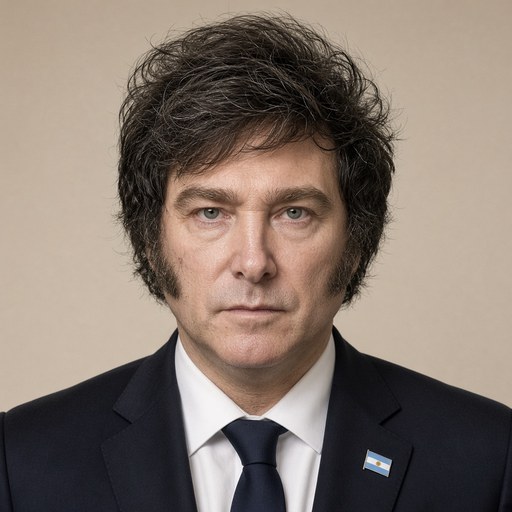
Words from the President of the Nation, Javier Milei, after receiving the Salamanca School Award, from the Riojan Center, Spain.
 Javier Milei · President of Argentina
- Context
- Milei addressed a gathering in Spain on June 13, 2025, after receiving the Salamanca School Award from the Riojan Center, sharing Argentina's anti-inflation experience.
- Main themes
- Eradication of inflation, School of Salamanca, Austrian economics, monetary theory, fiscal deficit reduction, money supply, exchange rate policy, Central Bank reform, Argentine economic crisis, libertarian economic policy
- Duration
- ~65 min
- Words
- 7,786
- Sentences
- 327
- Readability
- 60
- Grade
- 10.6
- Syntax
- 3.31
- Vocabulary
- 2.02
Translated from Spanish
The broad sphere of national life a sentence belongs to. Every sentence has an Arena, so it is the denominator the other indices are read against.
Other327 sentences in 45 paragraphs
Good afternoon. Thank you very much for this recognition; by the way, I already handed it over to the Chief of Protocol, so they can't take it away from me, just so you know. Moreover, it is an enormous pleasure to always have the opportunity to listen to this colossus of freedom, Dr. Jesús Huerta de Soto. And when we made the first attempt... the thing is that Argentina is a country with its complexities; I had been thinking of putting together a sort of talk, something like constructing a family tree of the School of Salamanca, and when they told me that Professor Jesús Huerta de Soto was going to be here, I said: "What do I have to say... Professor Huerta de Soto will say much more interesting things." In other words, I had thought of reviewing value theory, monetary theory, banking theory. Moreover, about the labor market and the whole discussion of interest rates. A discussion that is quite, quite complex.
And, in reality, it seemed to me that the most I could contribute to offer something different was to share my experience, that is to say that – basically – it is the way in which we are eradicating inflation. When we came to power, inflation was running at more than 1% daily; that, in annualized terms, is close to 3500% per year. Moreover, if one takes wholesale inflation – which usually leads and is the one I continuously refer to – it had been 54% monthly; that, annualized, gives 17,000. In other words, at that level of madness, inflation was traveling in Argentina. And, basically – as Professor Huerta de Soto points out – I had been repeating a phrase from Milton Friedman for years, but with some improvements, which, for those who understand Value Theory, are substantial and know that only the principle is from Milton Friedman, but the rest contains a lot of Austrian School and its origin is the School of Salamanca.
The postulate is simple, it is well-known, and, in fact, yesterday on Twitter, after the monthly inflation of 1.5% was announced. That is to say, that consumer inflation, which at one point reached 25.5%; which – in year-on-year terms – reached almost a peak of 300%. Today, basically, if you take the year-on-year, it is at 43, but if you take the point, it is already at 20%. And believe me, I will now give the reasons why it will continue to decrease and we will end it.
And it was essential to tackle the inflationary problem, but clearly – as says our foremost exponent of the ideas of freedom in Argentina, Professor Alberto Benegas Lynch (h), a friend of many of us here – he says: "There is nothing more useful than a good theory" and the postulate is that "inflation is always – and everywhere – a monetary phenomenon." Up to that point, the phrase from Friedman goes, and we add: generated by an excess of money supply, either because the supply increases or because demand falls, or both things happen at the same time, which results in a loss of purchasing power of money; that is to say, all prices expressed in monetary units rise, which is what we know as inflation.
So – based on that diagnosis – what we decided is: "Okay, we need to cut the money issuance." And – in that context – we found ourselves with a fiscal deficit of 15 points of GDP: 5 in the National Treasury; 10 in the Central Bank, and the important thing is that, in addition, that debt that the Central Bank had, which was really nothing more than debt generated because the State, because the Central Bank financed the National State with monetary issuance and then withdrew that money, sterilizing it by paying interest, being condemned to the unpleasant monetarist arithmetic of Sargent and Wallace, that is to say, that the final result ended up being more inflationary because more was issued, because the fiscal issue was never corrected. This occurred in a situation where, in addition, within the Central Bank, there were 4 monetary bases, and – during the previous government – those liabilities were maturing in an average span of 60 to 90 days. And one of the things the previous government did was to move all those monetary liabilities to one day; that is to say, we could find ourselves in a situation where – overnight – the amount of money could quintuple, with the disaster that that could imply. Not only that, but also, there were debt maturities in pesos equivalent to 90 billion US dollars. And, given what was – basically – the amount of monetary base in Argentina, it was at least between 8 and 9 monetary bases; moreover, if obviously there was a need to pay and there were no resources, it would have multiplied the amount of money by 10. So, notice that we had hidden there about 15 monetary bases circulating.
But, in addition, we had an intervened exchange market with a gap of 200%. That is to say, the official exchange rate and the parallel exchange rate; basically, there was a 3 to 1 relationship. The Central Bank had negative international reserves of 12 billion dollars; we had debts with importers equivalent to 45 billion dollars and, in addition, we had fallen out of agreement with the International Monetary Fund because we never met the fiscal targets. In other words, we were literally naked, full of water, bathed, sitting in the electric chair. And, with many, trying to plug it in and make it work. That is why I often say that we need to know how to separate between liberals and libertarians, and the liberal libertarados. In this group, I always include the idiot Hans-Hermann Hoppe and others from Argentina who say the same nonsense. No, it was very easy; close the Central Bank and the problem would be over. The problem is that the remunerated liabilities and the monetary base are liabilities, and if you closed the Central Bank like that, just because, the value of those instruments would become zero, and the only way to make those instruments zero is how? By making the price level tend to infinity. That is to say, it would have generated a tremendous hyperinflation; poverty would have exploded and would have reached levels of 95%; we would have had a situation even worse than that of Venezuela. And when the holidays came, when Christmas and New Year arrived, all the Peronist paraphernalia would have started with looting and so on, and today, clearly, I would not be here. In other words, this is not only about knowing economic theory; it is about understanding sequentialities; it is about understanding how perverse politics is, and – above all – knowing what to do, how to do it, but, above all, having courage.
Therefore – in this context – the main thing we had to try was to end inflation, and with that, we had to end monetary issuance. That is to say, it was necessary to stop the machine that printed bills. And so, the first thing we did was cut the fiscal deficit.
Here it is very interesting, in a talk, Dr. Sturzenegger presents it brilliantly. He says that many people call him, although this part of the chainsaw is Caputo's chainsaw, "Toto" Caputo, who made me very happy when he was named the best Minister of Economy in the world. He recounts that many call him – from his role as a professor at Harvard – and many call him to say: "Well, I have to make the adjustment, how do I do it? And what about this, that, and the other?" And then he tells them: "Well, how much do you have to adjust?" "Well, 5 of GDP." "Okay? And what do you plan to do?" "Well, more or less, one point per year." And he says: "And you don't...? Well, what do you think if you adjust 5 in one month?" They say: "No, no, no, that's impossible." "Well, that's what we did: we adjusted five in one month."
In strict rigor – I tell you – we didn't adjust 5, we adjusted 7 because, in the mess we were in – literally in the electric chair – and one started to cut. So we overreacted the adjustment, we made an adjustment of 7 points and then we started to recompose items and concretely, we reduced public spending by 30%. In fact, a study done by Dr. Sturzenegger's assistants says: "Well, I will check over time, from the year 40 onwards, who made such a reduction in public spending." And then he says he found 14 cases. But all those cases occurred after a war, that is to say, there is no historical record of anyone who has reduced public spending by 30% without being at war. Thus, we also made the largest fiscal adjustment in history.
But that's not all, because we also had 10 points of GDP in the Central Bank. So, our first task was to stop the first tap of issuance, which was to cut the fiscal deficit, and we did that in the first month. We have had 17 consecutive months of financial surplus, that is to say, not only operational, but also, we pay the interests and – in that context – the Country Risk, which was around 3000 basis points, is now looking to break 600 basis points. That is to say, there is a drastic drop in the interest rate as a consequence of the reduction of Country Risk.
Therefore, the second phase of the program consisted – now – in ending the quasi-fiscal deficit. There, basically, what we did is that – as soon as we took office – because we also didn't have dollars to defend the exchange rate and we couldn't lift all the restrictions because, basically, the system was deeply unbalanced, and the dynamics of the stocks could – if they turned into flows – generate an inflationary disaster. The first thing we did was correct the exchange rate, and by making the exchange rate jump, the expectation of devaluation disappeared. And that allowed us to arbitrate the rate in pesos and dollars, which – although it was positive in terms of dollars – in real terms of pesos was negative. I say this because the International Monetary Fund and many domestic economists said that the interest rate had to be raised. And if we had raised the interest rate, only if we had followed, for example, the retail inflation of the first month, or that is to say, by the following month we wouldn't have had 4 hidden bases in the Central Bank, but we would have had five. So imagine that that wouldn't have ended well. So, what did we do? We said: what would the market do? It would arbitrate the rate here. And that was what allowed us to partially dilute the debt of the Central Bank while those who were in those positions continued to earn in dollars. But not only that, that debt should never have been in the Central Bank, because that debt was generated – basically – because the State gave non-transferable notes and took dollars to the Central Bank, or – alternatively – asked for advances on profits or other aberrations or transfers. And that made it so that, to finance the treasury, and then, the Central Bank rescued that money by paying interest. That is to say, it was an indirect form of indebtedness of the National Treasury. So, that debt should never have been inside the Central Bank; it should have been in the hands of the Government.
And there – in a titanic effort, the President of the Central Bank, Santiago Bausili, and the Secretary of Finance, Pablo Quirno – began a whole process to dismantle the monetary liabilities of the Central Bank and transfer them to the public sector, to the Treasury, which is who had truly gone into debt. So that the problem caused by the public sector did not turn into a monetary problem, with the harmful characteristics that inflation has, either due to the distortion it generates in relative prices and, therefore, not only does it shrink the planning horizon of human beings, of individuals, because, as Mises said: "The more the State plans, the less the individual plans," that is to say: the more the State meddles, the more it ruins us. Which also generates a distortion for economic calculation, making it very complicated. But, in addition, that also impacts more cruelly and violently on the most vulnerable sectors. In fact – when we took office – the very acknowledgment of the variables led poverty levels to 57%. Basically – in Argentina – the official measurement of poverty is done semi-annually. This makes sense because, if that variable is growing, always in the semester, the average is taken, and it is a number that is underestimating. That is to say, not because INDEC does not do the numbers well, but because, in reality, for example, the gentleman, the Soviet, the communist from the province of Buenos Aires – because, at one point, he eliminated the statistics because he found it stigmatizing; it is interesting because the media... that is why, when I saw Wall Street Wolverine here, it made me very happy, because he has a wonderful phrase that says: "We do not hate journalists enough." Imagine that the chainsaw, having eliminated public works, discretionary transfers, something that I could not stop eliminating was the official advertising. So, if you see that, in some Argentine media trash, they say that I killed Kennedy, it is false, because I was born in 1970.
But then – basically – what is interesting is that by lowering the country risk, we were able to start this whole debt transfer. And the most interesting thing is that... I was talking about poverty, but there are also other issues that are important and not included in the measurement of poverty, because you have prices, there were price controls. So you had price controls and those prices were marked. But what is the problem? You would go to the shelf and the good was not there. So poverty was already underestimated, because the effect of scarcity was not taken into account, that you went to look for the product, the product was not there and – consequently – you had to buy another one that was indeed more expensive. Or the distortion that you modify your path or your consumption pattern in light of the distortions of price controls, because consumption is being diverted. And obviously, when we made all that transparent, poverty was at 57%. There, yes, the media trash said that we had raised poverty to 57%. Then, when the number started to fall, evidently the measurements no longer worked, neither private nor monthly nor anything; only where the improvement is worse. But to make it hurt even more for the media trash because they are accomplices of the thieving politicians – today – poverty is below 35%. We reduced poverty by 22 percentage points. And that means that 10 million people came out of poverty. That is to say, we – the heartless, the insensitive, the villains of the libertarian liberals – precisely favored those who have the least, taking 10 million people out of poverty.
Therefore – in that context – we were then making the transition of the debt from the Central Bank to the National State. And then, someone might say: “No, well, but they were increasing the debt” or other things that these... I don’t want to call them “primates” because I believe that the Society for the Prevention of Cruelty to Animals would have to report me for animal abuse. They think I have to talk to monkeys who believe that rolling the debt is taking on debt, when it is so easy, because – if we take the amount of debt – much to the chagrin of the media trash and the filthy political caste, we are the first government in history that – in one year – reduced debt, and we reduced 45 billion dollars of debt. It is true that part of it was because we liquefied it, with this interest rate arbitration, but it is also true that we put 25 billion dollars in cash. So – around the middle of last year – the Central Bank was cleaned up. And if it already seemed like a lot to make a fiscal adjustment of 5 points of GDP, imagine then that, in 6 months, we achieved a fiscal adjustment of 15 points of GDP, making the largest fiscal adjustment in the history of humanity.
And not only that, but also – as if that were not enough – we returned 2 points of GDP in the reduction of 19 taxes. Look at what we are doing for the model of Freedom! But, even so, inflation still struggled to go down. We maintained that, in addition, monetary policy has a lag of 18 to 24 months. That is why, a few days ago, I publicly pointed out that – by the middle of next year – inflation will have been history in Argentina, because we kept the amount of money constant since the middle of last year, it did not grow anymore. Therefore, sooner or later, the inflation rate in Argentina will disappear.
And, in that sense, we detected another problem we had: the levels of monetary aggregates – in Argentina – were very low. That is to say, the monetary base – in terms of GDP – should oscillate between 10 and 15 points of GDP, and it was at 2 and a half. So, it was clear that there was potential demand for money for the demand for money to jump to a higher level. But, in addition, there was also another problem. Well, it is not a problem: since the economy is growing strongly, despite what the Keynesians predicted – because one of the things they said was that if one made an adjustment of this nature, we would sink into a recession – adjustments of half the size had generated GDP declines of 15%; therefore, they predicted a disaster for us, in terms of activity, employment, poverty. It is interesting because – the previous government – had left us a negative statistical drag in GDP, because it had been falling by close to 3%. When you take the final number, it is a number that is around 1 and a half; but, if you take the monthly frequency, the GDP of December 24, despite having made the largest fiscal adjustment in the history of humanity, ended up 6% above the GDP of December 23, which means we also ended another Keynesian and interventionist myth: that adjusting the State is recessionary. No. Adjusting the State was expansive.
So, faced with that situation that the demand for money had to be restored because inflation was going down, that the economy is growing; in fact – between April and December – the economy expanded by 10%; in the first quarter it expanded by 6%; in the second quarter it is doing so at 8%. It is clear that, given the fixed amount of money, we are going to have a problem because the demand for money is growing a lot and I have the fixed amount of money, the monetary base is fixed. So – while there is excess money – as a result of what were the interventions of the National State, of exchange controls; of the exchange rate and other price controls, I emphatically recommend looking at the monetary chapter of “Man, Economy, and State” by Rothbard, which perfectly describes the money overhang, so I leave it as a nice task to do.
In fact, the excess money we had was – at least – double what we had in the Rodrigazo in 1975, when the inflation rate multiplied by six. And, in that sense, while there was a money overhang, we can continue to maintain this trend of fixed money supply and growing money demand, because that money overhang is absorbed, either partly by prices and partly by quantities. The problem lies in how much that number reaches, the money overhang is exhausted, inflation becomes zero, and Argentina has to start transitioning to deflation, but with a contractual structure not suited for that. I quote, to the point of exhaustion – I must have cramped my tongue – at least 20 times – quoting the beautiful book by Philipp Bagus: “Defending Deflation,” but the contractual structure is there, and the electric chair... there are always people willing to turn it on.
So, basically, we said: “Well, how do we get people to start using dollars?” Argentina is a country that has, today, to give you an idea, 10 monetary bases outside the system. That is to say, the dollars that Argentines took out of the system are equivalent to 10 monetary bases. Because – deep down – the amount of money within the economy is determined by individuals. Because, deep down, the demand for money is a derived demand, which is a mirror of what happens in the goods market. Consequently, the real amount of money in an economy is determined by individuals, and there is nothing better than the monetization of the economy being done by the individuals themselves.
In that context, we launched the first stage: endogenous dollarization. That is to say, a stage where people could start making all their transactions in foreign currency. That is to say, you can make all transactions in the currency you want in Argentina. However, it did not work: people did not do it, they continued using pesos, people did not monetize. So, another thing we said was: “Well, here the fundamental role must also be to eliminate the controls.” And so, we started working on the elimination of the controls, that is, of capital controls. And one of the things that also seemed very important to us was to clean up the balance sheet of the Central Bank, because if – basically – the liabilities of the Central Bank are debt, I know that by the condition of transversality the real balances must be zero. And they can be zero either because I paid that debt or because prices went to infinity. Now, the more robust the asset of the Central Bank, the more I have to honor those monetary liabilities. And, consequently, the more cleaned up the balance sheet of the Central Bank, the lower the long-term price level is. And, if I take the price level today, and the long-term one, the slope is the underlying inflation, which this economy has.
Therefore, to the extent that I clean up the balance sheet of the Central Bank; strengthen the asset of the Central Bank, that is, in stage 2, we clean up the liabilities of the Central Bank; in stage 3, basically we start working on the asset of the Central Bank, making it more solvent, therefore, that the long-term price level is lower and, consequently, the inflation to which the system travels falls.
In that sense, we went to the International Monetary Fund and made an absolutely revolutionary proposal, because – in general – all countries go to the International Monetary Fund for what? To ask for debt to finance the fiscal deficit, so that they can do it gradually, so that it does not hurt the people, which is a lie. The best thing that can be done is a hard and pure ax to public spending, because it is giving money back to the people.
So, we went to the International Monetary Fund and asked to put together a package to clean up the balance sheet of the Central Bank, to clean up the asset of the Central Bank, so that those pesos that each good Argentine has in their pocket start to have a counterpart of value, that has value, that is not just painted paper. And, in that context, our estimates said that to get out of the controls we needed about 12 billion dollars. And since both “Toto” Caputo and I are very risk-averse – because outside it is easy, but with the electric chair it is not so easy – then what did we say? We are going to go to a band scheme, but we open if they give us 15 billion dollars, so that we could deliver, we could buy pesos with dollars, for the equivalent of 3 billion dollars.
The terminology is not trivial. If you notice, I am using different terminology, because others would say: we would sell 3 billion dollars. But I am saying something else: I am buying pesos. Because what I am saying is: I want to keep the amount of money constant, I want to end the scam of seigniorage. Because the issue is not that the inflation tax is zero. That is a lie, because then, if I have growth in the demand for money and I accompany it with growth in supply, then prices do not rise. It is true, but I am scamming the people. Or am I not issuing money? If the Central Bank were not issuing money, there would have been healthy deflation, deflation due to growth, and there is the amount of the scam. Therefore, it must be absolutely prohibited to issue money.
And, in that context, we put together the program; we had to endure all kinds of pressure from the opposition; we had to endure all kinds of lies; many journalists – clearly corrupt – betting that we would fail, spreading all kinds of lies. In fact, I had to face the situation of reading that I was supposedly making my Minister of Economy resign, and I was on the plane with the Minister of Economy designing aspects of economic policy, or having to go to meetings, they would take me aside and say: “But you are not going to fire him, are you?” That is what the trash of journalists generates. That is why I think they are such despicable beings, 90% of the time.
So that was not free either, because it generated a lot of volatility for us. We had to announce the program, that we were going to do something. We did it, on March 1, and, between the complicity of the media trash and the trash of politics, they generated a lot of instability for us; it made the demand for money fall; inflation soared to 3.7% monthly. They said that – when we opened – it would go between 5% and 7% and from there it would start to stabilize and would never go down again. And – in the end – we ended up getting a package of 49 billion dollars: basically 20,000 from the Fund; 12,000 from the World Bank; 10,000 from the IDB; 2,000 from a REPO and the government of China that refinanced the Swap for us.
In that context, what did journalists and politicians say? That I would never dare to open the controls in an election year; that if I did, I would do it after the elections. However, I said that if they gave me 15 billion dollars in cash, I would open it. The program contains 20 billion dollars in cash, and since doing the right thing is not negotiable – because freedom is not negotiable – when we got the program with 20 billion dollars in cash, we opened the controls.
I also want to make a note about this: why the bands? The reality is that Argentina is a society that has been accustomed to living under continuous financial repression for the last 90 years, to the point that - for example - it is deeply rooted that jumps in the exchange rate, that is, a devaluation of the currency, leads to the emergence of inflation. And, in reality, it is as if there is a causation from the exchange rate to the price level, when in fact the causation is from the amount of money to prices, where the exchange rate is just another price, and since it is a financial asset, it rises first and then the others follow. In other words, if they understood the Hume-Cantillon effect, they could see it clearly. That is to say, I can have a situation where my demand for money falls, in an arbitrage against the dollar. So, first the dollar rises; then the tradables rise; then the wholesale prices rise; then the retail prices rise; and finally, the wages rise. That is why, in addition, devaluation is also highly unpopular. But it has to do with a problem of what is happening in the monetary market. Because, if I - for whatever reason - decide to demand more dollars, or because my preferences changed, or because there was a change in the international context of the foreign exchange market, which leads to the dollar being more expensive, if I keep buying the same amount of dollars, what is going to happen now? A greater proportion of my income will have to be applied there. This means that I will have to spend less in other areas and, therefore, those prices will fall. If they had read "Economics in One Lesson" by Hazlitt, they would know this, but they don’t read. So, what happens? In that case, there is no problem at all. And it is clearly demonstrated that there is no causation from the exchange rate to the price level. Now, if the Central Bank, in that consideration, assumes that prices will not fall and issues money, then monetary issuance appears that validates it. So, since we have been living with that disease for 90 years where there has always been inflation - because, in addition, the monetary validation did not come later; it had already been generated before, financing the fiscal deficit - then, what is the point? The point is that people had found that there was a relationship between the exchange rate and the price level, and the reality is that, for 90 years, that model proved them right. It is as if I were standing at the moment Malthus wrote his model, and I look back: if I give the task to an economist, Malthus was right, and yet he was fiercely wrong.
So, what happens? In that context, basically, we found ourselves having to explain that the relationship went from the amount of money to prices, because people are not to blame for what happened over the last 90 years. So, we had to float, but without making people afraid, that is, to keep the problem contained. That is why the bands, that is why a ceiling and that is why a floor. But see that both the ceiling and the floor move at 1% per month: the ceiling rises by 1% per month and the floor falls by 1% per month. In the limit, they will go to a free exchange rate. And where did that idea come from? That is why there is nothing more useful than a good theory. If you were lucky enough to take a general equilibrium course, you will find that the first part of a general equilibrium course works with functions, that is, with applications ready for you to demonstrate that equilibrium exists, but that it is also unique. Apart from stability, it is easier because assuming that direct effects are greater than cross effects is enough, which is quite obvious. It is obvious that the price of tea affects the tea market more than the coffee market. You don’t have to be a genius for that.
In that sense, basically, that is the first demonstration of existence that is made, with bounded sets and so on, to be able to apply a Fixed Point Theorem. Then they want to generalize it, so they work with correspondences - that is, point-set applications - that is, they allow another type of more violent substitution levels, to put it in some way. And the most expanded stage of all is when you do not bound the economy, that the economy is not bounded. That brings some problems - from a mathematical point of view - because to apply the Fixed Point Theorems you need those sets to be closed, bounded, convex, that the functions are continuous, and if they are correspondences, they must be upper semicontinuous. But, what does the last stage do? It frees that restriction that the set be bounded. So, the problem is we cannot apply the Fixed Point Theorems. I mean, we have a problem there, the Fixed Point Theorems are made like that, not how we want. So, what is the trick that general equilibrium economists do? They generate an artificially bounded economy. That is, it is not bounded, but I invent a bound. And, if - when I go to prove existence - the equilibrium is not on the edge, then it means that now that equilibrium and all the properties of equilibrium. This is exactly the same process. What did we do? We bounded - artificially - and let the exchange rate fluctuate within the band. They said, obviously, the econochantas, the always wrong economists and their partners, the trash journalists, 90% - so they don’t cry later -. Well, they say that I put them all in the same bag and I only talk about the 90% that lies recurrently. So, this is interesting because we have fallen in the ranking of freedom of expression, do you know why we fell in the ranking? Because we removed the official guidelines. That is to say, we precisely gave them the freedom to do whatever they want. They can tell me anything, but of course, it seems that I touched the most sensitive organ of the human being: the pocket.
So, after saying that the exchange rate was going to go to the ceiling of the band, that we were going to lose billions and billions of dollars, that inflation was going to shoot up, that it was going to go to levels of 5% to 7% and that - afterwards - it would not go down anymore… the exchange rate fell and is closer to the floor than to the ceiling. Moreover, think about this because this is very basic, Economics 101, even studying from the basic books. So, they graph supply and demand. Then, they present the case of a minimum price. What happens when there is a minimum price? There is an excess of demand and the price in the parallel market remains high. If you free it, what happens? The quantities expand and the price falls. What happened? The quantities traded in the exchange market increased sharply and the price went to an intermediate point, closer to the floor than to the ceiling. Point for economic theory; another own goal for lying journalists and economists.
So, well, that’s it, we got out of the clamp; now everything is great, let endogenous dollarization begin. It didn’t happen. It didn’t happen. Now we had opened the clamp, the exchange rate hadn’t jumped, nothing of all the things they said happened, and it didn’t happen. So - recently - we sent one of the most revolutionary reforms, which is the Historical Reparation to Argentine Savers, where - in Argentina - until that day, we were all guilty of tax evasion unless we could prove otherwise. From this measure, we are all innocent until the revenue agency shows otherwise. And this is also very interesting because it reverses the burden of proof, regardless of the fact that I believe the State is a violent criminal organization, that taxes are theft, but I need time.
I will tell you something that you will also like: today, Argentina must have about 450 billion dollars in debt and we, with "Toto" Caputo's team, assumed that if we manage to be in power until 2031, that is, if Argentines decide to support us in '27, and with the growth path perspectives in which Argentina has embarked, we estimate that we could be growing at rates between 6% and 8% annually. And not only that, but also, what we will be doing is that - every year - we will return one and a half points of GDP in taxes. This means that - by the end of the term - we would be returning to Argentines the slight amount of 500 billion dollars.
So, I am going to make a very simple explanation of what this fourth monetary transformation is about, which involved removing about 300 regulations. And, in that sense - basically - when you present, when you have to declare profits, you declare income and they make you declare a consumption. So, what happens? Suppose you earned 100, but spent 400. So, you have to inform the revenue agency that you also spent 400. So, what happens? It doesn’t add up, there is a differential of 300. So, what did the revenue agency do? It also looked at the variation in wealth, so that if your wealth didn’t fall by 300, it fell somewhere. And there was a whole series of controls. That is, for example, every time you went to the supermarket, if the purchase exceeded the equivalent of 100 dollars, it had to be reported to the revenue agency, to give an idea of the level of Soviet control we were immersed in. How? The tyranny of control, I loved it. So, what did we do? We removed the requirement to declare consumption and wealth variation, and - today - there is no need to report anything, unless you spend more than 50,000 dollars per month.
In this way, what happens? You will find yourself in a situation where today Argentines can take out the dollars that were outside the system and use them freely, and there will be no way for the revenue agency to pursue them. And this is very interesting because basically what it allows is for individuals to monetize the economy whenever and however they want, the only thing they will have to do is take the dollars out of the mattress, whenever they want, however they want, in whatever way they want. That is, they will be able to use all that savings freely, they will be able to dispose of the fruits of their labor freely and no one will pursue them.
Therefore, if we have 10 monetary bases hidden in mattresses, when this whole process has taken course, we will find a monetary base in pesos and we will have the equivalent of 11 monetary bases in dollars. Therefore, dollarizing and closing the Central Bank will be as easy as a snap of the fingers.
That is to say, while I promised during the campaign the free choice of currency - well inspired by Hayek and in that wonderful book: "The Denationalization of Money" - there, let’s say, closing the Central Bank is within reach. But having said that, I have not negotiated any of my postulates. And, what I want to do to close this, because I used to say that Menem's first government was the best government in Argentine history. During that government, there was a very successful stabilization program, which was convertibility, and 100 structural reforms were made.
Our stabilization program is making inflation fall much faster than convertibility, but with some quite different things: first, there was never price control nor a call to reorder or discipline; there was no prior hyperinflation that left real balances so low that the very remonetization and recovery of money demand allowed for faster stabilization; the exchange rate was not controlled, which is a shortcut for that to be much faster.
Not only that, property rights were not expropriated; that is, Argentina complied with the creditors to whom it owed the debt for imports; Argentina complied with the creditors of the Central Bank; Argentina complied with the International Monetary Fund; and Argentina also honored the debt with the market. That is, we did all this without generating a single expropriation: we respected property rights to the letter.
And as if all that were not enough, many stabilization programs in light of the problems with subsidies would start; first, someone had to do the dirty work: someone would come and devalue, someone would come and liquefy, someone would come and expropriate, someone would come and raise the price of tariffs. We found that the tariffs - at the moment we took office - covered only 20% of the cost, the regulated tariffs did not; today it covers 100% and - despite all this - the inflation rate, if we measure it in dollars, has decreased because in convertibility there was a one-to-one exchange rate, it decreased much faster than convertibility. Moreover - as I was saying - consumer inflation reached levels of 300% annually and - today - it is at 20% annually and will disappear by the middle of next year. But furthermore, if you look at wholesale inflation, which is the one that anticipates, which was traveling at 54% and reached peaks of 500%, 600%, year-on-year, it is likely that this month wholesale inflation, which will be reported next Tuesday, will start at zero. That is to say, we will be going from levels of 500%, 600% to levels of less than 10% annually, and all this while respecting property rights. We have not harmed anyone, all done in freedom. And if, in addition to that, we add that we made 2,500 structural reforms, not only do we have an anti-inflationary program that was better than convertibility, but it is also 25 times more reformist, all in a year and a half, with 15% of the Chamber of Deputies and 10% of the Senate, no matter how much the econochantas dislike it, no matter how much the journalists dislike it, we are the best government in history.
Long live Freedom, damn it! Long live Freedom, damn it! Long live Spain! Long live Argentina! Long live Freedom, damn it! Long live the Forces of Heaven!
Can I talk about that area? Thank you for singing "Va, pensiero." "Va, pensiero" is the most famous chorus in the history of opera. That story is a very strong story, it is probably Verdi's most well-known opera, it is the one with which I started listening to opera, precisely by listening to "Va, pensiero." And it is very interesting because "Va, pensiero" is an opera where what is done is to draw an equivalence between the occupation (interference) of the Austro-Hungarians, with the occupation of the Jewish people at the hands of Babylon. And, in that equivalence, in that part of the opera, they basically send the Jews to the gallows, that is, to kill them. And a miracle happens and then the Jewish people are saved. But it is basically... moreover, when Verdi wrote that opera - now I will start with the gossip of the time - Verdi, when he finished his second opera, had been a total failure, he was practically bankrupt, his son died, his wife died (interference) and the one who was the first soprano of La Scala, who was the wife of the owner of La Scala, was somehow very infatuated with the young master Verdi. So, when the job came, she emphatically requested that it be given to the young master Verdi, which not only saved him from bankruptcy, but also he ended up with the heroine, but what it evokes is freedom.
Because, moreover, if there is a people that has learned about what freedom is, it is the Jewish people. And it is interesting to say it, on a day like today as well, and... obviously all the victims of socialism. But here there is an additional problem: you have neighbors who want to kill you. So, because Israel accepts that other countries exist, but Iran does not accept that Israel exists. Or - at least - its fundamentalist groups like Hamas, like Hezbollah, like the Houthis. So, why do I bring up the book of Shemot, the book of Exodus? Because, first, the Jewish people when they integrated into Egypt, were free. And - in the name of a national cause - they all started to work, and that is how they were chained. Why? Because they were taxed and continued to progress. And despite the taxes, they continued to progress. And after a little more than 400 years, Moshe appeared and went with his brother Aaron, stood before the Pharaoh and said: "I come to free my people." And then, it is very interesting, because it is as if Egypt at that moment was like the sum of the United States, China, and Russia, all together. And it was two brothers who stood up to the Pharaoh and said: "Free my people." The Pharaoh, obviously, resisted, and Moses, with the forces that come from heaven - guided by our Lord - managed to get the Jewish people out of Egypt. So I think it is a nice testimony for us to keep in mind.
And now comes another part of the testimony, so that you do not feel frustrated. When you read the Torah or read the Old Testament, in the Pentateuch, that is, the book of Shemot, the Exodus, what will you find? It says that: Only one in five decided to leave Egypt. That is so you have an awareness of the size of the fight, because 80%, despite complaining for 400 years about slavery, decided to stay with a comfortable home and food in Egypt, and only 20% decided to embrace the ideas of freedom.
That is why the contribution of Professor Jesús Huerta de Soto is so valuable, he is a source of inspiration for all and humanity owes him a lot because it is fighting against the, as the professor says in one of his lectures, "it is there," let’s say, Samuel 8: "we are fighting against evil, we are fighting against the very demon," the State is evil, but well, we will be fewer. But, as the book of Maccabees 3:19 says: "Victory in battle does not depend on the number of soldiers, but on the forces that come from heaven." Long live freedom, damn it!
The original Spanish. The tags above are read on the English translation's sentences.
Buenos tardes. Muchísimas gracias por este reconocimiento, aparte ahora ya se lo llevó al Jefe de Protocolo, no me lo pueden sacar, les aviso. Además, es un placer enorme siempre tener la posibilidad de escuchar a este coloso de la libertad, que es el doctor Jesús Huerta de Soto. Y cuando hicimos el primer intento… lo que pasa es que la Argentina es un país que tiene sus complejidades, había estado pensando en armar una suerte de charla, con algo así como una construcción de un árbol genealógico de la Escuela de Salamanca, y cuando me dijeron que iba a estar el Profesor Jesús Huerta de Soto, dije: “¿Qué tengo que estar diciendo yo…va a decir cosas mucho más interesantes el Profesor Huerta de Soto”. Es decir, había pensado hacer un repaso sobre teoría del valor, sobre teoría monetaria, sobre teoría bancaria. Es más, sobre mercado laboral y toda la discusión de la tasa de interés. Una discusión bastante, bastante compleja.
Y, en realidad, me pareció que lo que más podía hacer como contribución para aportar algo distinto, era contarles mi experiencia, es decir que – básicamente - es la forma, en la cual estamos erradicando la inflación. Nosotros cuando llegamos al poder, la inflación venía corriendo más que el 1% diario; eso en términos – anualizados - es cerca del 3500% anual. Es más, si uno toma la inflación mayorista - que es la que suele adelantar y es la que sobre la cual yo hago continua referencia- había sido del 54% mensual; eso – anualizado - da 17.000. Es decir, a ese nivel de locura venía viajando la inflación en Argentina. Y, básicamente -tal como lo señala el Profesor Huerta de Soto- yo llevaba años repitiendo una frase de Milton Friedman, pero con algunas mejoras, que, para los que entienden en Teoría del Valor, son sustanciales y saben que solamente el principio es de Milton Friedman, pero el resto contiene muchísima Escuela Austríaca y su origen es la Escuela de Salamanca.
El postulado es simple, es conocido y, de hecho, ayer en Twitter, después que se conociera la inflación mensual del 1 y medio. Es decir, que la inflación al consumidor que, en su momento, tocó el 25,5%; que - en términos interanuales - llegó a ser un casi pico de 300%. Hoy, básicamente, si se toma el interanual, está en 43, pero si se toma la punta ya está en 20%. Y créame que voy a dar ahora los motivos por los cuáles va a seguir bajando y la vamos a terminar.
Y era fundamental atacar el problema inflacionario, pero claramente - como dice nuestro máximo exponente de las ideas de la libertad de la Argentina, el Profesor Alberto Benegas Lynch (h), amigo de muchos de lo que estamos acá, dice: “No hay nada más útil que una buena teoría” y el postulado es que “la inflación es siempre - y en todo lugar - un fenómeno monetario”. Hasta ahí llega la frase de Friedman y ahí le sumamos: generado por un exceso de oferta de dinero, ya sea o porque sube la oferta o porque cae la demanda u ocurren las dos cosas a la vez, lo cual deriva en una pérdida del poder adquisitivo del dinero; es decir, todos los precios expresados en unidades monetarias suben, que es lo que conocemos como inflación.
Entonces - a partir de ese diagnóstico - lo que decidimos es: “ok, hay que cortar con la emisión de dinero”. Y - en ese contexto - nos encontramos con un déficit fiscal de 15 puntos del PBI: 5, en el Tesoro Nacional; 10, en el Banco Central, y lo importante es que, además, esa deuda que tenía el Banco Central, que en realidad no era - ni más ni menos - deuda que se había generado porque el Estado, porque el Banco Central financiaba al Estado Nacional con emisión monetaria y después retiraba ese dinero, lo esterilizaba pagando tasa de interés, quedando condenados a la desagradable aritmética monetarista de Sargent y Wallace, es decir, que el resultado final terminaba siendo más inflacionario porque se terminaba emitiendo más, porque nunca se corregía la cuestión fiscal. Eso se daba en una situación, donde además, dentro del Banco Central, había 4 bases monetarias, y -durante el Gobierno anterior- esos pasivos vencían en un lapso promedio entre 60 días y 90 días. Y una de las cosas que hizo el Gobierno anterior fue pasar todos esos pasivos monetarios a un día; es decir, nosotros nos podíamos encontrar con una situación que - de la noche a la mañana - se nos quintuplicara la cantidad de dinero, con el desastre que eso podía implicar. No sólo eso, sino que, además, había vencimientos de deuda en pesos por el equivalente de 90.000 millones de dólares americanos. Y que, dado lo que era – básicamente - la cantidad de base monetaria en Argentina era por lo menos entre 8 y 9 bases monetarias; más, que si obviamente había que pagarle y no tenía los recursos, hubiera hecho multiplicar por 10 la cantidad de dinero. Entonces, fíjense que teníamos escondido ahí cerca de 15 bases monetarias dando vuelta.
Pero, además, teníamos el mercado de cambios intervenido y con una brecha del 200%. Es decir, el tipo de cambio oficial y el tipo de cambio paralelo; básicamente, había una relación 3 a 1. El Banco Central tenía reservas internacionales negativas por 12 mil millones de dólares; teníamos deudas con importadores por el equivalente a 45 mil millones de dólares y, además, teníamos caído el acuerdo con el Fondo Monetario Internacional porque nunca cumplimos con las metas fiscales. Es decir, estábamos literalmente desnudos, llenos de agua, bañados, sentados en la silla eléctrica. Y, con muchos, tratando de enchufarla y hacerla funcionar. Por eso, muchas veces digo que tenemos que saber separar entre los liberales y libertarios, y los liberales libertarados. En este grupo siempre incluyo al imbécil de Hans-Hermann Hoppe y otros de Argentina que dicen las mismas estupideces. No, era muy fácil, cerraba el Banco Central y se terminaba el problema. El problema es que los pasivos remunerados y la base monetaria son pasivos, y si ustedes cerraban el Banco Central así, porque sí, el valor de esos instrumentos se hacía cero, y la única forma de hacer cero a esos instrumentos ¿cómo es? haciendo que el nivel de precios tienda a infinito. Es decir, hubiera generado una tremenda hiperinflación; la pobreza hubiera estallado y hubiera ido a niveles del 95 %; hubiéramos tenido una situación aún peor que la de Venezuela. Y cuando llegaban las fiestas, cuando llegaba Navidad y Año Nuevo, toda la parafernalia peronista hubiera empezado con los saqueos y demás y, hoy, claramente yo no estaría acá. Es decir, con lo cual, esto no sólo se trata de saber de teoría económica, se trata de entender secuencialidades; se trata de entender lo perverso que es la política, y - sobre todas las cosas - hay que saber qué hacer, cómo hacerlo, pero, sobre todas las cosas, hay que tener coraje.
Por lo tanto - en este contexto - lo principal que teníamos que intentar era terminar con la inflación, y con eso había que terminar con la emisión monetaria. Es decir, era necesario frenar la máquina, que imprimía billetes. Y así es que - lo primero que hicimos - fue cortar con el déficit fiscal.
Acá es muy interesante, en una charla, el doctor Sturzenegger lo plantea, de manera genial. Dice que muchas personas lo llaman, si bien esta parte de la motosierra, es la motosierra de Caputo, de “Toto” Caputo, que me puso muy feliz cuando lo nombraron el mejor ministro de Economía del mundo. Cuenta que, muchos lo llaman - desde su rol de profesor en Harvad - y muchos lo llaman para decirle: “Bueno, tengo que hacer el ajuste ¿y cómo hago? ¿Y qué esto, que lo otro?” Y entonces les dice: “Bueno, ¿cuánto tenés que ajustar?” “Bueno, 5 del PBI.” “¿Ok? ¿Y qué pensás hacer?” “Bueno, más o menos, un punto por año.” Y les dice: “¿Y ustedes no...? Bueno, ¿qué te parece si ajustás 5, en un mes?” Dice: “No, no, no, eso es imposible.” “Bueno, es lo que hicimos nosotros: ajustamos cinco en un mes”.
En estricto rigor - les cuento - que no ajustamos 5, ajustamos 7 porque, en el despiole que estábamos - literalmente en la silla eléctrica - y uno empezó a cortar. Entonces sobrereaccionábamos el ajuste, hicimos un ajuste de 7 puntos y después empezamos a recomponer partidas y concretamente, el gasto público lo redujimos en 30%. De hecho, un trabajo que hicieron los ayudantes del doctor Sturzenegger dice: “Bueno, voy a chequear en el tiempo, desde el año 40 en adelante, quién hizo semejante reducción del gasto público”. Y entonces dice que encontró 14 casos. Pero que - todos esos casos - se habían dado después de una guerra, es decir que no hay registro histórico alguno de alguien que haya achicado 30% el gasto público, sin estar en guerra. Con lo cual además hicimos el ajuste fiscal más grande de la historia.
Pero eso no es todo, porque teníamos también, 10 puntos del PBI en el Banco Central. Entonces, nuestra primer tarea fue frenar el primer grifo de emisión que era cortar con el déficit fiscal, y eso lo hicimos en el primer mes. Llevamos 17 meses continuos de superávit financiero, es decir, no sólo el operativo, sino que, además, pagamos los intereses y - en ese contexto - el Riesgo País, que estaba en torno a los 3000 puntos básicos, hoy está buscando romper los 600 puntos básicos. Es decir, hay una drástica caída de la tasa de interés como consecuencia de la reducción del Riesgo País.
Por lo tanto, la segunda fase del programa consistía - ahora - en terminar con el déficit cuasifiscal. Ahí, básicamente, nosotros lo que hicimos es que - ni bien asumimos - porque tampoco teníamos dólares como para defender el tipo de cambio y no podíamos levantar todas las restricciones porque, básicamente, el sistema estaba profundamente desequilibrado, y la dinámica de los stocks podía - si se convertían en flujos – nos generaba un desastre inflacionario. Lo primero que hicimos fue corregir el tipo de cambio, y al hacer saltar el tipo de cambio, la expectativa de devaluación desapareció. Y eso nos permitió arbitrar la tasa en pesos y en dólares, que - si bien era positiva en términos de dólares -, en términos reales de pesos era negativa. Digo esto porque el Fondo Monetario Internacional y muchos economistas domésticos decían que había que subir la tasa de interés. Y si nosotros subíamos la tasa de interés, sólo si hubiéramos seguido, por ejemplo, la inflación minorista del primer mes, o sea, ya al mes siguiente no teníamos 4 bases escondidas en el Central, sino que hubiéramos tenido cinco. Así que imagínese que eso no hubiera terminado bien. Entonces, ¿qué hicimos? Dijimos: ¿qué haría el mercado? Arbitraría acá la tasa. Y eso fue lo que permitió ir licuando - en parte - la deuda del Banco Central mientras que los que estaban en esas posiciones seguían ganando en dólares. Pero no sólo eso, esa deuda nunca tendría que haber estado en el Banco Central, porque esa deuda se generaba – básicamente - porque el Estado le daba letras intransferibles y se llevaba dólares al Banco Central, o - alternativamente - le pedía adelanto de utilidades o demás aberraciones o transferencias. Y eso hacía que, para financiar al fisco, y después, el Banco Central rescataba ese dinero pagando tasa de interés. Es decir, que era una forma indirecta de endeudamiento del Tesoro Nacional. Entonces, esa deuda nunca debería haber estado, adentro del Banco Central; debería estar en cabeza del Gobierno.
Y ahí - en una labor titánica el Presidente del Banco Central, Santiago Bausili, y el Secretario de Finanzas, Pablo Quirno - comenzaron todo un trabajo para desmontar los pasivos monetarios del Banco Central, y llevarlos hacia el sector público, hacia el Tesoro, que es quien verdaderamente se había endeudado. De modo tal, que el problema que había causado el sector público no se transformara en un problema de índole monetario, con las características nocivas que tiene la inflación, ya sea por la distorsión que genera en los precios relativos y, por lo tanto, no sólo que achica el horizonte de planificación de los seres humanos, de los individuos, porque, como decía Mises: “Cuanto más planifica el Estado, menos planifica el individuo'", es decir: cuanto más mete la mano el Estado, más nos arruina. Lo cual, también, genera una distorsión para el cálculo económico, lo hace muy complicado. Pero, además, eso también impacta de manera más cruel y violenta sobre los sectores más vulnerables. De hecho - cuando nosotros asumimos - el propio sinceramiento de las variables llevó los niveles de pobreza al 57%. Básicamente - en Argentina - la medición oficial de la pobreza se hace de manera semestral. Esto tiene un sentido, porque, si esa variable viene creciendo, siempre en el semestre, se pone el promedio, y es un número que está subestimando. Es decir, no porque no haga bien los números el INDEC, sino que, en realidad, por ejemplo, al señor, al soviético, al comunista de la provincia de Buenos Aires – porque, en un momento, eliminó la estadística porque le parecía estigmatizante; es interesante porque los medios de comunicación... por eso, cuando lo vi, acá, a Wall Street Wolverine, me dio mucha alegría, porque él tiene una frase maravillosa que dice: "no odiamos lo suficiente a los periodistas". Imagínense que la motosierra, habiendo eliminado obra pública, transferencias discrecionales, algo que no podía dejar de eliminar era la pauta oficial. Así es que, si ven que, en alguna basura mediática argentina, dicen que maté a Kennedy, es falso, porque yo nací en el año 70.
Pero, entonces – básicamente - lo interesante es que nosotros, al bajar el riesgo país, pudimos empezar a hacer toda esta transferencia de deuda. Y lo más interesante es que...estaba con el tema de la pobreza, pero también hay otros temas que es importante que no están contemplados en la medición de la pobreza, porque ustedes tienen los precios, había controles de precios. Entonces a ustedes les quedaban los controles de precios y tenían esos precios marcados. Pero ¿cuál es el problema? Que ustedes iban a la góndola y el bien no estaba. Entonces ya estaba subestimada la pobreza, porque no estaba el efecto de la escasez, de que ustedes iban a buscar el producto, el producto no estaba y – consecuentemente - tenían que comprar otro que sí era más caro. O la distorsión de que ustedes modifican su sendero o su patrón de consumo a la luz de las distorsiones de los controles de precio, porque van desviando el consumo. Y obviamente que - cuando nosotros sinceramos todo eso - la pobreza fue del 57%. Ahí, sí, las basuras mediáticas dijeron que la pobreza la habíamos hecho subir al 57%. Después, cuando el número empezó a caer, evidentemente ya no sirven más las mediciones, ni privadas, ni mensuales, ni nada; sólo sirve, donde la mejora es peor. Pero para que les siga doliendo más a las basura mediática porque son cómplices de los políticos ladrones - hoy - la pobreza está debajo del 35%. Bajamos la pobreza en 22 puntos porcentuales. Y eso implica que 10 millones de personas salieron de la pobreza. Es decir, que nosotros - los desalmados, los insensibles, los malos de la película de los liberales libertarios - justamente favorecimos con mayor fuerza a los que menos tienen, sacando a 10 millones de personas de la pobreza.
Por lo tanto - en ese contexto – estábamos, entonces, haciendo el pasaje de la deuda del Banco Central al Estado Nacional. Y entonces, alguien puede decir: “No, bueno, pero estaban aumentando la deuda” o demás cosas que dicen estos... Yo no quiero decirles “primate” porque creo que la Sociedad Protectora de Animales, me tendría que denunciar por maltrato a los animales. Crean que tengo que hablar con simios que creen que rollear la deuda es tomar deuda, cuando es tan fácil, porque - si tomamos el monto de deuda - mal que le pese a la basura mediática y a la casta inmunda política, somos el primer gobierno de la historia que - en un año - bajamos deuda, y bajamos 45 mil millones de dólares de deuda. Es cierto que parte porque la licuamos, con esto del arbitraje de las tasas, pero también es cierto que 25.000 millones de dólares los pusimos cash. Entonces - allá por mediados del año pasado - se terminó de limpiar el Banco Central. Y si ya parecía mucho hacer un ajuste fiscal de 5 puntos del PBI, imagínense entonces que, en 6 meses, concretamos un ajuste fiscal de 15 puntos del PBI, haciendo el ajuste fiscal más grande de la historia de la humanidad.
Y no sólo eso, sino que, además - como si fuera poco - devolvimos 2 puntos del PBI en baja de 19 impuestos. ¡Vaya que estamos haciendo algo por el modelo de la Libertad! Pero, aun así, a la inflación todavía le costaba bajar. Nosotros sosteníamos que, además, la política monetaria tiene un rezago de 18 a 24 meses. Es por eso que, días atrás, yo señalé públicamente, que - para mitad del año que viene - la inflación habrá sido historia en Argentina, porque dejamos constante la cantidad de dinero desde mediados del año pasado, no creció más. Por lo tanto, más tarde o más temprano, la tasa de inflación en Argentina va a desaparecer.
Y, en ese sentido, detectamos otro problema que teníamos: los niveles de agregados monetarios - en Argentina - eran muy bajos. Es decir, la base monetaria - en términos del PBI - debería oscilar entre 10 y 15 puntos del PBI, y estaba en 2 y medio. Entonces, estaba claro que había demanda de dinero potencial para que pegue un salto de nivel la demanda de dinero. Pero, además, también había otro problema. Bueno, no es un problema: como la economía está creciendo fuertemente, a pesar de lo que vaticinaban los keynesianos - porque una de las cosas que decían era que, si uno hacía un ajuste de estas características, nos íbamos a hundir en una recesión-, ajustes de la mitad del tamaño habían generado caídas del PBI de 15%; por lo tanto, nos auguraban un desastre, en términos de actividad, empleo, pobreza. Es interesante porque - el gobierno anterior - nos había dejado una arrastre estadístico negativo en el PBI, porque venía cayendo de cerca del 3%. Cuando ustedes toman el número final, es un número que está en torno del 1 y medio; pero, si ustedes toman la frecuencia mensual, el PBI de diciembre del 24, a pesar de haber hecho el ajuste fiscal más grande de la historia de la humanidad, terminó 6% arriba del PBI de diciembre del 23, con lo cual, también terminamos con otro mito keynesiano e intervencionista: que ajustar al Estado es recesivo. No. Ajustar al Estado fue expansivo.
Entonces, frente a esa situación de que se tenía que recomponer la demanda de dinero porque la inflación estaba bajando, que la economía está creciendo; de hecho - entre abril y diciembre - la economía se expandió 10%; en el primer trimestre se expandió al 6%; en el segundo trimestre lo está haciendo al 8%. Está claro que, dada la cantidad de dinero fija, vamos a tener un problema porque me está creciendo mucho la demanda de dinero y tengo la cantidad de dinero fija, la base monetaria la tengo fija. Entonces - mientras que haya sobrante monetario - fruto de lo que eran las intervenciones del Estado Nacional, de controles de cambio; del tipo de cambio y demás controles de precios, recomiendo – enfáticamente - ver el capítulo monetario de “El hombre, la economía y el Estado” de Rothbard, describe el money overhang a la perfección, con lo cual, se lo dejo como una linda tarea para hacer.
De hecho, el sobrante monetario que teníamos era - por lo menos - el doble del que habíamos tenido en el Rodrigazo en 1975, cuando la tasa de inflación se multiplicó por seis. Y, en ese sentido, mientras que hubiera money overhang, nosotros podemos seguir manteniendo esta tendencia de cantidad de dinero fija y demanda de dinero creciente, porque se va absorbiendo ese money overhang, ya sea parte por precios y parte por cantidades. El problema radica en cuánto ese número llega, se agota el money overhang, la inflación se hace cero, y Argentina tiene que empezar a transitar la deflación, pero con una estructura contractual no adecuada a eso. Yo cito, hasta el cansancio - se me debe haber acalambrado -por lo menos - 20 veces la lengua - citando al hermoso libro de Philipp Bagus: “Defendiendo la deflación”, pero la estructura contractual está ahí, y la silla eléctrica... hay gente siempre dispuesta a encenderla.
Entonces, básicamente, decíamos: “Bueno, ¿cómo hacemos para que las personas empezaran a utilizar los dólares?” Argentina es un país que tiene, hoy, para que se den una idea, 10 bases monetarias fuera del sistema. Es decir, los dólares que sacaron del sistema los argentinos equivalen a 10 bases monetarias. Porque - en el fondo - la cantidad de dinero dentro de la economía la determinan los individuos. Porque, en el fondo, la demanda de dinero es una demanda derivada, que es un espejo de lo que pasa en el mercado de bienes. Consecuentemente, la cantidad real de dinero en una economía la determinan los individuos, y no hay nada mejor que la monetización de la economía la hagan los propios individuos.
En ese contexto, nosotros lanzamos la primera etapa: la dolarización endógena. Es decir, una etapa donde la gente podía empezar a hacer todas sus transacciones en moneda extranjera. Es decir, ustedes pueden hacer todas las transacciones en la moneda que quieran en Argentina. Sin embargo, no funcionó: la gente no las hacía, seguía usando los pesos, la gente no monetizaba. Entonces, otra de las cosas que nosotros dijimos fue: “Bueno, acá tiene que jugar un rol fundamental también eliminar el cepo”. Y, entonces, empezamos a trabajar en la eliminación del cepo, es decir, de los controles de capitales. Y una de las cosas que nos parecía también muy importante era sanear el balance del Banco Central, porque, si – básicamente - los pasivos del Banco Central son deuda, yo sé que por condición de transversalidad los saldos reales tienen que ser cero. Y pueden ser cero ya sea porque pagué esa deuda o porque los precios se fueron a infinitos. Ahora, cuanto más robusto sea el activo del Banco Central, más tengo para honrar esos pasivos monetarios. Y, consecuentemente, cuanto más saneado esté el balance del Banco Central, el nivel de precios de largo plazo es más bajo. Y, si yo tomo el nivel de precios hoy, y el de largo plazo, la pendiente es la inflación subyacente, que tiene esta economía.
Por lo tanto, en la medida que yo vaya limpiando el balance del Banco Central; robustezca el activo del Banco Central, o sea la etapa 2, limpiamos el pasivo del Banco Central; en la etapa 3, básicamente empezamos a trabajar sobre el activo del Banco Central, hacerlo más solvente, por ende, que el nivel de precio de largo plazo sea más bajo y, por ende, la inflación a la cual viaja el sistema caiga.
En ese sentido, fuimos - al Fondo Monetario Internacional - e hicimos una propuesta absolutamente revolucionaria, porque - en general - todos los países van al Fondo Monetario Internacional ¿para qué? Para pedir deuda para financiar el déficit fiscal, para que lo puedan hacer gradualmente, para que no le duela a la gente, lo cual es mentira. Lo mejor que se puede hacer es hachazo duro y puro al gasto público, porque es devolverle dinero a la gente.
Entonces, fuimos al Fondo Monetario Internacional y pedimos armar un paquete para sanear el balance del Banco Central, para sanear el activo del Banco Central, para que esos pesos que tiene en el bolsillo cada argentino de bien, empiecen a tener una contraparte de valor, que tenga valor, que no sea un papel pintado. Y, en ese contexto, nuestras estimaciones decían que para salir del cepo necesitábamos cerca de 12 mil millones de dólares. Y como tanto “Toto” Caputo como yo, somos muy aversos al riesgo - porque afuera es fácil, pero con la silla eléctrica no es tan fácil -, entonces ¿qué dijimos? Vamos a ir a un esquema de banda, pero abrimos si nos dan 15 mil millones de dólares, de modo tal que pudiéramos entregar, pudiéramos comprar pesos con dólares, por el equivalente de 3.000 millones de dólares.
No es trivial la terminología. Si ustedes se fijan, estoy usando una terminología distinta, porque otros dirían: venderíamos 3.000 millones de dólares. Pero estoy diciendo otra cosa: estoy comprando pesos. Porque lo que estoy diciendo es: yo quiero dejar constante la cantidad de dinero, quiero terminar con la estafa del señoreaje. Porque la cuestión no es, que el impuesto inflacionario sea cero. Eso es una mentira, porque entonces, si yo tengo crecimiento de la demanda de dinero y lo acompaño con crecimiento de la oferta, entonces los precios no suben. Es cierto, pero estoy estafando a la gente. ¿O acaso no estoy emitiendo dinero? Si no estuviera el Banco Central emitiendo dinero, habría habido sana deflación, la deflación por crecimiento, y ahí está el monto de la estafa. Por lo tanto, hay que dejar - terminantemente prohibido - emitir dinero.
Y, en ese contexto, nosotros armamos el programa; tuvimos que sufrir todo tipo de presión por parte de la oposición; tuvimos que soportar todo tipo de mentiras; muchos periodistas - claramente corruptos- apostando para que nos vaya mal, difundiendo todo tipo de mentiras. Es más, me he tenido que enfrentar a la situación de leer, que estaba haciendo, que – supuestamente - estaba haciendo renunciar a mi ministro de Economía, y estaba en el avión con el ministro de Economía diseñando aspectos de la política económica, o tener que ir a reuniones, me llevaban a un costado y me decían: “pero usted no lo va a echar, ¿no?”. O sea, eso es lo que genera la mierda de los periodistas. Por eso, creo que son seres tan despreciables, en un 90%.
Entonces eso tampoco fue gratis, porque nos generó mucha volatilidad. Nosotros teníamos que anunciar el programa, que algo íbamos a hacer. Lo hicimos, el primero de marzo y, entre la complicidad de las basuras periodistas y las basuras de la política, nos generaron muchísima inestabilidad; nos hizo caer la demanda de dinero; la inflación trepó al 3,7% mensual. Decían que - cuando abriéramos - se iba a ir entre el 5% y el 7% y de ahí se iba a empezar a estacionar y no iba a bajar nunca más. Y - al final - terminamos consiguiendo un paquete de 49.000 millones de dólares: básicamente 20.000 del Fondo; 12.000 del Banco Mundial; 10.000 del BID; 2.000 de un REPO y el gobierno de China que nos refinanció el Swap.
En ese contexto, ¿qué decían periodistas y políticos? Que de ninguna manera me iba a animar a abrir el cepo en un año electoral; que si lo hacía, lo hacía, después de las elecciones. Sin embargo, yo decía que, si me daban 15 mil millones de dólares cash, lo abría. El programa contiene 20.000 millones de dólares cash, y como hacer lo correcto no se negocia - porque la libertad no se negocia -, cuando conseguimos el programa con 20 mil millones de dólares cash, abrimos el cepo.
También quiero hacer una nota de color sobre esto: ¿el por qué de las bandas? La realidad es que, Argentina es una sociedad que estuvo acostumbrada a vivir en la continua represión financiera desde los últimos 90 años, a punto tal que - por ejemplo - está muy arraigado en que los saltos en el tipo de cambio, es decir una devaluación de la moneda, lleva a la aparición de la inflación. Y, en realidad, eso es como que hay una causación desde el tipo de cambio hacia el nivel de precios, cuando en realidad la causación es desde la cantidad de dinero a los precios, donde el tipo de cambio es un precio más, y como es un activo financiero, trepa primero y después siguen los demás. O sea, si supieran el efecto Hume-Cantillon, podrían verlo con claridad. Es decir, yo puedo tener una situación, donde me cae la demanda de dinero, en un arbitraje contra el dólar. Entonces, primero sube el dólar; después suben los transables; después suben los mayoristas; después suben los precios minoristas y, por último, los salarios. Por eso, además, también es altamente impopular la devaluación. Pero tiene que ver con un problema de lo que está ocurriendo en el mercado monetario. Porque, si yo - por el motivo que fuera - decido demandar más dólares, o porque cambió mis preferencias, o porque hubo un cambio en el contexto internacional del mercado de divisas, que lleva a que el dólar esté más caro, si yo me mantengo comprando la misma cantidad de dólares, ¿qué me va a pasar ahora? Una mayor proporción de mis ingresos la voy a tener que aplicar ahí. Eso significa que voy a tener que gastar menos en otros lugares y, por ende, esos precios van a caer. Si hubieran leído: “La economía en una lección” de Hazlitt, lo sabrían, pero no leen. Entonces, ¿qué es lo que ocurre? En ese caso, no hay ningún tipo de problema. Y ahí queda - claramente demostrado - que no hay una causación desde el tipo de cambio, al nivel de precios. Ahora bien, si el Banco Central, en esa consideración, supone que los precios no van a caer y emite, entonces aparece la emisión monetaria que convalida. Entonces, como llevamos 90 años de vivir en esa enfermedad donde siempre hubo inflación - porque, además, la convalidación monetaria no es que venía después; ya se había generado antes, financiando el déficit fiscal -, entonces, ¿cuál es el punto? El punto es que, la gente había encontrado que había una relación entre el tipo de cambio y el nivel de precios, y la realidad es que, durante 90 años, ese modelo le dio la razón. Es como si yo estuviera parado, en el momento, que escribió Malthus y su modelo, y yo miro para atrás: si le doy la tarea a un economista, Malthus tenía razón, y, sin embargo, se equivocó ferozmente.
Entonces, ¿qué es lo que ocurre? En ese contexto, básicamente, nosotros nos encontramos con que teníamos que explicar que la relación iba desde la cantidad de dinero a los precios, porque la gente no tiene la culpa de lo que pasó durante los últimos 90 años. Entonces, teníamos que flotar, pero que la gente no tuviera miedo, es decir, que estuviera acotado el problema. Por eso las bandas, por eso un techo y por eso un piso. Pero vean que tanto el techo como el piso se mueven al 1% mensual: el techo crece al 1% mensual y el piso baja al 1% mensual. En el límite, se van a un tipo de cambio libre. ¿Y de dónde salió esa idea? Por eso, no hay nada más útil que una buena teoría. Si ustedes tuvieron la suerte de tomar algún curso de equilibrio general, se van a encontrar que la primera parte de un curso de equilibrio general, trabaja con funciones, es decir con aplicaciones a punto para que ustedes puedan demostrar que el equilibrio existe, pero que además es único. Aparte de la estabilidad es más fácil porque con suponer que los efectos directos son mayores que los cruzados alcanza y sobra, lo cual es bastante obvio. Es obvio que el precio del té pega más en el mercado del té, que en el del café. No hay que ser un genio para eso.
En ese sentido, básicamente, esa es la primera demostración de existencia que hace, con conjuntos acotados y demás, para poder aplicar un Teorema de Punto Fijo. Después lo quieren generalizar, entonces trabajan con correspondencias - es decir, aplicaciones punto- conjunto -, es decir, permiten otro tipo de niveles de sustitución más violentos, por decirlo de alguna manera. Y la etapa más ampliada de todo es cuando ustedes no acotan la economía, que la economía no está acotada. Eso trae algunos problemas - desde el punto de vista matemático - porque para aplicar los Teoremas de Puntos Fijos necesitan que esos conjuntos estén cerrados, acotados, que sean convexos, que las funciones sean continuas, y si son correspondencias sean semicontinuas superiormente. Pero, ¿qué es lo que hace, la última etapa? Libera esa restricción de que el conjunto esté acotado. Entonces, el problema es no podemos aplicar los Teoremas de Punto Fijo. O sea tenemos un problema ahí, los Teoremas de Punto Fijo están hechos así, no como nosotros queremos. Entonces, ¿cuál es el truco que hacen los economistas de equilibrio general? Generan una economía artificialmente acotada. Es decir, no está acotada, pero yo le invento una cota. Y, si - cuando yo voy a probar la existencia - el equilibrio no está en el borde, entonces quiere decir que, entonces ahora ese equilibrio y todas las propiedades del equilibrio. Este es exactamente el mismo proceso. ¿Nosotros qué es lo que hicimos? Acotamos – artificialmente - y que el tipo de cambio, dentro de la banda, fluctuara. Dijeron, obviamente, los econochantas, los economistas pifiadores de siempre y sus socios, las basuras periodistas, 90% - para que después no lloren -. Bueno, dicen que los meto a todos en la misma bolsa y yo solo hablo del 90% que miente recurrentemente. Entonces, es interesante esto, porque nosotros hemos caído, en el ranking de libertad de expresión, ¿saben por qué caímos en el ranking? Porque quitamos la pauta oficial. Es decir, justamente le dimos libertad de que hagan lo que se les canta. Me pueden decir cualquier cosa, pero claro, parece que les toqué el órgano más sensible del ser humano: el bolsillo.
Entonces, después de decir, que el tipo de cambio se iba a ir al techo de la banda, que íbamos a perder miles y miles de millones de dólares, que la inflación se iba a disparar, que se iba a ir a niveles del 5% al 7% y que – después - no iba a bajar más… el tipo de cambio bajó y está más cerca del piso que del techo. Es más, piensen esto porque esto es bien básico, Economía Uno, aun estudiando desde los libros básicos. Entonces, les grafican oferta y demanda. Entonces, les ponen el caso de un precio mínimo. ¿Qué pasa cuando por un precio mínimo? Les queda un exceso de demanda y el precio en el mercado paralelo les queda arriba. Si ustedes liberan, ¿qué pasa? Se expanden las cantidades y el precio cae. ¿Qué pasó? Las cantidades transadas en el mercado de cambio aumentaron fuertemente y el precio fue a un punto intermedio, más cerca del piso que del techo. Punto para la teoría económica; otro gol en contra para periodistas y economistas mentirosos.
Entonces, bueno, ya está, salimos del cepo; ahora está todo bárbaro, que empiece la dolarización endógeno. No pasaba. No pasaba. Ahora habíamos abierto el cepo, no había saltado el tipo de cambio, no había pasado nada de todas las cosas que decían, y no pasaba. Entonces - hace poco - mandamos una de las reformas más revolucionarias, que es la Reparación Histórica a los Ahorristas argentinos, donde - en Argentina -, hasta ese día, todos éramos culpables de evasión fiscal salvo que pudiéramos probar lo contrario. A partir de esta medida, somos todos inocentes hasta que, la agencia de recaudación, muestre lo contrario. Y esto, también, es muy interesante porque se revierte la carga de la prueba, al margen de que yo creo que el Estado es una organización criminal, violenta, que los impuestos son un robo, pero necesito tiempo.
Les voy a comentar algo que, también, les va a gustar: hoy, Argentina debe tener cerca de 450.000 millones de dólares de deuda y nosotros, con el equipo de “Toto” Caputo, asumió que si llegamos a estar en el poder hasta 2031, es decir, que los argentinos en el ‘27 decidan acompañarnos, y con las perspectivas de sendero de crecimiento en el cual Argentina se ha metido, estamos estimando que podríamos estar creciendo a tasas entre el 6 y el 8% anual. Y no sólo eso, sino que, además, lo que vamos a estar haciendo es que - todos los años - vamos a devolver un punto y medio del PBI en impuestos. Eso significa que - al finalizar el mandato - estaríamos devolviendo los argentinos la ligera cantidad de 500.000 millones de dólares.
Entonces, yo voy a hacer una explicación muy simple de qué va esta cuarta transformación monetaria, que implicó hacer como 300... hubo que quitar 300 regulaciones. Y, en ese sentido - básicamente - ustedes, cuando presentan, cuando tienen que declarar ganancias, declaran ingresos y les hacen declarar un consumido. Entonces, ¿qué pasa? Supongan que ustedes ganaron 100, pero gastaron 400. Entonces, ustedes le tienen que informar a la agencia recaudadora que ustedes gastaron 400 también. Entonces, ¿qué es lo que pasa? No les cierra, hay un diferencial de 300. Entonces, ¿qué hacía la agencia recaudadora? También miraba la variación patrimonial, de modo tal que, si a ustedes el patrimonio no les caía en 300, les caía por ahí. Y había toda una serie de controles. Es decir, por ejemplo, cada vez que ustedes iban al supermercado, si la compra superaba el equivalente a 100 dólares, había que informarlo a la agencia recaudadora, para que, más o menos, se diera una idea del nivel de control soviético al que estábamos inmersos. ¿Cómo? La tiranía del control, me encantó. Entonces, ¿qué es lo que hicimos nosotros? Quitamos que haya que declarar el consumido y la variación patrimonial, y - hoy - no hay que informar nada, salvo que ustedes gasten más que 50.000 dólares por mes.
De esa manera, ¿qué es lo que ocurre? Ustedes se van a encontrar con una situación en la que hoy los argentinos pueden sacar los dólares que estaban fuera del sistema y usarlos libremente, y no va a haber forma bajo la cual la agencia recaudadora los pueda perseguir. Y esto es muy interesante porque básicamente lo que permite es que ahora los individuos puedan monetizar la economía cuándo y cómo quieran, lo único que van a tener que hacer es sacar los dólares del colchón, cuándo quieran, cómo quieran, de la manera que quieran. Es decir, van a poder utilizar todo ese ahorro libremente, van a poder disponer del fruto de su trabajo libremente y nadie los va a perseguir.
Por lo tanto, si nosotros tenemos en los colchones, escondidas 10 bases monetarias, cuando todo este proceso haya tomado curso, nos vamos a encontrar con una base monetaria en pesos y vamos a tener el equivalente a 11 bases monetarias en dólares. Por lo tanto, dolarizar y cerrar el Banco Central va a ser tan fácil como un chasquido de dedos.
Es decir, con lo cual, si bien yo durante campaña prometí la libre elección de moneda - bien inspirado en Hayek y en ese maravilloso libro: “La desnacionalización del dinero” – ahí, digamos, cerrar el Banco Central está a tiro de nada. Pero dicho esto, no he negociado ninguno de mis postulados. Y, lo que quiero hacer para cerrar esto, porque yo solía decir que el primer gobierno de Menem había sido el mejor gobierno de la historia argentina. Durante ese gobierno, se tuvo un programa de estabilización muy exitoso, que fue la convertibilidad, y se hicieron 100 reformas estructurales.
Nuestro programa de estabilización está haciendo que la inflación baje mucho más rápido que la convertibilidad, pero con algunas cosas bastante distintas: primero, nunca hubo control de precios ni llamamiento a reordenar ni a disciplinar; no hubo una hiperinflación previa que dejara los saldos reales tan abajo que la propia remonetización y recuperación de la demanda de dinero permitiera estabilizar más rápido; no se controló el tipo de cambio, que es un atajo para que eso fuera muchísimo más rápido.
No sólo eso, no se expropiaron derechos de propiedad; es decir, Argentina cumplió con los acreedores que se les debía la deuda de las importaciones; Argentina cumplió con los acreedores que tenía el Banco Central; Argentina cumplió con el Fondo Monetario Internacional; y Argentina también honró la deuda con el mercado. Es decir, hicimos todo esto sin generar una sola expropiación: respetamos el derecho de propiedad a rajatabla.
Y como si todo eso fuera poco, muchos programas de estabilización a la luz de los problemas con los subsidios, arrancaban, primero alguien tenía que hacer el trabajo sucio: alguien venía y devaluaba, alguien venía y licuaba, alguien venía y expropiaba, alguien venía y subía el precio de las tarifas. Nosotros nos encontramos que las tarifas - al momento de asumir - cubrían solamente el 20% del costo, las tarifas reguladas no; hoy se cubre el 100% y - a pesar de todo esto - la tasa de inflación, si la medimos en dólares, bajó porque en la convertibilidad había tipo de cambio uno a uno, bajó mucho más rápido que la convertibilidad. Es más - como les decía - la inflación consumidor llegó a tocar niveles del 300% anual y – hoy - viaja al 20% anual y va a desaparecer a mitad del año que viene. Pero es más, si ustedes miran la inflación mayorista, que es la que se anticipa, la que venía viajando al 54% y que tocó picos de 500%, 600%, interanual, es probable que este mes la inflación mayorista, que se va a comunicar el martes que viene, arranque con cero. Es decir, que vamos a estar pasando de niveles del 500%, 600% a niveles de menos del 10% anual, y todo esto respetando el derecho de propiedad. No hemos vulnerado a nadie, todo hecho en libertad. Y si, además de eso, sumamos que hicimos 2500 reformas estructurales, no sólo que tenemos un programa antiflacionario entonces que fue mejor que la convertibilidad, sino que además es 25 veces más reformista, sólo en un año y medio, con el 15% de la Cámara de Diputados y 10% de la Cámara de Senadores, por más que no le guste a los econochantas, por más que no les gusten los periodistas, somos el mejor gobierno de la historia.
¡Viva la Libertad Carajo! ¡Viva la Libertad Carajo! ¡Viva España! ¡Viva Argentina! ¡Viva la Libertad Carajo! ¡Vivan las Fuerzas del Cielo!
¿Puedo contar sobre ese área? Gracias por cantar el “Va, pensiero”. El “Va, pensiero” es el coro más conocido de la historia de la ópera. Esa historia es una historia muy fuerte, probablemente sea la ópera más conocida de Verdi, es con la que yo empecé a escuchar ópera, justamente escuchando el “Va, pensiero”. Y es muy interesante porque “Va, pensiero” es una ópera donde lo que se hace es trazar un equivalente entre la ocupación (interferencia) de los austrohúngaros, con la ocupación del pueblo judío a manos de Babilonia. Y, en esa equivalencia, en ese tramo de la ópera, básicamente mandan a los judíos al cadalso, es decir, a matarlos. Y ocurre un milagro y después el pueblo judío se salva. Pero es básicamente… es más, cuando Verdi escribió esa ópera -ahora voy a empezar con los chimentos de la época– Verdi, cuando termina su segunda ópera, había sido un fracaso total, queda prácticamente en la quiebra, muere su hijo, muere su mujer (interferencia) y la que era la primera soprano de la Scala, que era la esposa del dueño de la Scala, estaba de alguna manera muy metejoneada con el joven maestro Verdi. Entonces, cuando llegó el trabajo pidió – enfáticamente - que se lo dieran al joven maestro Verdi, lo cual no solo lo salvó de la quiebra, sino que además también se quedó con la heroína, pero lo que evoca es la libertad.
Porque además, si hay un pueblo que ha aprendido acerca de lo que es la libertad, es el pueblo judío. Y es interesante decirlo, en un día como hoy también, y… obviamente todas las víctimas del socialismo. Pero acá hay un problema adicional: que tenés vecinos que te quieren matar. Entonces, porque Israel acepta que existan otros países, pero Irán no acepta que exista Israel. O - al menos - sus grupos fundamentalistas como Hamas, como los Hezbollah, como los hutíes. Entonces, ¿por qué traigo ahora entonces, me hacés traer el libro de Shemot, el libro del Éxodo? Porque, primero, el pueblo judío cuando se integró a Egipto, era libre. Y - en nombre de una causa nacional - se pusieron todos a trabajar, y así fue como los encadenaron. ¿Por qué? Porque les cobraban impuestos y seguían progresando. Y a pesar de los impuestos, seguían progresando. Y después de, poco más de 400 años, apareció Moshe y fue con su hermano Aarón, se plantó frente al faraón y le dijo: “Vengo a que liberes a mi pueblo”. Y entonces, es muy interesante, porque es como que Egipto en ese momento era como si fuera la suma de Estados Unidos, China y Rusia, todos juntos. Y fueron dos hermanos y se le plantaron al faraón y le dijo: “Liberá a mi pueblo”. El faraón, obviamente, se resistió, y Moisés, con las fuerzas que vienen del cielo - guiado por nuestro Señor - logró que saliera el pueblo judío de Egipto. Entonces me parece que es un lindo testimonio para que lo tengamos en cuenta.
Y ahora viene otra parte del testimonio, para que no se sientan frustrados. Cuando ustedes leen la Torá o leen el Antiguo Testamento, en el Pentateuco, o sea el libro de Shemot, El Éxodo, ¿qué van a encontrar? Que dice que: Sólo uno de cada cinco decidieron salir de Egipto. Eso es para que tengan conciencia del tamaño de la pelea, porque el 80%, a pesar de estar quejándose durante 400 años por la esclavitud, decidió quedarse con casa y comida tranquila en Egipto, y solamente el 20% decidió abrazar las ideas de la libertad.
Es por eso que es tan valioso el aporte del Profesor Jesús Huerta de Soto, es una fuente de inspiración para todos y la humanidad le debe muchísimo porque es pelear contra el, como dice el profesor en una de sus conferencias, “ella está”, digamos, Samuel 8: “estamos peleando contra el mal, estamos peleando contra el propio demonio”, el Estado es el mal, pero bueno, seremos menos. Pero, como dice el libro de Macabeos 3:19: “La victoria en la batalla, no depende de la cantidad de soldados, sino de las fuerzas que vienen en el cielo”. ¡Viva la libertad, carajo!