




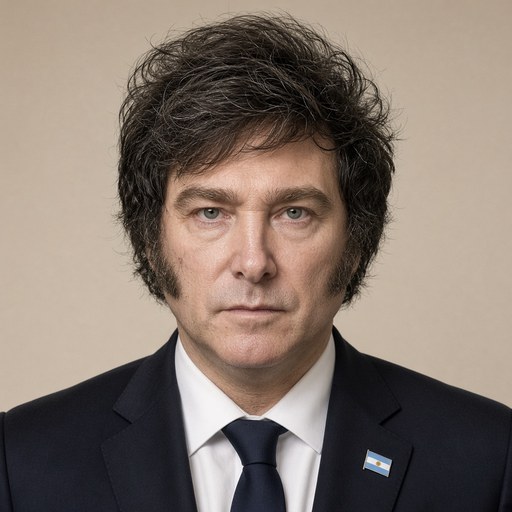
Words of the President of the Nation, Javier Milei, at the inauguration of the 142nd ordinary session of the Legislative Assembly, from the Congress of the Nation.
 Javier Milei · President of Argentina
- Context
- Milei addressed the Argentine Legislative Assembly on March 1, 2024, opening the 142nd ordinary session with a state-of-the-nation address detailing the economic crisis he inherited.
- Main themes
- Economic crisis inheritance, fiscal deficit and public debt, inflation and monetary disorder, poverty and real wages decline, populism critique, public spending excess, Central Bank liabilities, capital accumulation and investment, labor market rigidity, pension system failure, social assistance misuse, Argentina's economic decline
- Duration
- ~68 min
- Words
- 8,210
- Sentences
- 265
- Readability
- 42
- Grade
- 15.0
- Syntax
- 3.44
- Vocabulary
- 2.19
Translated from Spanish
The broad sphere of national life a sentence belongs to. Every sentence has an Arena, so it is the denominator the other indices are read against.
Other265 sentences in 75 paragraphs
Members of the Chamber of Deputies and Senators of the National Congress; Governors, Ministers of the Supreme Court of Justice of the Nation; Ambassadors and those who accompany us today in this chamber: we gather here – as mandated by the National Constitution – to communicate the state of our Nation to all the Argentine people, who are watching us across the country.
Today marks exactly 83 days since we took on the challenge of leading the Nation, in what is possibly the most critical economic moment in its history. After more than a hundred years of insisting on a impoverishing model and having almost completely forgotten the ideas that made our country great, the last 20 years have been particularly an economic disaster; a frenzy of public spending; uncontrolled issuance, resulting in the worst legacy that any government in Argentine history has ever received.
In fact, the twin deficits that we inherited reached 17 percentage points of GDP. Many of the economic data from the legacy we received are public, from day one when we took command of the country: 5 points of fiscal deficit in the Treasury and 10 points of quasi-fiscal deficit generated by the Central Bank, totaling 15 points of consolidated deficit. Also, a colossal debt with importers and multilateral credit organizations, which left us on the brink of default; negative net reserves in the Central Bank of 11.2 billion dollars; suppressed transportation and energy prices, in some cases, to a fifth of their real value and the dollar with a gap of 200 percent between the official and the parallel; rampant issuance in the last years of government, amounting to 13 points of GDP, added to the more than 15 points of GDP that had been issued during the first three years of government.
Moreover, during the first week of December, retail inflation was running at an annual rate of 3,700 percent; during the second week, it accelerated to 7,500 percent annually, while – for those who consider these numbers a fantasy – the 52 percent monthly inflation in wholesale prices implied an annual inflation of 17,000 percent. These were numbers that perfectly matched the monetary surplus and the potential for issuance, derived from the remunerated liabilities of the Central Bank. I understand that some politicians struggle with addition, unless it concerns their own. Therefore, asking them to compute a geometric growth function is an oxymoron for those who have not seen it, do not see it, and will not see it.
None of this is new; however, the disaster does not end there, as we audit the national public administration, and some lagging symptoms of the economic chaos they left us materialize, we are getting to know more deeply the size of the crisis we inherited, a crisis that is present in all dimensions of society. Perhaps the most stark indicator of the legacy we received was recently revealed, with the public disclosure that nearly 60 percent of Argentines are living below the poverty line. However, for some, it seems that poverty appeared overnight. I would like to point out that real wages result from the marginal productivity of labor and that this is determined by the accumulation of capital. That is why the much-touted phrase of "fighting capital" undermines investment, reduces the stock of capital per capita, and consequently, real wages.
This madness to which populism has led us has resulted in the average salary – in dollars – at the parallel exchange rate, being 300 dollars, when in the 1990s it had reached 1,800 dollars, which, when thought of in today's currency, would be 3,000 dollars. This means: populism has taken away 90 percent of our income, reaching a level of madness where one-third of formal workers are poor. This is a heartbreaking statistic that starkly reveals the brutality of the legacy we have received and the havoc wrought by the famous model of the present State.
From being the richest country in the world when we embraced the ideas of freedom to becoming a country where 6 out of 10 Argentines are poor, while the majority of politicians – like many of you – are rich.
To this tragedy of poverty, which has multiplied by 10 in the last 50 years, we must add as additional problems social debts and deep issues in all dimensions of Argentine life. A society with record numbers of indigence and that – at the same time – has never in its history distributed as much social assistance as now, where – a good part of that assistance – functions as war booty for leftist organizations that steal money from those they claim to defend and attacks those who produce it.
We are a society with a labor market where the formal private sector is frozen, which, due to rigidity and high labor costs, has not produced a single new job in 12 years, while public employment and informal work are the only areas that are growing. And as if that were not enough, we have a broken pension system, which costs more each day in relation to its income and which – in the last 10 years – incorporated almost 4 million beneficiaries without contributions, through moratoriums that are a moral affront to all those who have fulfilled their responsibilities throughout their lives.
Retirees, victims of this legacy, continue to be tied to a formula that we wanted to change, because it pulverizes their income in a regime of high inflation due to the previous government, and that if it were not for the discretionary recomposition of the bonds we are carrying out, would have resulted in a loss of up to 40 percent of their purchasing power. In fact, the recurrent use of compensatory bonds is a clear indication of how poorly designed the formula is and that it urgently needs to be modified so that retirees are not victims of the mismanagement of politics.
In terms of security, we find ourselves in a society abandoned to its fate, entire cities held hostage by drug trafficking, streets taken over by chaos and disorder, both generated by leftist organizations in their constant effort to extort various governments, a chaos that politics has fueled over the last 20 years for its own benefit. In the face of this, security forces mistreated and trampled by previous governments, which tied their hands and prevented them from doing their jobs, siding with criminals, exemplified in the absurdity of releasing prisoners during the pandemic.
Regarding education, we face a crisis that has been dragging on for decades, which is becoming increasingly profound and has resulted in half of third-grade children in Argentina not understanding what they read, and 70 percent unable to solve a basic math problem. This is the reality of a country with more Nobel Prize winners in the region, which used to be – in its past – a beacon of quality in education. Incipient illiteracy is to our education what inflation is to our economy.
In the realm of Higher Education, the creation of universities has become another business of politics, and in teacher training colleges and institutes, educational curricula of the left, openly anti-capitalist and anti-liberal, proliferate, in a country where what is most needed is more capitalism and more freedom. In terms of health, there is a system pushed towards a crisis of shortages, caused by the irresponsible trade policy of the previous government, which left doctors, patients, and families without stock of all kinds of medical supplies and – in particular – special medications like oncology drugs. All this amid the farce of "The State takes care of you" during the pandemic, where if we had done things as a non-mediocre country, we would have had 30,000 real deaths, while we had 130,000 with the enormous pain that this entails.
This means: they sold us the idea that the State works like an insurance, but in real life, when the disaster occurs, it defaults. In technical terms, this happens when they steal the premium, just as can be inferred from a State that does everything very poorly.
In terms of defense, we inherited a disfunded and even discredited Army by the State itself, without the resources or training to face the challenges of a constantly changing world that is increasingly distant from peace. And as if that were not enough, this national debacle is leading us further into irrelevance in the concert of nations, making us incapable of protecting our own territory and forcing us to crawl before the most questioned countries in the world.
This is the reality they left us, who are by right and history one of the most important countries in the world. A country that, 120 years ago, had one of the three highest per capita GDPs in the world and received immigrants from all corners of the planet. Behind all these ills, we find an inoperative National State, bankrupt and unable to even fulfill its basic functions, a State that does everything and does everything poorly, causing harm in every aspect of social life in which it interferes. As Milton Friedman pointed out: "nothing good can be expected from the State." According to the father of monetarism, there are four ways to spend: one can spend one's own money on oneself or on others, while the same can be done with other people's money. Thus, the best way to spend one's own money is on oneself, since one knows what one wants and how much it cost to earn it. That is, the benefit is maximized. On the other hand, when one spends one's own money on other people, the cost is minimized; while when one spends other people's money on oneself, one falls into wastefulness. Therefore, it follows that there is no worse way to spend than to spend other people's money on others, precisely what the State does. That is why the greater the presence of the State, the greater the waste and the lesser the well-being for decent Argentines.
The Situation Report, from the 114 dependencies of the national public administration – carried out by the SIGEN and the Secretariat of State Transformation – has yielded alarming information, among which stands out a consolidated debt of nearly 3 billion dollars in unpaid goods and services, a State that not only does not control, but what it controls, it controls poorly, designed not to fulfill its basic functions, but to generate a kiosk in every place possible for the benefit of the bureaucrat in charge. Perhaps the case of the insurance we have recently seen in the media is the best example of this, as it was a system designed to create an intermediary between the different State agencies in order to collect returns from each operation; a corrupt system that has generated hundreds of millions of dollars in returns that ended up in the pockets of politicians. This is perhaps the best definition we can give of the situation in which we found the State: a criminal organization, designed so that in every permit, in every regulation, in every procedure, and in every operation there is a bribe for the politician in charge.
This putrid scheme is extended to all branches of the State, both the Executive, the Legislative, and the Judicial, and at all levels: national, provincial, and municipal, supported by media outlets that live off official advertising and opinion makers who are bribed, who look the other way or carefully choose whom to accuse and whom not to, also supported by patronage-seeking businessmen who support this model because, in return for paying a bribe, it is more tempting than the challenge of competing in the market, as well as by union leaders who betray their workers, deceiving them with supposed benefits while promoting a labor regime that only benefits them. That is to say, a system in absolute moral bankruptcy and intrinsically unjust; a system that can only generate poor people and at the cost of that produces a privileged caste that lives as if they were monarchs, reaching obscene levels of impunity, such as – for example – the one we experienced this week, when we learned that a former Governor imprisoned a citizen for 50 days without due process, merely for the crime of speaking ill of the crown in a private chat. It offends the silence of those who claim to be republicans. In case it was not heard due to the applause: it offends the silence of those who claim to be republicans.
After having seen with my own eyes and in detail the vulgarity of the wastefulness with which politics has become accustomed to live, I reaffirm once again that this is not a matter of incompetence. That a system that causes so much harm to so many people is not a coincidence; it is the disaster into which they have plunged us. It is a conscious and planned scheme; it is what I call "the caste model." There is an intimate relationship between the privileges of politics and the discomfort of ordinary Argentines. It is precisely the economic model of the present state, a regime of high public spending, fiscal deficit, debt, and monetary emission. The system that the political caste uses to expropriate wealth from good Argentines and give it to their clients and friends. In this system, what is at the root of the deterioration has been generalized over the last 100 years, the construction of a facade, a business cloaked in lies. This is the lamentable material and spiritual state of our Nation.
For many years, we have denounced this model to society. And just over three months ago, after 100 years of gradual decline and more than a decade of free fall into misery, a silent majority raised its voice. That silent majority is made up of those who work, those who produce, the rural laborers who get up at four in the morning, the shopkeeper, the self-employed, the informal worker, the young person who cannot find a job, and the housewives who have the enormous task of educating our future generations.
A silent majority of those unprotected Argentine citizens, who were not invited to sit at the table of power, where the direction of the country has always been defined. That Argentina woke up, went to the polls, and put in the Presidency a man new to political life, who leads a new political force, which may not have parliamentary majorities, mayors, or governors, but knows what it has to do, knows how to do it, and has the conviction to do it.
A President who may not have the power of politics, but who has the power of conviction and the support of millions of Argentines who want real change. Because as the sacred scriptures say in the book of Maccabees, commemorated during the festival of Hanukkah: "Victory in war does not depend on the number of soldiers, but on the forces that come from heaven."
Thirty-five years ago, in his first speech on the state of the nation, President Carlos Saúl Menem said that "the courage of a people is not only tested on the battlefield or when facing misfortunes, but it is also tested by the number of truths it can bear."
He was speaking to the Argentine people, in a context with some economic similarities to the current context, urging them to make difficult decisions, similar to those I must make today. During the electoral campaign, we spoke to the Argentine people with the truth for the first time in decades, and the people understood it, accepted it, and chose us. Despite the fact that there were other candidates promising the same old solutions, repeating the same conciliatory and deceptive discourse as always, for the first time in a long time, society chose the candidate who preferred to tell an uncomfortable truth rather than a comfortable lie. We presented to society that the only way to avoid a worse economic catastrophe would be with a brutal and rapid adjustment of public spending. We also told society that the correction of repressed prices and lagging inflation, resulting from monetary emission, would generate months of very high inflation and that cleaning up the shattered economy we inherited would involve sacrifice and pain, and it would take time to get out of the hole. We signed an electoral contract of effort and sacrifice because 100 years of decline cannot be turned around overnight.
But at the same time, we made a commitment to the Argentines that the effort would be worth it because doing so would allow us to achieve two objectives: first, it would allow us to end inflation forever and advance in structural reforms so that Argentina could once again be a prosperous and dynamic country; second, it would allow us to end the regime of political apartheid that has existed in Argentina for decades. A regime in which politicians and their friends are first-class citizens and good Argentines are second-class citizens.
Therefore, by the mandate of change given to us by the people and with the endorsement of having told the truth and nothing but the truth during the campaign, during our first 82 days in office, we have carried out the most ambitious government program ever remembered. Economically, we started by destroying the snake's egg: the fiscal deficit. We have made the deepest reduction in public spending in our history, cutting 5 percentage points of GDP in just one month, reducing the primary spending of the National State by 40% in real terms, where this result came from eliminating public works, reducing 98% of transfers to the provinces, halving the ministries, firing ghost public employees, eliminating social plans for people who did not need them, ending the intermediaries of poverty, and minimizing the fleet of cars, advisors, and cell phones. That is to say, while there has been some liquefaction, there has been much more of a chainsaw, all for politics.
In short, it is an adjustment that has been carried out mostly on the National Public sector and not as it has always been done, by raising taxes and placing the entire burden on the private sector. As you may not have heard in the last 123 years, Argentina has had a fiscal deficit in 112 of them. The fiscal deficit and the fight against high tax pressure are for us the mother of all battles; they are the cause of poverty and stagnation over the last 100 years. After decades of governments that squandered taxpayers' money, Argentina once again has a government that will take care of every peso that Argentines pay with work and sweat. Second: we avoided default with the IMF and other multilateral organizations, which we were about to fall into 11 days after taking office. Third: we cut off monetary emission, which is the only proven cause of inflation. And through an ambitious financial program, we advanced with the cleaning up of the Central Bank's balance sheet. In fact, since we took office, we have bought nearly 9 billion dollars in the market, where despite this emission, the execution of puts against the BCRA and the payment of interest on remunerated liabilities, the contraction due to BOPREAL and the fiscal adjustment has managed to keep the monetary base constant. That is, for the same monetary base in pesos, today we have 9 billion additional reserves that cover more than 90% of it. Not only that, the monetary base, which during the 21st century has been around 9% of GDP, today only represents 3%, while if you consider the broad version, something only feasible in a furious crisis of confidence, it is in line with the historical average. Therefore, in the last month, the price of the parallel dollar has collapsed, the gap with the dollar for imports corrected by the Country Tax has disappeared, and the futures of the dollar have aligned with the guidelines established by the BCRA, in a context where the price of bonds rises, country risk decreases, and stocks soar, despite the attempts of some degenerate prosecutors to sabotage the future of good Argentines.
Therefore, in this context, although there are still a few months of high inflation ahead, it will continue to fall sharply, and the exit from the capital controls will be closer and closer. Fourth: we have been able to resolve the debt problem of importers, which was a Damocles sword of 42 billion dollars hanging over the heads of all Argentines. As a result of all these economic measures, we reached a surplus, both primary and financial, in our first month of government, which constitutes a global record in the history of modern capitalism. And as if that were not enough, we have taken all these measures solely with the levers of the Executive Power, without any support from the rest of the political spectrum, except for honorable exceptions.
But our work is not limited solely to the economy. In security, we have inaugurated a new doctrine of public order that no one dared to implement, despite it being unequivocally the only correct path. First, we began to enforce the law without exceptions. That is why we freed the streets from the scourge of constant strikes through our public order protocol. In each and every one of the demonstrations that were called in these almost three months of government, which began immediately after we took office, breaking a record in democratic history, we maintained order and avoided the indiscriminate cutting of streets, through a controlled deployment of security forces.
In addition, we are compelling the organizations that call for demonstrations to take responsibility for the cost of police operations. Second, we protect the victims and those who protect us. The vile culture of despising law enforcement and crime victims and glorifying criminals has ended with us. That is why we are promoting an expansion of the framework of legitimate defense and duty fulfillment, so that citizens who protect themselves or police officers who protect citizens do not end up behind bars while criminals roam free on our streets.
Third: we are relentless in the fight against organized crime. That is why, through Operation Bandera, we deployed new federal forces in Rosario. And thanks to preventive work, we managed to reduce intentional homicide in public spaces in the areas controlled by federal forces by almost 60% in these two months. For this reason, we also created a special management system for high-risk prisoners in our penitentiary system. From now on, they will be monitored by an elite group to prevent them from continuing to commit crimes from confinement, a practice that has unfortunately become commonplace in recent times.
Regarding social assistance, we committed to putting an end once and for all to the business of poverty managers, who use the intermediation of plans as a revenue mechanism and as an extortion resource to manipulate those who have the least. That is why we carried out an audit process of social plans that revealed, as we suspected, that at least 52,000 Potenciar Trabajo plans were improperly assigned to beneficiaries who did not meet the conditions. VIP plan recipients who fraudulently collected without needing it, many of them while traveling abroad by plane, many with shady connections in politics, many public employees, and whose removal from the registry resulted in an annual savings of 43 billion pesos.
That is why we also implemented the 134 hotline of the Ministry of Security, which helped us uncover the perverse mechanism that picketer organizations use to bring people against their will to demonstrations, under the threat of taking away their plan. We received nearly 80,000 calls that resulted in more than 1,300 judicial complaints, and we managed to uncover - thanks to this reporting system - the darkest face of this phenomenon. A political gang, in Chaco, that sexually exploited women and arbitrated their social plans.
We are putting an end to the extortion of social organizations towards beneficiaries, and thanks to the security protocol - implemented by Minister Bullrich - we are also ending the daily extortion that social organizations impose on society every time they block a street. We have always said, in our Government, "those who block, do not collect."
But we have the vocation to protect as much as possible the victims of the impoverishing system that we are trying to change. No Argentine is to blame for the incompetence and greed of politicians destroying their incomes, especially the most vulnerable. That is why we decided to end the system of intermediation in assistance and strengthen direct assistance mechanisms. Along these lines, we have doubled the amounts of the Universal Child Allowance, the Pregnancy Allowance, and the Food Card. We have also made it compatible to receive social assistance with having a salary of up to 1 million pesos, so that those receiving a social plan can gradually reintegrate into the world of work. We have also absorbed functions that were carried out in an un-audited manner, without registration and without control by social organizations, such as the distribution of food. Now we know exactly what happens with each food bag that is distributed.
In education, we have quadrupled the school aid so that families affected by drastic increases - in this new school year - can buy the supplies and materials that their children need. This measure will benefit families of 7.3 million children, from early childhood to secondary school.
In an Argentina where children do not know how to read and write, we cannot allow Baradel and his friends to use students as hostages to negotiate salary agreements with provincial governments. That is why we included education as an essential service in the Decree of Necessity and Urgency, which will take the weapon out of the hands of the unions and force them to provide at least 70 percent of educational services during any strike.
We have always said that we gave the vote to the people not to give us power, but to give it to the Argentines. This crusade begins by reducing the size of the State to its minimum and indispensable level and purging it of privileges for politicians and their friends. That is why we reduced the number of Ministries from 18 to 8, and the number of secretariats from 106 to 54, cutting hierarchical public positions by more than 50 percent. That is what we call a chainsaw.
That is why we also canceled official advertising in the media for a year. This will result in savings of more than 100 million pesos, if we take last year's spending as a parameter. It is immoral that in a poor country—like ours—the governments spend the people's money to buy the goodwill of journalists. Furthermore, we eliminated government agencies like INADI, which, in addition to acting as thought police, had an annual budget of 2.8 million pesos to maintain militant activists.
In this same vein, we will close the Télam Agency, which has been used, for the last few decades, as a Kirchnerist propaganda agency. We reduced discretionary transfers to the provinces to a minimum. Resources that have historically been used as bargaining chips to buy political support. To give you an idea of what this means, updated to today's value, last year the National State spent 5.4 trillion pesos on discretionary transfers to the provinces.
Both I and my officials travel on commercial flights and not on private planes as politicians who have a lax conception of what a medical plane is for are accustomed to doing. That is why, in the coming days, the National Civil Aviation Administration will establish a new regulatory criterion so that no politician or family members of politicians can use private planes, except for strictly official matters. Also, starting March 1, no official traveling on a ticket paid for by a public agency can accumulate miles for personal travel, a senseless privilege that perfectly illustrates the model of the caste.
We also put an end to the festival of official vehicles, which anyone used for anything, as if a human resources director needed a driver. All ministries have complied with the mandate to confiscate at least 30 percent of their fleet. We also eliminated SIRAs and the non-automatic essence for imports. Thus, we have put an end to discretion and favoritism. Now anyone who wants to import can do so without asking anyone, the era of bribes in exchange for import permits is over.
Finally, we also signed a mega Decree of Necessity and Urgency to… for the first time in decades, return freedom to the Argentines instead of curtailing it. This decree included 366 articles that eliminate or modify regulations that hindered the economy, complicated people's lives to protect some privilege, or aggravated the problems they intended to solve. Among these things, I want to highlight that we freed the choice of health insurance so that workers are no longer held hostage by the union and its activities, and can choose which service provider they prefer.
We repealed the disastrous rental law, and exactly what we said happened: the supply of goods in the market doubled from December to February; consequently, the real value of rents decreased. We also repealed the disastrous supply law, which was a tool that politicians used to extort companies, and we prohibited the political power to ban exports. We modernized labor legislation to facilitate the hiring of registered employment, something that was fought against by the unions.
However, all these initial achievements represent only the surface of the major changes we are here to implement in Argentina. To deepen our mission of ending the privileges of politics and its friends, we are sending a package of anti-caste laws to Congress; from which I want to share some of its components with you.
We will eliminate privileged pensions for presidents and vice presidents. We will require unions to elect their authorities through periodic, free elections supervised by the Electoral Justice; which will limit the terms of those authorities to four years, establishing a cap of only one possible reelection. The specific collective agreements made in free association by the workers of a company or group of companies will take precedence over the collective agreements of the sector. We will put an end to the madness of imposing on people the working conditions defined by someone behind a desk who has not worked for 30 years.
People convicted of corruption, in the second instance, will not be able to run as candidates in national elections. Furthermore, any former public official with a firm conviction, in the second instance, for corruption will automatically lose any benefits they have for having been an official. We will drastically reduce the number of contracts for advisors to the deputies and senators of the Nation; it has been a common practice in politics for representatives of the people to have 30-40 advisors each, squandering the resources of Argentines. The salary of state employees who do not go to work due to a strike will be deducted from their pay. And at the same time, we will eliminate public funding for political parties; each party will have to finance itself with voluntary contributions from its own members.
All serious economists in the world—except for some lapdogs of Argentine politics—agree that financing the treasury with money issued by the Central Bank generates inflation. This is not debatable; financing the treasury with issuance is simply wrong, technically and morally wrong. This is so because it generates inflation and dilutes the purchasing power of all Argentines, and for what? To put money in the hands of politics, which uses it for nothing but personal gain.
However, in Argentina, we have done this time and again, and as a result, we are one of the countries that has had the most inflation in modern history. With us, it ends; we will send a project to Congress to penalize by law the President of the Nation, the Minister of Economy, the officials of the Central Bank, and the deputies and senators who approve a budget that contemplates financing the fiscal deficit with monetary issuance to put an end once and for all to these morally and criminally unsustainable practices. And we will also propose that this crime be on par with a crime against humanity, so that it is imprescriptible, so that sooner or later they pay the cost of their actions.
These are just some of the reforms we are going to implement. We will advance, whether through bills, decrees, or modifying regulations, in the most ambitious economic regulation process in our history, because if we do not change this economic model from the roots, Argentina has no future. However, all these measures we have implemented, as well as the reform projects we have promoted, have been met with suspicion and distrust by a good part of the Argentine political leadership, to say the least, with outright rejection.
What happened with the labor chapter of the DNU and with the law of "Bases and Starting Point for the Freedom of Argentines," which reflected some of the changes we want to advance, clearly demonstrates this point. A law that aims to embrace the model of Freedom inspired by the ideas of Alberdi from the generation of '37, which seeks to liberate the productive forces of Argentines, to restore freedoms, to end privileges and businesses of the caste, was mishandled and rejected by a part of the political class that resists change. Because we must not deceive ourselves; there is a significant sector in the political leadership that does not want to abandon the privileges of the old regime.
We saw them in the violent protests outside Congress, in the statements of union leaders who resist understanding that the Argentina of privileges is over, in the actions of deputies who asked for votes supporting change but attempted to betray their mandate while no one was watching. We also saw it in the reappearance of the horsemen of failure like Sergio Massa, Pablo Moyano, Juan Grabois, and Máximo Kirchner. Even with the reappearance of the former president, Cristina Fernández de Kirchner, who has been responsible for one of the worst governments in history. But we also saw it with journalists, who, in the face of the decision to end official advertising, decided to come out and defend their privileges in a shameless manner, even resorting to crimes of slander and defamation and lying depravedly.
We also saw it in governors who only care about securing the funds to continue the party of public spending, official advertising, high-fee concerts by dubious quality artists, private planes, and so many other vices that politicians have accustomed us to for decades. Clearly, there are many actors in the political and economic establishment of the country who do not want to leave behind the Argentina of failure; some out of fear of change, others because they are the beneficiaries of this old regime. It is important for society to understand that it was the resistance of a large part of the political class to renounce their privileges that sabotaged the law, as was evident when there were 142 votes rejecting the article on the elimination of trust funds.
Throughout the negotiation process for the approval of the law, a sector of the political class that does not understand the historical moment, nor for what the people elected us, was made evident. We did not come to play the mediocre game of politics; we did not come to engage in the usual give-and-take, to emulate those politicians who subordinate their projects to the exchange of favors, positions, and businesses. We did not come to do more of the same. We came to change the country for real. That is why, before approving a project emptied of content, we prefer to withdraw it. We do not negotiate change, and we will fulfill the promise we made to society, with or without the support of the political leadership. We will do it with the tools that may be provided to us, or we will do it solely with the legal levers of the Executive Power, as we have been doing so far. Because when we encounter an obstacle, we will not back down; we will keep accelerating.
Now, the reality is that today we find ourselves at a turning point. The crisis we have characterized is much deeper than simply material: it is a crisis of horizon because everything we Argentines have tried in the last 100 years has failed. There are no more options: the logical conclusion is that the only possible alternative is to do something diametrically different from what has been done in the past. That is what we are trying to do: return to the foundations, return to the ideas that made this country great. However, we have encountered an unwavering resistance to making any change. We have found a will to build any reform. Any hint of change that implies a sacrifice for the political class has been rejected. Some because they do not understand the gravity of the situation we are in and cling to past traditions that have only produced failures, and others who resist losing their privileges, their businesses, or their comfort.
This leaves us facing two possible scenarios: the first is the path we are immersed in, the path of confrontation, the path of conflict. That is not the path we chose, and we have demonstrated it by attempting to send this honorable house an ambitious bill, with the expectation that it would be supported. Now, while we did not choose the path of confrontation, we do not shy away from it either. Because we have known since the day we decided to get into politics that fighting this battle would not be easy. I want to tell you, however, that if you choose the path of confrontation, you will find a very different animal than the one you are used to. Because unlike some of those here or those who watch us from their province, politics for us is not an end in itself. We do not live for politics, we do not live off politics, we have no ambition for power. Far from all that, the only thing we have is a thirst for change.
We do not make decisions thinking about our political careers. We came to raise the banners of freedom, fully aware that we would have to pay the costs of the obscene party that many of you have held. Because what drives us is not power for power's sake, but our sacred cause: the defense of life, freedom, and private property of Argentines. We do not seek or provoke confrontation; we do not want to discuss the past. We come to propose a future agenda, because as the saying goes, "The secret of change is to concentrate all your energy, not on fighting the old, but on building the new."
We come to put our energy into building the new, but I want to tell everyone here and those watching us that if what you seek is conflict, conflict you will have. Because unlike some of you, who are thinking about your next election or your own interests, we only think about defending the cause of Freedom, rebuilding our Nation, and providing a future of prosperity for our children at any cost. However, confrontation is not the path we want nor the one we choose; there is another possible path, a different path, a path of peace and not confrontation; a path of agreement and not conflict. Agreement yes, not consensus against change.
I must be honest in saying that I do not have too much hope that you will take this path. I believe that corruption, meanness, and selfishness are too widespread. But while I do not have too much hope, I have not lost it either. In fact, I want you to prove me wrong; I want to challenge you to show that politics can be more than what it is, that we can aspire to be better, that you can demonstrate that despite our differences we can put the interests of the nation above the miserable electoral interests. For this reason, and with the desire to be wrong in my distrust towards many of you, I want to take this opportunity to extend an invitation.
Today, at the first opening of sessions of our administration, I want to call upon both governors and former presidents and leaders of the main political parties, to set aside our personal interests and meet on May 25, in the province of Córdoba, for the signing of a new social contract called the May Pact: a social contract that establishes the 10 principles of the new Argentine economic order.
In this way, I hope that we can leave behind the antinomies of the past, abandon the recipes for failure, and return - just as our founding fathers did more than 200 years ago - to embrace once and for all the ideas of freedom. That May Pact will finally establish the 10 state policies that the country needs to abandon the path of failure and begin to walk the path of prosperity.
Those 10 state policies are: one, the inviolability of private property; two, the non-negotiable fiscal balance; three, the reduction of public spending to historical levels around 25% of GDP; four, a tax reform that reduces the tax burden, simplifies the lives of Argentines, and promotes trade; five, to renegotiate the federal tax sharing and put an end once and for all to the current extortionist model; six, a commitment from the provinces to advance in the exploitation of the country's natural resources; seven, a modern labor reform that promotes formal work; eight, a pension reform that gives sustainability to the system, respects those who have contributed and continue to contribute, and allows those who prefer to subscribe to a private retirement system; nine, a structural political reform that modifies the current system and realigns the interests of representatives and the represented; ten, and finally, the opening of international trade so that Argentina can once again be a player in the global market.
These 10 ideas, which are the foundations of the progress of any nation, can lay the conditions for Argentine growth for the next 100 years, so that once again Argentina can be a beacon of light for the West.
All politics is called to accompany us. We do not care who you are, where you come from, or what ideas you have defended. To show the government's commitment to moving in this direction, I have instructed the Chief of Cabinet, the Minister of Economy, and the Minister of the Interior to, as a first step before signing the May Pact, call the governors of all Argentine provinces to the Casa Rosada to sign a pre-agreement and sanction both the "Bases" law and a package of fiscal relief for the provinces. Once both laws are sanctioned, as a show of goodwill, we can begin to work on a common document based on these 10 principles outlined previously, so that on May 25 of this year, gathered in La Docta, we can begin a new era of glory for our country.
This is the offer we put on the table: it will be up to you and the rest of the Argentine leadership to seize the opportunity to change history; or, on the contrary, to continue down this path of decadence, which you have brought us. That day we will see who is sitting at the table working for Argentines and who intends to continue down this path of servitude. I want to be clear about the nature of this call: our convictions are unalterable. We will order Argentina's fiscal accounts with or without the help of the rest of the political leadership. But if the rest of the political class accompanies us, we will do it faster and better, with lower social costs and greater costs for those who live off this system. If the rest of the political class supports the reforms we will implement, they will have a more lasting character and consequently generate greater security for local and foreign economic actors, which will lead to accelerating economic growth, reducing poverty, and improving well-being.
This historic moment is not for everyone; it is not for leaders who speculate politically, it is not for those who think that governing is a popularity contest, it is not for those who want to maintain their privileges at the expense of a broken country, and it is not for beautiful souls, for whom the forms and commas in a text weigh more than the will for change. It is for men or women of state, for patriots, for those who think about history, who are willing to risk everything for the benefit of the Nation, because fixing this country requires enormous sacrifices.
We do not govern to be popular; the pursuit of popularity is bad advice for a leader. It is that compass that pushed governments – over the last 20 years – to postpone measures that, while difficult, were also necessary. We do not listen to those siren songs; we do not govern to be popular, neither today nor tomorrow; we govern for all Argentines, even for the Argentines who have not yet been born, so that one day, in 30 years, when Argentina is a world power, future generations will look back and say: "It was there, in 'La Docta', in our beloved province of Córdoba, that the path of prosperity began."
That is why we have a firm hand because we have a clear direction. That is also why we accept to pay all the political costs to achieve these changes, including political costs that do not belong to us. Because if the price of fixing this country is falling into ostracism, there you will find me with pride, because – for us – there is nothing more sacred than the struggle for freedom.
I look at Argentina and see a country with everything to do, a country rich in natural resources, rich in human capital, and with a spirit hungry for prosperity, but locked up, constrained, and repressed by a model that can only lead to failure. We come to restore freedom to Argentines, because only a free society can progress; only a dynamic society, that works, that employs, that trades, that produces, that imports and exports, without anyone telling it what and how it can prosper. Only by being a free society can we as a nation take advantage of the natural gifts that God has granted us.
I look at Argentina today, and I am certain that with the ideas of freedom as a beacon, this country still has everything to resume the path of prosperity. That is why we govern: to make Argentina once again one of the great nations of the world, a leader and reference in the region, a productive, agricultural, energy, commercial, maritime, and technological power full of life, voracious to populate the corners of the Homeland with the spirit of frontier that once characterized us. That is the country I dream of and for which I govern.
In conclusion, this message to the Governors, the leaders, the different parties of the political system, and to the deputies and senators who are here present today, I say: you are at a turning point in Argentine history; you can cling to an unjust system, of which the vast majority of society is a victim, or you can set aside your particular interests and ideological prejudices to collaborate with our mission of change, help us transform the country, and pass into posterity as patriots. If you choose to rise to the occasion and show up in Córdoba to sign the May Pact, both I and the Argentine people will recognize that gesture as an act of humility and courage and a clear sign that we can work together, without resentment.
To the Argentines, I ask for just one thing: patience and trust; it will take time for us to perceive the fruits of the economic cleanup and the reforms we are implementing. Moreover, we have not yet seen all the effects of the disaster we inherited, but we are convinced that we are on the right path because for the first time in history we are addressing the problem at its root: the fiscal deficit and not its symptoms. That is why I ask for patience and trust because no matter how dark the night may be, the Sun always rises in the morning.
King Solomon asked God for wisdom to distinguish good from evil; courage to choose it, and temperance to stay on that path. I ask the same for myself and for all those present here.
Thus, the ordinary sessions – number 142 – of the Honorable Congress of the Nation are inaugurated. May God bless the Argentines and may the Forces of Heaven accompany us.
Thank you very much. Long live freedom, damn it!
The original Spanish. The tags above are read on the English translation's sentences.
Diputados y Senadores del Congreso de la Nación; Gobernadores, ministros de la Corte Suprema de Justicia de la Nación; embajadores y quienes nos acompañan, hoy, en este recinto: nos reunimos, aquí - como marca la Constitución Nacional – para comunicar el estado de nuestra Nación a todo el pueblo argentino, que nos está mirando a lo largo y a lo ancho de todo el país.
En el día de hoy se cumplen exactamente 83 días, desde que asumimos el desafío de conducir la Nación, en lo que posiblemente el momento económico más crítico de su historia. Luego de más de cien años de insistir con un modelo empobrecedor y habiendo olvidado casi por completo las ideas que hicieron grande, a nuestro país, los últimos 20 años han sido, particularmente, un desastre económico; una orgía de gasto público; emisión descontrolada, que tuvo como resultado la peor herencia que ningún gobierno en la historia argentina haya recibido jamás.
De hecho los déficits gemelos, que heredamos, alcanzaron los 17 puntos porcentuales, del PBI. Muchos de los datos económicos de la herencia que recibimos son públicos, desde el día 1 en que tomamos el mando del país: 5 puntos del Producto de déficit fiscal en el Tesoro y 10 puntos de déficit cuasi-fiscal, generado por el Banco Central, sumando un total de 15 puntos de déficit consolidado. También una deuda descomunal con importadores y organismos multilaterales de créditos, que nos dejaban al borde del default; reservas netas negativas, en el Banco Central por 11.200 millones de dólares; precios de transporte y energía reprimidos, en algunos casos, hasta un quinto de su valor real y el dólar con una brecha del 200 por ciento entre el oficial y el paralelo; una emisión desenfrenada, en los últimos años de gobierno, por 13 puntos del PBI, sumados a los más de 15 puntos del PBI, que se había emitido, durante los primeros tres años de gobierno.
A su vez, durante la primera semana de diciembre, la inflación minorista corría a un ritmo de 3700 por ciento, anual; durante la segunda se aceleró a 7.500 por ciento, anual, mientras que – para aquellos que consideran que estos números son una fantasía – la inflación del 52 por ciento mensual, en mayorista implicaba una inflación, anual, del 17.000 por ciento. Eran números que cuadraban de modo perfecto con el sobrante monetario y el potencial de emisión, derivado de los pasivos remunerados del BCRA. Entiendo que algunos políticos suman con dificultad, salvo que se trate de la propia. Por lo que pedirles que computen una función de crecimiento geométrico es un oximoron para aquellos que no la han visto, no la ven y no la verán.
Nada de todo esto es nuevo, sin embargo el desastre no termina ahí, pues en la medida que auditamos la administración pública nacional, y se van materializando algunos síntomas rezagados del caos económico, que nos dejaron, vamos conociendo con mayor profundidad el tamaño de la crisis que heredamos, una crisis que está presente en todas las dimensiones de la vida de la sociedad. Tal vez el indicador más descarnado de la herencia, que hemos recibido lo conocimos recientemente, al haberse hecho público el dato de que, cerca del 60 por ciento de los argentinos se encuentran por debajo de la línea de pobreza. Sin embargo, para algunos pareciera que la pobreza ha aparecido de un día para el otro. Les comento que el salario real resulta de la productividad marginal de trabajo y que la misma viene dada por la acumulación del capital. Por eso, la tan mentada frase de: “combatiendo al capital” atenta contra la inversión, reduce el stock de capital por habitante y como consecuencia de eso los salarios reales.
Esta locura a la que nos ha llevado el populismo ha hecho que el salario promedio – en dólares – al tipo de cambio paralelo, porque el precio es al que hay sea de 300 dólares, cuando en la década de los 90 había llegado a los 1800 dólares, que pensado en monedas, de hoy, sería de 3.000 dólares. Esto es: el populismo nos quitó el 90 por ciento de nuestros ingresos llegando a un nivel de locura tal, donde un tercio de los trabajadores formales son pobres. Esto es un dato desgarrador, que revela crudamente la brutalidad de la herencia, que hemos recibido y los estragos, que ha producido el famoso modelo del Estado presente.
De ser el país más rico del mundo, cuando abrazamos las ideas de la libertad a ser un país donde 6 de cada 10 argentinos son pobres, mientras la mayoría de los políticos – como muchos de ustedes – son ricos.
A esta tragedia de la pobreza, que se ha multiplicado por 10, en los últimos 50 años se le suman como problemas adicionales deudas sociales y problemas profundos en todas las dimensiones de la vida argentina. Una sociedad con cifras récords de indigencia y que – al mismo tiempo – nunca en su historia repartió tanta asistencia social, como ahora, donde - buena parte de esa asistencia – funciona como botín de guerra para organizaciones de izquierda que le roban la plata, a quienes dicen defender y atenta contra aquellos que la producen. (APLAUSOS).
Somos una sociedad con un mercado laboral, donde el sector privado formal se encuentra congelado, que producto de la rigidez y sus altos costos laborales, hace 12 años no produce un solo puesto de trabajo nuevo, mientras el empleo público y el trabajo informal son los únicos que crecen. Y como si fuera poco tenemos un sistema previsional quebrado, que cuesta cada día en menos ingresos en proporción a sus gastos y que – en los últimos 10 años – incorporó casi 4 millones de beneficiarios sin aportes, a través de moratorias que son una afrenta moral para todos aquellos, que durante toda su vida cumplieron con su responsabilidad.
Los jubilados, víctimas de esta herencia, continúan atados a una fórmula, que quisimos cambiar, porque pulveriza sus ingresos, en un régimen de alta inflación a causa del gobierno pasado y que si no fuera por la recomposición discrecional de los bonos, que estamos llevando adelante, hubiera redundado en una pérdida de hasta 40 por ciento de su poder adquisitivo. De hecho el uso recurrente de bonos compensatorios es una clara muestra de lo mal diseñada que está la fórmula y que la misma requiere ser modificada, de manera urgente de modo tal que los jubilados no sean víctimas de los desaguisados de la política.
En materia de seguridad, nos encontramos con una sociedad abandonada a su suerte, ciudades enteras rehenes del narcotráfico, las calles tomadas por el caos y el desorden, ambos generados por las organizaciones de izquierda en su afán de extorsionar constantemente a los distintos gobiernos, un caos que la política alimentó, durante los últimos 20 años para beneficio propio. Frente a eso, unas fuerzas de seguridad maltratadas y pisoteadas por los gobiernos anteriores, que los ataron de mano y les impidieron cumplir con su trabajo, poniéndose del lado de los delincuentes, ejemplificado en el absurdo de soltar presos, durante la pandemia.
En lo que respecta a la educación, una crisis que ya arrastra décadas, que es cada vez más profunda y que ha redundado en que, hoy, la mitad de los chicos, de tercer grado, no entienden qué leen, en la Argentina y el 70 por ciento no puede resolver un problema de Matemática básica. Esta es la realidad de un país con más Premios Nobel de la región, que supo ser – en su pasado – un faro de calidad en la educación. El analfabetismo incipiente es a nuestra educación lo que la inflación es a nuestra economía.
En el plano de la Educación Superior, la creación de universidades se ha convertido en un negocio más de la política y en los profesorados e instituto de formación docente proliferan currículas educativas de izquierda, abiertamente anticapitalista y antiliberales, en un país en el cual lo que más se necesita es más capitalismo y más libertad. En materia de salud, hay un sistema empujado hacia una crisis de desabastecimiento, causada por la política comercial irresponsable, del gobierno anterior, que dejó a médicos, pacientes y familias sin stock de insumos médicos de todo tipo y – en particular – de medicamentos especiales como los oncológicos. Todo esto en el medio de la farsa de “El Estado te cuida”, durante la pandemia, donde si hubiéramos hecho las cosas como un país no mediocre hubiéramos tenido 30.000 muertos, de verdad, mientras que tuvimos 130.000 con el dolor enorme, que eso significa.
Esto es: nos vendieron la idea de que el Estado trabaja como un seguro, pero, en la vida real, cuando el siniestro ocurre defaultea. En términos técnicos eso ocurre, cuando roban la prima, tal como se puede inferior de un Estado que todo lo hace muy mal.
En el plano de la defensa, heredamos un Ejército desfinanciado y hasta desprestigiado por el propio Estado, sin los recursos ni la preparación para hacer frente a los desafíos de un mundo en constante cambio y cada vez más alejado de la paz. Y como si fuera poco, esta debacle nacional nos está llevando cada vez más a la irrelevancia en el concierto de las naciones volviéndonos incapaces de proteger nuestro propio territorio y obligándonos a arrastrarnos ante los países más cuestionados del mundo.
Esta es la realidad que nos dejaron a nosotros, que somos por derecho e historia uno de los países más importantes del mundo. Un país que, hace 120 años, tenía uno de los 3 PBI per cápita más alto del mundo y recibía inmigrantes de todos los confines del planeta. Detrás de todos estos males nos encontramos con un Estado Nacional inoperante, quebrado y que no puede ni siquiera cumplir con sus funciones básicas, un Estado que hace todo y todo lo hace mal, generando perjuicio en cada aspecto de la vida social en que se entromete. Tal como señalara Milton Friedman: “nada bueno del Estado se puede esperar”. Según el padre del monetarismo existen cuatro formas de gastar: uno puede gastar el dinero propio en uno o en terceros, mientras que lo mismo se puede hacer con el dinero de otros. Así la mejor manera de gastarse el dinero propio es en uno mismo, ya que uno sabe lo que quiere y cuánto le costó ganarlo. Es decir, se maximiza el beneficio. Por otra parte, cuando se gasta el dinero propio en otras personas se minimiza el costo; mientras que cuando se gasta el dinero de otros en uno mismo se cae en el despilfarro. Por ende, de esto se deriva que no hay forma peor de gastar que gastar el dinero de otros en otros, justamente lo que hace el Estado. Es por eso que a mayor Estado presente, mayor despilfarro y menor bienestar para los argentinos de bien.
El Informe de Situación, de las 114 dependencias de la administración pública nacional – realizado por la SIGEN y la secretaría de Transformación del Estado - ha arrojado información alarmante, entre las que se destaca una deuda consolidada, de cerca de 3.000 millones de dólares en bienes y servicios impagos, un Estado que no sólo no controla, sino que lo que controla lo controla mal, diseñado no para cumplir sus funciones básicas, sino para generar un kiosco en cada lugar, donde sea posible para beneficio del burócrata de turno. Tal vez, el caso de los seguros, que hemos visto recientemente, en los medios de comunicación sea el mejor ejemplo de esto, pues era un sistema diseñado para generar un intermediario entre los distintos organismos del Estado de manera de poder cobrar retornos de cada operación; un sistema corrupto que ha generado cientos de millones de dólares de retornos, que terminaron en los bolsillos de los políticos. Es esa, tal vez, la mejor definición que podemos dar de la situación en la que hemos encontrado el Estado: una organización criminal, diseñada para que en cada permiso, en cada regulación, en cada trámite y en cada operación haya una coima para el político de turno.
Este esquema putrefacto está extendido a todos los poderes del Estado, tanto el Poder Ejecutivo, el Poder Legislativo y el Poder Judicial y en todos sus niveles: nacional, provincial y municipal, sustentados por medios de comunicación, que viven de la pauta oficial y formadores de opinión ensobrados, que miran para el otro lado o que eligen cuidadosamente a quién acusar y a quién no, sustentados también por empresarios prebendarios, que apoyan este modelo porque, al retorno de pagar una coima, es más tentador que el desafío de competir en el mercado, también por sindicalistas que entregan a sus trabajadores, engañándolos con supuestos beneficios, mientras promueven un régimen laboral, que sólo los beneficia a ellos. Es decir, un sistema en absoluta bancarrota moral e intrínsecamente injusto; un sistema que sólo puede generar pobres y a costa de eso produce una casta privilegiada, que viven como si fueran monarcas, que llega a absurdos obscenos de impunidad, como – por ejemplo – el que vivimos esta semana, cuando nos enteramos de que un ex Gobernador metió tras las rejas, sin debido proceso, por 50 días, a un ciudadano, meramente por el crimen de hablar mal de la corona en un chat privado. Ofende el silencio de aquellos que se dicen republicanos. Por si no se escuchó por los aplausos: ofende el silencio de aquellos que se dicen republicanos.
Tras haber visto con mis propios ojos y en detalle la vulgaridad del despilfarro con el que la política se acostumbró a vivir, ratifico una vez más que no se trata de impericia. Que un sistema que haga tanto daño a tanta gente no es casualidad el desastre en el que nos han sumergido. Se trata de un esquema consciente y planificado, se trata de lo que yo llamo “el modelo de la casta”. Es que hay una relación íntima entre los privilegios de la política y el malestar del común de los argentinos. Es precisamente el modelo económico del Estado presente, un régimen de gasto público alto, déficit fiscal, deuda y emisión monetaria. El sistema del que la casta política se sirve para expropiar riqueza de los argentinos de bien y dárselos a sus clientes y amigos. En este sistema, lo que está en la base del deterioro es generalizado en los últimos 100 años, la construcción de una fachada, un negocio amparado en la mentira. Este es el lamentable estado material y espiritual de nuestra Nación.
Hace muchos años que denunciamos este modelo ante la sociedad. Y hace poco más de tres meses, después de 100 años de paulatina decadencia y más de una década de caída libre a la miseria, una mayoría silenciosa levantó la voz. Esa mayoría silenciosa que se compone de los que trabajan, de los que producen, de los peones rurales que se levantan a las cuatro de la mañana, del que atiende un negocio, del cuentapropista, del trabajador informal, del joven que no encuentra trabajo y de las amas de casas que tienen la enorme tarea de educar a nuestras generaciones futuras.
Una mayoría silenciosa de aquellos ciudadanos argentinos desprotegidos, que no los invitaron a sentarse en la mesa del poder, en la que siempre se definió el rumbo del país. Esa Argentina despertó, asistió a las urnas y puso en la Presidencia a un hombre recién llegado a la vida política, que conduce una fuerza política nueva, que puede no tener mayorías parlamentarias, ni intendentes, ni gobernadores, pero que sabe lo que tiene que hacer, sabe cómo hacerlo y tiene la convicción para hacerlo.
Un Presidente que puede no tener el poder de la política, pero que tiene el poder de la convicción y el apoyo de los millones de argentinos que quieren un cambio de verdad. Porque como dicen las sagradas escrituras en el libro de Macabeos y que se conmemora en la fiesta de Janucá: “la victoria en la guerra no depende de la cantidad de soldados, sino de las fuerzas que vienen del cielo”.
Hace 35 años en su primer discurso acerca del estado de la nación, el presidente Carlos Saúl Menem, dijo que “el coraje de un pueblo no se comprueba únicamente en el campo de batalla o al enfrentar desgracias, sino que también se comprueba por la cantidad de verdades que es capaz de soportar”.
Él le hablaba al pueblo argentino, en un contexto con algunas similitudes económicas al contexto actual, que lo instaban a tomar decisiones difíciles, similares a las que me toca tomar a mí hoy. Durante la campaña electoral le hablamos al pueblo argentino con la verdad por primera vez en décadas y el pueblo lo comprendió, lo aceptó y nos eligió. A pesar de que había otros candidatos que prometían las mismas soluciones de siempre, repitiendo el mismo discurso conciliador y engañoso de siempre, por primera vez, en mucho tiempo, la sociedad eligió al candidato que prefería decir una verdad incómoda que una mentira confortable. Nosotros le planteamos a la sociedad que la única forma de evitar una catástrofe económica peor sería con un ajuste del gasto público brutal y rápido. Le planteamos a la sociedad también que la corrección de los precios reprimidos y la inflación rezagada, producto de la emisión monetaria generarían meses de inflación muy alta y también que sanear la economía destrozada, que heredábamos, implicaría sacrificio y dolor y tardaríamos en salir del pozo. Firmamos un contrato electoral de esfuerzo y sacrificio, porque 100 años de decadencia no se dan vuelta de un día para el otro.
Pero al mismo tiempo, asumimos un compromiso con los argentinos de que el esfuerzo iba a valer la pena, porque hacerlo nos iba a permitir cumplir dos objetivos: primero, nos permitiría terminar con la inflación para siempre y avanzar en las reformas estructurales para que la Argentina vuelva a ser un país próspero y pujante; segundo, nos permitiría terminar con el régimen de apartheid político que hay en la Argentina desde hace décadas. Un régimen en que los políticos y sus amigos son ciudadanos de primera y los argentinos de bien son ciudadanos de segunda.
Por eso, por el mandato de cambio que nos dio la gente y con el aval de haber dicho la verdad y nada más que la verdad en campaña, durante nuestros primeros 82 días en funciones hemos llevado adelante el programa de gobierno más ambicioso del cual se tenga memoria. En el plano económico, comenzamos por destruir el huevo de la serpiente: el déficit fiscal. Hemos avanzado en la reducción del gasto público más profunda de nuestra historia, haciendo un recorte de 5 puntos del PBI en tan solo un mes, redujimos el gasto primario del Estado Nacional en 40% en términos reales, donde dicho resultado surgió de eliminar la obra pública, reducir el 98% de las transferencias a las provincias, reducir los ministerios a la mitad, echar empleados públicos fantasmas, eliminar planes sociales a personas que no lo necesitaban, terminar con los intermediarios de la pobreza y reducir al mínimo la flota de autos, asesores y teléfonos celulares. Es decir, si bien ha habido licuación, ha habido mucho más de motosierra, todo para la política.
En definitiva, es un ajuste que ha sido realizado mayormente sobre el sector Público Nacional y no como se hizo siempre, aumentando impuestos y cargando todo el peso sobre el sector privado. Como ya no se habrán escuchado decir en los últimos 123 años, la Argentina tuvo déficit fiscal en 112 de ellos. El déficit fiscal y la lucha contra la alta presión fiscal son para nosotros la madre de todas las batallas, son la causa de la pobreza y del estancamiento de los últimos 100 años. Luego de décadas de gobierno que despilfarraron el dinero de los pagadores de impuestos, la Argentina vuelve a contar con un gobierno que va a cuidar cada uno de los pesos que con trabajo y sudor los argentinos pagan. Segundo: evitamos el default con el FMI y otros organismos multilaterales en el que íbamos a caer a 11 días de haber asumido. Tercero: cortamos con la emisión monetaria que es la única y probada causa de la inflación. Y a través de un ambicioso programa financiero avanzamos con el saneamiento del balance del Banco Central. De hecho, desde que llegamos al gobierno, hemos comprado en el mercado cerca de 9 mil millones de dólares, donde pese a esta emisión, la ejecución de puts contra el BCRA y el pago de intereses a los pasivos remunerados, la contracción por BOPREAL y por el ajuste fiscal, ha logrado mantener la base monetaria constante. Esto es, para la misma base monetaria en pesos, hoy tenemos 9.000 millones de reservas adicionales que cubren más del 90% de la misma. No solo eso, la base monetaria que durante el siglo XXI se ha ubicado en torno al 9% del PBI, hoy solo representa el 3%, mientras que si consideran la versión amplia, algo sólo factible en una crisis de confianza furiosa, la misma está en línea con el promedio histórico. Por ello, en el último mes se ha desplomado el precio del dólar paralelo, la brecha con el dólar de importación corregido por impuesto País ha desaparecido y los futuros del dólar se han alineado con las pautas establecidas por el BCRA, en un contexto en el cual el precio de los bonos sube, el riesgo País baja y las acciones vuelan por las nubes, pese a los intentos de algunos degenerados Fiscales por sabotear el futuro de los argentinos de bien.
Por lo tanto, en este contexto, pese a que aún quedan algunos meses de alta inflación, la misma seguirá cayendo fuertemente y la salida del cepo estará cada vez más cerca. Cuarto: hemos podido resolver el problema de la deuda de los importadores, que era una espada de Damocles de 42 mil millones de dólares que colgaba sobre la cabeza de todos los argentinos. Como consecuencia de todas estas medidas económicas, llegamos al superávit, tanto primario como financiero, en nuestro primer mes de gobierno, lo cual constituye un récord global en la historia del capitalismo moderno. Y como si fuera poco, hemos tomado todas estas medidas únicamente con los resortes del Poder Ejecutivo, sin apoyo de ningún tipo del resto del arco político, salvo honrosas excepciones.
Pero nuestro trabajo no se limita únicamente a lo económico. En seguridad hemos inaugurado una nueva doctrina del orden público que nadie se animó a implementar, a pesar de que era inequívocamente el único camino correcto. En primer lugar, empezamos a hacer cumplir la ley sin excepciones. Por eso, liberamos la calle del flagelo de los paros constantes a través de nuestro protocolo de orden público. En todas y cada una de las manifestaciones que se convocaron en estos casi tres meses de gobierno, y que comenzaron inmediatamente apenas asumimos, rompiendo un récord en la historia democrática, en todas ellas mantuvimos el orden y evitamos el corte indiscriminado de calles, mediante un despliegue controlado de las fuerzas de seguridad.
Además, estamos intimando a las organizaciones que convocan a manifestarse para que se hagan cargo del costo de los operativos policiales. Segundo, cuidamos a las víctimas y a quienes nos cuidan. Se terminó con nosotros la cultura vil del despreciar a las fuerzas del orden y a las víctimas del delito y el enaltecer a los delincuentes. Por eso, estamos impulsando una ampliación del marco de legítima defensa y de cumplimiento del deber, para que no termine entre las rejas los ciudadanos que se protegen a sí mismos o los policías que protegen a los ciudadanos, mientras los delincuentes pasean libres por nuestras calles.
Tercero: somos inclementes en el combate contra el crimen organizado. Por eso, a través del Operativo Bandera, desplegamos efectivos nuevos de las fuerzas federales en Rosario. Y gracias al trabajo de prevención, se logró disminuir en estos dos meses casi un 60% el homicidio doloso en la vía pública en las zonas controladas por las fuerzas federales. Por eso, también creamos un sistema de gestión especial para presos de alto riesgo de nuestro sistema penitenciario. De ahora en más, estarán controlados por un grupo de élite para evitar que sigan cometiendo delitos desde el encierro, práctica que lamentablemente se volvió moneda corriente en el último tiempo.
Respecto a la asistencia social, nos comprometimos a terminar de una vez y para siempre con el negocio de los gerentes de la pobreza, que usan la intermediación de planes como mecanismo recaudatorio y como recurso extorsivo para manipular a los que menos tienen. Por eso, llevamos adelante un proceso de auditoría de los planes sociales que arrojó, como sospechábamos, que al menos 52.000 planes Potenciar Trabajo estaban asignados de forma indebida a beneficiarios que no cumplían las condiciones. Planeros VIP que cobraban fraudulentamente sin necesitarlo, muchos de ellos mientras viajaban en avión al exterior, muchos con conexiones espúreas en la política, muchos empleados públicos y cuya eliminación del padrón redundó en un ahorro anual de 43.000 millones de pesos.
Por eso también implementamos la línea 134 del Ministerio de Seguridad, que nos ayudó a poner al descubierto el mecanismo perverso que las organizaciones piqueteras usan para llevar gente contra su voluntad a las manifestaciones, bajo amenaza de quitarles el plan. Recibimos cerca de 80 mil llamados que decantaron en más de 1.300 denuncias judicializadas, y llegamos a descubrir -gracias a este sistema de denuncias- a la cara más oscura de este fenómeno. Una banda política, en Chaco, que explotaba sexualmente a mujeres y arbitraba sus planes sociales.
Estamos terminando con la extorsión de las organizaciones sociales hacia los beneficiarios, y gracias al protocolo de seguridad -instrumentado por la ministra Bullrich- estamos terminando también con la extorsión cotidiana que las organizaciones sociales le imponen a la sociedad cada vez que corta una calle. Siempre lo dijimos, en nuestro Gobierno “el que corta, no cobra”.
Pero nosotros tenemos la vocación de proteger lo más posible a las víctimas del sistema empobrecedor, que estamos intentando cambiar. Ningún argentino tiene la culpa de que la inoperancia y avaricia de los políticos hayan destruidos sus ingresos, y menos los más vulnerables. Por eso decidimos terminar con el sistema de intermediación de la asistencia y fortalecer los mecanismos de asistencia directa. En esa línea, hemos duplicado los montos de la Asignación Universal por Hijo, la Asignación por Embarazo y la tarjeta Alimentar. Hemos también compatibilizado percibir asistencia social con tener salario hasta de 1 millón de pesos, para quienes perciban un plan social puedan reintégrese con el tiempo al mundo del trabajo. También absorbimos funciones que realizaban en forma no auditada, sin registro y sin control las organizaciones sociales como es la entrega de alimentos. Ahora sabemos exactamente qué pasa con cada bolso de comida que se reparte.
En materia educativa, multiplicamos por 4 la ayuda escolar para que las familias que se vieron afectadas por aumento drásticos -en este nuevo inicio de clases- puedan comprar los útiles y materiales escolares que sus chicos necesitan. Esta medida va a beneficiar a las familias de 7.300.000 chicos, desde nivel inicial hasta el secundario.
En una Argentina donde los chicos no saben leer y escribir no podemos permitir más que Baradel y sus amigos usen a los estudiantes como rehenes para negociar paritarias con los gobiernos provinciales. Por eso incluimos en el Decreto de Necesidad y Urgencia la educación como servicio esencial, lo cual le sacará el arma de la mano a los sindicatos y los obligará a prestar al menos un 70 por ciento de servicio educativo durante cualquier huelga.
Siempre dijimos que le dimos el voto a la gente no para que nos dé poder a nosotros, sino para dárselo a los argentinos. Esa cruzada empieza por reducir el tamaño del Estado a su mínimo e indispensable y purgarlo de privilegios para los políticos y sus amigos. Por eso pasamos de 18 a 8 Ministerios, y de 106 a 54 secretarías, reduciendo los cargos públicos jerárquicos en más de un 50 por ciento. Eso si es motosierra.
Por eso también cancelamos la publicidad oficial en medios comunicación por un año. Lo que va a redundar en un ahorro de más de 100 millones de pesos, si tomamos como parámetros en lo que se gastó el año pasado. Es una inmoralidad que en un país pobre -como el nuestro- los gobiernos gasten el dinero de la gente para comprar voluntades de periodistas. Además, eliminamos agencias de Gobierno como el INADI, que además de cumplir el rol de policía al pensamiento, contaba con un presupuesto anual de 2.800.000 millones de pesos para mantener militantes restados.
En esta misma línea, vamos a cerra la Agencia Télam que ha sido utilizado, durante las últimas décadas, como agencia de propaganda kirchnerista. Redujimos las trasferencias discrecionales a las provincias al mínimo. Recursos que históricamente se usaron como moneda de cambio para comprar apoyos políticos. Para que dimensione de qué se trata, se lo actualizamos al valor de hoy, el año pasado el Estado Nacional gastó 5,4 billones de pesos en trasferencias discrecionales a las provincias.
Tanto yo como mis funcionarios, viajamos en vuelos comerciales y no en aviones privados como están acostumbrados a hacer los políticos que tiene una concepción laxa de para qué sirve un avión sanitario. Por eso en los próximos días la Administración Nacional de Aviación Civil, establecerá un nuevo criterio regulatorio para que ningún político ni familiares de políticos puedan usar aviones privados, salvo para cuestiones estrictamente oficiales. También desde el 1 de marzo ningún funcionario que viaje con un pasaje pagado por un organismo público puede acumular millas para viajes personales, un privilegio sin sentido que gráfica a la perfección el modelo de la casta.
Terminamos también con el festival de los vehículos oficiales, que los usaba cualquiera para cualquier cosa, como si un director de recursos humanos necesitara chofer. Todos los ministerios han cumplido con el mandato de decomisar al menos el 30 por ciento de su flota. También eliminamos las SIRAS y la esencia no automática para las importaciones. De modo tal, que le hemos puesto un punto final a discrecionalidad y al amiguismo. Ahora el que quiere importar lo puede hacer sin preguntarle a nadie, se acabó la era de las coimas a cambios de permisos de importación.
Por último, también firmamos un mega Decreto de Necesidad y Urgencia para…, por primera vez en década, devolverles la libertad a los argentinos en vez de cercenarla. En ese decreto estaban incluidos 366 artículos que eliminan o modifican regulaciones que entorpecían la economía, le complicaban la vida a la gente para proteger algún privilegio o agravaban los problemas que pretendían solucionar. Dentro de estas cosas quiero resaltar, liberamos la elección de las obras sociales para que los trabajadores ya no estén presos del sindicato y de su actividad, y puedan elegir cuál prestador de servicios prefieren.
Derogamos la nefasta ley de alquileres y pasó exactamente lo que dijimos, la oferta de bienes en el mercado se duplicó de diciembre a febrero; en consecuencia, el valor en términos reales de los alquileres bajo. Derogamos también la nefasta ley de abastecimiento, que era una herramienta que los políticos utilizaban para extorsionar a las empresas y prohibimos la potestad de la política de prohibir exportaciones. Modernizamos la legislación laboral para facilitar la contratación del empleo registrado, algo que fue combatido por los sindicatos.
Sin embargo, todos estos logros primerizos representan únicamente la superficie de los grandes cambios que venimos a implementar en la Argentina. Para profundizar en nuestra misión de terminar con los privilegios de la política y sus amigos, estamos enviando al Congreso un paquete de leyes anticasta; del cual quiero partir con ustedes algunos de sus componentes.
Eliminaremos las jubilaciones de privilegio para presidentes y vicepresidentes. Obligaremos a los sindicatos a elegir sus autoridades a través de elecciones periódicas, libres y supervisadas por la Justicia Electoral; que limitará los mandatos de esas autoridades a cuatro años, establecerá un tope de una sola reelección posible. Los convenios colectivos específicos que realicen en asociación libres los trabajadores de una empresa o grupo de empresas primaran sobre los convenios colectivos del sector. Vamos a terminar con esa locura de imponerle a la gente las condiciones laborales que define de atrás de un escritorio un señor que no trabaja hace 30 años.
Las personas condenadas por corrupción, en segunda instancia, no podrán presentarse como candidatos en elecciones nacionales. Además, todo exfuncionario público con condena firme, en segunda instancia, por delitos de corrupción perderá automáticamente cualquier beneficio que tenga por haber sido funcionario. Reduciremos drásticamente la cantidad de contratos para asesores de los diputados y senadores de la Nación, ha sido una práctica común de la política que los representantes del pueblo armen pymes de 30-40 asesores cada uno dilapidando los recursos de los argentinos. Se descontará la jornada del sueldo a los empleados del Estado que no vayan a trabajar por motivo de paro. Y a su vez, eliminaremos el financiamiento público de los partidos políticos, cada partido tendrá que financiarse con aportes voluntarios que (INAUDIBLE) afiliados propios.
Todos los economistas serios del mundo -salvo algunos perros falderos de la política argentina- coinciden que financiar el tesoro con dinero emitido por el Banco Central genera inflación. Esto no es opinable, financiar al tesoro con emisión está simplemente mal, técnica y moralmente mal. esto es así porque genera inflación y porque licua la capacidad de compra de todos los argentinos, ¿y para qué? para poner plata en la mano de la política, que no la usan para otra cosa que su provecho personal.
Sin embargo, en Argentina, lo hemos hecho una y otra vez, y como resultado somos uno de los países que más inflación ha tenido en la historia moderna. Con nosotros se acaba, vamos a enviar un proyecto al Congreso para penalizar por ley al presidente de la Nación, al ministro de Economía, a los funcionarios del Banco Central y a los diputados y senadores que aprueben un presupuesto que contemple financiar déficit fiscal con emisión monetaria para terminar de una vez por toda y para siempre en estas prácticas insostenibles moralmente y criminal. Y además propondremos que dicho delito este a la altura de un delito de Lesa humanidad, de manera tal que sea imprescriptible para que tarde o temprano paguen el costo de sus acciones.
Estas son solo algunas de las reformas que vamos a implementar. Avanzaremos, ya sea a través de proyecto de ley, de decretos o modificando regulaciones, en el proceso de regulación económica más ambiciosa de nuestra historia, porque si no cambiamos este modelo económico de raíz, Argentina no tiene futuro. Sin embargo, todas estas medidas que hemos implementado como también los proyectos de reforma que hemos promovido han sido recibidos con recelo y desconfianza por buena parte de la dirigencia política argentina, por no decir con abierto rechazo.
Lo que pasó con el capítulo laboral del DNU y con la ley de “Bases y Punto de partida para la libertad de los argentinos”, que reflejaban algunos de los cambios los que queremos avanzar, demuestra cabalmente este punto. Una ley que tiene como Norte volver a abrazar el modelo de la Libertad inspirados en las ideas de Alberdi de la generación del 37 que viene a liberar las fuerzas productivas de los argentinos, a devolver libertades, a terminar con privilegios y negocios de la casta, fue manoseada y rechazada por una parte de la clase política que se resiste a cambiar. Porque no debemos engañarnos hay un sector importante en la dirigencia política que no quiere abandonar los privilegios del antiguo régimen.
Los vimos en las violentas manifestaciones frente al Congreso, en las declaraciones de los sindicalistas que se resisten a entender que la Argentina de los privilegios se terminó, en el accionar de diputados que pidieron el voto apoyando el cambio, pero que pretendieron traicionar su mandato mientras nadie veía. Lo vimos también en la reaparición de los jinetes del fracaso como Sergio Massa, Pablo Moyano, Juan Grabois y Máximo Kirchner. Incluso con la reaparición de la expresidente, Cristina Fernández de Kirchner, que ha sido responsable de uno de los peores gobiernos de la historia. Pero también lo vimos con periodistas, que frente a la decisión de terminar con la pauta oficial han decidido salir a defender sus privilegios de manera descarnada, llegando a caer en delitos de calumnia e injurias y mentir de manera depravada.
Lo vimos también en gobernadores a los que sólo les importa asegurarse la caja para poder seguir con la fiesta del gasto público, la pauta oficial, los recitales de artista con alto cachet y dudosa calidad, los aviones privados y tantos otros vicios a los que nos tienen acostumbrados los políticos hace décadas. Evidentemente hay muchos actores del establishment político y económico del país que no quieren dejar atrás la Argentina del fracaso; algunos por miedo al cambio, otros porque son los beneficiarios de este antiguo régimen. Es importante que la sociedad comprenda que fue la resistencia de gran parte de la política a renunciar a sus privilegios lo que boicoteó la ley, como quedó de manifiesto cuando hubo 142 votos rechazando el artículo de la eliminación de los fondos fiduciarios.
Durante todo el proceso de negociación para la sanción de la ley se puso en evidencia un sector de la clase política que no entiende el momento histórico, ni para qué nos eligió la gente. Nosotros no vinimos a jugar el juego mediocre de la política, no vinimos a prestarnos al toma y daca de siempre, a emular esos políticos que supeditan sus proyectos al intercambio de favores, cargos y negocios. No vinimos a hacer más de lo mismo. Vinimos a cambiar el país en serio. Por eso, antes que aprobar un proyecto vaciado de contenido preferimos retirarlo. No negociamos el cambio y vamos a cumplir la promesa que le hicimos a la sociedad, con o sin el apoyo de la dirigencia política. Lo haremos con las herramientas que nos puedan brindar o lo haremos únicamente con los resortes legales del Poder Ejecutivo, como venimos haciendo hasta ahora. Porque nosotros cuando nos encontramos con un obstáculo, no vamos a dar marcha atrás, vamos a seguir acelerando.
Ahora, la realidad es que hoy nos encontramos frente a un punto de inflexión. La crisis que hemos caracterizado es mucho más profunda que simplemente material: es una crisis de horizonte porque todo lo que hemos probado los argentinos, los últimos 100 años, ha fracasado. Ya no quedan opciones: la conclusión lógica es que la única alternativa posible es hacer algo diametralmente distinto o lo que se ha hecho en el pasado. Eso es lo que estamos intentando hacer nosotros: volver a las bases volver a las ideas que hicieron grande a este país. Sin embargo, nos hemos encontrado con una resistencia indeclinable a realizar cualquier cambio. Hemos encontrado una voluntad por construir cualquier reforma. Todo atisbo de cambio que implique un sacrificio para la clase política ha sido rechazado. Algunos porque no entienden la gravedad de la situación en la que nos encontramos y se aferran a tradiciones pasadas que solo han producido fracasos y otros que se resisten a perder sus privilegios, sus negocios o su comodidad.
Esto nos deja de frente a dos escenarios posibles: el primero es el camino en el que estamos inmersos, el camino de la confrontación, el del conflicto. Ese no es el camino que elegimos y lo hemos demostrado, haciendo el intento de enviar a esta honorable casa un ambicioso proyecto de ley, con la expectativa de que fuera acompañado. Ahora, si bien no elegimos el camino de la confrontación, tampoco le escapamos. Porque sabemos desde el día que decidimos meternos en política que dar esta pelea no iba a ser fácil. Quiero decirles, sin embargo, que si eligen el camino de la confrontación, se encontrarán con un animal muy distinto al que están acostumbrados. Porque a diferencia de algunos de los que están acá o de quienes nos miran desde su provincia, la política para nosotros no es un fin en sí mismo. No vivimos por la política, no vivimos de la política, no tenemos ambición de poder. Lejos de todo eso, lo único que tenemos es sed de cambio.
Nosotros no tomamos decisiones pensando en nuestra carrera política. Nosotros vinimos enarbolar las banderas de la libertad, con plena conciencia de que íbamos a tener que pagar los costos de la fiesta obscena que muchos de ustedes realizaron. Porque lo que nos mueve a nosotros no es el poder por el poder mismo, sino nuestra causa sagrada: la defensa de la vida, la libertad y la propiedad privada de los argentinos. No buscamos ni provocamos la confrontación, no queremos discutir el pasado. Venimos a plantear una agenda de futuro, porque como dice el refrán “El Secreto del cambio es concentrar toda tu energía, no en luchar contra los viejos, sino en construir lo nuevo”.
Nosotros venimos a poner nuestra energía en construir lo nuevo, pero quiero decirles a todos los que están acá y a quienes nos están mirando que si lo que buscan es el conflicto, conflicto tendrán. Porque a diferencia de algunos de ustedes, que están pensando en su próxima elección o en sus propios intereses, nosotros solo pensamos en defender la causa de la Libertad, en reconstruir nuestra Nación y en brindarle un futuro de prosperidad a nuestros hijos a cualquier precio. Sin embargo, la confrontación no es el camino que queremos ni el que elegimos, hay otro camino posible, un camino distinto, un camino de paz y no de confrontación; un camino de acuerdo y no de conflicto. Acuerdo sí no el consenso contra el cambio.
Debo ser honesto en decirles que no tengo demasiadas esperanzas de que tomen este camino. Creo que la corrupción, la mezquindad y el egoísmo están demasiado extendidos. Pero si bien no tengo demasiadas esperanzas, tampoco las he perdido. Es más, quiero que me demuestren que estoy equivocado, quiero desafiarlos a que demuestren que la política puede ser más que lo que es, que podemos aspirar a ser mejores, que demuestren que a pesar de nuestras diferencias podemos anteponer los intereses de la nación a los miserables intereses electorales. Por esta razón y con el deseo de estar equivocado en mi desconfianza hacia muchos de ustedes, es que quiero aprovechar esta ocasión para extenderles una invitación.
Hoy, en la primera apertura de sesiones de nuestra administración, quiero convocar tanto a gobernadores como expresidentes y líderes de los principales partidos políticos, a que depongamos nuestros intereses personales y nos encontremos el próximo 25 de mayo, en la provincia de Córdoba, para la firma de un nuevo contrato social llamado pacto de mayo: un contrato social que establezca los 10 principios del nuevo orden económico argentino.
De esta manera, espero que podamos dejar atrás las antinomias del pasado, abandonar las recetas del fracaso y volver -tal como hicieron nuestros padres fundadores hace más de 200 años- a abrazar de una vez y para siempre las ideas de la libertad. Ese pacto de mayo tendrá por fin establecer las 10 políticas de Estado que el país necesita para abandonar la senda del fracaso y comenzar a recorrer el camino de la prosperidad.
Esas 10 políticas de Estado son: uno, la inviolabilidad de la propiedad privada; dos, el equilibrio fiscal innegociable; tres, la reducción del gasto público a niveles históricos en torno al 25% del PIB; cuatro, una reforma tributaria que reduzca la presión impositiva, simplifique la vida de los argentinos y promueva el comercio; cinco, rediscutir la coparticipación Federal de impuestos y terminar para siempre con el modelo extorsivo actual; seis, un compromiso de las provincias de avanzar en la explotación de los recursos naturales del país; siete, una reforma laboral moderna que promueva el trabajo formal; ocho, una reforma previsional que le dé sustentabilidad al sistema, respete a quienes aportaron y aporten y permita a quienes prefieran suscribirse un sistema privado de jubilación; nueve, una reforma política estructural que modifique el sistema actual y vuelva a alinear los intereses de los representantes y los representados; diez, y por último, la apertura de comercio internacional de manera que la Argentina vuelva a ser un protagonista del mercado global.
Estas 10 ideas, que son las bases del progreso de cualquier nación, podrán sentar las condiciones del crecimiento argentino por los próximos 100 años, para que una vez más Argentina sea un faro de luz para occidente.
Toda la política está convocada a acompañarnos. No nos importa quienes sean, de donde vengan, ni qué de ideas hayan defendido. Para mostrar el compromiso del gobierno de avanzar en esta dirección, he instrumentado al jefe de Gabinete, al ministro de Economía y al ministro del Interior a que, como primer paso antes de firmar el Pacto de Mayo, convoque a los gobernadores de todas las provincias argentinas a la Casa Rosada para firmar un preacuerdo y sancionar tanto la ley “Bases” como un paquete de alivio fiscal para las provincias. Sancionadas ambas leyes, como muestra de buena voluntad, podremos empezar a trabajar en un documento común basada en estos 10 principios esbozado previamente, para así el 25 de mayo, de este año, reunidos en la Docta, podamos dar inicio a una nueva época de gloria para nuestro país.
Esta es la oferta que nosotros ponemos sobre la mesa: quedará en ustedes y en el resto de la dirigencia argentina saber aprovechar la oportunidad de cambiar la historia; o, en lo contrario pretender continuar por este camino de decadencia, por el cual nos han traído. Ese día veremos quiénes están sentados en la mesa trabajando por los argentinos y quienes pretenden continuar por este camino de servidumbre. Quiero ser claro acerca de la naturaleza de esta convocatoria: nuestras convicciones son inalterables. Ordenaremos las cuentas fiscales de la Argentina con o sin la ayuda del resto de la dirigencia política. Pero si el resto de la política acompaña lo haremos más rápido y mejor, con menor costo social y mayor costo para quienes viven de este sistema. Si el resto de la política acompaña las reformas que implementaremos tendrán un carácter más duradero y en consecuencia generarán mayor seguridad para los actores económicos locales y extranjeros, lo cual redundará en acelerar el crecimiento económico, la caída de la pobreza y la mejora del bienestar.
Este momento histórico no es para cualquiera, no es para dirigentes que especulan políticamente, no es para quienes piensan que gobernar es un concurso de popularidad, no es para los que quieren mantener sus privilegios, a costa de un país quebrado y no es para almas bellas, para las cuales las formas y las comas en un texto pesan más, que la voluntad de cambio. Es para hombres o mujeres de Estado, para patriotas, para aquellos que piensan en la historia, que están dispuestos a arriesgarlo todo en beneficio de la Nación, porque arreglar este país requiere de enormes sacrificios.
Nosotros no gobernamos para ser populares, la búsqueda de la popularidad es un mal consejo para un líder. Es esa brújula la que empujó a los gobiernos – de los últimos 20 años – a postergar medidas, que si bien eran difíciles eran también necesarias. Nosotros no escuchamos esos cantos de sirenas, no gobernamos para ser populares, ni hoy ni mañana; gobernamos para todos los argentinos, incluso para los argentinos que aún no nacieron para que algún día, dentro de 30 años, cuando la Argentina sea una potencia mundial, las generaciones futuras miren para atrás y digan: “fue ahí, en ´’La Docta’, en nuestra querida provincia de Córdoba, que comenzó el camino de la prosperidad”.
Por eso, tenemos la mano firme porque tenemos el rumbo claro. Por eso, también, aceptamos pagar todos los costos políticos para lograr esos cambios, inclusive costos políticos que no nos corresponden. Porque si el precio de arreglar este país es caer al ostracismo allí me encontrarán con orgullo, porque – para nosotros – no hay nada más sagrado que la lucha por la libertad.
Miro a la Argentina y veo un país con todo por hacer, un país rico en recursos naturales, rico en capital humano y con un espíritu hambriento de prosperidad, pero encerrado, encorsetado y reprimido por un modelo, que sólo puede conducir al fracaso. Nosotros venimos a devolverle la libertad a los argentinos, porque sólo una sociedad libre puede progresar; sólo una sociedad dinámica, que trabaja, que emplea, que comercia, que produce, que importa y que exporta, sin que nadie le diga qué y cómo puede prosperar. Sólo siendo una sociedad libre podemos aprovechar como nación los dones naturales, que Dios nos ha concedido.
Miro a la Argentina, hoy, y tengo la certeza de que con las ideas de la libertad como faro este país aún tiene todo para retomar el camino de la prosperidad. Para eso gobernamos: para volver a hacer, de la Argentina, una de las grandes naciones del mundo, líder y referencia en la región, una potencia productiva, agrícola, energética, comercial, marítima y tecnológica llena de vida, voraz por poblar los rincones de la Patria con el espíritu de frontera, que alguna vez nos caracterizó. Ese es el país con el que sueño y para el que gobierno.
Para concluir, este mensaje, a los Gobernadores, los dirigentes, los distintos partidos del sistema político y a los diputados y senadores, que se encuentran, aquí, presentes hoy les digo: están ante un momento bisagra en la historia argentina, pueden aferrarse a un sistema injusto, del cual la gran mayoría de la sociedad es víctima o bien pueden dejar sus intereses particulares y prejuicios ideológicos de lado para colaborar con nuestra misión del cambio, ayudarnos a transformar el país y pasar a la posteridad como patriotas. Si eligen estar a la altura de las circunstancias y presentarse, en Córdoba, a firmar el Pacto de Mayo, tanto yo como el pueblo argentino, reconoceremos ese gesto como un acto de humildad y valentía y una señal clara de que podemos trabajar juntos, sin rencores.
A los argentinos les pido sólo una cosa: paciencia y confianza, falta un tiempo para que podamos percibir el fruto del saneamiento económico y de las reformas, que estamos implementando. Es más, todavía no hemos visto todos los efectos del desastre que heredamos, pero estamos convencidos que vamos por el camino correcto porque por primera vez en la historia estamos atacando el problema por su causa: el déficit fiscal y nos por sus síntomas. Por eso les pido paciencia y confianza porque por más oscura que sea la noche, siempre sale el Sol por la mañana.
El Rey Salomón le pidió a Dios sabiduría para distinguir el bien del mal; coraje para elegirlo y templanza para mantenerse en ese camino. Yo le pido lo mismo para mí y para todos los aquí presentes.
De esta manera quedan inauguradas las sesiones ordinarias – número 142 – del Honorable Congreso de la Nación. Que Dios bendiga a los argentinos y que las Fuerzas del Cielo nos acompañen.
Muchas gracias. ¡Viva la libertad, carajo!