




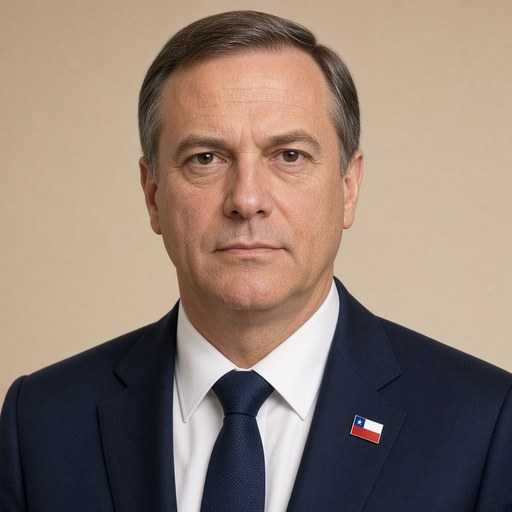
His Excellency the President of the Republic, José Antonio Kast, participates in a seminar of the Council for Transparency.
 José Antonio Kast · Leader of the Republican Party (Chile)
- Context
- Kast addressed a Council for Transparency seminar during Transparency Week in Chile on April 24, 2026, emphasizing transparency as a constitutional duty and AI's role in combating corruption.
- Main themes
- Government transparency, anti-corruption measures, artificial intelligence in public administration, constitutional obligation of probity, Council for Transparency, public information access, prevention and training, civic accountability, state auditing, open government data
- Duration
- ~16 min
- Words
- 1,865
- Sentences
- 121
- Readability
- 57
- Grade
- 9.2
- Syntax
- 2.84
- Vocabulary
- 1.96
Translated from Spanish
The broad sphere of national life a sentence belongs to. Every sentence has an Arena, so it is the denominator the other indices are read against.
Other121 sentences in 31 paragraphs
Good morning.
I congratulate the president and the Council for the video they showed us. It is impressive to see in an institution that is about transparency, which at many moments could generate tension in the people involved, showing us with optimism what the development of an activity that helps the nation can be. So, to those who collaborated and to you yourselves for being part of the presentations, I thank you because it is clear that you traveled through Chile, that you were there, that you were in schools, educational institutions, and with civil society. It is not an entity that is hidden away somewhere, but rather has a presence in the citizenry.
Also, as you say very well, the figures speak. And the figures to which we have access there and in other documents you have provided are very impressive. So, all my respect and gratitude for the work you do, and on your behalf, president, I ask you to convey to all the people who collaborate how grateful we are.
I also want to thank the speakers, the panelists who will be here later. It is very relevant to talk, discuss, and sometimes disagree on how to move forward. If there were no disagreement, how would we advance, if we all thought the same about what is to come?
It is relevant that this seminar, this panel, takes place during Transparency Week. I did check Instagram and other pages before presenting myself to get a little immersed in what you do and in other seminars, because you are making progress and continue to surprise us.
I also want to thank the Comptroller's Office, because it has already facilitated the venue for several of us to present. The Comptroller's Office, like you, has a fundamental role. The State will soon also be perfecting internal auditing.
It was mentioned, in part, by the president, what our Constitution states. In Article VIII it says: The exercise of public functions obliges their holders to strictly comply with the principle of probity in all their actions. Next, in paragraph II, the publicity of the acts and resolutions of the State is enshrined, as well as the foundations and procedures that are used.
This part is always difficult. Because we have to ensure that each one seeks how to communicate properly and hopefully always with the same system. I remember that when I was a deputy and requested oversight reports from different public institutions, well, each one presented the information in a different way. I think we discussed this once. Some uploaded a photo, others had an Excel sheet. Of course, trying to merge that data was practically impossible. So I said, well, at least they had to take the trouble to send it to me.
I must say that my life changed when I was able to access the Council for Transparency. With all due respect to the Chamber of Deputies and to the institution, it worked much faster than all the historical oversight procedures we had as deputies. That is an enormous job that you do.
Therefore, transparency, publicity, is not just an aspiration. It is a constitutional obligation. Every day we must strive, each one of us. No one is perfect. We all have to improve transparency and make public acts known.
We have to use this in a good sense, prevention. You also mentioned training, instruction, and education. Because not everyone who accesses public office comes knowing. Not everyone has had the opportunity to take courses like the ones we had here at the Comptroller's Office, where we also had talks from prosecutors, meetings with you. Of course, from there, collecting all that, studying it, processing it, and developing the work is not so easy.
But prevention is fundamental because corruption does not distinguish political color. This is not an attribute of one political sector or another. It is not the heritage of one government or another, of one coalition or another. It is unfortunately a permanent temptation that arises in power because humans are not perfect. And the best antidote to avoid falling into those vices, into corruption, is transparency.
The good news today is that we have more and more tools, more innovations that strengthen the capacity of different institutions and the State to face possible acts of corruption and promote transparency. Among those tools, one that is completely revolutionary is artificial intelligence. It never ceases to amaze us every day what can be done.
That is indeed a technical tool that changes the paradigm of how to face this. For example, before one could audit millions of State transactions, but it took months or years to cross-reference the information. There were many piles of papers. Today, the artificial intelligence system, if well supplied with information, can do it in a couple of hours. That is something unprecedented.
Before, it was even difficult to detect any pattern of corruption, and it was basically like a stroke of luck: look, we found this, I crossed these 15 contracts and here I found this and that. Well, artificial intelligence with an algorithm can quickly detect anomalies, patterns of behavior. We want to advance in that.
Before, a citizen could request information and the response took quite a long time, and most of the time it arrived incomplete. So, one had to go back to consult about the same thing one or two times until one managed to explain well to the person on the other side what one was interested in. Clearly, both knew what the person wanted. Today, artificial intelligence allows the institution to provide a very quick response. Artificial intelligence, as has already been said, allows for transparency, speed, exposure, and effectiveness. And that is very good for our nation.
What artificial intelligence does not replace is political will. Because all the tools can be there, all the instruments can be there, but if there is no political will in different State departments, it is very difficult for this to be put into practice.
That starts in a civil society organization, it can be in a municipality, in a ministry, in the Government, in the Legislative Power, in the Judicial Power. We need everyone to collaborate on this. There is no better antidote for complex situations than transparency.
What we do need to seek is to eliminate any excuse for not being transparent. It requires training, it requires in some cases saying: well, let’s agree again, let’s train, and from here on out, all of this has to change, but there can no longer be excuses.
At least in what corresponds to our Government, that is what we have indicated and requested from all officials. From the one speaking, who can also make mistakes due to ignorance. It is clear that I made a mistake due to ignorance and it will not happen again, so do not worry. No one can now feel invited to lunch, unless it is an official act. But one can amend, and that is what correction is for; that is why one fundamentally welcomes and appreciates oversight. Yes, one always acts on the basis that oversight is to improve something that was not functioning well. We all must meet the same standard.
We have even asked all internal auditors to become even more active. We already had the second meeting, both virtual and in-person, with the more than a thousand auditors within the Government. A thousand auditors.
Perhaps some of them said: well, we will wait for them to tell us. We, at least I told them: act with everything. Yes, you are our first assurance that things will be done well. Of course, many spreadsheets, many reports were requested that perhaps were not done before. Precisely to standardize information and be able to cross-reference the data that the State itself has.
There, situations that need to be improved are emerging. We do not want to pursue anyone; we want to organize. Without order, it is very difficult to advance. There we also ask you to collaborate with creativity because one does not know everything. Many times there are people who have been around for a long time, and surely from this panel, from the presentations, good ideas will emerge, which you should also share with us so we can put them into practice.
A great example of everything that can be done with the same people who are in an institution is precisely what you have done and what the Comptroller has done in this building. With the same people, significant advances for Chile have been achieved. You mentioned here the issue of medical licenses from the perspective of doctors. Well, the Comptroller did it regarding those who “used” medical licenses. Well, a custom had already been established that no one paid attention to. Well, it was incorrect, it is incorrect. And that is what we thank each institution that collaborates in that line.
You are about to turn 20 years old, just a little bit more to go. Twenty years ago, this law was enacted, which was pioneering for that time. In a very different world, without artificial intelligence, or perhaps with the first lines of artificial intelligence, without Big Data, without the number of social networks that exist today.
The time has come, as the president said, to perfect it. A proposal was delivered to us some time ago. That proposal, as the president said, has already passed the first stage. Later, the minister, who is part of this great Government team, along with the undersecretary, will be given the floor. Both are very aware, from Segpres, that the processing of that bill needs to be expedited.
With all the necessary innovations. Because you say: It entered the Congress of the Republic in 2018, it has already passed the first stage. But we talked with the president of the Senate that in many cases substitute indications can be generated. I forgot the language of which I was part for so many years, but a substitute indication can be generated. And I believe it will gather support across different benches. This should not be a project that generates as much tension as other projects that can arise in political life.
In this, we must have agreement because the future and development of the nation depend on this. We can achieve a lot of investment, we can overcome many social issues. But if we do not have transparency, we will not guarantee a developed Chile in order and peace. Because transparency, doing things well, guarantees civic peace. That is something that is very important to us.
So, we are in a world full of opportunities. Count on us as a Government to advance in any of these matters.
Thank you very much for the invitation. Thank you very much to each of you for what you do. Thank you very much to those who will present, and please send us everything necessary so that we as a Government can also achieve maximum transparency. Because that way we will achieve a good Government that improves the quality of life for all our compatriots.
Thank you very much.
The original Spanish. The tags above are read on the English translation's sentences.
Muy buenos días.
Felicito a la presidenta y al Consejo por el video que nos mostraron. Es impresionante ver en una institución que es sobre transparencia, que en muchos momentos podría generar tensión en las personas que están, mostrarnos con optimismo lo que puede ser el desarrollo de una actividad que ayuda a la nación. Así que, a los que colaboraron y a ustedes mismos porque fueron parte de las presentaciones, darles las gracias porque se ve que recorrieron Chile, que estuvieron ahí, que estuvieron en colegios, instituciones de educación, estuvieron con la sociedad civil. No es un ente que está escondido en algún lugar, sino que tienen presencia en la ciudadanía.
También, ustedes lo dicen muy bien, las cifras hablan. Y las cifras a las cuales tenemos acceso ahí y en otros documentos que nos han entregado, son muy impresionantes. Así que, todo mi respeto y mi agradecimiento por la labor que hacen y en su nombre, presidenta, le pido que transmita a todas las personas que colaboran, lo agradecidos que estamos.
También, darles gracias a los expositores, los panelistas que van a estar posteriormente aquí. Es muy relevante conversar, discutir, discrepar en algunos momentos de cómo salir adelante. Si no hubiera discrepancia, cómo avanzamos, si todos pensáramos igual en lo que viene.
Es relevante que este seminario, este panel, se desarrolle en la Semana de la Transparencia. Yo sí ingresé al Instagram y a otras páginas antes de presentarme e imbuirme un poquito de lo que hacían y de otros seminarios, porque van avanzando y cada vez nos siguen sorprendiendo.
Agradecerle, también a la Contraloría, porque ya nos ha facilitado a varios el lugar para poder exponer. Tiene la Contraloría, igual que ustedes, un rol fundamental. El Estado, próximamente, va a ir perfeccionando también la auditoría interna.
Se mencionó, en parte, por la presidenta, lo que señala nuestra Constitución. En el artículo VIII se dice: El ejercicio de las funciones públicas obliga a sus titulares a dar estricto cumplimiento al principio de probidad en todas sus actuaciones. A continuación, en el inciso II, se consagra la publicidad de los actos y resoluciones del Estado, así como los fundamentos y los procedimientos que se utilizan.
Esta parte siempre es difícil. Porque tenemos que lograr que cada uno busque cómo comunicar de buena manera y ojalá siempre con el mismo sistema. Yo recuerdo que cuando era diputado y pedía oficios de fiscalización a distintas instituciones públicas, bueno, cada uno presentaba los antecedentes de una manera distinta. Creo que lo conversamos alguna vez. Algunos subían una foto, otros tenían un Excel. Claro, y tratar de unir esos datos era prácticamente imposible. Entonces yo decía, bueno, al menos tuvieron que darse la molestia de mandármelo.
Debo decir que mi vida cambió cuando pude acceder al Consejo Para la Transparencia. Con todo el respeto a la Cámara de Diputados y a la institucionalidad, funcionaba bastante más rápido que todo el procedimiento que teníamos histórico de fiscalización como diputados. Ese es un trabajo enorme que realizan ustedes.
Por lo tanto, la transparencia, la publicidad, no es sólo una aspiración. Es una obligación constitucional. Cada día debemos esforzarnos, cada uno de nosotros. Nadie es perfecto. Todos tenemos que ir mejorando la transparencia y el dar a conocer los actos públicos.
Tenemos que utilizar esto en el buen sentido, la prevención. También ahí ustedes mencionaban la capacitación, la instrucción, la formación. Porque no todos los que acceden a lo público llegan sabiendo. No todos han tenido la oportunidad de tener cursos como los que tuvimos nosotros aquí en la Contraloría, donde también nos hablaron fiscales, reuniones con ustedes. Claro, de ahí además a recoger todo eso, estudiarlo, procesarlo y desarrollar la labor no es tan fácil.
Pero prevenir es fundamental porque la corrupción no distingue color político. Este no es un atributo de un sector político o de otro sector político. No es el patrimonio de un gobierno, de otro, de una coalición o de otra. Es lamentablemente una tentación permanente que se da en el poder porque los humanos no somos perfectos. Y el mejor antídoto para que no se caiga en esos vicios, en la corrupción, es la transparencia.
La buena noticia hoy día es que cada vez tenemos más herramientas, más innovaciones que fortalecen la capacidad de las distintas instituciones y del Estado para enfrentar posibles actos de corrupción y promover la transparencia. Entre esas herramientas una totalmente revolucionaria es la inteligencia artificial. No deja de sorprendernos todos los días lo que se es capaz de hacer.
Esa sí es una herramienta técnica que cambia el paradigma de cómo enfrentar esto. Un ejemplo, antes uno podía auditar millones de transacciones del Estado, pero se requerían meses o años para cruzar la información. Eran muchas rumas de papeles. Hoy día el sistema de inteligencia artificial, si es bien proveído de información, lo puede hacer en un par de horas. Eso es algo inédito.
Antes incluso costaba detectar algún patrón de corrupción y era básicamente como un golpe de suerte: mira, encontramos esto, crucé estos 15 contratos y aquí encontré esto y esto otro. Bueno, la inteligencia artificial con un algoritmo puede rápidamente detectar anomalías, padrones de comportamiento. Nosotros en eso queremos ir avanzando.
Antes un ciudadano podía pedir una información y se demoraba bastante tiempo la respuesta y la mayoría de las veces llegaba incompleta. Entonces, uno tenía que volver a consultar sobre lo mismo una o dos veces, hasta que lograba explicarle bien a la persona que estaba al otro lado lo que a uno le interesaba. Claramente, los dos sabían lo que la persona quería. Hoy la inteligencia artificial le permite a la institución dar una respuesta muy rápida. La inteligencia artificial, como ya se ha dicho, permite la transparencia, permite la rapidez, la exposición, la eficacia. Y eso es muy bueno para nuestra nación.
Lo que sí no reemplaza a la inteligencia artificial es la voluntad política. Porque pueden estar todas las herramientas, pueden estar todos los instrumentos, pero si en distintas reparticiones del Estado no está la voluntad política, es muy difícil que esto llegue a la práctica.
Eso parte en una organización de la sociedad civil, puede estar en un municipio, en un ministerio, en el Gobierno, en el Poder Legislativo, en el Poder Judicial. Necesitamos que todos colaboremos en esto. No hay mejor antídoto para situaciones complejas que la transparencia.
Lo que sí, nosotros tenemos que buscar que se termine cualquier excusa para no ser transparente. Requiere una formación, requiere en algunos casos decir: bueno, pactamos de nuevo, formémonos y de aquí para adelante todo esto tiene que cambiar, pero ya no puede haber excusas.
Al menos en lo que corresponde a nuestro Gobierno, es lo que les hemos señalado y solicitado a todos los funcionarios. Desde quien habla, que también uno puede cometer errores por desconocimiento. Está claro que yo cometí un error por desconocimiento y no se va a volver a repetir, así que no se preocupen. Nadie se puede sentir ahora invitado a almorzar, salvo que sea un acto oficial. Pero uno puede enmendar y para eso es la corrección, para eso en el fondo uno acoge también y agradece las fiscalizaciones. Sí uno siempre actúa de la base de que una fiscalización es para mejorar algo que no estaba funcionando bien. Todos debemos cumplir el mismo estándar.
Les hemos pedido incluso a todos los auditores internos que se activen más aún. Tuvimos ya el segundo encuentro entre virtual y presencial con los más de mil auditores que hay dentro del Gobierno. Mil auditores.
Quizás algunos de ellos decían: bueno, vamos a esperar que nos digan. Nosotros, al menos yo les dije: actúen con todo. Sí ustedes son nuestro primer seguro de que las cosas se van a hacer bien. Claro, se les solicitaron muchas planillas, muchos informes que quizás antes no se hacían. Precisamente para uniformar información y poder cruzar los datos que tiene el propio Estado.
Ahí van apareciendo situaciones que hay que ir mejorando. Nosotros no es que queramos hacer una persecución, sino que queremos ordenar. Sin orden es muy difícil avanzar. Ahí también les pedimos a ustedes que nos colaboren con la creatividad porque uno no conoce todo. Muchas veces hay personas que llevan tiempo, y seguramente de este panel, de las exposiciones, van a salir buenas ideas, que también nos las compartan para poder llevarlas a la práctica.
Un gran ejemplo de todo lo que se puede hacer con las mismas personas que están en una institución es precisamente lo que han hecho ustedes y lo que ha hecho la contralora en este edificio. Con las mismas personas ha logrado avances muy significativos para Chile. Ustedes mencionaban aquí el tema de las licencias médicas desde el punto de vista de los médicos. Bueno, la Contraloría lo hizo respecto de los que “usaban” las licencias médicas. Bueno, ya se había dado una costumbre que a nadie le llamaba la atención. Bueno, era incorrecto, es incorrecto. Y eso es lo que nosotros le agradecemos a cada institución que colabora en esa línea.
Ya están por cumplir 20 años, falta un poquitito. Hace 20 años se dictó esta ley que fue pionera para esa época. En un mundo bastante distinto, sin la inteligencia artificial, o quizás con las primeras líneas de inteligencia artificial, sin la Big Data, sin la cantidad de redes sociales que hay hoy día.
Ha llegado el momento, como decía la presidenta, de perfeccionarla. Se nos entregó hace un tiempo atrás una propuesta. Esa propuesta, como dijo la presidenta, ya pasó el primer trámite. Después, le van a dar la palabra aquí al ministro, que forma parte de este gran equipo de Gobierno, junto con la subsecretaria. Los dos están muy conscientes, desde la Segpres, de que hay que darle agilidad a la tramitación de ese proyecto de ley.
Con todas las innovaciones necesarias. Porque usted dice: Entró en el año 2018 al Congreso de la República, ya pasó a la primera etapa. Pero conversábamos con la presidenta del Senado que en muchos casos se pueden generar indicaciones sustitutivas. Se me olvidó el lenguaje del que fui parte tantos años, pero se puede generar una indicación sustitutiva. Y que yo creo que va a convocar transversalmente a las distintas bancadas. Este no debiera ser un proyecto que genere tanta tensión como otros proyectos que se pueden dar en la vida política.
En esto tenemos que tener coincidencia, porque de esto depende el futuro y desarrollo de la nación. Nosotros podemos lograr mucha inversión, podemos superar muchos temas sociales. Pero si no tenemos transparencia, no vamos a garantizar un Chile desarrollado en orden y paz. Porque la transparencia, las cosas bien hechas, garantizan la paz ciudadana. Eso es algo que para nosotros es muy importante.
Así que, estamos en un mundo lleno de oportunidades. Cuenten con nosotros como Gobierno para poder avanzar en cualquiera de estas materias.
Muchas gracias por la invitación. Muchas gracias a cada uno de ustedes por lo que hacen. Muchas gracias a los que van a exponer y háganos llegar, de verdad, todo lo que sea necesario para que nosotros como Gobierno también logremos el máximo de transparencia. Porque así vamos a lograr un buen Gobierno que mejore la calidad de vida de todos nuestros compatriotas.
Muchas gracias.