




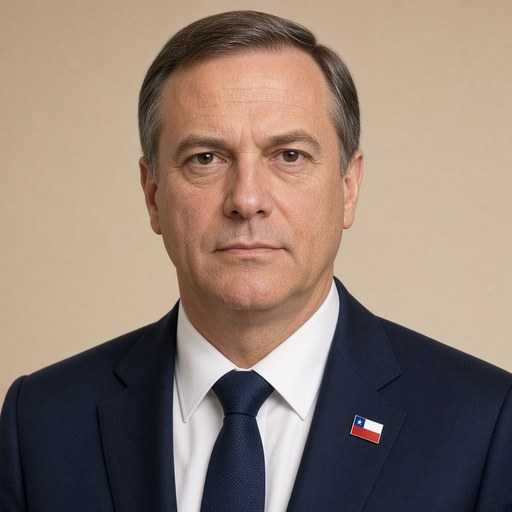
His Excellency the President of the Republic participates in the inauguration of the 2026 academic year of the University of Chile.
 José Antonio Kast · Leader of the Republican Party (Chile)
- Context
- Kast addressed the University of Chile's 2026 academic year inauguration, honoring the outgoing rector and reflecting on education's role in building the republic.
- Main themes
- University of Chile inauguration, education as foundation of republic, Andrés Bello's legacy, public university extension and outreach, youth and professional formation, dialogue and institutional respect, national identity and republican virtues
- Duration
- ~18 min
- Words
- 2,172
- Sentences
- 126
- Readability
- 54
- Grade
- 10.1
- Syntax
- 2.89
- Vocabulary
- 2.14
Translated from Spanish
The broad sphere of national life a sentence belongs to. Every sentence has an Arena, so it is the denominator the other indices are read against.
Other126 sentences in 31 paragraphs
Good morning.
Good morning, rector. It is a pleasure to be here this year as you leave this great university, and you leave it with the affection that was reflected in the initial applause. It was as if the applause would not stop. That demonstrates the affection that the entire university, and indeed the whole country, has for you, as I have expressed on occasions when we have met.
I also want to greet the undersecretary, the undersecretaries who accompany us, those who are taking on the challenge of replacing the rector, and those who have been rectors; I knew both of them. I had a long and pleasant conversation with Rector Ennio Vivaldi in Italy when I was serving as ambassador. I thank him for that conversation; I also had him in the House of Deputies, in the Science Committee, and in the Health Committee. I also greet Deputy Roberto Celedón, whom I met, as I would say, many gray hairs ago, for a social role he always fulfilled as a lawyer, concerned about the most vulnerable people. That was in the municipality of Paine. This also makes me thank the university for that role of Extension that they carry out, for example, in the high schools of San Nicolás and Peralillo.
So, you young people, what an honor it is for you to be here and to have been invited by the rector. And that, just as other young people can come to this great house of study, become tremendous professionals, and help ensure that all people do well, thanks to the public policies and ideas that you will put into practice once you enter the labor or academic life, whatever it may be. I do not know the Liceo de Peralillo; I hope to get to know it at some point. I know the Liceo de San Nicolás, and it is truly a source of pride what is done there, what the school director and the teachers do. There is a tremendous team.
I also greet Alfredo Zamudio. Thank you for coming, for giving the talk to the entire management team that is here. To the deans, to the professors, to the staff, and to the students of the University of Chile, who have brought prestige to Chile with their knowledge and research, and who have a tremendous challenge ahead. Beyond the differences we may have with some students, this is a place where dialogue and respect must take place.
This is the second time I am here. I remember when your chief of staff invited me to a debate years ago. It was able to take place without any problem. At one point, I was in a debate at one of the medical campuses. Another time, I was in a debate at the School of Law. Therefore, I appreciate every invitation. I am sure that in the future, not only the Undersecretary of Higher Education but also other ministers will be very honored to be present at activities in this great Casa de Bello.
I also thank you for the Extension. Forgive me, but I remember the theater and I say it is impressive what you have achieved there. The Extension in terms of books that you provide. Yesterday, you delivered more than 3,000 books. A line of people formed, who, in an orderly and respectful manner, each accessed material prepared by you.
Perhaps some already know this, but Andrés Bello accompanies me every day in the office. Because at the entrance of the office, to one side of the door, is the portrait of Bernardo O'Higgins, and on the other side is the portrait of Andrés Bello. I just discovered, yes, that it is a copy of the original that is here. The rector showed it to me.
And his presence there is not a coincidence, as he had a national vision; it was a balanced view between virtues and republican institutions. For Bello, there is no Republic without virtuous people to uphold those virtues, and there are no virtues without institutions that take charge of the education of people.
That was precisely the spirit behind the founding of the University of Chile. In his inaugural speech as rector in 1843, he said that "the education of the people is one of the most important and privileged objectives to which the Government can direct its attention." For years, I was in the Education Commission debating, discussing, trying to advance ideas. So, young people, Andrés Bello already said that education is the most important thing.
He continued by saying: "education is a primary and urgent necessity, the basis of all solid progress and the indispensable growth of republican institutions." Today that message is stronger than ever. When one is in university, one must not miss the opportunity to learn, learn, and learn. Then, deliver all that knowledge and make it available to compatriots who have not had the opportunity to reach a university classroom, such as those at the University of Chile.
In that line and with that objective, the University of Chile has played that fundamental role in the construction of our nation. From this House of Study, 21 Presidents of the Republic have graduated. It is impressive. And not only Presidents of the Republic; Arturo Prat, Pablo Neruda, Eloísa Díaz were also here. Just as you are the first female rector, she was one of the first female university students who also worked for the most vulnerable, for the youth. Just like Dr. Mönckeberg, she was concerned about child malnutrition many years before Dr. Mönckeberg.
Not to mention that more than 200 National Prize winners have graduated from this university in various fields of science, literature, humanities, and others.
Several alumni are ministers in the Government that I lead. I am very proud to have May Chomalí as Minister of Health, Jorge Quiroz as Minister of Finance. So, there you can tell them: hey, you are an alumnus. With the Minister of Labor, who is Tomás Rau; with the Minister of Defense, Fernando Barros; with the Minister of Energy, Ximena Rincón. And then to mention the number of undersecretaries, delegates, and regional secretaries who are alumni of the university and are proud to be alumni of the University of Chile. As you can see, the university has been a fundamental pillar of the nation.
I want to mention, you mentioned some points, three issues. One, which is evident and what you also point out, are the different challenges of how to maintain the sustainability of the higher education system. Both due to financial issues, which is what concerns us today, and also due to demographic issues. Because clearly, fewer students will be graduating from different educational establishments, and that will affect education in universities. And in this, we must prepare. You also mentioned artificial intelligence, connectivity. All are new challenges.
Secondly, we have a challenge in the curricular area, and we must keep updating. Because beyond the relevant, fundamental aspect of in-person education, the book, the text, there are realities today that are changing, and we must find ways for all those young people to have jobs afterward. Because we also realize, on some occasions, that an educated unemployment is starting to occur. Many people feel a degree of frustration when they cannot work in the areas for which they prepared.
We have to think about how to innovate in the curricular area, adapting professional training to these new technologies and also rethinking the duration of careers. Today, of course, I studied Law; it took many years, but perhaps I already knew, when I entered, which area I liked the most. But I had to learn about many areas. Today, perhaps one could specialize in a certain area and then deepen over time, because education is a continuous process.
Finally, we have a challenge regarding the governance of the university system, which has become somewhat more complex, where we have the Superintendency, we have the National Accreditation Commission, we have the ministries, different ministries, because all ministries today are intersecting, the Ministry of Education, the Ministry of Science; there are so many ministries that start to interact. Each one fulfills its role; however, we are aware that, with so many requirements, institutions have also been somewhat overloaded by administrative demands, which we can work on together to achieve and make life easier for rectors and deans.
As we are also doing at the school level with the directors of the establishments. We need directors focused on the young people they are teaching, not busy filling out a huge number of forms, because a large part of the difference in the high school, in the high schools of San Nicolás and Peralillo, is that the directors make a big difference, as was the case with a very emblematic director at the Augusto D’Halmar High School. They are the leaders of the educational community.
Before I finish, I also want to refer to a challenge that exceeds the scope of some public policies, which is the issue you mentioned, of coexistence and responsibility. There, the University of Chile plays a fundamental role.
Today, universities suffer new threats, violence, and cancellation. You mentioned a very harsh, painful event for a university, for a center of thought, such as the aggression against a minister of state. She very bravely said: I will continue to go, I will continue to expose, because violence cannot prevent teaching from being exercised.
But this is also permeating educational establishments, and we are all responsible for what happens here. You are neighbors of one of the most distinguished and recognized institutions in our history, the Instituto Nacional. It was always a source of pride for someone to say: I am an alumnus of the Instituto Nacional. Today, the enrollments of the Instituto Nacional are not always filled. So, we have to rethink why that place of study, that place of meeting, that place of community, has ceased to be so.
We have also seen it at INBA, where young people using explosive devices are getting burned. We cannot forget that. Young people who, while handling gasoline, get burned in a bathroom. We need to do a deep reflection and, while respecting the right to protest, prevent violence from taking over educational establishments. Also, in another place, teachers were doused with gasoline. In Calama, an inspector was murdered.
These are very difficult times that we must face from our position. Not to see how young people have to confront each other to safeguard their educational establishment. I met a young man the other day, and he told me: "Hey, we lack so many things." It was the Instituto de la Aplicación. I said: but do your classmates take care of the things that have been provided? Because the Instituto de la Aplicación has been remodeled several times. And there are unscrupulous young people who destroy what is so hard to build. I insist, protests are legitimate, but violence is not. Cancellation is not legitimate.
And what can the University of Chile do? A lot. Because you are at the forefront. You are at the forefront in a ceremony like this.
In a ceremony or in a public debate, where different thoughts that we can legitimately have are expressed.
Andrés Bello himself, at the end of the speech I mentioned at the beginning, said that universities have the role of educating their students in freedom. Freedom, he believed, faced two great adversaries. First, the passive attitude, which accepts everything without questioning, and the other, recklessness, which leads to rebellion against all norms and authority, without heeding reasons. The key here is balance because there must be conviction, but there must also be reflection. There must be criticism, but there must also be respect. And there must be freedom, always with responsibility. That is what characterizes a good citizen.
At least I have a lot of confidence in what is to come in the education of our country. I have confidence, among other reasons, because there are institutions like the University of Chile, which has been contributing to the country for 184 years. With the work of the university, the concept of the public university is vindicated. But not only public in terms of ownership, but also in a vocation of service to Chile. I know that the University of Chile will continue to be that beacon of knowledge that illuminates everyone.
And that from our Government, you can count on the best disposition, with the best possible dialogue, so that the collaboration you provide to Chile reaches even further, beyond what you are doing in San Nicolás and Peralillo. I hope that in every commune in Chile there could be a representative of the university in those high schools to uplift the spirit of the young people and that many of them have the opportunity to study here.
So, rector, thank you very much. And to everyone, may it be a good year for education.
Thank you.
The original Spanish. The tags above are read on the English translation's sentences.
Muy buenos días.
Muy buenos días, rectora. Qué gusto estar acá en este año en que usted deja esta gran universidad y la deja con ese cariño que se reflejó en el aplauso inicial. Era como que no paraban los aplausos. Eso demuestra el cariño que le tiene transversalmente, no sólo la universidad, sino que el país entero, como se lo he expresado en ocasiones en que nos hemos encontrado.
Quiero saludar también a la subsecretaria, a los subsecretarios que nos acompañan. A quienes están en el desafío de asumir el reemplazo de la rectora. A quienes fueron rectores, a ambos los conocí, con el rector Ennio Vivaldi tuvimos una larga y grata conversación en Italia cuando ejercía de embajador. Le agradezco esa conversación, también lo tuve en la Comisión de Diputados, en la Comisión de Ciencia y en la de Salud. También saludo aquí al diputado Roberto Celedón, a quien conocí, como diría, hace hartas canas atrás de los dos, por un rol social que él cumplía siempre como abogado, preocupado de las personas más vulnerables. Eso fue en la comuna de Paine. Eso me hace también darle las gracias a la universidad por ese rol de Extensión que realizan, por ejemplo, en los liceos de San Nicolás y de Peralillo.
Así que, ustedes jóvenes, qué honor que puedan estar acá y que hayan sido invitados por la rectora. Y que, así como otros jóvenes puedan llegar a esta gran casa de estudio, ser tremendos profesionales y ayudar a que a todas las personas les vaya bien, gracias a las políticas públicas, a las ideas que ustedes van a llevar a la práctica una vez que ya entren en la vida laboral, académica, en la que sea. El Liceo de Peralillo no lo conozco, espero conocerlo en algún momento. El Liceo de San Nicolás lo conozco y es de verdad un orgullo lo que se realiza ahí, lo que hace el director del colegio, los profesores. Hay un tremendo equipo.
Saludo también a Alfredo Zamudio. Gracias por venir, por dar la charla a todo el equipo directivo que está aquí. A los decanos, a los profesores, a los funcionarios y a los alumnos de la Universidad de Chile, que han prestigiado a Chile con sus conocimientos, sus investigaciones y tienen un tremendo desafío por delante. Más allá de las diferencias que podamos tener con algunos alumnos, este es un lugar donde se debe dar el diálogo, el respeto.
Esta es la segunda vez que estoy aquí. Me acuerdo cuando su jefe de gabinete, hace años atrás, también me invitó a un debate. Se pudo dar, no hubo problema. En algún momento estuve en un debate en una de las sedes de Medicina. Otra vez estuve en un debate en la Escuela de Derechos. Por lo tanto, agradezco cada invitación. Estoy seguro que más adelante, no sólo la subsecretaria de Educación Superior, sino que otros ministros estarán muy honrados de poder estar presentes en actividades de esta gran Casa de Bello.
Le doy las gracias también por la Extensión. Perdonen, pero me acuerdo del teatro y digo es impresionante lo que han logrado ahí. La Extensión en temas de libros que entregan. El día de ayer entregaron más de 3.000 libros. Se formó una fila de personas que, de manera ordenada y respetuosa, cada uno accedió a un material elaborado por ustedes.
Quizás algunos ya lo saben, pero Andrés Bello me acompaña todos los días en la oficina. Porque a la entrada de la oficina, a un costado de la puerta, está el retrato de Bernardo O’Higgins y al otro costado está el retrato de Andrés Bello. Acabo de descubrir, sí, que es una copia del original que está acá. Me lo mostró la rectora.
Y su presencia ahí no es casualidad, ya que él tenía una mirada país, era una mirada equilibrada entre las virtudes y las instituciones republicanas. Para Bello no hay República sin personas virtuosas que sostengan esas virtudes y no hay virtudes sin instituciones que se hagan cargo de la educación de las personas.
Ese fue precisamente el espíritu detrás de la fundación de la Universidad de Chile. En su discurso inaugural, como rector en 1843, dijo que “la educación del pueblo es uno de los objetos más importantes y privilegiados al que puede dirigir su atención el Gobierno”. Por años estuve en la Comisión de Educación debatiendo, discutiendo, tratando de llevar adelante ideas. Así que, jóvenes, ya Andrés Bello decía que la educación es lo más importante.
Continuaba diciendo: “la educación es una necesidad primera y urgente, la base de todo sólido progreso y el crecimiento indispensable de las instituciones republicanas”. Hoy ese mensaje toma más fuerza que nunca. Cuando uno está en la universidad no tiene que desaprovechar la oportunidad para aprender, aprender y aprender. Luego entregar todos esos conocimientos y ponerlos a disposición de los compatriotas que no han tenido la oportunidad de llegar a un aula universitaria como, por ejemplo, las de la Universidad de Chile.
En esa línea y con ese objeto, la Universidad de Chile ha jugado ese rol fundamental en la construcción de nuestra nación. Desde esta Casa de Estudio han egresado 21 Presidentes de la República. Es impresionante. Y no solamente Presidentes de la República, también estuvieron aquí Arturo Prat, Pablo Neruda, Eloísa Díaz. Así como usted es la primera rectora, ella fue de las primeras estudiantes universitarias mujeres que trabajó también por los más vulnerables, por los jóvenes. Así como el Dr. Mönckeberg, ella años antes, muchos años antes que el Dr. Mönckeberg ya se estaba preocupando por la desnutrición infantil.
Para qué decir que más de 200 Premios Nacionales han egresado de esta universidad en las más distintas áreas de la ciencia, literatura, humanidad y otras.
Incluso varios exalumnos son ministros del Gobierno que me toca encabezar. Me siento muy orgulloso de contar con May Chomalí como ministra de Salud, con Jorge Quiroz como ministro de Hacienda. Así que, ahí usted puede decirles: oiga, usted es exalumno. Con el ministro del Trabajo que es Tomás Rau; con el ministro de Defensa, Fernando Barros; con la ministra de Energía, Ximena Rincón. Y para ahí decirle la cantidad de subsecretarios, delegados y seremis, que son exalumnos de la universidad y se sienten orgullosos de ser exalumnos de la Universidad de Chile. Como pueden ver, la universidad ha sido un pilar fundamental de la nación.
Quiero hacer mención, usted hizo mención a algunos puntos, a tres temas. Uno, que es evidente y lo que usted señala también, son los distintos desafíos de cómo mantener la sostenibilidad del sistema de educación superior. Tanto por el tema financiero, que es el que hoy nos tiene preocupados, como también por el tema demográfico. Porque claramente van a ir egresando menos alumnos de los distintos establecimientos educacionales y eso va a afectar el tema de la educación ya en las universidades. Y en esto hay que prepararse. Usted también mencionó la inteligencia artificial, la conectividad. Todos son desafíos nuevos.
En segundo lugar, tenemos un desafío en el tema curricular y hay que ir actualizándose. Porque más allá de lo relevante, fundamental, que es la presencialidad, el libro, el texto, hay realidades hoy día que van cambiando y nosotros tenemos que buscar cómo todos esos jóvenes tengan después trabajo. Porque también nos damos cuenta, en algunas ocasiones, que se empieza a producir en el tema del desempleo, un desempleo ilustrado. Muchas personas sienten un grado de frustración cuando no pueden ejercer en aquellas áreas para las cuales se prepararon.
Tenemos que pensar cómo ir innovando en la materia curricular, adaptando la formación profesional a estas nuevas tecnologías y también repensar la extensión de las carreras. Hoy día, claro, yo estudié Derecho, fueron muchos años, pero quizás yo ya sabía, cuando entré, qué área me gustaba más. Pero tuve que aprender de muchas áreas. En el día de hoy, quizás uno podría ir especializándose en alguna área y después en el tiempo ir profundizando, porque la educación es un proceso continuo.
Por último, tenemos un reto que se refiere a la gobernanza del sistema universitario, que se ha vuelto algo más compleja, donde tenemos la Superintendencia, tenemos la Comisión Nacional de Acreditación, tenemos los ministerios, distintos ministerios, porque todos los ministerios hoy día se van cruzando, el Ministerio de Educación, el Ministerio de Ciencia, hay tantos ministerios que empiezan a interactuar. Cada uno cumple su rol, sin embargo, estamos conscientes que, con tanto requerimiento, las instituciones también se han visto algo sobrecargadas por exigencias administrativas, que podemos ir trabajando en conjunto para lograr y facilitarles la vida a los rectores, a los decanos.
Como también lo estamos haciendo a nivel escolar con los directores de los establecimientos. Nosotros necesitamos directores ocupados de los jóvenes a los cuales están enseñando, no ocupados de llenar una cantidad de formularios enormes, porque gran parte de la diferencia que hay en el liceo, en los liceos de San Nicolás y de Peralillo, es que los directores marcan una gran diferencia, como lo fue un director muy emblemático en el Liceo Augusto D’Halmar. Son los líderes de la comunidad educacional.
Antes de terminar, también quiero hacer referencia a un desafío que supera el alcance de algunas políticas públicas, que es el tema que usted mencionó, de la convivencia y la responsabilidad. Ahí la Universidad de Chile juega un rol fundamental.
Hoy las universidades sufren nuevas amenazas, la violencia y la cancelación. Usted hizo mención a un hecho muy duro, doloroso para una universidad, para un centro de pensamiento, como fue la agresión a una ministra de Estado. Ella muy valiente dijo: yo voy a seguir yendo, voy a seguir exponiendo, porque la violencia no puede impedir que se ejerza la docencia.
Pero esto también está permeando establecimientos educacionales y somos todos responsables de lo que ocurre aquí. Ustedes son vecinos de una de las instituciones más destacadas y reconocidas a nivel de nuestra historia, el Instituto Nacional. Era siempre un orgullo para alguien decir: soy exalumno del Instituto Nacional. Hoy día, no siempre se llenan las matrículas del Instituto Nacional. Entonces, tenemos que repensar por qué ese lugar de estudios, ese lugar de encuentro, ese lugar de comunidad, dejó de serlo.
También lo hemos visto en el INBA, donde jóvenes utilizando elementos explosivos se queman. No podemos olvidar eso. Jóvenes que manipulando bencina se queman en un baño. Tenemos que hacer una reflexión profunda y respetando el derecho a la manifestación, impedir que la violencia se tome los establecimientos educacionales. También, en otro lugar, rociaron profesores con bencina. En Calama asesinaron a una inspectora.
Son tiempos muy difíciles y que nosotros tenemos que enfrentar desde nuestra posición. No ver cómo jóvenes tienen que enfrentarse entre ellos mismos para resguardar su establecimiento educacional. Me encontré con un joven la vez pasada y me decía: “oiga, nos faltan tantas cosas”. Era el Instituto de la Aplicación. Le dije: pero, ¿sus compañeros cuidan las cosas que se han entregado? Porque se ha remodelado el Instituto de la Aplicación varias veces. Y hay jóvenes inescrupulosos que destruyen lo que tanto cuesta construir. Vuelvo a insistir, las manifestaciones son legítimas, pero la violencia no. La cancelación no es legítima.
¿Y qué puede hacer la Universidad de Chile? Mucho. Porque ustedes van a la vanguardia. Van a la vanguardia en una ceremonia como esta.
En una ceremonia o en un debate público, donde se expresen los distintos pensamientos que legítimamente podemos tener.
El mismo Andrés Bello, al final del discurso que les mencionaba al comienzo, decía que las universidades tienen el rol de educar a sus alumnos en la libertad. La libertad, creía él, enfrentaba dos grandes adversarios. Primero, la actitud pasiva, la que acepta todo sin cuestionamientos y, la otra, la temeridad, que lleva a rebelarse contra toda norma y autoridad, sin atender razones. La clave aquí es el equilibrio porque tiene que haber convicción, pero también tiene que haber reflexión. Tiene que haber crítica, pero también tiene que haber respeto. Y tiene que haber libertad, siempre con responsabilidad. Eso es lo que caracteriza a un buen ciudadano.
Al menos yo tengo mucha confianza en lo que está por venir en la educación de nuestro país. Tengo confianza, entre otras razones, porque existen instituciones como la Universidad de Chile, que lleva 184 años contribuyendo al país. Con el trabajo de la universidad se reivindica el concepto de la universidad pública. Pero no solamente pública por un tema de propiedad, sino que por una vocación de servicio a Chile. Sé que la Universidad de Chile seguirá sendo ese faro de conocimiento que ilumina a todos.
Y que desde nuestro Gobierno puedan contar con la mejor disposición, con el mejor diálogo posible, para que esa colaboración que ustedes le prestan a Chile llegue aún más lejos, más allá incluso de lo que están haciendo en San Nicolás y Peralillo. Ojalá en cada comuna de Chile pudiera haber un representante de la universidad en esos liceos para sacar adelante el espíritu de los jóvenes y que muchos de ellos tengan la oportunidad de estudiar aquí.
Así que, rectora, muchas, muchas gracias. Y a todos, que sea un buen año para la educación.
Gracias.