




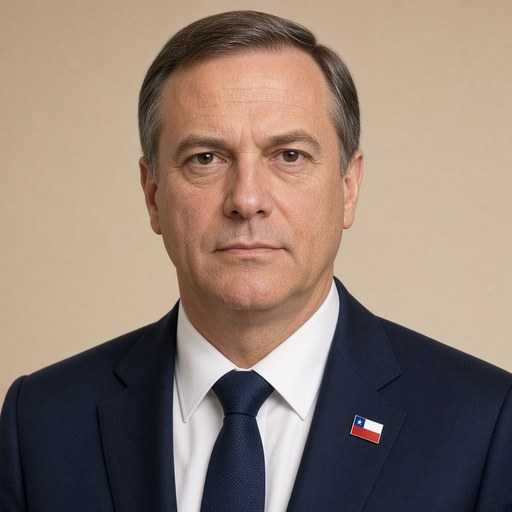
His Excellency the President of the Republic, José Antonio Kast Rist, participates in the launch of the Sebastián Piñera Chair at the University of Development and highlights his legacy of growth and democratic strengthening.
 José Antonio Kast · Leader of the Republican Party (Chile)
- Context
- Kast addressed the launch of the Sebastián Piñera Chair at the University of Development on March 12, 2026, honoring the late president's legacy.
- Main themes
- Legacy of Sebastián Piñera, public service and commitment to Chile, democracy and freedom, family values and personal legacy, economic growth and stability, political collaboration and differences, work ethic and leadership, University of Development chair launch, Chilean political history, memory and tribute
- Duration
- ~21 min
- Words
- 2,536
- Sentences
- 116
- Readability
- 56
- Grade
- 10.7
- Syntax
- 3.08
- Vocabulary
- 1.99
Translated from Spanish
The broad sphere of national life a sentence belongs to. Every sentence has an Arena, so it is the denominator the other indices are read against.
Other116 sentences in 43 paragraphs
Dear rector, I thank you for the opportunity to have been invited. For me, it is truly an honor to be here on the second day. I would have been here on the first day as well, but being here today is an honor, a recognition of a great president, and one always says, recognizing that “history is taking its place.”
I thank Mrs. Cecilia and her children. The greatest legacy you left, the greatest legacy, are your children and your grandchildren. That is a legacy that must also be incorporated into the lecture, because it strengthens what we seek, life in community.
A few days after handing over the leadership of the Nation to President Boric, President Piñera wrote a message on his social media: “Countries are not built overnight; each generation, each government builds upon the work of those who preceded them and also passes the baton to those who take over the future.”
This was on March 9, four years ago, and by the circumstances of life, here I am as President of the Republic, speaking about the life, the work, and the legacy of President Piñera’s government. If President Piñera had not had that fatal accident, I would not have been here. Eventually. And it must be said, because there is no first without a second, no second without a third, and mine was the third.
But as I learned from my parents, who suffered the loss of three children, and here is Joaquín Lavín who wrote a book about my brother – the eldest, 18 years older, thank you Joaquín for that book – the Lord has His times for each one and has thought them out from the beginning, and He gives us a wonderful life, and I am sure, I am convinced, that President Piñera made the most of it.
And that is the memory one must have, of that active man, of that powerful image, especially the memory you have of your father, of that concern for each child and for each grandchild.
I was surprised by that vocation he had, not only to hide one under the desk – there was León – but to visit another permanently in a complex moment, and he never failed. And there the great values of people are tested, in the care of family.
And I must also say that we did not always share or were so close with President Piñera. We were always very well received in his home, Mrs. Cecilia, and I thank you for every attention you gave us; it was truly a pleasure to always meet and see that permanent joy you brought to your home.
We faced each other in an electoral contest and also at some different moments of political differences we had. And we had them, and we did not hide them, and I believe that is also healthy; it is good to always express things with respect.
But it is also true that those differences never prevented us from recognizing something essential, that we both conceive public service as a form of commitment and love for Chile. And it must also be recognized that there were moments of great collaboration, back and forth. So I thank all those moments in which we could share.
In 2009, I was a candidate, working there in San Bernardo, where today the great mayor of Providencia continues, playing a role that later the crane took him as minister. So, at that time, in 2009, I already worked intensely for the gentleman who is there, and then I worked intensely for her husband. So I got to know both of them quite well.
And not to mention, in 2017, where it was also a tough challenge, but it ended well. And I also felt proud to travel all over Chile, defending the ideas of freedom.
He also offered me advice on more than one occasion, and as I said, his family, who are here present, have been a tremendous support during this period, in the electoral period, the first and second rounds, and they have also continued to talk to our children, telling them everything that means the environment of a presidency, and for us that is very, very relevant. So thank you very much for your affection.
At the end of the day, what unites us is the desire for Chile not to lose its course of growth, order, and stability. My presence here, therefore, is not a mere protocol act, but a profound testimony of respect towards someone who always put Chile ahead of any other interest.
So the first thing is to remember President Piñera, and in a very sincere way, to lament his passing. We were all shocked. We were shocked by the affection that the citizens also expressed to him in his farewell over several days.
This act is not an academic recognition of a distinguished career, but also an invitation to reflect on the value of public service and the importance of defending democracy and freedom with conviction. Sebastián Piñera was a public servant who worked with discipline, with conviction, to make Chile a strong and free democracy. The president had a rigorous work ethic in his public life, openness to innovation, as mentioned by the rector, a reformist will, and an uncommon tenacity to pursue ambitious goals for our country.
That work ethic, because that is a will to work, an ethic of work, was shaping a legacy that today is part of the recent history of our country. His first government, as the rector pointed out, faced a very difficult moment, picking up a country destroyed, devastated by an earthquake, and he did it impressively.
After he rebuilt cities, homes, infrastructure, as had never been seen before, and restored our spirits, he faced the issue of unemployment and, with good collaborators, achieved that longed-for million jobs, which was also a debate now. Curiously, they achieved it, we lost it, and now we have the challenge of recovering it.
Nothing to say about those stellar moments, “We are fine, the 33,” the discussion you had with him, the little paper, but our government program had 33 measures, and it was precisely for that reason, in memory of that great feat, where several here present had an active participation. He had to lead, but alongside him worked men and women committed to saving lives and never losing hope. That is why I was so pleased with the name of one of the granddaughters, Esperanza, who is somewhere here. That must always be remembered.
And that same situation he faced in his first challenge of rebuilding Chile, of rescuing the miners, brought Chile forward in the toughest pandemic we have had to live through. We were a world example, once again, with that tenacity, with that projection, and with the doctor who is there, Dr. Mañalich, who was later succeeded by Dr. París, and Dr. Paula Daza. And others, but there was continuity and a very strong team. So how can we forget that “Crocodile Dundee” hat of Dr. Mañalich?
And also the extreme violence, because we had moments of extreme harshness. There was the intendant who was going to be a candidate for governor and remained in the position. So thank you, Carla, for also stepping up at that moment. Everyone stayed in their positions; everyone had other possibilities, but in the face of the urgent and emergency call of the country, each one stayed in their place.
Thank you, Víctor, also for that challenge you took on, which was not easy. There was Undersecretary Ubilla. Thank you to all. I could mention you all, because each one is... Minister Varela too. I see you and I see stories, and I also see a good continuity of what we face today.
How can we not remember that tough moment, in which the president identified well, that it was a non-traditional coup d'état, where tempers flared, common sense was lost, and step by step we recovered it, with differences as well.
But I believe everything happens for a reason. When I say everything will be fine, everything has been fine, and each one has built, has put a part so that we can reconnect. Perhaps that harsh situation we went through was necessary to be able to recover today and have the opportunity to build a new era.
We have an opportunity; it is not guaranteed, but if we do things right, we can recover the development and growth that President Piñera sowed.
Also, and reflecting what I see here, is his concern for, sometimes I say Latin America, but now I will say Hispanic America, to include everyone, because he had a real concern. And he knew that in our continent, if poverty continues to exist, if misery continues to exist, democracy and freedom will always be in danger.
Because there are some who do not believe in democracy, do not believe in freedom. And here we have a great woman. You have already been applauded, you have been recognized, but your courage, your bravery, motivates us all. Because we say, how? In a country where tyranny, hatred, oppression, forced migration prevails, a woman brings forth the soul of the homeland. So María Corina, thank you very much for your presence, for your constant work.
And I believe your Nobel Prize was a just recognition. And it was incredible that you were there, and that today you can travel the world, shouting for freedom for your beloved Venezuela.
Here several of the parliamentarians, who were parliamentarians in a swearing-in of the new president, went with the plaque “Venezuela Libre,” and it was big, and we carried it with pride, because we knew there were brave people fighting on the ground. I am sure President Piñera would be very happy, very pleased, and I believe he is very happy up there, and he is greeting you, he is greeting the heavens and then looking down. So thank you for that perseverance.
And in the moments of greatest danger in our region, he was also very clear. He always spoke of dictatorship, and of that harsh dictatorship, which also cost us, because it was, and they do not forgive there. But today the one who caused the greatest drama is well guarded, as several other tyrants and dictators should be.
And the recent history of Chile and Latin America is clear. Those countries that have closed their economies, that have tried to replace freedom with statist models and dictatorships, as still partially exist in Venezuela, but we are working for the recovery of full democracy, as it should be, and especially in Cuba. They have not generated any policies of social justice, nor have they given dignity to their peoples. On the contrary, they have generated poverty, they have generated stagnation, they have generated oppression and forced immigration, which we have seen here, and crimes that transcend borders, as we have also experienced here.
And President Piñera believed exactly the opposite. He believed in the virtues of the Chilean experience, that a strong democracy, an open economy, a State at the service of the people and the common good, is the safest path to material and spiritual progress.
Sebastián Piñera believed in those ideals until the last of his days, and for that reason, I believe there is no better way to honor him than to continue working to make Chile and Latin America and Hispanic America a region free of poverty, free of insecurity, free of tyranny.
Having said all of the above, perhaps the true measure of Sebastián Piñera's dedication to the country is revealed when observing his last hours of life.
There is a fact that has always seemed especially revealing of what his character was. A few days before his tragic passing, President Piñera was working, intensely occupied with his teams, among which was our current Minister of Housing and Urbanism, Iván Poduje, great Iván. He was working on a reconstruction project for the Fifth Region, devastated by the forest fires of that summer.
Imagine that Sebastián Piñera rebuilt an entire country, entirely. And unfortunately today in Viña there are people who, two years later, still have not recovered their homes. It is unimaginable what he did, and it is unbelievable what this government that is ending did not do.
So in that painful death, we now remember with our work, and I am sure Iván will reclaim everything that was proposed that time and will rebuild for those families who have been anxious for so long and also for the families in the south believing they will be forgotten. We will not forget them, and that legacy is also part of what the well-done work of President Sebastián Piñera left us.
But the legacy, and I am already finishing, is not limited solely to the works and results of a government. During his governments, and this is something very important, many young people from different backgrounds joined the State for the first time, and that is indeed a great legacy. There they discovered that serving Chile from public office is not only a responsibility but also a vocation. Many of these professionals continue to serve the country in different spaces and places in Chile, just like several of those I see here, who were called at some point to go to Concepción, to Aysén, to Arica, to Antofagasta.
Well, that legacy remains active; it was generated with some of those who are here, and we want to maintain it, and that is why we invite young people with such strength and energy to join public service. And the cranes are operating, so do not stop them, because from various places we are bringing young people to work in public service. We feel very proud to have ministers. We almost achieved a Sub 30, but from 30 to 40 we have a great opportunity to show young leadership that helps us never lose that energy.
And as a personal reflection, I want to say that I am very grateful to have been invited, because what I see here is much deeper than the works and everything that brings us together. This is much more than a symbolic act, beyond the differences we may have had.
This will be a lecture that will not only be a space for memory, but also a space for learning and for meeting. And there is nothing more important than coming together again. And here I follow what Pía says. We need more affection, more hugs. Sometimes it is difficult, it is hard for us to forgive, but it is possible. And I must tell you that here, with several, more than you can imagine, we have forgiven each other, we have reunited. And with those I have yet to meet, we will reunite and we will forgive each other, because Chile deserves much more. And the new generations must learn from what we do.
Precisely that will be the best tribute we can pay to the memory of Sebastián Piñera: the meeting, hope, and progress for our nation.
Thank you very, very much.
The original Spanish. The tags above are read on the English translation's sentences.
Estimado rector, le agradezco la oportunidad de haber sido invitado. Para mí, de verdad, es un honor estar en el segundo día. Habría estado en el primero también, pero estar hoy día aquí es un honor, un reconocimiento a un gran presidente y siempre uno dice, va reconociendo “la historia va ocupando su lugar”.
Le agradezco a la señora Cecilia y a sus hijos. El mejor legado, el legado más grande que ustedes dejaron, son sus hijos y sus nietos. Ese es un legado que también hay que incorporar a la cátedra, porque fortalece lo que nosotros buscamos, la vida en comunidad.
A pocos días de haber entregado el mando de la Nación al presidente Boric, el presidente Piñera escribió un mensaje en sus redes sociales: “Los países no se construyen de un día para otro, cada generación, cada gobierno construye sobre la obra de quienes lo antecedieron y también pasa la aposta a quienes asumen el relevo del futuro”.
Esto fue un 9 de marzo, hace cuatro años atrás y por las circunstancias de la vida, aquí me encuentro como Presidente de la República, hablando sobre la vida, la obra y el legado del gobierno del presidente Piñera. Si el presidente Piñera no hubiese tenido ese fatal accidente, eventualmente yo no habría estado acá. Eventualmente. Y hay que decirlo, porque no hay primera sin segunda, no hay segunda sin tercera y la mía fue la tercera.
Pero como aprendí de mis padres, que sufrieron la pérdida de tres hijos, y aquí está Joaquín Lavín que escribió un libro sobre mi hermano –el mayor, 18 de diferencia, gracias Joaquín por ese libro– el Señor tiene sus tiempos para cada uno y los tiene pensados desde siempre y nos regala una vida maravillosa y estoy seguro, estoy convencido, que el presidente Piñera la aprovechó al máximo.
Y ese es el recuerdo que uno tiene que tener, de ese hombre activo, de esa imagen potente, sobre todo el recuerdo que ustedes tienen de su papá, de esa preocupación por cada hijo y por cada nieto.
Me sorprendió esa vocación que tenía, no solamente de esconder a uno debajo del escritorio –por ahí vía León– sino de visitar a otro permanentemente en un momento complejo y nunca falló. Y ahí se prueban los grandes valores de las personas, en el cuidado de la familia.
Y también debo decir que no siempre compartimos o fuimos tan cercanos con el presidente Piñera. Siempre fuimos muy bien acogidos en su casa, señora Cecilia, y le agradezco cada atención que nos dio, era de verdad un agrado siempre encontrarnos y ver esa alegría permanente que usted ponía en su casa.
Nos enfrentamos en una contienda electoral y también en algunos distintos momentos de diferencias políticas que tuvimos. Y las tuvimos y no las ocultamos, y yo creo que eso también es sano, es bueno poder plantear siempre con respeto.
Pero también es cierto que esas diferencias nunca nos impidieron reconocer algo esencial, que ambos concebimos el servicio público como una forma de compromiso y amor por Chile. Y también hay que reconocer que tuvo momentos de gran colaboración, de ida y de vuelta. Así que agradezco todos esos momentos en los cuales pudimos compartir.
Me tocó el año 2009 ser candidato, trabajar ahí en San Bernardo, donde después siguió hoy día el gran alcalde de Providencia, ejerciendo un rol que además después la grúa se lo llevó de ministro. Así que, en esa época, en el 2009, ya trabajé intensamente por el caballero que está ahí, y después trabajé intensamente por su marido. Así que a ambos los conocí bastante.
Y para qué decir, el año 2017, donde también, claro, fue un desafío duro, pero que concluyó bien. Y también me sentí orgulloso de recorrer Chile entero, defendiendo las ideas de la libertad.
Él también me ofreció consejos en más de una oportunidad, y como lo dije, su familia, que está aquí presente, han sido un tremendo apoyo en este periodo, en el periodo electoral, la primera y segunda vueltas, y también han seguido conversando con nuestros hijos, contándoles todo lo que significa el entorno de una presidencia, y para nosotros eso es muy, muy relevante. Así que muchas gracias por su cariño.
Al final del día, lo que nos une es el deseo de que Chile no extravíe el rumbo del crecimiento, el orden y la estabilidad. Mi presencia aquí, por lo tanto, no es un mero acto protocolar, sino un testimonio profundo de respeto hacia quien siempre puso a Chile por delante de cualquier otro interés.
Y así que lo primero es recordar al Presidente Piñera, y de manera muy sincera, lamentar su partida. Todos quedamos impactados. Quedamos impactados por el cariño también que le expresó la ciudadanía en su despedida de varios días.
Este acto no es un reconocimiento académico a una trayectoria destacada, sino también una invitación a reflexionar sobre el valor del servicio público y la importancia de defender con convicción la democracia y la libertad. Sebastián Piñera fue un servidor público que trabajó con disciplina, con convicción, para hacer que Chile fuera una democracia fuerte y libre. El presidente tuvo un trabajo riguroso en su vida pública, de apertura a la innovación, como lo fue mencionado por el rector, de voluntad reformista y de una tenacidad poco común para perseguir metas ambiciosas para nuestro país.
Esa ética del trabajo, porque eso es una voluntad de trabajo, una ética del trabajo, fue configurando un legado que hoy forma parte de la historia reciente de nuestro país. Su primer gobierno, y lo señaló el rector, tuvo un momento muy difícil, recoger un país destruido, devastado por un terremoto, y lo hizo de manera impresionante.
Después de que levantó ciudades, viviendas, infraestructura, como jamás se había visto, y nos recuperó el ánimo, el espíritu, se enfrentó al tema del desempleo y también con buenos colaboradores logró ese anhelado millón de empleos, que también fue debate ahora. Curiosamente lo lograron, lo perdimos, y ahora tenemos el desafío de recuperarlo.
Nada que decir de esos momentos estelares, “Estamos bien los 33”, la discusión que usted tenía con él, el papelito, pero nuestro programa de gobierno tenía 33 medidas, y era precisamente por eso, en recuerdo de esa gran gesta, donde hay varios aquí presentes que tuvieron una participación activa. A él le tocó liderar, pero junto a él trabajaron hombres y mujeres jugados por salvar la vida y nunca perder la esperanza. Por eso me alegró tanto el nombre de una de las nietas, Esperanza, que por alguna parte está. Eso siempre hay que recordarlo.
Y esa misma situación que hizo en su primer desafío de reconstruir Chile, de rescatar a los mineros, sacó a Chile adelante en la pandemia más dura que nos ha tocado vivir. Fuimos un ejemplo mundial, una vez más, con esa tenacidad, con esa proyección, y con el doctor que está ahí, el doctor Mañalich, que después fue sucedido por el doctor París, y por la doctora Paula Daza. Y otros más, pero ahí había una continuidad y un equipo muy potente. Así que cómo olvidar ese sombrero tipo “Cocodrilo Dundee” del doctor Mañalich.
Y también la violencia extrema, porque tuvimos momentos de dureza extrema. Ahí estaba la intendenta que iba a ser candidata a gobernadora y se mantuvo en el puesto. Así que gracias, Carla, por haberte la jugado también en ese momento. Todos se mantuvieron en sus puestos, todos tenían otras posibilidades, pero frente al llamado de urgencia y emergencia del país, cada uno se quedó en su lugar.
Gracias, Víctor, también por ese desafío que asumiste, que no fue fácil. Ahí el subsecretario Ubilla. Gracias a todos. Podría mencionarlos a todos, porque cada uno está... El ministro Varela también. Los veo y veo historias, y veo también una buena continuidad de lo que nos toca hoy día.
Cómo no recordar también ese momento duro, en ese que el presidente identificó bien, que era un golpe de Estado no tradicional, donde se exacerbaron los ánimos, se perdió el sentido común y paso a paso lo fuimos recuperando, con diferencias también.
Pero yo creo que todo pasa por algo. Cuando yo digo todo va a estar bien, todo ha estado bien, y cada uno ha construido, ha puesto una parte para que podamos reencontrarnos. Quizás fue necesaria esa situación dura por la cual atravesamos, para poder hoy día recuperar y tener la oportunidad de construir una nueva era.
Tenemos una oportunidad, no está garantizado, pero si hacemos las cosas bien podemos recuperar el desarrollo y el crecimiento que sembró el presidente Piñera.
También, y reflejo de lo que veo aquí, es su preocupación por, a veces digo Latinoamérica, pero ahora voy a decir Hispanoamérica, para incluirlos a todos, porque tuvo una preocupación real. Y sabía que, en nuestro continente, si sigue existiendo pobreza, si sigue existiendo miseria, la democracia y la libertad van a estar siempre en peligro.
Porque hay algunos que no creen en la democracia, no creen en la libertad. Y aquí tenemos a una mujer grande. Ya te han aplaudido, te han reconocido, pero tu coraje, tu valentía, nos motiva a todos. Porque decimos, ¿cómo? En un país donde prima la tiranía, el odio, la opresión, la migración forzada, una mujer saca adelante el alma de la patria. Así que María Corina, muchas gracias por tu presencia, por tu trabajo permanente.
Y creo que fue un justo reconocimiento tu premio Nobel. Y fue increíble que estuvieras allá, y que hoy día puedas recorrer el mundo, gritando libertad para tu Venezuela querida.
Aquí varios de los parlamentarios, que fuimos parlamentarios en un juramento del nuevo presidente, íbamos con la plaquita “Venezuela Libre”, y era grande, y la llevamos con orgullo, porque sabíamos que había gente valiente, que daba la lucha en terreno. Estoy seguro que el presidente Piñera estaría muy contento, muy feliz, y creo que está muy feliz de ahí arriba, y ahí te está saludando, está saludando al cielo y después mirando para abajo. Así que gracias por esa perseverancia.
Y en los momentos de mayor peligro en nuestra región, él también fue muy claro. Él siempre habló de dictadura, y de esa dictadura dura, que también nos costó, porque fue, y allá no perdonan. Pero hoy día el que causó el mayor drama está bien guardado, a buen resguardo, como deberían estar varios otros tiranos y dictadores.
Y la historia reciente de Chile y América Latina es clara. Aquellos países que han cerrado sus economías, que han intentado reemplazar la libertad por modelos estatistas y dictaduras, como que hoy todavía en parte siguen vigentes en Venezuela, pero estamos trabajando para la recuperación de la plena democracia, como corresponde, y sobre todo en Cuba. Ellos no han generado ninguna política de justicia social, ni han dado dignidad a sus pueblos. Todo lo contrario, lo que han generado pobreza, lo que han generado estancamiento, han generado opresión y inmigración forzada, que la hemos visto acá, y crímenes que trascienden las fronteras, como también lo hemos vivido acá.
Y el presidente Piñera creía exactamente lo contrario. Creía en las virtudes de la experiencia chilena, que una democracia fuerte, una economía abierta, un Estado al servicio de las personas y el bien común, es el camino más seguro hacia el progreso material y espiritual.
Sebastián Piñera creyó en esos ideales hasta el último de sus días, y por lo mismo creo que no habrá mejor manera de rendirle honor que seguir trabajando para hacer de Chile y de Latinoamérica y de Hispanoamérica una región libre de pobreza, libre de inseguridad, libre de tiranía.
Dicho todo lo anterior, quizás la verdadera medida de la entrega de Sebastián Piñera al país se revela al observar sus últimas horas de vida.
Hay un hecho que siempre me ha parecido especialmente revelador de lo que era su carácter. Pocos días antes de su trágico fallecimiento, el presidente Piñera estaba trabajando, ocupado intensamente junto a sus equipos, dentro de los cuales estaba nuestro actual ministro de Vivienda y Urbanismo, Iván Poduje, grande Iván. Estaba trabajando en una obra de reconstrucción de la Quinta Región, devastada por los incendios forestales de ese verano.
Imagínense que Sebastián Piñera levantó un país entero, entero. Y lamentablemente hoy día en Viña hay gente que a dos años aún no recupera sus viviendas. Es inimaginable lo que hizo y es de no creer lo que no hicieron en este gobierno que termina.
Así que en esa dolorosa muerte recordamos ahora con nuestro trabajo, y estoy seguro que Iván va a reivindicar todo lo que planteó esa vez y va a reconstruir para esas familias que están angustiadas desde tanto tiempo y también para las familias que están en el sur creyendo que los van a olvidar. No los vamos a olvidar y ese legado también es parte de lo que nos dejó el trabajo bien hecho del presidente Sebastián Piñera.
Pero el legado, y ahí ya voy terminando, no se limita únicamente a las obras y los resultados de un gobierno. Durante sus gobiernos, y esto es algo muy importante, muchos jóvenes provenientes de distintos mundos se integraron al Estado por primera vez y ese sí que es un gran legado. Allí descubrieron que servir a Chile desde la función pública no sólo es una responsabilidad sino también una vocación. Muchos de estos profesionales hoy continúan sirviendo al país en distintos espacios y lugares de Chile, al igual que varios de los que veo acá, que fueron convocados en alguna época a irse a Concepción, a Aysén, a Arica, a Antofagasta.
Bueno, ese legado sigue vigente, se generó con algunos de los que están acá y nosotros queremos mantenerlo y por eso invitamos con tanta fuerza y energía a gente joven a que se integre al servicio público. Y las grúas están operando, así que no las detengan, porque de varias partes estamos llevando jóvenes a trabajar al servicio público. Nos sentimos muy orgullosos de tener ministras y ministros. Casi logramos una Sub 30, pero de 30 a 40 tenemos una gran posibilidad de ir mostrando liderazgos jóvenes que nos vayan ayudando a nosotros a nunca perder esa energía.
Y como reflexión personal, decir que agradezco que me hayan invitado, mucho, porque lo que veo acá es mucho más profundo que las obras y que todo lo que nos convoca. Esto es mucho más que un acto simbólico, más allá de las diferencias que podemos haber tenido.
Esta será una cátedra que no solamente será un espacio para la memoria, también será un espacio para el aprendizaje y para el encuentro. Y no hay nada más importante que volver a encontrarse. Y aquí sigo lo que dice Pía. Necesitamos más cariño, más abrazos. A veces cuesta, nos cuesta perdonar, pero se puede. Y debo decirles que aquí, con varios, más de lo que ustedes se imaginan, nos hemos perdonado, nos hemos reencontrado. Y con los que me falte, ya nos reencontraremos y ya nos perdonaremos, porque Chile merece mucho más. Y las nuevas generaciones tienen que aprender de lo que nosotros hagamos.
Precisamente ese será el mejor homenaje que le podremos rendir a la memoria de Sebastián Piñera: el encuentro, la esperanza y el progreso para nuestra nación.
Muchas, muchas gracias.