




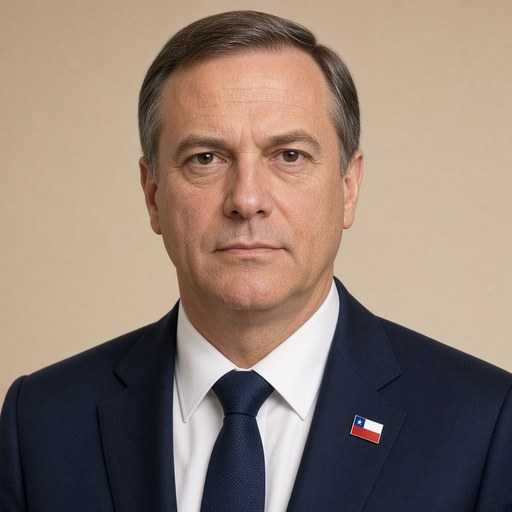
His Excellency the President of the Republic, José Antonio Kast Rist, inaugurates Aquasur, the main aquaculture fair in the southern hemisphere.
 José Antonio Kast · Leader of the Republican Party (Chile)
- Context
- Kast addressed the Aquasur aquaculture fair in Chile's Los Lagos region in March 2026, inaugurating the southern hemisphere's largest aquaculture exhibition.
- Main themes
- Aquaculture and salmon industry, Aquasur fair, regional development, entrepreneurship and business, scientific progress in salmon farming, Salmon 2050 project, international competitiveness, regional cooperation, Chilean workers and families, tourism linkages
- Duration
- ~28 min
- Words
- 3,322
- Sentences
- 202
- Readability
- 61
- Grade
- 8.8
- Syntax
- 2.81
- Vocabulary
- 1.97
Translated from Spanish
The broad sphere of national life a sentence belongs to. Every sentence has an Arena, so it is the denominator the other indices are read against.
Other202 sentences in 49 paragraphs
I would like to repeat the applause for the governor. We have known each other for quite some time, and for me, it is a pride and a joy that you lead the region today, especially with that commitment. I was telling Marcelo that I feel at home because Marcelo is also from the region. A greeting to the governors; I thank you for being here, also accompanying the governor. The work done by regional governments is very important.
And hopefully, there will also be a fair in Aysén. That way, we can have three fairs in one. I am sure the governor will be fully willing to collaborate. We can even have two fairs a year.
Why do I say I feel at home? Because I see FISA, and I was asking Mr. Francisco if it is the same FISA where we all went every year to the Maipú area. And it leaves a mark on you. These meetings mark people and mark children. Also, I was saying when I entered, when I was a candidate, I would go through all the stands and leave with all the merchandise for the children. So, now as an adult, I have kept the habit from when I was little, where one becomes immersed in mining, agriculture, and education when one has the opportunity to learn.
That is why I value these fairs so much. I want to say that I am sure that at the right moment, President Frei would also have been at all the fairs. Because if there is a promoter, a defender of salmon farming, aquaculture, and modernity, it is President Frei. So, Mr. President, I thank you. I also feel honored to be by your side. I asked the president for a selfie; now it is the selfie with Frei. What the president has done for Chile, placing Chile on a global level, is something that must be highlighted. I never tire of thanking you; as always, you are defending the Chilean industry, Chilean entrepreneurship, and the Chilean family. So, thank you very much.
I want to thank Aquasur for this meeting. It is a meeting; we have both mayors here. We are at the limit. There is a dispute about whether it goes over there or comes over here. Next year, we need to do it right in the middle. So, 50 thousand meters that way and 50 thousand meters this way. The mayor of Puerto Varas, Tomás Gárate, and the mayor Rodrigo Wainraihgt will be there, both pushing for Aquasur. So, thank you both for being here. Through you, I greet the other mayors who accompany us.
I want to thank the unions. Again, I feel at home because I see my president. I was the secretary general when we were in the same party as my president, Patricio Melero. Also, president of the Chamber. To Loreto Seguel, from the National Association of Agriculture. I appreciate that the ambassadors are here. They are very important to us.
There is space for everyone, as the governor said. I learned that from my father. We were dedicated to the trade sector. My father always said: there is space for everyone; we should not be small in this. The world needs it; it needs Norway and it needs Chile. Who is first or second does not matter; both of us can sell more. But for that, we need ambassadors. To invite people to Chile, to know the benefits of our land and from salmon we move to tourism, from tourism we move to salmon and to different other SMEs that are linked to what is here.
But I also want to thank those who work in the salmon industry, those who have defended the salmon industry. When I learned about the Salmon 2050 project – we can leave it there, governor, no problem. Even by 2030, we will be fine, but by 2050, it will be much better – I heard impressive testimonies. I thank the governor and the mayor of Puerto Montt for generating a movement that brought together different mayors, who may think politically differently, and different governors, but all move for a greater purpose, which is to improve the quality of life of people.
There, testimonies were given by people who worked in the salmon industry, in the processing plants, who proudly said: I have built my life around this job. It is hard work, standing work, many hours on your feet, but they felt proud of what they had achieved for their families because they had the opportunity to have stable work.
Thanks to the entire scientific community that has allowed Chile to overcome difficulties, to improve production, to increase production. All that scientific work is appreciated.
To the entrepreneurs, to the businesspeople. We should not be afraid to thank those who venture. Every entrepreneur wants to become a businessman. Any service provider wants to grow, and that is something we must value and push, unlike some who say: no, businesspeople are always causing problems. If we help businesspeople, they will surely help back.
Last year, I was here in the municipality of Frutillar; I don’t know if the mayor of Frutillar is around, but I spoke on the phone a few days ago with Javier. I was at the Salmon Summit. Evelyn Matthei and Jeannette Jara were there, and we agreed that this was the industry of the future. We all said that we were very much in agreement on making relevant changes so that this company, this business sector, would have more possibilities.
On that occasion, I said that salmon is stubborn, and here I am. Because it was a complex moment, but I said salmon is stubborn because it swims upstream, and it swims upstream because it knows it has a mission. We all together have a mission, which is to move our homeland forward. Chileans are stubborn; we are persistent; we move forward; after any catastrophe, we move forward.
That image of the salmon today takes on more relevance because our homeland is also swimming upstream. We have a global situation that we did not ask for, but it is there. And does it complicate our lives? Yes, for everyone. We are all in a complex situation. We have a very tough situation with organized crime, with illegal immigration that has advanced in the world and also in Chile. That is why I appreciate the call we received from the United States to group a series of countries where, of course, I went as an elected president, but there were 11 leaders from different countries suffering from the same scourge, which is organized crime, drug trafficking, and illegal immigration.
That is something that affects our country very strongly because, as we had a more accelerated progress than other countries, we are an attractive country for people who are having a hard time in their homelands. In that context, we have also had to make decisions that are not popular, that are not comfortable, but we make the right decisions.
That is why I also thank the responsibility with which the different political sectors have taken on the challenge because everyone understands that there is a situation that affects us beyond the local reality, which is a global situation. If oil prices double the value we were used to, that clearly affects us, and we have to make serious and responsible decisions.
Here, again, making a parallel with the industry. The governor mentioned it, and so did Francisco; 40 years ago, no one would have dreamed of the development that the salmon farming industry has had in Chile. You there also were, those who started were as stubborn as the salmon, swimming upstream, against all difficulties. This was not an accident that this industry was generated at a national level.
The collaboration is from many; I already mentioned the researchers, the scientists, in everything related to the development of vaccines, in the area of genetic improvements. The veterinarians, who today also have a new area of development. Who would have imagined 40 years ago the number of veterinarians we would need to care for salmon? One had a different mindset. Forty years ago in Magallanes, who would have thought that salmon would save the region's issues, the export issues? Because we were all focused, and we all knew that livestock was the most important. Today, it is fish.
The people in transportation—who would have thought of the number of transporters we need today? This, in addition, the confluence between the truck and the train that is generated not in Puerto Montt, not in Puerto Varas, but in Llanquihue, was going to lift a community like Llanquihue or Frutillar in terms of freight trains. We were always thinking about passenger trains, some about freight trains, but here that is revealed.
The issue of work for women. Well, in the area of the industry of the plants, clearly, the work for women, which is an area where we have difficulties today, has a tremendous impact. And that testimony I heard, I don’t remember if the person is here or not, but it was truly moving. They said: I supported my family in a salmon processing plant. That is also true. Look at how I am. Neat.
Also, the support of the different communities, dialoguing communities. Here we have a huilliche chief who has always been present, looking for ways to collaborate. That has allowed what Mr. Francisco said, that today this linked industry generates more than 86,000 direct and indirect jobs and that there are more than 4,000 entrepreneurs linked to this. And, again, having the experience of knowing someone who manages their cameras and helps in the detection of how the seabed is and who lives as a service provider. Or knowing a group of divers who go to Magallanes and spend a week on a boat, in very tough conditions, but also with good pay, with good quality in the work they do.
That reflects in the regional GDP, more than 14% here, close to 20% already in Aysén, and of the exports to Magallanes today, almost 60% of the exports from Magallanes are reflected in the salmon farming issue.
But there is something that must be highlighted, which is how rural poverty has been overcome because looking at the numbers, one can say that between 1992 and 2002, nearly a third of the reduction in rural poverty is due to the emergence of this industry. That is quality of life; these are people who have improved their quality of life. That should catch our attention. No public policy could match what you have done over the course of these 40 years, especially in that decade.
For the private system to function, it needs a collaborating state, and we are willing to collaborate. Unlike what we have sometimes seen, where ideology can outweigh the quality of life of people, we want to call on all those who do not sometimes live in the region, who do not know the region, to come, to know, to help us improve the quality of life of thousands of people.
The markets in the world, as Mr. Francisco and the governor said, more than 100 countries in Chile, where today we can sell our products, are exported directly from here from the airport to other countries. Well, all that, why? Because the world continues to grow, and it needs what you pointed out, which is healthy, nutritious protein, produced with increasing environmental commitment.
Here, I also want to pause because many times it is said that no more salmon farming is wanted and that everything should be stopped. Well, if everything is stopped, pollution will be greater. To the extent that the companies are more efficient, the higher the standards, the greater the care for the environment. It would not be in anyone's interest to invest or produce if that is going to end soon, and it will end if there is pollution.
The most interested parties in the end are the same workers, the same entrepreneurs, the same people who invest in this, in making things right. A company that is doing well invests more to maintain its production. It would not be understandable for me to kill the possibility of moving forward. And that is something that some confuse and believe that by stopping everything, the environment will be saved. On the contrary, to the extent that we collaborate, and from the state, we are willing to do so, the entire process of environmental care will improve.
The companies in the area have had to operate, not with a facilitating state. Many times, it is the state that creates difficulties. There are many examples of this. If we, for example, in the matter of relocation, were collaborators, well, in the last 10 years, we would not have had one or two, but we would have had many relocations that would have helped improve production, to improve the quality of the environment. But, again, a very biased view of what is intended to be done hinders the development and growth of an industry that improves the quality of life.
There is no ecological sustainability if there is no economic sustainability. We have often heard this call to stop everything. On the contrary, ecological sustainability is based on economic sustainability.
There we will indeed make a real change, to listen, to attend, to respond. There are times when responses were not given to the requests made. Well, just by responding in a timely manner, by listening to what the problems are, we can take giant steps to replace what was misused, the permits, to go against common sense.
We want to work for clear norms, real deadlines, and provide legal certainty. We also want to oversee that things are done well. The environment must be cared for, and that requires effective and efficient oversight.
As long as there are clear rules and defined deadlines, I am sure we will be able to work together, the public and the private sectors. We need each other.
Just as we have declared an alert and a health emergency to address the oncological issue, which has also affected the Magallanes Region for a long time, we lack treating physicians in oncology. Well, we cannot solve everything at once, but we are sending signals and taking steps to address the problems.
A special recognition to the national and foreign scientists. And a special invitation also to the research centers, to the universities, to the technical-professional centers, to the high schools.
There, the National Society of Agriculture can also provide great collaboration. They are already doing so in various places, but we can also move forward in preparing and training students who then enter a continuous process, which can be in a technical education center, it can be in the university. The important thing is that research does not remain shelved, that it can be delivered.
And there, I am looking here at the undersecretary, please stand up, undersecretary, so that everyone who does not know you can get to know you. But we have a great undersecretary, very open to the idea that science and technology complement each other. Together with the Minister of Science, I am sure they will generate a very important movement for the industry.
But I must insist on academic work. We need all the academic work that you have developed – this region is an example for the country, we do not see this in all regions – if we achieve joint work between academia and industry, and project it to other regions, Chile will do very, very well. Everything is in place.
Before I finish, I must refer to the situation that, unfortunately, will also affect the industry. Because they also move their barges, people move. We all need oil. I must say that this week we had to make a decision that is tough, that is painful for many people and affects family economies. But it was absolutely necessary.
We cannot borrow to provide a subsidy that in a short time will return to its real price. Here we must be very responsible with the public finances. We had a period where decisions were made that we do not agree with. In previous years, the figures did not support the spending that was made.
Does this affect us today? Yes. Because we have a very complex fiscal situation. Could we gain popularity by taking loans or going into debt? Yes. Is that responsible? No. We have said that we will be responsible and transparent with the situation the country is facing. There we need everyone's collaboration. It is very easy to point fingers at the Government and say: they are not doing what I need. And I would invite you to sit at the table, to discuss what is needed: to go into debt to gain a moment of popularity? To stretch the issue?
Indeed, opinion studies give us a very high percentage. The highest for a president who has just taken office. Am I going to live off popularity? No. I am going to live off the well-being of people. That is what will allow us to be a Government. Not momentary popularity. It may be that today some are very critical of the current situation and the rise in fuel prices. I am sure that in a year they will appreciate the responsibility we have had as a Government to tell the truth. Nothing worse than being populist in these conditions.
Tough measures also require palliatives. Also, the Minister of Finance listed a series of palliatives to maintain stability for the most vulnerable people and also for the middle class. Public transport is used by the majority of Chileans. We need to maintain stability in the fare, and that will be done. Smaller collective transport also requires additional support, because many families depend on that. We are also looking at that situation.
Regarding heating, we are also looking at how to address the situation, and there we do need the collaboration of the parliamentarians. I thank Mauro, who is here today because he will convey this urgent need to Parliament, to support us on the issue of kerosene, on the issue of support for collectives, and on everything that is required in the legislative matter.
I also thank the senators from the region, all three of them, because on this issue, on the issue of salmon farming, all three have been on the same page. All three, Senator Espinoza, Senator Kuschel, and Senator Moreira, have been part of the solution and not part of the problem. That also deserves recognition, the same that I hope to give them next week when we have the help, with the collaboration of the parliamentarians on this very relevant matter.
Just to close, I want to say that we need and count on the private sector. The private sector, complemented by the State, and here is reflected that union among the three governors, the parliamentarians, the mayors, the business community, and the private sector, Chile will rise again. We will have more jobs for our compatriots. We will have more order and security thanks to the work carried out by Carabineros and Investigations of Chile, with the collaboration of our Armed Forces and a special recognition also to the Gendarmerie of Chile, which plays a fundamental role.
Thanks to the police, because their work, which faces complex situations like the murder of Carabinero Javier Figueroa Manquemilla that moved us all, must keep Chile alert, always respecting and caring for our police forces.
Chile, as I tell you, rises with work, rises with order, and rises with freedom.
Thank you very much to each one of you for making this great, great event possible.
Thank you very much.
The original Spanish. The tags above are read on the English translation's sentences.
Yo le repetiría el aplauso al gobernador. Nos conocemos hace bastante tiempo y para mí es un orgullo y una alegría que usted lidere hoy día la región y, sobre todo, con ese compromiso. Le decía a Marcelo que me siento en casa, porque Marcelo también es de la región. Un saludo a los gobernadores, les doy las gracias por estar acá, acompañando también aquí al gobernador. Es muy importante la labor que se realiza desde los gobiernos regionales.
Y ojalá también una feria en Aysén. Así podemos hacer tres ferias en uno. Estoy seguro que el gobernador va a estar con toda la disposición de colaborar. Se pueden hacer hasta dos ferias al año.
¿Por qué digo que me siento en casa? Porque veo FISA y le preguntaba a don Francisco si es la misma FISA, donde nosotros todos los años íbamos ahí a la zona de Maipú. Y a uno lo va marcando. Estos encuentros marcan a las personas y marcan a los niños. También, le decía cuando entraba, cuando era candidato, pasaba por todos los stands y me iba con todo el merchandising para los niños. O sea, ahora ya de adulto se me quedó la costumbre de pequeño, donde uno va compenetrándose con el tema minero, el tema agrícola, el tema educacional, cuando uno tiene la posibilidad de conocer.
Por eso estas ferias las valoro tanto. Decirle que estoy seguro que en el momento en que correspondía, el presidente Frei también habría estado en todas las ferias. Porque si hay un promotor, un defensor de la salmonicultura, la acuicultura, de la modernidad, es el presidente Frei. Así que, presidente, le doy las gracias. Me siento también honrado de estar al lado suyo. Le pedí una selfie al presidente, ahora es la selfie con Frei. Lo que ha hecho el presidente por Chile, de colocar a Chile a nivel mundial, es algo que hay que destacar. No me canso de agradecerle, como siempre, está defendiendo la industria chilena, el emprendimiento chileno, la familia chilena. Así que muchas gracias.
Agradecerle a Aquasur por este encuentro. Es un encuentro, tenemos a los dos alcaldes. Estamos como en el límite. Hay una disputa si se va para allá, si se viene para acá. El próximo año hay que hacerlo justo en la mitad. Entonces, 50 mil metros para allá y 50 mil metros para acá. Va a estar el alcalde de Puerto Varas, Tomás Gárate, y el alcalde Rodrigo Wainraihgt, van a estar los dos empujando a Aquasur. Así que a los dos, muchas gracias por estar acá. A través de ustedes, saludo a los otros alcaldes que nos acompañan.
Agradecerles a los gremios. De nuevo, me siento en casa porque veo a mi presidente. Yo fui secretario general cuando militábamos en el mismo partido de mi presidente, Patricio Melero. Además, presidente de la Cámara. A Loreto Seguel, la Asociación Nacional de Agricultura. Se agradece que estén acá a los embajadores. Son muy importantes para nosotros.
Hay espacio para todos, como decía el gobernador. Eso se lo aprendí a mi padre. Nos dedicábamos al rubro del comercio. Mi padre siempre decía: hay espacio para todos, no hay que ser pequeños en esto. El mundo lo necesita, necesita a Noruega y necesita a Chile. Quien sea primero o segundo, da lo mismo, los dos podemos vender más. Pero para eso necesitamos a los embajadores. Que inviten gente a Chile, que conozcan las bondades de nuestra tierra y del salmón pasamos al turismo, del turismo pasamos al salmón y a distintas otras pymes que están encadenadas en lo que está acá.
Pero les quiero dar las gracias también a quienes trabajan en la industria del salmón, a quienes han defendido la industria del salmón. Cuando supe del proyecto Salmón 2050 –lo podemos dejar ahí nomás, gobernador, no hay problema. Igual el 2030 vamos a estar bien, pero el 2050 va a estar mucho mejor– escuché testimonios impresionantes. Les agradezco al gobernador y al alcalde de Puerto Montt que generaron un movimiento que agrupó a distintos alcaldes, que piensan quizás políticamente distinto, a distintos gobernadores, pero todos se mueven por un fin mayor, que es mejorar la calidad de vida de las personas.
Ahí se dieron testimonios de personas que trabajaban en la industria del salmón, en las plantas faenadoras que con mucho orgullo decían: yo he construido mi vida en torno a este trabajo. Que es un trabajo duro, un trabajo de pie, muchas horas de pie, pero se sentían orgullosas de lo que habían logrado para sus familias porque habían tenido la oportunidad de tener un trabajo estable.
Gracias a toda la comunidad científica que ha permitido que Chile supere dificultades, que mejore la producción, que aumente la producción. Se agradece todo ese trabajo científico.
A los emprendedores, a los empresarios. No hay que tener temor de darles las gracias a las personas que emprenden. Todo emprendedor quiere convertirse en un empresario. Cualquier prestador de servicios quiere crecer y eso es algo que nosotros tenemos que valorar y empujar, a diferencia de algunos que dicen: no, los empresarios siempre poniendo problemas. Si nosotros les ayudamos a los empresarios, seguramente ellos van a ayudar de vuelta.
El año pasado estuve aquí en la comuna de Frutillar, no sé si está el alcalde por ahí de Frutillar, pero hablé por teléfono hace pocos días con Javier. Estuve en el Salmon Summit. Estuvimos Evelyn Matthei y Jeannette Jara y coincidimos en que esto era la industria del futuro. Transversalmente dijimos que estábamos muy de acuerdo en hacer cambios relevantes para que esta empresa, este sector empresarial tuviera más posibilidades.
En esa ocasión dije que el salmón era terco y aquí estoy. Porque era un momento complejo, pero yo decía el salmón es terco porque nada contracorriente y nada contracorriente porque sabe que tiene una misión. Nosotros todos juntos tenemos una misión, que es sacar adelante nuestra Patria. Los chilenos somos tercos, somos porfiados, salimos adelante, después de cualquier catástrofe salimos adelante.
Esa imagen del salmón hoy día toma más relevancia porque nuestra Patria también está nadando contracorriente. Tenemos una situación a nivel mundial que nosotros no pedimos, pero está ahí. ¿Y nos complica la vida? Sí, a todos. Todos estamos en una situación compleja. Tenemos una situación muy dura con el tema del crimen organizado, de la inmigración ilegal que ha avanzado en el mundo y también en Chile. Por eso, agradezco la convocatoria que nos hicieron desde Estados Unidos para agrupar una serie de países donde, claro, yo fui como presidente electo, pero había 11 mandatarios de distintos países que sufren por el mismo flagelo, que es el crimen organizado, el narcotráfico y la inmigración ilegal.
Eso es algo que afecta a nuestro país de manera muy fuerte, porque como tuvimos un progreso más acelerado que otros países, somos un país atractivo para personas que lo están pasando mal en sus patrias. En ese contexto, nosotros hemos tenido que también tomar decisiones que no son populares, que no son cómodas, pero tomamos las decisiones correctas.
Por eso les agradezco también la responsabilidad con que han asumido el desafío los distintos sectores políticos, porque todos entienden que hay una situación que nos afecta más allá de la realidad local, que es una situación mundial. Si el petróleo sube al doble del valor que estábamos acostumbrados, eso claramente nos afecta y tenemos que tomar decisiones serias y responsables.
Aquí, de nuevo, hacer un símil con la industria. Lo mencionaba el gobernador, también Francisco, hace 40 años nadie habría soñado el desarrollo que ha tenido la industria de la salmonicultura en Chile. Ustedes ahí también fueron, los que partieron fueron tercos como el salmón, contracorriente, contra todas las dificultades. Esto no fue un accidente, que se generara esta industria a nivel nacional.
La colaboración es de muchos, ya lo mencioné, el tema de los investigadores, de los científicos, en todo lo que son el desarrollo de las vacunas, en el tema de las mejoras genéticas. Los veterinarios, que hoy día tienen también un área nueva de desarrollo. ¿Quién se habría imaginado hace 40 años la cantidad de veterinarios que íbamos a necesitar para cuidar salmones? Uno tenía otra mentalidad. Hace 40 años en Magallanes, ¿quién habría pensado que el salmón iba a salvar el tema de la región, el tema de exportaciones? Porque estábamos todos enfocados y todos sabíamos que el ganado era lo más importante. Hoy día son los peces.
La gente del transporte ¿Quién habría pensado la cantidad de transportistas que necesitamos hoy día? Esta, además, confluencia entre el camión y el tren que se genera no en Puerto Montt, no en Puerto Varas, sino en Llanquihue, iba a levantar una comunidad como la de Llanquihue o la de Frutillar en temas de trenes de carga. Siempre estábamos pensando en trenes de pasajeros, algunos en trenes de carga, pero aquí se revela eso.
El tema del trabajo para mujeres. Bueno, en el tema de la industria de las plantas, claramente, el trabajo para mujeres, que es un área donde hoy día tenemos dificultades, tiene un impacto tremendo. Y ese testimonio que escuché, no me acuerdo si la persona está por aquí o no, pero de verdad era conmovedor. Decía: yo saqué adelante a mi familia en una planta industrial salmonera. Eso también es cierto. Mire como estoy yo. Ordenadito.
También el apoyo de las distintas comunidades, comunidades dialogantes. Aquí tenemos un cacique huilliche que siempre ha estado presente, buscando cómo colaborar. Eso ha permitido lo que decía don Francisco, que hoy día esta industria encadenada, genere más de 86 mil empleos directos e indirectos y que haya más de 4 mil emprendedores vinculados a esto. Y, de nuevo, tener la experiencia de conocer a alguien que maneja sus cámaras y ayuda en la detección o de cómo está el fondo marino y que viven de prestador de servicios. O conocer un grupo de buzos que se van a Magallanes y que están ahí una semana en un barco, en condiciones muy duras, pero también con una buena remuneración, con una buena calidad en el trabajo que realizan.
Eso refleja en el PIB regional, el más del 14% acá, cerca del 20% ya en Aysén y de las exportaciones a Magallanes hoy día casi el 60% de las exportaciones de Magallanes se ven reflejadas en el tema de la salmonicultura.
Pero hay algo que hay que destacar, que es cómo se ha superado la pobreza rural, porque viendo los números uno puede decir que, entre el año 1992 y el año 2002, cerca de un tercio de la reducción de la pobreza rural se debe al surgimiento de esta industria. Eso es calidad de vida, son personas que han mejorado su calidad de vida. Eso tiene que llamarnos la atención. Ninguna política pública podría igualar lo que ustedes han hecho en el transcurso de estos 40 años y, sobre todo, en esa década.
Para que el sistema privado funcione necesita un Estado que colabore y nosotros estamos dispuestos a colaborar. A diferencia de lo que hemos visto a veces que la ideología puede más que la calidad de vida de las personas, nosotros queremos hacerles un llamado a todas las personas que no viven a veces en la región, que no conocen la región, que vengan, que conozcan, que nos ayuden a sacar adelante la calidad de vida de miles de personas.
Los mercados en el mundo, también lo decía don Francisco y lo decía el gobernador, más de 100 países en Chile, donde nosotros hoy día podemos vender nuestros productos, se exporta directamente aquí desde el aeropuerto a otros países. Bueno, todo eso ¿por qué? Porque el mundo sigue creciendo y se necesita lo que señalaba usted, que es la proteína sana, nutritiva, que es producida cada vez con mayor compromiso ambiental.
Aquí también hacer un alto, porque muchas veces se dice que no se quiere más salmonicultura y se quiere detener todo. Bueno, si se detiene todo, la contaminación va a ser mayor. En la medida que más eficientes, más elevados sean los estándares de la empresa, mayor cuidado va a haber del medio ambiente. A nadie le convendría invertir o producir, si al corto tiempo eso se va a terminar y se va a terminar si hay contaminación.
Los más interesados al final son los mismos trabajadores, los mismos emprendedores, las mismas personas que invierten en esto, en que las cosas se hagan bien. A una empresa que le va bien invierte más para mantener su producción. No sería entendible que yo matara la posibilidad de salir adelante. Y eso hay algunos que lo confunden y creen que deteniendo todo se va a salvar el medio ambiente. Por el contrario, en la medida que nosotros colaboremos y desde el Estado estamos dispuestos a hacerlo va a mejorar todo el proceso de cuidado del medio ambiente.
Las empresas en la zona han tenido que operar, no con un Estado facilitador. Muchas veces es el Estado el que pone dificultades. Ejemplos de esto, hay muchos. Si nosotros, por ejemplo, en el tema de la relocalización, fuéramos colaboradores, bueno, en los últimos 10 años no habríamos tenido una o dos, sino que habríamos tenido muchas relocalizaciones, que habrían colaborado a mejorar la producción, a mejorar la calidad del medio ambiente. Pero, de nuevo, una mirada muy sesgada de lo que se pretende hacer, impide el desarrollo y el crecimiento de una industria que mejora la calidad de vida.
No hay sustentabilidad ecológica si es que no hay sustentabilidad económica. Hemos escuchado muchas veces esto de que tenemos que detenerlo todo. Por el contrario, la sustentabilidad ecológica se basa en la sustentabilidad económica.
Nosotros ahí sí vamos a hacer un cambio real, de escuchar, de atender, de responder. Hay veces en que no se daban respuestas a las solicitudes que se hacían. Bueno, ya sólo con responder oportunamente, con escuchar cuáles son los problemas, nosotros podemos dar pasos gigantes para reemplazar lo que se mal utilizó, la permisología, para ir en contra del sentido común.
Queremos trabajar por normas claras, plazos reales y dar certeza jurídica. También fiscalizar para que las cosas se hagan bien. El medio ambiente hay que cuidarlo y eso requiere fiscalización eficaz y efectiva.
En la medida que haya reglas claras y plazos acotados, estoy seguro que vamos a poder trabajar en conjunto, lo público y lo privado. Nos necesitamos.
Así como hemos decretado una alerta y una emergencia sanitaria para enfrentar el tema oncológico, que ha afectado también a la Región de Magallanes por largo tiempo, nos faltan médicos tratantes en temas de oncología. Bueno, no podemos solucionar todo de una vez, pero vamos dando señales y vamos dando pasos para ir solucionando los problemas.
Un reconocimiento especial a los científicos nacionales y extranjeros. Y una invitación especial también a los centros de estudio, a las universidades, a los centros de técnico-profesionales, a los liceos.
Ahí la Sociedad Nacional de Agricultura nos puede dar también una gran colaboración. Ya la dan en distintas partes, pero también podemos ir avanzando en preparar, capacitar a los alumnos que después entran en un proceso continuo, que puede ser en un centro de educación técnica, puede ser en la universidad. Lo importante es que la investigación no quede guardada, que se pueda entregar.
Y ahí, estoy mirando aquí al subsecretario, póngase de pie, subsecretario, para que todos los que no lo conocen, lo conozcan. Pero tenemos un gran subsecretario, muy abierto a que la ciencia, la tecnología se complementen. Junto con la ministra de Ciencia, estoy seguro de que van a generar un movimiento muy importante para la industria.
Pero insistirles en el trabajo académico. Nosotros necesitamos que todo el trabajo académico que ustedes han desarrollado –esta región es un ejemplo para el país, esto no lo vemos en todas las regiones– si logramos un trabajo en conjunto entre la academia y la industria, y lo proyectamos a otras regiones, a Chile le va a ir muy, pero muy bien. Está todo dado.
Antes de terminar, tengo que referirme a la situación que, lamentablemente, también va a afectar a la industria. Porque también mueven sus barcazas, las personas se mueven. Todos necesitamos petróleo. Decir que esta semana hemos tenido que tomar una decisión que es dura, que es dolorosa para muchas personas y afecta a la economía familiar. Pero era absolutamente necesario.
Nosotros no podemos pedir prestado para entregar un subsidio que en poco tiempo más va a volver a tener el precio real. Aquí tenemos que ser muy responsables con las arcas fiscales. Tuvimos un periodo donde se tomaron decisiones que nosotros no compartimos. En los años anteriores, las cifras no daban para el gasto que se realizó.
¿Eso nos afecta a nosotros hoy día? Sí. Porque tenemos una situación fiscal muy compleja. ¿Podríamos ganar popularidad tomando préstamos o endeudándonos? Sí. ¿Eso es lo responsable? No. Hemos dicho que vamos a ser responsables y transparentes con la situación que vive el país. Ahí necesitamos la colaboración de todos. Es muy fácil salir a apuntar con el dedo al Gobierno y decir: no están haciendo lo que necesito. Y yo los invitaría a sentarse a la mesa, a conversar qué es lo que se necesita: ¿Endeudarse para ganar un tiempo de popularidad? ¿Estirar el tema?
Efectivamente, los estudios de opinión nos dan un porcentaje muy alto. El más alto de un presidente que recién asume. ¿Yo voy a vivir de la popularidad? No. Yo voy a vivir del bienestar, de que a las personas se les vaya bien. Eso es lo que nos va a permitir ser un Gobierno. No la popularidad momentánea. Puede ser que hoy día algunos sean muy críticos de la situación actual y del alza de los combustibles. Estoy seguro que en un año van a agradecer la responsabilidad que hemos tenido como Gobierno de decir la verdad. Nada peor que ser populistas en estas condiciones.
Medidas duras también requieren paliativos. También, el ministro de Hacienda enumeró una serie de paliativos para poder mantener la situación estable para las personas más vulnerables y también para la clase media. El transporte público lo ocupan la mayoría de los chilenos. Necesitamos mantener la estabilidad en el valor del pasaje, se va a hacer. El transporte colectivo menor también requiere un apoyo adicional, porque muchas familias dependen de eso. También estamos mirando esa situación.
El tema de la calefacción, también estamos mirando cómo poder enfrentar la situación y ahí sí necesitamos la colaboración de los parlamentarios. Le agradezco a Mauro, que hoy día está acá porque él va a transmitir esta necesidad urgente al Parlamento, de que nos apoye en el tema de la parafina, en el tema del aporte a los colectivos y en todo lo que se requiera en el tema legislativo.
Les doy las gracias también a los senadores de la región, a los tres, porque en este tema, en el tema de la salmonicultura, los tres han estado en una sola línea. Los tres, el senador Espinoza, el senador Kuschel y el senador Moreira, han sido parte de la solución y no parte del problema. Eso merece también un reconocimiento, el mismo que espero poder darles la próxima semana cuando contemos con la ayuda, con la colaboración de los parlamentarios en esto que es tan relevante.
Solo para ir cerrando, decirles que necesitamos y contamos con el mundo privado. El mundo privado, complementado con el Estado, y aquí está reflejado esa unión entre los tres gobernadores, los parlamentarios, los alcaldes, el mundo gremial y la empresa privada, Chile volverá a levantarse. Vamos a tener más trabajo para nuestros compatriotas. Vamos a tener más orden y seguridad gracias a la labor que realiza Carabineros e Investigaciones de Chile, con la colaboración de nuestras Fuerzas Armadas y un reconocimiento especial también a la Gendarmería de Chile que cumple un rol fundamental.
Gracias a las Policías, porque su labor, que tiene estas situaciones complejas como el asesinato del carabinero Javier Figueroa Manquemilla que nos conmovió a todos, pero tiene que mantener a Chile en alerta, siempre respetando y cuidando a nuestras fuerzas policiales.
Chile, como les digo, se levanta con trabajo, se levanta con orden y se levanta con libertad.
Muchas, muchas gracias a cada uno por hacer posible este gran, gran evento.
Muchas gracias.