




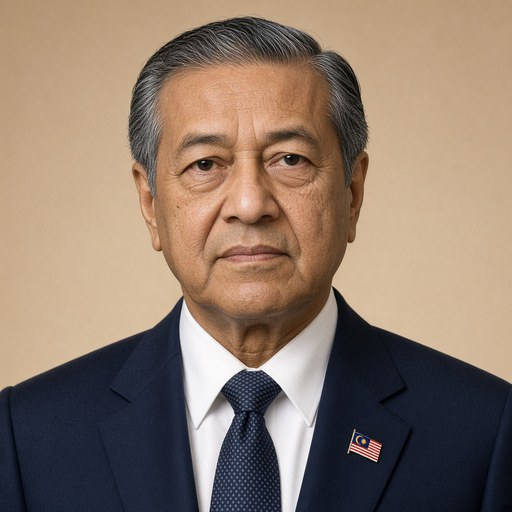
INAUGURAL CEREMONY OF THE ANNUAL GENERAL MEETING OF THE NATIONAL YOUTH COOPERATIVE LIMITED (KOBENA)
 Mahathir Mohamad · Prime Minister of Malaysia
- Context
- Mahathir addressed the inaugural AGM of the National Youth Cooperative Limited (KOBENA) in Malaysia on 20 March 1982, emphasizing youth development and cooperative reform.
- Main themes
- Youth cooperatives, national development, work ethic and discipline, cooperative movement reform, professional management, economic progress, Malaysia's human resources, lessons from Japan and South Korea, love of country, industrialization and modernization
- Duration
- ~11 min
- Words
- 1,324
- Sentences
- 67
- Readability
- 53
- Grade
- 10.8
- Syntax
- 2.59
- Vocabulary
- 2.31
Translated from Malay
The broad sphere of national life a sentence belongs to. Every sentence has an Arena, so it is the denominator the other indices are read against.
Other67 sentences in 17 paragraphs
Peace be upon you and the mercy of Allah and His blessings. The Honorable Dato Mokhtar Hashim, Minister of Culture, Youth and Sports; The Honorable Dato Abdullah Ahmad Badawi, Chairman of KOBENA; Honorable Members; Distinguished Guests; Ladies and Gentlemen.
First of all, I would like to express my gratitude to the Board of Directors of KOBENA for inviting me to this event and giving me the opportunity to say a few words at the first Annual General Meeting of KOBENA this morning.
2. The independence of our country has been achieved through the struggles and sacrifices of the nation's leaders and the people. They were willing to fight and sacrifice to give birth to a sovereign, peaceful, and prosperous nation that has been longed for. This dream and aspiration become the responsibility of those who come after, who inherit this country, to fill it and give it meaning.
3. With all the resources that exist in our country and other factors that can help us develop, there is no reason why we, as modern Malaysians, cannot become a progressive and great nation in all fields. I am confident this will be achieved if each of us translates the concept of love for the country into actions of hard work, discipline, and dedication. We must not only be willing to die for our love of the country but must also work to fill the independence of our nation because we love our country.
4. We can learn from the experiences of other nations and countries. History has shown us how a nation can develop and advance into a great civilization and how, due to certain factors, that great civilization has become paralyzed and destroyed, replaced by another civilization. In our time, we have seen how Western industrialized countries have risen to the peak of progress, but recently we have observed how their attitudes and characteristics reflect symptoms that will weaken them. Conversely, we can also see how the Republic of Korea and Japan, for example, have been able to compete with advanced Western countries, not only matching them but also showing signs that they will surpass the achievements of Western countries because they can maintain their accomplishments. As I have previously emphasized, the experiences of the Republic of Korea and Japan, particularly in aspects of work ethics, should serve as a guide for us in our efforts to develop the country.
Ladies and Gentlemen.
5. The youth are an important group of human resources for the development of the country. This importance is not only in terms of their large numbers but also because of their roles and potential in advancing all fields, whether social, economic, or cultural. Similarly, the cooperative movement, which is an activity with a philosophy aimed at bringing prosperity and justice to society through cooperation and self-reliance, also has a significant role and potential in advancing the people and involving them in the currents of development. Therefore, KOBENA, as a youth cooperative, not only has a significant role and potential but also has a bright future and great achievements to fulfill the aspirations and desires of national development if it is nurtured according to certain principles.
6. KOBENA is a non-elite youth cooperative in terms of its membership. The members of KOBENA are ordinary youths who, if left to their own devices, would largely be unable to participate in the currents of modern development in various fields. That is why I am proud that KOBENA has not only entered various fields of economic activity but, more importantly, has shown its willingness to accept major challenges, such as in collaboration with foreign companies to develop the National University of Technology and to explore more dynamic trading methods, namely, sogoshosha-style trading. I have witnessed KOBENA's capabilities with its success in establishing training camps to provide trained youth for the construction of the National University of Technology in a short period. KOBENA's capabilities can also be seen from its financial performance, which has shown profits since 1980, approximately four years after commencing business.
7. Our experience with the cooperative movement, in general, has been less than pleasant. A large number of cooperative organizations in our country face various problems. The core of these problems is weak management. Today, I would like to take this opportunity to emphasize three points that should guide cooperatives.
8. First of all, cooperatives that wish to succeed must be willing to compete in the modern business world. This does not necessarily mean that the characteristics of cooperatives will be lost; rather, it will place cooperatives on a new platform to ensure competitive competition in this modern world, isolated in such a way as not to affect the operations and performance of the cooperatives.
9. Here, I want to emphasize the need for cooperatives to place their operations in the hands of professional management so that cooperatives can be directed towards the characteristics of modern business and management. A cooperative that wishes to succeed must prioritize professionalism in management. For me, there is no compromise in this matter.
10. Thirdly, cooperative bodies, just like public enterprises, must be able to separate fundamental issues from management issues so that the efforts undertaken do not become adrift and ultimately fail due to personal and political group influences. Cooperatives must be managed to ensure high performance in terms of profits and finances as well as management efficiency, and these matters can be achieved without being undermined or hidden behind so-called social objectives that are often considered factors that undermine performance. The assumption that the financial performance of an organization, whether a cooperative or a public enterprise, is influenced by social objectives is a myth unless these bodies can prove that they have been managed effectively and efficiently; otherwise, what must be accepted is that it is a result of inefficient and weak management or misappropriation. I hope this understanding will guide us so that we no longer make excuses for our weaknesses.
11. From the analysis of the fundamentals of success, we certainly understand that it is the personal factors of individuals that determine success or inefficiency and prioritize self-interest; no system can bring success. That is why emphasis is now placed on the formation of good character among Malaysian youth. They must be disciplined, willing to work hard, and ready to face challenges. They must prioritize the success of Malaysian society over personal success. They must be willing to sacrifice today for the good of tomorrow. They should not prioritize immediate profits or quick gains at the expense of long-term benefits and honor. They must uphold their dignity and the dignity of the nation and never sell their dignity easily.
12. I am proud of KOBENA, which has given due attention to the matters I have mentioned. I hope KOBENA will continue to cultivate these characteristics as its new tradition. This tradition should also serve as an example not only to the cooperative movement but also to the youth movement in efforts to enhance the participation of the bumiputera in business and enterprises under the New Economic Policy.
13. I hope KOBENA will always enhance its capabilities to undertake larger efforts. KOBENA should expand its training schemes to provide trained manpower for its other activities, which I understand are spread throughout the country. I assure KOBENA that I will consider its proposals to enter larger fields while also providing integrated training plans. KOBENA can also participate in "turn-key" projects that are currently prioritized by the Government. The training methods employed by KOBENA should also be emulated by other parties so that the country will have the supply of trained manpower needed with the appropriate work ethics for our entry into a development era that is on par with advanced countries.
14. In closing, I congratulate and wish KOBENA success, and with this, I also officially open this Annual General Meeting.
Peace be upon you and the mercy of Allah and His blessings.
The original Malay. The tags above are read on the English translation's sentences.
Assalamu'alaikum warahmatullahi wabarakatuh Yang Berhormat Dato Mokhtar Hashim Menteri Kebudayaan Belia dan Sukan; Yang Berhormat Dato Abdullah Ahmad Badawi Pengerusi KOBENA; Yang Berhormat-Yang Berhormat; Dif-dif Kehormat; Tuan-tuan dan puan-puan sekelian.
Terlebih dahulu saya mengucapkan terima kasih kepada Lembaga Pengarah KOBENA kerana telah menjemput saya ke Majlis ini dan memberi peluang kepada saya untuk memberi sepatah dua kata sempena Mesyuarat Agung KOBENA yang pertama pada pagi ini.
2. Kemerdekaan negara kita telah dicapai dengan perjuangan serta pengorbanan tokoh-tokoh negara dan rakyat sekelian.Mereka sanggup berjuang dan berkorban demi untuk melahirkan satu negara yang berdaulat, aman dan sejahtera yang diidam-idamkan. Impian dan idaman ini menjadi tanggungjawab mereka yang datang kemudian yang mewarisi negara ini untuk mengisikannya dan memberi makna kepadanya.
3. Dengan segala sumber-sumber yang wujud di negara kita dan lain-lain faktor yang dapat membantu kita untuk membangun, tidak ada sebab mengapa kita sebagai bangsa Malaysia moden tidak dapat menjadi satu bangsa yang maju dan agung di dalam semua lapangan. Saya yakin ini akan tercapai jika setiap orang daripada kita menterjemahkan konsep cintakan negara sebagai tindakan untuk bekerja dengan kuat, dengan disiplin dan dengan dedikasi. Kita bukan sahaja mesti sanggup mati kerana cintakan negara tetapi harus bekerja bagi mengisikan kemerdekaan negara kita kerana kita cintakan negara.
4. Kita dapat belajar daripada pengalaman bangsa-bangsa dan negara-negara lain. Sejarah telah menunjukkan kepada kita bagaimana sesuatu bangsa itu berkembang dan maju menjadi satu tamadun yang besar dan bagaimana pula kerana faktor-faktor tertentu tamadun yang besar itu telah menjadi lumpuh dan hancur dan tempatnya digantikan oleh tamadun lain. Di zaman kita ini, kita telah melihat bagaimana negara-negara perindustrian barat telah meningkat ke puncak kemajuan tetapi semenjak akhir-akhir ini kita telah nampak bagaimana sikap dan sifat mereka telah mencerminkan gejala-gejala yang akan melemahkan mereka. Sebaliknya kita juga dapat melihat bagaimana Republik Korea dan Jepun misalnya dapat berlumba dengan negara-negara barat yang maju sehingga bukan sahaja dapat menandingi mereka malahan menunjukkan ciri-ciri bahawa mereka akan melintasi pencapaian negara-negara barat kerana mereka dapat mengekalkan pencapaian mereka. Sebagaimana saya pernah tegaskan, pengalaman Republik Korea serta Jepun khususnya aspek-aspek etika bekerja harus menjadi pedoman kepada kita dalam usaha-usaha kita untuk membangunkan negara.
Tuan-tuan dan puan-puan sekelian.
5. Kaum Belia merupakan satu kumpulan tenaga manusia yang penting bagi pembangunan negara. Kepentingan ini bukan sahaja dari segi jumlahnya yang besar tetapi juga kerana peranan serta potensinya dalam memajukan semua bidang dan lapangan sama ada sosial, ekonomi mahupun budaya. Begitu pula gerakan koperasi yang merupakan satu aktiviti dengan falsafah untuk membawa kemakmuran dan keadilan kepada masyarakat secara kerjasama dan dengan berdikari. Gerakan koperasi juga mempunyai peranan serta potensinya yang amat besar bagi memajukan rakyat serta melibatkan mereka di dalam arus pembangunan. Oleh itu KOBENA sebagai sebuah koperasi belia, bukan sahaja mempunyai peranan dan potensi yang besar, tetapi juga mempunyai masa depan yang cerah dan pencapaian yang besar bagi memenuhi cita-cita dan hasrat pembangunan negara sekiranya ianya dipupuk mengikut lunas-lunas tertentu.
6. KOBENA adalah satu koperasi belia yang bukan-elite dari segi keanggotaannya. Ahli-ahli KOBENA adalah belia-belia biasa yang jika dibiarkan secara bersendirian sebahagian besarnya tidak dapat menyertai arus pembangunan moden dalam berbagai-bagai lapangan. Itulah sebabnya saya berbangga kerana KOBENA bukan sahaja telah memasuki berbagai bidang kegiatan ekonomi malahan yang lebih penting ialah kesanggupannya untuk menerima cabaran-cabaran besar seperti dalam usaha-sama dengan syarikat asing untuk membangunkan Universiti Teknologi Kebangsaan dan untuk menerokai cara perdagangan yang lebih dinamis iaitu perdagangan ala-sogoshosha. Kemampuan KOBENA telah dapat saya saksikan dengan kejayaannya menubuhkan kem latihan bagi membekalkan tenaga belia yang terlatih bagi pembinaan UTK dalam jangka waktu yang singkat. Kemampuan KOBENA juga dapat kita saksikan dari prestasi kewangannya yang telah menunjukkan keuntungan semenjak tahun 1980 iaitu kira-kira empat tahun selepas menjalankan perniagaan.
7. Pengalaman kita berhubung dengan gerakan koperasi pada umumnya kurang menyenangkan. Sebahagian besar daripada pertubuhan koperasi di negara kita mengalami berbagai masalah. Teras masalah ini ialah pengurusan yang lemah.Pada hari ini suka saya mengambil peluang untuk menekankan tiga perkara yang harus menjadi panduan kepada koperasi.
8. Pertama sekali, koperasi yang ingin berjaya mestilah sanggup untuk bertanding di dalam dunia perniagaan moden.Ini tidak semestinya akan menghilangkan ciri-ciri koperasi tetapi sebaliknya akan meletakkan koperasi di atas landasan yang baru bagi menjamin persaingan secara competitive dalam dunia serba moden ini.diasingkan sebegitu rupa supaya tidak menjejas perjalanan dan prestasi koperasi.
9. Di sini yang ingin saya tekankan ialah keperluan koperasi meletakkan perjalanan koperasi kepada pihak pengurusan yang profesional supaya koperasi dapat diteraskan kepada ciri-ciri perniagaan dan pengurusan moden. Koperasi yang ingin berjaya tidak dapat tidak mesti memberi keutamaan kepada profesionalisma di dalam pengurusan. Bagi saya tidak ada kompromi dalam hal ini.
10. Ketiga, badan-badan koperasi, sebagaimana juga dengan perusahaan-perusahaan awam atau "public enterprises" mestilah dapat memisahkan persoalan dasar dengan persoalan pengurusan supaya usaha-usaha yang dijalankan tidak akan menjadi terumbang-ambing dan seterusnya gagal kerana dipengaruhi oleh gejala-gejala peribadi dan politik kumpulan. Koperasi mesti diuruskan untuk menjamin prestasi yang tinggi dari segi keuntungan dan kewangan serta kecekapan pengurusan, dan perkara-perkara ini boleh dicapai tanpa dijejaskan atau dengan berselindung di sebalik aspek-aspek objektif-objektif sosial yang kononnya selalu dianggap sebagai faktor yang menjejaskan prestasi. Anggapan bahawa prestasi kewangan sesuatu badan, sama ada satu koperasi atau perusahaan awam dipengaruhi oleh objektif-objektif sosial adalah satu perkara dongeng kecuali badan-badan ini dapat membuktikan yang ianya telah diuruskan dengan berkesan dan efisien, kalau tidak, apa yang harus diterima ialah ia adalah akibat pengurusan yang tidak cekap dan lemah ataupun penyelewengan. Saya harap pengertian ini akan menjadi panduan kita supaya kita tidak lagi berdalih-dalih di atas kelemahan-kelemahan kita.
11. Dari analisa asas kejayaan ini, kita tentu faham bahawa faktor peribadi manusialah yang menentukan jaya atau tidak cekap dan yang mengutamakan kepentingan diri, tidak ada sistem yang boleh membawa kejayaan. Sebab itulah penekanan sekarang diberi kepada pembentukan peribadi yang baik di kalangan belia Malaysia. Mereka hendaklah berdisiplin, sanggup bekerja kuat dan sanggup menghadapi cabaran. Mereka hendaklah mengutamakan kejayaan masyarakat Malaysia lebih dari kejayaan bagi diri sendiri. Mereka hendaklah sanggup berkorban hari ini kerana kebaikan pada hari esok. Mereka tidak harus utamakan keuntungan semasa atau secepat mungkin dengan membelakangkan nikmat dan kehormatan jangka panjang. Mereka hendaklah menjaga maruah diri dan maruah bangsa dan jangan sekali-kali menjual maruah dengan mudah.
12. Saya berbangga dengan KOBENA yang telah memberi perhatian yang sewajarnya kepada perkara-perkara yang telah saya sebutkan itu. Saya harap KOBENA akan terus memupuk ciri-ciri ini sebagai tradisinya yang baru. Tradisi ini harus pula menjadi contoh bukan sahaja kepada gerakan koperasi tetapi juga kepada gerakan belia dalam usaha-usaha untuk meningkatkan penyertaan bumiputera di dalam bidang perniagaan dan perusahaan di bawah Dasar Ekonomi Baru.
13. Saya harap KOBENA akan sentiasa meningkatkan kemampuannya bagi menjalankan usaha-usaha yang lebih besar.KOBENA harus memperluaskan sekim latihannya bagi membekal tenaga terlatih untuk aktiviti-aktivitinya yang lain yang saya faham tersebar di seluruh negara. Saya memberi jaminan kepada KOBENA untuk mempertimbangan cadangan-cadangannya untuk memasuki bidang-bidang yang lebih besar dengan juga menyediakan rancangan latihan secara integrated. KOBENA juga boleh mengambil bahagian di dalam projek-projek "turn-key" yang sekarang ini diberi keutamaan oleh Kerajaan.Cara latihan yang dijalankan oleh KOBENA juga harus dicontohi oleh pihak-pihak yang lain supaya negara akan mendapat bekalan tenaga terlatih yang diperlukan dengan etika kerja yang sesuai bagi kemasukan kita ke dalam era pembangunan yang setanding dengan negara-negara maju.
14. Akhir kata, saya mengucapkan tahniah dan selamat maju jaya kepada KOBENA dan dengan ini juga merasmikan Mesyuarat Agung ini.
Wassalamu'alaikum warahmatullahi wabarakatuh.