




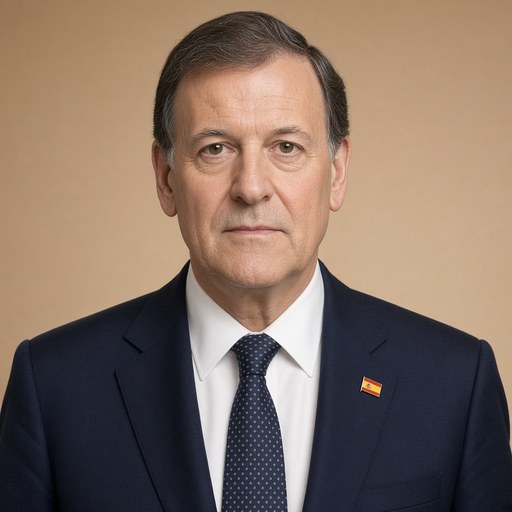
Speech by the President of the Government at the Plenary Session of the Lower House of Parliament to report on the conclusions from the European Council meeting in Brussels
 Mariano Rajoy · Prime Minister of Spain
- Context
- Rajoy addressed the Spanish Lower House on 7 February 2012 to report on the January European Council meeting and Spain's deteriorating economic situation.
- Main themes
- European Council conclusions, Spanish economic recession, unemployment crisis, fiscal consolidation, public deficit, GDP decline, foreign trade and exports, internal demand weakness, austerity measures, youth unemployment, credit availability, economic reform
- Duration
- ~48 min
- Words
- 5,734
- Sentences
- 220
- Readability
- 38
- Grade
- 14.0
- Syntax
- 3.14
- Vocabulary
- 2.23
The broad sphere of national life a sentence belongs to. Every sentence has an Arena, so it is the denominator the other indices are read against.
Other220 sentences in 97 paragraphs
Members of Parliament,
I have asked to appear before this House to report on the resolutions adopted at the European Council meeting that took place on 30 January.
To explain the consequences for Spain implied by said resolutions requires certain preliminary considerations on our economic situation and the measures adopted by this Government. You can appreciate that the two matters are so closely interrelated that we cannot deal with one without referring to the other, in the same way as it is not possible to understand the kind of measures adopted without understanding the economic situation that conditions them.
I regret to inform you that my presentation will not be brief. Given the circumstances and the volume of information that I wish to report on, my only solution is to speak for longer than I would like. However I will be concise, perhaps even too much so for the sake of clarity. In any case, I am at your disposal to explain, elaborate on or discuss anything that you might deem pertinent.
Members of Parliament,
It is difficult to imagine a worse position for this legislature to start from: an economy in recession, the highest ever unemployment rate, non-compliance with the public deficit targets, a drop in available credit, high levels of indebtedness and a worsening international situation.
The difficult situation that the Spanish economy is going through is, to a great extent, the result of excesses and imbalances accumulated over the last few years. The recent activity figures for the Spanish economy show this clearly: during the last three months of last year, the Gross Domestic Product fell by 0.3% on the third quarter and, in year-on-year terms, it is estimated that the Spanish economy grew by barely 0.7%. The breakdown of these figures will be announced in a few days time, but we can already anticipate this since the only sector buoying up this fall is foreign trade thanks to the increase in exports.
The latest forecasts from the International Monetary Fund point to our economy suffering a recession in 2012, with GDP falling by 1.7%, while this fall will be 0.3% in 2013. In turn, the Bank of Spain's forecasts anticipate GDP falling by 1.5% in 2012 and growth of 0.2% in 2013.
Internal demand remains very weak, as can be seen by the 5.8% decline in retail sales in the last year.
For their part, while companies are cleaning up their balance sheets and reducing their indebtedness - which is a positive thing - it is true that entrepreneurs cannot find clear investment opportunities. This naturally affects economic growth and job creation.
In terms of national demand, forecasts for 2012 show a decline, both of public and private demand. As regards private internal demand, it is expected that family spending will shrink, both due to the fall in employment and to the impact of fiscal consolidation on family income. In addition, family savings continue to fall as a result of the fall in income.
Against this negative macro-economic backdrop, only the foreign trade sector is contributing to growth. During the first 11 months of 2011, the current account and capital deficit fell by 23.2% in year-on-year terms. The reduced deficit of the trade balance is behind this improvement, thanks to the dynamic nature of exports and an improvement in the surplus of the balance of services. But let's not kid ourselves; the weakness of our internal demand has contributed towards this improvement in the foreign sector, resulting in our imports increasing less than our exports.
However, there is one factor that is contributing to making our products and services more competitive overseas. And that is inflation. The latest figure announced for the month of January showed that inflation had slowed down by 2% year-on-year, while the figure for the Eurozone stood at 2.7%. However, these lower inflationary pressures should be evaluated with certain caution, since they are also partly due to the delicate situation the economy is going through.
As regards employment, you are aware, Honourable Members, that the situation couldn't be worse. Last year more than 600,000 net jobs were lost and we find ourselves in a critical situation, with an unemployment rate of 22.9%. The last time we saw such a high rate was in March 1996. In December 2011, the Active Population Survey found there to be 5,273,600 unemployed, which means that unemployment rose by 577,000 people in 2011. There are 1,575,000 households with every member out of work, 247,000 more than the year before. Just in the month of January 2012, recorded unemployment increased by 177,470 people and the average number of Social Security contributors fell by 283,000 people.
Unfortunately, these figures are not going to improve in the short term. What's more, they will in fact worsen in 2012. That forces us to pay special attention to facilitating economic growth and job creation.
Unemployment is not bound by age, but it very particularly affects our young people. This can be seen in the unemployment rate of 48.6% among those under the age of 25. Put another way, one in every two young people is seeking employment, can't find it and hence we are witnessing the alarming phenomenon whereby a significant number of qualified young people are emigrating in search of a better life beyond our borders.
As regards our public accounts, in the absence of the final figures, the public deficit for 2011 will not go below 8% of the Gross Domestic Product. This figure is not only significantly higher than the target of 6% committed to in the Stability Programme of the Kingdom of Spain as part of the correction of the excessive deficit of our country, but worse still, it represents a lower deficit reduction than that attained in the previous year.
In terms of the financial sector, we are faced with a situation of across-the-board credit restrictions which is even more acute for those who most need it: households and smaller companies. As shown by the figures released by the Bank of Spain (the latest available), the financing of companies and homes fell in the first 11 months of the year by 41 and 20.4 billion euros respectively. And yet, while financing to the private sector fell, financing to the public authorities increased by 74 billion euros.
Late payments are also at a critical point, with delinquency rates rising to 7.5%. Behind this global figure there are significant divergences: households present delinquency rates of 3.4% while in the case of companies this is in double figures, specifically 10.4%. And within the segment of companies there is also disparate performance: loans for real estate services show a delinquency rate of 19% and the construction sector 16%; while loans for other production activities show average rates of around 5%.
It is true that we are starting off from very high levels of global indebtedness, as our net foreign debt already exceeds one trillion euros, but the solution cannot be to refuse credit for viable projects or to solvent families. It is essential that financial entities clean up their balance sheets in order to suitably channel credit to those who need it.
These entities have reached an unsustainable situation due to the credit supplied to the real estate sector. In June 2011, problematic assets in this sector in the hands of credit entities amounted to 176 billion euros, while the banks and savings banks had reserves that covered 33%, or 58 billion euros.
And hence, Members of Parliament, that is where we start from; a point from which no Government would want to start from, but the responsibility of the Government is precisely to tackle the reality and work to change it, not to wish that the reality were otherwise.
As I said in my investiture speech, "I do not intend, through this reminder, to diminish the weight of responsibility that we must assume in any way whatsoever. In politics, there is no indifferent inheritance. We knew what to expect and we knew and we know that we will be judged by what we achieve and not for what we try to achieve or for how we found things when we came to power".
And so, Members of Parliament, given the circumstances, we cannot consider any other objective for this Government than reversing the trend towards economic and social decline that we inherited; returning confidence and credit to the Spanish economy, and doing away with the increasing uncertainty and negative results that have been strangling our society for more than three years now. In short, our objective is to facilitate economic growth and job creation.
We need to reverse current expectations, normalise the financing of our companies and households, and substantially improve competition after years of accumulated imbalances. At the same time, we must stop being a country of uncertainty within the Eurozone and return to being a fully integrated member of the system.
We must be aware of what has happened here. When we joined the Euro, all the new members implicitly undertook to guarantee the operation of the Monetary Union. Countries which, like Spain, had suffered a devaluation every five years on average undertook to make their economies more flexible and to make their prices evolve in a similar way to their more competitive partners.
We also explicitly undertook to guarantee the stability of the public finances under the Stability and Growth Agreement, in such a way that a lack of control of the deficit and public debt would not worsen the value of the currency and negatively impact monetary policy. And it is important to highlight at this juncture that this commitment was self-imposed; the European Union didn't oblige us to do anything, we imposed this on ourselves when we decided to join a club with its own specific rules, and we would do well to remember that the alternative to non-compliance is none other than leaving the club.
It is clear today that Spain is very far from complying with the commitment it accepted at that time. That is why it is suffering from market pressure. The economic plan of this Government intends to recover all this lost time, to carry out as swiftly as possible the structural reforms that will allow us to gain flexibility and competitiveness; maintain the public finances on a sustainable path and ensure growth and job creation.
There is a lot to correct and that is why this Government has opted to act immediately in the most important areas, although the reform process will continue right though this legislature.
The first thing is to ensure the sustainability of the public finances. That will allow us to increase confidence in our economy and reduce the hoarding of credit on the part of public authorities. Better organised public accounts with credible time-lines are essential for reducing the risk premium and for making access to financing easier.
The second thing is to guarantee the visibility and credibility of our financial system. It is necessary to suitably value assets, particularly real estate assets. This would dispel any doubts regarding the soundness of our entities, provide incentives for the sale of real estate assets and help return availability of credit to normal.
Thirdly, it is necessary to act on matters such as competition and flexibility. The labour reform will be the first action in this area, but we should also ensure energy supply at competitive prices, support entrepreneurs with fiscal measures and the removal of obstacles, take better advantage of a domestic market of 47 million inhabitants, improve training and innovation, etc.
These reforms are our best business card to the European Union, the best argument so that support is provided to those who are most committed to their own growth and that of the EU, and the best way to guarantee the stability of our currency and the liquidity of the system. The greater our commitment, the easier for the European institutions to provide liquidity to the system and stability to the markets.
Members of Parliament,
The most urgent matter, as I said, is to guarantee the sustainability of the Spanish Treasury, which is essential to reduce the cost of private financing and re-establishing the flow of credit to families and companies. The Government found itself faced with a deficit forecast for year-end 2011 greater than 8% for public authorities overall. In barely five days a decision was taken to correct part of this figure through a Royal Decree Law on emergency measures in budgetary, fiscal and financial matters. There was no other option. It was necessary to deal with the root cause of the problem of credibility that accepting this figure without further ado would have meant.
The result of the public debt auctions in January show that the Royal Decree Law marked the right way. A Government that acts without hesitation is more reliable. The demand for Treasury bonds and similar instruments has increase significantly and has more than doubled the offer. Investors are not only demanding more Spanish debt, but they are doing so while accepting a much lower return than during the latter months of last year.
This is a package of balanced measures for an amount of a little more than 15 billion euros, of which two thirds corresponds to permanent adjustments to expenditure and one third to temporary tax increases.
The road to adjustment in public expenditure has been started down by the approval of the non-availability of credit for the sum of 89.15 billion euros and which will be detailed in the General State Budget for 2012, to be presented by the Government at the end of March.
For its part, as regards revenue, and in line with the principle of equity, capacity to pay and social justice, Personal Income Tax and Property Tax have been modified, given that these taxes are those that can be best distributed in a just manner with criteria of progressivity.
This has not been an easy decision. No government likes to start its legislature in this way, but this decision has been prompted by circumstances. Remember, Members of Parliament, that if the forecasts that were made had been correct, it would not have been necessary to take these measures so urgently. As I already said, the adjustment package applied so far amounts to some 15 billion euros, while the difference between the forecasts and what is the reality significantly exceeds 22 billion euros.
In the case of Personal Income Tax, we are asking for a progressive effort according to income, which is higher for income from capital than for income from work for the next two years. On the other hand, with the modification of the Property Tax, the owners of property with a high value will pay more since they are the ones who have greater economic capacity.
Within the intense calendar of structural reforms planned, three fundamental reforms will play a key role in the first three months of 2012: the approval of the Constitutional Law on Budgetary Stability, the reform of the financial system and the labour reform.
The Draft Law on Budgetary Stability, which I will refer to later on when I talk about the fiscal pact, has already been discussed in the Fiscal and Financial Policy Council, and will be reported on by the Council of State. After these processes, it will be submitted to Parliament as a Draft Constitutional Law.
As regards the financial reform, a Royal decree Law was approved last Friday which will be ratified in this House, should the Honourable Members consider it opportune and appropriate, in the near future.
The credit entities have real estate assets to the tune of 323 billion euros on their balance sheets, of which 175 billion are considered problematic assets. Given that there are doubts as to the valuation of these real estate assets, it is understood that these entities have trouble attaining wholesale financing and that, as we said earlier, there is little funding for the private sector of the economy.
In order to start to remedy these problems, we have developed a major reform with stiff, credible, reasonable and transparent measures. The strategy followed to date, based on generally unfeasible integration and a very slow reorganization process, have clearly been insufficient.
The main pillars of the reform are: firstly, cleaning up the balance sheets by means of greater demands for provisions and capital of around 50 billion euros to be applied before the end of the year, unless they undertake concentration processes; secondly, severe limits are introduced on the remuneration of directors and executives of those entities that have received public aid.
Thirdly, I will speak about the reform of the job market. Members of Parliament, it doesn't seem reasonable that, while in Europe the unemployment rate during this crisis has risen to 10.4% from 7.6%, it has risen in Spain to 22.8% from 8.2%. While the European average has risen by 2.8%, in Spain it has risen by 14.6%.
Blaming this difference on the regulation of the job market and employment legislation would be a profound mistake, but it is no less certain that our job market needs a profound reform to make it more favourable to job creation and stability of the labour market.
Convinced as I was of this, and even before the investiture, I invited the main trade unions and business organizations to various meetings at which I showed my concern and my desire to act in this matter. Since I am a profound believer in social dialogue, I encouraged them to seek agreement on a series of matters (absenteeism, collective bargaining, stability, functional mobility within companies, types of employment contract, labour intermediation, professional training, etc.), because I believe that it is always better that legal regulation in this area has the support of the parties most directly involved.
The first thing I must do is thank the way in which both the trade union representatives and employers' associations were receptive to my request, particularly at such an important time as during the Christmas festivities. After various rounds of negotiations, the social stakeholders announced an agreement in principle on salaries, collective bargaining and internal flexibility.
Specifically, agreement was reached on the following points: salary moderation for three years, maximum salary increases of 0.5% in 2012 and 0.6% in 2013 and in 2014 if the GDP for 2013 grows by less than 1%, of 1% if there is growth of between 1 and 2% and only for the part that exceeds this 2% a safeguard clause has been agreed to, thus significantly removing its index-linked nature.
This was the exclusive scope of action of the social stakeholders: the scope in which only they, by being responsible, could reach a transcendental agreement for our country, and I sincerely thank them for doing so.
It hasn't been possible for them to make clear progress in other areas of the labour market whose regulation falls to Parliament of the Government. I am speaking about questions such as intermediation, hiring, internal flexibility, training or the structure of collective bargaining; all of which are basic aspects in the operation of our labour relations and on which it is necessary to make major improvements if we want Spain to stop being the country with the worst performance in the job market in the whole of Europe. However, trade unions and employers' associations have provided us with their partial agreements and their reasons for not being in agreement on other matters, which have enriched the preparation of the reform on which this Government is working.
Following the calendar set in the Investiture Debate, after the approval by the Council of Ministers of the Draft Constitutional Law on the reorganisation of the financial system, this coming Friday is the turn of the labour reform. It is the Government's intention that this is broad in scope and in-depth, as well as balanced and, above all, useful for attaining a climate that fosters competitiveness, new hirings and stable employment.
Members of Parliament,
These are the most immediate measures undertaken by the Government along the lines of action that we consider most essential to exit the current situation. This is the context in which the European Council was held on 30 January, the content of which I will now move on to analyse.
This first European Council of 2012 was informal. The President of the Council, Mr. Van Rompuy, wanted, and rightly so in my opinion, to focus on the need to drive economic growth and stimulate employment against a backdrop of fiscal consolidation in which all the major European economies are immersed.
Given the current circumstances, this focus couldn't have been better. The uncertainty surrounding the project of European integration, the lack of financing and the current lack of confidence require very decisive, clear and simultaneous actions in terms of fiscal consolidation, flexibility and the competitiveness of our economies. There is no other road to go down if we are to maintain the viability of the Eurozone, recover the path to growth and offer employment opportunities to our citizens. It falls to each country, but also to the European institutions, to work decisively to overcome these limitations. An open debate on these subjects at this time is hence fundamental.
Spain is working decisively along these lines and it has conveyed this to the European leaders during this Council. Our economic history shows that fiscal discipline and economic flexibility are necessary requirements for the growth of our economy. Hence, the Spanish economic agenda coincides with the European economic agenda.
Despite the unfavourable economic context, the new Government of Spain is resolved and committed to recovering economic growth through an improvement in fiscal discipline and the implementation of structural reforms. This is our task and we are employing all of our political capital to that end because these are tough reforms that are long overdue.
This has been included in the statement made by the Heads of State and Government of the Eurozone: the decisive measures applied by Spain and Italy in terms of fiscal consolidation and improvement in competitiveness have been welcomed and we have been asked to continue along these lines.
But, furthermore, my message at the Council was clear in another aspect: in order for the adjustment process in which Spain and Europe are both immersed to be successful, it is fundamental to receive funding in those countries that are complying with their agreed adjustment programmes. In this respect, the new Stability Mechanism and the actions of the European Central Bank are key, together with fiscal discipline and structural reforms to protect the single currency.
Members of Parliament,
In addition to the matters linked to growth and employment, the Heads of State and Government attested to the agreement on the new International Treaty on Stability, Coordination and Governance in the Economic and Monetary Union, known as the "fiscal pact". Furthermore, we, the leaders of the Eurozone, support the text of the Treaty establishing the European Stability Mechanism.
As I have already indicated, the main subject of the European Council was growth and employment in the context of fiscal consolidation. The debate was structured around three pillars: youth employment, the single market and SMEs. Various countries, including Spain, made proposals on these matters.
Spain is satisfied with the suggestions of our partners contained in the statement and which are along the lines of the working areas identified by the Commission in its Annual Growth Survey.
We should drive the single market more - the true engine for growth in Europe. In this area we have agreed to actions at an EU level that can greatly contribute to creating employment and fostering growth. We should particularly make progress in achieving the single energy market - of fundamental importance to Spain because of its condition as an 'energy island' - driving the liberalisation of a single market for services and the digital single market, to quote three important examples. It is also necessary to reduce administrative and regulatory burdens for SMEs and micro-companies.
On matters of employment, we must reform our job markets to repair the consequences of the economic crisis on employment, which, as we have seen before, manifests itself particularly harshly in Spain; we must make progress in terms of flexibility, mobility and capacity to adapt to economic circumstances, and reduce the duality of the job market and improve training as ways of promoting jobs for young people. The discussion at the European Council was intense in this area of particular importance for Spain and we agreed to implement some actions immediately, both at a national level and at a Community level, aimed at improving the offer of work and reducing unemployment, particularly among young people.
I had the occasion to act as a speaker together with my Irish counterpart in the debate on SMEs. The need to attend to small- and medium-sized enterprises in this crisis is fundamental. They form the basis of our business fabric and the very cornerstone of employment. We must achieve that those SMEs that cannot today gain access to credit, whilst they see costs rising and their markets shrinking, become - if we get our policies right - the main players in our economic recovery. The current debt crisis, in a context of strong deleveraging and a widespread lack of confidence, is particularly affecting small businesses, since the little liquidity that exists is being swallowed up by the public sector.
Each euro that is employed to finance the public deficit is a euro that is not being invested in job creation. Each base interest point that increases the performance of public debt represents an additional cost in the calculations of someone that launches a business initiative. Without reforms and without sufficient liquidity there will be no investment and no job creation.
That was the message I gave at the Council: the adoption of specific measures such as those included in the Final Statement are a necessary complement, but cannot constitute the nucleus of our actions in terms of economic policy. Our commitment today must be comprised of clear and effective policies in fiscal consolidation and the flexibility of the markets that provide financing and reduce costs. This must be done both at a national and at a European level.
As I have said on various occasions and as can be seen from the first part of my speech, Spain is committed to this and that it what I conveyed to my colleagues.
As you are aware, three ideas have been proposed at a European level: Firstly, setting up common rules to create a capitalisation fund for workers that replaces dismissal costs. This will facilitate hiring in companies, particularly SMEs, and employment mobility, and hence it will contribute towards developing the single market.
Secondly, the harmonisation of the remuneration of executives of financial entities that have received public aid, establishing quantitative limits. It is necessary to put in order those accounts that have partially caused credit to dry up. That will enable us to prevent situations such as the current one in the future and will contribute towards avoiding that the existing lack of credit significantly limits the capacity of our companies to grow and create employment.
And thirdly, we are in favour of the idea of re-using those surplus European funds to generate employment, to reduce the technology divide and facilitate the financing of small- and medium-sized enterprises. Spain expects to benefit from these funds and that they will be aimed at areas in which we consider that they can have the greatest impact. We are working on this with the European Commission and with the rest of the European institutions.
Members of Parliament,
I will now turn to the two Treaties that were under discussion and that we have left ready to be signed in this Council.
Firstly, the new International Treaty on Stability, Coordination and Governance in the Economic and Monetary Union, the so-called "fiscal pact". This Treaty will be endorsed by twenty-five Member States and contains elements that Spain considers to be essential to laying much more solid foundations in the Eurozone and which are vital for guaranteeing the healthy growth of our economy.
I am specifically referring to the fiscal rule. The Treaty establishes the need for the fiscal rules contained therein to hold constitutional status within the legal system of each one of the Member States that adopt them. We have already done this with the agreement of the Socialist Parliamentary Group. This constitutional reform agreed by the two major parties established the need to have budgetary stability except in extraordinary circumstances. Spain jumped the gun, with criteria of responsibility and a pro-European spirit, last August ahead of what we have just adopted here in the European Union.
By budgetary balance we agreed that we would adhere to that established by the European Union (Article 135.2 of the Constitution), as was the case, or in default thereof, that the Constitutional law be balanced if the structural deficit is less than 0.4% of GDP.
The "fiscal pact" Treaty obliges the so-called "Medium-Term Objective" to be attained and maintained, which European regulation defines as a 0% balance, except when a Member State applies a structural reform that represents an increase in the deficit in the short term, but a decrease in the medium term. This is exactly what has been reflected in Article 11.2 of the Draft Constitutional Law on Budgetary Stability, with a limit on the deficit, in the event of an extraordinary measure, of 0.4% of GDP, thus scrupulously complying with the constitutional agreement with the Socialist Party.
Furthermore, the Treaty includes a disciplinary mechanism for those Member States that do not comply with this new fiscal rule. Spain has also jumped the gun in this matter through its Draft Constitutional Law on Budgetary Stability, approved on Friday, 27 January by the Council of Ministers, which includes a disciplinary mechanism that is identical to that contained in the new Treaty.
Members of Parliament,
We also spent time, as I mentioned, albeit more briefly, looking at the Treaty establishing the European Stability Mechanism. This Treaty will be signed by the Eurozone countries and is a necessary complement in the design of the Eurozone since it allows liquidity to be guaranteed for those countries that comply with their fiscal obligations.
But the Council also dealt with aspects related to fostering employment, particularly for our young people, and the necessary boost for financing the economy, in particular of small- and medium-sized enterprises.
For us, for Spain, speaking about financing for SMEs and growth in employment is the same thing. The recovery of the economy and employment will go hand-in-hand with an improvement in the situation of small- and medium-sized companies.
This requires four types of measures: firstly fiscal consolidation, which we have already spoken about: secondly, the raft of structural measures that endow the economy with flexibility and increase competitiveness; thirdly, all the measures that boost the general liquidity of the system, and fourthly, a raft of specific measures such as, for example, the assignment of unassigned surplus funds from previous years to specific projects.
All these measures should be implemented at the same time because isolated decisions in this respect hold no purpose. A global policy is necessary that includes all these aspects. To put it another way, fiscal consolidation does not help in achieving job creation and re-launching the economy. Whilst it is a necessary condition, it is not sufficient. The adjustments are essential but we cannot solely and exclusively implement these adjustments.
So, Members of Parliament, these are the most outstanding aspects of the Summit on 30 January. This is the policy that we are starting to implement jointly. We are all obliged to implement this but in the words of Orwell, some are more obliged than others and I don't feel it is necessary to remind you of the current differences in countries such as Spain or Italy compared with Germany, Austria, Finland or Holland.
Spain must demand a greater effort of itself, but I am sure that, as on other occasions, we will rise to the occasion of the challenge facing us.
I am aware, Members of Parliament, that the texts containing the conclusions and guidelines approved at this type of Council are sometimes received with a certain disdain due to the use of language which some consider to be excessively "diplomatic", but I cannot stop pointing out that the Council expressed "its congratulations on the measures that Spain and Italy have decided to take and have applied to reduce the public deficit and foster employment and competitiveness, and I would ask that you continue with the major effort you are making at budgetary organisation and structural reforms. These reforms, as well as their rapid implementation, strengthen the financial stability of Italy and Spain, and the Eurozone as a whole". Members of Parliament, this recognition should serve as an incentive.
I will finish now; I have set out the most important aspects of the Spanish situation, the measures that my Government has implemented or plans to apply in the near future and the main features of the recent Summit in Brussels.
As I have already indicated, the priority objectives of this Government are growth and job creation. This is a mandate from the Spanish people, a requirement for justice and an imperative based on reason. All other governmental initiatives will be secondary to this; something I believe that all those here agree upon. All the reforms, improvements and initiatives that I have outlined are mere instruments for achieving these objectives.
As the Honourable Members will have seen, we are in perfect harmony with the European Union, both regarding objectives and procedures. Europe does not demand from us anything that we shouldn't have already done ourselves.
I believe that my speech only lacks one vital instrument: time. We have to take account of time, not as you have seen at the time of acting but rather, inevitably, when harvesting the results. It is my conviction that the fruits will arrive if we eliminate improvisations, avoid floundering and are tenacious in the application of the measures, without losing heart until we achieve our goals.
That is what this Government has proposed; a Government that wishes, above all, to be predictable. I hope, to that end, to be able to count on the collaboration of the Honourable Members. Nothing else, and thank you very much, Mr. Speaker.