




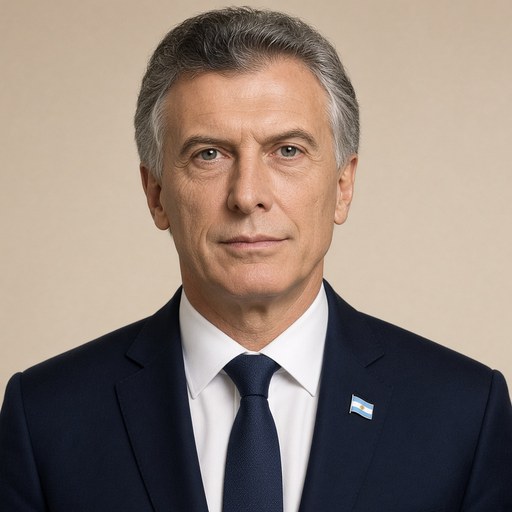
President Mauricio Macri announced more than 10,000 scholarships for digital training.
 Mauricio Macri · President of Argentina
- Context
- Macri announced a government-business partnership launching 10,000 digital training scholarships at an event in Argentina on June 18, 2019.
- Main themes
- Digital training scholarships, public-private partnership, digital revolution, employment opportunities, digital infrastructure, knowledge economy, workforce reskilling, internet connectivity, rural education, programming and tech skills, future of work
- Duration
- ~7 min
- Words
- 880
- Sentences
- 45
- Readability
- 59
- Grade
- 9.9
- Syntax
- 2.97
- Vocabulary
- 1.90
Translated from Spanish
The broad sphere of national life a sentence belongs to. Every sentence has an Arena, so it is the denominator the other indices are read against.
Other45 sentences in 9 paragraphs
Good afternoon and welcome. Thank you, Andrés, for inviting me. The truth is that it is a pride to start the week like this, and I believe that all of us here must feel the same way because we are once again providing a clear demonstration that when government and businesses work together, opportunities for Argentines multiply. And the result of this collaborative work is the 10,000 scholarships we are launching today. Ten thousand scholarships for thousands of Argentines to train in digital tools and secure employment in an industry that has a lot, a lot to offer them.
There is no doubt that we are immersed in an unprecedented digital revolution in the history of humanity, a revolution that presents us with challenges and opportunities that we cannot let pass. And that is why, from day one, we have promoted a digital agenda with dozens of projects that are already showing concrete benefits for Argentines. And I want to share some of them with you. Today, there are towns with fewer than 500 inhabitants that never imagined their schools and medical centers would one day have the capacity to be connected to the world, and today it is a reality. Today, millions of Argentines who used to travel hundreds of kilometers to carry out a procedure can do it online. Today, those who export products or services have saved 75 percent of their time with the Single Window for Foreign Trade, where all procedures are done online. Three out of every four hours. That is a lot of time to keep creating. And today, there are 1,600 rural schools connected with satellite internet. There are more than 5 million students connected across the country. Today, children learn robotics, programming, and artificial intelligence at all levels of compulsory education. And just a few days ago, we were with María Eugenia in Tres de Febrero, where children from the age of four will have access to these tools. And today, there are 500 digital points. What are digital points? Places where our grandparents and young people can acquire digital tools for free.
And all these things are possible because we improved the infrastructure. By the end of the year, internet speed will be four times greater than when we started. We started with 5 megabits per second, and we will reach 20.
And 4G now reaches practically the entire urban population. In 2015, only 16 percent of the country's localities had 4G. Today, we exceed 70, and by the end of the year, it will be 93 of the population.
And this is just part of the digital agenda we are working on. The other part, which I want to talk to you about today, is about generating employment, about bringing thousands of Argentines who do not have jobs the opportunity to train for highly demanded jobs. Today, you tell me that in many of your companies there are empty chairs because there is a significant shortage of people trained in digital tools. When I talk about digital training, I mean programmers, PC repairers, digital marketing analysts, software development, and other things that you know better than I do. And a not insignificant detail is that salaries for these profiles are higher than the average in the labor market. That is why we are going to provide this scholarship to 10,000 Argentines so they can train in these tools, and thus they will have the opportunity to fill that space that is currently empty.
Let’s think that, in three years, more than half of the workers in the world will need to retrain to keep up with technology. This is something that doctors have been doing for many years, and it is happening. And Argentines have talent, we have creativity, and a lot of determination to see this as an opportunity. And we have already started: the Knowledge Economy Law, which Congress voted on almost unanimously, is an example to expand our possibilities in the future of work. It was truly a great step forward. That is why I insist again that it is time to look to the future with our feet firmly planted in the present. What we do today directly impacts what happens tomorrow. And I am not referring to the next few months or the next year; we are talking about future generations.
That is why I want to sincerely thank you for this initiative we have started together, to all the companies that are here today, which have also committed to incorporating the first 500 from the training course into internships at their companies to continue training, because this is something that begins and never ends. It is the world we live in, one that constantly challenges us. But what we need to be clear about, once again, is that for things to happen, we must work together.
So I want to tell you that we are on this path, which is the right one, that we have much to develop, that I visit you daily in your companies, I see how you are growing, and we all know that we have many valuable people who, with these tools, will be able to make their contribution.
So thank you very much, and let’s keep working together.
The original Spanish. The tags above are read on the English translation's sentences.
Buenas tardes y bienvenidos. Gracias, Andrés, por invitarme. La verdad es que es un orgullo empezar la semana así, y creo que a todos los que estamos acá nos tiene que generar el mismo sentimiento porque estamos dando, una vez más, una muestra clara de que, cuando Gobierno y empresas trabajan en equipo, se multiplican las oportunidades para los argentinos. Y el resultado de este trabajo colaborativo son las 10 mil becas que estamos lanzando hoy. Diez mil becas para que miles de argentinos puedan capacitarse en herramientas digitales y conseguir empleo en una industria que tiene mucho, mucho para ofrecerles.
No hay duda de que estamos inmersos en una revolución digital sin precedentes en la historia de la humanidad, una revolución que nos presenta desafíos y oportunidades que no podemos dejar pasar. Y, por eso, desde el día 1 impulsamos una agenda digital con decenas de proyectos que ya están mostrando beneficios concretos para los argentinos. Y quiero compartir algunos de ellos con ustedes. Hoy, hay pueblos de menos de 500 habitantes que jamás imaginaban que sus escuelas y sus centros médicos contarían, algún día, con la capacidad de estar conectados con el mundo, y hoy es una realidad. Hoy, millones de argentinos que se trasladaban cientos de kilómetros para hacer un trámite pueden hacerlo online. Hoy, quienes exportan productos o servicios ahorraron 75 por ciento de su tiempo con la Ventanilla Única de Comercio Exterior, donde los trámites son todos por internet. Tres de cada cuatro horas. Eso es mucho tiempo para seguir creando. Y, hoy, hay 1.600 escuelas rurales conectadas con internet satelital. Son más de 5 millones de alumnos conectados en todo el país. Hoy, los chicos aprenden robótica, programación, inteligencia artificial en todos los niveles de educación obligatoria. Y, ahora, estuvimos hace pocos días con María Eugenia en Tres de Febrero, desde los cuatro años van a tener esas herramientas. Y, hoy, hay 500 puntos digitales. ¿Que son los puntos digitales? Lugares donde nuestros abuelos y jóvenes, gratis, adquieren herramientas digitales.
Y todas estas cosas son posibles porque mejoramos la infraestructura. A fin de año internet va a tener una velocidad cuatro veces mayor que cuando arrancamos. Arrancamos con 5 MWh por segundo, y vamos a llegar a 20.
Y el 4G ya alcanza prácticamente a toda la población urbana. En 2015, solo el 16 por ciento de las localidades del país tenía 4G. Hoy, superamos el 70 y, para fin de año, 93 de la población.
Y esto es solo una parte de la agenda digital que estamos trabajando. La otra, de la que quiero hablarles hoy, que para eso estamos, tiene que ver con generar empleo, con acercarles a miles de argentinos que no tienen trabajo la posibilidad de capacitarse en trabajos que son altamente demandados. Hoy, me dicen ustedes que en muchas de sus empresas hay sillas vacías porque hay un faltante importante de personas con formación en herramientas digitales. Cuando hablo de formación digital me refiero a programadores, reparadores de PC, analistas de marketing digital, desarrollo de software y otras cosas que ustedes saben mejor que yo. Y un detalle no menor es que los sueldos para esos perfiles son mayores al promedio del mercado de trabajo. Por eso es que vamos a dar esta beca a 10 mil argentinos para que puedan capacitarse en estas herramientas, y así van a tener la posibilidad de ocupar ese espacio que hoy está vacío.
Pensemos que, dentro de tres años, más de la mitad de los trabajadores en el mundo van a necesitar recapacitarse para estar a tono con la tecnología. Esto que ya hacen los médicos hace muchos años está pasando. Y los argentinos tenemos talento, tenemos creatividad y mucha determinación para ver esto como una oportunidad. Y ya empezamos: la Ley de la Economía del Conocimiento, que votó el Congreso casi por unanimidad, es un ejemplo para expandir nuestras posibilidades en el futuro del trabajo. Fue realmente un gran paso adelante. Por eso, les vuelvo a insistir que es hora de mirar al futuro con los pies puestos en el presente. Lo que hagamos hoy impacta directamente en lo que pase mañana. Y no me refiero a los próximos meses o al próximo año, estamos hablando de las futuras generaciones.
Por eso, quiero agradecerles, de verdad, esto que hemos empezado en conjunto, a todas las empresas que están hoy, que además se comprometieron a que los 500 primeros del curso de capacitación se van a incorporar en pasantías a sus empresas para seguir entrenándose, porque esto es algo que comienza y nunca termina. Es el mundo que nos toca vivir, el que nos desafía permanentemente. Pero lo que tenemos que tener claro, de vuelta, es que para que las cosas pasen tenemos que trabajar juntos.
Así que quiero decirles que vamos por este camino que es el correcto, que tenemos mucho para desarrollar, que a ustedes los visito diariamente en sus empresas, veo cómo están creciendo y también todos sabemos que tenemos mucha gente valiosa que con esas herramientas va a poder hacer su aporte.
Así que muchas gracias y a seguir trabajando juntos.