




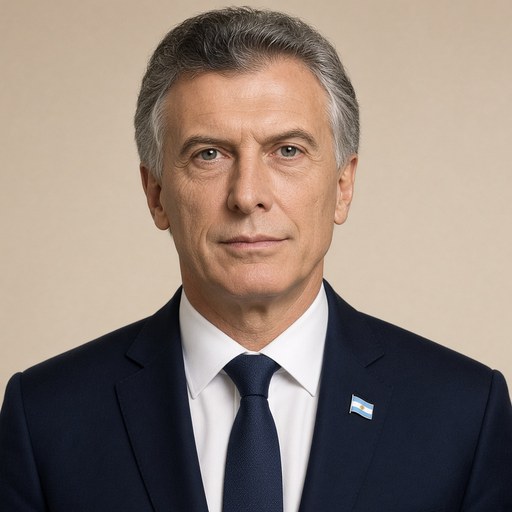
President Mauricio Macri inaugurated a new section of National Route 7 in San Andrés de Giles, Province of Buenos Aires.
 Mauricio Macri · President of Argentina
- Context
- Macri inaugurated a new bypass section of National Route 7 in San Andrés de Giles, Buenos Aires Province, on June 24, 2019, highlighting decades-awaited infrastructure progress.
- Main themes
- Road infrastructure investment, Route 7 inauguration, connectivity and logistics, agricultural economy, transparency in public works, political service to citizens, national development, digital connectivity, regional trade with Chile, road safety
- Duration
- ~8 min
- Words
- 961
- Sentences
- 43
- Readability
- 60
- Grade
- 10.5
- Syntax
- 3.07
- Vocabulary
- 1.82
Translated from Spanish
The broad sphere of national life a sentence belongs to. Every sentence has an Arena, so it is the denominator the other indices are read against.
Other43 sentences in 10 paragraphs
Good day, good day to everyone. How are you? I am also here, happy to share this day with all of you, a day so eagerly awaited by all of you, by many more than just you. There are more than 230 thousand residents of Buenos Aires who live in Giles, in Chacabuco, in Areco, in Junín, in Luján, and all those who come from afar and pass through this route. Because this route is very important. You know that it is the route that connects us with Chile, that a large part of our trade with Chile comes through here. It is a very important route for tourism. And it is also a very important route for all those who every morning go out to give their all, producing wheat, corn, soybeans, livestock.
And the truth is that you know, as María Eugenia said, how difficult it was to travel through this stretch, how complex, this crossing that they called "the crossing of death." That is why for so many years, decades, you have been demanding this work, this first variant, of many variants, that had never been done and that we are doing. Because the roads had been left in the middle of all the cities and that brings a lot of conflict, a lot of problems, a lot of risk, many worried mothers; roads that need to be crossed, people who come anxious to arrive quickly to cover all those kilometers and do not realize that it is an urban area. All these dangerous things that we have lived with and continue to live with, because we have much to do. But, once again, this route is real. This is real. I knock here and it is real, it is not a story, it is not nonsense, this is done.
And, moreover, even though the pavement may be cold, it may be rough, harsh, this is not cold, because it represents much more than this work. It represents, first, that we learned to listen to each other again. You had a proposal, a need. Second, that we understand and value again what politics is, that politics must be there to care for people, politics must be at the service of the people. Third, and no less important, that we can trust in what we are capable of doing, that when we work together as we are doing we can accomplish works like this and we are doing them, because this is not an isolated event, this is not happening only here, on Route 7, it is happening all over the country; every day we are inaugurating works throughout the country. And specifically regarding roads, we have already completed 7,600 kilometers of highways and roads. And we have 13,480 kilometers under construction. This is more than in the last 65 years. More than in the last 65 years.
And this has to do with that, with understanding that we need to believe in ourselves and give ourselves the tools we need to grow, and connectivity is a fundamental tool because we protect the lives of everyone when there is a safe highway on which to travel, but we also allow that with that connectivity work can grow, because for what you produce, and the farther you are from a port generates more work, it needs this. Good connectivity. That is why we are investing not only in roads and highways, but also in trains, in airports, in ports. And we are demanding that all those who work in the logistics chain do so respecting others, not wanting to abuse or take privileges by leaving others without work.
That is why it is also so important to understand that every work we finish reaffirms that the path we have taken is the right one, that there is a future here, that here all Argentines will have the opportunity, no matter where we were born, to progress.
Because that is also why we are investing in connectivity that, before, when we arrived, only 16 percent of the territory had 4G, and today already 80 percent of the territory has 4G. Because connectivity is also extremely important, as important today as physical connectivity.
And we are doing this in a process of transparency, of dialogue, because these works start and finish on the dates we promised you, and they are done with transparent bidding that has come thanks to Dietrich's team and all those who accompany him and from the Road Authority at a cost of 40 percent less, 40 percent less than what they cost in the previous government. And this is good because it gives us more resources from the scarce ones we have to make more kilometers, because this is a huge country and we need to connect it.
That is why I want to congratulate not only the Transport team but also all the guys who have worked on the project, whom I see there. And a round of applause for them too. They have changed the lives of many Argentines. Guys, congratulations. Vialmani, congratulations also to the construction company.
And to tell everyone that we have begun a journey. That it may take longer, that it may cost more does not mean that we are not doing it, it means that it is serious, that this time it is for real, and we are generating on solid foundations, on well-made foundations, a future for all these kids who today also accompany us along with us, the older ones.
Thank you, really, for joining us, thank you María Eugenia, let’s keep working, because on this path there is a lot of future. And yes, it is possible, of course it is possible. Thank you, thank you, thank you.
The original Spanish. The tags above are read on the English translation's sentences.
Buen día, buen día a todos. ¿Cómo andan? Yo también estoy acá, feliz de compartir este día con todos ustedes, un día tan esperado por todos ustedes, por muchos más que todos ustedes. Son más de 230 mil bonaerenses que viven en Giles, en Chacabuco, en Areco, en Junín, en Luján, y todos los que además vienen de lejos y pasan por esta ruta. Porque esta ruta es muy importante. Ustedes saben que es la ruta que nos conecta con Chile, que una gran parte de nuestro comercio con Chile viene por acá. Es una ruta muy importante para el turismo. Y también es una ruta muy importante para todos los que todas las mañanas salen a poner todo, produciendo trigo, maíz, soja, ganadería.
Y la verdad es que ustedes saben, como decía María Eugenia, lo difícil que era circular por este tramo, lo complejo, este cruce que llamaban “el cruce de la muerte”. Por eso hace tantos años, décadas, que reclamaban por esta obra, por esta primera variante, de muchas variantes, que nunca se habían hecho y que estamos haciendo. Porque las rutas se habían quedado en medio de todas las ciudades y eso trae mucho conflicto, mucho problema, mucho riesgo, muchas madres preocupadas; rutas que hay que cruzar, gente que viene ansiosa por llegar rápido a recorrer todos esos km y no se da cuenta de que es una zona urbana. Todas estas cosas peligrosas con las cuales hemos convivido y seguimos conviviendo, porque tenemos mucho por hacer. Pero, otra vez, esta ruta es real. Esto es real. Yo golpeo acá y es real, no es relato, no es sarasa, esto está hecho.
Y, además, por más que el pavimento puede ser frío, puede ser rugoso, áspero, esto no es frío, porque representa mucho más que esta obra. Representa, primero, que supimos volvernos a escuchar. Ustedes tenían un planteo, una necesidad. Segundo, que entendemos y ponemos en valor, otra vez, lo que es la política, que la política tiene que estar para cuidar a la gente, la política tiene que estar al servicio de la gente. Tercero, y no menos importante, que podemos confiar en lo que somos capaces de hacer, que cuando trabajamos juntos como lo estamos haciendo podemos hacer obras como esta y las estamos haciendo, porque esto no es un hecho aislado, esto no está pasando sólo acá, en la 7, está pasando en todo el país; todos los días estamos inaugurando obras en todo el país. Y en lo que hace específico a lo vial, ya terminamos 7.600 km entre autopistas y rutas. Y tenemos 13.480 km en construcción. Esto es más que en los últimos 65 años. Más que los últimos 65 años.
Y esto tiene que ver con eso, con entender que necesitamos creer en nosotros y darnos las herramientas que hacen falta para poder crecer, y la conectividad es una herramienta fundamental porque cuidamos las vidas de todos cuando hay una autopista segura en la cual se puede viajar, pero también permitimos que con esa conectividad crezca el trabajo, porque para que lo que ustedes producen, y cuanto más lejos estén de un puerto genere más trabajo, necesita esto. Una conectividad buena. Por eso, estamos invirtiendo no sólo en rutas y autopistas, sino también en trenes, en aeropuertos, en los puertos. Y estamos reclamando que todos los que trabajan en la cadena logística lo hagan respetando a los demás, no queriendo abusar ni sacarle privilegios a partir de que los demás se queden sin trabajo.
Por eso, también, es tan importante entender que cada obra que terminamos nos reafirma que el que hemos tomado es el camino correcto, que por acá hay futuro, que por acá todos los argentinos vamos a tener la oportunidad, hayamos nacido donde hayamos nacido, de progresar.
Porque también por eso estamos invirtiendo en la conectividad que, antes, cuando llegamos, solamente el 16 por ciento del territorio tenia 4G, y hoy ya el 80 por ciento del territorio tiene 4G. Porque también la conectividad es importantísima, tan importante hoy como la conectividad física.
Y esto lo estamos haciendo en un proceso de transparencia, de diálogo, porque estas obras empiezan y terminan en las fechas en que les hemos prometido, y se hacen con licitaciones transparentes que han llegado gracias al equipo de Dietrich y todos los que lo acompañan y de Vialidad a costar 40 por ciento menos, 40 por ciento menos de lo que costaban en el gobierno anterior. Y esto es bueno porque nos da más recursos de los escasos que tenemos para hacer más kilómetros, porque este es un país enorme y necesitamos conectarlo.
Por eso, quiero felicitar no sólo al equipo de Transporte sino también a todos los muchachos que han trabajado en la obra, que los veo ahí. Y un aplauso también para ellos. Les han cambiado la vida a muchos argentinos. Muchachos, felicitaciones. Vialmani, felicitaciones también a la constructora.
Y decirles a todos que hemos comenzado un camino. Que lleve más tiempo, que cueste no significa que no lo estamos haciendo, significa que va en serio, que esta vez es de verdad, y estamos generando sobre bases sólidas, sobre bases bien hechas, un futuro para todos estos chicos que hoy también nos acompañan junto a nosotros, los más adultos.
Gracias, de verdad, por acompañarnos, gracias María Eugenia, sigamos trabajando, que por este camino hay mucho futuro. Y sí, se puede, claro que se puede. Gracias, gracias, gracias.