




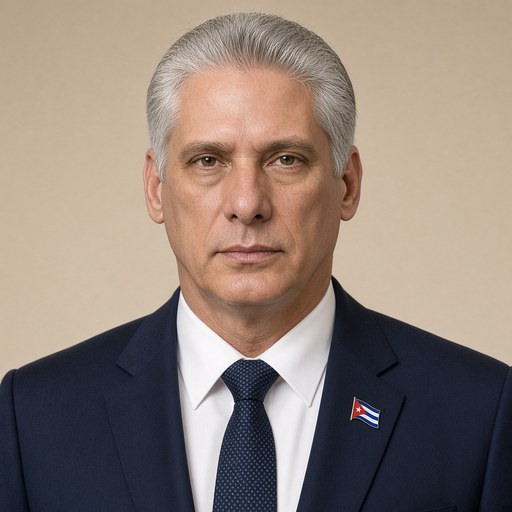
Díaz-Canel: "Here is the victorious Cuban Revolution and we are going for more."
 Miguel Díaz-Canel · President of Cuba
- Context
- Díaz-Canel addressed a televised Round Table on July 3, 2019, detailing new economic measures adopted by Cuba's Council of Ministers amid intensifying U.S. sanctions.
- Main themes
- Cuban Revolution's resilience, U.S. blockade and economic pressure, economic reform measures, wage policy, socialism and anti-imperialism, internal economic obstacles, Cuban Communist Party leadership, workers' demands, popular participation, social services defense
- Duration
- ~15 min
- Words
- 1,824
- Sentences
- 63
- Readability
- 35
- Grade
- 15.2
- Syntax
- 3.18
- Vocabulary
- 2.21
Translated from Spanish
The broad sphere of national life a sentence belongs to. Every sentence has an Arena, so it is the denominator the other indices are read against.
Other63 sentences in 42 paragraphs
To the imperialists, we have a "bad news" to share: Here is the victorious Cuban Revolution, and we are going for more.
CUBA, July 3, 2019.- The President of the Councils of State and Ministers, Miguel Díaz-Canel Bermúdez; and the heads of Economy and Planning, Alejandro Gil Fernández; Finance and Prices, Meisi Bolaños Weiss; and Labor and Social Security, Margarita González Fernández, appeared in the first of the Round Tables dedicated to providing details about the measures recently adopted by the Council of Ministers.
In the television program, attended by members of the Council of Ministers and the Secretariat of the Central Committee of the Party, Díaz-Canel deemed the announced economic decisions significant, considering the increasingly numerous difficulties imposed on our people by the measures taken by the U.S. administration.
We are starting from the current situation we are living in, marked by the wickedness and the ever-growing set of difficulties that the current policy of the U.S. Government imposes on our people every day, denounced the Cuban leader.
This creates a group of problems in the internal order, such as financial persecution, the contraction of credit due to the pressures exerted by the U.S. administration, the practically absolute closure of the markets closest to our country, the ruthless attack on the sources of income we have, and the threats of sanctions or the very sanctions already applied to anyone who dares to trade with Cuba.
But no one in Cuba has lost sleep over these threats, over this interventionist policy, and over the escalation of rhetoric from the U.S. Government against Cuba. We have reaffirmed that we have not renounced and will not renounce making our economy – small and besieged – in these 60 years of Revolution prosperous and sustainable. That is a will. That is a desire, and we will continue to defend it.
It is demonstrated, he pointed out, that the Cuban people, with conviction and determination, confront the genocidal blockade, and we also strive to identify and unlock the obstacles, which some call the internal blockade, that is, our shortcomings, the very barriers we impose, the bureaucracy we have, and all those impediments that prevent us from advancing in a more coherent manner, with the very precepts and principles we have been defending in the updating of our economic and social model.
But we have also stated that no threat will distract us from our duty to defend the invulnerability of the Revolution in all areas.
The measures we have proposed, which will be shared more broadly today by the present comrades of the Council of Ministers, have nothing to do with populism, as some who have never been interested in the well-being of the Cuban people have tried to attack them and who seek to denigrate and tarnish every step the Revolution takes.
This has a lot to do with what the Council of Ministers has experienced in this stage of exchange with our people and in the scenarios where they carry out their economic and social life, it has a lot to do with things that were postponed and that already needed a response, it has to do with the demands of the workers at the recently concluded Congress of the CTC, with the demands and contributions of economists at the Congress of the ANEC, it also has to do with ideas that were reaffirmed this weekend at the Congress of the UNEAC, and I believe it has to do with the whole sense of popular debate with which our people have expressed themselves in recent times, as demonstrated in the debate on the new Constitution of the Republic.
NO STAGNATION, NOTHING STATIC
With this, we begin to break an inertia and give another dynamic to the issue of salaries, to the relationship of work with the income of people, in a sector that deserves that attention. In that sector, the basic conquests of the Revolution are defended. That sector provides public services that are very necessary for the Cuban family and public services that families demand and also recognize. So that there is no stagnation, that there is nothing static is how we will advance in the implementation of the measures.
These measures, after analysis by experts, academics, and members of the Council of Ministers, were presented to the Political Bureau in a working session presided over by its First Secretary, Army General Raúl Castro Ruz. After obtaining the political assessment of what we proposed, they were then definitively approved by the Council of Ministers.
Immediately, I believe that two days after those assessments, while we made some adjustments based on the contributions made during the discussion in the Political Bureau, we announced it in a press release that described what was discussed in the Council of Ministers.
A note cannot cover the details, but we did not want the time between the decision and the announcement to the Cuban population of these measures to be prolonged. Then, the next day, when the visit to Pinar del Río occurred with the representation of the Council of Ministers and there was the possibility to explain the topic, we presented the fundamental content of this measure more broadly.
We decided to let the weekend pass to also gather the opinions of the population, their concerns, the main uncertainties, and come here today to the Round Table.
THINKING AND ACTING AS A COUNTRY
We are calling for thinking as a country, which carries a sense of responsibility and participation from the entire population. Family interests must be combined with social ones.
We are summoned with these measures not to return to the conditions of the special period, because we are in another historical moment, with potential to assume this stage and advance towards future development.
There is a desire from the United States to continue pressing, but our socialist process will continue. We are organizing for the future, and with these economic measures, we strengthen our economy to function correctly.
Thinking and acting as a country means that these measures must be accompanied by other elements such as strengthening accounting, he emphasized.
We must achieve with these measures, and for the future, that economic facts are adequately recorded, in order to make timely analyses that allow for timely decisions to correct, alert, rectify, and solve, Díaz-Canel pointed out.
He said that, as it is stated, we now have to set up mechanisms to observe how the market, consumption, the consumer price index, and others that impact are moving, if corrections are needed.
He emphasized that this moment also prepares us to begin replacing administrative methods with other economic-financial ones to direct the economy, which is the current demand.
It also contributes to continuing to develop a concept that should provide us with more coherence in present and future times, which is that every time we apply measures, we must seek intentionality and elements of motivation, incentive, and social responsibility that support them.
He highlighted that with these measures, among other things, the goal is to create motivation to produce more, with quality and greater commitment.
He acknowledged that the people support when their talent is called upon, and what has been observed and confirmed, even the reports presented in the Round Table show that people know the difficult conditions under which these changes are made, feel part of these measures, and commit to acting better.
THE MEASURES DEMAND MORE COMMITMENT FROM EVERYONE
The leader called for better use of the workday, for everyone in their position to be more efficient, and urged maintaining food production to achieve food sovereignty and for the entire economy of the country to be interconnected to move forward in these goals.
He insisted that the salary increase must lead to improvements in the quality of services of all kinds in the budgeted sector. He added that salaries will not only increase in that sector but also in the business sector, given the powers that continue to be granted to the entities, which now have the possibility to provide a productive increase response to the demand that will exist.
These measures will demand more commitment from everyone, he specified. He also emphasized that there must be insistence on the training of cadres, officials, and administrators to avoid misinterpretations of these measures and that their effects are not undermined by the unscrupulous actions of those who seek any niche to enrich themselves at the expense of the people. Therefore, control will have to be an important part, he added.
We are not static; the circumstances themselves will require us to make new assessments, and we will have to propose and apply more actions.
In the realm of revolutionary feelings and emotions, in moments like these, we take risky but necessary and also encouraging steps. We see this when we listen to the people's reaction to the approved economic measures. We must remember a phrase from Che when he said: "Let me tell you, at the risk of seeming ridiculous, that the true revolutionary is guided by great feelings of love."
We learned from our founding fathers, from Fidel and Raúl, the Commanders of the Revolution, and from all the fighters who have been accompanying this battle to sustain, against all odds, the Cuban Revolution, with the forces of that love, affirmed the Cuban President.
That force of love is precisely in the solid, strong, and indestructible unity that the Revolution has with its people. A Revolution like this can only be sustained by the love of the people. That love is the Revolution itself.
These elements emerge in the emotion, in what one reasons, in what is argued when steps like this are taken. The measures we take and that we will have to take in the immediate future will surely only succeed if the people make them their own; that is why we explain them and dwell on the arguments.
The contribution of every citizen of our country and of every worker will be important. We call for work, for creation, for that revolutionary creation, with passion, beauty, intelligence, and also with love. To give content to everything we have proposed to make a better country, contributing each from the possibility of participation we have with what we can offer.
The sum of all those efforts will make the miracle of sustainable prosperity that we have not renounced and with which we will continue to fight, asserted Díaz-Canel.
The enemy wanted to punish us with a harsh summer full of uncertainty and bad news. Today we can tell the imperialist gentlemen that we only have one "bad news" to share: Here is the victorious Cuban Revolution, and we are going for more, even in the midst of difficult situations.
We precisely count on that unbeatable Revolution that is the Cuban people, with its tremendous history and its hopeful future.
"Tomorrow (today) we will meet to also address the concerns of the population," he concluded.
(Cubaminrex-Granma)
The original Spanish. The tags above are read on the English translation's sentences.
A los imperialistas les tenemos una «mala noticia» que dar: Aquí está la Revolución Cubana victoriosa y vamos por más
CUBA, 3 de julio de 2019.- El Presidente de los Consejos de Estado y de Ministros, Miguel Díaz-Canel Bermúdez; y los titulares de Economía y Planificación, Alejandro Gil Fernández; Finanzas y Precios, Meisi Bolaños Weiss; y de Trabajo y Seguridad Social, Margarita González Fernández, comparecieron en la primera de las Mesas Redondas dedicadas a brindar detalles sobre las medidas adoptadas recientemente por el Consejo de Ministros.
En el programa televisivo, al que asistieron miembros del Consejo de Ministros, y del Secretariado del Comité Central del Partido, Díaz-Canel valoró de significativas las decisiones económicas anunciadas, teniendo en cuenta las cada vez más numerosas dificultades a partir de las medidas impuestas por la administración estadounidense.
Estamos partiendo de la coyuntura actual en que estamos viviendo, de la situación actual, marcada por la perversidad y el cada vez más numeroso conjunto de dificultades que le impone cada día a nuestro pueblo la actual política de la administración del Gobierno de Estados Unidos, denunció el mandatario cubano.
Eso nos crea un grupo de problemas en el orden interno, como son la persecución financiera, la contracción de los créditos por las propias presiones que hace la administración estadounidense, el cierre prácticamente absoluto de los mercados más próximos a nuestro país, el ataque despiadado a las fuentes de ingreso con que contamos y las amenazas con sanciones o las propias sanciones que ya aplican a todo el que se atreva a comerciar con Cuba.
Pero nadie en Cuba ha perdido el sueño por estas amenazas, por esta política injerencista y por esta subida de la retórica de la administración del Gobierno de Estados Unidos contra Cuba. Nosotros hemos ratificado que no hemos renunciado ni vamos a renunciar a hacer que nuestra economía –pequeña y asediada– en estos 60 años de Revolución sea próspera y sostenible. Esa es una voluntad. Ese es un anhelo y lo vamos a seguir defendiendo.
Está demostrado, puntualizó, que el pueblo cubano con convicción y decisión se enfrenta al genocida bloqueo y también nos esforzamos en identificar y destrabar los obstáculos, lo que algunos llaman el bloqueo interno, o sea, nuestras insuficiencias, las propias trabas que ponemos, la burocracia que tenemos y todos aquellos trebejos que nos impiden avanzar de una manera más coherente, con los propios preceptos y principios que hemos estado defendiendo en la actualización de nuestro modelo económico y social.
Pero también hemos planteado que ninguna amenaza nos va a distraer de nuestro deber de defender la invulnerabilidad de la Revolución en todos los ámbitos.
Las medidas que hemos planteado, que hoy van a ser compartidas con más amplitud por los compañeros presentes del Consejo de Ministros, no tienen nada que ver con el populismo, como han querido atacarlas algunos de los que nunca han estado interesados por el bienestar del pueblo cubano y que tratan de denigrar y mancillar cada paso que da la Revolución.
Esto tiene que ver mucho con lo vivido por el Consejo de Ministros en esta etapa de intercambio con nuestro pueblo y en los escenarios donde realizan su vida económica y social, tiene que ver mucho con cosas que estaban pospuestas y que ya necesitaban de una respuesta, tiene que ver con el reclamo de los trabajadores en el recién finalizado Congreso de la ctc, con el reclamo y los aportes de los economistas en el Congreso de la anec, tiene que ver también con ideas que se ratificaron este fin de semana en el Congreso de la Uneac y yo creo que tiene que ver con todo el sentido de debate popular con que nuestro pueblo se ha expresado en los últimos tiempos, como se demostró en el debate de la nueva Constitución de la República.
QUE NO HAYA INMOVILISMO, QUE NO HAYA NADA ESTÁTICO
Con esto comenzamos a romper una inercia y a dar otra dinámica a la problemática de los salarios, a la relación del trabajo con los ingresos de las personas, en un sector que merece esa atención. En ese sector se defienden las conquistas elementales de la Revolución. Ese sector da servicio público de mucha necesidad para la familia cubana y servicios públicos que las familias exigen y que también reconocen. De manera que no haya inmovilismo, que no haya nada estático es que vamos a avanzar en la aplicación de las medidas.
Estas medidas, después del análisis realizado por expertos, académicos y por miembros del Consejo de Ministros se presentaron al Buró Político en una sesión de trabajo que estuvo presidida por su Primer Secretario, el General de Ejército Raúl Castro Ruz. Después de contar con la valoración política de lo que proponíamos, entonces se aprobaron definitivamente en el Consejo de Ministros.
De inmediato, yo creo que a los dos días de esas valoraciones, mientras tomamos algunos ajustes a partir del propio aporte que hizo la discusión en el Buró Político, lo dimos a conocer en una nota de prensa que describía lo tratado en el Consejo de Ministros.
Una nota no puede abarcar los detalles, pero no queríamos que se prolongara el tiempo entre la toma de la decisión y el anuncio a la población cubana de estas medidas. Después, al día siguiente, cuando ocurrió la visita a Pinar del Río con la representación del Consejo de Ministros y había la posibilidad de explicar el tema, ahí expusimos con más amplitud el contenido fundamental de esta medida.
Decidimos que pasara el fin de semana, para recoger también las opiniones de la población, sus inquietudes, las principales incertidumbres y venir hoy aquí, a la Mesa Redonda.
PENSAR Y ACTUAR COMO PAÍS
Estamos convocando a que se piense como país, lo cual lleva un sentido de responsabilidad y de participación de toda la población. Deben conjugarse los intereses desde el punto de vista familiar con los sociales.
Estamos convocados con estas medidas para no regresar a las condiciones de periodo especial, porque estamos en otro momento histórico, con potencialidades para asumir esta etapa y avanzar hacia un desarrollo futuro.
Hay un anhelo de Estados Unidos de seguir presionando, pero nuestro proceso socialista va a continuar. Nos ordenamos para el futuro y con estas medidas económicas fortalecemos nuestra economía para que funcione de una manera correcta.
Pensar y actuar como país significa que hay que acompañar estas medidas con otros elementos como fortalecer la contabilidad, recalcó.
Hay que lograr con estas medidas, y para el futuro, que se registren adecuadamente los hechos económicos, a fin de hacer oportunos análisis que permitan adoptar decisiones también oportunas, para corregir, alertar, rectificar, solucionar, señaló Díaz-Canel.
Dijo que, como se plantea, ahora hay que montar mecanismos para observar cómo se mueven el mercado, el consumo, el índice de precios del consumidor y otros que impactan, si hay que corregir.
Subrayó que este momento nos prepara también para ir sustituyendo métodos administrativos por otros económico-financieros para dirigir la economía, que es la demanda actual.
También contribuye a seguir desarrollando un concepto que nos debe propiciar que en tiempos presentes y futuros tengamos más coherencia y es que, cada vez que apliquemos medidas, hay que buscar intencionalidad y elementos de motivación, de incentivo y de responsabilidad social que las apoyen.
Destacó que con estas medidas se persigue, entre otras cosas, que haya motivación para producir más, con calidad y más compromiso.
Reconoció que el pueblo apoya cuando se apela a su talento y lo observado y constatado, incluso los reportajes expuestos en la Mesa Redonda evidencian que la gente sabe en qué condiciones difíciles se realizan estos cambios, se siente partícipe de estas medidas y se compromete a actuar mejor.
LAS MEDIDAS DEMANDAN MÁS COMPROMISO DE TODOS
El mandatario llamó al mejor aprovechamiento de la jornada laboral, que cada quien en su puesto sea más eficiente, e instó a mantener la producción de alimentos para lograr la soberanía alimentaria y que toda la economía del país se encadene para salir adelante en estos propósitos.
Insistió en que el incremento salarial tiene que conllevar al mejoramiento en la calidad de los servicios de todo tipo en el sector presupuestado. Añadió que los salarios no solo aumentan en ese sector, sino también en el empresarial, dadas las facultades que se les siguen otorgando a las entidades, que ahora tienen la posibilidad de dar una respuesta de incremento productivo para responder a la demanda que va a existir.
Estas medidas demandarán más compromiso de todos, precisó. Asimismo, recalcó que debe insistirse en la preparación de los cuadros, funcionarios y administradores para evitar malas interpretaciones de estas medidas y que no se malogren sus efectos por el actuar inescrupuloso de quienes buscan cualquier nicho para enriquecerse a costa del pueblo. Por eso el control tendrá que ser parte importante, agregó.
No estamos estáticos, las propias circunstancias nos van a exigir que hagamos nuevas valoraciones y habrá que proponer y aplicar más acciones.
En el plano de los sentimientos revolucionarios y en el de las emociones, en momentos como estos, damos pasos arriesgados, pero necesarios y también alentadores. Eso lo vemos cuando escuchamos la reacción del pueblo ante las medidas económicas aprobadas. Debemos recordar una frase del Che cuando decía: «Déjeme decirle, a riesgo de parecer ridículo, que el revolucionario verdadero está guiado por grandes sentimientos de amor».
Nosotros aprendimos con nuestros padres fundadores, con Fidel y con Raúl, los Comandantes de la Revolución y con todos los luchadores que han estado acompañando esta batalla por sostener, contra viento y marea, a la Revolución Cubana, con las fuerzas de ese amor, afirmó el Presidente cubano.
Esa fuerza de amor está precisamente en la unidad sólida, fuerte e indestructible que tiene la Revolución con su pueblo. Una Revolución como esta solo puede sostenerse por el amor del pueblo. Ese amor es la propia Revolución.
Esos elementos saltan en la emoción, en lo que uno razona, en lo que se argumenta cuando se dan pasos como este. Las medidas que tomamos y que tendremos que tomar en el futuro inmediato seguramente solo tendrán éxito si el pueblo las hace suyas, por eso las explicamos y nos detenemos en las argumentaciones.
El aporte de cada ciudadano de nuestro país y de cada trabajador será importante. Hacemos una convocatoria al trabajo, a la creación, a esa creación revolucionaria, con pasión, belleza, inteligencia y también con amor. A darle contenido a todo lo que nos hemos propuesto para hacer un país mejor, aportando cada uno desde la posibilidad de participación que tengamos con lo que pueda aportar.
La suma de todos esos esfuerzos hará el milagro de la prosperidad sostenible a la que no hemos renunciado y con la cual vamos a seguir combatiendo, aseveró Díaz-Canel.
El enemigo nos quería castigar con un duro verano lleno de incertidumbre y malas noticias. Hoy podemos decir a los señores imperialistas que solo tenemos una «mala noticia» que dar: Aquí está la Revolución Cubana victoriosa y que vamos por más, incluso, en medio de situaciones difíciles.
Contamos precisamente con esa Revolución imbatible que es el pueblo cubano, con su tremenda historia y con su esperanzador futuro.
«Mañana (hoy) nos vemos para contestar también las inquietudes de la población», concluyó.
(Cubaminrex-Granma)