




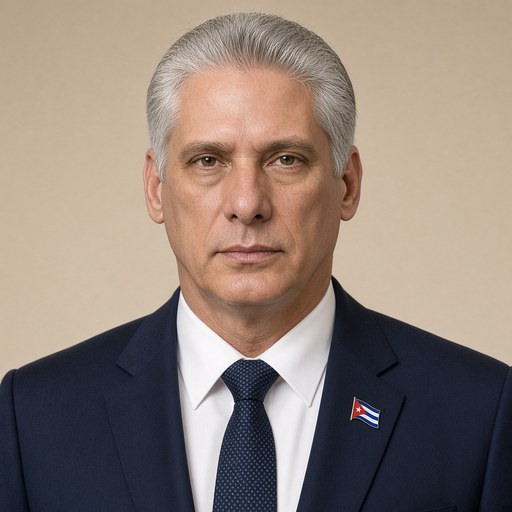
Intervention at the High-Level Plenary Meeting to commemorate and promote the International Day for the Total Elimination of Nuclear Weapons, New York, September 26, 2018, "Year 60 of the Revolution."
 Miguel Díaz-Canel · President of Cuba
- Context
- Díaz-Canel addressed the UN High-Level Plenary Meeting on the International Day for the Total Elimination of Nuclear Weapons in New York on September 26, 2018.
- Main themes
- Nuclear disarmament, Treaty on the Prohibition of Nuclear Weapons, international peace and security, nuclear deterrence rejection, Latin America as Nuclear-Weapon-Free Zone, Fidel Castro's legacy, multilateralism, JCPOA and Iran nuclear deal, Non-Aligned Movement, peaceful use of nuclear energy, humanitarian consequences of nuclear weapons
- Duration
- ~6 min
- Words
- 673
- Sentences
- 29
- Readability
- 17
- Grade
- 16.6
- Syntax
- 2.89
- Vocabulary
- 2.38
Translated from Spanish
The broad sphere of national life a sentence belongs to. Every sentence has an Arena, so it is the denominator the other indices are read against.
Other29 sentences in 20 paragraphs
Madam President;
Mr. Secretary-General;
Distinguished Heads of Delegation;
Delegates:
They say that when the brilliant physicist Albert Einstein was asked what weapons would be used in a hypothetical Third World War, he replied that the Fourth would be fought with sticks and stones.
Sadly, he did not live to see that his emphatic calls to stop the arms race with nuclear technology would fall on deaf ears and that the production of those weapons would grow enormously to the point of surpassing any possibility of survival if even a tiny fraction of them were used.
That is why we consider it an unavoidable duty to join in the commemoration every September 26 of the International Day for the Total Elimination of Nuclear Weapons, which contributes to the United Nations' goal of preserving international peace and security.
We take pride in the fact that such an achievement is based on an initiative promoted by the Non-Aligned Movement that the international community has embraced.
For Cuba, this annual call also represents a just tribute to the memory of the historical leader of the Cuban Revolution, Fidel Castro Ruz, who was an tireless fighter for nuclear disarmament, a topic to which he dedicated numerous Reflections and all his energies.
Seventy-three years after the criminal atomic bombings of Hiroshima and Nagasaki, humanity continues to be threatened by the existence of approximately 14,400 nuclear weapons, of which 3,750 are deployed and nearly 2,000 are kept in a state of operational alert.
Cuba rejects security policies and military doctrines based on nuclear deterrence. We adopt Fidel's words when he stated in 1979: “The noise of weapons, of threatening language, of arrogance on the international stage must cease. Enough of the illusion that the problems of the world can be solved with nuclear weapons. Bombs may kill the hungry, the sick, the ignorant, but they cannot kill hunger, diseases, ignorance.”
Madam President:
It is a source of joy for Latin America and the Caribbean to have been the first densely populated area in the world to declare itself a Nuclear-Weapon-Free Zone, through the Treaty of Tlatelolco born in 1967. This will of our countries was reaffirmed in the Proclamation of Latin America and the Caribbean as a Zone of Peace, a document signed by the Heads of State and Government of the region, on the occasion of the II Summit of the Community of Latin American and Caribbean States (CELAC), held in Havana in January 2014.
Cuba maintains a firm commitment to strengthening and consolidating multilateralism and to international treaties on disarmament, particularly with the goal of achieving a world free of nuclear weapons. As a demonstration of this will, on January 31, 2018, our country became the fifth State to ratify the Treaty on the Prohibition of Nuclear Weapons.
We will persist in the objective that this Treaty, which prohibits the use, existence, and development of nuclear weapons and reaffirms that they are inhumane, immoral, and ethically indefensible, is someday implemented and complemented with effective measures that lead to the total elimination of those arsenals in an effective, transparent, and irreversible manner.
The use of nuclear energy and technology has contributed to the socioeconomic development of our nations. Consequently, we reaffirm the right to the peaceful use of nuclear energy without discrimination.
We reject the decision of the United States government to withdraw from the Joint Comprehensive Plan of Action (JCPOA) or Nuclear Agreement with Iran. The failure to comply with these international commitments undermines the norms of coexistence among States and will have serious consequences for stability and security in the Middle East.
Madam President:
In conclusion, I share with you a fragment of the speech by the First Secretary of our Party, Army General Raúl Castro Ruz, during the Rio +20 Summit: “Let us leave behind justifications and selfishness and seek solutions. This time, all of us, absolutely all of us, will pay the consequences (…) Let the plunder cease, let the war cease, let us move towards disarmament and destroy nuclear arsenals.”
Thank you very much.
The original Spanish. The tags above are read on the English translation's sentences.
Señora Presidenta;
Señor Secretario General;
Distinguidos Jefes de delegaciones;
Delegadas y delegados:
Dicen que cuando al genial físico Albert Einstein le preguntaron con qué armas se libraría una hipotética Tercera Guerra Mundial, respondió que la Cuarta sería con palos y piedras.
Tristemente no vivió para ver que sus enfáticos llamados a detener la carrera armamentista con tecnología nuclear caerían en saco roto y la producción de esas armas crecería descomunalmente al punto de superar cualquier posibilidad de supervivencia si apenas se empleara una ínfima parte de ellas.
Por eso consideramos un deber insoslayable sumarnos a la conmemoración cada 26 de septiembre del Día Internacional para la Eliminación Total de las Armas Nucleares, que contribuye al objetivo de las Naciones Unidas de preservar la paz y la seguridad internacionales.
Nos enorgullece que tal logro se sustente en una iniciativa promovida por el Movimiento de Países No Alineados que la comunidad internacional hizo suya.
Para Cuba, esta convocatoria anual representa, además, un justo tributo a la memoria del líder histórico de la Revolución Cubana, Fidel Castro Ruz, quien fuera un luchador incansable en favor del desarme nuclear, tema al que dedicó numerosas Reflexiones y todas sus energías.
A 73 años de los criminales bombardeos atómicos contra Hiroshima y Nagasaki la humanidad continúa amenazada por la existencia de aproximadamente 14 400 armas nucleares, de las que 3 750 se encuentran desplegadas y casi 2 000 se mantienen en estado de alerta operacional.
Cuba rechaza las políticas de seguridad y las doctrinas militares sustentadas en la disuasión nuclear. Hacemos nuestras las palabras de Fidel cuando en 1979 afirmó: “El ruido de las armas, del lenguaje amenazante, de la prepotencia en la escena internacional debe cesar. Basta ya de la ilusión de que los problemas del mundo se puedan resolver con armas nucleares. Las bombas podrán matar a los hambrientos, a los enfermos, a los ignorantes, pero no pueden matar el hambre, las enfermedades, la ignorancia.”
Señora Presidenta:
Es motivo de regocijo para América Latina y el Caribe haber sido la primera área densamente poblada en el mundo que se declaró Zona Libre de Armas Nucleares, a través del Tratado de Tlatelolco nacido en 1967. Esta voluntad de nuestros países quedó ratificada en la Proclama de América Latina y el Caribe como Zona de Paz, documento firmado por los Jefes de Estado y Gobierno de la región, en ocasión de la II Cumbre de la Comunidad de Estados Latinoamericanos y Caribeños (Celac), celebrada en La Habana, en enero de 2014.
Cuba mantiene un firme compromiso con el fortalecimiento y la consolidación del multilateralismo y con los tratados internacionales en materia de desarme, en particular, con la meta de alcanzar un mundo libre de armas nucleares. Como muestra de esta voluntad, el 31 de enero de 2018 nuestro país se convirtió en el quinto Estado en ratificar el Tratado sobre la Prohibición de las Armas Nucleares.
Persistiremos en el objetivo de que ese Tratado, que proscribe el uso, existencia y desarrollo de las armas nucleares y refrenda que estas son inhumanas, inmorales, y éticamente indefendibles, sea alguna vez implementado y complementado con medidas eficaces que conduzcan a la eliminación total de esos arsenales de manera efectiva, transparente e irreversible.
El empleo de la energía y la tecnología nucleares ha contribuido al desarrollo socioeconómico de nuestras naciones. En consecuencia, reafirmamos el derecho al uso pacífico de la energía nuclear sin discriminación.
Rechazamos la decisión del gobierno de los Estados Unidos de retirarse del Plan de Acción Integral Conjunto (PAIC) o Acuerdo Nuclear con Irán. El incumplimiento de estos compromisos internacionales atenta contra las normas de convivencia entre los Estados y provocará graves consecuencias para la estabilidad y la seguridad en el Medio Oriente.
Señora Presidenta:
Para concluir, comparto con ustedes un fragmento del discurso del Primer Secretario de nuestro Partido, el General de Ejército Raúl Castro Ruz, durante la Cumbre Río +20: “Dejemos las justificaciones y egoísmos y busquemos soluciones. Esta vez, todos, absolutamente todos, pagaremos las consecuencias (…) Cese el despojo, cese la guerra, avancemos hacia el desarme y destruyamos los arsenales nucleares.”
Muchas gracias (Aplausos).