




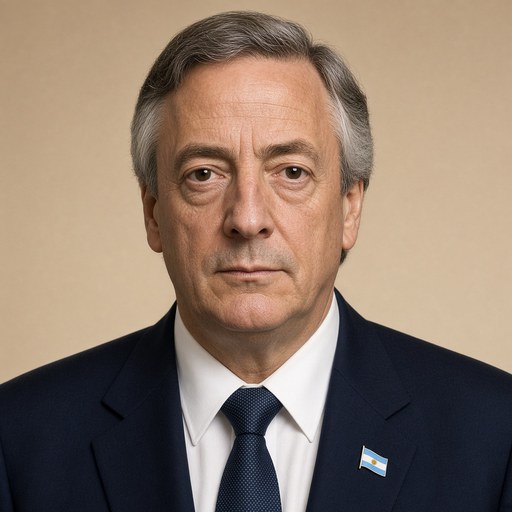
President Néstor Kirchner interviewed by Magdalena Ruiz Guiñazú
 Néstor Kirchner · President of Argentina
- Context
- Kirchner spoke in an interview with journalist Magdalena Ruiz Guiñazú on May 24, 2007, the eve of Argentina's national day and his four-year presidential anniversary.
- Main themes
- Four years in office, economic recovery, personal reflections on the presidency, Argentine society and politics, state rebuilding, scientific and technological advancement, political joys and challenges, international relations, historical memory, governance model
- Duration
- ~78 min
- Words
- 9,402
- Sentences
- 439
- Readability
- 52
- Grade
- 11.2
- Syntax
- 2.90
- Vocabulary
- 2.04
Translated from Spanish
This is an interview, press conference or exchange with other speakers. It is split into sentences and counted in the corpus, but its sentences are not tagged on the twelve indices.
439 sentences in 211 paragraphs
JOURNALIST: I thank you very much, Doctor Kirchner, for this conversation, this opportunity. It also has a double historical significance because tomorrow marks four years since you took office, and obviously, it is May 25th. 24/5/2007
PRESIDENT: Magdalena, it is a pleasure to be able to talk with you for several reasons. First, because of the deep respect I have for you; second, if you had asked me on May 24, 2003, if on May 24, 2007, we would be able to have this conversation, obviously you as a journalist, but me as president, it would have been a lottery to guess given the framework and reality in which we had to take office.
JOURNALIST: You know that when Alberto Fernández told me that the interview was possible, I thought several things. You are a president, after four years in office, of whom certain things are known; for example, we know your anger, but we do not know your joys. What are your joys, Mr. President?
PRESIDENT: Multiple, the majority. I live happily; I do not get angry. Some, due to a lack of personal knowledge, may think that one gets angry; sometimes there are things that hurt. Here, the Argentines, not in personal terms, when one has to exercise this function that I thank the Argentine people for, know that many times one has to overcome them with great strength and with great Christian quality. But the things that have happened to us Argentines, Magdalena, hurt us all. And when one starts finding and solving problems, can you imagine? The day I took the oath, I locked myself in the office for a little while with Cristina and my children, one son who is from the 1970s, born in '77, who had to live through those times, and a girl raised in the 1990s, born when I was mayor of Río Gallegos in 1990, that is, during two culturally absolutely different countries. We looked at each other and I thought, "And now?" because that was the issue; we are here. The four of us took each other's hands and did not make any major expressions. The next day I had to receive the leaders who had attended the inauguration, and among them, I had two long meetings that honestly put me to the test, one was with the president of Venezuela and another with the president of Cuba, Fidel Castro; Fidel liked to talk. I had so much on my mind that if you ask me what we talked about that day, it is likely that I do not remember what we discussed with the presidents at that moment because I was really focused on the problems that were happening in our country. A few hours later, there was a Plaza de Mayo full of claimants; Plaza de Mayo expressed the claimants and the excluded sectors, but the claimants were also from the middle class, sectors of the national business community, sectors of Argentine culture, intellectuals.
JOURNALIST: Did it bring you joy to see them there?
PRESIDENT: A huge responsibility, but that is how Argentines are; it is as if the backpack was already loaded on my back. That is to say, now I am going to enter to resolve, to try to improve the situation.
JOURNALIST: But you like it.
PRESIDENT: Yes, but we are human beings; the situation was distressing. I got on the helicopter and told the kids who work as secretaries with me, "We are going to go second by second." After a while, I told them, "We are going to go hour by hour," and today I say we are going day by day because Argentina is still in hell; we are recovering. But obviously, a country that was not only emptied patrimonially but also intellectually and culturally. Today I had great joy at the Atomic Energy Commission, at the Roffo Institute, where a first-class tomograph was put into operation, which there is no other in South America, which we worked on during this administration, and we are one step away from creating the National Cancer Institute. I had great joy for the technological advancement; it is the Argentina we need, but the State is still, this is the reality, has been left empty of neurons. Because when I hear about competitions sometimes, many competitions in the 1990s were totally rigged; they responded more to interests other than those of the State itself; the people who competed had to be those who were absolutely convinced of the political and economic project being carried out at that time in Argentina. In other countries of the world, I have been able to verify because one goes with a great eagerness; there are three models that I have followed very closely: the German, the French, and the Spanish. The Spanish captivates me, with all the problems in Spain, but it captivates me because today in Spain the economic model is successful, and civil unions are being discussed; obviously, the problem of ETA is being discussed, but to be able to discuss those issues, they have achieved many things.
JOURNALIST: Right, the Iraq war took Aznar down.
PRESIDENT: Exactly. That demonstrates culture, maturity.
JOURNALIST: You are successful, Mr. President; you have had a successful administration and will probably win the elections this year. So one wonders... successful, four years in which, as you point out, you have been able to do things. So why a public official like Moreno? What do you think about violence?
PRESIDENT: If you knew Moreno, one day I would like you to talk to him. Moreno is not violent.
JOURNALIST: I have heard Moreno speak on the phone.
PRESIDENT: It may be a subject for analysis how he expresses himself, but I think he is improving. I have had him talk with all the Argentine businessmen; with this, I want to be absolutely sincere, in a framework of respect, coexistence, and in a very friendly manner with the same businessmen who later criticize him from the outside. One can have more or less sympathy for a public official; this is the reality, but I believe that Moreno is a capable man; he is an honest person and obviously must have flaws, errors. But they have created the figure of the one who mistreats, of the one who says things. If I had heard him say some of the things they say he said, which I cannot absolutely affirm he did not say...
JOURNALIST: He has all the INDEC employees who just yesterday afternoon formed a ring around the building in protest against what they call Moreno's finger; there were also some posters that spoke about that.
PRESIDENT: It is impossible. In the INDEC issue, it is impossible to penetrate its functioning and everything else. If you study it technically, not all employees are from INDEC; INDEC has more than 1,000 employees. What happens is that there are also things that get politicized; INDEC also has many officials who sometimes work or provide advice to private companies and to INDEC itself; there are many issues. They are raised and speeches are made that later are... I can assure you, Magdalena, one thing: if Moreno were to approach the breaking of the public morality of the State and everything else, you would send me an email saying, "Look, Doctor, this thing," and Moreno would go. I always say that when one is in public office and has the responsibility, Alberto gets angry with me when I say it, but it is my turn to have it at this time in history; I cannot put my hand in the fire for anyone; I can only put my hand in the fire for Argentine society; this is the concrete reality. And so, at a certain moment, in a certain circumstance, it may hurt more or less, one has to resolve always preserving the most important values that one has in management.
JOURNALIST: You are skilled because you did not answer me about Moreno. But just when you talk about Argentine society, there is a somewhat concerning issue, Mr. President.
PRESIDENT: You know how many I have concerning.
JOURNALIST: These are issues that have overlapped. Yesterday, the Pan-American highway was blocked; two days ago, we had a serious problem at the Constitución station; we have not solved the subway issue. How do you see these events?
PRESIDENT: Your question is very good. Notice that the UTA has made one of the best union agreements in recent years; the subway workers are in this agreement. But this must be said in all letters; most of the union delegates are militants in leftist parties, whatever they may be called, according to what we understand by left; that would be another discussion.
JOURNALIST: Combative.
PRESIDENT: What do we understand by combative? It is a philosophical discussion.
JOURNALIST: What do we understand by combative? Stopping the Pan-American highway and six kilometers of traffic.
PRESIDENT: For a long time, the irrational intransigence, which I, as a generation, perhaps had some responsibility for at that historical moment, was confused with the combative vocation. A combative leader was someone like Ongaro, for example; there are several examples, Tosco.
JOURNALIST: Daer in recent hours completely disavowed the blocking of the Pan-American highway.
PRESIDENT: They are groups that belong to parties that obviously express themselves, the Workers' Party and others, that when they do not have strength and representativeness in the bases and in the industrial unions, resort to roadblocks as a provocative element, especially when electoral periods approach.
JOURNALIST: But in Constitución, they were not political groups.
PRESIDENT: I may be mistaken, Magdalena, but I will tell you. First, it was a correct protest by users of a poorly provided service; let us define it categorically, and then undoubtedly there were activists who took advantage of a certain situation. A user who is upset about a service does not break anything, except in an extreme case; that is done by those who are directed to generate certain actions of social disturbance. But that cannot lead us to make mistakes and fall into the simplification of saying that this was an act of activists because we would be disrespecting the people. The people, in the face of a noticeable deficiency in services, generated a complaint; I call it the complaint of the users. Because the value of citizenship is gradually appearing in Argentina; I say the construction of citizenship is appearing, and then the citizen has their individuality, their freedom of thought, their expression, which is synthesized in that public services must be provided correctly. That is why we are working; yesterday we took the measures we had to take. I am studying very thoroughly both the French system and the Spanish system of functioning in the train system, and God willing, within a few days, I can send a law to the National Congress that is not an orthodox state operation because I believe that is not where the core of the problem lies.
JOURNALIST: Would it be a mixed society?
PRESIDENT: We are studying it well. That is to say, there should be state participation, but there should also be a possibility of quality private operators.
JOURNALIST: Besides, I don't think the tracks are suitable for the dreams we all have of high-speed trains.
PRESIDENT: But we are working on a topic that we started working on with the city during Aníbal Ibarra's government; we continued doing it in Telerman's government, and with the government of the province of Buenos Aires, and we will reach Morón, which will speed up the Sarmiento railway, which is the underground. Logically, Magdalena, you remember that they used to say, "branch that stops, branch that closes"; the entire Argentine railway system was disarticulated.
JOURNALIST: It is terrible. The number of towns that died. But what happens is that at that moment, it caught us Argentines like a paralysis, even within Peronism; I do not remember that Menem had the opposition not to be able to implement the branch that closes.
PRESIDENT: In Peronism, we have a great capacity for self-criticism, like all political forces in Argentina. I will tell you what my thought is; sometimes this bothers me when I say it. But I believe that the world evolves; the political expressions that responded to the needs and ideas that Argentines had for many decades are in clear crisis, and among them is my own party. I have no doubt and hope to see it, as president or fundamentally as a citizen, that modern expressions can emerge that express the reality of Argentina and the world, which today surpass the traditional conception of politics. This cannot be a River – Boca; there must be an intellectual evolution, an evolution of proposals; we are facing a totally different world.
JOURNALIST: In a few hours, as we said, four years of presidential mandate will be completed, and we thank you doubly for this opportunity to talk about things that journalists usually cannot discuss with you. Why don’t you hold press conferences, Mr. President?
PRESIDENT: Fundamentally because I believe that...
JOURNALIST: They punish you with the questions sometimes.
PRESIDENT.- No, they do not punish me; on the contrary, I love them. What I believe is that in the construction of what Argentine journalism is, there must also be an evolutionary process. It is very important to talk to many Argentine journalists, but just as those of us who run for office and seek to take the initiative in leading the State have the obligation to study, to prepare ourselves, to self-criticize, to accept criticism whether we like it or not, I believe that everything that has been experienced in Argentina has led to a loss, I say this with all due respect, of quality. I think there is a lack of research; many times the topics cannot be addressed with the depth that is necessary. Sometimes, in the superficiality of the topic, one responds in a way that may seem to evade a question or a very vague thought; however, it requires a back-and-forth with the journalist that leads to a deepening of the subject to see the different perspectives that can be had, or the task of inquiry that you have, which is natural given the framework to do so, not to see if I can put something in or not, or to try to generate a certain situation with a question, but rather that the listener can obtain their own analysis from our dialogue.
JOURNALIST.- Does the same happen to you with Cabinet meetings, because you do not hold Cabinet meetings?
PRESIDENT.- I meet permanently with all the ministers.
JOURNALIST.- Yes, but not all together.
PRESIDENT.- It is not necessary to hold a Cabinet meeting or issue a press release to say that we have met; we have met many times. What happens is that we have given the Cabinet meetings or the individual meetings we have had the necessary privacy so as not to overwhelm people. Do you remember? I am marked by this; it is true, I have tried to keep a lower profile because I had to see and hear, you as a journalist know, for a long time Cabinet meetings that were grotesque for citizens, due to the things that were said, done, and so on. So we, as public officials, have the obligation to be austere in our actions and statements, especially in such difficult times that Argentina is experiencing. I believe that within the framework of the maturation process that must take place in this country, that will happen... We meet permanently; otherwise, we cannot build Argentina; it is impossible.
JOURNALIST.- It seems like you are not very happy with the Cabinet you have then?
PRESIDENT.- Yes, I am perfectly happy. If I were not happy, I would change it; I have no commitment.
JOURNALIST.- That shows, as well as with a lot of authority; those who know you say that nothing escapes your control.
PRESIDENT.- I wish. No, the construction of authority is intellectual preparation, the capacity for analysis, reflection, and correction.
JOURNALIST.- Obedience.
PRESIDENT.- No, the truth is that I have a Cabinet that tells me, starting with Cristina; I always say that I have all the work meetings during the day, in which many times Cristina herself is present, and then she is my main critic; she is strong. And then many times there are different positions from mine, and thanks to many positions from many ministers, I have been helped not to make mistakes. What happens is that we manage it within the framework of our privacy. You know how big the State is; you know how it has been emptied. I can assure you that there are officials who even come from before, whom I do not even know. The construction of the Argentine neuronal State is a pending and very difficult task to carry out, so obviously one often does not know who they are talking to; this is the concrete reality, and sometimes what interests a certain official may be responding to. That is why I believe when I say that on December 10, 2007, we will come out of hell; it is a characterization that we will move to purgatory.
JOURNALIST.- Remember that limbo no longer exists; did you see that the Pope said it no longer exists?
PRESIDENT.- I come from a very Catholic family; I am not very practicing.
JOURNALIST.- That is why I say, we do not know about purgatory either, but limbo does not exist anymore.
PRESIDENT.- I say this in the sense that the citizen of Argentina needs and will surely have starting in 2007 a deep debate of ideas to build a strategic Argentina. It is like in a house; when you want to talk about the future of your family and you do not have your house, you have to live in a shed, the kids go to the community dining hall, the dad does not have a job, the dad and mom do not get along because economic distress destroys them; then what feeling, what bond, what projection of family can one have? In Argentina, we have the same problem; I always say that every house we inaugurate is very important, and that every father or mother who gets a job is very important because the family comes back together, and there one begins to build a life project, a home; you will go to university, you will study.
JOURNALIST.- By the way, for example, in a woman President, since you have been so kind and we have this conversation, what do you prefer in a woman, intelligence or kindness?
PRESIDENT.- You are going to call me a sycophant.
JOURNALIST.- Why?
PRESIDENT.- Because I have a partner who has intelligence, who has kindness, and who is consistent but not obsequious with me. One starts from their own analysis; I can start from the analysis of my mother, who is a Croatian-Yugoslav with very strong Catholic principles; we prayed at the table in my house before eating; I have a grandfather, the nono Yugoslav, who did not pray. We have lived through so many things together with Cristina for so many years that I think I like intelligent women and, of course, with kindness.
JOURNALIST.- But if you had to choose, of course, the ideal is that both virtues are present. For example, in Cristina, which virtue do you think is more important, intelligence or kindness?
PRESIDENT.- I believe that those of us who know Cristina privately know her kindness, but she has a quality and intelligence that is somewhat superior. She has three fundamental elements: one is her capacity for research, what she studies, and what she reads, which makes me expect... Of course, when one has had their home, their partner for many years, it is the fundamental partner. I told a colleague of yours a few days ago that this past Sunday, on a certain channel, they were showing Rome, and I, on a Sunday when Racing had not lost, wanted to watch a bit of Sunday football.
JOURNALIST.- But you need more televisions.
PRESIDENT.- But we wanted to be together. Because besides, we watch Rome; we really like history, and analyses, topics, and realities arise. But what I want to say is that it is very important to discuss the why of things; otherwise, it would be very boring, and it is also very important because one tends to qualify themselves. I would say that for me, it would be very boring and very routine not to have a partner like the one I have.
JOURNALIST.- So you prefer intelligence over kindness.
PRESIDENT.- No, kindness is also very important; kindness, affection, and love are privacy.
JOURNALIST.- But what do you do with kindness if you do not have understanding?
PRESIDENT.- Besides, what is kindness? Years ago, you would see couples who had lived together for 50 years, culturally, not because of what the world was, what Argentina itself was, and you would find an alarming, tremendous subjugation of the woman. I am not, if you allow me the word, perhaps a bit misogynistic in saying it this way; this is how I like them. But be careful; in the case of the Cabinet, I have women with a lot of personality; Nilda is like that, Felisa.
JOURNALIST.- Poor Nilda with the planes that fall.
PRESIDENT.- No, thank God.
JOURNALIST.- Always on the verge.
PRESIDENT.- It is just a system that has been emptied for years; now Zapatero did very well; on June 14, a very important radar is arriving; everything is functioning well. But the transition of controllers to the private sector, all that was like that. There were two countries in the world, Argentina, Brazil, and some others in the world that still had controllers in the hands of the Air Force; these are things that were not done for a long time. So you find, Magdalena, that there are many pending issues. Spain has taken 15 years to consolidate a model; we Argentines will have at least another decade regarding consolidation, projecting a better country.
JOURNALIST.- Since you mention the radar. When on March 1, the lightning disabled the radar, I remember you said that "it will be replaced immediately," and we are now on May 20-something, and it still has not arrived.
PRESIDENT.- Do you know what it is to get the radars? To bid them, for companies to present themselves, to come and see what system is in place, all the technical studies.
JOURNALIST.- Well, like everything else.
PRESIDENT.- And we obtained, thanks to the very good will of President Zapatero, this radar from Spain, which we have indefinitely with us. But what happens, do you know how many people travel on the Roca railway?
JOURNALIST.- 450,000 every day.
PRESIDENT.- 11 million, and some who do not pay; there would be 3 or 4 million more.
JOURNALIST.- But the railway does not fall apart.
PRESIDENT.- No. Do you know how much air traffic has increased in Argentina? Tremendously.
JOURNALIST.- That means it is working better.
PRESIDENT.- Of course, it is working better, but I will tell you an anecdote that happened to me this morning. I was meeting with automobile manufacturers in Argentina, and they were talking to me about the fabulous investment projects, the significant number of jobs, the industrialization of the country, the industrial growth that reached 8.3 last year and that we will be at 6.8 this year. And just that morning, with those typical fogs of Capital Federal, I had to go by land. Well, a traffic jam, typical, I say, of the porteño culture; they got out of the car, argued, typical of the culture; you see what Capital Federal is like. And of course, notice that there are 400,000 more vehicles circulating. Well, it is the tension of growth; there are 400,000 more vehicles, and the investment in infrastructure, and in some places, it is already almost impossible; we have to see how we can improve; it is evident that it generates problems, and many of the inconveniences we have today are due to growth; building an airport does not happen overnight.
JOURNALIST.- Those are the questions we have asked the candidates for heads and deputy heads of government, basically what they are going to do about traffic.
PRESIDENT.- Of course, it is a problem. I was the mayor of a small city, but as mayor, I became a great observer of cities, obviously because Cristina and I would go out at night to take a walk around the city; we would see a pothole, and I would quickly call the maintenance department to come fix the pothole. I would say, they are going to fix the pothole; tomorrow they will say anything; it was a small city; at that time, Río Gallegos would have 80,000, 60,000 inhabitants; at that time, it would have 50,000 or 60,000, but it is evidently a big problem. The coastal highway will have to be built, which is a very important investment; the Capital deserves significant infrastructure investments. Our Capital is the capital of tourism, of shopping; a lot of people come here; there is a spectacular economic movement.
JOURNALIST.- And there will be more and more.
PRESIDENT.- More and more; it requires substantial investments, and the nation has to support it.
JOURNALIST.- Speaking of investments, President, I do not want to be bothersome, but the truth is that it is public; how did you take the fall of the third official in the Skanska case? Because we have Ulloa, Madaro, and now Rodríguez, the Undersecretary of Public Works.
PRESIDENT.- I had to do what no president has done, at least since the beginning of the democratic era, right? What happened here fundamentally during the last decade was that it was said to wait for what the Justice would say, which is logical; in normal terms, it would be logical to wait for what Justice says to see if someone is guilty or not. When I heard what Alberto Fernández, the Chief of Cabinet, transmitted to me, that Aníbal Fernández had told him, who then told me too, that the prosecutor of the case had said what he said and that we reproduced in the text of the decree, I always said, and for me, this case continues to be a case of corruption of private individuals, where there may or may not be a public official involved, but they have not even been summoned for questioning yet. So, I believe that in one paragraph of the decree, I put, for God's sake, they may be innocent, but given the circumstances, the history, the cultural process that we have had to live through as Argentines, I have to proceed and fulfill the promise I made at that time; I had no doubt in the decision I had to make, and I did it, I did it with the responsibility that one has to do the things they must do, even thinking that sometimes one may be...
JOURNALIST.- No, but that is very good, but it was not such a private matter that you had to take official action.
PRESIDENT.- No, but you know what happens, I took action on the matter because I cannot leave any doubts that this State and in my personal case as President really want with all my strength for there to be a transparent State, which will cost, it is not an easy task, there are thousands and thousands of officials and one does not even know what some do on a daily basis, right? It is impossible to know. The destruction was great in Argentina. These officials may be innocent, but Argentina, with everything that happened to us, with that cultural formation throughout the past decade, so to speak. Let us hope to see if they are guilty or not and if they will continue to be officials. I cannot, after what happened, allow someone who is being called to give a statement to continue being an official.
JOURNALIST.- No, no, I totally agree, that is why it is not a corruption among private individuals.
PRESIDENT.- No, it is corruption among private individuals that may have collaboration; but there is no structural participation of the State.
JOURNALIST.- There is an investiture that is the position held by the person who has been corrupted or who corrupts.
PRESIDENT.- Of course, but the core, the matrix, you are right in what you say, but the matrix of the problem is a corruption among private individuals; that this corruption among private individuals may be associated with some member of the State, well, God willing that it is not so, Justice will rule, but Magdalena, Justice will rule with the officials out of the State and that is a relief for the State.
JOURNALIST.- Of course, that is important.
PRESIDENT.- There are two cases, I clarify that I hardly know that official, I don’t know if I have been in any meeting with him. In the other case, the Undersecretary of Public Works, Rodríguez, is mentioned in a matter related to La Pampa. I cannot have an official who is mentioned in a matter where I do not know deeply what the issue is, far from it, but the Justice of La Pampa will determine. You see, there is a reality, 94 percent of the public works being done in Argentina were tendered by the provinces; out of 10,500 works being done, 9,000 were tendered by the provinces. We sign agreements, send the funds, and they tender. So, what happens is that when a country that needs so much investment, things can happen that one does not want to happen and has to proceed; we have to proceed, proceed, and proceed. Now let’s see, the truth is that now we wait calmly for Justice to decide, we took the measures we had to take and we continue working with great strength.
JOURNALIST.- Now, a question that most citizens are asking and that I take this opportunity that you so kindly give me. Why are all the funds from Santa Cruz not repatriated?
PRESIDENT.- They are repatriated.
JOURNALIST.- All of them?
PRESIDENT.- If you give me 5 minutes. One of my great frustrations in my life is these famous funds from Santa Cruz.
JOURNALIST.- But all of them were repatriated?
PRESIDENT.- All, all, they are, I don’t know where they have them invested now and so on, but they are…
JOURNALIST.- Because Acevedo was very angry about that money.
PRESIDENT.- No, he was the one who took care of doing all the paperwork and everything. Sergio went and did it well, he really did it well, and besides, Sergio always participated with me in the administration of the funds, he always knew where the funds were, how the funds were, and so on, as the subsequent governor knew and now the current one knows, they are being administered by the Bank of the Province of Santa Cruz.
JOURNALIST.- All of them.
PRESIDENT.- All of them. Look, about 2.4 billion, 2.5 billion dollars were collected for poorly liquidated royalties.
JOURNALIST.- Yes, when YPF was sold.
PRESIDENT.- Yes, of course, when YPF was sold, part of it and then the last part when the gold share was sold and so on. The province of Santa Cruz at that time collected in bonds at face value; I don’t remember now what the market value was, but let’s talk about bonds, it collected 630 million dollars in bonds that were probably worth 400 in real value. I kept them, I could have spent them, I kept them and since I was honestly afraid, you saw what Cavallo decided to take, he took it…
JOURNALIST.- Yes, yes.
PRESIDENT.- So we put it out of the reach of those hands, of several hands and we put it to be administered first in the United States and then in…
JOURNALIST.- Luxembourg.
PRESIDENT.- In Luxembourg because of the default in Argentina.
JOURNALIST.- The idea was good to save…
PRESIDENT.- No, but listen to me, Tierra del Fuego spent it, no one knows what they spent it on; Chubut spent it, no one knows what they spent it on; Neuquén spent it, no one knows what they spent it on; Mendoza spent it, bankrupted both banks. None have to account for anything, the only one who is asked to account is where the funds are. For me it is so absurd, it is so absurd that I feel anguish, I say, we saved them, the funds are there, thank God they serve the province of Santa Cruz. Why do they criticize us if we have managed them well, we have safeguarded them, we have not spent them, we have preserved the capital and the heritage of the province.
JOURNALIST.- They are saved, they have not been invested?
PRESIDENT.- No, they are, obviously there have been many works in which investments have been made, but Magdalena all those funds have been generating interests and so on, all approved by the Court of Accounts, that is to say, everything was done as it should be. And I say then here in Argentina it is better to spend everything, not to manage anything, not to save. I come from a culture, I don’t know if correct or incorrect, even in my personal life; I like to have my savings, manage my things; that is to say, with the State I do the same, I look at the accounts every day in the State, Magdalena, I look at how much there is in revenue, what interest we have, how much we have in reserves.
JOURNALIST.- Of course, but since I have a bad head for numbers, I love that you explain it to me. Of that money, did it all come back, is it all invested in the province of Santa Cruz?
PRESIDENT.- No, that money is not invested, it is in titles, in bonds, well, I don’t know now, we would have to ask them where they have put it, the administrators which is the Bank Provincia.
JOURNALIST.- In our country?
PRESIDENT.- In our country they can have titles that can be from our country or not; they can be international titles or not, to speak more simply.
JOURNALIST.- Yes, yes, because it is a question that everyone is asking. Also when you just mentioned the great religiosity of your family, the other day you had a very good idea when you had that conversation with Bishop Pigna, but one could not help but think, it was very clever to have the conversation with Pigna who was also your opponent in Misiones, but why can’t you talk to Bergoglio?
PRESIDENT.- Why not?
JOURNALIST.- And, because you don’t talk.
PRESIDENT.- I have my doors open and my heart open to Monsignor. I don’t know why this kind of stories are sometimes generated.
JOURNALIST.- Well, I don’t know, you go to the Tedeum in a province, you are not here in the Cathedral, those things.
PRESIDENT.- But that is a matter of federal conception. We believe that May 25 should be celebrated in different places; we were there last year, the year before we were not there, this year we are not there. Under no circumstances, for whatever Monsignor Bergoglio may say, whom we absolutely respect his thoughts; we can agree, we can have diversity. What problem, Magdalena, is there if Monsignor says something that we do not agree with? More than once I will go out to respond with what I think, he will say what he thinks, we are two Argentines, two Christians, we are of the same flock, he is my pastor. I believe that these issues should be de-dramatized. I talk to many bishops, the other day I listened to the bishop of La Rioja, Monsignor Rodríguez with all the institutional problem that there was in La Rioja that national funds were not reaching La Rioja, I personally called Monsignor Rodríguez, I spoke with him, I talk to many bishops permanently…
JOURNALIST.- Is your relationship with Romaní good?
PRESIDENT.- I do not have a bad relationship with Romaní, no; if I have a difference, I respect it.
JOURNALIST.- Because Romaní was very happy about your meeting with Pigna.
PRESIDENT.- No, no, that is to say, we can have different views or not, or perhaps circumstantially different. Magdalena, perhaps you and I discuss a certain issue, but why if we discuss or have our relative truth a different opinion are we going to think differently in everything? It is impossible for there to be a uniform thought and thank God it does not exist. Look, I have always gotten along very well with the bishops of my province and I had 2 bishops, one of them Monsignor Alemán who was absolutely a great fighter, just like Bucolini, we had and worked through a thousand problems because Santa Cruz is a province… you know what it was in the 90s when oil was 8 pesos, the oil workers, a heavy union if there is one, or the miners in Río Turbio, they are wonderful people but there was this gentleman, I met him there, I don’t even want to name him, who always pursued me, I commented last night for so many years, who won so many concessions in the 90s…, and they helped me a lot; they also criticized me a lot. That does not bother me.
JOURNALIST.- And the teachers in your province?
PRESIDENT.- Look, the teachers in my province are.
JOURNALIST.- Because Taselli is a sad story but the teaching issue is another thing.
PRESIDENT.- No, but they are the highest paid in the whole country; retired teachers are the ones who receive the highest percentage in the whole country. The truth is that it is the structuring of the salary the discussion that was left, whether it was 161 pesos or not, but they were collecting everything complete at this moment I think it would be around, give or take, 2,000 pesos as a minimum wage, we closed with CTERA 1,040 with each province, as a minimum wage, we have advanced a lot and the teachers' strike in my province has nuances…. some teachers I am sure did it for reivindicative reasons, one can agree or not, others –I know them- are active militants of some parties that have fought with me for a long time did it for political reasons, you will realize because even today with 500 pesos of basic they do not solve it, that is to say, only 70 percent of the teaching staff in Santa Cruz is working and some sectors do not. These issues happen, but I believe that when one has responsibility in the State, Magdalena, it does not mean conceding always what they ask for and it does not mean always giving them reason for what they ask for, because it would then be very easy to administer. It seems to me that the State must say: up to here I can when it touches and up to here I cannot; advance in good faith as far as possible. Sometimes, of course, it is not nice to say no, but sometimes you have to know how to say no to manage seriously and that always brings some collision. Now one cannot get angry when one is in the State, there are different positions. I always say that difference and divergence exist, the vision of optics exists and I do not like the Manichaeism of good and evil. I tell you with all due respect what my vision is, but with this I do not make a…. saying they are the bad ones and I am the good one because that seems totally absurd to me. I explain to you with all sincerity what the situation is, our teachers have always been the best paid in Argentina.
JOURNALIST.- And do you think the situation can evolve favorably?
PRESIDENT.- It should, because the teachers from Santa Cruz are generally responsible, mature, I know many who have worked for years really a lot and well. The province will evolve, everything has its evolutionary process, that is to say, we are never at the end of days, as I say sometimes one must have the necessary patience. It is like when I was asked about the aggression towards Alicia, some of your colleagues. I said that I felt sorry not for Alicia, but for those who turned divergence into aggression.
JOURNALIST.- Both things, because for Alicia it was very unpleasant really.
PRESIDENT.- Magdalena, perfect, but I wanted to express that one should never have to… Look, we, and I as a generation lived it, when one wants to resolve issues through violent methods surely the defeat is of all.
JOURNALIST.- President, we will continue in a moment, does that sound good to you?
PRESIDENT.- You lead.
JOURNALIST.- Incredible.
JOURNALIST.- How obedient, huh.
JOURNALIST.- You are very kindly answering the questions we ask you but you haven’t finished telling me if in a woman you find intelligence or kindness more important. For example, if Cristina heads the ticket, what do you wish for her in terms of achievement, an intelligent achievement or a kind achievement?
PRESIDENT.- I have great admiration for Cristina, this is the reality. I believe that Cristina can provide the quality of statesmanship, the improvement in institutional quality that the country needs, the experience, the reflection, and the study, and can put an end to that theory that some have, that absurd differentiation between women and men. I believe that if Cristina were the candidate, and it will have to be said in its moment, I have no doubt that she could be a very important step forward for Argentines.
JOURNALIST.- And if she were the candidate, what would you do?
PRESIDENT.- My personal matters. I will tell you three things, with total honesty. First, I love dedicating myself to my personal matters with my son, who is taking care of them over there; it is a happiness I have not experienced before.
JOURNALIST.- I don’t see you distancing yourself from politics.
PRESIDENT.- I’m not going to say, like some, that I’m going to the studio, no. Then, helping to build something that we left unfinished, and I believe we must address it with all courage before it ends… otherwise, I wouldn’t feel honest with myself. Then, obviously, I will be just another citizen because I have no doubt about that. Well, you know Cristina; if she ever asked me something about the topic, I would tell her, but I would never mix things that should not be mixed, as she does with me. The thing is, for me, in this stage, she has been an absolute companion; she helped me reflect and solve many problems. But there is one issue that keeps me awake at night, which is the construction of new political expressions in Argentina. It keeps me awake as it kept Dr. Alfonsín awake at the time, because you see, Dr. Alfonsín spoke of a third historical movement; let’s go back 20 years, he already knew - he was a very intelligent man - that something was failing in the traditional political system. He was clear about it. The problems he had at that time were some of the ones we have now and others, but within the framework of the problem, the evil was already embedded; that model had already begun, initiated by Martínez de Hoz and continued. Then, during the 1990s, the idea of a unique model was established, uniform thinking.
JOURNALIST.- Did you feel like an enemy of Menem?
PRESIDENT.- Not an enemy; I don’t feel like an enemy of anyone.
JOURNALIST.- How can you say that when you say you will turn the other cheek and turn your back?
PRESIDENT.- I felt like someone who thought absolutely differently because I also believed that Menem would be different. In the 1989 campaign, when people embraced him, kissed him…
JOURNALIST.- Not everyone.
PRESIDENT.- Not everyone, but many, huh.
JOURNALIST.- You also embraced him.
PRESIDENT.- I believed that Menem could be the recovery of a national project and so on; I believed, as many of us believed many things, but, speaking beyond the individuals, the idea of a unique model was established. I believe that in Argentina, the modernization of the political system or the updating or the refounding of the political system is central and fundamental. I believe that in Argentina – this will be heavily criticized – there must be a great center-left force and a great center-right force, with nuances, with diversities, pluralities, that can express the nuances that society has. Look at the Spanish Socialist Party or the Popular Party, Aznar’s party – I also spoke with Aznar – they have very few members, and there is no room for clientelism. They have all study cabinets, and when they decide who will lead the party, how they will be formed, it is often 15 or 20 thousand people who decide, who are completely immersed in the project they are going to carry out. Now tell me about a party like Justicialism, with 3 or 4 million members, I don’t know how many millions, unfortunately in a closed party, even with open elections, a thousand things can intervene, the greatest economic power, clientelism. That is to say, the idea, the idea. In Spain, we can see Rajoy and Zapatero arguing heatedly, but the economic model, a nuance more here, a nuance more there, is consolidating strongly in Spain.
JOURNALIST.- They also have the Community behind them; remember that Spain used to end at the Pyrenees.
PRESIDENT.- Yes, but we in Argentina have a spectacular country, a spectacular human resource, our kids. There is a task that Filmus has done in Education, what we have worked on with Filmus, what I have learned alongside Filmus.
JOURNALIST.- He is a great Minister of Education; that’s why it’s a shame they made him a candidate.
PRESIDENT.- No, you know what happens? The Federal Capital needs a statesman at this level, who can provide the quality and projection it needs.
JOURNALIST.- For example, if Filmus doesn’t win, would he return to the Ministry? Because he is a valuable asset in education.
PRESIDENT.- Obviously, as long as I am President. Look, we made the new Education Law, the Technical Education Law, the 6 points of the gross domestic product towards the Bicentennial; Filmus is a great administrator. In Perón’s time – this is not said – I believe it was when the most schools were built; it was a much smaller country, 80 schools were built during the entire administration. Do you know how many schools we built with Filmus now? 700 schools, seriously. We traveled and went everywhere. That is to say, besides having great qualities…
JOURNALIST.- That’s why I was asking you what your sense of authority is, Mr. President, because suddenly you displace a very valuable minister and put him at the head of a campaign where, well, for now, it’s not going so well.
PRESIDENT.- Out of respect for the Federal Capital… I don’t know. Listen to what I’m going to say and allow me one more minute. The important thing when you make an electoral offer to society is not only to look at how much it gives in the polls but that you have the certainty that in the porteño citizenry, which has its particularities, each citizen will vote as they wish to do so, and I think it’s great that they do, but our political space wants to have the certainty that we have offered someone who can meet the qualities that the Capital and the porteño citizen need. Then the electoral option will be made by each person, but what one cannot do is connect in any way to achieve electoral victory and then build failures. We have to try to build, I’m not saying resounding successes in management, but step by step we improve day by day.
JOURNALIST.- Do you see him winning on June 3?
PRESIDENT.- It would be an act of political paternalism that I don’t like to do under any circumstances in any province or anywhere… I made a mistake; I self-criticized it strongly. I will tell you a story I have never told anyone. The day I went to Misiones, I went to bring works, constructions, housing.
JOURNALIST.- When you went to see Rovira?
PRESIDENT.- To Rovira.
JOURNALIST.- It didn’t go so well, I think.
PRESIDENT.- No, Rovira still has a good image, but I made a mistake; forget about Rovira; each one has to be responsible for the things they do. The truth is that I wasn’t going to campaign at all.
JOURNALIST.- It came across as if you were.
PRESIDENT.- No, I did; I didn’t come across as if I were doing it; I did it because I may have exceeded what I should have said and started to express opinions on a topic that the people of Misiones should have opined on, not me. Obviously, the result was absolutely clear, and one has to learn the lessons of history because otherwise, it doesn’t serve either.
JOURNALIST.- You are doing great today, Mr. President.
PRESIDENT.- But that’s how I think; where did you get that I’m bad? I’m a human being, Magdalena. The citizens of the Capital will express themselves, so we, as a political space, offer Daniel Filmus as our option. If I said, “on June 3 we will win,” with that old political liturgy, you are tired, and I am too; on June 3 they will vote; we need to de-dramatize; there are no longer eternal administrations where the one who comes stays for life; that is to say, they will choose; whoever they choose must be supported to make the best possible management.
JOURNALIST.- You even gained wisdom, Mr. President. Because sometimes I am impressed by you, who is a man of the law, a lawyer, a man of jurisprudence, who for example never mentions the trial that was held against the commanders here, which was a very important thing. Even in the Rome tribunal, when I was a witness, the prosecutor told me, “what you did in Argentina with Argentine judges was only done in Greece in the trial against the colonels.” Because in Nuremberg it was a tribunal of the allies; the judges were not German, the prosecutors were, but here the judges were Argentine.
PRESIDENT.- You are right in what you say. I had the opportunity to inaugurate the ESMA museum; I was very moved that day for a thousand reasons, even personal ones, and perhaps I couldn’t express myself clearly or didn’t give the right speech; one is a perfectible human being like anyone else. But then I called Dr. Alfonsín.
JOURNALIST.- But it’s not a matter of Alfonsín; it’s a legal matter.
PRESIDENT.- No, excuse me; it has a very important intrinsic political value.
JOURNALIST.- However, Alfonsín did not complete his term, so it didn’t bring him much.
PRESIDENT.- Well, but those are the incongruities; we can talk about that too. But let me finish defining this topic. The political, institutional, legal, cultural value… the only dictatorship in Latin America that was tried was during the democratically elected government in 1983 of Dr. Alfonsín.
JOURNALIST.- Not even in the world; Greece is the only precedent.
PRESIDENT.- And in Spain…
JOURNALIST.- Are you talking about any tribunal?
PRESIDENT.- Tejero was convicted by a tribunal, not institutionally, but for Tejero’s coup against the Spanish Parliament.
JOURNALIST.- But it wasn’t a crime against humanity, and he was sanctioned as a member of the Armed Forces.
PRESIDENT.- You are right, but it was an important step.
JOURNALIST.- The Hague tribunal in the case of Croatia also did not have national judges. That’s why I’m a bit impressed by that.
PRESIDENT.- But I have recognized it permanently; the thing is that that day…
JOURNALIST.- But I never hear you say it.
PRESIDENT.- No, I say it; listen to me; I say it, I recognize it, and I feel proud of the trial that was carried out, for the judges who participated and also for the political decision that was made at the time. Then regarding what happened, I have my differences.
JOURNALIST.- Then the laws of pardon and the pardons were regrettable; who disputes that? But remember, Mr. President, that the audios of the accusations could not be aired on the news because the issue of insecurity and the threats received was such that only in 1998 could Canal 13 air the audio.
PRESIDENT.- I believe that the work of the government at that time, of CONADEP, of so many people who collaborated, is in Argentine history; it transcends Argentine history, and the truth is that it honors us.
JOURNALIST.- Yes, but listen to me, Mr. President, they added a prologue to Nunca Más on top of Ernesto Sabato’s; that’s not done; it’s like if you didn’t like a Borges poem and changed the ending.
PRESIDENT.- I agree with you.
JOURNALIST.- Did a functionary slip through who did that?
PRESIDENT.- Sometimes it happens; the truth is that I don’t control everything.
JOURNALIST.- Ernesto can’t defend himself at this point in his life.
PRESIDENT.- I have great appreciation and affection for Ernesto.
JOURNALIST.- What does that have to do with it? Works are loves.
PRESIDENT.- Ernesto is indisputable, but we share the criticism.
JOURNALIST.- Tell me, what did you feel when the Supreme Court asked you for restraint?
PRESIDENT.- They have every right to express themselves; I also did my part, so no…
JOURNALIST.- Because it’s a good Court; that’s why I thought it must be quite impressive for someone to tell you that.
PRESIDENT.- Magdalena, let’s de-dramatize the facts. Everyday circumstances arise in daily life; sometimes different points arise, but that is part of democracy. I have great respect for the Court, and well, sometimes we will think the same on some issues and differently on others. I speak and walk, and well, sometimes they agree with what I say and sometimes they don’t. When I said that Justice was slow on certain issues, I thought so; I think so, and the bad thing is for the President to keep quiet about what he thinks. It’s better for the President… I, as President, don’t like to speak like those who differentiate the person…
JOURNALIST.- Who speak in the third person, as if they were dead.
PRESIDENT.- I walk; sometimes I’m wrong, and sometimes I think I’m right too.
JOURNALIST.- Is that why you like the decrees of necessity and urgency so much? I was looking; you made 228, more than Menem.
PRESIDENT.- Well, we had a deep crisis, but one day I will tell you the true story of the decrees of necessity and urgency.
JOURNALIST.- Why don’t you tell me?
PRESIDENT.- I will tell you when I am no longer President; I promise you.
JOURNALIST.- That’s what Parliament is for.
PRESIDENT.- Many of the ones we made had to be done; I believe that others could have gone to Parliament without any problem. Now we are sending practically everything to Parliament. We listened carefully to the voices of those who told us that, but the first hours were also extremely difficult.
JOURNALIST.- Mr. President, thank you very much for this conversation; I really appreciate it, and I wish for your mandate and for all Argentines who support this democratic process that what remains for you to go through is truly the best possible, because you deceive us with the penguin, but it seems to me that you will go as the head of the formula.
PRESIDENT.- How curious you are, Magdalena, but no, I tell you with total sincerity what I am expressing, but I deeply appreciate the opportunity you give me to be able to converse with you, with the frankness with which we have done so, and simply always ask me; I honestly don’t mind being asked; the only thing I ask is that you have the capacity for endurance; I will always say what I think; that doesn’t mean it is the truth.
JOURNALIST.- Thank you, Mr. President.
The original Spanish. The tags above are read on the English translation's sentences.
PERIODISTA: Le agradezco mucho doctor Kirchner esta conversación, esta posibilidad. Además tiene un doble carácter histórico porque mañana hace 4 años que usted asumió y obviamente es 25 de Mayo. 24/5/2007
PRESIDENTE.- Magdalena es un placer poder estar conversando con usted por varios motivos. Primero por el profundo respeto que le tengo; segundo, si usted me preguntaba el 24 de mayo del 2003 si el 24 de mayo del 2007 íbamos a poder estar conversando, obviamente usted sí como periodista pero yo como presidente, era una lotería acertar viendo el marco y la realidad en que nos tocó asumir.
PERIODISTA.- Usted sabe que cuando Alberto Fernández me dijo que era posible la entrevista pensé varias cosas. Usted es un presidente, después de 4 años de mandato, de quien se conocen ciertas cosas, por ejemplo conocemos sus enojos, pero no conocemos sus alegrías. ¿Cuáles son sus alegrías Presidente?
PRESIDENTE.- Múltiples, la mayoría. Yo vivo alegremente, no me enojo. Algunos por falta de conocimiento personal pueden pensar que uno se enoja, a veces hay cosas que duelen. Acá los argentinos, no en términos personales, cuando a uno le toca ejercer en esta función que le agradezco al pueblo argentino, sabe que muchas veces tiene que superarlas con una gran fuerza y con una gran calidad cristiana. Pero, las cosas que nos han pasado a los argentinos Magdalena nos duelen a todos. Y cuando uno va encontrando, resolviendo problemas, ¿se imagina usted? El día que juré me encerré un ratito en el despacho con Cristina y mis hijos, un hijo que es la década del ’70, nació en el 77, que nos tocó vivir aquellos tiempos, y una nena criada en la década del ’90, nació cuando era intendente de Río Gallegos en 1990, es decir durante dos países culturalmente absolutamente diferentes. Nos miramos y pensé ¿y ahora?, porque este era el tema, estamos acá. Nos tomamos los cuatro de la mano y no hicimos mayores expresiones. Al otro día tenía que recibir a los mandatarios que habían asistido a la asunción y entre ellos tuve dos largas audiencias que la verdad me pusieron a prueba, una fue con el presidente de Venezuela y otra con el presidente de Cuba Fidel Castro, a Fidel le gustaba hablar. Yo tenía la cabeza con tantas cosas que si usted me pregunta qué hablamos ese día es factible que no recuerde qué hablamos con los presidentes en ese momento porque realmente estaba con la problemática de lo que estaba pasando y sucediendo en nuestro país. A las pocas horas estaba una Plaza de Mayo llena de demandantes, la Plaza de Mayo expresaba a los demandantes y a los sectores excluidos, pero eran demandantes los sectores de la clase media, sectores del empresariado nacional, sectores de la cultura argentina, intelectuales.
PERIODISTA.- ¿Le dio alegría verlos ahí?
PRESIDENTE.- Una enorme responsabilidad, pero los argentinos somos así, es como que la ya la mochila se cargaba sobre mi espalda. Es decir ahora voy a entrar a resolver, a tratar de mejorar la situación.
PERIODISTA.- Pero a usted le gusta.
PRESIDENTE.- Sí, pero somos seres humanos, la situación era angustiante. Yo me subí al helicóptero y les decía a los chicos que trabajan de secretarios conmigo “vamos a ir segundo a segundo”. Al poco tiempo les dije “vamos a ir hora a hora” y hoy digo vamos día a día porque la Argentina aún sigue estando en el infierno, nos vamos recuperando. Pero obviamente, un país que no fue sólo vaciado patrimonialmente, sino un país que fue vaciado intelectualmente, culturalmente. Hoy tuve una gran alegría en la Comisión de Energía Atómica, en el Instituto Roffo, donde se puso en marcha un tomógrafo de primera calidad, que no hay otro en Sudamérica, que lo trabajamos durante esta gestión, y estamos a un paso de la creación del Instituto Nacional del Cáncer. Tuve una gran alegría por el avance tecnológico, es la Argentina que nosotros necesitamos, pero el Estado está todavía, esta es la realidad, ha quedado vacío de neuronas. Porque cuando a mí me hablan de concursos a veces, muchos concursos en la década del ’90 fueron totalmente amañados, respondían más que a intereses del propio Estado a otros intereses, la gente concursada tenía que ser aquella que estaba absolutamente convencida del proyecto político y económico que se llevaba adelante en ese momento en la Argentina. Usted en otros países del mundo, yo lo he podido comprobar porque uno va con una avidez muy grande, hay 3 modelos que he seguido muy de cerca: el alemán, el francés y el español. El español me cautiva, con toda la problemática que hay en España pero me cautiva, porque hoy en España el modelo económico es exitoso y se discuten en las uniones civiles, se discute obviamente el problema de la ETA, pero para poder discutir esos temas han logrado muchísimas cosas.
PERIODISTA.- Buena, la guerra de Irak se llevó puesto a Aznar.
PRESIDENTE.- Exactamente. Eso demuestra la cultura, la madurez.
PERIODISTA.- Usted es exitoso Presidente, ha tenido una gestión exitosa y probablemente gane las elecciones este año. Entonces uno se pregunta… exitoso, 4 años en lo que como usted señala ha podido hacer cosas. ¿Entonces por qué un funcionario como Moreno, qué piensa usted de la violencia?
PRESIDENTE.- Si usted lo conociera a Moreno, algún día me gustaría que usted converse con él. Moreno no es violento.
PERIODISTA.- Yo lo he escuchado hablar por teléfono a Moreno.
PRESIDENTE.- Puede ser que sea motivo de análisis como él se expresa, pero creo que va mejorando. Lo he hecho charlar con todos los empresarios argentinos, con esto quiero serle absolutamente sincero, en un marco de respeto, de convivencia y en un trato muy afable con los mismos empresarios que después lo critican por afuera. Uno puede tener más o menos simpatía por un funcionario, esta es la realidad, pero creo que Moreno es un hombre capaz, es una persona honesta y obviamente que debe tener fallas, errores. Pero le han hecho, le han creado también la figura del que maltrata, del que dice cosas. Si yo lo hubiera escuchado decir alguna de las cosas que dicen que dijo, que no puedo afirmar absolutamente que no las dijo…
PERIODISTA.- Tiene a todos los empleados del INDEC que justamente ayer por la tarde hicieron un cinturón alrededor del edificio en protesta por lo que ellos llaman el dedo de Moreno, habían unos afiches que también hablaban de eso.
PRESIDENTE.- Es imposible. En el tema del INDEC es imposible penetrar en su funcionamiento y todo lo demás. Si usted lo estudia técnicamente no son todos empleados del INDEC, el INDEC tiene más de 1.000 empleados largamente. Lo que pasa es que también hay cosas que se politizan, el INDEC también tiene muchos funcionarios que a veces trabajan o hacen asesoramientos a empresas privadas y al propio INDEC, hay muchas cuestiones. Se van enarbolando y se van haciendo discursos que después son… Le puedo asegurar Magdalena un solo tema, si Moreno rondara el quiebre de la moral pública del Estado y todo lo demás usted con un mail me dice mire doctor tal cosa, Moreno se va. Yo siempre digo que cuando uno está en la función pública y tiene la responsabilidad, Alberto se enoja conmigo cuando lo digo, pero me toca tenerla a mí en este tiempo de la historia, no puedo poner las manos en el fuego por nadie, solamente tengo que poner las manos en el fuego por la sociedad argentina, esta es la realidad concreta. Y así en determinado momento, en determinada circunstancia, le pueda doler más o menos a uno tiene que resolver siempre preservando los valores más importantes tutelados que tiene uno en la gestión.
PERIODISTA.- Usted es hábil porque no me contestó de Moreno. Pero justamente cuando usted habla de la sociedad argentina hay un tema que es medio preocupante Presidente.
PRESIDENTE.- Sabe cuántos tengo preocupantes.
PERIODISTA.- Son temas que se han superpuesto. Ayer se corta la Panamericana, hace 2 días tenemos en la estación Constitución un problema serio, con los subtes no lo tenemos solucionados. ¿Cómo ve los hechos?
PRESIDENTE.- Es muy buena su pregunta. Fíjese que la UTA hace uno de los mejores acuerdos sindicales de los últimos años, la gente del subte está en este acuerdo. Pero esto hay que decirlo con todas las letras, la mayoría de los delegados sindicales militan en partidos de izquierda, como se puedan llamar, según lo que entendemos por izquierda, sería otra discusión.
PERIODISTA.- Combativos.
PRESIDENTE.- Qué entendemos por combativos, es una discusión filosófica.
PERIODISTA.- ¿Qué entendemos por combativos? Parar la Panamericana y 6 kilómetros de cola.
PRESIDENTE.- Por mucho tiempo la intransigencia irracional, que yo como generación por ahí alguna responsabilidad en su momento histórico también la tuve, se confundió con la vocación combativa. Combativo fue un dirigente como Ongaro, por dar un ejemplo, hay varios ejemplos, Tosco.
PERIODISTA.- Daer en las últimas horas desautorizó totalmente el corte de la Panamericana.
PRESIDENTE.- Son grupos que pertenecen a partidos que obviamente se expresan, Partido Obrero y demás, que al no tener fuerza y representatividad en las bases y en los gremios industriales recurren al corte de ruta como elemento provocativo, más cuando se acercan períodos electorales.
PERIODISTA.- Pero en Constitución no eran grupos políticos.
PRESIDENTE.- Puedo estar equivocado, Magdalena, pero le voy a contar. Primero fue una correcta protesta de usuarios de un servicio mal prestado, definámoslo taxativamente, y después indudablemente hubo activistas que aprovecharon una determinada situación. Un usuario que está molesto por un servicio no rompe nada, salvo en un caso extremo, eso lo hacen quienes están direccionados a generar determinadas acciones de perturbación social. Pero eso no nos puede llevar a nosotros a equivocarnos y a caer en la simplificación de decir que esto fue un acto de activistas porque estaríamos faltando el respeto a la gente. La gente ante una notoria deficiencia de los servicios generó una queja, yo la llamo la queja de los usuarios. Porque está apareciendo de a poco el valor ciudadano en la Argentina, la construcción de ciudadanía digo yo, está apareciendo el valor de construcción ciudadana y entonces el ciudadano tiene su individualidad, su libertad de pensamiento, su expresión, que se sintetiza en que los servicios públicos deben ser prestados correctamente. Por eso estamos trabajando, ayer procedimos a tomar las medidas que teníamos que tomar. Estoy estudiando muy a fondo tanto el sistema francés como el sistema español de funcionamiento en el sistema de trenes, y Dios quiera que dentro de muy pocos días pueda mandar una ley al Congreso de la Nación, que no sea un funcionamiento ortodoxamente estatal, porque creo que ahí no está el núcleo del problema.
PERIODISTA.- ¿Sería una sociedad mixta?
PRESIDENTE.- Estamos estudiándolo bien. Es decir que haya una participación del Estado pero que pueda existir también una posibilidad de operadores privados de calidad.
PERIODISTA.- Además las vías no creo que den para los sueños que todos tenemos de trenes de gran velocidad.
PRESIDENTE.- Pero estamos trabajando en un tema que lo empezamos a trabajar con la ciudad en el gobierno de Aníbal Ibarra, lo seguimos haciendo en el gobierno de Telerman, y con el gobierno de la provincia de Buenos Aires y vamos a llegar hasta Morón, lo que va a acelerar el ferrocarril Sarmiento, que es el soterramiento. Lógicamente Magdalena, usted se acuerda que decían ramal que para ramal que cierra, se desarticuló todo el sistema ferroviario argentino.
PERIODISTA.- Es terrible. La cantidad de pueblos que murieron. Pero lo que pasa es que en su momento a los argentinos nos agarró como una parálisis, incluso dentro del Justicialismo, yo no recuerdo que Menem tuviera la oposición como para no poder poner en práctica el ramal que cierra.
PRESIDENTE.- En el Justicialismo nosotros tenemos una gran capacidad de autocrítica como todas las fuerzas políticas de la Argentina. Yo le voy a decir cual es mi pensamiento, a veces esto molesta cuando lo digo. Pero creo que el mundo evoluciona, las expresiones políticas que respondían a las necesidades y a las ideas que tenían los argentinos durante muchas décadas están en franca crisis y entre ellas está mi propio partido. Yo no tengo ninguna duda y espero poder verlo, como presidente o fundamentalmente como ciudadano, que puedan aparecer expresiones modernas que expresen la realidad de la Argentina y del mundo, que superan hoy a la concepción tradicional de la política. Esto no puede ser un River – Boca, tiene que haber una evolución intelectual, una evolución de propuestas, estamos ante un mundo totalmente distinto.
PERIODISTA.- Dentro de pocas horas, como decíamos, se cumplen 4 años de mandato presidencial y le agradecemos doblemente esta oportunidad para poder charlar de cosas que habitualmente los periodistas no podemos charlar con usted. ¿Por qué no hace conferencias de prensa Presidente?
PRESIDENTE.- Fundamentalmente porque creo que..
PERIODISTA.- Lo castigan las preguntas por ahí.
PRESIDENTE.- No, no me castigan, al contrario me encantan. Lo que creo es que también en la construcción de lo que es el periodismo argentino tiene que haber un proceso evolutivo, es muy importante conversar con muchos periodistas argentinos, pero así como quienes nos postulamos y buscamos la iniciativa en la conducción del Estado tenemos la obligación de estudiar, de prepararnos, de autocriticarnos, de aceptar las críticas nos gusten o no, creo que todo lo que se vivió en la Argentina llevó a una pérdida, lo digo con todo respeto, de calidad. Creo que falta investigación, muchas veces los temas no se pueden tocar con la profundidad que es necesario, a veces en la superficialidad del tema uno responde algo que puede resultar eludir una pregunta o un pensamiento muy vago, sin embargo requiere un ida y vuelta con el periodista que llega a la profundización del mismo para ver las visiones diferentes que se pueden tener, o de la tarea de requerir que tienen ustedes, que es natural que así sea, dado el marco de poder hacerlo, no para ver si puedo poner o no, o tratar de generar determinada situación con una pregunta, sino que quien escucha pueda de nuestro diálogo obtener su propio análisis.
PERIODISTA.- ¿Lo mismo le pasa con las reuniones de Gabinete, porque usted no hace reuniones de Gabinete?
PRESIDNETE.- Yo me reúno permanentemente con todos los ministros.
PERIODISTA.- Sí, pero no todos juntos.
PRESIDENTE.- No necesariamente para reunirse hay que hacer una reunión de Gabinete ni sacar un comunicado de prensa para decir que nos hemos reunido, nos hemos reunido muchísimas veces. Lo que pasa es que les hemos dado a las reuniones de Gabinete o a las reuniones individuales que hemos tenido la privacidad necesaria para no aturdir a la gente. ¿Se acuerda? Yo en eso estoy marcado, es cierto, he tratado de dar el perfil más bajo porque me tocó ver y escuchar, usted como periodista lo sabe, durante mucho tiempo reuniones de Gabinete que eran grotescas para los ciudadanos, por las cosas que se decían, se hacían y demás. Entonces nosotros como funcionarios públicos tenemos la obligación de ser austeros en nuestras acciones y declaraciones, más en momentos tan difíciles que la Argentina tiene. Creo que en el marco del proceso de maduración que tiene que darse en este país, eso se va a ir… Nos reunimos permanentemente sino no se pude construir la Argentina, es imposible.
PERIODISTA.- ¿Es cómo que no está muy contento con el Gabinete que tiene entonces?
PRESIDENTE.- Sí, estoy perfectamente contento. Si no estuviera contento lo cambio, no tengo compromiso.
PERIODISTA.- Eso se le nota, así como con mucha autoridad, los que lo conocen dicen que nada escapa a su control.
PRESIDENTE.- Ojalá. No, la construcción de autoridad es la preparación intelectual, la capacidad de análisis, de reflexión, de corrección.
PERIODISTA.- La obediencia.
PRESIDENTE.- No, la verdad que tengo un Gabinete que me dice, empezando por Cristina, siempre digo que tengo todas las reuniones de trabajo durante el día, en la que muchas veces la propia Cristina está y después es mi principal crítica, es fuerte. Y después muchas veces hay posturas diferentes a las que yo tengo y gracias a muchas posturas de muchos ministros me ayudó a no cometer errores. Lo que pasa que lo manejamos en el marco de nuestra privacidad. Sabe lo grande que es el Estado, sabe cómo lo han vaciado. Le puedo asegurar que hay funcionarios que inclusive vienen de antes, que ni los conozco. La construcción del Estado neuronal argentino es una tarea pendiente y muy difícil para llevar adelante, así que obviamente uno muchas veces no sabe con quien habla, esta es la realidad concreta, y a veces a qué intereses puede estar respondiendo determinado funcionario. Por eso creo cuando digo que el 10 de diciembre del 2007 vamos a salir del infierno, es una caracterización de que vamos a pasar al purgatorio.
PERIODISTA.- Mire que el limbo no existe más, ¿vio que el Papa dijo que no existe más?
PRESIDENTE.- Yo vengo de una familia muy católica, no soy muy practicante.
PERIODISTA.- Por eso le digo, purgatorio tampoco sabemos, pero el limbo tampoco existe.
PRESIDENTE.- Lo digo en este sentido, el ciudadano de la Argentina necesita y lo va a tener seguramente a partir del 2007 a fondo, un gran debate de ideas para construir la Argentina estratégica. Es como en la casa, cuando usted quiere hablar del futuro de su familia y no tiene su casa, tiene que vivir en un galpón, los chicos van al comedor comunitario, el papá no tiene trabajo, el papá y la mamá se llevan mal porque la angustia económica los destruye, entonces qué sentir, qué vínculo, qué proyección de familia se puede tener. En la Argentina nos pasa lo mismo, siempre digo que cada vivienda que inauguramos es muy importante y que cada padre o madre que consigue trabajo es muy importante porque se vuelve a juntar la familia y ahí se entra a construir un proyecto de vida, de hogar, vas a ir a la universidad, vas a estudiar.
PERIODISTA.- A propósito, por ejemplo en una mujer Presidente, ya que ha sido tan amable y tenemos esta conversación, ¿qué prefiere en una mujer, la inteligencia o la bondad?
PRESIDENTE.- Usted me va a tratar de alcahuete.
PERIODISTA.- ¿Por qué?
PRESIDENTE.- Porque yo tengo una compañera que tiene inteligencia, que tiene bondad y que es consecuente pero no obsecuente conmigo. Uno parte del propio análisis, yo puedo partir del análisis de mi madre que es una croata – yugoslava con principios católicos muy fuertes, se rezaba en la mesa de mi casa antes de comer; tengo un abuelo, el nono yugoslavo, que el no rezaba era.. Nos tocó vivir tantas cosas juntos con Cristina durante tantos años que creo que a mí me gustan las mujeres inteligentes y con bondad por supuesto.
PERIODISTA.- Pero si tuviera que elegir, por supuesto que lo ideal es que estén las dos virtudes. ¿Por ejemplo en Cristina cuál virtud le parece, la inteligencia o la bondad?
PRESIDENTE.- Creo que quienes conocemos en privado a Cristina sabemos de sus bondades, pero tiene una calidad e inteligencia algo superior. Tiene 3 elementos fundamentales, uno la capacidad de investigación que tiene, lo que estudia, y lo que lee, lo cual a mí me hace esperar… Por supuesto cuando uno ha tenido su hogar, su pareja durante muchos años, es la pareja fundamental. Yo le contaba a un colega suyo hace pocos días, que este último domingo en un determinado canal pasaban Roma, y yo un domingo que Racing no había perdido quería ver un rato el fútbol del domingo.
PERIODISTA.- Pero tiene que tener más televisores.
PRESIDENTE.- Pero nosotros queríamos estar juntos. Porque aparte vemos Roma, nos gusta mucho la historia y nacen análisis, temas, realidades. Pero que le quiero decir, que es muy importante discutir el porqué de las cosas, sino sería muy aburrido y además es muy importante porque tiende uno a cualificarse. Yo diría que para mí sería muy aburrido y muy rutinario no tener una compañera como la que tengo.
PERIODISTA.- O sea que prefiere la inteligencia a la bondad.
PRESIDENTE.- No, la bondad también, es muy importante, la bondad, el cariño y el afecto es la privacidad.
PERIODISTA.- ¿Pero que hace con la bondad si no tiene el entendimiento?
PRESIDENTE.- Además qué es la bondad. Usted hace años veía parejas que habían vivido 50 años juntos, culturalmente, no por lo que fue el mundo, lo que fue la propia Argentina, y encontraba un sometimiento en la mujer alarmante, tremendo. Yo no soy, si me permite la palabra, por ahí un poco misógino diciéndolo así, así me gustan a mí. Pero ojo que en el caso del Gabinete tengo mujeres con mucha personalidad, Nilda es así, Felisa.
PERIODISTA.- Pobre Nilda con los aviones que se le caen.
PRESIDENTE.- No, gracias a Dios.
PERIODISTA.- A punto todo el tiempo.
PRESIDENTE.- Justo es un sistema que fue vaciado durante años, ahora Zapatero estuvo muy bien, el 14 de junio está llegando un radar muy importante, están funcionando todos bien. Pero el paso de los controladores al sector privado, todo eso estaba así. Había dos países en el mundo, Argentina, Brasil y algún otro en el mundo que seguíamos con los controladores en manos de la Fuerza Aérea, son cosas que no se hicieron durante mucho tiempo. Entonces usted se encuentra Magdalena con que las asignaturas pendientes que hay son muchísimas. España ha tardado 15 años en consolidar un modelo, los argentinos vamos a tener por lo menos una década más en cuanto a la consolidación, la proyección un país mejor.
PERIODISTA.- Ya que usted menciona el radar. Cuando el 1º de marzo el rayo inutilizó el radar, me acuerdo que usted dijo que “inmediatamente se va a reemplazar” y estamos a 20 y tanto de mayo y todavía no llegó.
PRESIDENTE.- ¿Sabe lo qué es conseguir los radares? Licitarlos, que las empresas se presenten, vengan a ver cuál es el sistema que se tiene, todos los estudios técnicos.
PERIODISTA.- Bueno, como todas las cosas.
PRESIDENTE.- Y conseguimos por la muy buena voluntad del presidente Zapatero este radar de España que lo tenemos indefinidamente con nosotros. Pero qué pasa, ¿sabe cuántas personas viajan en el ferrocarril Roca?
PERIODISTA.- 450.000 todos los días.
PRESIDENTE.- 11 millones y algunas que no pagan, habría 3 ó 4 millones más.
PERIODISTA.- Pero el ferrocarril no se cae.
PRESIDENTE.- No. ¿Usted sabe cuánto aumentó el tráfico aéreo en la Argentina? Tremendamente.
PERIODISTA.- Eso quiere decir que anda mejor.
PRESIDENTE.- Claro, anda mejor pero le voy a contar una anécdota que me pasó a la mañana. Estuve reunido con los fabricantes de automóviles de la Argentina y me hablaban de los proyectos de inversión gracias a Dios fabulosos, muy importante la cantidad de puestos de trabajo, la industrialización del país, el crecimiento industrial que llegó al 8,3 el año pasado y que vamos a estar en el 6,8 este año. Y justo esa mañana, de esas neblinas típicas de Capital Federal, yo había tenido que ir por tierra. Bueno, un embotellamiento, típico digo de la cultura porteña, se bajaban del auto, discutían, típico de la cultura, vio lo que es Capital Federal. Y claro, fíjese usted que están circulando 400.000 vehículos más. Bueno, es la tensión del crecimiento, hay 400.000 vehículos más y la inversión en infraestructura y además en algunos lugares ya casi es imposible, hay que ver cómo se puede mejorar, es evidente que genera problemas y esto genera molestias y muchas molestias que tenemos hoy son propias del crecimiento, hacer un aeropuerto no se hace de un día para otro.
PERIODISTA.- Esas son las preguntas que les hemos hecho a los candidatos a jefes y vicejefes de Gobierno, básicamente qué van a hacer con el tránsito.
PRESIDENTE.- Claro, es un problema. Fui intendente de una ciudad chica, pero yo como intendente me convertí en un gran observador de las ciudades, obviamente porque salíamos con Cristina a la noche a dar una vuelta por la ciudad, veíamos un bache y yo llamaba rápidamente al corralón para que vinieran a arreglar el bache. Decía, van a arreglar el bache, mañana van a decir cualquier cosa; era una ciudad chiquita, en este momento Río Gallegos tendrá 80.000, 60.000 habitantes, en ese momento tendría 50,60, pero evidentemente es un gran problema. Habrá que hacer la autopista ribereña que es una inversión muy importante, la Capital merece inversiones importantes de infraestructura. Nuestra Capital es la Capital del turismo, de la compra, viene muchísima gente acá, hay un movimiento económico espectacular.
PERIODISTA.- Y va a haber cada vez más.
PRESIDENTE.- Cada vez más, requiere inversiones de fondo y la nación tiene que acompañar.
PERIODISTA.- A propósito de inversiones, Presidente, no quiero ser molesta pero la verdad que es público, ¿cómo le cayó la caída del tercer funcionario del caso Skanska? Porque tenemos Ulloa, Madaro y ahora Rodríguez, el subsecretario de Obras Públicas.
PRESIDENTE.- A mí me tocó hacer lo que no hizo, no recuerdo, ningún presidente por lo menos desde el inicio de la etapa democrática, ¿no es cierto? Acá lo que pasó fundamentalmente durante la década pasada, que se decía hay que esperar lo que diga la Justicia, que es lo lógico, en términos normales sería lo lógico, hay que esperar lo que diga la Justicia para ver si alguien es culpable o no. Cuando escuché lo que me transmitió Alberto Fernández, el jefe de Gabinete, que le había comentado Aníbal Fernández que después me comentó a mí también, que el fiscal de la causa había dicho lo que dijo y que nosotros reprodujimos en el texto del decreto, yo siempre dije y para mí sigue siendo este caso un caso de corrupción de privados, donde puede haber o no circunstancialmente un funcionario, pero realmente ni siquiera han prestado declaración indagatoria todavía. Entonces, creo que en un párrafo el decreto coloco, por Dios, pueden llegar a ser inocentes, pero dadas las circunstancias, la historia, el proceso cultural que nos tocó vivir a los argentinos, tengo que proceder y cumplir con la palabra empeñada que dije en su momento; no tuve ninguna duda en la decisión que tuve que tomar y lo hice, lo hice con la responsabilidad de que uno tiene que hacer las cosas que debe hacer aún pensando que a veces uno puede estar…
PERIODISTA.- No, pero está muy bien, pero tan no era un asunto privado que usted tuvo que tomar cartas en el asunto oficialmente.
PRESIDENTE.- No, pero sabe lo que pasa, tomé cartas en el asunto porque yo no puedo dejar dudas que este Estado y en mi caso personal como Presidente quiero realmente con todas mis fuerzas que haya un Estado cristalino, que va a costar, no es una tarea fácil, son miles y miles de funcionarios que hay y uno no sabe ni lo que hacen algunos por día, ¿no es cierto?, es imposible saberlo. Lo de la destrucción fue grande en la Argentina. Puede ser que estos funcionarios sean inocentes, pero la Argentina con todo lo que nos pasó, con esa conformación cultural durante toda la década pasada, por decirlo así. Esperemos haber si es culpable o no y si seguirá siendo funcionario. Yo no puedo después de lo que pasó permitir que alguien que está siendo llamado a prestar declaración indagatoria, siga siendo funcionario.
PERIODISTA.- No, no, totalmente de acuerdo, por eso no es una corruptela entre privados.
PRESIDENTE.- No, es corrupción entre privados que puede tener colaboración; pero no hay una participación estructural del Estado.
PERIODISTA.- Hay una investidura que es el cargo que ocupa la persona que ha sido corrompida o que corrompe.
PRESIDENTE.- Por supuesto, pero el núcleo, la matriz, usted tiene razón en lo que dice, pero la matriz del problema es una corrupción entre privados; que esa corrupción entre privados pueda tener asociado a algún miembro del Estado, bueno, Dios quiera que así no sea, la Justicia va a dictaminar, pero Magdalena, la Justicia va a dictaminar con los funcionarios fuera del Estado y eso es una tranquilidad para el Estado.
PERIODISTA.- Por supuesto, eso es importante.
PRESIDENTE.- Hay dos casos, le aclaro que a ese funcionario casi no lo conozco, no sé si habré estado en alguna reunión con él. En el otro caso, el subsecretario de Obras Públicas, Rodríguez, aparece mencionado en un tema que tiene que ver con La Pampa. Yo no puedo tener un funcionario que está mencionado en un tema donde no sé profundamente cómo es el tema ni mucho menos, pero la Justicia de La Pampa determinará. Fíjese usted que hay una realidad, el 94 por ciento de las obras públicas que se están haciendo en la Argentina las licitaron las provincias; de 10.500 obras que se están haciendo, 9.000 fueron licitadas por las provincias. Nosotros firmamos convenios, enviamos los fondos y ellos licitan. Entonces, lo que pasa es que cuando un país que necesita tanta inversión, pueden pasar cosas que uno no quiere que pasen y tiene que proceder; tenemos que proceder, proceder y proceder. Ahora veamos, la verdad es que ahora esperamos con tranquilidad que la Justicia decida, tomamos las medidas que teníamos que tomar y seguimos trabajando con mucha fuerza.
PERIODISTA.- Ahora, una pregunta que se hace la mayoría de la ciudadanía y que yo aprovecho esta ocasión que usted tan amablemente me brinda. ¿Por qué no se repatrían todos los fondos de Santa Cruz?
PRESIDENTE.- Están repatriados.
PERIODISTA.- ¿Todos?
PRESIDENTE.- Si usted me da 5 minutos. Una de mis grandes frustraciones de mi vida son estos famosos fondos de Santa Cruz.
PERIODISTA.- ¿Pero todos los repatriaron?
PRESIDENTE.- Todos, todos, están, no sé dónde los tendrán invertidos ahora y demás pero están…
PERIODISTA.- Porque Acevedo estaba muy enojado con esa plata.
PRESIDENTE.- No, si él fue el que se encargó de hacer todo el trámite y todo el tema. Sergio fue y lo hizo bien, la verdad que lo hizo bien, y además Sergio siempre participó conmigo en la administración de los fondos, siempre supo dónde estaban los fondos, cómo estaban los fondos y demás, como lo supo el posterior gobernador y ahora lo sabe el actual, están siendo administrados por el Banco de la Provincia de Santa Cruz.
PERIODISTA.- Todos.
PRESIDENTE.- Todos. Fíjese, se cobraron cerca de 2.400, 2.500 millones de dólares por regalías mal liquidadas.
PERIODISTA.- Sí, cuando se vendió YPF.
PRESIDENTE.- Sí, claro, cuando se vendió YPF, una parte y después la última parte cuando se terminó de vender la acción de oro y demás. La provincia de Santa Cruz en ese momento cobró en bonos a valor nominal; no recuerdo ahora cuanto estaba el valor en el mercado, pero vamos a hablar de bonos, cobró 630 millones de dólares en bonos que por ahí eran 400 el valor real. Yo los guardé, los podía haber gastado, los guardé y como tenía miedo honestamente, usted vio que Cavallo lo que decidía tomar, lo tomaba…
PERIODISTA.- Sí, sí.
PRESIDENTE.- Entonces nosotros lo pusimos a resguardo de aquellas manos, de varias manos y lo pusimos a administrar primero en Estados Unidos y después en..
PERIODISTA.- Luxemburgo.
PRESIDENTE.- En Luxemburgo por el tema del default en la Argentina.
PERIODISTA.- La idea era buena para salvar…
PRESIDENTE.- No, pero escúcheme, Tierra del Fuego los gastó, nadie sabe en qué los gastó; Chubut los gastó, nadie sabe en qué los gastó; Neuquén los gastó, nadie sabe en qué los gastó; Mendoza los gastó, fundió los dos bancos. Ninguno tiene que rendir cuentas de nada, al único que le piden rendición de cuentas es adonde están los fondos. Para mí es tan absurdo, es tan absurdo que yo siento una angustia, digo, los guardamos, los fondos están ahí, gracias a Dios le sirven a la provincia de Santa Cruz. Por qué nos critican si los hemos administrado bien, los hemos resguardado, no los hemos gastado, hemos preservado el capital y el patrimonio de la provincia.
PERIODISTA.- ¿Están guardados, no se han invertido?
PRESIDENTE.- No, si están, obviamente que se ha ido invirtiendo, hubo muchísimas obras en las que se fue invirtiendo, pero Magdalena todos esos fondos fueron generando intereses y demás, todo aprobado por el Tribunal de Cuentas, es decir, todo fue hecho como Dios manda. Y digo entonces acá en la Argentina mejor es gastar todo, no administrar nada, no ahorrar. Yo vengo de una cultura, no sé si correcta o incorrecta, hasta en mi vida personal; me gusta tener mis ahorros, administrar mis cosas; es decir, con el Estado hago lo mismo, miro las cuentas todos los días en el Estado, Magdalena, miro cuánto hay de recaudación, qué interés tenemos, cuánto tenemos de reservas.
PERIODISTA.- Claro, pero como yo tengo mala cabeza para los números, a mí me encanta que me explique. De esa plata ¿volvió toda, está toda invertida en la provincia de Santa Cruz?
PRESIDENTE.- No, esa plata no está invertida, está en títulos, en bonos, bueno, no sé ahora, habría que preguntarles a ellos dónde la han puesto, a los administradores que es el Banco Provincia.
PERIODISTA.- ¿En nuestro país?
PRESIDENTE.- En nuestro país que pueden tener títulos que pueden ser de nuestro país o no; pueden ser títulos internacionales o no, para hablar con más sencillez.
PERIODISTA.- Sí, sí, porque es una pregunta que todo el mundo se hace. También cuando usted mencionó recién la gran religiosidad de su familia, el otro día tuvo una idea muy buena usted cuando tuvo esa conversación con el obispo Pigna, pero uno no podía dejar de pensar, muy piola haber hecho la conversación con Pigna que además fue su contrincante en Misiones, pero ¿por qué no puede conversar con Bergoglio?
PRESIDENTE.- ¿Por qué no?
PERIODISTA.- Y, porque no conversa.
PRESIDENTE.- Yo tengo las puertas abiertas y el corazón abierto a Monseñor. No sé por qué se ha…, a veces se generan todo este tipo de historias.
PERIODISTA.- Bueno, qué se yo, ustedes van al Tedeum a una provincia, no están acá en la Catedral, esas cosas.
PRESIDENTE.- Pero esa es una cuestión de concepción federal. Nosotros creemos que el 25 de Mayo tiene que ser celebrado en distintos lugares; estuvimos el año pasado, el anteaño pasado no estuvimos, este año no estamos. Bajo ningún aspecto, por lo que pueda decir monseñor Bergoglio a quien le respetamos absolutamente su pensamiento; podemos estar de acuerdo, podemos tener diversidad. ¿Qué problema, Magdalena hay si Monseñor dice algo que nosotros no estamos de acuerdo? Más de una vez yo le saldré a contestar lo que pienso, él dirá lo que piensa, somos dos argentinos, dos cristianos, somos de la misma grey, es mi pastor. Yo creo que hay que desdramatizar estos temas. Yo hablo con muchos obispos, el otro día escuché al obispo de La Rioja, monseñor Rodríguez con todo el problema institucional que hubo en La Rioja que no llegaban los fondos nacionales a La Rioja, lo llamé personalmente a monseñor Rodríguez, hablé con él, hablo con muchísimos obispos permanentemente…
PERIODISTA.- ¿Con Romaní su relación es buena?
PRESIDENTE.- Con Romaní no tengo mala relación, no; si tengo una diferencia se la respeto.
PERIODISTA.- Porque Romaní se alegró muchísimo de su reunión con Pigna.
PRESIDENTE.- No, no, es decir, podemos tener visiones diferentes o no, o por ahí circunstancialmente diferentes. Magdalena por ahí usted y yo discutimos un determinado tema, pero por qué si discutimos o tenemos de nuestra verdad relativa una opinión diferente vamos a pensar diferente en todo. Es imposible que haya un pensamiento uniforme y gracias a Dios que no existe. Mire, yo con los obispos de mi provincia siempre me llevé muy bien y tuve 2 obispos, uno de ellos monseñor Alemán que era absolutamente un gran luchador, igual que Bucolini, tuvimos y trabajamos mil problemas porque Santa Cruz es una provincia… sabe lo que era en la década del ´90 cuando el petróleo estaba 8 pesos, los petroleros, gremio pesado si los hay, o los mineros en Río Turbio, son una belleza de gente pero estaba este señor, me lo encontré allá ni lo quiero nombrar, que me persiguió siempre, comentaba anoche durante tantos años, que ganó tantas concesiones en la época del ´90…, y me ayudaron muchísimo; también me criticaron muchísimo. A mí no me molesta eso.
PERIODISTA.- ¿Y los docentes de su provincia?
PRESIDENTE.- Mire, los docentes de mi provincia son.
PERIODISTA.- Porque Taselli es una triste historia pero el tema docente es otra cosa.
PRESIDENTE.- No, pero son los que más ganan en todo el país; los docentes jubilados son los que mayor porcentaje de todo el país reciben. La verdad que es la estructuración del salario la discusión que quedó, si era 161 pesos o no, pero cobraban todo completito en este momento creo estaría rondando moneda más moneda menos los 2.000 pesos como sueldo mínimo, nosotros cerramos con la CTERA 1.040 con cada provincia, como sueldo mínimo, hemos avanzado muchísimo y el paro docente de mi provincia tiene matices….algunos docentes estoy seguro que lo hicieron por cuestiones reivindicativas, uno puede estar de acuerdo o no, otros –yo los conozco- son militantes activos de algunos partidos que han combatido conmigo durante muchísimo tiempo lo hicieron por cuestiones políticas, se va a dar cuenta porque aún hoy con 500 pesos de básico tampoco lo solucionan, es decir, está trabajando nada más que el 70 por ciento de la docencia en Santa Cruz y algunos sectores no lo hacen. Estas cuestiones pasan, pero creo que cuando uno tiene responsabilidad en el Estado, Magdalena, no significa conceder siempre lo que piden y no significa darle siempre la razón a lo que piden, porque sería entonces muy fácil administrar. Me parece que el Estado debe decir: hasta acá puedo cuando le toca y hasta acá no puedo; avanzar de buena fe hasta donde se puede. A veces, claro, no queda simpático decir no, pero a veces hay que saber decir que no para administrar seriamente y eso siempre trae alguna colisión. Ahora tampoco uno se puede enojar cuando está en el Estado, tiene posturas diferentes. Yo siempre digo que la diferencia y la divergencia existen, la visión de ópticas existen y no me gusta el maniqueísmo de buenos y malos. Yo le digo con todo respeto cuál es la visión que tengo, pero con esto no hago una….diciendo ellos son los malos y yo soy el bueno porque eso me parece totalmente absurdo. Le explico con toda sinceridad cuál es la situación, siempre nuestros docentes fueron los mejores pagos de la Argentina.
PERIODISTA. ¿Y usted piensa que la situación puede evolucionar favorablemente?
PRESIDENTE.- Debiera, porque los docentes santacruceños son en general responsables, maduros, yo conozco a muchos que han trabajado durante años realmente muchísimo y bien. La provincia va a evolucionar, cada cosa tiene su proceso evolutivo, es decir, nunca estamos en el final de los días, como digo a veces hay que tener la paciencia necesaria. Es como cuando me preguntaban por la agresión a Alicia, algún colega suyo. Yo decía que sentía pena no por Alicia, sino por aquellos que a la divergencia la transformaron en agresión.
PERIODISTA.- Las dos cosas, porque para Alicia fue muy desagradable realmente.
PRESIDENTE.- Magdalena, perfecto, pero yo quería expresar que uno nunca tiene que… Mire, nosotros, y yo como generación lo viví, cuando uno quiere resolver las cuestiones mediante métodos violentos seguro que la derrota es de todos.
PERIODISTA.- Presidente, seguimos en un instante, ¿le parece bien?
PRESIDENTE.- Usted manda.
PERIODISTA.- Increíble. (Riendo)
PERIODISTA.- Qué obediente, eh.
PERIODISTA.- Muy amablemente está contestando las preguntas que le hacemos pero no terminó de decirme si en una mujer le parece más importante la inteligencia o la bondad. Por ejemplo si Cristina encabeza la fórmula usted que le desea en cuanto a realización, ¿una realización inteligente o una realización bondadosa?
PRESIDENTE.- Yo tengo una gran admiración por Cristina, esta es la realidad. Creo que Cristina le puede dar la calidad de estadista, la superación en calidad institucional que necesita el país, la experiencia, la reflexión y el estudio, y puede terminar con esa teoría que tienen algunos, esa diferenciación tan absurda entre mujeres y hombres. Creo que Cristina si fuera la candidata, y habrá que decirlo en su momento, no tengo ninguna duda que podría llegar a ser un paso superador muy importante para los argentinos.
PERIODISTA.- ¿Y si ella fuera la candidata usted qué haría?
PRESIDENTE.- Mis cosas particulares. Tres cosas le cuento, con total honestidad. Primero me encanta dedicarme a mis cosas particulares con mi hijo, que las está atendiendo allá, es una felicidad que no he tenido.
PERIODISTA.- No lo veo alejado de la política.
PRESIDENTE.- No voy a decir como algunos que me voy al estudio, no. Después, ayudar a construir algo que dejamos inconcluso y creo que lo tenemos que tocar con toda valentía antes que termine…, sino no me sentiría honesto conmigo mismo. Luego evidentemente seré un ciudadano más porque no tenga ninguna duda, bueno, usted la conoce a Cristina, si algún día me preguntara algo del tema le diría pero jamás mezclaría las cosas que no se deben mezclar, como hace ella conmigo. Lo que pasa es que para mí en esta etapa ha sido una compañera absoluta, me ayudó a dar reflexión y a resolver muchos problemas. Pero hay un tema que me desvela que es la construcción de las nuevas expresiones políticas en la Argentina. Me desvela como lo desveló al doctor Alfonsín en su momento, porque fíjese que el doctor Alfonsín hablaba de un tercer movimiento histórico, retrocedamos 20 años atrás, él ya sabía -es un hombre muy inteligente- que algo estaba fallando en el sistema tradicional de la política. Lo tenía en claro. Los problemas que tenía en su momento eran algunos de los que tenemos ahora y otros, pero en el marco de la problemática el mal ya estaba insertado, ya había empezado ese modelo que se inició de las manos de Martínez de Hoz y continuó. Después durante la década del 90 se instauró la idea del modelo único, pensamiento uniforme.
PERIODISTA.- ¿Usted se sentía enemigo de Menem?
PRESIDENTE.- No enemigo, yo no me siento enemigo de nadie.
PERIODISTA.- ¿Cómo que no, cuando dice que va a poner la otra mejilla y la espalda?
PRESIDENTE.- Me sentía alguien que pensaba absolutamente diferente, porque aparte yo creía que Menem iba a ser distinto. En la campaña del 89, cuando la gente lo abrazaba, lo besaba…
PERIODISTA.- No todos.
PRESIDENTE.- No todos pero muchos, eh.
PERIODISTA.- Usted también lo abrazaba.
PRESIDENTE.- Yo creía que Menem podía ser la recuperación de un proyecto nacional y demás, creía, como tantos creímos tantas cosas, pero, hablando más allá de las personas, se instaló la idea del modelo único. Creo que en la Argentina la modernización del sistema político o la actualización o la refundación del sistema político es central y fundamental. Creo que en la Argentina –esto me lo van a criticar por ahí muchísimo- tiene que haber una gran fuerza de centro-izquierda y una gran fuerza de centro-derecha, con matices, con diversidades, pluralidades, que puedan expresar los matices que la sociedad tenga. Fíjese que en el Partido Socialista Español o en el Partido Popular, el de Aznar –también lo hablé con Aznar- tienen muy pocos afiliados y ahí no hay lugar al clientelismo. Tienen todos gabinetes de estudio y cuando deciden quién va a conducir el partido, cómo lo van a conformar, son 15 o 20 mil personas muchas veces los que lo deciden, que están totalmente compenetradas con el proyecto que van a llevar adelante. Ahora dígame usted en un partido como el Justicialismo, con 3 ó 4 millones de afiliados, no sé cuantos millones, lamentablemente en un partido cerrado, aún con elecciones abiertas, mil cosas pueden intervenir, el mayor poder económico, el clientelismo. Es decir la idea, la idea. En España podemos ver discutir acaloradamente a Rajoy y Zapatero, pero el modelo económico, matiz más para acá, matiz más para allá, se va consolidando en España fuertemente.
PERIODISTA.- Tienen la Comunidad detrás también, acuérdese que España antes terminaba en los Pirineos.
PRESIDENTE.- Sí, pero nosotros en la Argentina tenemos un país espectacular, un recurso humano espectacular, los chicos nuestros. Hay una tarea que ha hecho Filmus en Educación, lo que hemos trabajado con Filmus, lo que yo he aprendido al lado de Filmus.
PERIODISTA.- Es un gran ministro de Educación, por eso es una lástima que lo hayan puesto de candidato.
PRESIDENTE.- No, sabe lo que pasa, la Capital Federal necesita un estadista a estos niveles, que pueda darle la calidad y la proyección que necesita.
PERIODISTA.- Por ejemplo, si no gana Filmus, ¿volvería al Ministerio? Porque es un valor en educación.
PRESIDENTE.- Obviamente, mientras me toque ser el Presidente. Fíjese que hicimos la nueva Ley de Educación, la Ley de Educación Técnica, los 6 puntos del producto bruto interno hacia el Bicentenario, es un gran administrador Filmus. En la época de Perón –esto no se dice- creo que fue cuando más escuelas se habían hecho, era un país mucho más chico, se hicieron 80 escuelas durante toda la gestión. ¿Sabe cuántas escuelas hicimos con Filmus ahora? 700 escuelas, en serio. Recorrimos y anduvimos por todos lados. Es decir que aparte de tener grandes calidades…
PERIODISTA.- Por eso le preguntaba cuál era su sentido de la autoridad, Presidente, porque de pronto usted desplaza a un ministro muy valioso y lo pone a la cabeza de una campaña donde bueno, por ahora no le va tan bien.
PRESIDENTE.- Por respeto a la Capital Federal…, no sé. Escúcheme lo que voy a decir y permítame un minuto más. Lo importante cuando usted hace una oferta electoral a la sociedad no solamente es mirar cuánto da en la encuesta sino que usted tenga la seguridad de que en la ciudadanía porteña, que tiene sus particularidades, cada ciudadano va a votar como quiera hacerlo y me parece bárbaro que lo haga, pero nuestro espacio político quiere tener la certeza de que nosotros le hemos ofrecido alguien que puede estar de acuerdo a las calidades que necesita la Capital y el ciudadano porteño. Después la opción electoral la hará cada persona, pero lo que uno no puede hacer es entroncar de cualquier manera para llegar al triunfo electoral y después construir fracasos. Nosotros tenemos que tratar de construir no digo éxitos rotundos en gestiones pero sí que paso a paso vayamos mejorando día tras día.
PERIODISTA.- ¿Usted lo ve ganando el 3 de junio?
PRESIDENTE.- Sería un acto de paternalismo político que no me gusta hacer bajo ningún aspecto en ninguna provincia ni en ninguna… Yo cometí un error, me lo autocritiqué fuertemente, le voy a contar una historia que nunca se la conté a nadie. El día que fui a Misiones, fui a llevar obras, construcciones, viviendas.
PERIODISTA.- ¿Cuando lo fue a ver a Rovira?
PRESIDENTE.- A Rovira.
PERIODISTA.- Le fue medio mal me parece.
PRESIDENTE.- No, Rovira todavía tiene buena imagen, pero cometí un error yo, olvídese de Rovira, cada uno tiene que ser responsable de las cosas que hace. La verdad que yo no iba a hacer campaña electoral ni mucho menos.
PERIODISTA.- Quedó como que hacía.
PRESIDENTE.- No, la hice, no quedé como que la hacía, la hice porque por allí me excedí en lo que debía decir y entré a opinar sobre un tema que debían opinar los misioneros y no yo. Obviamente el resultado fue absolutamente claro y uno tiene que aprender las lecciones de la historia, porque si no tampoco sirve.
PERIODISTA.- Está buenísimo usted hoy, Presidente.
PRESIDENTE.- Pero es así, yo pienso así, ¿de dónde sacó que soy malo? Soy un ser humano, Magdalena. Los ciudadanos de la Capital se van a expresar, entonces nosotros como espacio político ofrecemos a Daniel Filmus como nuestra opción. Si yo dijera “el 3 de junio ganamos”, con esa vieja liturgia de la política, usted está cansada y yo también, el 3 de junio votarán, hay que desdramatizar, ya no hay administraciones eternas que el que viene se queda para toda la vida, es decir que elegirán, al que elijan hay que apoyarlo para que haga la mejor gestión posible.
PERIODISTA.- Incluso le vino la sabiduría, Presidente. Porque a mí a veces me impresiona usted que es un hombre de la ley, es abogado, es un hombre de la jurisprudencia, que por ejemplo nunca menciona el juicio que se hizo a los comandantes acá que fue una cosa importantísima. Incluso en el tribunal de Roma cuando yo fui de testigo el fiscal me dijo “lo que ustedes hicieron en Argentina con jueces argentinos solamente se hizo en Grecia en el juicio a los coroneles”. Porque en Nuremberg fue un tribunal de los aliados, los jueces no eran alemanes, los fiscales sí lo eran, en cambio acá los jueces eran argentinos.
PRESIDENTE.- Usted tiene razón en lo que dice. A mí me tocó ir a poner en marcha el museo de la ESMA, me emocioné ese día fuertemente, por mil motivos hasta personales, y por allí no pude expresarme con claridad o no di el discurso acertado, uno es un ser humano perfectible como cualquiera. Pero después lo llamé al doctor Alfonsín.
PERIODISTA.- Pero no es un tema de Alfonsín, es un tema jurídico.
PRESIDENTE.- No, discúlpeme, tiene un valor político intrínseco muy importante.
PERIODISTA.- Sin embargo Alfonsín no terminó su mandato, así que mucho no le reportó.
PRESIDENTE.- Bueno, pero esas son las incongruencias, de esto podemos hablar también. Pero le termino de definir este tema. El valor político, institucional, jurídico, cultural…, a la única dictadura en América Latina que se le hizo juicio fue en el gobierno democrático elegido en 1983 del doctor Alfonsín.
PERIODISTA.- Ni en el mundo, está Grecia nada más como antecedente.
PRESIDENTE.- Y en España…
PERIODISTA.- ¿Usted habla de algún tribunal?
PRESIDENTE.- Tejero fue condenado por un tribunal, no institucionalmente pero por el golpe de Tejero al Parlamento Español.
PERIODISTA.- Pero no era un delito de lesa humanidad y fue sancionado como miembro de las Fuerzas Armadas.
PRESIDENTE.- Tiene razón pero fue un paso importante.
PERIODISTA.- Tampoco el tribunal de La Haya en el caso de Croacia fue con jueces nacionales. Por eso me impresiona un poco eso.
PRESIDENTE.- Pero yo le he reconocido permanentemente, lo que pasa es que ese día…
PERIODISTA.- Pero nunca se lo oigo decir.
PRESIDENTE.- No, lo digo, escúcheme que lo digo. Lo digo, lo reconozco y me siento orgulloso del juicio que se llevó adelante, por los jueces que participaron y también por la decisión política que se tomó en su momento. Después respecto de lo que se fue dando tengo mis diferencias.
PERIODISTA.- Después la leyes de perdón y los indultos fueron lamentables, ¿eso quién lo discute? Pero acuérdese Presidente que no se podían pasar en los noticieros los audios de las acusaciones porque era tal el tema de inseguridad y las amenazas que se recibían que recién en 1998 Canal 13 pudo pasar el audio.
PRESIDENTE.- Creo que la tarea del gobierno de aquel momento, de la CONADEP, de tanta gente que colaboró, está en la historia argentina, trasciende la historia argentina y la verdad que nos honra.
PERIODISTA.- Sí, pero escúcheme, Presidente, al Nunca Más le adosaron un prólogo encima del de Ernesto Sábato, eso no se hace, es como si a usted no le gustara un poema de Borges y le cambia el final.
PRESIDENTE.- Estoy de acuerdo con usted.
PERIODISTA.- ¿Se le escapó un funcionario que hizo eso?
PRESIDENTE.- A veces pasa, la verdad que no controlo todo.
PERIODISTA.- Ernesto no se puede defender a esta altura de la vida.
PRESIDENTE.- A Ernesto le tengo un gran aprecio y cariño.
PERIODISTA.- ¿Qué tiene que ver? Obras son amores.
PRESIDENTE.- Ernesto es indiscutible, pero compartimos la crítica.
PERIODISTA.- Cuénteme, ¿qué sintió cuando la Corte Suprema le pidió mesura?
PRESIDENTE.- Ellos tienen todo el derecho a expresarse, yo también hice lo mío así que no…
PERIODISTA.- Porque es una buena Corte, por eso yo pensé debe ser bastante impresionante que a uno le digan eso.
PRESIDENTE.- Magdalena, desdramaticemos los hechos. Se van dando circunstancias cotidianas en el andar diario, a veces se producen puntos diferentes pero es propio de la democracia. Yo tengo un gran respeto por la Corte y bueno, a veces pensaremos en algunos temas igual y en otros diferente. Yo hablo y ando y bueno, a veces están de acuerdo con lo que digo y otras no. Cuando dije que la Justicia en ciertos temas era lenta pensaba así, pienso así y lo malo es que el Presidente se calle la boca en lo que piensa. Es mejor que el Presidente…, yo como Presidente, no me gusta hablar como esos que diferencian la persona…
PERIODISTA.- Que hablan en tercera persona, como si fuera un muerto.
PRESIDENTE.- Yo ando, por ahí me equivoco y por ahí creo que a veces tengo razón también.
PERIODISTA.- ¿Por eso le gustan tanto los decretos de necesidad y urgencia? Estuve mirando, usted hizo 228, más que Menem.
PRESIDENTE.- Bueno, tuvimos una crisis profunda, pero yo algún día le voy a contar la verdadera historia de los decretos de necesidad y urgencia.
PERIODISTA.- ¿Y por qué no me lo cuenta?
PRESIDENTE.- Se lo voy a contar cuando no sea Presidente, se lo prometo.
PERIODISTA.- Para algo está el Parlamento.
PRESIDENTE.- Muchos que hicimos había que hacerlos, creo que otros podían haber ido al Parlamento tranquilamente. Ahora estamos enviando prácticamente todo al Parlamento. Escuchamos atentamente la voz de los que nos decían eso, pero las primeras horas también eran extremadamente difíciles.
PERIODISTA.- Presidente, muchísimas gracias por esta conversación, realmente se lo agradezco de verdad y deseo por su mandato y por todos los argentinos que acompañamos este proceso democrático que realmente sea lo mejor posible lo que le quede por transitar, porque usted nos engaña con la pingüina pero me parece que va a ir usted como cabeza de fórmula.
PRESIDENTE.- Qué curiosa que es Magdalena, pero no, le digo con total sinceridad lo que le estoy expresando, pero le agradezco profundamente la oportunidad que me da de poder conversar con usted, con la franqueza con que lo hemos hecho, y simplemente pregúnteme siempre, a mí no me molesta honestamente que me pregunten, lo único que le pido es que tenga capacidad de soportabilidad, yo siempre voy a decir lo que pienso, eso no significa que sea la verdad.
PERIODISTA.- Gracias Presidente.