




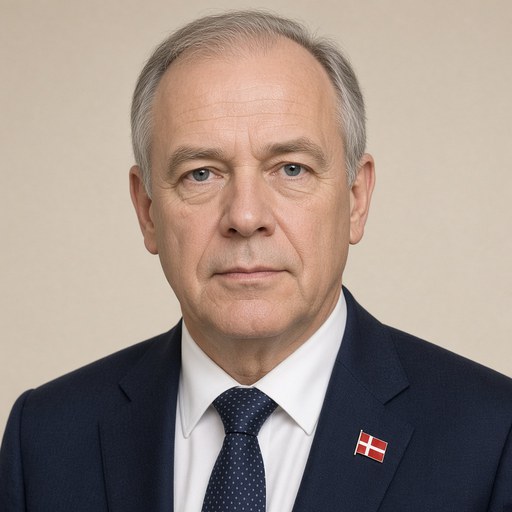
The Prime Minister's speech to the inquiry debate F 47 on April 6, 2000.
 Poul Nyrup Rasmussen · Prime Minister of Denmark
- Context
- Rasmussen addressed the Danish Folketing on April 6, 2000, during an inquiry debate on ongoing negotiations over the future constitutional relationship between Denmark and the Faroe Islands.
- Main themes
- Faroese self-determination, future of the Danish Realm, Denmark-Faroe Islands relationship, sovereignty negotiations, Home Rule history, globalization and small nations, solidarity and mutual respect, Faroese identity, associated state status
- Duration
- ~13 min
- Words
- 1,525
- Sentences
- 82
- Readability
- 45
- Grade
- 10.9
- Syntax
- 2.77
- Vocabulary
- 2.27
Translated from Danish
The broad sphere of national life a sentence belongs to. Every sentence has an Arena, so it is the denominator the other indices are read against.
Other82 sentences in 35 paragraphs
"What can the government inform about the upcoming negotiations between the Faroese government and the government regarding a changed relationship between Denmark and the Faroe Islands?"
This is a historic debate we are embarking on today. In the Faroe Islands, the debate has been ongoing for a long time. Here in Denmark, in the Folketing, we are now engaging in the discussion about our future relationship with the Faroe Islands.
It is 600 years of community between the Faroe Islands and Denmark that is now on the agenda.
Therefore, it is also natural that we now carefully consider what paths are emerging for the future of the community between the Faroe Islands and Denmark.
When one finds oneself at a crossroads, one must stop and look around before deciding which way to choose for the journey ahead. Reflect on the experiences one has had along the way. And at the same time, look ahead, take stock of the paths that open up, and assess the choices that must be made in light of the new international world we now find ourselves in.
The Faroe Islands are at a crossroads. The community with Denmark and thus the future of the realm is on the agenda. The people of the Faroe Islands must make a decision – a choice that has decisive significance for the Faroe Islands and our common future. A choice that can only and must be made in the Faroe Islands.
So where do we stand right now – from Denmark's perspective? What do we think about our community - our Realm and its future?
The Realm is not an unchangeable entity for us. It is a community that has always been able to adapt to the new times. It has been in development. History bears witness to that. Within the Home Rule Act, our cooperation has developed over more than 50 years.
The value of the Realm cannot be quantified in numbers and paragraphs. What our community is built on, what has sustained us along the way, is solidarity, mutual respect, and the right to self-determination. We have stood together for over 600 years.
There have been many dramas and conflicts along the way – also in the history of Home Rule.
And when the discussion has heated up, one suddenly meets a person in everyday life who says 'I am a Faroese.' Or a colleague at work notes that he is also a Faroese. And another talks about a cousin who is married to a Faroese. One does not think about it in everyday life. But the community is strong - and the conflicts have nevertheless been resolved every time. And life and cooperation have continued into a new period.
We have something to offer each other in the Realm. What binds us together are the strong cultural and common historical ties.
But it is more than that: The community consists of thousands of touchpoints in our families, in schools and educational institutions, during summer vacations, at workplaces, and many other areas of everyday life. Many thousands of Faroese – about 20 percent of the total Faroese population live in Denmark.
Precisely because we are part of a large community, it is important that we respect each other and understand our motives both in Denmark and in the Faroe Islands when our connections need to find a new form.
* * *
When the new path is to be found, it is also important that we know the new international landscape at the beginning of the 21st century.
The world has changed fundamentally in just 10 years. Globalization is a reality. Competition is tougher, international economics reigns. There is pressure on all societies – including our own welfare societies.
One thing is certain for me: International influence for small and lesser nations does not come by itself.
It requires many resources, it requires a lot of political work to assert oneself in the global community today.
I clearly feel that solidarity makes us better equipped to cope in an increasingly harsh international world, where competition has become extremely fierce.
* * *
I have said it before - I would like to repeat it today during this important debate: The government prefers that the Faroe Islands remain in the Realm with Denmark and Greenland. But I deliberately use the formulation 'prefers.' To emphasize that the decision should not be made in Denmark.
The real decision about the Faroe Islands' future relationship with Denmark is made entirely in the Faroe Islands – ultimately by the Faroese people.
* * *
After these principled introductory remarks, I would like to outline the government's position on the government's proposal.
Negotiations about the future relations between Denmark and the Faroe Islands were initiated at a meeting with the Faroese government on March 17, where the government presented its draft treaty to the government, clearly and distinctly.
It appears from the draft treaty, which has been sent to the Folketing, that the government wishes for the Faroe Islands to be established as a free and sovereign state, that an associated state connection be established between Denmark and the Faroe Islands, which will entail that the Danish monarch is also the monarch of the Faroe Islands that the monetary relations between Denmark and the Faroe Islands are continued that cooperation agreements are entered into in the following areas:
<ul><li>foreign affairs
courts, prosecution, and police supervision of financial enterprises and the deposit guarantee scheme healthcare the social sector aviation ship safety.
The question of an economic transitional arrangement has also been addressed in the government's draft treaty. It proposes an arrangement that will mean an immediate write-off of the entire Faroese debt to Denmark of over 4 billion DKK.
a reduced block grant of 650 million DKK, which will be maintained until it constitutes 3% of the Faroese GDP.
The question of an economic transitional arrangement has also been addressed in the government's draft treaty. It proposes an arrangement that will mean So much for the government's proposal. - And now to the government's position. * * * From the beginning of the process we are now in, I have repeated the fundamental principle: Every choice has its consequences. Sovereignty and responsibility must go hand in hand. A Faroese choice of sovereignty must necessarily have consequences in the economic area, in the administrative area, and in the cooperative relations between our countries. The establishment of the Faroe Islands as a sovereign state will mean that the Faroe Islands take over competence for all areas concerning the Faroe Islands. This also applies to the areas that are currently financed by the Danish state via the block grant or managed by Danish authorities. With the political responsibility for the new areas also comes the economic responsibility - the financing obligation. This is what lies in the principle of the connection between responsibility and economy. During the inquiry debate on January 27, 1998, the Folketing adopted, among other things, that the government should renegotiate the total Faroese debt repayment so that it would occur in a reasonable relation to the Faroese economy's capacity. The government and the Faroese government entered into an agreement on this on June 10, 1998, which includes a restructuring of the Faroese debt, and - in relation to the negotiations about the future relationship between Denmark and the Faroe Islands - a transitional arrangement that aims to build a self-sustaining Faroese economy. The agreement supports, in other words, the positive development that the Faroe Islands were already experiencing at that time. After a deep crisis, which everyone here in the Folketing remembers - and the resulting hardships for the population in the early 1990s, it has been possible to turn the development around. It should also be said from this podium today: It was a significant achievement that the Faroese people can only be proud of today. It shows the survival capacity, a resilience that exists on the islands in the North Atlantic and why the Faroese – under the far from easy, natural conditions – have nevertheless developed society into a modern welfare society. It should also be said today that in recent years there have been solid surpluses in the treasury, employment has increased, and the islands' total foreign debt has turned into a net asset. It is a development that the Faroese can rightly be proud of. The Faroese economy is on the right track. It also shows that the Danish assistance during the hard years has proven to be beneficial. I began today by saying that the community between the Faroe Islands and Denmark cannot simply be put into paragraphs and money. But when the choices for the future are to be made, we cannot avoid also addressing the economic side of the matter. Our position is clear: The main content of the future economic relations between Denmark and a sovereign Faroe Islands must be that
The block grant is abolished.
All services that the Faroe Islands agree to have provided by Denmark must be financed by the Faroe Islands.
Existing agreements between the state and the Faroe Islands will be revisited for renegotiation.
The original Danish. The tags above are read on the English translation's sentences.
'Hvad kan regeringen oplyse om de forestående forhandlinger mellem Færøernes landsstyre og regeringen om en ændret tilknytning mellem Danmark og Færøerne?'
Det er en historisk debat, vi tager fat på i dag. På Færøerne har debatten været i gang længe. Her i Danmark, i Folketinget, tager vi nu fat på debatten om vort fremtidige forhold til Færøerne.
Det er 600 års fællesskab mellem Færøerne og Danmark, som nu er sat på dagsordenen.
Derfor er det også naturligt, at vi nu overvejer grundigt, hvilke veje der tegner sig i fremtiden for fællesskabet mellem Færøerne og Danmark.
Når man befinder sig ved en korsvej, må man stoppe op og se sig omkring, før man beslutter, hvilken vej man skal vælge på sin videre færd. Tænke over de erfaringer, man har gjort sig undervejs. Og samtidig se fremad, tage bestik af de veje, der åbner sig, og vurdere de valg, der skal træffes i lyset af den nye internationale verden, vi nu befinder os i.
Færøerne er ved en korsvej. Fællesskabet med Danmark og dermed rigsfællesskabets fremtid er sat på dagsordenen. Færøernes befolkning skal træffe en beslutning – et valg, som har afgørende betydning for Færøerne og vor fælles fremtid. Et valg, som i virkeligheden kun kan og skal træffes på Færøerne.
Hvor står vi så lige nu – set fra Danmark? Hvad mener vi om vort fællesskab - vort Rigsfællesskab og dets fremtid?
Rigsfællesskabet er for os ikke en uforanderlig størrelse. Det er et fællesskab, der hele tiden har evnet at tilpasse sig den ny tid. Det har været i udvikling. Det vidner historien om. Inden for Hjemmestyreloven har vort samarbejde udviklet sig gennem mere end 50 år.
Rigsfællesskabets værdi kan ikke gøres op i tal og paragraffer. Dét, vort fællesskab bygger på, dét, der har båret undervejs, er samhørigheden, den gensidige respekt og retten til selvbestemmelse. Vi har holdt sammen i over 600 år.
Der har været mange dramaer og konflikter undervejs – også i Hjemmestyrets historie.
Og når diskussionen er gået højt, møder man pludselig et menneske i hverdagen, som siger 'jeg er færing'. Eller en kollega på arbejdspladsen bemærker, at han forresten også er færing. Og en anden taler om en kusine, der er gift med en færing. Det tænker man ikke over i hverdagen. Men fællesskabet er stærkt - og konflikterne er dog alligevel blevet løst hver gang. Og livet og samarbejdet er fortsat i en ny periode.
Vi har noget at give hinanden i Rigsfællesskabet. Dét, der binder os sammen, er de stærke kulturelle og de fælles historiske bånd.
Men det er mere end det: Fællesskabet er tusinde berøringsflader i vore familier, i skole og uddannelsessteder, i sommerferien, på arbejdspladserne og mange andre områder i hverdagen. Mange tusinde færinger – ca. 20 procent af den samlede færøske befolkning bor i Danmark.
Netop fordi vi er en del af et stort fællesskab, er det vigtigt, at vi respekterer hinanden og forstår vore motiver både i Danmark og på Færøerne, når vore forbindelser mellem os skal finde en ny form.
* * *
Når den nye vej skal findes, er det også vigtigt, at vi kender det nye interna-
tionale landskab ved starten af det 21. århundrede
Verden har forandret sig helt afgørende på blot 10 år. Globaliseringen er en realitet. Konkurrencen er hårdere, international økonomi hersker. Der er pres på alle samfund – også på vore egne velfærdssamfund.
Én ting er for mig helt sikkert: International gennemslagskraft for små og mindre nationer kommer ikke af sig selv.
Det kræver mange ressourcer, det kræver meget politisk arbejde at gøre sig gældende i verdenssamfundet i dag.
Jeg føler helt klart, at sammenholdet gør os bedre rustede til at klare os i en international barskere verden, hvor konkurrencen er blevet voldsomt skærpet.
* * *
Jeg har sagt det før - jeg vil gerne gentage det i dag under denne vigtige debat: Regeringen ser helst, at Færøerne bliver i Rigsfællesskabet med Danmark og Grønland. Men jeg bruger bevidst formuleringen 'ser helst'. For at understrege, at beslutningen ikke skal træffes i Danmark.
Den reelle beslutning om Færøernes fremtidige tilknytning til Danmark træffes helt og holdent på Færøerne – i sidste ende af den færøske befolkning.
* * *
Efter disse principielle, indledende bemærkninger vil jeg gerne redegøre for regeringens stilling til landsstyrets forslag.
Forhandlingerne om de fremtidige relationer mellem Danmark og Færøerne blev indledt på et møde med det færøske landsstyre den 17. marts, hvor landsstyret fremlagde sit traktatudkast for regeringen, klart og tydeligt.
Det fremgår af udkastet til traktat, som er sendt til Folketinget, at landsstyret ønsker, at Færøerne oprettes som en fri og suveræn stat, at der etableres en associeret statsforbindelse mellem Danmark og Færøerne, der vil indebære
at den danske regent tillige er regent over Færøerne
at de monetære relationer mellem Danmark og Færøerne videreføres
at der indgås samarbejdsaftaler på følgende områder:<ul><li>udenrigsanliggender
domstole, anklagemyndighed og politi
tilsynet med finansielle virksomheder og indskydergarantiordningen
sundhedsområdet
det sociale område
luftfartsområdet
skibes sikkerhed.
Spørgsmålet om en økonomisk overgangsordning er også behandlet i landsstyrets traktatudkast. Der lægges op til en ordning, der vil betyde
en straks-afskrivning af hele den færøske gæld til Danmark på godt 4 mia. kr.
et reduceret bloktilskud på 650 mio. kr., som opretholdes indtil dette udgør 3 % af det færøske BNP.
Spørgsmålet om en økonomisk overgangsordning er også behandlet i landsstyrets traktatudkast. Der lægges op til en ordning, der vil betydeSå vidt landsstyrets udspil. - Og så til regeringens holdning.* * *Fra begyndelsen af den proces vi nu er i, har jeg gentaget det principielle grundsynspunkt: Ethvert valg har sine konsekvenser.Suverænitet og ansvar må følges ad. Et færøsk valg af suverænitet må nødvendigvis have konsekvenser på det økonomiske område, på det administrative område og på samarbejdsrelationerne mellem vore lande.Etableringen af Færøerne som suveræn stat vil indebære, at Færøerne overtager kompetencen for samtlige områder, der vedrører Færøerne. Det gælder også de områder, der i dag finansieres af den danske stat via bloktilskuddet eller varetages af danske myndigheder.Med det politiske ansvar for de nye områder følger med andre ord også det økonomiske ansvar - finansieringsforpligtelsen. Det er det, der ligger i princippet om sammenhængen mellem ansvar og økonomi.Under forespørgselsdebatten den 27. januar 1998 vedtog Folketinget bl.a., at regeringen skulle genforhandle den samlede færøske gældsafvikling, så den ville ske i et rimeligt forhold til færøsk økonomis bæreevne.Regeringen og landsstyret indgik en aftale herom den 10. juni 1998, der bl.a. indebærer en sanering af den færøske gæld, og - i relation til forhandlingerne om det fremtidige tilknytningsforhold mellem Danmark og Færøerne - en overgangsordning, der tilstræber opbygning af en selvbærende færøsk økonomi.Aftalen understøtter med andre ord den positive udvikling, som Færøerne allerede på det tidspunkt var inde i. Efter en dyb krise, som alle her i Folketinget erindrer - og heraf følgende afsavn for befolkningen i begyndelsen af 1990’erne, er det lykkedes at få vendt udviklingen.Det skal også siges her fra talerstolen i dag: Det var en betydelig præstation, som den færøske befolkning i dag kun kan være stolte af. Den viser, hvilken overlevelsesevne, en overlevelseskraft, der eksisterer på øerne i Nordatlanten og hvorfor færingerne – under de langtfra nemme, naturgivne betingelser – alligevel har udviklet samfundet til et moderne velfærdssamfund.Det skal også siges i dag, at der i de senere år har været solide overskud i landskassen, beskæftigelsen er steget, og øernes samlede udlandsgæld er vendt til et nettotilgodehavende. Det er en udvikling, som færingerne med rette kan være stolte af. Færøernes økonomi er på ret spor. Det viser også, at den danske bistand i de hårde år, har vist sig at være til nytte.Jeg indledte i dag med at sige, at fællesskabet mellem Færøerne og Danmark ikke bare kan sættes i paragraffer og penge. Men når valgene for fremtiden skal foretages, så slipper vi ikke for også at forholde os til den økonomiske side af sagen.Vor holdning er klar:Hovedindholdet for de fremtidige økonomiske forhold mellem Danmark og et suverænt Færøerne må være, at
Bloktilskuddet falder bort.
Alle tjenester, som Færøerne efter aftale får varetaget af Danmark, må finansieres af Færøerne.
Eksisterende aftaler mellem staten og Færøerne tages op med henblik på genforhandling.