




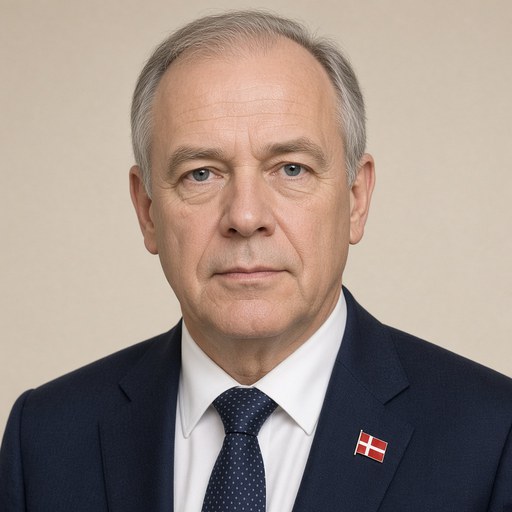
Prime Minister Poul Nyrup Rasmussen's speech at the Nordic Council's 52nd session on November 6, 2000.
 Poul Nyrup Rasmussen · Prime Minister of Denmark
- Context
- Rasmussen addressed the Nordic Council's 52nd session in Reykjavik on November 6, 2000, reviewing Denmark's Nordic Council presidency themes.
- Main themes
- Nordic welfare state, globalization and societal change, Nordic cooperation, education and lifelong learning, sustainable development, Nordic neighboring area strategy, Kaliningrad and Northern Dimension, individual freedom and solidarity, Baltic partnership, high employment, environmental initiatives, research and innovation
- Duration
- ~9 min
- Words
- 1,058
- Sentences
- 80
- Readability
- 41
- Grade
- 10.0
- Syntax
- 2.43
- Vocabulary
- 2.23
Translated from Danish
The broad sphere of national life a sentence belongs to. Every sentence has an Arena, so it is the denominator the other indices are read against.
Other80 sentences in 30 paragraphs
The barometer is set for renewal
Madam President, dear colleagues in the Nordic Council,
The barometer is set for change. Globalization sets entirely new conditions for the individual and the development of society. We in the Nordic countries are well prepared for this development.
* * *
The theme of the Danish presidency has been the Nordic welfare states. There are not many welfare states in the world – most of them are in the Nordic region. The 21st century is ours. It belongs to us. Eastern Europe has experienced communism. Southern Europe has felt fascism. Others have experienced extreme liberalism and conservatism. Today, the welfare state is a common goal for the vast majority in Europe. So let us not have any doubts. We have something to offer.
The Nordic welfare model rests on clear common values.
The starting point for our strategy is solidarity and community. Community is the fundamental prerequisite for us to expand freedom and opportunities for the individual. The vision for the 21st century is a sustainable welfare society that develops partnerships – partnerships that create cohesion and belonging among people at all levels in our societies.
The individual must be placed at the center. The individual is the core of the Nordic welfare societies – precisely the theme that the Finnish presidency also wishes to focus on with 'Nordbo 2001'.
* * *
Nordic cooperation has been characterized by activity both in depth and breadth during the Danish presidency. We have initiated new initiatives in important areas such as the environment, energy, culture, information technology, education, and research.
Denmark has sought to contribute to ensuring that the Nordic welfare model will shape development in the 21st century. We have the opportunity to create the frameworks that provide security for all. High employment creates the best conditions for our societies to be organized socially justly.
* * *
We must secure our values in a new reality. Therefore, the consequences of – and also the response to – globalization have been an important theme for the Danish presidency. We must organize our societies in such a way that we avoid the negative sides of globalization, including a polarization of our societies. We must work nationally and internationally to set frameworks and regulate the market economy so that we achieve socially just and sustainable development.
We must equip our citizens to learn to live with the changes brought about by globalization.
It is particularly through education and research that we in the Nordic countries must find the answers to the challenges of globalization. We cannot and should not compete with the low wages found elsewhere in the world. We must compete with a skilled and well-educated workforce.
The ability to change jobs, the ability to acquire new technology, and education are all central in this context.
Therefore, several programs and activities regarding education and research have been initiated under the Danish presidency. Lifelong education and research are cornerstones in the survival of the welfare state. We must maintain the goals of a common Nordic educational space, binding cooperation, transparency in educational systems, and mutual recognition of studies and examinations.
* * *
Based on the Prime Minister's declaration from 1998, the work on the strategy for a sustainable Nordic region has been an important priority for the Danish presidency. We must ensure broadly that the development in the Nordic societies is sustainable and that we can ensure quality of life and progress for future generations. The work on the strategy is now largely completed. The ministers for cooperation and the environment will address the issue in the coming days. The strategy will then be forwarded to the Nordic Council, which has expressed a desire to base the spring thematic conference on it.
The revision of the Council of Ministers' strategy for cooperation with the Nordic neighboring areas has been an important priority for the Danish presidency. There are now concrete proposals for a revised Nordic neighboring area strategy. It is proposed, among other things, that the focus of neighboring area cooperation gradually shifts to the Russian neighboring area – and that cooperation with the Baltic countries develops into a more equal partnership. We should not have less, but more cooperation. I look forward to the outcome of the discussion that the Nordic Council has planned around these issues here in Reykjavik.
The Danish presidency has also sought to focus on the specific problems in the Kaliningrad area. Together with the EU Commission and the Nordic Council of Ministers, we held a conference in May in Copenhagen on the EU's Northern Dimension and Kaliningrad. The conference aimed to discuss European and regional cooperation opportunities with Kaliningrad. The results of the conference will be included in the further work on the Northern Dimension.
The Nordic countries' neighboring area cooperation also includes the Arctic region. The Danish presidency has worked to strengthen the Arctic Council and Arctic cooperation within the framework of the Nordic Council of Ministers. The prospects for establishing an 'Arctic window' in the Northern Dimension, as desired by Greenland, have improved. Thus, the EU Commission participated for the first time last month as an observer at the ministerial meeting of the Arctic Council in Alaska.
* * *
Let me take this opportunity to thank you for the good cooperation during the Danish presidency.
The experience from the Danish presidency is quite simple – and we actually knew it well beforehand: Each of the Nordic countries has limited resources. The challenges are great and diverse. Many of them are cross-border. No one can solve them alone. But together we can achieve more. Together we can make a difference.
The Danish presidency now passes the baton to Finland. I am convinced that Finland will know how to bear the great responsibility and carry the Nordic cooperation forward in the best possible way.
There are not many welfare states in the world. The 21st century is on our side. We have something to learn. But we also have much to offer. Our welfare has always flourished in cooperation with others. We have not isolated ourselves. We in the Nordic region have shown that we can indeed make a difference.
Madam President,
As Einar Már Gudmundson, who received the Nordic Council's Literature Prize in 1995, says: 'The Nordic region is in order.'
Thank you for your attention.
The original Danish. The tags above are read on the English translation's sentences.
Barometret står på fornyelse
Fru præsident, kære kolleger i Nordisk Råd,
Barometret står på forandring. Globaliseringen sætter helt nye betingelser for det enkelte menneske og samfundets udvikling. Vi er i Norden godt forberedt på den udvikling.
* * *
Temaet for det danske formandskab har været de nordiske velfærdsstater. Der er ikke så mange velfærdsstater i verden – de fleste af dem ligger i Norden. Det 21. århundrede er vores. Det tilhører os. Østeuropa har prøvet kommunismen. Sydeuropa har følt fascismen. Andre har prøvet den ekstreme liberalisme og konservatisme. I dag er velfærdsstaten for langt de fleste i Europa et fælles mål. Så skal vi ikke komme i tvivl. Vi har noget at byde på.
Den nordiske velfærdsmodel hviler på klare fælles værdier.
Udgangspunktet for vor strategi er solidaritet og fællesskab. Fællesskabet er den grundlæggende forudsætning for, at vi kan udbygge friheden og udfoldelsesmulighederne for den enkelte. Visionen for det 21. århundrede er et holdbart velfærdssamfund, der udvikler partnerskaber – partnerskaber som skaber sammenhængskraft og samhørighed mellem mennesker på alle niveauer i vore samfund.
Mennesket skal sættes i centrum. Mennesket er kernen i de nordiske velfærdssamfund – netop det tema som også det finske formandskab ønsker at sætte i fokus med ’Nordbo 2001’.
* * *
Det nordiske samarbejde har under det danske formandskab været præget af aktivitet såvel i dybden som i bredden. Vi har iværksat nye initiativer inden for vigtige områder som miljø, energi, kultur, informationsteknologi, uddannelse og forskning.
Danmark har ønsket at give sit bidrag til, at den nordiske velfærdsmodel kommer til at præge udviklingen i det 21. århundrede. Vi har mulighed for at skabe de rammer, som giver tryghed for alle. En høj beskæftigelse skaber de bedste forudsætninger for, at vore samfund kan indrettes socialt retfærdigt.
* * *
Vi skal sikre vore værdier i en ny virkelighed. Derfor har konsekvenserne af - og også svaret på - globaliseringen været et vigtigt tema for det danske formandskab. Vi skal indrette vore samfund, således at vi undgår globaliseringens negative sider, herunder en polarisering af vore samfund. Vi skal nationalt og internationalt arbejde for at sætte rammer og regulere markedsøkonomien, så vi får en socialt retfærdig og bæredygtig udvikling.
Vi skal ruste vores borgere til at lære sig at leve med forandringen fra globaliseringen.
Det er ikke mindst gennem uddannelse og forskning, at vi i de nordiske lande skal finde svaret på globaliseringens udfordringer. Vi kan og skal ikke konkurrere med de lave lønninger, som man finder andre steder i verden. Vi skal konkurrere med en dygtig og veluddannet arbejdskraft.
Evnen til jobskifte, evnen til at tilegne sig ny teknologi samt uddannelse er helt centralt i denne sammenhæng.
Derfor er der under det danske formandskab iværksat flere programmer og aktiviteter vedrørende uddannelse og forskning. Livslang uddannelse og forskning er krumtapper i velfærdsstatens overlevelse. Vi må fastholde målsætningerne om et fælles nordisk uddannelsesrum, forpligtende samarbejde, gennemsigtighed i uddannelsessystemerne og gensidig anerkendelse af studier og eksaminer.
* * *
På baggrund af statsministerdeklarationen fra 1998 har arbejdet med strategien for et holdbart Norden været en vigtig prioritet for det danske formandskab. Vi må over en bred front sikre, at udviklingen i de nordiske samfund er bæredygtig, og at vi kan sikre livskvalitet og fremgang for kommende generationer. Arbejdet med strategien er nu stort set tilendebragt. Samarbejdsministrene og miljøministrene vil behandle spørgsmålet i de kommende dage. Strategien vil herefter blive fremsendt til Nordisk Råd, som har ønsket at lægge den til grund for forårets temakonference.
Revisionen af Ministerrådets strategi for samarbejdet med Nordens nærområder har været en vigtig prioritet for det danske formandskab. Der foreligger nu konkrete forslag til en revideret nordisk nærområdestrategi. Det foreslås blandt andet, at tyngdepunktet for nærområdesamarbejdet gradvis flyttes til det russiske nærområde – og at samarbejdet med de baltiske lande udvikles til et mere ligeværdigt samarbejde. Vi skal ikke have mindre, men mere samarbejde. Jeg ser frem til resultatet af den drøftelse, som Nordisk Råd har planlagt omkring disse spørgsmål her i Reykjavik.
Det danske formandskab har desuden ønsket at rette fokus mod de særlige problemer i Kaliningrad-området. Sammen med EU-Kommissionen og Nordisk Ministerråd afholdt vi i maj måned i København en konference om EU’s Nordlige Dimension og Kaliningrad. Konferencen tog sigte på at drøfte europæiske og regionale samarbejdsmuligheder med Kaliningrad. Resultatet af konferencen vil indgå i det videre arbejde med Den Nordlige Dimension.
De nordiske landes nærområdesamarbejde omfatter også det arktiske område. Det danske formandskab har arbejdet for, at Arktisk Råd og det arktiske samarbejde inden for rammerne af Nordisk Ministerråd styrkes. Udsigterne til at der - som ønsket af Grønland - vil kunne etableres et såkaldt 'arktisk vindue' i Den Nordlige Dimension er blevet forbedret. Således deltog EU-Kommissionen i sidste måned for første gang som observatør under ministermødet i Arktisk Råd i Alaska.
* * *
Lad mig til slut benytte lejligheden til at takke for godt samarbejde under det danske formandskab.
Erfaringen fra det danske formandskab er ganske enkel – og vi kendte den faktisk godt i forvejen: Hver for sig har de nordiske lande begrænsede ressourcer. Udfordringerne er store og mangeartede. Mange af dem er grænseoverskridende. Ingen kan løse dem alene. Men sammen kan vi mere. I fællesskab kan vi gøre en forskel.
Det danske formandskab giver nu stafetten videre til Finland. Jeg er overbevist om, at Finland vil vide at bære det store ansvar og på bedste måde bringe det nordiske samarbejde videre.
Der er ikke så mange velfærdsstater i verden. Det 21. århundrede er på vores side. Vi har noget at lære. Men vi har også meget at byde på. Vores velfærd har altid blomstret i samvirke med andre. Vi har ikke isoleret os. Vi har i Norden vist, at vi godt kan gøre forskel.
Fru præsident,
Som Einar Már Gudmundson, der modtog Nordisk Råds litteraturpris i 1995, siger: 'Norden er i orden'.
Tak for jeres opmærksomhed.