




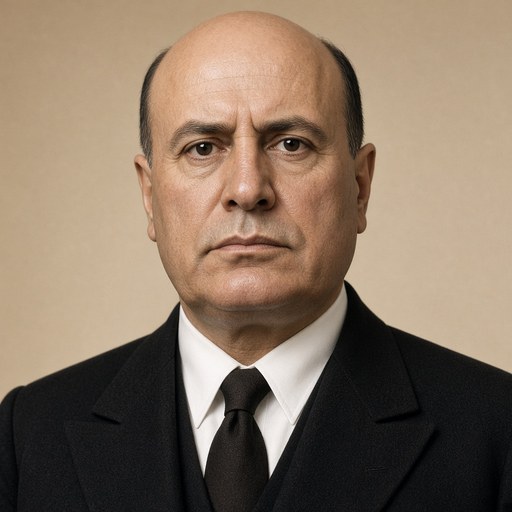

- Context
- Mussolini addressed Italians by radio on September 18, 1943, dateline Munich, after his rescue by German forces, denouncing the King and Badoglio's armistice and announcing a new Fascist republican state and renewed war alongside Germany.
- Main themes
- Mussolini's arrest and detention after 25 July, rescue from the Gran Sasso by German glider troops, responsibility of the House of Savoy, Badoglio government and the armistice, betrayal of Germany, loss of Italian territories and disbanding of the army, surrender of the Royal Navy at Malta, republican tradition and Mazzini, Fascist social state, continuing the war alongside Germany and Japan, elimination of traitors, abolition of plutocracies and primacy of labour
- Duration
- ~16 min
- Words
- 1,911
- Sentences
- 72
- Readability
- 45
- Grade
- 13.4
- Syntax
- 3.27
- Vocabulary
- 2.32
Translated from Italian Source: it.wikisource.org ↗
The broad sphere of national life a sentence belongs to. Every sentence has an Arena, so it is the denominator the other indices are read against.
Other72 sentences in 41 paragraphs
Munich, 18 September 1943
Blackshirts, Italian men and women!
After a long silence, my voice reaches you once again, and I am sure you will recognise it: it is the voice that rallied you in difficult moments and that celebrated with you the triumphant days of the Fatherland.
I waited a few days before addressing you because, after a period of moral isolation, it was necessary for me to regain contact with the world.
The radio does not allow for long speeches. Without recalling the earlier events for now, I come to the afternoon of 25 July, on which there occurred what, in my already rather adventurous life, is the most incredible of adventures.
The conversation I had with the King at Villa Savoia lasted twenty minutes, perhaps less. I found a man with whom all reasoning was impossible, since he had already made his decisions. The outbreak of the crisis was imminent.
It has happened before, in peace and in war, that a minister has resigned or a commander has been sacked, but it is unique in history that a man who, like the one speaking to you, had for twenty-one years served the King with absolute, I say absolute, loyalty, should be arrested on the threshold of the King's private house, forced to climb into a Red Cross ambulance on the pretext of shielding him from a plot, and driven at breakneck speed first to one carabinieri barracks, then to another.
I immediately had the impression that this protection was in reality nothing but detention. That impression grew when I was taken from Rome to Ponza, and later, through my wanderings from Ponza to La Maddalena and from La Maddalena to the Gran Sasso, I became convinced that the plan devised included handing my person over to the enemy.
I had, however, the distinct sense, even though I was completely cut off from the world, that the Führer was concerned about my fate. Göring sent me a telegram that was more than comradely, it was brotherly. Later the Führer had a truly monumental edition of the works of Nietzsche delivered to me.
The word "loyalty" has a profound, unmistakable, I would even say eternal, meaning in the German soul; it is the word that, in the collective and in the individual, sums up the German spiritual world.
I was convinced that I would have proof of it. Once I learned the terms of the armistice, I did not doubt for a single minute what lay hidden in the text of Article 12. Besides, a high official had told me: "You are a hostage."
During the night of 11 to 12 September I let it be known that the enemy would never have me alive in their hands. In the clear air around the imposing summit of the mountain there was a kind of expectation. It was 2 p.m. when I saw the first glider land, then others after it; then squads of men advanced towards the refuge, determined to break any resistance.
The guards watching over me understood this, and not a single shot was fired. It all lasted 5 minutes: the operation, which revealed German organisation, spirit of initiative and decisiveness, will remain memorable in the history of the war. In time it will become legendary.
Here ends the chapter that might be called my personal drama, but it is a quite negligible episode compared to the appalling tragedy into which the democratic, liberal and constitutional government of 25 July has thrown the entire nation. At first I did not believe that the government of 25 July had such catastrophic plans with regard to the party, the regime, the nation itself. But after a few days the first measures showed that a programme was being carried out aimed at destroying the work accomplished by the regime over twenty years and erasing twenty years of glorious history that had given Italy an empire and a place in the world such as it had never had.
Today, before the ruins, before the war that goes on with us as spectators on our own territory, some would like to split hairs in search of compromise formulas and mitigating circumstances as regards responsibilities, and thus to continue in ambiguity.
While we fully claim our own responsibility, we wish to set out precisely that of others, beginning with the Head of State, since it has turned out that, not having abdicated, as the majority of Italians expected, he can and must be called directly to account.
It is this same dynasty that, throughout the whole period of the war, although it was the King who declared it, was the chief agent of defeatism and anti-German propaganda. Its indifference to the course of the war, its prudent and not always prudent mental reservations, lent themselves to every speculation by the enemy, while the heir, who had even wished to take command of the armies of the south, never once appeared on the battlefields.
I am now more convinced than ever that the House of Savoy wanted, prepared and organised the coup d'état down to the smallest detail, with Badoglio as accomplice and executor, and as accomplices certain cowardly generals who shirked the front and certain elements of Fascism who had turned craven. There can be no doubt whatsoever that the King authorised, immediately after my capture, the armistice negotiations, negotiations which perhaps had already begun between the two dynasties of Rome and London.
It was the King who advised his accomplices to deceive Germany in the most wretched manner, denying, even after the signing, that negotiations were under way.
It is the dynastic clique that premeditated and carried out the demolition of the regime which, twenty years ago, had nevertheless saved it, and created the powerful internal diversion based on the return of the Statute of 1848 and of liberty protected by a state of siege. As for the terms of the armistice, which were supposed to be generous, they are among the harshest history records. The King raised no objection of any kind, not even, needless to say, regarding the premeditated handing over of my person to the enemy. It is the King who, with his act, dictated by concern for the future of his Crown, has created for Italy a situation of chaos and of internal shame, which can be summed up as follows: on every continent, from the far reaches of Asia to America, people know what keeping faith with agreements means where the House of Savoy is concerned.
The enemies themselves, now that we have accepted the shameful capitulation, do not hide their contempt for us, nor could it be otherwise. England, for example, which no one intended to attack, and the Führer least of all, entered the field, according to Churchill's own statements, because of its word given to Poland.
From now on it may happen that every Italian is held under suspicion even in private dealings. If all this had consequences only for the group of those responsible, the harm would not be serious; but we must not delude ourselves: all of this is being paid for by the Italian people, from the first to the last of its citizens.
After our compromised honour, we have lost, besides the metropolitan territories occupied and plundered by the enemy, also, and perhaps forever, all our Adriatic, Ionian, Aegean and French positions, which we had conquered not without sacrifices of blood.
The Royal Army has almost everywhere rapidly disbanded. And nothing is more humiliating than being disarmed by a betrayed ally amid the scorn of the local populations.
This humiliation must have been especially bitter for those officers and soldiers who had fought valiantly alongside their German comrades on so many battlefields.
Even in the cemeteries of Africa and Russia, where Italian and German soldiers lie together after their last battle, the weight of this ignominy must have been felt.
The Royal Navy, built entirely during the Fascist twenty years, surrendered itself to the enemy at Malta, which constituted, and will constitute even more, the permanent threat against Italy and the stronghold of English imperialism in the Mediterranean.
Only the air force managed to save a good part of its equipment, but it too is practically disorganised. These are the indisputable responsibilities, irrefutably documented also in the speech of the Führer, who recounted hour by hour the deception laid against Germany, a deception reinforced by the deadly bombings which the Anglo-Americans, in agreement with Badoglio's government, continued, despite the signing of the armistice, against large and small towns of central Italy.
Under these conditions, it is not the regime that betrayed the monarchy, but the monarchy that betrayed the regime, so much so that today it has fallen in the conscience of the people, and it is simply absurd to suppose that this could in the slightest way compromise the unity of the Italian people. When a monarchy fails in its duties, it loses all reason to exist. As for traditions, there are more republican than monarchical ones: more than by the monarchists, the unity and independence of Italy were willed, against all the more or less foreign monarchies, by the republican current, which had its pure and great apostle in Giuseppe Mazzini.
The State we wish to establish will be national and social in the broadest sense of the word: that is, it will be Fascist in the sense of our origins. While we wait for the movement to grow until it becomes irresistible, our postulates are the following:
1) to take up arms again alongside Germany, Japan and the other allies: only blood can erase so shameful a page in the history of the Fatherland;
2) to prepare, without delay, the reorganisation of our Armed Forces around the formations of the Militia; only he who is driven by a faith and fights for an idea does not measure the extent of the sacrifice;
3) to eliminate the traitors, and in particular those who until 9.30 p.m. on 25 July served, sometimes for many years, in the ranks of the party and have gone over to the ranks of the enemy;
4) to annihilate the parasitic plutocracies and to make labour, at last, the subject of the economy and the unbreakable foundation of the State.
Faithful Blackshirts of all Italy!
I call you once again to work and to arms. The enemy's jubilation at Italy's capitulation does not mean that it already holds victory in its fist, for the two great empires, Germany and Japan, will never capitulate.
You, squadristi, reconstitute your battalions that have accomplished heroic deeds.
You, young Fascists, join the ranks of the divisions that must renew, on the soil of the Fatherland, the glorious feat of Bir el Gobi.
You, airmen, return alongside your German comrades to your cockpits, to make the enemy's action against our cities vain and costly.
You, Fascist women, resume your work of moral and material assistance, so necessary to the people. Peasants, workers and minor clerks, the State that will emerge from this immense ordeal will be yours, and as such you will defend it against anyone who dreams of impossible returns. Our will, our courage and your faith will give back to Italy its face, its future, its possibilities of life and its place in the world. More than a hope, this must be, for all of you, a supreme certainty.
Long live Italy! Long live the Republican Fascist Party!
The original Italian. The tags above are read on the English translation's sentences.
Monaco, 18 settembre 1943
Camicie Nere, Italiani e Italiane!
Dopo un lungo silenzio, ecco che nuovamente vi giunge la mia voce e sono sicuro che la riconoscerete: è la voce che vi ha chiamato a raccolta nei momenti difficili e che ha celebrato con voi le giornate trionfali della Patria.
Ho tardato qualche giorno prima di indirizzarmi a voi perché, dopo un periodo di isolamento morale, era necessario che riprendessi contatto col mondo.
La radio non ammette lunghi discorsi. Senza ricordare per ora i precedenti, vengo al pomeriggio del 25 luglio, nel quale accadde quella che, nella mia già abbastanza avventurosa vita, è la più incredibile delle avventure.
Il colloquio che io ebbi col Re a Villa Savoia durò venti minuti e forse meno. Trovai un uomo col quale ogni ragionamento era impossibile, poiché egli aveva già preso le sue decisioni. Lo scoppio della crisi era imminente.
È già accaduto, in pace e in guerra, che un ministro sia dimissionario, un comandante silurato, ma è un fatto unico nella storia che un uomo il quale, come colui che vi parla, aveva per ventun anni servito il Re con assoluta, dico assoluta, lealtà, sia fatto arrestare sulla soglia della casa privata del Re, costretto a salire su una autoambulanza della Croce Rossa, col pretesto di sottrarlo ad un complotto, e condotto ad una velocità pazza, prima in una, poi in altra caserma dei carabinieri.
Ebbi subito l'impressione che la protezione non era in realtà che un fermo. Tale impressione crebbe, quando da Roma fui condotto a Ponza e successivamente mi convinsi, attraverso le peregrinazioni da Ponza alla Maddalena e dalla Maddalena al Gran Sasso, che il piano progettato contemplava la consegna della mia persona al nemico.
Avevo però la netta sensazione, pur essendo completamente isolato dal mondo, che il Fuhrer si preoccupava della mia sorte. Goering mi mandò un telegramma più che cameratesco, fraterno. Più tardi il Fuhrer mi fece pervenire una edizione veramente monumentale dell'opera di Nietzsche.
La parola "fedeltà" ha un significato profondo, inconfondibile, vorrei dire eterno, nell'anima tedesca, è la parola che nel collettivo e nell'individuale riassume il mondo spirituale germanico.
Ero convinto che ne avrei avuto la prova. Conosciute le condizioni dell'armistizio, non ebbi più un minuto di dubbio circa quanto si nascondeva nel testo dell'articolo 12. Del resto, un alto funzionario mi aveva detto: "Voi siete un ostaggio".
Nella notte dall'11 al 12 settembre feci sapere che i nemici non mi avrebbero avuto vivo nelle loro mani. C'era nell'aria limpida attorno all'imponente cima del monte, una specie di aspettazione. Erano le 14 quando vidi atterrare il primo aliante, poi successivamente altri: quindi, squadre di uomini avanzarono verso il rifugio decisi a spezzare qualsiasi resistenza.
Le guardie che mi vegliavano lo capirono e non un colpo partì. Tutto è durato 5 minuti: l'impresa rivelatrice dell'organizzazione e dello spirito di iniziativa e della decisione tedesca rimarrà memorabile nella storia della guerra. Col tempo diverrà leggendaria.
Qui finisce il capitolo che potrebbe essere chiamato il mio dramma personale, ma esso è un ben trascurabile episodio di fronte alla spaventosa tragedia in cui il governo democratico liberale e costituzionale del 25 luglio ha gettato l'intera nazione. Non credevo in un primo tempo che il governo del 25 luglio avesse programmi così catastrofici nei confronti del partito, del regime, della nazione stessa. Ma dopo pochi giorni le prime misure indicavano che era in atto l'applicazione di un programma tendente a distruggere l'opera compiuta dal regime durante venti anni ed a cancellare vent'anni di storia gloriosa che aveva dato all'Italia un impero ed un posto che non aveva mai avuto nel mondo.
Oggi, davanti alle rovine, davanti alla guerra che continua noi spettatori sul nostro territorio taluno vorrebbe sottilizzare per cercare formule di compromesso e attenuanti per quanto riguarda le responsabilità e quindi continuare nell'equivoco.
Mentre rivendichiamo in pieno la nostra responsabilità, vogliamo precisare quelle degli altri a cominciare dal Capo dello Stato, essendosi scoperto che, non avendo abdicato, come la maggioranza degli italiani si attendeva, può e deve essere chiamato direttamente in causa.
È la stessa dinastia che, durante tutto il periodo della guerra, pur avendola il Re dichiarata, è stata l'agente principale del disfattismo e della propaganda antitedesca. Il suo disinteresse all'andamento della guerra, le prudenti e non sempre prudenti riserve mentali, si prestarono a tutte le speculazioni del nemico mentre l'erede, che pure aveva voluto assumere il comando delle armate del sud, non è mai comparso sui campi di battaglia.
Sono ora più che mai convinto che casa Savoia ha voluto, preparato, organizzato anche nei minimi dettagli il colpo di stato, complice ed esecutore Badoglio, complici taluni generali imbelli ed imboscati e taluni invigliacchiti elementi del fascismo. Non può esistere alcun dubbio che il Re ha autorizzato, subito dopo la mia cattura, le trattative dell'armistizio, trattative che forse erano già incominciate tra le due dinastie di Roma e di Londra.
È stato il Re che ha consigliato i suoi complici di ingannare nel modo più miserabile la Germania, smentendo anche dopo la firma che trattative fossero in corso.
È il complesso dinastico che ha premeditato ed eseguito le demolizioni del regime che pur vent'anni fa l'aveva salvato e creato il potente diversivo interno a base del ritorno dello Statuto del 1848 e della libertà protetta dallo stato d'assedio. Quanto alle condizioni dell'armistizio, che dovevano essere generose, sono tra le più dure che la storia ricordi. Il Re non ha fatto obbiezioni di sorta nemmeno, ben inteso, per quanto riguardava la premeditata consegna della mia persona al nemico. E' il Re che ha, con il suo gesto, dettato dalla preoccupazione per l'avvenire della sua Corona, creata per l'Italia una situazione di caos, di vergogna interna, che si riassume nei seguenti termini: in tutti i continenti, dalla estrema Asia all'America, si sa che cosa significhi tener fede ai patti da parte di casa Savoia.
Gli stessi nemici, ora che abbiamo accettata la vergognosa capitolazione, non ci nascondono il loro disprezzo, né potrebbe accadere diversamente. L'Inghilterra, ad esempio, che nessuno pensava di attaccare e specialmente il Fuhrer non pensava di farlo è scesa in campo, secondo le affermazioni di Churchill, per la parola data alla Polonia.
D'ora innanzi può accadere che anche nei rapporti privati ogni italiano sia sospettato. Se tutto ciò portasse conseguenze solo per il gruppo dei responsabili, il male non sarebbe grave; ma non bisogna farsi illusioni: tutto ciò viene scontato dal popolo italiano, dal primo all'ultimo dei suoi cittadini.
Dopo l'onore compromesso, abbiamo perduto, oltre i territori metropolitani occupati e saccheggiati dal nemico, anche, e forse per sempre, tutte le nostre posizioni adriatiche, joniche, egee e francesi che avevamo conquistato non senza sacrifici di sangue.
Il regio Esercito si è quasi dovunque rapidamente sbandato. E niente è più umiliante che essere disarmato da un alleato tradito tra lo scherno delle popolazioni.
Questa umiliazione deve essere stata soprattutto sanguinosa per quegli ufficiali e soldati che si erano battuti da valorosi accanto ai loro camerati tedeschi su tanti campi di battaglia.
Negli stessi cimiteri di Africa e di Russia, dove soldati italiani e tedeschi riposano insieme, dopo l'ultimo combattimento, deve essere stato sentito il peso di questa ignominia.
La regia Marina, costruita tutta durante il ventennio fascista, si è consegnata al nemico, in quella Malta che costituiva e più ancora costituirà la minaccia permanente contro l'Italia e il caposaldo dell'imperialismo inglese nel Mediterraneo.
Solo l'aviazione ha potuto salvare buona parte del suo materiale, ma anch'essa è praticamente disorganizzata. Queste sono le responsabilità indiscutibili, documentate irrefutabilmente anche nel discorso del Fuhrer, il quale ha narrato, ora per ora, l'inganno teso alla Germania, inganno rafforzato dai micidiali bombardamenti che gli angloamericani, d'accordo col governo di Badoglio, hanno continuato, malgrado la firma dell'armistizio, contro grandi e piccole città dell'Italia centrale.
Date queste condizioni, non è il regime che ha tradito la monarchia, ma è la monarchia che ha tradito il regime, tanto che oggi è decaduta nelle coscienze del popolo ed è semplicemente assurdo supporre che ciò possa compromettere minimamente la compagine unitaria del popolo italiano. Quando una monarchia manca a quelli che sono i suoi compiti, essa perde ogni ragione di vita. Quanto alle tradizioni, ve ne sono più repubblicane che monarchiche: più che dai monarchici, l'unità e l'indipendenza d'Italia fu voluta, contro tutte le monarchie più o meno straniere, dalla corrente repubblicana che ebbe il suo puro e grande apostolo in Giuseppe Mazzini.
Lo Stato che noi vogliamo instaurare sarà nazionale e sociale nel senso più lato della parola: sarà cioè fascista nel senso delle nostre origini. Nell'attesa che il movimento si sviluppi fino a diventare irresistibile, i nostri postulati sono i seguenti:
1) riprendere le armi a fianco della Germania, del Giappone e degli altri alleati: soltanto il sangue può cancellare una pagina così obbrobriosa nella storia della Patria;
2) preparare, senza indugio, la riorganizzazione delle nostre Forze Armate attorno alle formazioni della Milizia; solo chi è animato da una fede e combatte per una idea non misura l'entità del sacrificio;
3) eliminare i traditori e in particolar modo quelli che fino alle 21,30 del 25 luglio militavano, talora da parecchi anni, nelle file del partito e sono passati nelle file del nemico;
4) annientare le plutocrazie parassitarie e fare del lavoro, finalmente, il soggetto dell'economia e la base infrangibile dello Stato.
Camicie Nere fedeli di tutta Italia!
Io vi chiamo nuovamente al lavoro e alle armi. L'esultanza del nemico per la capitolazione dell'Italia non significa che esso abbia già la vittoria nel pugno, poiché i due grandi imperi Germania e Giappone non capitoleranno mai.
Voi, squadristi, ricostituite i vostri battaglioni che hanno compiuto eroiche gesta.
Voi, giovani fascisti, inquadratevi nelle divisioni che debbono rinnovare, sul suolo della Patria, la gloriosa impresa di Bir el Cobi.
Voi, aviatori, tornate accanto ai vostri camerati tedeschi ai vostri posti di pilotaggio, per rendere vana e dura l'azione nemica sulle nostre città.
Voi, donne fasciste, riprendete la vostra opera di assistenza morale e materiale, così necessaria al popolo. Contadini, operai e piccoli impiegati, lo Stato che uscirà dall'immane travaglio sarà il vostro e come tale lo difenderete contro chiunque sogni ritorni impossibili. La nostra volontà, il nostro coraggio e la vostra fede ridaranno all'Italia il suo volto, il suo avvenire, le sue possibilità di vita e il suo posto nel mondo. Più che una speranza, questa deve essere, per voi tutti, una suprema certezza.
Viva l'Italia! Viva il Partito Fascista Repubblicano!