




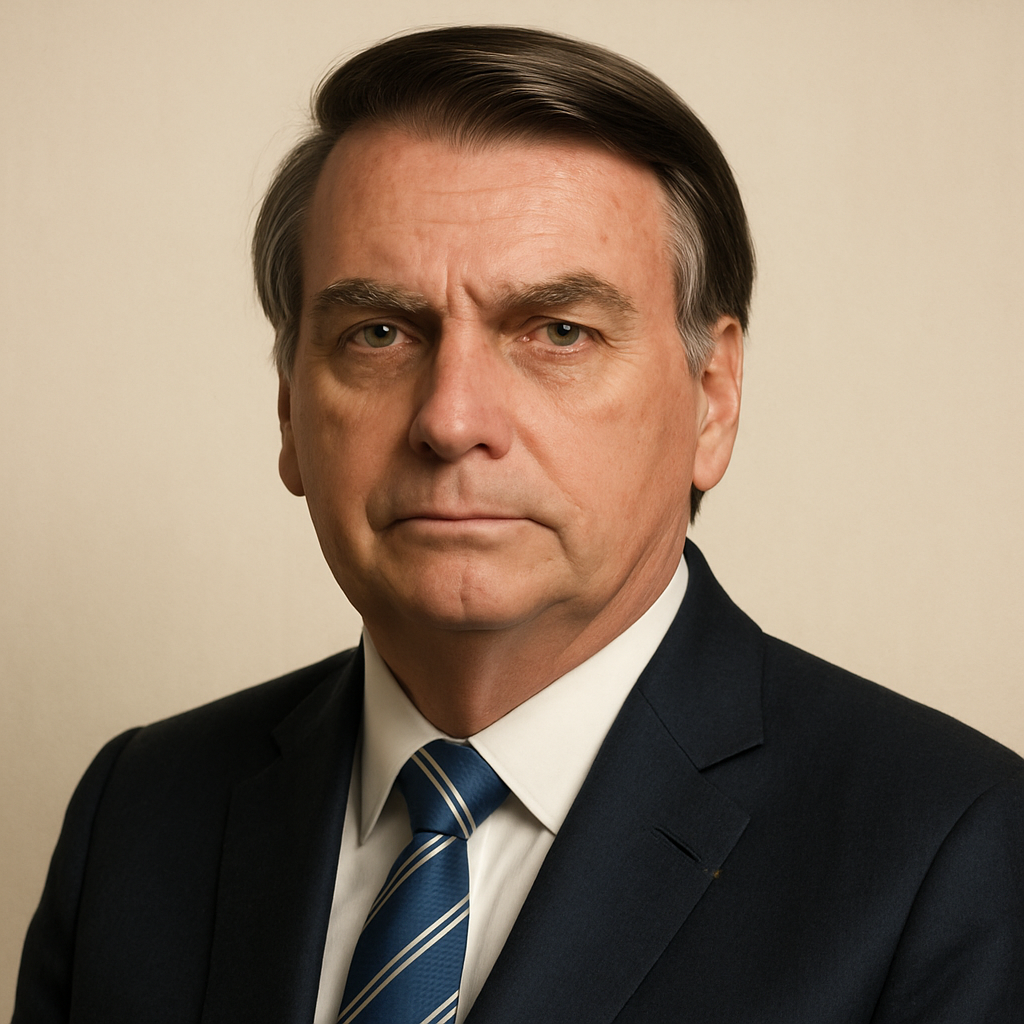
Speech by the President of the Republic, Jair Bolsonaro, Ceremony for the Signing of the Provisional Measure for the Coronavirus (COVID-19) Vaccine - Palácio do Planalto
 Jair Bolsonaro · Former President of Brazil
- Context
- Bolsonaro addressed officials at Palácio do Planalto on August 6, 2020, during the signing of a provisional measure related to COVID-19 vaccine acquisition.
- Main themes
- COVID-19 vaccine procurement, hydroxychloroquine advocacy, off-label drug use, pandemic management, military leadership philosophy, indecision vs. decisive action, Ministry of Health leadership, ICU capacity, federalism and resource distribution, Supreme Federal Court restrictions, vaccine technology transfer
- Duration
- ~8 min
- Words
- 963
- Sentences
- 76
- Readability
- 58
- Grade
- 8.3
- Syntax
- 2.62
- Vocabulary
- 2.18
Translated from Portuguese
The broad sphere of national life a sentence belongs to. Every sentence has an Arena, so it is the denominator the other indices are read against.
Other76 sentences in 21 paragraphs
Dear Pazuello, fellow paratrooper,
Major Vitor Hugo,
Admiral Barra,
Mrs. Nísia,
Authorities,
Parliamentarians,
My greetings to all.
I am a captain in the Army, my activity is different. But I put myself in the place of a doctor at the moment when he has to decide.
Dear Peternelli, if, in Juiz de Fora, the doctor had waited for tests, I would have died. And he had to decide. Even if, perhaps, I had been nasoenteritized, he had to cut my belly at that moment.
I always say, it is a military teaching: worse than a poorly made decision is indecision. You cannot just stand there… “Stay at home.” It doesn’t work. From the beginning, I adopted this line.
And we feel sad, dear Tereza Cristina, when we see people signing decrees prohibiting certain medications. Even if there was no scientific proof, but it did not present an alternative. What is at stake? Lives.
And, from the beginning, I took this stance: we had to do something, even though I am not a doctor. But I spoke with many doctors across Brazil. And they all talked to me about the issue of off-label use, right? Outside the package insert. If this practice had been adopted decades and decades ago, many diseases would still be out there today, without a solution. Studying a little, I went to see there in the Pacific War. The soldier arrived wounded, there was no one left to receive blood from, then they discovered that “let’s put coconut water in his vein.” And it worked. Dozens, hundreds of lives were saved. If we had waited for scientific proof, how many would not have died at that moment?
Today, we had a protocol from the minister first, in Health, that ordered the application of hydroxychloroquine only in severe cases. It is throwing pills away. You don’t need to have knowledge, nor brains, to understand that it is throwing pills away and losing lives. Did I have disagreements? Yes. It is not what I want, but many doctors thought, including Osmar Terra, that the line was not that. And, regrettably, this minister became, then, a commentator on Globo, for several and several weeks, until we replaced him. Then, the other minister had a personal problem, of an intimate nature, and left. And the interim took over.
I imposed nothing on Pazuello. I told him to talk. There are 5,000 civil servants here in Brasília, isn’t that right? Five thousand, four hundred and seventy. He took 15 military personnel there. Technical military personnel. Because one of the great problems of public administration is management. And it is a ministry, to be polite, complicated. And, obviously, there are people who “have to have a doctor there.” The ideal is that it were a managing doctor. And we do not have that ease of finding a managing doctor; it is difficult. And he started to do well in management.
Two weeks ago, I learned that 17 state health secretaries consulted him and all praised his work, because everything they needed, and we had the means - we had the support of Parliament, the Chamber, and the Senate, we had the support of the Federal Court of Accounts - was met. And the goal of flattening the curve, back then, was to avoid bottlenecks, the crowding of people in hospitals, without having the means to attend to them.
As far as I know, I may be mistaken, it has not come to my knowledge, at least, that we lost lives due to a lack of ICU beds or ventilators. It seems, I don’t know if this happened in some location. Some cases, yes, it is possible, but the vast majority had equipment there; as nowadays, field hospitals are deactivated, equipment is relocated to other municipalities, to meet the demand that comes.
I was restricted, my government, in the possibility of discussing this issue; by our, here, to my left, the Supreme Federal Court. It was up to us, practically, to provide means and resources for states and municipalities. Pará, for example, received more than R$ 2 billion. And this was done proportionally.
We are at peace with our conscience. There was no vaccine at that time, as there is still not, there was no medication, only the promise, at first, of hydroxychloroquine, then other things appeared. I regret that in some places in Brazil, the respective head of the Executive continues to prohibit this, I repeat, without presenting alternatives.
The human being is agile. And we often act according to necessity. And the Ministry of Health - my greetings now to Pazuello and all his team - sought means, in the world, to find the vaccine. And we signed this protocol, in the past, becoming part of this select group. Our counterpart, basically, is financial, at the moment with some people too, but basically financial at the moment, almost R$ 2 billion. Perhaps in December, perhaps, December, January, there is the possibility of the vaccine, and then this problem will be overcome, a few weeks later. And, what is more important: in this vaccine, unlike that other one that a governor decided to negotiate with another country, comes the technology for us. There, along with the means we have, we can really say that we did everything possible and impossible to save lives. Unlike those who insist on continuing in opposition, since 2018, to say otherwise.
So, to all of you, this wonderful group that is here: Mrs. Nísia; Pazuello; dear government leader, there, Vitor Hugo; dear Admiral Barra, president of Anvisa. My congratulations to all of you and to say that I am very happy to be part of this project to save lives and to serve our Brazil.
Thank you very much to all.
The original Portuguese. The tags above are read on the English translation's sentences.
Prezado Pazuello, colega paraquedista,
Major Vitor Hugo,
Almirante Barra,
Senhora Nísia,
Autoridades,
Parlamentares,
Meus cumprimentos a todos.
Eu sou capitão do Exército, minha atividade é outra. Mas me coloco no lugar de um médico, no momento que tem que decidir.
Prezado Peternelli, se, em Juiz de Fora, o médico fosse esperar exames, eu teria morrido. E tinha que decidir. Mesmo que, porventura, estivesse nasoenterizado, ele tinha que cortar minha barriga naquele momento.
Eu sempre digo, é um ensinamento militar: pior que uma decisão mal tomada é uma indecisão. Não pode ficar parado ali… “Fique em casa”. Não dá. Desde o começo, eu adotei essa linha.
E a gente fica triste, prezada Tereza Cristina, quando a gente vê pessoas assinando decreto proibindo determinado medicamento. Mesmo que não tinha comprovação científica, mas ele não apresentava uma alternativa. O que está em jogo? Vidas.
E, desde o começo, eu assumi essa postura: tinha que fazer alguma coisa, mesmo não sendo médico. Mas conversei com muitos médicos pelo Brasil. E todos me falaram da questão do off labels , não é? Fora da bula. Se essa prática tivesse sido adotada décadas e décadas atrás, muitas doenças estariam vivas até hoje por aí, sem solução. Estudando um pouquinho, eu fui ver lá na Guerra do Pacífico. O soldado chegava ferido, não tinha mais de quem receber sangue, daí descobriram que “vamos meter água de coco na veia dele”. E deu certo. Dezenas, centenas de vidas foram salvas. Se fosse esperar uma comprovação científica, quantos não teriam morrido naquele momento?
Hoje, tínhamos um protocolo do ministro primeiro, na Saúde, que mandava aplicar, apenas em estado grave, a hidroxicloroquina. É jogar comprimido fora. Não precisa ter conhecimento, nem cérebro, para entender que é jogar comprimido fora e perder vidas. Tive desentendimento? Sim. Não é o que eu quero, mas muitos médicos achavam, inclusive o Osmar Terra, que a linha não era aquela. E, lamentavelmente, esse ministro virou, aí, um comentarista da Globo, por várias e várias semanas, até que o trocamos. Depois, o outro ministro, teve um problema pessoal, de foro íntimo, e saiu. E entrou o interino.
Nada impus ao Pazuello. Falei para ele conversar. São 5 mil servidores aqui em Brasília, não é isso? Cinco mil, quatrocentos e setenta. Ele levou 15 militares para lá. Militares técnicos. Porque um dos grandes problemas da administração pública é a gestão. E é um ministério, para ser educado, complicado. E, obviamente, tem gente que “tem que ter um médico lá”. O ideal é que fosse um médico gestor. E não temos essa facilidade de encontrar um médico gestor; é difícil. E ele começou a dar certo na gestão.
Há duas semanas, fiquei sabendo que 17 secretários de Saúde estaduais foram consultá-lo e todos elogiaram o trabalho dele, porque tudo que eles precisavam, e nós tínhamos meios - tínhamos o apoio do Parlamento, da Câmara e do Senado, tivemos o apoio do Tribunal de Contas da União - eram atendidos. E o objetivo de achatar a curva, lá atrás, era evitar o engarrafamento, o amontoamento de gente em hospitais, sem que tivesse meios para atendê-los.
Pelo que eu tenho conhecimento, posso estar equivocado, não chegou ao meu conhecimento, pelo menos, que tenhamos perdido vidas por falta de leitos de UTIs ou respiradores. No que parece, não sei se em algum local aconteceu isso. Alguns casos, sim, é possível, mas a grande maioria tinha equipamento lá; como hoje em dia, hospitais de campanha são desativados, equipamentos são remanejados para outros municípios, para atender à demanda que vem aí.
Eu fui cerceado, o meu governo, na possibilidade de discutir esse assunto; pelo nosso, aqui, à minha esquerda aqui, o Supremo Tribunal Federal. A nós coube apenas, praticamente, fornecer meios e recursos para estados e municípios. Pará, por exemplo, recebeu mais de R$ 2 bilhões. E isso foi feito de forma proporcional.
Estamos com a consciência tranquila. Não existia naquela época, como não existe ainda, uma vacina. Não existia medicamento, apenas a promessa, num primeiro momento, da hidroxicloroquina, depois outras coisas apareceram. Lamento que em alguns locais do Brasil, o respectivo chefe do Executivo continua proibindo isso, repito, sem apresentar alternativas.
O ser humano é ágil. E nós, muitas vezes, agimos de acordo com a necessidade. E o Ministério da Saúde - meus cumprimentos, agora, ao Pazuello e toda a sua equipe -, que procuraram meios, no mundo, de buscar a vacina. E assinamos esse protocolo, no passado, fazendo, passando a fazer parte desse seleto grupo. A nossa contrapartida, basicamente, é financeira, no momento com algumas pessoas também, mas basicamente financeira no momento, quase R$ 2 bilhões. Talvez em dezembro, talvez, dezembro, janeiro, exista a possibilidade da vacina, e daí esse problema estará vencido, poucas semanas depois. E, o que é mais importante: nessa vacina, diferente daquela outra que um governador resolveu acertar com outro país, vem a tecnologia para nós. Aí, junto com os meios que nós temos, nós temos como, realmente, dizer que fizemos o possível e o impossível para salvar vidas. Ao contrário daqueles que teimam em continuar na oposição, desde 2018, dizer o contrário.
Então, a todos os senhores, esse pessoal maravilhoso que está aqui: dona Nísia; Pazuello; prezado líder do governo, aí, Vitor Hugo; prezado almirante Barra, presidente da Anvisa. Meus parabéns a todos vocês e dizer que eu estou muito feliz em estar dentro desse projeto para salvar vidas e para servir o nosso Brasil.
Muito obrigado a todos.