




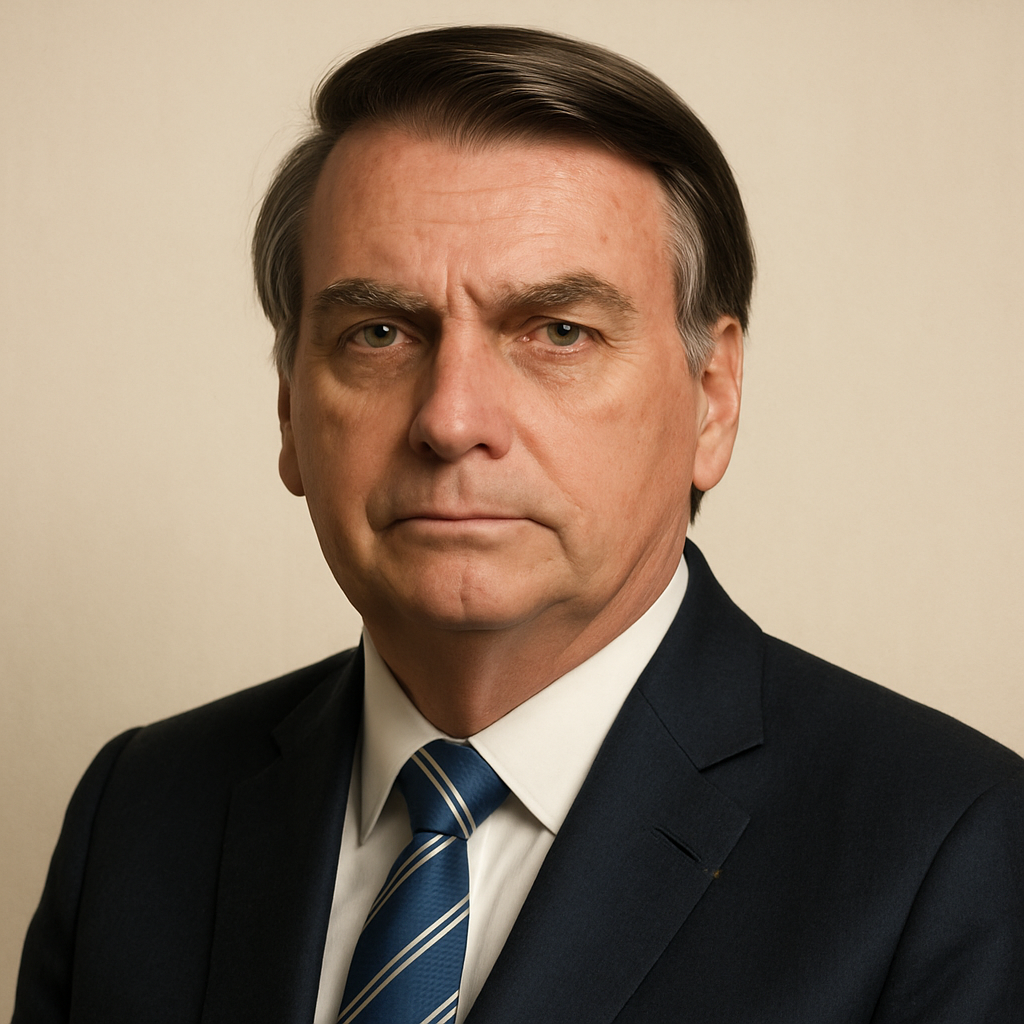
Speech by the President of the Republic, Jair Bolsonaro, during the Ceremony for the Sanction of Provisional Measures to Facilitate Access to Credit - Palácio do Planalto
 Jair Bolsonaro · Former President of Brazil
- Context
- Bolsonaro addressed a ceremony at Palácio do Planalto on August 19, 2020, to sanction provisional measures expanding credit access during the COVID-19 pandemic.
- Main themes
- COVID-19 pandemic economic response, emergency aid program, credit access legislation, unemployment prevention, Brazil's economic recovery, defense of government pandemic policies, fiscal debt concerns, informal workers support, state and municipal financial assistance
- Duration
- ~7 min
- Words
- 829
- Sentences
- 43
- Readability
- 64
- Grade
- 9.1
- Syntax
- 3.06
- Vocabulary
- 2.08
Translated from Portuguese
The broad sphere of national life a sentence belongs to. Every sentence has an Arena, so it is the denominator the other indices are read against.
Other43 sentences in 12 paragraphs
I am so connected to Paulo Guedes, so connected, that I live in Alvorada and he lives in Torto. I don’t know which minister will be dismissed next week by the mainstream media; I am waiting to see who is the next target.
Indeed, since the pandemic broke out, I made a statement to the nation. Obviously, I was harshly criticized. And I understood that, from the criticisms, like my speech at the UN, I was on the right track. There I had said: “We have two problems ahead: the virus and unemployment. These are two issues that we must address responsibly, but simultaneously.” The “stay at home” crowd and the opposition began to say that I was insensitive and not concerned about people’s lives. And always saying, Paulo Guedes, that the economy can be recovered, but life cannot.
Look, an economic collapse - you don’t need to be a doctor to say this, nor an economist - the causes, the collateral effect of this is much, much worse than the virus itself. Nowadays, it is already starting to be noticed that, back then, the government - because when I say the government, everyone speaks - was on the right path.
While almost everything was closing in Brazil, we here did not stop, especially with the economic team, working, seeking ways to ensure that jobs were not destroyed. And the proposals we presented were exceptional.
In my view, keeping the proper proportions, I have not seen anyone in the world who faced this issue better than our government. This makes us proud. It shows that there are capable people and people who care, especially about the poorest and the most humble. When the idea of emergency aid appeared, at first, we had 38 million informal workers and, with other categories, it could reach 45 million. In fact, we reached around 65 million people.
And, Paulo Guedes, I have been traveling around Brazil. This Friday, God willing, with Rogério Marinho and a few other parliamentarians, I think Fábio Faria will be there too, we will be in Rio Grande do Norte. In two states, the governors confessed to me that the other aid you provided, Paulo, to compensate for the loss of ICMS, they said that your aid was much greater than what they actually lost. And, for sure, I think this will go towards investment in the states. So, the states benefited from this. Now, when the states benefit, the government benefits, Brazil benefits. And this emergency aid, in municipalities, for example, the poorest ones, reached to triple, quadruple the money that was reaching the municipalities. But all of this, not only the economic team, we had here Pedro Guimarães from Caixa Econômica, who worked hard on this issue.
And we are now in the final phase, because today I had coffee with Rodrigo Maia at Alvorada, and we also discussed the issue of emergency aid. The 600 reais weighs heavily on the Union. This is not the people's money, because it is not saved; this is debt. Is that right? Am I speaking correctly? I think I am, right? So that I won’t be criticized later. It is debt. And if the country goes too far into debt, you end up losing your credibility for the future.
So, the 600 reais is a lot. Paulo Guedes, someone from the Economy said, in 200, I think it is little, but it is possible to reach a middle ground and we seek for it to be extended for a few more months, perhaps until the end of the year, so that we can get out of this situation and ensure that jobs, both formal and informal, return to normality and we can then continue on the upward path that we ended and started at the beginning of this year, when the economy was really pointing to being among the best in the world for Brazil, after decades of stagnation, let’s say, Brazil was stagnating in economic matters.
So, what I say at this moment, after sanctioning the Conversion Bill, which provides means for credit to be more available and interest rates more accessible for the working class in Brazil. This really helps us; it is another great step that we can, perhaps, be finalizing the last measures of the government so that we return to normality in Brazil.
Thus, I greet my 23 ministers, as well as the bank presidents, well represented here by Roberto Campos and Pedro Guimarães, who collaborated greatly so that Brazil could really overcome the difficult moment that was pointed out back then without major crises.
Let us imagine what Brazil would be like without these measures and without emergency aid, where Brazil could be submerged, with a huge class of people who, especially in the informal sector, had lost all their income.
Thus, thank you all very much. And let us, God willing, come out of this pandemic stronger than when we started, back then.
The original Portuguese. The tags above are read on the English translation's sentences.
Eu estou tão ligado ao Paulo Guedes, mas tão ligado, que eu moro no Alvorada e ele mora no Torto. Eu não sei qual ministro vai ser demitido, na próxima semana, pela grande mídia, eu estou esperando quem é a bola da vez.
Realmente, desde quando estourou a pandemia, eu fiz um pronunciamento à nação. Obviamente, fui duramente criticado. E eu entendi que, pelas críticas, a exemplo do meu discurso na ONU, estava no caminho certo. Lá eu havia dito: “Temos dois problemas pela frente: o vírus e o desemprego. São dois assuntos que devemos tratar com responsabilidade, mas simultaneamente”. A turma do “fica em casa” e a turma do contra começou a dizer que eu era insensível e não estava preocupado com a vida das pessoas. E dizendo sempre, Paulo Guedes, que a economia você recupera, a vida não.
Olha, uma quebradeira na economia - não precisa ser médico para dizer isso, nem economista -, as causas, o efeito colateral disso é muito, mas muito pior, que o próprio vírus. Hoje em dia já se começa a notar que, lá atrás, o governo - porque quando eu falo o governo todo fala - estava no caminho certo.
Enquanto se fechava quase tudo no Brasil nós, aqui, não paramos, em especial com a equipe econômica, trabalhando, buscando meios, para que empregos, então, não fossem destruídos. E as propostas apresentadas por nós foram excepcionais.
No meu entender, guardando-se as devidas proporções, não existe, não vi, no mundo, quem enfrentou melhor essa questão do que o nosso governo. Isso nos orgulha. Mostra que tem gente capacitada e tem gente preocupada, em especial com os mais pobres, os mais humildes. Quando apareceu a ideia, então, do auxílio emergencial que, num primeiro momento, tínhamos 38 milhões de informais e, mais outra categorias, que poderia chegar a 45 milhões. Na verdade, chegamos na casa dos 65 milhões de pessoas.
E, Paulo Guedes, eu tenho andado pelo Brasil. Sexta-feira agora, se Deus quiser, com o Rogério Marinho e mais alguns parlamentares, eu acho que o Fábio Faria vai estar nessa também, estaremos no Rio Grande do Norte. Em dois estados, os governadores confessaram para mim que aquele outro auxílio que você deu, Paulo, para compensar a perda do ICMS, eles falaram que o seu auxílio foi muito superior ao que eles realmente perderam. E, com toda certeza, acho que isso vai para o investimento nos estados. Então, os estados ganharam com isso. Agora, os estados ganhando, ganha o governo, ganha o Brasil. E esse auxílio emergencial, em municípios, por exemplo, os mais pobres, chegou a triplicar, quadruplicar o dinheiro que chegava na ponta da linha do município. Mas, isso tudo, não apenas a equipe econômica, tivemos aqui o Pedro Guimarães, da Caixa Econômica, que trabalhou árdua e duramente nessa questão.
E nós estamos, agora, em fase final, porque hoje eu tomei café com o Rodrigo Maia, no Alvorada, também tratamos desse assunto do auxílio emergencial. Os 600 reais pesa muito para a União. Isso não é dinheiro do povo, porque não está guardado, isso é endividamento. É isso mesmo? Estou falando certo? Acho que estou, não é? Para não me criticarem depois. É endividamento. E se o País se endivida demais, você acaba perdendo a sua credibilidade para o futuro.
Então, os 600 reais é muito. O Paulo Guedes, alguém falou, da Economia, em 200, eu acho que é pouco, mas dá para chegar num meio termo e nós buscarmos que ele venha a ser prorrogado por mais alguns meses, talvez até o final do ano, de modo que nós consigamos sair dessa situação e fazendo com que os empregos e também os empregos formais, bem como os informais, voltem à normalidade e nós possamos, então, continuar naquele ritmo ascendente que terminamos e começamos o início deste ano, que a economia realmente estava apontando para os melhores do mundo, para o Brasil, depois de algumas décadas de patinação, vamos assim dizer, o Brasil patinava na questão da economia.
Então, o que eu falo nesse momento, após sancionar o Projeto de Lei de Conversão, que leva meios para que o crédito fique mais disponível e os juros mais acessíveis para a classe trabalhadora do Brasil. Isso daí nos ajuda, realmente, é mais um grande passo que nós podemos, talvez, estar ultimando as últimas medidas do governo para que voltemos à normalidade no Brasil.
Assim sendo, eu cumprimento meus 23 ministros, bem como os presidentes de bancos, aqui bem representado pelo Roberto Campos e pelo Pedro Guimarães, que colaboraram, e muito, para que o Brasil realmente, sem crises maiores, suplantasse o momento difícil que se apontou lá atrás.
Imaginemos o que seria do Brasil sem essas medidas e sem o auxílio emergencial, onde poderia estar mergulhado o Brasil, com uma classe enorme de pessoas que, em especial na informalidade, haviam perdido todo o seu ganho.
Assim sendo, muito obrigado a todos vocês. E vamos, se Deus quiser, cada vez mais, sair dessa pandemia mais fortes do que quando começamos, lá atrás.