




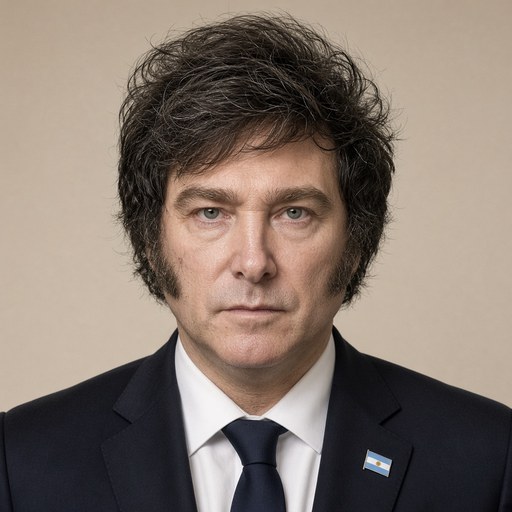
Speech by President Javier Milei at the Cato Institute and Liberty and Progress conference.
 Javier Milei · President of Argentina
- Context
- Milei addressed the Cato Institute and Liberty and Progress conference in June 2024, reviewing his government's first six months of radical economic reforms in Argentina.
- Main themes
- Fiscal adjustment and surplus, hyperinflation prevention, economic crisis inheritance, monetary reform, public spending cuts, libertarian economic policy, seigniorage reduction, Central Bank debt, political opposition criticism, Argentina's economic turnaround
- Duration
- ~48 min
- Words
- 5,713
- Sentences
- 240
- Readability
- 51
- Grade
- 12.0
- Syntax
- 3.15
- Vocabulary
- 2.16
Translated from Spanish
The broad sphere of national life a sentence belongs to. Every sentence has an Arena, so it is the denominator the other indices are read against.
Other240 sentences in 26 paragraphs
Having recently completed six months since the beginning of our mandate, I want to take a moment to emphasize the magnitude of the feat that Minister Caputo and his team are undertaking, because sometimes one hears some politicians or economic analysts and from what they say, it seems as if they live in another country: it would seem they live in Narnia. So let’s briefly put into perspective the work of our economic team. In December, we inherited twin deficits of 17 points of GDP; a currency gap of 3 to 1 between the parallel dollar and the official dollar; and a monetary surplus similar to that before the Rodrigazo; a state nearly on the brink of default; prices that were already rising at 1.5% daily, which combined with the debt of the Central Bank was leading us towards hyperinflation, with the aggravating factor of having poverty indicators much worse than in the lead-up to any other crisis in our history. In other words, in plain terms, we received a situation worse than that before the inheritance of the Rodrigazo, in terms of monetary imbalance, a situation in the Central Bank much worse than that which existed at the beginning of 1989, prior to the hyperinflation of Alfonsín, and with social indicators that were even worse than those we had in 2001. We were facing what was going to be the worst crisis in all of Argentine history.
And it is also worth mentioning that the outgoing government was aware of this. They speculated that our libertarian position would decide to open everything up instantly. And this is interesting because they had moved all the remunerated liabilities to one day, with phenomenal stock imbalances, the debt of the SIRA amounting to 50 billion dollars, debt for dividends, debt in pesos maturing equivalent to 90 billion dollars, 25 billion dollars of external debt maturing with multilateral organizations, with the agreement with the Fund fallen through. A government that, moreover, over the four years issued the equivalent of 28 points of GDP, but of those 28, 13 were issued during the last year. And I have to say it to their faces, they expected us to free everything, ignoring the dynamics of the stocks and that everything would explode such that they would throw people into the streets, do not dismiss their methodology of throwing corpses in the streets, going for looting. Something that some journalists promote from their platforms. They cry out for freedom of expression but are calling for the commission of crimes, which is also a crime. And in that context, that the whole crisis would do the work, the dirty adjustment, and they would return as redeemers at the beginning of 2024.
In just 6 months of management, we abruptly halted Treasury financing with monetary issuance, we made the largest public spending adjustment in the history of humanity, and we achieved the first quarter with a fiscal and financial surplus in the national public sector after 20 years. In that context, we also systematically lowered the Central Bank rates and are deactivating the bomb of debt in pesos. Even in a context of high inflation, despite what many said could not be done. I also want to mention here, because this is important: when we talked about the adjustment we were going to make, they said it was impossible. Some shameless individuals said that we could not adjust more than one point of GDP, when we made the Treasury adjustment, we expected to achieve financial balance throughout 2024 and we achieved it in the first month of management. Then they said we did it with accounting cosmetics, I say accounting cosmetics to adjust five points of GDP is quite difficult. But those same people who said we could not adjust more than one point later found that not only did we have a financial surplus in January, we had a financial surplus in February, we had a financial surplus in March, we had a financial surplus in April, in May, and we are going to finish the first semester with a surplus. And not only that, but in parallel, we had a quasi-fiscal deficit of 10 points of GDP and today we have reduced it by 9 points of GDP. We have adjusted up to this moment the equivalent of 15 points of GDP. And all of that we did in less than 6 months. Many times I find it amusing when they say “he said he was going to lower taxes and he raised them” and the question is, what do you think seigniorage is? Seigniorage is a scam. We are shrinking seigniorage by 15 points of GDP. We are returning to the people 15 points of GDP.
Therefore, while in December we were discussing hyperinflation, which many dishonest intellectuals also try to sidestep by only reporting what was happening with the CPI and not what was happening with the wholesale price index, which was 54%. And that annualized number gives 17,000. The wholesale inflation in April was 3.4%, which annualized gives 50%. I understand that 50% is an aberration, it is an aberration. But in the alternative scenario, we were traveling at 17,000%. It would be good if they were more intellectually honest. Another discussion that also seems very interesting to me, and that has great academic value from my point of view, is the discussion of the interest rate. To use it as an economic policy instrument to control inflation. My dislike for this manipulation of the interest rate is not new. My dislike for that Keynesian perspective that the interest rate is determined in the money market is not new. Because the interest rate exists because time exists, not because money exists. It exists because time exists. And it exists with individuals who are willing to pass consumption from the present to the future, to save; and there are individuals who are willing to pass production from the present to the future, that is, to invest. And therefore, the interest rate is a mechanism of intertemporal coordination, not the result of printing colored paper.
In that context, we consider that inflation is always, everywhere, a monetary phenomenon generated by an excess of money supply, either because the supply increased or because demand fell, or both things happened at the same time, which causes the purchasing power of money to fall and that implies that all prices expressed in monetary units rise. Therefore, our bet was to stop the issuance of money. We were convinced and were managing to close the issuance to finance the treasury, but we had another problem which was the endogenous issuance of money: if you look at it, most analysts at that time recommended us to set the interest rate at positive real levels. If we had listened to them, today the ratio between remunerated liabilities and the monetary base would be above 8, we would be discussing the carry trade problem, we would be discussing the bomb of the LELIQs and lowering inflation would be literally impossible.
However, we decided to arbitrate the interest rate in dollars. This implied a negative real interest rate in pesos and that allowed us to put the balance sheet of the Central Bank in order. Simultaneously, with the fiscal surplus, that also allowed us a substantial drop in country risk and allowed us to recreate a debt market for government debt, in a monumental task carried out by the Secretary of Finance Pablo Quirno and which in conjunction with the President of the Central Bank, began to mutate the debt that was in the Central Bank, to take it to where it should have originally been, in front of the financing of the fiscal imbalance, which was in the Treasury accounts. This means that today, the ratio of remunerated liabilities to the monetary base is at 1.2 times. That is to say, we reduced it to one third. But it is important to have an idea of the quantitative notions of that. Today we have a monetary base of 15 trillion pesos and we have remunerated liabilities of 18 trillion pesos. Now, the interesting thing is that of those 18 trillion pesos, 12 trillion are in the hands of public banks. Of those 12 trillion, seven are in the Banco Nación, where in addition the counterpart is that there are 3.5 trillion in Treasury deposits within the Banco Nación, therefore, there are seven that are not a problem. There are three that are in the hands of the Banco Provincia Buenos Aires. I say, although the little communist is an enemy of freedom and especially of this government, the fact that he has a fiscal deficit means that he uses the Banco Provincia as a financing mechanism and has such a tight liquidity position that he cannot move it from there. And, what remains, a large part is with the government of the City. Therefore, the real problem we face is 6 trillion pesos. And think that we have had, in some of the placements, offers for 18 trillion pesos. That is to say, that the problem of remunerated liabilities, that problem of endogenous issuance we have practically cornered.
However, I also want to express that once we finish with that, there is still a final stage to resolve the problem of the cepo, which is to resolve the problem of the puts. This is probably one of the greatest perversions committed by the previous government. Faced with the unwillingness of banks to finance the treasury, they indirectly used the Central Bank. And a way that also had the complicity of the International Monetary Fund, they financed it with instruments that are puts. So, what is the problem? Within the balance sheet of the Central Bank, what appears is the amount of the put and not the contingent liabilities that are open. To give you an order of magnitude, those contingent liabilities represent four points of GDP, when today the monetary base is 2.8. Imagine what it would be to throw all that amount of money into the street. Imagine that in addition and be aware of this that they are not even European puts, where you have defined the deadline when they expire; they are American puts and can be executed at any time. Therefore, once we finish with the remunerated, what we are doing is working on the solution to the problem of the puts to definitively open the cepo.
In that context, we are also confident because today between what we have in monetary base and remunerated liabilities that already reaches six points of GDP, when historically the demand for base in the 21st century has oscillated between 8 and 9 points of GDP. Therefore, once we finish resolving the problem of the puts, I commit to opening the cepo definitively. So, having made these references both in the fiscal and monetary realms, as a result of the fiscal anchor and the monetary anchor, inflation has been decreasing significantly for the past 5 months. Moreover, in a few days the inflation data corresponding to May will be known and all indications are that it will be below five points. Ultimately, our stabilization program is demonstrating its effectiveness. I also want to mention the intellectual dishonesty of many of our colleagues, because I can be President but I do not stop being an economist, nor will I stop being one. Furthermore, after this I have to continue earning a living as a speaker, which is why I resigned from my privileged pension to make it clear.
So, well, they took me out of the speech. I have been out of the speech for a while. But well, nothing, I will continue. What seems to me is the issue of the intellectual dishonesty of our colleagues, and one has to understand the characteristics of who makes the decisions. A stabilization program basically has three parts: it has a fiscal policy, an adjustment, it has a monetary policy and a exchange rate policy. Obviously, as a result of having had our brains washed for more than 100 years with socialist and dirigiste policies, they believe that there must be sectoral things, that prices must be controlled, that the dynamics of such price must be managed, that the other must be controlled. Guys, I am a libertarian liberal, I am not going to do that kind of garbage. I believe in freedom, I do not believe that politicians are gods.
Moreover, another thing that also seems profoundly intellectually dishonest to me, because it is not that it goes down… “oh, by magic the inflation goes down”, there is a program that is what makes inflation go down. And in that sense, I am surprised because if one has the evidence, one should at least be more sincere. But we are also doing it in a context where we are recomposing relative prices. Therefore, when one wants to look at inflation, ok, they do not like to look at wholesale prices because it proves that they were wrong and that things are working much better than they expected. Ok, I understand, but when they go to look at inflation, I say the most intellectually honest thing would be to look at the core. But no, it does not matter, let them continue denying the achievements, obviously they do not see it. So, I think we should be looking at the core. Still, you know what? No problem, because we are not only going to beat the core but we are also going to beat the general. We are going to crush inflation.
And, as if this were not enough, we have governed these first six months of the year uphill, managing the worst inheritance in history and without the Legislative Power or the instruments that all governments before ours have had. This is not a minor issue. It is not that politics has not accompanied us. Politics, even before we took office, has put sticks in our wheels. They put sticks in our wheels by finishing off the balance sheet of the Central Bank. And they put sticks in our wheels every single day that we try to govern. But, you know what? All of this is proving that the ideas of freedom are stronger, because despite the filthy political caste, we are achieving it. We are defeating inflation. But the country needs profound changes, fundamental economic reforms that exceed the immediate economic policy decisions that a president can make. And today, while the most ambitious economic, social, tax, and fiscal reform project since the return of Democracy is being discussed in the national Senate, there can be no doubt that Argentina is at a turning point. We can insist on the path that brought us here, insist on the model of the present state, which is really only present for some and sinks the rest into misery. We can insist on the model of runaway spending, of the productive interior drained and abused by politics from Buenos Aires, of suffocating tax pressure, of debt, of monetary issuance, of the discouragement of economic activity, and of the bureaucracy that hinders everything. Or alternatively, we can return to the path of freedom from which we should never have strayed: to reclaim the ideas and values that once made Argentina a world power, to resume the defense of life, liberty, and private property. And to aspire to be a country worthy of our identity and our history once again.
The bad thing is that we have lost a lot of time. We lost a century's worth of time. For 100 years, we have squandered the stock of resources, wealth, and advantages that our golden age bequeathed to us. We squandered it in the service of nothing, in the service of chimeras. We went from being a power to being a country of mediocre results. Despite the fact that our people are not mediocre, they are exceptional. The model of social justice and the present state has tied the hands of and plunged an exceptional people into misery, and unfortunately, we will never be able to recover this time. The good thing is that Argentine society, for the first time in years, has mobilized to demand a radical change in direction. It chose as president someone who, during the campaign, acknowledged and dared to speak truths that any other politician would have hidden with modesty. Society chose the path of freedom, knowing all the costly sacrifices that this entailed in the short term, and it chose it with the largest number of individual votes in the history of Argentine democracy. However, for some politicians, the popular mandate of nearly 15 million Argentines meant nothing. Because their priority is not the society that demands change out loud, not the country that needs to be redirected to prosper, but their personal and petty interests of the political caste that resists making reforms because they know that if they are made, it will work and will not return.
That is why, six months after taking office, they still do the impossible to prevent our program from prospering. Over the 100 years we have already lost, they make us continue to waste time because they know that our program threatens the unjust system from which they feed. This is not the first time I say this: the history of the last 100 years of our homeland allows a glimpse, a small window into what could happen with the rest of the free world if it lets its guard down and is seduced by socialism. Because it is the same ideas that are currently in vogue among the elites of the West that destroyed freedom in Argentina and condemned us to poverty. Ideas that possibly in some cases arise from a noble cause, which is to provide assistance to the weakest or those who have the least. But that has a vice at its root, which is state intervention as an instrument to impart social justice. They must understand that charity is good, but if it is done with one's own pocket, as Rothbard said: it is incredible how infinitely charitable people can be when the pocket that pays is someone else's.
In this context, the State is neither in its right nor capable of imparting justice through the distribution of wealth, because social justice is a morally, theoretically, and empirically flawed concept. On a moral level, because every act of distribution presupposes a prior act of coercion, which is to confiscate the goods of a private individual that are theirs by natural right. This means that the State is a criminal and violent organization, as it is financed by a coercive source of income called taxes. On a theoretical level, because by definition, the greater the state intervention, the less free the markets are and the worse they function, producing misery instead of wealth. As Hayek said, "every time the State intervenes, it generates a worse outcome than if it had not interfered." Why? Because state intervention introduces distortions in the price system, prevents correct economic calculation, and consequently nullifies what Hayek called "the correct functioning of the market as a discovery process." That is, in the constant search to compete in the market, the capitalist finds the right path. But this can only occur in a system of free prices that extract and transmit better information about the quantities of which goods or services are demanded and at what price. Collectivism, by inhibiting this discovery process and making it difficult to appropriate what has been discovered, ties the entrepreneur's hands and prevents them from producing better goods and offering better services at a better price.
And finally, as if all this were not enough, there is also empirical evidence of the inferiority of socialism. If we look at the indices of economic freedom, the freest countries have a per capita GDP 12 times larger than the repressed ones. And even the inhabitants of the lowest decile of the free system live better than 90% of the population of the repressed countries. In other words, free enterprise capitalism is superior to socialism even in the main task that socialism claims to do better, which is to help the marginalized. What underlies all this is that there is a proven direct relationship between repression and misery on one side; and conversely, there is a proven relationship between freedom and prosperity. And socialist ideas are fundamentally incompatible with prosperity, precisely because they are incompatible with freedom. The annulment of competition is incompatible with the defense of merit and effort; bureaucratic control is incompatible with creativity and innovation; directed distribution is incompatible with wealth generation; and at its core, a large state with broad powers that interferes in every private matter of people is incompatible with having a free, creative, and dynamic society that can generate wealth for itself and for future generations.
Today it seems that Argentina and a good part of the free world are turning in opposite directions. While some Western powers forget the basic norms that brought the prosperity they enjoyed in recent decades, Argentina is reconnecting with those ideas and values and is betting again on the model of Freedom. While developed countries become heavy with regulations and unjustified impositions, we are removing the regulations that have tied our people’s hands for decades and inviting the world's capital to cooperate with Argentina; because we understand free economic activity as the most natural act of cooperation that the human species has. That is, in Argentina we are reconnecting with the ideas that made modern Western civilization the greatest civilizational and economic development feat in human history. And we want to be a refuge for those who defend and live these ideas across the planet. There has always been a struggle between those who innovate and those who regulate; between those who generate and those who confiscate; between those who explore the territory and those who then draw the maps and set the limits. There has always been and will always be a struggle between the private and the state. Today in the technology sector, which is the most dynamic sector of the global economy, that struggle is palpable. The great visionaries of the sector flee from the regulations that the global political leadership infected with socialism seeks to impose on them. I tell you today what I have already told these actors in person: this Argentina is on the side of the private sector, not the State; it is on the side of those who work, of those who trade, of those who strive, it is on the side of those who take risks, invest, innovate.
As I said, it is on the side of those who take risks, invest, and innovate, who are by nature social benefactors, and it will defend the ideas of freedom with nails and teeth, because we know that in them lies the formula for prosperity. But it is not just about having the right ideas; we also need the material conditions to accompany us. Because after decades of stagnation, Argentina has everything in place to embark on a process of economic convergence that will place us on par with the great powers of the world in a few decades. At its core, the question is: What is the process of convergence? Here it is also worth making a methodological note about what we economists do, right? Because convergence is something that when you look at the history of humanity, those who embrace the ideas of freedom achieve it, but our growth models are simplified behind certain formats of the production function. And in reality, we do not even have the foundation for why convergence occurs. Ultimately, it arises in relation to the concavity of the production function and how far we are from the equilibrium of the per capita capital stock of the stationary state. Ultimately, what we are talking about is a mathematical relationship, and it is devoid of content. Convergence does not happen just like that, because if it did, then every country that was lagging behind could undoubtedly grow without doing anything, and that is false.
That is why I emphasize so much on two works: on Hayek's work and on Locke's work, which is synthesized by Israel Kirzner: this idea of the market as a discovery process and Locke's principle of appropriation, in a context where property rights are respected. If you do that, convergence will occur, because there are a lot of things that need to be discovered, and others have already discovered them. And that is why throughout the history of humanity, it takes fewer and fewer years to double per capita GDP: the first to achieve it was England, which took 58 years, but the last to do so was China, and it did it in 7 years. Moreover, in 14 years it quadrupled its per capita GDP, because it doubled it once and then doubled it again, and it did so from the impetus of the areas liberated to the market. So it is not that convergence is something that will happen tautologically, due to the shape of the production function, which also has no empirical counterpart. Because the empirical counterpart is increasing returns, not diminishing marginal returns.
And there, the key is precisely that what is at the core are the ideas of freedom. In some of the slides I saw during this conference, for example, I showed the relationship between per capita GDP among free countries and repressed ones. Moreover, not only that, free countries grow more than double than the repressed ones. So, the key lies there, in the institutional framework that allows for convergence. And if you add to that the improvements we are seeing in technological terms, especially with artificial intelligence, that convergence can be accelerated. So, Argentina today has the opportunity, if our reform prospers, to initiate this process of convergence to reach living standards similar to those of the most developed countries on Earth. More or less to give you an idea, the largest structural reform ever made in Argentina's history was Menem's in the 90s. The reform we are sending in the Bases Law is five times larger than that. And if you add the DNU, which is still in effect, we are making structural reforms eight times larger than what was the largest reform in Argentine history. And then the shameless come to say that there is no plan.
Moreover, if this first phase prospers, we would climb 90 places in economic freedom and we would start to resemble countries like Germany, France, and Italy. But that is not enough for me. One could think of Ireland, except for what it is doing at this moment. I mean, what it did was, with market-friendly reforms, go from being the most miserable country in Europe to having a per capita income 50% higher than that of the United States, and that could be a model. It also falls short of our ambitions. We still have 3,200 structural reforms pending. We will carry them out whether politics wants it or not. And we will make Argentina the freest country in the world. And then there are also the issues of the current situation.
Because we have been for decades a boiling pressure cooker with the lid on, all that needs to be done is to uncover it and resume the task of the market as a process of discovery. Where the low capitalization of the economy, the result of 20 years of populism bent on destroying capital, already generates enormous investment opportunities for those who bet on the country. Thus, by reducing the deficit, reducing the tax burden on economic activity, and staunchly defending property rights, we will achieve development that ceases to be a dream and becomes a reality. But not only will we make the right decisions regarding economic freedom and respect for property rights, we can converge in a relatively short time to levels of wealth enjoyed by the world's major powers today, but economic convergence for us is simplified, because we do not have to go through this laborious process of discovery that Hayek spoke of, since others have done it for us, which is what I was explaining about the foundations of convergence.
There is nothing to invent to reach the levels of wealth of the main countries in the world. We only need to generate the conditions of respect for private property so that private actors can take the knowledge of those who have already gone through the economic discovery process and reproduce it. This facilitates the process of wealth generation and economic growth. That is to say, they have already done the work for us. The arduous discovery process in which an actor finds a need and develops a product or service to satisfy it has already occurred and happens every day where property rights are respected. Because without appropriation, no discovery process is possible. That is why socialism has failed and will always fail. Because it inhibits the appropriation process of what has been discovered, destroying innovation and, consequently, the generation of wealth. For this reason, because the private sector learns from the discovery process of others, global economic growth has been accelerating for more than 100 years and is accelerating even more. If we add to this the technological tools we have today, such as artificial intelligence, that economic convergence process to reach the living standards of developed countries can be even much shorter than we think. All this implies that, in just one generation, Argentina could go from being a poor country to one of the most important countries in the world. All we need to do is to embrace the ideas of freedom again, defend life, and defend property.
So, I want to revisit something I expressed in recent weeks before the most powerful businesspeople in the world, in the technological sectors that are the frontiers of economic activity. Argentina was once a land of promises, capturing the imagination of adventurers and entrepreneurs because everything was yet to be done, because they knew they could invest their effort and capital and they would do well, because there was a state that protected property rights and protected the freedom of association among private individuals. Today we have everything to walk that path again and become the new Mecca of the West. We have the natural resources that the world needs, ready to be harnessed. We have the best human capital in the region, curious and trained to face the challenges of the present. And for the first time in 150 years, we are becoming a freer country every day. With these conditions, we have the opportunity to be at the forefront of technological and energy development, as we already are in the agricultural sector. For example, we can be a global hub for development in artificial intelligence, which is a market of high demand and high remuneration, which will facilitate a leap in productivity for an immense number of value chains in the economy and which will also allow us to reform the state so that it functions better and stops squandering taxpayers' resources. You already know that as the economy grows, I will keep spending in check. Why? To return the money to those who genuinely and originally generated it: to the private sector.
In this sense, we have the obligation to seize this opportunity. We owe it to the good Argentines to show them that their effort is for something, that work and sacrifice correspond to an improvement in their quality of life. I want to remind Argentines of what, after accumulating failure after failure, we forgot but what the rest of the world has known for the last 100 years: that economic freedom brings prosperity and brings prosperity for all, not just for some. For all these reasons, returning to my initial idea, today as a society, as a country, and as political leadership, we are at a crossroads: either we persist on the path of decay or we dare to walk the path of Freedom. That battle is even taking place in the streets. Fortunately, we have a great Minister of Security who is putting the streets in order, as we promised during the campaign.
Society has already chosen which of the two paths it wants to embark on. It has already taken the risk that comes with choosing freedom. And, from the presidency, we are embarking on that course with the tools we have. Now it is up to the rest of the political sphere to decide whether to support or turn their backs on the popular mandate to live in a freer country with a more dynamic economy, or whether to insist on persisting on the path of servitude, condemning us all to misery. They still have time to work together and show society that political leadership can rise to meet its demands. We have no other ambition than to generate the material and spiritual conditions for Argentina to become a prosperous country again. We are not interested in political power as an end in itself; we are not interested in gaining anything for personal gain.
We are here willing to give everything in service of our cause, even if it costs us our own personal well-being. If we manage to generate the necessary stability to reactivate economic activity, if we manage to pave the way for freedom, if we manage to withdraw the state as necessary for society to flourish, we will have succeeded. Because free economic activity will result in benefits for the common good of society. If we achieve this, it will not be our triumph, but that of society as a whole, which will have managed to leave behind 100 years of statism and decay. That is why, as we walk the path to that new Argentina, I thank all of you for being here. God bless the Argentines and may the strength of heaven be with us! Long live freedom, damn it! Long live freedom, damn it! Long live freedom, damn it!
The original Spanish. The tags above are read on the English translation's sentences.
Habiéndose cumplido hace pocos días seis meses del inicio de nuestro mandato, quiero detenerme un momento en remarcar el tamaño de la hazaña que estamos llevando adelante el ministro Caputo y su equipo, porque a veces uno escucha algunos políticos o analistas económicos y por lo que dicen, parece idea que vivieran en otro país: parecería que viven en Narnia. Así que vamos a poner brevemente en perspectiva el trabajo de nuestro equipo económico. En diciembre recibimos como herencia déficit gemelos por 17 puntos del PBI; una brecha cambiaria de 3 a 1 entre el dólar paralelo y el oficial y un sobrante monetario similar al de la previa del Rodrigazo; un estado endeudado casi al borde del default; precios que viajaban ya al 1,5% diario y que conjugados con la deuda del Banco Central nos llevaba camino una hiperinflación, con el agravante contar con indicadores de pobreza mucho peores que en la antesala de cualquier otra crisis de nuestra historia. O sea, en buen romance recibimos un cuadro de situación peor a la previa de la herencia del Rodrigazo, en términos de desequilibrio monetario, una situación en el Banco Central muchísimo peor que la que había en los inicios del 89, previo a la hiperinflación de Alfonsín, y con indicadores sociales que eran aún peores que los que teníamos en el 2001. Estábamos frente a lo que iba a ser la peor crisis de toda la historia Argentina.
Y vale la pena también decirlo, que el gobierno que se iba tenía conciencia de ello. Especulaba con que nuestra posición libertaria decidiera abrir todo de manera instantánea. Y esto es interesante porque habían pasado todos los pasivos remunerados a un día, con un desequilibrio de stocks fenomenales, la deuda de las SIRA por 50 mil millones de dólares, la deuda por los dividendos, deuda en pesos venciendo por el equivalente a 90 mil millones de dólares, 25 mil millones de dólares de deuda externa por vencer con organismos multilaterales, con el acuerdo con el Fondo caído. Un gobierno que, además, a lo largo de los cuatro años emitió por el equivalente 28 puntos del PBI, pero de esos 28, 13 los emitió durante el último año. Y hay que decírselos en la cara, ellos esperaban que nosotros liberáramos todo, ignorando la dinámica de los stocks y que todo estallara tal que nos tiraran la gente a la calle, no descarten la metodología de ellos de tirar muertos en la calle, ir por los saqueos. Cosa que algunos periodistas promueven desde sus espacios. Claman por libertad de expresión pero están llamando a cometer delitos, lo cual también es un delito. Y en ese contexto, que toda la crisis hiciera el trabajo, el ajuste sucio y ellos volver como redentores a inicios de 2024.
En solo 6 meses de gestión frenamos en seco el financiamiento del Tesoro con emisión monetaria, hicimos el ajuste del gasto público más grande de la historia de la humanidad y logramos el primer trimestre con superávit fiscal y financiero en el sector público nacional, luego de 20 años. En ese contexto además bajamos sistemáticamente las tasas del Central y estamos desactivando la bomba de deuda en pesos. Incluso en un contexto de alta inflación, a pesar de lo que muchos decían que no se podía. Quiero también ahí mencionar, porque esto es importante: cuando nosotros hablábamos del ajuste que íbamos a hacer decían que era imposible. Algunos caraduras que decían que no se podía ajustar más que un punto del PBI, cuando nosotros hicimos el ajuste del Tesoro, nosotros esperábamos alcanzar el equilibrio financiero a lo largo del 2024 y lo logramos en el primer mes de gestión. Entonces dijeron que lo habíamos hecho de manera con cosmética contable, digo cosmética contable para ajustar cinco puntos del PBI es bastante difícil. Pero esos mismos que decían que no podíamos ajustar más que un punto, después se encontraron con que no solo tuvimos superávit financiero en enero, tuvimos superávit financiero en febrero, tuvimos superávit financiero en marzo, tuvimos superávit financiero en abril, en mayo y vamos a terminar el primer semestre con superávit. Y no solo eso, sino que, en paralelo, teníamos un déficit cuasifical de 10 puntos del PBI y hoy lo hemos bajado 9 puntos del PBI. Llevamos ajustado hasta este momento el equivalente de 15 puntos del PBI. Y todo eso lo hicimos en menos de 6 meses. Muchas veces me causa como gracia también cuando dicen “dijo que iba a bajar los impuestos y lo subió” y la pregunta es la pregunta es, ¿qué creen que es el señoreaje? El señoreaje es una estafa. Estamos achicando el señoreaje 15 puntos del PBI. Le estamos devolviendo a la gente 15 puntos del PBI.
Por eso, mientras que en el mes de diciembre discutíamos la hiperinflación, cosa que también muchos deshonestos intelectuales tratan de dejar de lado informando solamente lo que pasaba con el IPC y no lo que pasaba con el índice de precios mayoristas, que dio 54%. Y ese número anualizado da 17.000. La inflación mayorista de abril fue del 3,4%, lo cual anualizado da 50%. Entiendo que 50% es una aberración, es una aberración. Pero en el escenario alternativo, veníamos viajando al 17.000%. Sería bueno que sean más honestos intelectualmente. Otra discusión que también me parece muy interesante, y que tiene un gran valor académico desde mi punto de vista, es la discusión de la tasa de interés. De utilizarla como instrumento de política económica para controlar la inflación. No es nuevo mi desagrado con esto de manosear la tasa de interés. No es nuevo mi desagrado con esa perspectiva keynesiana de que la tasa interés se determina en el mercado monetario. Porque la tasa de interés existe, porque existe el tiempo, no porque existe el dinero. Existe porque existe el tiempo. Y existe con individuos que están dispuestos a pasar consumo del presente al futuro, ahorrar; y hay individuos que están dispuestos a pasar la producción del presente al futuro, o sea, invertir. Y por ende, la tasa de interés es un mecanismo de coordinación intertemporal, no el resultado de andar imprimiendo papelitos de colores.
En ese contexto nosotros consideramos que la inflación es siempre, en todo lugar, un fenómeno monetario que se genera por un exceso de oferta de dinero, ya sea o porque aumentó la oferta o porque cayó la demanda, o pasó las dos cosas a la vez, que hace que caiga el poder adquisitivo del dinero y eso implica que todos los precios expresados en unidades monetarias suban. Por lo tanto nuestra apuesta era frenar con la emisión de dinero. Teníamos la convicción y estábamos logrando cerrar la emisión para financiar al fisco, pero teníamos otro problema que era la emisión endógena de dinero: si ustedes se fijan la mayoría de los analistas en esos momentos nos recomendaban poner la tasa de interés en niveles reales positivos. Si le hubiéramos hecho caso, hoy la relación entre pasivos remunerados y base monetaria estaría arriba de 8, estaríamos discutiendo el problema del carry trade, estaríamos discutiendo la bomba de las Leliqs y bajar la inflación sería literalmente imposible.
Sin embargo, nosotros decidimos arbitrar la tasa de interés en dólares. Implicaba una tasa de interés real negativa en pesos y eso fue permitiendo poner en orden la hoja de balance del Banco Central. En simultáneo, con el superávit fiscal eso también nos permitió una sustancial caída del riesgo país y nos permitió recrear un mercado de deuda para la deuda del gobierno, en una tarea monumental llevada a cabo por el secretario de finanzas Pablo Quirno y que en conjunción con el presidente del Banco Central, empezaron a mutar la deuda que estaba en el Banco Central, a llevarla a donde originalmente debería haber estado, frente al financiamiento del desequilibrio fiscal, que era en las cuentas del Tesoro. Eso hace que hoy, la relación de pasivos remunerados respecto a la base monetaria se encuentre en 1,2 veces. Es decir que lo redujimos a un tercio. Pero es importante tener idea de las nociones cuantitativas de eso. Nosotros hoy tenemos una base monetaria de 15 billones de pesos y tenemos pasivos remunerados por 18 billones de pesos. Ahora, lo interesante es que esos 18 billones de pesos, 12 billones están en manos de los bancos públicos. De esos 12 billones, siete están en el Banco Nación, donde además la contrapartida es que hay 3.5 billones de depósitos del Tesoro dentro del Banco Nación, por lo tanto, hay siete que no son un problema. Hay tres que están en manos del Banco Provincia Buenos Aires. Digo, si bien el enano comunista es un enemigo de la libertad y en especial de este gobierno, el hecho de que tenga déficit fiscal hace que use al Banco Provincia como mecanismo de financiamiento y tiene la posición tan exigida en liquidez que no la puede mover de ahí. Y, lo que queda, gran parte está con el gobierno de la Ciudad. Por lo tanto, el problema verdadero que enfrentamos son 6 billones de pesos. Y piensen que hemos tenido, en alguna de las colocaciones, ofertas por 18 billones de pesos. Es decir, que el problema de los pasivos remunerados, ese problema de emisión endógena lo tenemos prácticamente acorralado.
Sin embargo, también quiero manifestar que una vez que terminemos con eso, todavía queda una etapa final para resolver el problema del cepo, que es resolver el problema de los puts. Probablemente sea una de las mayores perversiones que cometió el gobierno anterior. Frente a la no voluntad de los bancos de financiar al tesoro, utilizaron de manera indirecta al Banco Central. Y una forma que además tuvo la complicidad del Fondo Monetario Internacional, lo financiaron con instrumentos que son puts. Entonces, ¿cuál es el problema? Dentro del balance del Banco Central lo que figura es el monto del put y no los pasivos contingentes que están abiertos. Para que tengan un orden de magnitudes esos pasivos contingentes representan cuatro puntos del PBI, cuando hoy la base monetaria es de 2.8. Imagínense lo que sería tirar toda esa cantidad de dinero a la calle. Imagínense que además y tomen conciencia de esto que no son ni siquiera puts europeos, donde ustedes tienen definido el plazo donde vencen; son puts americanos y se pueden ejecutar en cualquier momento. Por lo tanto, una vez que terminemos con los remunerados, lo que estamos haciendo es trabajar sobre la solución del problema de los puts para definitivamente ahí sí abrir el cepo.
En ese contexto, también estamos confiados porque hoy entre lo que tenemos de base monetaria y pasivos remunerados eso ya llega a seis puntos del PBI, cuando históricamente la demanda de base en el siglo XXI, osciló entre 8 y 9 puntos del PBI. Por lo tanto, una vez que terminemos de resolver el problema de los puts yo me comprometo a que vamos a abrir definitivamente el cepo. Entonces, dichas estas referencias tanto en el plano fiscal como en el plano monetario, producto del ancla fiscal y el ancla monetaria, la inflación está bajando de forma contundente desde hace 5 meses. Es más, en pocos días se conocerá el dato de inflación correspondiente a mayo y todo indica que estará por debajo de los cinco puntos. En definitiva, nuestro programa de estabilización está demostrando su efectividad. Ahí también quiero mencionar la deshonestidad intelectual de muchos de nuestros colegas, porque puedo ser Presidente pero no dejo de ser economista, ni lo voy a dejar de ser. Además, después de esto me tengo que seguir ganando la vida como conferencista, por eso renuncié a mi jubilación de privilegio para que quede claro.
Entonces, bueno, me sacaron del discurso. Estoy fuera del discurso hace rato. Pero bueno, nada, voy a seguir. A mí lo que me parece es el tema de la deshonestidad intelectual de nuestros colegas, y uno tiene que entender las características también de quién toma las decisiones. Un programa de estabilización básicamente tiene tres partes: tiene una política fiscal, de ajuste, tiene una política monetaria y una política cambiaria. Obviamente que, fruto de que nos lavaron el cerebro durante más de 100 años con políticas socialistas y dirigistas, creen que tiene que haber cosas sectoriales, que hay que controlar los precios, que hay que manejar la dinámica de tal precio, que hay que controlar el otro. Muchachos, soy liberal libertario, yo no voy a hacer ese tipo de porquería. Yo creo en la libertad, no creo que los políticos son dioses.
Es más, otra cosa que también me parece profundamente deshonesta intelectualmente, porque aparte no es que baja… “uy, por arte de magia baja la inflación”, hay un programa que es lo que hace bajar la inflación. Y en ese sentido a mí me sorprende porque si uno tiene la evidencia, debería ser por lo menos más sincero. Pero además lo estamos haciendo en un contexto donde estamos recomponiendo precios relativos. Por lo tanto, cuando uno quiere mirar la inflación, ok, no les gusta mirar los mayoristas porque prueba que se equivocaron y que las cosas están funcionando mucho mejor de lo que esperaban. Ok, lo entiendo, pero cuando van a mirar la inflación, digo lo más honesto intelectualmente sería mirar la núcleo, la core. Pero no, no importa, que sigan negando los logros, obvio que no la ven. Entonces, me parece que habría que estar mirando la núcleo. Igual, ¿saben qué? No hay problema, porque no solo vamos a estar batiendo a la núcleo sino que también vamos a batir a la general. Vamos a llevar aplastada la inflación.
Y, como si esto fuera poco, hemos gobernado estos primeros seis meses del año cuesta arriba, gestionando la peor herencia de la historia y sin el Poder Legislativo ni los instrumentos con los que todos los gobiernos antes que el nuestro han contado. Esto no es un tema menor. No es que a nosotros la política no nos acompañó. La política, desde antes de asumir, nos ha puesto palos en la rueda. Nos pusieron palos en la rueda terminando de romper la hoja de balance del Banco Central. Y nos ponen palos en la rueda cada uno de los días que intentamos gobernar. Pero, ¿saben qué? Todo esto está probando que las ideas de la libertad son más fuertes, porque a pesar de la casta inmunda política, lo estamos logrando. Estamos venciendo la inflación. Pero el país necesita cambios profundos, reformas económicas de base que excedan las decisiones de política económica inmediata que puede tomar un presidente. Y hoy, mientras se discute en el senado de la nación el proyecto de reforma económica, social, tributaria y fiscal más ambicioso desde el retorno de la Democracia, no pueden quedar dudas que la Argentina está ante un punto de inflexión. Podemos insistir por el camino que nos trajo hasta acá, insistir con el modelo del estado presente, pero que realmente solo está presente para algunos y hunden la miseria al resto. Podemos insistir con el modelo del gasto desbocado, del interior productivo drenado y ultrajado por la política desde Buenos Aires, de la presión impositiva asfixiante, de la deuda, de la emisión monetaria, del desaliento de la actividad económica y de la burocracia que entorpece todo. O alternativamente podemos retornar la senda a la libertad de la que nunca nos deberíamos haber extraviado: retomar las ideas y valores que alguna vez hicieron de la Argentina una potencia mundial, retomar la defensa de la vida la libertad y la propiedad privada. Y aspirar a ser un país a la altura de nuestra identidad y nuestra historia una vez más.
Lo malo es que hemos perdido mucho tiempo. Perdimos el tiempo de un siglo. Hace 100 años que dilapidamos el stock de recursos, riquezas y ventajas que nuestra edad dorado nos legó. Lo dilapidamos al servicio de la nada, al servicio de quimeras. Pasamos de ser potencia, a ser un país de resultados mediocres. A pesar de que nuestro pueblo no es mediocre, es excepcional. El modelo de la justicia social y del Estado presente ató de manos y sumió en la miseria un pueblo excepcional y este tiempo lamentablemente nunca lo vamos a poder recuperar. Lo bueno, es que la sociedad argentina, por primera vez en años, se movilizó para exigir un vuelco en una dirección radicalmente distinta. Eligió como presidente a alguien que en campaña se asumió y se animó a decir verdades que cualquier otro político hubiera ocultado con pudor. La sociedad eligió el camino de la libertad, a sabiendas de todos los costosos y sacrificios que eso conllevaba en el corto plazo y lo eligió con la mayor cantidad de votos individuales de la historia de la democracia argentina. Sin embargo, para algunos políticos el mandato popular de cerca de 15 millones de argentinos no significó nada. Porque su prioridad no es la sociedad que demanda a viva voz un cambio, no es el país que necesita ser reencauzado para prosperar, sino su interés personal y rastrero de la casta política que se resiste a hacer las reformas porque saben que si se las hacen esto va a funcionar y no vuelve más.
Por eso, a 6 meses de haber asumido nuestro gobierno, aún hacen lo imposible para que nuestro programa no prospere. Por sobre los 100 años que ya perdimos ellos nos hacen seguir perdiendo tiempo, porque saben que nuestro programa pone en riesgo el sistema injusto del que ellos se alimentan. No es la primera vez que digo esto: la historia de los últimos 100 años de nuestra patria permite un vistazo, una pequeña ventana a lo que podría pasar con el resto del mundo libre si baja la guardia y se deja seducir por el socialismo. Porque son las mismas ideas que hoy están en boga entre las élites de occidente las que en Argentina destruyeron la libertad y nos condenaron a la pobreza. Ideas que posiblemente en algunos casos salen de una causa noble, que es darle asistencia al más débil o al que menos tiene. Pero que tiene un vicio en la raíz que es la intervención estatal como instrumento para impartir justicia social. Tienen que entender que la caridad es buena, pero si se hace con el bolsillo propio, como decía Rothbard: es increíble lo infinitamente caritativa que puede ser la gente, cuando el bolsillo que paga es de otro.
En este contexto, el Estado ni está en su derecho, ni es capaz de impartir justicia a través de la distribución de la riqueza, porque la justicia social es un concepto equivocado a nivel moral, a nivel teórico y a nivel empírico. En el plano moral porque todo acto de distribución supone el acto de coacción previa, que es confiscarle sus bienes a un privado que son suyos por derecho natural. Lo cual significa que el Estado es una organización criminal y violenta, en tanto se financia con una fuente coactiva de ingresos llamada impuestos. En el plano teórico, porque por definición a mayor intervención estatal menos libres son los mercados y peor funcionan, produciendo miseria en vez de riqueza. Como decía Hayek “cada vez que el Estado interviene genera un resultado peor a que si no se hubiera entrometido”. ¿Por qué? Porque la intervención estatal introduce distorsiones en el sistema de precios, impide el correcto cálculo económico y, en consecuencia, anula lo que Hayek llamaba “el correcto funcionamiento del mercado como proceso de descubrimiento”. Esto es, en la búsqueda constante por competir en el mercado, el capitalista encuentra el rumbo correcto. Pero esto solo puede ocurrir en un sistema de precios libres que extraigan y transmitan mejor la información acerca de las cantidades de qué bien o de qué servicios son demandados y a qué precio. El colectivismo, al inhibir este proceso de descubrimiento y al dificultar la apropiación de lo descubierto, ata al emprendedor de las manos y le imposibilita producir mejores bienes y ofrecer mejores servicios a un mejor precio.
Y por último, como si todo esto no alcanzara, también está a la vista la evidencia empírica de la inferioridad del socialismo. Si miramos los índices de libertad económica, los países más libres tienen un PBI per cápita 12 veces más grandes que los reprimidos. E incluso los habitantes del decil más bajo del sistema libre, viven mejor que el 90% de la población de los países reprimidos. O sea que el capitalismo de libre empresa es superior al socialismo incluso en la principal tarea que presumen el socialismo hace mejor, que es ayudar a los relegados. Lo que está en la base de todo esto es que hay una relación directa y probada entre represión y miseria, por un lado; y por el contrario hay una relación probada entre libertad y prosperidad. Y las ideas socialistas son fundamentalmente incompatibles con la prosperidad, precisamente porque son incompatibles con la libertad. Son incompatibles la anulación de la competencia con la defensa del mérito y el esfuerzo; son incompatibles el control burocrático con la creatividad y la innovación; son incompatibles la distribución dirigida con la generación de riqueza; y en el fondo son incompatibles un estado grande con atribuciones amplias que se mete en cada uno de los asuntos privados de la gente, con tener una sociedad libre, creativa y pujante, que pueda generar la riqueza para sí y para las futuras generaciones.
Hoy parece que la Argentina y buena parte del mundo libre giran en direcciones contrarias. Mientras algunas potencias de Occidente se olvidan las normas básicas que trajeron la prosperidad de la que gozaron en las últimas décadas, la Argentina se reencuentra con esas ideas y valores y vuelve a apostar por el modelo de la Libertad. Mientras los países desarrollados se vuelven pesados en regulaciones, en imposiciones injustificadas, nosotros quitamos las regulaciones que desde hace década atan de las manos a nuestro pueblo e invitamos a los capitales del mundo a cooperar con la Argentina; porque entendemos la actividad económica libre como el acto de cooperación más natural que tiene la especie humana. Esto es, en Argentina nos estamos reencontrando con las ideas que hicieron del occidente moderno la hazaña civilizatoria y de desarrollo económico más grande de la historia humana. Y queremos ser un refugio para quienes defienden y viven estas ideas a lo largo y a lo ancho del planeta. Siempre hubo una puja entre quienes innovan y quienes regulan; entre quienes generan y quiénes confiscan; entre quienes exploran el territorio y quienes luego dibujan los mapas y trazan los límites. Siempre hubo y habrá una puja entre el privado y el estado. Hoy en el sector tecnológico, que es el sector más dinámico de la economía global, esa puja es palpable. Los grandes visionarios del sector huyen de las regulaciones que les buscan imponer la dirigencia política global infectada de socialismo. Yo les digo hoy a ustedes lo que ya le he dicho a estos actores en persona: esta Argentina está del lado del sector privado, no del Estado; está del lado de los que trabajan, de los que comercian, de los que se esfuerzan, está del lado de quienes arriesgan, invierten, innovan.
Como decía, está del lado de quienes arriesgan, invierten e innovan, que son por naturaleza benefactores sociales y va a defender con uñas y dientes las ideas de la libertad, porque sabemos que en ellas está la fórmula para la prosperidad. Pero no se trata solo de tener las ideas correctas, también hay que tener condiciones materiales que nos acompañan. Porque después de décadas de estancamiento, la Argentina tiene todo dado para emprender un proceso de convergencia económica que nos coloque a la par de las grandes potencias del mundo en pocas décadas. En el fondo, la pregunta ¿Qué es el proceso de convergencia? Acá también vale la pena hacer una nota metodológica sobre lo que hacemos los economistas, ¿no? Porque la convergencia es algo que cuando ustedes miran la historia de la humanidad, aquellos que abrazan las ideas de la libertad la logran, pero nuestros modelos de crecimiento están simplificado detrás de determinado formatos de la función de producción. Y que en realidad no tenemos ni el fundamento de por qué se termina convergiendo. En el fondo, surge en función de la concavidad que tenga la función de producción y cuán lejos estemos del equilibrio del stock de capital per cápita del Estado estacionario. En definitiva, de lo único que estamos hablando es de una relación matemática y está vacía de contenido. La convergencia no se da porque sí, porque entonces si no todo país que estuviera rezagado, sin lugar a dudas, podría crecer sin hacer nada y eso es falso.
Por eso yo enfatizo tanto en dos trabajos: en el trabajo de Hayek y en el trabajo de Locke, que es sintetizado por Israel Kirzner: esta idea del mercado como proceso de descubrimiento y el principio de apropiación de Locke, en un contexto donde se respeten los derechos de propiedad. Si ustedes hacen eso, la convergencia se va a dar, porque hay un montón de cosas que había que descubrir y ya las descubrieron otros. Y es por eso que a lo largo de la historia de la humanidad cada vez se necesita menos años para duplicar el PBI per cápita: el primero en lograrlo fue Inglaterra que tardó 58 años, pero el último en hacerlo fue China y lo hizo en 7 años. Es más, en 14 años multiplicó por cuatro su PBI per cápita, porque lo duplicó una vez y lo volvió a duplicar y lo hizo a partir del impulso de las zonas liberadas al mercado. Entonces no es que la convergencia es algo que se va a dar de modo tautológico, por la forma que tiene la función de producción, que además no tiene contrapartida empírica. Porque la contrapartida empírica son los rendimientos crecientes, no los rendimientos marginales decrecientes.”
Y ahí, la clave justamente es que lo que está de fondo y lo que está de fondo son las ideas de la libertad. Yo en algunas de las filminas que vi pasar de esta conferencia, por ejemplo, mostraba la relación entre el PBI per cápita entre los países libres y los reprimidos. Es más no solo eso, los países libres crecen más que el doble que los reprimidos. Entonces, la clave pasa por ahí, en el entramado institucional que permite la convergencia. Y si ustedes a eso le suman las mejoras que estamos viendo en términos tecnológicos, en especial con inteligencia artificial, esa convergencia puede ser acelerada. Entonces, la Argentina tiene hoy, de prosperar nuestra reforma, la oportunidad de iniciar este proceso de convergencia para alcanzar niveles de vida similares a los países más desarrollado en la Tierra. Más o menos para que se den una idea, la reforma estructural más grande que se hizo en Argentina en la historia fue la de Menem, en los 90. La reforma que nosotros estamos enviando en la Ley Bases, es cinco veces más grande que esa. Y si ustedes le suman el DNU, el cual aún sigue en pie, estamos haciendo reformas estructurales ocho veces más grandes que lo que fue la reforma más grande de la historia Argentina. Y después vienen los caradura a decir que no hay plan.
Es más, de prosperar esta primera fase, nosotros escalaríamos 90 puestos en libertad económica y nos empezaríamos a parecer a países como Alemania, como Francia, como Italia. Pero eso a mí no me alcanza. Uno podría pensar en Irlanda, salvo lo que está haciendo en este momento. Digo, que hizo que con las reformas pro mercado de ser el país más miserable de Europa hoy tiene un pedido per cápita 50% mayor que el de Estados Unidos, y ese podría ser un modelo. También se queda corto respecto a nuestras ambiciones. Nosotros tenemos todavía 3.200 reformas estructurales pendientes. Nosotros las vamos a llevar a cabo quiera o no quiera la política. Y vamos a hacer de Argentina el país más libre del mundo Y después están las cuestiones de la coyuntura también.
Porque somos desde hace década una olla presión hirviendo con la tapa cerrada, lo único que hay que hacer es destaparla y reanudar la tarea del mercado como proceso de descubrimiento. Donde la baja capitalización de la economía, fruto de 20 años de populismo empecinado en destruir el capital, ya eso mismo genera oportunidad de inversión enormes para aquellos que apuesten por el país. Así, reduciendo el déficit, reduciendo la carga impositiva sobre la actividad económica, defendiendo a rajatabla los derechos de propiedad, habremos de alcanzar el desarrollo deje de ser un sueño para volverse una realidad. Pero no solo que tomamos las decisiones correctas en materia de libertad económica y respeto de los derechos de propiedad, podemos converger en un plazo relativamente corto a niveles de riqueza de los que gozan los principales potencia del mundo hoy, sino que la convergencia económica para nosotros está simplificada, porque no debemos pasar por este trabajoso proceso de descubrimiento del que Hayek hablaba, ya que otros lo han hecho por nosotros, que era lo que estaba explicando sobre los fundamentos de la convergencia.
No hay nada que inventar para alcanzar los niveles de riqueza de los principales países del Mundo. Solamente hay que generar las condiciones de respeto a la propiedad privada para que los actores del mundo privado puedan tomar el conocimiento de aquellas que ya hicieron el proceso de descubrimiento económico y reproducirlo. Eso facilita el proceso de generación de riqueza y crecimiento económico. Es decir, ya han hecho el trabajo por nosotros. El arduo proceso de descubrimiento en el que un actor encuentra una necesidad y desarrolla un producto o servicio para satisfacerla ya ocurrió y ocurre todos los días allí donde sí se respetan los derechos de propiedad. Porque sin apropiación no hay proceso de descubrimiento posible. Por eso fracasó y va a fracasar siempre el socialismo. Porque inhibe el proceso de apropiación de lo descubierto, destruyendo la innovación y, en consecuencia, la generación de riqueza. Por esta razón, por el hecho de que el privado aprende del proceso de descubrimiento de terceros, es que el crecimiento económico a nivel global se viene acelerando hace más de 100 años y cada vez se acelera más. Si a esto le sumamos las herramientas tecnológicas con las que contamos hoy, como por ejemplo la inteligencia artificial ese proceso de convergencia económica para alcanzar los niveles de vida de los países desarrollados puede ser incluso mucho más corto de lo que creemos. Todo esto implica que, en una sola generación, la Argentina podría pasar de ser un país pobre a un país de los países más importantes del mundo. Lo único que necesitamos es volver a abrazar las ideas de la libertad, defender la vida y defender la propiedad.
Entonces, quiero retomar algo que manifesté en las últimas semanas ante los empresarios más poderosos del Mundo, en los sectores tecnológicos que son las fronteras de la actividad económica. Argentina alguna vez fue una tierra de promesas, que capturaba la imaginación de aventureros y emprendedores porque estaba todo por ser hecho, porque sabían que podían hundir su esfuerzo y capital y les iba a ir bien, porque había un Estado que protegía los derechos de propiedad y protegía la libertad de asociación entre privados. Hoy tenemos todo para volver a recorrer ese camino y convertirnos en la nueva meca de Occidente. Tenemos los recursos naturales que el mundo necesita, prestos a ser aprovechados. Tenemos el mejor capital humano de la región, curioso y formado para afrontar los desafíos del presente. Y por primera vez, en 150 años, nos convertimos cada día en un país más libre. Con estas condiciones tenemos la oportunidad de estar a la vanguardia del desarrollo tecnológico y energético, como ya lo somos en el sector agrícola. Por ejemplo, podemos ser un hub global de desarrollo en Inteligencia artificial, que es un mercado de alta exigencia y alta remuneración, que va a facilitar un salto en productividad a una cantidad inmensa de cadenas de valor de la economía y que también va a permitir reformar el estado para que funcione mejor y deje de dilapidar los recursos de los contribuyentes. Ustedes ya saben que en la medida que la economía crezca, el gasto yo lo voy a mantener pisado. ¿Para qué? Para devolverle el dinero a los que lo generaron genuinamente y originalmente: al sector privado.
En este sentido, tenemos la obligación de aprovechar esta oportunidad. Se lo debemos a los argentinos de bien demostrarle que su esfuerzo es para algo, que al trabajo y al sacrificio le corresponde una mejora en su calidad de vida. Quiero recordarle a los argentinos lo que después de acumular fracaso tras fracaso nos olvidamos pero que el resto del mundo conoció durante los últimos 100 años: que la libertad económica trae prosperidad y trae prosperidad para todos, no solo para algunos. Por todo esto, volviendo a mi idea inicial, hoy como sociedad, como país y como dirigencia política estamos ante una bifurcación: o persistimos en el camino de la decadencia o nos animamos a recorrer el camino de la Libertad. Hasta se está dando en la calle esa batalla. Afortunadamente, tenemos una gran ministra de Seguridad y que está poniendo la calle en orden, como prometimos en campaña.
La sociedad ya eligió cuál de los dos caminos se abren y quiere emprender. Ya tomó el riesgo que implica elegir la libertad. Y, desde la presidencia, estamos emprendiendo ese rumbo con las herramientas con las que contamos. Ahora le toca el turno al resto de la política de decidir si acompaña o si le da la espalda al mandato popular de vivir en un país más libre y con una economía más dinámica, o si insiste en persistir en el camino de la servidumbre, condenándonos a todos a la miseria. Todavía están a tiempo de trabajar juntos y demostrarle a la sociedad que la dirigencia política puede estar a la altura de sus demandas. Nosotros, no tenemos otra ambición que generar las condiciones materiales y espirituales para que la Argentina vuelva a ser un país próspero. No nos interesa el poder político como fin en sí mismo, no nos interesa ganar nada a título personal.
Estamos acá dispuestos a dejarlo todo al servicio de nuestra causa, incluso si nos costara nuestro propio bienestar personal. Si logramos generar la estabilidad necesaria para reactivar la actividad económica, si logramos abrirle paso a la libertad, si logramos retirar el Estado lo necesario para que la sociedad pueda florecer, habremos tenido éxito. Porque la actividad económica libre redundará en beneficios para el común de la sociedad. Si logramos esto, no será un triunfo nuestro, sino de la sociedad en su conjunto, que habrá logrado dejar atrás 100 años de estatismo y decadencia. Por eso, mientras transitamos el camino a aquella nueva Argentina, les agradezco a todos ustedes por estar aquí. ¡Dios bendiga a los argentinos y que la fuerza del cielo nos acompañe! ¡Viva la libertad, carajo! ¡Viva la libertad, carajo! ¡Viva la libertad, carajo!