




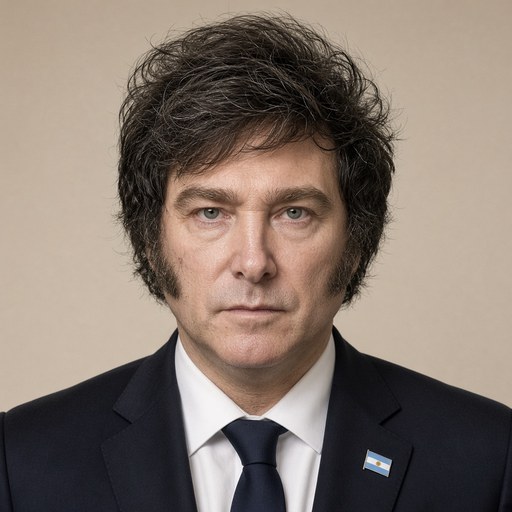
Words of the President of the Nation, Javier Milei, at the Flag Day event in the City of Rosario.
 Javier Milei · President of Argentina
- Context
- Milei addressed a Flag Day ceremony in Rosario on June 20, 2024, commemorating Manuel Belgrano's death and the origins of the Argentine flag.
- Main themes
- Manuel Belgrano's legacy, Argentine flag symbolism, freedom and independence, political courage vs. elite obstruction, austerity and public service, oath to the flag, national identity, Argentine progress and prosperity, Buenos Aires vs. interior tensions, historical memory
- Duration
- ~9 min
- Words
- 1,112
- Sentences
- 41
- Readability
- 53
- Grade
- 12.6
- Syntax
- 3.32
- Vocabulary
- 2.27
Translated from Spanish
The broad sphere of national life a sentence belongs to. Every sentence has an Arena, so it is the denominator the other indices are read against.
Other41 sentences in 9 paragraphs
Argentinians, today we commemorate the passage to immortality of Manuel Belgrano, hero of the May Revolution and father of our Argentine flag. It is said that that first version of our national emblem, designed and requested by Belgrano back in 1812, was sewn by women from Rosario who wanted to contribute to the cause of freedom. Small gestures like that, like Belgrano's own actions, show that the will and actions of men and women committed to their time have the capacity to change the destinies of a nation, no matter how titanic the challenge may seem, and that every decision of every individual can have a decisive weight in the unfolding of our history.
As you know, to design our flag, Belgrano was inspired by the colors of our cockade, which was used to distinguish our troops on the battlefield. But when Belgrano wrote to the Triumvirate to ask them to rectify the flag as the official symbol, the government of Buenos Aires rejected it and ordered him not to hoist that flag, but another one. Why? Because the political leadership in Buenos Aires was still not talking about Independence, they were still not talking about a free country, but rather about an autonomous government from the viceroyal authorities, yet loyal to the crown, loyal to Ferdinand VII. Consequently, they did not want to send a wrong diplomatic message; they wanted to maintain appearances. As some still like to do today, some guided by fear because they did not dare to be free, others because they directly wanted to continue being subjects. They tried to strip the army of a symbol that shouted Independence. And thus, they did not authorize the Argentine people to give themselves a truly own flag. But Belgrano did not care a bit about the orders of the porteño elites and took his insignia to the battles that followed on the road to Upper Peru. He did not wait for authorization for anything and did what he knew was right, something that has become a healthy custom in the interior of the country, when the impositions and demands of Buenos Aires politics are excessive and unfounded.
Belgrano was a maximalist of freedom. He understood that we were either free or we were not; there were no buts or middle points. That is why he chose not to renounce the flag, even despite the orders from Buenos Aires, because freedom does not ask for permission, freedom imposes itself. We do not wait for the orders of any bureaucrat who speculates on what is convenient or what is not. Freedom is an innate instinct of being Argentine and that is why, in the long run, it always finds a way, because freedom is inevitable, no matter how much a few resist or want to contain it.
Belgrano was not only a leader of men, but he was also an example of austerity and honesty in the exercise of public authority. We are talking about someone who, when he was a member of the First Junta, was the only one who did not receive a salary; someone who, when he received a prize from the Assembly for his victories in the battles of Salta and Tucumán, donated it entirely to build four schools in the north. Unfortunately, those schools were never built because the money never reached where it was supposed to go. Belgrano also, like so many others after him, had to face the porous hands of politicians.
Finally, after all he did to liberate this land, Belgrano died poor, unable to collect the money that the State owed him in terms of salaries as General. In other words, we never paid him properly for the service he had provided. It is not a recent invention that politicians disrespect the uniformed who put their bodies on the line for the Homeland, but a tradition, unfortunately, that we must end.
The first time the Argentine flag was hoisted here, on the banks of the Paraná, Belgrano made his troops swear, inaugurating a ritual of initiation that to this day every Argentine must go through. The oath to the flag is a sacred moment for Argentinians, because the flag is, in some way, the embodiment of the homeland and, consequently, the most tangible way to swear loyalty to our land. The oath to the flag is a promise of freedom for a people; consequently, it is a promise of happiness. That is why flags are not burned, that is why flags are not washed, and that is why flags must never be captured by the enemy, because they are the materialization of the freedom and autonomy of a people. That is why today, here in Rosario, I want to invite you to repeat once again this commitment to freedom: to swear by the Argentine flag, as our peoples taught us.
I dream of a world where the Argentine flag flies high in the sky, proud among the most prosperous nations on earth. That we return to occupy the role that we once knew how to achieve and that we write a new chapter in the history of Argentine progress. To reach that dream, the dream of a free and own Argentina, it is essential that all those of us who share the cause of freedom, that all those who understand that Argentina must once again embrace the ideas that made us great, lay aside our partisan blinders, detach ourselves from our particular interests, and work together to establish the new economic order that Argentina needs to become a world power again.
For this reason, I want to take advantage of this day, with the Argentine flag flying in the sky, already advanced in the sanction of the Law Bases and the Fiscal Package. I want to take this opportunity to call on all political authorities, on the governors of the Argentine provinces, on the leaders of the main political parties, on the former presidents of the nation, on the members of the Honorable Supreme Court of Justice, on businessmen, on workers, and, of course, on all Argentine citizens to meet on the night of July 9 in Tucumán to sign the Pact of May and finally begin together to turn the page of our history.
I wish that this year is remembered in Argentine history as the turning point in which we began to be great again. May God bless Argentinians, may the forces of heaven accompany us, and long live freedom, damn it! Long live freedom, damn it! Long live freedom, damn it! Long live, long live the Homeland, long live the Homeland, long live the Homeland! Thank you very much!
The original Spanish. The tags above are read on the English translation's sentences.
Argentinos, hoy conmemoramos el paso a la inmortalidad de Manuel Belgrano, héroe de la Revolución de Mayo y padre de nuestra bandera Argentina. Dicen que esa primera versión de nuestra insignia nacional, diseñada y pedida por Belgrano, allá por 1812, fue cosida por rosarinas que querían hacer su aporte a la causa de la libertad. Pequeños gestos como ese, como el propio accionar de Belgrano, muestran que la voluntad y accionar de los hombres y mujeres comprometidos con su tiempo tiene la capacidad de cambiar los destinos de una nación, por más titánico que parezca el desafío, y que cada decisión de cada individuo puede tener un peso determinante en el devenir de nuestra historia.
Como saben, para diseñar nuestra bandera, Belgrano se inspiró en los colores de nuestra escarapela, que se usaba para distinguir a nuestras tropas en el campo de batalla. Pero cuando Belgrano escribió al Triunvirato para pedirles que rectificaran la bandera como símbolo oficial, el gobierno de Buenos Aires la rechazó y le ordenó que no izara esa bandera, sino otra. ¿Por qué? Porque la dirigencia política en Buenos Aires aún no hablaba de Independencia, aún no hablaba de un país libre, sino que hablaban de un gobierno autónomo de las autoridades virreinales, pero fiel a la corona, fiel a Fernando VII. En consecuencia, no querían mandar un mensaje diplomático equivocado; querían cuidar las formas. Como aún les gusta hacer a algunos hoy, algunos guiados por el miedo porque no se animaban a ser libres, otros porque directamente querían seguir siendo súbditos. Trataron de despojar al ejército de un símbolo que gritaba Independencia. Y así, no autorizaron que el pueblo argentino se diera a sí mismo una bandera realmente propia. Pero a Belgrano le importó un rábano las órdenes de las élites porteñas y llevó su insignia a las batallas subsiguientes al camino hacia el Alto Perú. No esperó la autorización de nada e hizo lo que sabía correcto, algo que se ha convertido en una sana costumbre en el interior del país, cuando las imposiciones y exigencias de los políticas de Buenos Aires son excesivas e infundadas.
Belgrano era un maximalista de la libertad. Él entendía que, o éramos libres o no lo éramos; no había peros ni puntos intermedios. Por eso eligió no renunciar a la bandera, aún a pesar de las órdenes de Buenos Aires, porque la libertad no pide permiso, la libertad se impone. No se esperan las órdenes de ningún burócrata que especula con qué conviene o con qué no. La libertad es un instinto innato de ser argentino y es por eso que, a la larga, siempre se abre camino, porque la libertad es ineludible, por más que unos pocos se resistan o la quieran contener.
Belgrano no solo fue un líder de hombres, sino también fue un ejemplo de austeridad y honradez en el ejercicio de la autoridad pública. Hablamos de alguien que, cuando fue vocal de la Primera Junta, era el único que no cobraba; alguien que, cuando recibió un premio de la Asamblea por sus victorias en las batallas de Salta y Tucumán, lo donó entero para construir cuatro escuelas en el norte. Lamentablemente, esas escuelas nunca se hicieron porque el dinero nunca llegó a donde debía llegar. Belgrano también, como tantos otros después de él, tuvo que enfrentarse a las porosas manos de los políticos.
Finalmente, después de todo lo que hizo para liberar esta tierra, Belgrano murió pobre, sin poder cobrar el dinero que el Estado le debía en conceptos de sueldos como General. O sea, nunca le pagamos correctamente por el servicio que había brindado. No es un invento de las últimas décadas que los políticos le falten el respeto a los uniformados que ponen el cuerpo por la Patria, sino una tradición, lamentablemente, que debemos terminar.
Aquella primera vez que se izó la bandera argentina aquí, a orillas del Paraná, Belgrano hizo a sus tropas jurar, inaugurando un ritual de iniciación por el que hasta hoy en día todo argentino debe pasar. El juramento a la bandera es un momento sagrado para los argentinos, porque la bandera es, de alguna forma, la encarnación de la patria y, en consecuencia, la forma más tangible de jurar lealtad a nuestra tierra. El juramento a la bandera es una promesa de libertad para un pueblo; en consecuencia, es una promesa de felicidad. Por eso, las banderas no se queman, por eso las banderas no se lavan y por eso las banderas nunca deben ser capturadas por el enemigo, porque son la materialización de la libertad y de la autonomía de un pueblo. Por eso hoy, aquí en Rosario, quiero invitarlos a repetir una vez más este compromiso de libertad: jurar por la bandera argentina, como nuestros pueblos nos enseñaron.
Sueño con un mundo en que la bandera argentina flamea alto en el cielo, orgullosa entre las naciones más prósperas de la tierra. Que volvamos a ocupar el rol que alguna vez supimos conseguir y que escribamos un nuevo capítulo en la historia del progreso argentino. Para poder alcanzar ese sueño, el sueño de una Argentina propia y libre, es fundamental que todos aquellos que compartimos la causa de la libertad, que todos aquellos que entendemos que la Argentina tiene que volver a abrazar las ideas que nos hicieron grandes, depongamos las anteojeras partidarias, nos desprendamos de nuestros intereses particulares y trabajemos juntos para establecer el nuevo orden económico que la Argentina necesita para volver a ser una potencia mundial.
Por esta razón, quiero aprovechar este día, con la bandera argentina flameando en el cielo, avanzada ya la sanción de la Ley Bases y el Paquete Fiscal. Quiero aprovechar para convocar a todas las autoridades políticas, a los gobernadores de las provincias argentinas, a los dirigentes de los principales partidos políticos, a los expresidentes de la nación, a los miembros de la Honorable Corte Suprema de Justicia, a empresarios, a trabajadores y, por supuesto, a toda la ciudadanía argentina a que nos encontremos la noche del próximo 9 de julio en Tucumán para firmar el Pacto de Mayo y finalmente empecemos juntos a dar vuelta la página de nuestra historia.
Deseo que este año sea recordado en la historia argentina como el punto de inflexión en el que volvimos a empezar a ser grandes. Que Dios bendiga a los argentinos, que las fuerzas del cielo nos acompañen y ¡Viva la libertad, carajo! ¡Viva la libertad, carajo! ¡Viva la libertad, carajo! ¡Viva, viva la Patria, viva la Patria, viva la Patria! ¡Muchas gracias!