




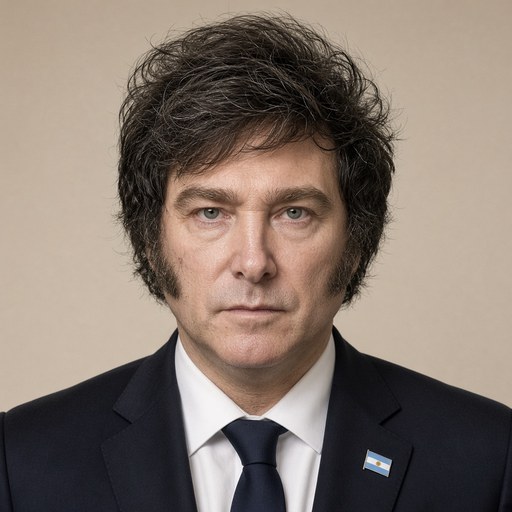
Words of the President of the Nation, Javier Milei, upon receiving the International Medal of the Community of Madrid, Spain.
 Javier Milei · President of Argentina
- Context
- Milei addressed an audience in Madrid upon receiving the International Medal of the Community of Madrid on June 21, 2024, warning against socialism.
- Main themes
- Socialism critique, economic decline of Argentina, social justice as unjust concept, fiscal deficit and public debt, free market capitalism, property rights, price system as social mechanism, populism dangers, tax burden, poverty generation, warning to Spain and Madrid
- Duration
- ~18 min
- Words
- 2,151
- Sentences
- 94
- Readability
- 51
- Grade
- 11.7
- Syntax
- 3.16
- Vocabulary
- 2.19
Translated from Spanish
The broad sphere of national life a sentence belongs to. Every sentence has an Arena, so it is the denominator the other indices are read against.
Other94 sentences in 14 paragraphs
Good afternoon. Thank you very much, President of the Community of Madrid, for this distinction. Thank you very much for your way of being. Thank you to everyone present here.
It is a true honor for me to receive this decoration and, as the president pointed out, in a sense I have said it in other speeches: we come from the future to tell you a story that is desirable to avoid, it is the story of the damage and decay caused by socialism. Argentina, at the end of the 19th century, was the richest country in the world. Today, after more than 100 years of impoverishing socialism and violent populism, Argentina, at the official exchange rate, has fallen to 140th in the parallel world ranking.
We received the country in that situation, with more than 13 years of decline in per capita GDP, over 50% of people living in poverty, and a scandalous situation, where a country that produces food for 400 million human beings, where the tax burden on the food-producing sector is 70%, meaning that the State takes the food of 280 million human beings, there are about 5 million Argentines who cannot afford to eat. That catastrophe is the virtue of socialism: to generate poverty.
That is why I want to share this with you and alert you about the risks and how that model works, because it is not necessary to reach such an extreme situation as Argentina has reached; it would be good to avoid all that pain. Especially, I was coming here and I see Madrid, and it is so beautiful. Do not let socialism ruin your life is the message. And the point is, when we started in the electoral race, already in the first stage, when I was about to run for a seat in the Chamber of Deputies for the Autonomous City of Buenos Aires, we were already talking about what the model of the caste was. The model of the caste basically starts from a socialist premise that says that where there is a need, a right is born. Now, that definition has a problem. The first is that needs are infinite, and the issue is that rights have to be paid for by someone, and resources are finite. Therefore, that inconsistency, that conflict between infinite needs and finite resources, requires a solution. Those of us who believe in the ideas of freedom, in free enterprise capitalism, where we consider that the market is a mechanism of social cooperation, where property rights are voluntarily exchanged, believe that this work is done by the price system. And there is nothing better that can resolve what the price system resolves, which has probably been one of the greatest human inventions in the history of humanity.
However, socialists do not believe in that; they believe in a horrible and impoverishing monster called social justice, a truly aberrant idea. Hayek spoke of something he called weasel words: every time you put an adjective on something, it destroys the original meaning of the word, in this case, social justice. The truth is that social justice is profoundly unjust and profoundly violent, because social justice first violates equality before the law, because it takes from some and gives to others, and that is preceded by theft, because taxes are not paid voluntarily; they are paid at gunpoint, in exchange for the fact that if you do not pay them, you go to jail. So, it is preceded by theft and unequal treatment before the law. Therefore, social justice is never just; it is profoundly unjust. Moreover, they often raise noble issues, but discretion always plays a bad trick, there are always leaks. Bastiat spoke of the porous hands of politicians. Perhaps it is not the politician's directly, perhaps it is a brother's, a partner's, or whatever. Those who want to understand, let them understand.
In that sense, what happens is that this intention manifests itself in an increase in public spending, in an increase in the fiscal deficit. The fiscal deficit has to be financed, always financed. You have different ways to finance the fiscal deficit. The way that the most heartless, populist, wild, and lying politician uses is indebtedness. Indebtedness is an absolutely immoral way to face the situation, because debt is nothing more and nothing less than future taxes. So, it means that the party of the present is being paid for by the work of people in the future, people who do not vote, people who are not even born. That is to say, it is profoundly immoral. They are financing the party of the populist politician today at the expense of the effort of generations that cannot even express themselves at the polls. Moreover, that is not free either, because when you resort to indebtedness in a pronounced way, it has implications for the interest rates that are paid. When higher interest rates are paid, because the economy of the treasury starts to become riskier, it has a clearly negative counterpart: less investment, a lower level of capitalization, and therefore, lower real wages and worse living standards. That is to say, it ends up being a brake on economic growth. When this situation gets out of hand, it also generates stagnation and decay. It is no coincidence that Argentina used this tool and became the biggest defaulter in modern history, something that we, from our government, are changing. We basically inherited a fiscal deficit of 15% of GDP, where five points were from the treasury and ten from the central bank. Against all the predictions that were made that making an adjustment of such caliber was impossible, we have done it in less than six months.
In less than six months, we not only achieved financial balance in the treasury, but we have practically finished the quasi-fiscal deficit in the Central Bank. That is to say, we made an adjustment of 15 points of GDP in 5 months. It is the strongest adjustment in the history of humanity, and that allowed us to start to decelerate inflation because we no longer need to finance the deficit with money issuance. Inflation, when we took office, was running at a rate of 17,000% annually. Wholesale inflation was 54% monthly, which annualized gave 17,000%. In the last observation, it was 3.5%, that is, the equivalent of 50% annually. It is still an aberrant and horrible number, but compared to the 17,000% that was left to us, it is much less and is a huge achievement.
Not only that, but another mechanism that politicians use when they run out of financing via debt is to use monetary issuance. Argentina, since it created its Central Bank in 1935, has removed 13 zeros from its currency. We could remove three more zeros.
Argentina has had two hyperinflations without war. Argentina chronically suffers from an inflation problem. And that is also important to keep in mind, because one of the most nefarious influences that Keynesianism has left is to believe that inflation depends on anything but the issuance of money. That is to say, if you pass through Argentina, you will find a lot of economists saying that inflation is multi-causal. And the reality is that the only cause of inflation is the issuance of money. When you generate an excess supply of money, whether because you issue money or because the demand for money falls (both things happen at the same time), that causes the purchasing power of the currency to lose value and all prices that are in monetary units to rise. In fact, we have undertaken this to cut off the financing of the treasury; we no longer issue for the fiscal sector, and we also sterilize the purchase of foreign currency through another window.
We still have some pending issues to resolve with the remunerated liabilities, but in principle, we are on the way to a zero issuance situation to definitively end inflation. In fact, when we have the Central Bank completely cleaned up, from that moment we will send a law where issuing money will be a crime and that crime will be against humanity. And if money is issued, the president of the nation, the minister of economy, the president of the Central Bank, all their board members, and deputies and senators who approve those measures will go to jail. And since it will be a crime against humanity, automatically, if another government comes and changes those laws, a liberal will always come back and put them in jail. So, we will also definitively end inflation in Argentina. We are ending the fiscal deficit, the quasi-fiscal deficit, and we are ending inflation. And the fruits are being seen, because after having gone through the worst moment during the last quarter of the year, today you are starting to see better activity indicators that show improvements. The diffusion indices already exceed 50%, that is, the number of sectors that are expanding already exceeds 50%, and the leading indicators have been showing positive records for more than 2 months. In short, it can be done.
The other mechanism that politicians use is to raise taxes. And when you raise taxes, in essence, it is nothing more and nothing less than expropriation. Essentially, what you are doing is killing economic growth; you are violating property rights. And if you violate property rights, there are no incentives to save, there are no incentives to invest, and therefore, the economy stagnates.
All these aberrations in Argentina have been suffered for more than 100 years, and they have generated this tremendous decay as rarely seen in the history of humanity. But fortunately, Argentines have awakened, they have awakened to the ideas of freedom, they have awakened and understood that there is no way out with populism; the way out is with responsibility, the way out is with capitalism, saving, and hard work, I would say, Professor Anxo Bastos. The way out is liberalism, that is why we - and this surprised me very much when we were doing our campaign events; we closed with a phrase from our greatest exponent of the ideas of freedom, Professor Alberto Venegas Lynch Jr., who says that “liberalism is the respect and respect for the life project of others, based on the principle of non-aggression and in defense of the right to life, liberty, and property, whose institutions are private property, free markets, non-state intervention, the division of labor, social cooperation, and where one can only be successful by serving others with better quality goods and better prices.” That is to say, where the true heroes are entrepreneurs and businesspeople, not the bureaucrats who persecute us, who persecute the press, who lie, who steal, and who fundamentally destroy a country, and above all, produce a damage that complicates the social fabric because socialism is based on envy, hatred, resentment, and unequal treatment before the law. If necessary, they have no problem resorting to murder, because where socialism has been applied purely, it has been a failure economically, culturally, socially, and never forget that they murdered more than 100 million human beings.
Therefore, it is always very pleasant for me to come to Spain. It is very pleasant to visit great friends. Today I have the opportunity to be with Isabel, whom I appreciate and admire so much, I admire her for her enormous battle, for those wonderful speeches, which I never miss the opportunity to watch on YouTube. That is why I say I am so happy to be here. But, above all, to alert you to the risk you have ahead. Because, moreover, when socialism begins to play, to take hold, the logic of Hayek's road to serfdom; every time there is an intervention, the functioning is worse. And, therefore, that leads to more intervention.
To conclude, I want to share two phrases, one from Mises and one from Hayek. Mises' phrase says that knowledge in economics leads to liberalism. And a phrase from Hayek that says that if socialists understood economics, they would not be socialists. Well, it seems that one of the exceptions that make the rule is made by you with Mr. Sánchez, who evidently, despite having been in economics, did not understand or likes the State too much to take advantage of the Spaniards. But I have hope that you are awakening, as they did in Argentina. I remember that when I started the campaign, at the closing I said that I did not come to guide sheep; I came to awaken lions. And it seems that that roar, from a place far away in South America, has begun to reach the whole world. It has already given a lesson to Europe recently, and we believe that in the world the ideas of freedom will return, which are the only ones that bring prosperity. Thank you very much!
The original Spanish. The tags above are read on the English translation's sentences.
Buenas tardes. Muchísimas gracias, presidente de la comunidad de Madrid, por esta distinción. Muchísimas gracias por tu forma de ser. Muchas gracias a todos los que están aquí presentes.
Es para mí un verdadero honor recibir esta condecoración y, tal como señalaba la presidente, en algún sentido lo he dicho en otros discursos: nosotros venimos del futuro a contarles una historia que es deseable evitar, es la historia del daño y la decadencia que causa el socialismo. Argentina, a fines del siglo XIX, era el país más rico del mundo. Hoy, después de más de 100 años de socialismo empobrecedor y populismo violento, Argentina, al tipo de cambio oficial, cayó a 140 del ranking mundial paralelo.
Recibimos el país en esa situación, con más de 13 años de caída del PBI per cápita, más del 50% de pobres y una situación escandalosa, donde un país que produce alimentos para 400 millones de seres humanos, donde la presión fiscal sobre el sector productor de alimentos es del 70%, es decir, que el Estado se queda con el alimento de 280 millones de seres humanos, hay cerca de 5 millones de argentinos que no les alcanza para comer. Esa catástrofe es la virtud del socialismo: generar pobreza.
Es por eso que quiero comentárselos y alertarles sobre los riesgos y cómo funciona ese modelo, porque no es necesario tener que llegar a una situación tan extrema como la que llegó a Argentina, sería bueno evitarse todos esos dolores. En especial, yo venía hacia acá y voy viendo Madrid, y es tan hermoso. No dejen que el socialismo les arruine la vida es la consigna. Y el punto es, cuando iniciamos en la carrera electoral, ya en la primera etapa, cuando estaba por ir por una banca de diputados por la Ciudad Autónoma de Buenos Aires, nosotros ya hablábamos de lo que era el modelo de la casta. El modelo de la casta, básicamente parte de una premisa socialista que dice que donde hay una necesidad nace un derecho. Ahora, esa definición tiene un problema. El primero es que las necesidades son infinitas, y el tema es que los derechos alguien los tiene que pagar y los recursos son finitos. Por lo tanto, esa inconsistencia, ese conflicto entre necesidades infinitas y recursos finitos, requiere de una solución. Aquellos que creemos en las ideas de la libertad, en el capitalismo de libre empresa, donde consideramos que el mercado es un mecanismo de cooperación social, donde voluntariamente se intercambian derechos de propiedad, consideramos que ese trabajo lo hace el sistema de precios. Y no hay nada mejor que pueda resolver lo que resuelve el sistema de precios, que probablemente haya sido una de las mayores invenciones humanas en la historia de la humanidad.
Sin embargo, los socialistas no creen en eso; creen en un monstruo horrible y empobrecedor llamado justicia social, una idea realmente aberrante. Hayek hablaba de algo que llamaba palabras comadrejas: cada vez que ustedes le ponían un adjetivo a algo, destruía el sentido original de la palabra, en este caso, justicia social. La verdad es que la justicia social es profundamente injusta y profundamente violenta, porque la justicia social lo primero que hace es violentar la igualdad ante la ley, porque a algunos les quita y a otros les da, y eso antes está precedido de un robo, porque los impuestos no se pagan voluntariamente, se pagan a punta de pistola, a cambio de que si no los paga uno, va preso. Entonces, está precedido de un robo y de un trato desigual ante la ley. Por lo tanto, la justicia social nunca es justa; es profundamente injusta. Además, suelen enarbolar cuestiones nobles, pero la discrecionalidad siempre juega una mala pasada, siempre hay filtraciones. Bastiat hablaba de las porosas manos de los políticos. Quizás no es la del político directamente, quizás es la de un hermano, la pareja o lo que fuera. El que quiere entender, que entienda.
En ese sentido, lo que sucede es que esa intención se manifiesta en un aumento del gasto público, en un aumento del déficit fiscal. El déficit fiscal tiene que ser financiado, siempre financiado. Ustedes tienen distintas formas de financiar el déficit fiscal. La forma que usa el político más desalmado, más populista, más salvaje, el más mentiroso, es el endeudamiento. El endeudamiento es una forma absolutamente inmoral de enfrentar la situación, porque la deuda no es ni más ni menos que impuestos futuros. Entonces, quiere decir que la fiesta del presente está siendo pagada por el trabajo de personas en el futuro, personas que no votan, personas que ni siquiera nacieron. Es decir, es profundamente inmoral. Están financiando la fiesta del político populista hoy a cambio del esfuerzo de generaciones que ni siquiera pueden manifestarse en las urnas. Además, no es gratis eso tampoco, porque cuando ustedes recurren al endeudamiento de manera pronunciada, eso tiene implicancias en las tasas de interés que se pagan. Al pagarse mayores tasas de interés, porque la economía del fisco empieza a ser más riesgosa, tiene una contraparte claramente negativa: una menor inversión, un menor nivel de capitalización y, por ende, salarios reales menores y peores niveles de vida. Es decir, termina siendo un freno al crecimiento económico. Cuando esta situación queda desmadrada, además, genera estancamiento y decadencia. No en vano Argentina utilizó esta herramienta y llegó a ser el máximo defaulteador de la historia moderna, algo que nosotros, desde nuestro gobierno, estamos cambiando. Nosotros, básicamente heredamos un déficit fiscal del 15% del PBI, donde cinco puntos eran del tesoro y diez del banco central. Contra todos los pronósticos que se hacían de que hacer un ajuste de semejante calibre era imposible, lo hemos hecho en menos de seis meses.
En menos de 6 meses no solo logramos el equilibrio financiero en el tesoro, sino que prácticamente tenemos terminado el déficit cuasifiscal en el Banco Central. Es decir, hicimos un ajuste de 15 puntos del PBI en 5 meses. Es el ajuste más fuerte en la historia de la humanidad, y eso nos permitió empezar a desacelerar la inflación porque no necesitamos más financiar el déficit con emisión de dinero. La inflación, cuando nosotros asumimos, viajaba a un ritmo del 17.000% anual. La inflación mayorista era del 54% mensual, lo que anualizado daba 17.000%. En la última observación fue del 3,5%, es decir, el equivalente a 50% anual. Sigue siendo un número aberrante y horrible, pero respecto al 17.000% que nos dejaron, es muchísimo menos y es un logro enorme.
No solo eso, sino que otro mecanismo que utilizan los políticos cuando ya se quedan sin financiamiento vía deuda es utilizar la emisión monetaria. Argentina, desde que creó su Banco Central en el año 1935, le quitó 13 ceros a la moneda. Podríamos quitarle tres ceros más.
Argentina tuvo dos hiperinflaciones sin guerra. Argentina padece crónicamente un problema de inflación. Y eso también es importante tenerlo en cuenta, porque una de las influencias más nefastas que ha dejado el keynesianismo es creer que la inflación depende de cualquier cosa menos de la emisión de dinero. Es decir, si pasaran por Argentina, se van a encontrar con un montón de economistas diciendo que la inflación es multicausal. Y la realidad es que la única causa de la inflación es la emisión de dinero. Cuando ustedes generan un exceso de oferta de dinero, ya sea porque emiten dinero o porque cae la demanda de dinero (pasan las dos cosas a la vez), eso hace que pierda el poder adquisitivo de la moneda y todos los precios que son de unidad monetaria suben. De hecho, nosotros hemos emprendido esto de cortarle el financiamiento del fisco, no emitimos más para el sector fiscal, y además esterilizamos la compra de divisas por otra ventana.
Tenemos algunos temas aún pendientes de resolución con los pasivos remunerados, pero en principio vamos camino a una situación de emisión cero para terminar definitivamente con la inflación. De hecho, cuando tengamos totalmente saneado el Banco Central, a partir de ese momento vamos a enviar una ley donde emitir dinero sea un delito y que ese delito sea de lesa humanidad. Y si se emite dinero, va a ir preso el presidente de la nación, el ministro de economía, el presidente del Banco Central, todo su directorio, y diputados y senadores que aprueben esas medidas. Y como va a ser un delito de lesa humanidad, automáticamente, si viniera otro gobierno y cambiara esas leyes, siempre va a volver algún liberal y los va a meter presos. Así es que, también vamos a terminar definitivamente con la inflación en la Argentina. Lo estamos terminando con el déficit fiscal, con el cuasi fiscal, y estamos terminando con la inflación. Y se están viendo los frutos, porque después de haber pasado el peor momento durante el último trimestre del año, hoy empiezan a ver mejores indicadores de actividad que muestran mejoras. Los índices de difusión ya superan el 50%, es decir, la cantidad de sectores que están expandiendo ya supera el 50%, y los indicadores líderes llevan más de 2 meses mostrando registros positivos. En definitiva, se puede hacer.
El otro mecanismo que utilizan los políticos es subir los impuestos. Y cuando ustedes suben los impuestos, en el fondo no es ni más ni menos que una expropiación. En el fondo, lo que están haciendo es matar el crecimiento económico, están violentando el derecho de propiedad. Y si ustedes violentan el derecho de propiedad, no hay incentivos para ahorrar, no hay incentivos para invertir y, por ende, la economía se estanca.
Todas estas aberraciones en la Argentina, hace más de 100 años que las padecemos, y han generado esta tremenda decadencia como pocas veces visto en la historia de la humanidad. Pero afortunadamente, los argentinos despertaron, despertaron a las ideas de la libertad, despertaron y entendieron que no se sale más con populismo, se sale con responsabilidad, se sale con capitalismo, ahorro y trabajo duro, diría el profesor Anxo Bastos. La salida es el liberalismo, por eso, nosotros - y esto a mí me resultó muy sorprendente cuando hacíamos nuestros actos de campaña; el cierre lo hacíamos con una frase de nuestro máximo exponente de las ideas de la libertad, el profesor Alberto Venegas Lynch hijo-, que dice que “el liberalismo es el respeto y respeto del proyecto de vida del prójimo, basado en el principio de no agresión y en defensa el derecho a la vida, a la libertad y a la propiedad, cuyas instituciones son la propiedad privada, los mercados libres, la no intervención estatal, la división del trabajo, la cooperación social y donde solamente se puede ser exitoso sirviendo al prójimo con bienes de mejor calidad y mejor precio”. Es decir, donde los verdaderos héroes son los empresarios y los emprendedores, no los burócratas que nos persiguen, que persiguen a la prensa, que mienten, que roban y que en el fondo destruyen a un país, y sobre todas las cosas, producen un daño mucho más complicado que deteriora el tejido social porque el socialismo está basado en la envidia, el odio, el resentimiento y el trato desigual frente a la ley. Si es necesario, no tienen problema en recurrir al asesinato, porque donde se aplicó el socialismo de manera pura fue un fracaso en lo económico, cultural, social, y nunca se olviden que asesinaron a más de 100 millones de seres humanos.
Por lo tanto, para mí siempre es muy grato venir a España. Es muy grato visitar a grandes amigos. Hoy tengo la posibilidad de estar con Isabel, a quien tanto aprecio y admiro, admiro por su enorme batalla, por esos discursos maravillosos, que no me pierdo la oportunidad de verlos por YouTube. Por eso digo que estoy tan feliz acá. Pero, sobre todas las cosas, para alertarles del riesgo que tienen enfrente. Porque, además, cuando el socialismo entra a jugar, a calar, la lógica del camino de servidumbre de Hayek; cada vez que se hace una intervención, el funcionamiento es peor. Y, por ende, eso lleva a más intervención.
Para finalizar, quiero contarles dos frases, una de Mises y una de Hayek. La frase de Mises dice que el conocimiento en la economía lleva al liberalismo. Y una frase de Hayek que dice que, si los socialistas entendieran de economía, no serían socialistas. Bueno, parece que una de las excepciones que hacen a la regla la hacen ustedes con el señor Sánchez, que evidentemente, a pesar de haber estado en economía, no entendió o le gusta mucho el Estado para llevarse puestos a los españoles. Pero tengo esperanzas de que estén despertando, como despertaron en Argentina. Yo recuerdo que, cuando arranqué la campaña, en el cierre dije que yo no venía a guiar corderos, venía a despertar leones. Y parece que ese rugir, desde un lugar alejado de Sudamérica, empezó a llegar a todo el mundo. Ya dio una lección a Europa recientemente y creemos que en el mundo volverán las ideas de la libertad, que son las únicas que traen prosperidad. ¡Muchísimas gracias!