




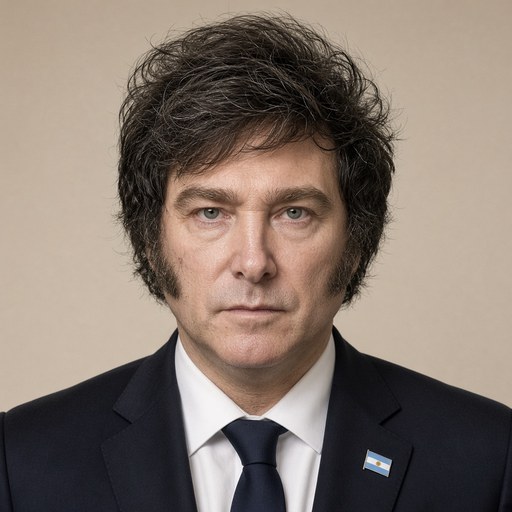
Words of President Javier Milei after receiving an Honorary Doctorate from Bar-Ilan University in Israel.
 Javier Milei · President of Argentina
- Context
- Milei addressed Bar-Ilan University upon receiving an Honorary Doctorate, delivering remarks on capitalism, morality, and Judeo-Christian values in Israel in April 2026.
- Main themes
- Capitalism and divine providence, Judeo-Christian values and prosperity, morality as state policy, natural law and liberty, economic efficiency and justice, Greek philosophy and Roman law, Stoic ethics, anarcho-capitalism, Argentine economic crisis, honorary doctorate address
- Duration
- ~59 min
- Words
- 7,107
- Sentences
- 314
- Readability
- 54
- Grade
- 11.2
- Syntax
- 3.08
- Vocabulary
- 2.16
Translated from Spanish
The broad sphere of national life a sentence belongs to. Every sentence has an Arena, so it is the denominator the other indices are read against.
Other314 sentences in 53 paragraphs
President of Bar-Ilan University, Professor Arie Zaban, authorities, faculty members, and student body:
I am deeply honored to receive this Doctorate Honoris Causa from you, especially in such a special year for this prestigious institution, which will mark its 60th anniversary. I am extremely grateful to have been considered for a distinction of this caliber, joining the select list of world leaders who have left their mark on modern history.
For this very special moment, which means so much to me to be recognized here in Israel, I will be presenting to you what is the epilogue of my new book, which we shall say, and the title of this talk is ‘Capitalism: the Divine Machinery of Paradise.’ Basically, the talk will have two parts. The first part is the name of the book, which is called: “Morality as State Policy,” where I will be providing the elements of how to construct state policies based on ethical and moral values, but unlike other cases and other talks I have given, in this one I will lay out the foundations of why I believe that embracing Judeo-Christian values leads to prosperity; hence saying that capitalism is the divine machinery of paradise. That is to say, we have been expelled from paradise, we cannot return to paradise, but if we act according to the laws of Hashem, paradise will come to us, and that will be the core of the presentation, of what is the epilogue of the book.
Therefore, I will first start with what I call morality as state policy, which basically has three blocks. One that relates to the ethical and moral values of the West; there is a block linked to economic efficiency; and there is a third block dedicated to political utilitarianism. When one designs policies according to ethical and moral values, the consequence is that one designs just policies, and when just policies are designed, those policies are efficient. That is to say, justice and efficiency are two sides of the same coin. There is a false dilemma that is often proposed to us as things that are in conflict. That is to say, one cannot do unjust things at the altar of efficiency. And the third part relates to political utilitarianism, if in the end one will reap or not the votes that allow one to continue working in the management of state administration.
So, when these issues are linked, they are in harmony, one generates policies that are just, and the result is that they generate prosperity, while when they come into conflict, they end in crisis. In fact, there is a beautiful phrase from Murray Newton Rothbard, the inventor of anarcho-capitalism, which could be applied to various issues. But what Rothbard points out in terms of economics is: the materialization of the crisis is of an economic nature, but the root is moral. So, when one begins to violate ethical and moral values, the result will inevitably be disaster. And believe me, I come from a place where, for almost 100 years, we have been trying those disasters, and that is how it has gone for us.
Thus, basically, what I will explain at this moment is this of morality as state policy and what I mean when I talk about the ethical and moral values of the West. Basically, on one hand, Greek philosophy, that is to say, the way in which the Greeks were thinking about the Western world. On the other hand, I refer to Roman law; the obligatory reference is Ulpian. Moreover, there are also the themes of law; I focus essentially on natural law, which is the right to life and the right to liberty, added to Locke's principle of appropriation, and that system has the characteristics not only of being just but also of being efficient. And that, moreover, has dynamic consequences.
On the other hand, another of the pillars is the rectitude of the Stoics, and the reality is that when I review the Stoics… moreover… when one reviews Adam Smith himself, whose most well-known work, which is The Inquiry into the Nature and Causes of the Wealth of Nations, is basically the work of a Stoic. Beyond the defects one might find in the work, much of his work relates to another of his works called The Theory of Moral Sentiments, and in the last point, he addressed the issue of virtue.
But since I am in Israel, I can make the presentation that one would find in the sacred scriptures, as an equivalent, and which, for example, has been very revealing for me. When I was already interacting with my dear friend the Argentine ambassador here in Israel, Rabbi Axel Wahnish. So, we were at the threshold of a new year, with a new Jew, and then Axel proposed that, when the moment came to enter the new year, I should make three wishes, and as we have such trust, later, when we could talk, he asked me what I wished for. So, I told him that I had asked for wisdom to be able to distinguish between good and evil, I had asked for courage to choose the good, and temperance to be able to sustain myself on the path of good. Well, to my surprise, he said: you asked for the wishes of King Solomon.
And, obviously, later, as I learned more, I added the issue of justice, that is to say, being very clear that something being legal does not necessarily make it legitimate, but that one must seek that, let’s say, natural law and positive law are in harmony, so that the law is just. When there is no harmony, something, no matter how legitimate, I say, no matter how legal it is, that does not make it legitimate, and I do not need to tell you so many things that have been enacted as laws and were profoundly illegitimate, profoundly unjust, and that were nothing more than to give a patina of false consciousness to people who wanted to commit atrocities.
And it is not a coincidence that they are the same virtues that the Stoics present and, basically, it is very similar to the framework that Adam Smith creates, only that it combines courage and temperance into something that would be like self-control, self-command, and thus in that combination reaches three and allows him to add beneficence, but beneficence done with one’s own resources, not with others’. So, basically, that is what I mean when I talk about the rectitude of the Stoics. And, basically, when I refer to Judeo-Christian values, which is the part that I will later be developing in what is the epilogue, I basically refer to the 10 commandments, the capital sins, and to not do; I understand that here you understand better what I mean when I talk about not doing.
The second issue I address, when I talk about morality as state policy, relates to economic efficiency, but which is something that is clearly a step below what are the ethical and moral values, basically what I am doing is talking about efficiency both in static terms and in dynamic terms. In general, the idea of efficiency is often viewed with a tool known as Pareto Optimality, where, basically, it is postulated that each of us, guided by our own interest, leads to maximum general well-being. However, what I do in that case is confront the neoclassical proposal of the invisible hand to Pareto and confront it with the vision of Hans-Hermann Hoppe. This, which seems like a matter of technical and aesthetic discussion, in practical terms is not, because it makes a big difference.
Basically, in the neoclassical vision, the core of neoclassical economics was equilibrium, and basically, when you look at an equilibrium, you try to prove that it exists, that it is unique, and that it is stable. However, economists did not want to stop there and, seduced by the idea of the invisible hand, sought a way that, in addition, the situation would also be optimal. The issue is that the way the problem was solved was by appealing to mathematics, specifically to topology; therefore, an analytical structure was built so that the demand functions, the supply functions, were derived from an optimization exercise, with which each of those individual demands and supplies would be constructed into excess demand functions that, moreover, arise from optima; therefore, in the case that one found the equilibrium price vector, that equilibrium would exist. If it had some properties regarding the strict convexity in the functions under analysis, that equilibrium would be unique; if the direct effects dominated the cross effects, which is quite reasonable, moreover, the equilibrium would be stable, but, in this case, moreover, it would be optimal.
The problem is that this leaves us subject to a very rigid mathematical structure, and the problem is what happens when the model does not map with reality. Well, from my point of view, economists take a very arrogant position, and when the model does not map with reality, we came up with calling those ‘market failures.’ Perhaps in academic terms one can accept it… Still, who is the owner of the finger to say how that world should be, right? But beyond that, the central axis is: as a professional economist, in my other life, so to speak, because now I am dedicated to another business… I worked for a very important businessman and I would make… you know that businessmen are doers, they are not much for words, they are men of yesterday, so, you can imagine that I would go with some work and tell him: no, well, the model says. Well, the model says, but if it makes me lose money, it is of no use to me, I mean, the destination was quite linear and quick. So… because it is as if you have the model and reality does not map the model, that is to say, that reality is wrong, which is nonsense. You should change the model, not torture reality.
So, the interesting thing about Hans-Hermann Hoppe's deduction, even though Hans-Hermann Hoppe detests me, literally, he hates me, says truly aberrant things, probably many of them are right, and makes a demonstration that is truly wonderful. He demonstrates efficiency using logic. That is to say, Hans-Hermann Hoppe's proposal is a philosophical proposal and he resolves it via logic. And when you understand that adding the principle of non-aggression plus natural rights, plus Locke's principle of original appropriation, with those postulates you derive that the system is efficient, and no one would think of talking about market failures if there are exchanges that are voluntary. Therefore, the demonstration that Hoppe makes is far superior because it is not restricted to a mathematical structure, which then when it does not map the structure…
Let’s see, to put it simply, because otherwise it seems that I am speaking very abstractly, let’s go to the case of monopoly, okay? Monopolistic structures basically have production functions with increasing returns. So, that has a problem: unless they have a corner solution, they cannot find a maximum. So, that has a problem for, as that is then translated into a supply function, which then is not a maximum, unless it is at the edge. And, if it is at the edge, they would have a single company in the entire economy, which is quite ridiculous. What do economists call this problem? They call it non-convexity, that is to say, because the production set is not convex. That is to say, if you take two points of a function that has the characteristics of having increasing returns, if you connect the points, put two points on the function, draw the line, that is outside the set. Consequently, there you have a problem. So, that is why it is called non-convexity.
Now, let’s suppose the following, and what is the consequence? Ah, let’s regulate. But, if I regulate, I am violating property rights. So, how am I going to justify that, in the name of efficiency, I am going to be stealing? Or is stealing okay? Stealing is wrong. So, you find yourself with hyper-regulated economies that, in the end, spoil property rights, and then that makes economies not grow. I mean, do you want a good example? Europe. Do you want an applied case of someone who works with these definitions and acts accordingly? Argentina. In just over two years, we have carried out more than fifteen thousand structural reforms. In fact, the Ministry led by Dr. Federico Sturzenegger is called the Ministry of Deregulation, but behind closed doors we call it the Ministry of Increasing Returns, and basically, deregulating means returning property rights, and that allows liberating increasing returns and that generates growth because it facilitates the division of labor. Well, that has…, obviously, that mathematical structure. So they compare it against an optimum and then they start to regulate it, and that is what generates the damage and ends up killing growth. However, the structure that Hoppe develops, being a logical structure, is not tied to that topological structure, so you do not violate property rights and prosperity is generated.
In that same vein, but already in dynamic terms, is where Jesús Huerta de Soto works, but Professor Huerta de Soto goes even further because he directly says: well, what is the dynamically efficient path? It is the one that generates the greatest economic growth. But the idea is that efficiency and justice are two values of the same..., they are two sides of the same coin. That is to say, you cannot pretend that something is efficient and unjust. It cannot be. I mean, how can something that is unjust be efficient, that you are harming someone? Therefore, when something is just, it will inevitably be efficient, and that does not happen just anywhere. I mean, what it does is set aside moral relativism. That is to say, there are things that are right and there are things that are wrong, and there is no room for discussion there. That is to say, with certain cultures we will not be able to coexist because if we respect the right to life, we cannot coexist with those who want to kill us. And that, then, has consequences in terms of economic growth.
The other point has to do with political utilitarianism. Many times politicians, in general all of them, except for rare exceptions, make decisions based on whether it generates votes or not. So, I will make a wild case: let’s suppose I have five people. One person has five hundred dollars and the other four have zero. Someone is going to come and say, ‘Oh, this is profoundly unjust,’ and it will seem horrible to them, let’s say, they will not ask how each one generated that, I mean, they do not care if the one who has five hundred worked hard or inherited it, right? But they inherited it from a relative who did work before, so why should I be appropriating the result of the work of a person who earned it honestly? In that context, a politician comes up with a brilliant idea called social justice and takes 400 from the one who has 500, and gives 100 to each of the other four. Now everyone has 100 each. If he goes to an election, he will win with 80% of the votes, but that is profoundly unjust. What that will do is undermine the system of incentives, that will end up penalizing economic growth. Moreover, it is unjust. So, that will not end well, it will end badly. I come from a place where for many years that was done, and I have to fight to explain that this is unjust and that it leads to disaster.
So, given this introduction, I want to share with you, because this is the first time I will do it in public, this reading, which is “Capitalism, the Divine Machinery of Paradise,” where it is the epilogue of my new book, and I want to read it to you just as I wrote it, because it also reflects a multitude of feelings that I have. The central axis is very simple: one could understand..., I will summarize it, then I will read it as it should be, not clearly, so you know where I am going, so I am not..., it is easier to follow. One could understand paradise as the situation of abundance and, by opposition, hell would be, basically, misery, scarcity, violence, time as a burdensome load. So, the interesting thing is that when we define liberalism accordingly, as our greatest exponent of the ideas of freedom does, which is in Argentina, Professor Alberto Benegas Lynch (h), says: “Liberalism is the unrestricted respect for the life project of others, based on the principle of non-aggression and the defense of the right to life, liberty, and property.” And that system is just and efficient, and that system has proven to be the only system that generates prosperity. Therefore, what I am going to show is that those underlying values, which are behind that model, are aligned with Jewish-Christian values. Ultimately, if one embraces the fulfillment of God's law, prosperity is generated. We will not be able to bring..., let’s see, we will not be able to return to paradise, because we have been expelled from paradise, but yes, as the Rebbe said, what we can do is bring paradise, that is to say, with which we will prove that capitalism is a divine machine to generate prosperity and to be closer to paradise.
And, by default, all the values that are those of socialism, which are envy, which is hatred, which is resentment, which is unequal treatment before the law and even the violation of life itself, lead to misery. Notice that when I raised the case of social justice just now, all that is generated why? Because there are four guys who are envious of the one who has five hundred. So..., and notice that it implies treating them unequally before the law because they took from one to give to another, and that violates the incentive system and that leads to misery. Moreover, it leads to humans getting along poorly, they cannot coexist in peace. So that is the..., that would be the central axis of the argument, and so now yes, as you already know where I am going..., I see a Boca jersey over there; we won. So, no, well, I have a minister who is from River, he is complaining. Sometimes it happens. So, now basically what I am going to do is read to you just as it was..., how the epilogue turned out, and you have it exclusively. It is the first time I will do it in public.
There are books that are written to inform. There are books that are written to convince. And there are books that are written because not writing them would be a betrayal. This is one of those. I did not choose it. It chose me. And when I reach the end, when the argumentative architecture has already fulfilled its function and the academic voice has already said everything it had to say, I have only one thing left to do: to bear witness. Because if there is something I learned, it is that behind every economic system there is a primary morality. Behind every policy, there is a conception of man. And behind every conception of man, there is an answer —conscious or not— to the oldest and most urgent question that exists: whether or not there is an order that transcends us. I found that answer and I cannot keep silent.
The conclusion I have reached is simple in its formulation and profound in its consequences. If one embraces Judeo-Christian values, their spiritual life vibrates in the same tune as their material life and, as a consequence of that consonance, they prosper. When one rejects those values, material life comes into conflict with spiritual life and the result is misery. It is not an intuition or a metaphor.
It is a law as rigorous as any economic law; 2 + 2 is 4. To understand why, one must start from the beginning, and the beginning, in the Hebrew tradition, is Genesis, that is, Bereshit. The Torah does not open with a discussion and a commandment, it opens with a creation, and in that creation is everything we need to know about the human condition and about the order that God imagined for it. The text says: “And God saw all that He had made, and it was very good,” that is, Genesis 1:31.
That radical goodness of the origin is the key: the world that God designed for man was not a world of scarcity, it was a world of abundance. What characterizes paradise is radical abundance, not only the availability of all the goods one could desire but also the elimination of the most fundamental restriction that human beings face on earth: time.
If I wanted to consume all the variety of fruits that exist, the problem in that world would not be availability, but time. But in paradise, there is eternal life (ḥayyei ʿolam) in Hebrew, so time ceases to be a restriction, and in paradise, the body does not wear out either; the machinery we inhabit here not only gets tired but also wears out. Your athletic condition today is not the same as it was twenty years ago. Well, in fact, when I was a soccer player, I was substantially thinner.
That is to say, in paradise, that degradation does not exist. By contrast, hell can be defined as radicalized misery, extreme misery, not only the absence of goods but the presence of time as a weight, as torment, as a day-to-day that crushes without horizon.
The Jewish tradition speaks of Gehenna not only as punishment but as consequence, the natural result of having strayed from the divine order. This is where the reflection becomes deeper and more incisive because before the state existed, before the market existed, before any system that man has built existed, work existed, and work did not arise from transgression, it arose from design. The Torah says it unambiguously: “And the eternal God took the man and put him in the garden of Eden to work it and to keep it,” Genesis 2:15.
That is prior to the fall, prior to transgression, prior to scarcity. Man worked in paradise with what we could call divine endowment. An infinite cognitive capacity, directly provided by the creator, which had no limit or decline. He had to name all the living creatures, which implied total mastery of language, biology, anatomy, geology, taxonomy. He did not learn it; he knew it. Because the One had given it to him. Today, with all the artificial intelligence available, with all the language models and computing systems that humanity has built, there is none that even comes close to the brain capacity that man had before the fall.
The storage, processing, and understanding that operated in Adam was incomparably superior to any current artificial intelligence and to all of them combined. Not because man was smarter in a biological sense, but because he operated with divine endowment, the direct provision of the creator. He worked, but did not sweat; he produced, but did not lack. That is the original condition: work in obedience to the creator, with infinite endowments within an order that did not restrict him but completed him.
And then the Torah says: of every tree of the garden you may freely eat - Genesis 2:16 - not of some, not according to your capacity, of all. That is radical abundance. That is paradise. Then came the fall. And with the fall came the loss, but it is essential to understand what was lost and what was not. What was lost was not work; what was lost was the divine endowment with which man worked. Before the fall, man had direct access to the provision of the creator. This is: infinite endowments, unlimited cognitive capacity, knowledge without effort. After the fall, everything was closed off. The endowments went from infinite to finite, the brain capacity was reduced to a fraction of what it was, and the technology, which in paradise was not necessary because the creator provided directly, became something that man had to discover for himself, with effort, with error, with time. And what the Torah describes with brutal precision appeared: with the sweat of your brow, you shall eat bread, Genesis 3:19. The same work, but with a broken tool; the same mandate to produce and grow, but now with scarcity, with effort, and with limits.
And at that moment, in the post-fall world, the world with finite endowments and technology that must be discovered, man has to choose how to organize himself. And here is the point I want to emphasize strongly: capitalism is the system that God prepared through His law so that after the fall, work would continue. Man did not invent it. Man discovered it by obeying. It is inscribed in the Ten Commandments. The moral order that the creator established before any state or market existed. It does not restore the divine endowment that was lost, it does not return to man the infinite capacity he had in Eden, but it is the only system that, in accordance with the law of God, allows man to work, innovate, discover technology, and generate prosperity within his current conditions. And furthermore, it is the path that, by aligning with that law, allows bringing paradise to earth. Not the paradise of infinite endowments. We lost that. But the possible paradise. Radical abundance within the fallen world, achieved by adhering to the divine order.
The conditions that capitalism needs to function are written in the Ten Commandments. This is not a metaphor or an analogy. It is a structural correspondence that I want to highlight with all the precision it deserves, and to do so, one must start from the beginning, from the true beginning, the first commandment of the Jewish version of the Torah. In Judaism, the first commandment is not a command in the strict sense; it is a declaration. It is in the book of Shemot, that is, Exodus, the Parashah Yitro, and it says: “I am the eternal, your God, who brought you out of the land of Egypt, out of the house of bondage,” Shemot 20:2.
God does not begin with a prohibition; He begins with an act of liberation. He presents Himself as the one who breaks the chains, as the one who takes man out of slavery. That is the foundation of everything that follows: before telling man what he cannot do, God reminds him who made him free. Freedom is not a human conquest; it is a divine gift, and from that gift arises the responsibility not to enslave one’s neighbor, not to subjugate him, and to strictly respect his life project. That is liberalism in its deepest essence: “The unrestricted respect for the life project of others, based on the principle of non-aggression and the defense of the right to life, liberty, and property.” It is not a laboratory ideology; it is the direct consequence of the first commandment.
Then, "you shall not kill," is the absolute defense of the right to life. Without that right, there is no possible life project, there is no property that matters, there is no contract that makes sense. It is the commandment that establishes the principle of non-aggression in its purest form: no one can initiate force against another, the life of one's neighbor is inviolable, their body is inviolable, and that inviolability is the condition for the possibility of all free coexistence.
We also have the commandment that says "you shall not steal." Without private property, there is no market. If the fruit of my labor can be confiscated by another, whether a thief or a state that redistributes by force, the incentive to produce disappears. Private property is not an arbitrary human convention. It is the recognition that a man's work belongs to him because the creator himself instructed it that way.
Another commandment that also plays a fundamental role is "you shall not bear false witness." Well, it seems that a large part of journalism plays for the forces of evil. The other day, in the conversation I had with my dear friend "Bibi," we talked about how we have to live and endure the lies, the slanders, the insults of journalism in a violent way. And one of the things that bothers you is that when you were on the other side of the Matrix, you actually believed them, and the problem is that when you are here, you realize all the aberrations they cause, but there is also something interesting because there are those who criticize everything... There is a wonderful part in Bibi's biography that says that the day he manages to walk on water, they will criticize him because he doesn't know how to swim.
Another case that inspires me a lot is the case of Moses, already having crossed the Red Sea, already on the way to the promised land... When Moses got up early, they criticized him saying he had fought with Zipporah. When he got up late, they criticized him because he was basically being lazy. And if he got up on time, they criticized him because they said he had nothing to do. In other words, no matter what he did, they were going to criticize him. And to put it in a closer case: a few days ago, I saw the special on Elvis Presley, it's EPiC: "Elvis Presley in Concert," and it starts when Elvis was young and the things they said..., that he couldn't sing, that he had no talent... Well, they said some pretty harsh things. Therefore, I also want to leave a message here. The truth is that they will always criticize you. They will always be criticized, power is inexorably a pyramid. Everyone aspires to be at the top of the pyramid, and people try to climb, some with legitimate tools and others with illegitimate tools, and it’s all like a criticism, and then those below criticize everyone, the next rung no longer looks at those below, they move on to those above, but there is a characteristic of the one who happens to be at the top of the pyramid: everyone criticizes them.
This is not a minor issue because it is the same as in a football match. The stands in Argentina are very beautiful with the light blue and white and very colorful and full of joy and with nice chants, but the goals are scored by Messi. So, the recommendation is that if anyone is interested in getting into this game of fighting with the horned one face to face, they have to know that they will be criticized, but the most interesting thing is that the one who is governing, the one who is administering, is the one who is writing history. No critic has ever made it into history. In other words, history is written by those who do, not by those who criticize.
Therefore, beyond those who criticize, but do so from lies, because if they criticized from true things, it would be very good, because one could improve. But when the criticism comes solely for the purpose of destroying and gaining advantages, it is like..., look, it is very sad for the one who lies, because - deep down - they are trying to achieve something based on deception. In other words, it is someone who lost before starting. They may win a battle, but believe me, they will lose the war.
And, therefore, in addition, this not bearing false witness, that is, has a correlate, which is that without truth in the contract, there is no possible deal. In other words, if you distrust the other party, lawyers become more important to resolve the problem than to make a deal. In other words, and that is complicated, because if we reached the limit that even to go buy, I don’t know, a candy at a kiosk we have to make a formal contract, we would have a huge problem, because transactions would become very expensive and the quality of life would fall substantially.
At the same time, the free market is, in essence, a system of voluntary exchange based on truthful information. Lies corrupt it, fraud destroys it. That is why honesty is not an optional virtue within capitalism; it is its condition of existence.
And then, this puts those on the left in a rather uncomfortable position: "you shall not covet." Without respect for others' property, there is no peaceful coexistence. Greed, the desire to appropriate what belongs to another, is exactly the moral fuel of collectivism and Marxism. The Torah prohibits it because it destroys the fabric of trust on which any free social order is built. These are the same norms that in Judaism are called the "do not do"; I will not mention it in Hebrew because I will do it wrong, I apologize. It is the barrier that protects free coexistence among individuals, and they are also the backbone of Christianity in all its traditions. The system that respects these norms, the system that makes private property and voluntary contract its pillars, is the system that is in harmony with the law of God, and that harmony is not accidental; it is structural. Hans-Hermann Hoppe rigorously demonstrated that the combination of two principles, the principle of non-aggression, which arises from "you shall not kill," and the Lockean principle of original appropriation, which arises from "you shall not steal," is the only possible basis for a socially just and efficient order.
A man's work on resources that no one has claimed generates legitimate property. That property, protected by non-aggression, generates voluntary exchange, and that voluntary exchange, free from coercion, is the engine of prosperity. Jesús Huerta de Soto specified it as his concept of dynamic efficiency. That system is not only just, but also maximizes long-term economic growth, unleashing entrepreneurial creativity, decentralizing knowledge, and making freedom the shortest path to abundance. The way back to paradise. That is why capitalism, and no other system, leads to radical abundance.
There is a teaching I heard at a conference in commemoration of the Rebbe, Rebbe Menachem Mendel Schneerson, of blessed memory, and it does not leave me: the mission was not to guide his people to the promised land, but to bring paradise to Earth. And the reason is even more fundamental, because God desires to have a dwelling in the physical world in the lower realms; it is not us who try to reach heaven, it is the creator who wants to inhabit the Earth, the total, eternal, and final government, that God is not only in the heavens, but also on Earth. This teaching has its roots in the Torah, in the book of Leviticus, "The Creator Promises": "If you walk in my statutes and keep my commandments and do them, I will give you your rain in its season, and the land shall yield its produce, and the tree of the field shall yield its fruit," Leviticus 26:3-4.
Material prosperity is the natural consequence of spiritual obedience: "Paradise is not reached; it is brought, and it is brought by fulfilling the law of God here, on this earth, at this moment." And it is in the Our Father too, for those who want to listen to the prayer, it tells us: "Let us go to the kingdom," it says: "Your kingdom come, on earth as it is in heaven." Paradise comes to us, to us who lost it, who were expelled, who cannot return by our own means. That is why the creator comes to us, because we lost that place and can no longer recover it alone. "On earth as it is in heaven" is not a liturgical formula; it is a program, it is to bring paradise to Earth, and to bring it, man must fulfill the law of God. By fulfilling the law of God, you will have an economic system that is just, that is efficient, and that also maximizes growth and, therefore, leads to radical abundance. That is capitalism in harmony with Judeo-Christian values, the way back, not to paradise itself, which we lost, but the system that, within the conditions of the fallen world, comes closest to it.
However, when one rejects the law of God, when one subscribes to Marxism, the result is not uncertain. Marxism is not simply an alternative economic theory with correctable technical errors. It is something much more serious. It self-declares as a satanic theory. Marx was a Satanist. His own youth texts reveal it. The drama Oulanem, an anagram of Manuel, the biblical name of Christ, is a hymn to destruction and hatred against the creator. He writes verbatim, "Soon I will embrace eternity and launch gigantic curses at humanity," Marx writes in that text. Richard Wurmbrand documented it rigorously in his book Marx and Satan. The texts exist, they are published, they are available for anyone who wants to read them. It is not a rhetorical accusation. It is a description of the worldview that is at the root of the system. And that worldview engenders a set of moral values that are exactly the opposite of Judeo-Christian values. The values of collectivism are envy, hatred, resentment, and unequal treatment under the law. In its most consistent expression, that system implies, depending on the group's objective, the physical extermination of individuals in all its forms. Whether in extreme communism or in the national socialist versions that were in some places like Italy, Germany, and Austria.
It is not a theoretical possibility. It is the verifiable history of all regimes that embraced that program. 150 million dead and the systematic misery of the peoples that fell under their dominion. What Marxism does in its theological essence is to occupy the place of the creator, just as the fall was born from the desire to be like God, "you will be like gods," the serpent said to Eve (Genesis 3:5), Marxism installs the total state, the limitless state, the state that encompasses and controls everything in the place of the one. It decides what is just, it defines what is due, it distributes what it does not produce. It is not the state as a tool limited to the service of order. It is the state as a substitute god, as absolute power without accountability to any law that transcends it. It is the most ambitious and devastating attempt to replace divine order with human order. And the result is always the same: misery, death, hell on earth. While God's program brings abundance and spiritual and material harmony, the Marxist program is a satanic program, which - instead of bringing you to paradise - brings you to hell. That is the program opposed to God's program. The choice is not political; it is moral.
The Torah closes the cycle with a clarity that does not admit intermediate interpretations. In the book of Deuteronomy, Moses speaks to the people before entering the Promised Land and tells them: "See, I have set before you today life and good, death and evil, because I command you today to love the Eternal your God, to walk in his ways and to keep his commandments, his statutes, and his decrees, that you may live and multiply, and the Eternal your God may bless you," Deuteronomy 30:15-16. Life and good on one side, death and evil on the other. There is no third way, there is no third way. You choose the side of good or you choose the side of evil. Any intermediate solution leads to evil.
That is what this book I wrote tries to convey in language, philosophy, and economics, but with a conviction that comes from above: that there is a moral order in the universe, that this order has concrete material consequences, and that the free man, who honors the law of God, is building, brick by brick, sweat by sweat, the only paradise that we are allowed to build in this life. Not the paradise we lost, the one we can bring, the one that is brought with obedience, with work, with freedom. The one that is brought when one chooses life and good and turns their back, once and for all, on death and evil. That is the battle, and in that battle, I am all in.
All of this applies to the individual man, but the Torah does not stop there; it goes further. What is true for the individual is also true for nations, and what is true for nations is especially true for those who govern them. The ruler who honors the law of God not only prospers himself but makes his people prosper. The ruler who rejects it not only falls himself but drags his people into misery. That is the heaviest responsibility that exists, and the Torah establishes it without euphemism in the Book of Proverbs: "When the righteous are in authority, the people rejoice; but when the wicked bear rule, the people mourn," Proverbs 29:2.
In Deuteronomy, Moses tells the people before entering the promised land: “You shall set a king over you who will not turn his heart away from the commandments so that he may prolong his days in his kingdom, he and his children, in the midst of Israel,” Deuteronomy 17:20. The king who obeys the law endures, the people who obey the law prosper, the nation that honors the divine order receives the blessing of that order, and the one that rejects it faces its consequences, not as an arbitrary punishment, but as an inevitable logical result, inscribed in the very nature of things since the beginning of time.
I, fortunately, was able to understand this, and that is why I govern the way I govern. Let him who has ears hear; let him who does not want to hear take responsibility for the consequences. May God bless the Argentines, may God bless Israel, may the forces of heaven accompany them, and long live freedom, damn it!
Thank you very much to all.
The original Spanish. The tags above are read on the English translation's sentences.
Presidente de la Universidad Bar-Ilan, Profesor Arie Zaban, autoridades, miembros del profesorado y cuerpo estudiantil:
Me honra profundamente recibir de parte de ustedes este Doctorado Honoris Causa, en especial, en un año tan especial para esta prestigiosa institución, que marcará su aniversario número 60. Estoy sumamente agradecido por haber sido considerado para una distinción de este calibre, sumándome a la selecta lista de líderes mundiales que han dejado su marca en la historia moderna.
Para este momento tan especial y que tanto significa para mí ser reconocido aquí, en Israel, voy a estar poniendo a consideración de ustedes lo que es el epílogo de mi nuevo libro que digamos y que el nombre de esta charla es ‘Capitalismo: la divina maquinaria del paraíso’. Básicamente, la charla va a tener dos partes. La primera parte que es el nombre del libro que se llama: “La moral como política de Estado”, donde voy a estar dando los elementos de cómo construir políticas de Estado en función y en base a los valores éticos y morales, pero a diferencia de los otros casos y las otras charlas que he dado, en este voy a dar las bases de por qué considero que abrazar los valores judeocristianos conducen a la prosperidad; de ahí decir que capitalismo, la divina maquinaria del paraíso. Es decir, hemos sido expulsados del paraíso, no podemos volver al paraíso, pero si obramos acorde a las leyes de Hashem, el paraíso va a venir a nosotros y esa va a ser el core de la presentación, de lo que es el epílogo del libro.
Por eso primero voy a arrancar con lo que yo llamo la moral como política de Estado, que básicamente tiene tres bloques. Uno que tiene que ver con los valores éticos y morales de Occidente; hay un bloque vinculado a la eficiencia económica; y hay un tercer bloque dedicado al utilitarismo político. Cuando uno diseña políticas, acorde a los valores éticos y morales, la consecuencia es que uno diseña políticas justas, y cuando se diseñan políticas justas esas políticas son eficientes. Es decir, justicia y eficiencia son dos caras de la misma moneda. Hay un falso el dilema que suelen proponernos como cosas que están en conflicto. Es decir, uno no puede en el altar de la eficiencia hacer cosas injustas. Y la tercera parte tiene que ver con el utilitarismo político, si en el fondo uno va a cosechar o no los votos que le permita seguir trabajando en el manejo del Estado de la administración.
Entonces, cuando estos temas están vinculados, están en consonancia, uno genera políticas que son justas y el resultado es que generan prosperidad, mientras que cuando entran en conflicto, terminan en crisis. De hecho, hay una frase hermosa de Murray Newton Rothbard, el inventor del anarcocapitalismo, y que podría ser aplicada a distintas cuestiones. Pero lo que señala Rothbard en términos de economía, dice: la materialización de la crisis es de naturaleza económica, pero la raíz es moral. Entonces, cuando uno empieza a violentar los valores éticos y morales, el resultado, inexorablemente va a ser el desastre. Y créame que vengo de un lugar donde, durante casi 100 años, estuvimos probando con esos desastres y así nos ha ido.
Así es que, básicamente, lo que voy a explicar en este momento es esto de la moral como política de Estado y a qué me refiero cuando hablo de los valores éticos y morales de Occidente. Básicamente, por un lado, la filosofía griega, es decir, la forma bajo la cual los griegos fueron pensando el mundo occidental. Por otra parte, hago referencia al derecho romano; la referencia obligada es Ulpiano. Es más, también son los temas del derecho; yo me focalizo esencialmente sobre el derecho natural, que es el derecho a la vida y al derecho a la libertad, sumado al principio de apropiación de Locke, y ese sistema tiene las características no solo de ser justo, sino que, además, de ser eficiente. Y que eso, además, tiene consecuencias dinámicas.
Por otra parte, otro de los pilares es la rectitud de los estoicos, y la realidad es que cuando repaso a los estoicos… es más…cuando uno repasa al propio Adam Smith, cuya obra más conocida, que es la investigación sobre la naturaleza y causa de las riquezas de las naciones, básicamente es la obra de un estoico. Más allá de los defectos que uno podría encontrarle a la obra, y mucho de su obra tiene que ver con otra obra de él que se llamaba La teoría de los sentimientos morales, y en el último punto abordaba la cuestión de la virtud.
Pero dado que estoy en Israel, puedo hacer la presentación que uno encontraría en las sagradas escrituras, como equivalente, y que, por ejemplo, ha sido muy revelador para mí. Cuando yo ya me encontraba en interacción con mi querido amigo el embajador argentino aquí, en Israel, el rabino Axel Wahnish. Entonces, estábamos a la puerta de un nuevo año, con nuevo judío, y entonces Axel me propuso que, cuando fuera el momento que se entraba en año nuevo, pidiera tres deseos y, como tenemos tanta confianza, después, cuando pudimos hablar, me preguntó qué pedí. Entonces, yo le dije que había pedido sabiduría para poder distinguir del bien del mal, había pedido coraje para elegir el bien y templanza para poder sostenerme en el camino del bien. Bueno, para mi sorpresa, me dijo: pediste los deseos del Rey Salomón.
Y, obviamente, después, como fui aprendiendo más sumé el tema de justicia, es decir, teniendo bien claro que algo por ser legal no necesariamente es legítimo, sino que uno lo que tiene que buscar es que, digamos, el derecho natural y el derecho positivo estén en consonancia, de modo tal que la ley sea justa. Cuando no hay consonancia, algo por más legítimo, digo, por más legal que sea, eso no lo hace legítimo, y no hace falta que le cuente tantas cosas que han sido sancionadas como leyes y eran profundamente ilegítimas, profundamente injustas y que no eran más ni menos que para darle una pátina de falsa conciencia a gente que quería ser atrocidades.
Y no es casualidad que son las mismas virtudes que presentan los estoicos y, básicamente, es muy similar al entramado que hace Adam Smith, solo que aúna el coraje y la templanza en algo que sería como el autocontrol, el self-command, y así en esa combinación llega a tres y le permite sumar la beneficencia, pero la beneficencia hecha con los propios recursos, no con los ajenos. Con lo cual, básicamente, a eso es a lo que me refiero cuando hablo con la rectitud de los estoicos. Y, básicamente, cuando hago referencia a los valores judeocristianos, que es la parte que después voy a estar desarrollando en lo que es el epílogo, básicamente hago referencia a los 10 mandamientos, a los pecados capitales y al no hacer; entiendo que acá me comprenden mejor qué es lo que quiero decir cuando hablo del no hacer.
La segunda cuestión que abordo, cuando hablo de la moral como política de Estado, que tiene que ver con la eficiencia económica, pero que es algo que claramente está un escalón debajo de lo que son los valores éticos y morales, básicamente lo que estoy haciendo es hablar de la eficiencia tanto en términos estáticos como en términos dinámicos. En general, la idea de eficiencia suele mirarse con una herramienta que se conoce como Óptimo de Pareto, dónde, básicamente, se postula que cada uno de nosotros, guiados por nuestro propio interés, eso conduce al máximo bienestar general. Sin embargo, lo que hago en ese caso es confrontar entre el planteo neoclásico de la mano invisible a la Pareto y lo confronto con la visión de Hans-Hermann Hoppe. Esto que parece algo así como una cuestión de discusión técnica y estética, en términos prácticos no lo es, porque hace la gran diferencia.
Básicamente, en la visión neoclásica, el core central de la economía neoclásica fue el equilibrio y, básicamente, cuando ustedes miran un equilibrio, intentan probar que existe, que es único y que es estable. Sin embargo, los economistas no quisieron quedarse ahí y, seducidos por la idea de la mano invisible, buscaron una forma que, además, se diera la situación de que eso además fuera óptimo. El tema es que la forma en la que se resolvió el problema fue apelando a la matemática, concretamente a la topología; por lo tanto, se construyó una estructura analítica que las funciones de demanda, las funciones de oferta, fueran derivados de un ejercicio de optimización, con lo cual cada una de esas demandas y ofertas individuales llegaran a construirse en funciones de exceso de demanda que, además, surgen de óptimos; por lo tanto, en el caso que uno encontrara el vector de precios de equilibrio, ese equilibrio existiría. Si tuviera algunas propiedades en cuanto a la estricta convexidad en las funciones bajo análisis, ese equilibrio sería único; si los efectos directos dominaran, a los efectos cruzados, lo cual es bastante razonable, además, el equilibrio sería estable, pero, en este caso, además, sería óptimo.
El problema es que eso nos deja sujetos a una estructura matemática muy rígida, y el problema es qué sucede cuando el modelo no mapea con la realidad. Bueno, desde mi punto de vista, los economistas tomamos una posición muy arrogante, y que cuando el modelo no mapea con la realidad, se nos ocurrió llamar esos ‘fallo de mercado’. Quizás en términos académicos uno lo puede aceptar… Igual quién es el dueño del dedo para decir cómo debería ser ese mundo, ¿no? Pero más allá de eso, el eje central es: a mí como economista profesional, en mi otra vida, por decirlo de alguna manera, porque ahora me dedico a otro negocio…Yo trabajaba para un empresario muy importante y yo me hacía… ustedes saben que los empresarios son hombres de hacer, no son mucho de las palabras, son hombres de ayer, entonces, ustedes imagínense que yo iba con algún trabajo y le dijera: no, bueno, el modelo dice. Bueno, el modelo dice, pero si me hace perder plata a mí no me sirve nada, o sea, el destino era bastante lineal y rápido. Con lo cual…, porque es como que si ustedes tienen el modelo y la realidad no mapea el modelo, es decir, que está mal la realidad, lo cual es un disparate. Usted tendría que cambiar el modelo, no torturar a la realidad.
Entonces, lo interesante de la deducción de Hans-Hermann Hoppe, pese a que Hans-Hermann Hoppe me detesta, literalmente, me odia, dice cosas verdaderamente aberrantes, probablemente muchas de ellas tengan razón, y hace una demostración que verdaderamente es maravillosa. Hace la demostración de la eficiencia utilizando la lógica. Es decir, el planteo de Hans-Hermann Hoppe es un planteo filosófico y lo resuelve vía la lógica. Y cuando ustedes comprenden que sumar el principio de no agresión más los derechos naturales, más el principio de apropiación originaria de Locke, ustedes con esos postulados derivan que el sistema es eficiente, y a nadie se le ocurriría estar hablando de fallos de mercado si hay intercambios que son voluntarios. Por lo tanto, la demostración que hace Hoppe es muy superior porque justamente no queda restringido a una estructura matemática, que entonces cuando no mapea la estructura…
A ver, para ponerlo fácil, porque si no parece que estoy hablando todo muy abstracto, vamos al caso del monopolio ¿sí? Las estructuras monopólicas, básicamente tienen funciones de producción con rendimientos crecientes. Entonces, eso tiene un problema: salvo que tengan una solución de esquina, no pueden encontrar un máximo. Entonces, eso tienen un problema para, como eso después lo traducen a una función de oferta, que entonces no es un máximo, salvo que esté en el borde. Y, si está en el borde, tendrían una sola empresa en toda la economía, lo cual es bastante ridículo. ¿Cómo lo llaman los economistas a este problema? Lo llaman no convexidad, es decir, porque el conjunto de producción no es convexo. Es decir, si ustedes toman dos puntos de una función que tiene las características de tener rendimiento creciente, si unen los puntos, ponen dos puntos en la función, trazan la línea, eso está fuera del conjunto. Consecuentemente, ahí tienen un problema. Entonces, por eso se lo llama no convexidad.
Ahora, supongamos lo siguiente, ¿y cuál es la consecuencia? Ah, vamos a regular. Pero, si yo regulo, estoy violentando los derechos de propiedad. Entonces, ¿cómo voy a estar justificando que, en aras de la eficiencia, voy a estar robando? ¿O acaso robar está bien? Robar está mal. Entonces, ustedes se encuentran con economías hiperreguladas que, en el fondo, es estropear derecho de propiedad, y después eso hace que las economías no crezcan. Digo, ¿quieren un buen ejemplo? Europa. ¿Quieren un caso aplicado de alguien que trabaja con estas definiciones y obra en consecuencia? Argentina. En poco más de dos años, llevamos a cabo más de quince mil reformas estructurales. De hecho, el Ministerio que comanda el doctor Federico Sturzenegger se llama Ministerio de Desregulación, pero puertas adentro lo llamamos el Ministerio de los rendimientos crecientes, y que, básicamente, desregular implica devolver derechos de propiedad, y eso permite liberar rendimientos crecientes y eso genera crecimiento porque facilita la división del trabajo. Bueno, eso tiene…, obviamente, esa estructura matemática, Entonces lo comparan contra un óptimo y entonces lo empiezan a regular, y eso es lo que genera el daño y termina matando el crecimiento. Sin embargo, la estructura que desarrolla Hoppe, al ser una estructura lógica no está atada a esa estructura topológica, entonces ustedes no violentan el derecho de propiedad y se genera prosperidad.
En esa misma línea, pero ya en términos dinámicos es donde trabaja Jesús Huerta de Soto, pero va a un punto más allá todavía el Profesor Huerta de Soto porque directamente dice: bueno, ¿cuál es el sendero dinámicamente eficiente? Es aquel que genere el mayor crecimiento económico. Pero la idea es que eficiencia y justicia son dos valores de la misma…, son dos caras de la misma moneda. Es decir, ustedes no pueden pretender que algo sea eficiente e injusto. No puede ser. O sea, cómo va a ser eficiente algo que sea injusto, que ustedes estén perjudicando a alguien. Por lo tanto, cuando ustedes algo es justo, digamos, inexorablemente va a ser eficiente, y eso no pasa por cualquier lado. O sea, lo que hace es dejar de lado el relativismo moral. Es decir, hay cosas que están bien y hay cosas que están mal, y ahí no hay lugar a discusión. Es decir, con determinadas culturas no vamos a poder convivir porque si nosotros respetamos el derecho a la vida no podemos convivir con quienes nos quieren matar. Y eso, entonces, tiene consecuencias en términos de crecimiento económico.
El otro punto tiene que ver con el utilitarismo político. Muchas veces los políticos, en general todos, salvo raras excepciones, toman decisiones en función si les genera votos o no. Entonces, voy a hacer un caso salvaje: supongamos que tengo cinco personas. Una persona tiene quinientos dólares y los otros cuatro tienen cero. Va a venir alguien y va a decir ‘Uy, esto es profundamente injusto’, y le va a parecer horrible, digamos, no va a preguntar cómo cada uno generó eso, o sea, no le importa si el que tiene quinientos se mató laburando o lo heredó, ¿no?, pero lo heredó de un familiar que sí trabajó antes así que por qué me voy a estar apropiando del resultado del trabajo de una persona que se lo ganó honestamente. En ese contexto, a un político se le ocurre una idea brillante llamada justicia social y le quita 400 al que tiene 500, y le da 100 a cada uno de los cuatro restantes. Ahora todos tienen 100 cada uno. Si va a ir a una elección, va a ganar con el 80% de los votos, pero eso es profundamente injusto. Eso lo que va a hacer es dinamitar el sistema de incentivos, eso va a terminar penalizando el crecimiento económico. Además, es injusto. Con lo cual, eso no va a terminar bien, va a terminar mal. Yo vengo de un lugar donde durante muchos años se hizo eso, y vaya que tengo que luchar para explicar que esto es injusto y que deriva en el desastre.
Entonces, dada esta introducción, yo les quiero compartir con ustedes, porque esta es la primera vez que lo voy a hacer en público, esta lectura, que es “Capitalismo, la Divina Maquinaria del Paraíso”, donde es el epílogo de mi nuevo libro, y se los quiero leer tal cual lo escribís, porque refleja, además, un cúmulo de sensaciones que yo tengo. El eje central es muy simple: uno podría entender el…, les hago el resumen, después lo leo como corresponde, no claro, así saben por dónde voy, así no los estoy…, es más fácil seguirlo. Uno podría entender el paraíso como la situación de la abundancia y, por oposición, el infierno sería, básicamente, la miseria, la escasez, la violencia, el tiempo como una carga agobiante. Entonces, lo interesante es que, cuando nosotros definimos liberalismo acorde, como lo hace nuestro máximo exponente de las ideas de la libertad, que es en la Argentina, el profesor Alberto Benegas Lynch (h), dice: “El liberalismo es el respeto irrestricto, el proyecto de vida del prójimo, basado en el principio de no agresión y en el defensa del derecho a la vida, la libertad y a la propiedad”. Y ese sistema es justo y eficiente, y ese sistema ha probado ser el único sistema que genera prosperidad. Por lo tanto, lo que yo voy a mostrar es que esos valores subyacentes, que están detrás de ese modelo, están alineados con los valores judíos-cristianos. En definitiva, si uno se abraza al cumplimiento de la ley de Dios, se genera prosperidad. No vamos a poder traer…, a ver, no vamos a poder volver al paraíso, porque hemos sido expulsados del paraíso, pero sí, como decía el Rebe, que lo que podemos hacer es traer el paraíso, es decir, con lo cual lo que vamos a probar es que el capitalismo es una máquina divina para generar prosperidad y para estar más cerca del paraíso.
Y, por defecto, todos los valores que son los del socialismo, que es la envidia, que es el odio, que es el resentimiento, que es el trato desigual frente a la ley y hasta la vulneración de la vida misma, conduce a la miseria. Fíjense que cuando yo planteo el caso de la justicia social recién, todo eso se genera ¿por qué? Porque hay cuatro tipos que le tienen envidia al que tiene quinientos. Entonces…, y fíjense que implica tratarlos desigualmente frente a la ley porque le quitaron a uno para dar a otro, y eso violenta el sistema de incentivo y eso lleva a la miseria. Es más, lleva a que, además, los seres humanos se lleven mal, no pueden convivir en paz. Así es que ese es el…, vendría a ser el eje central del argumento, y entonces ahora sí, como ya saben para dónde voy a estar yendo…, veo por ahí una camiseta de Boca; ganamos. Así que, no, bueno, tengo un ministro que de River, se está quejando. A veces toca. Entonces, ahora básicamente lo que voy a hacer es leerle tal cual fue…, cómo quedó el epílogo, y lo tienen ustedes en exclusiva. Es la primera vez que lo voy a hacer en público.
Hay libros que se escriben para informar. Hay libros que se escriben para convencer. Y hay libros que se escriben porque no escribirlo sería una traición. Este es uno de esos. No lo elegí. Me eligió. Y llegado al final, cuando la arquitectura argumental ya cumplió su función y la voz académica ya dijo todo lo que tenía que decir, me queda una sola cosa por hacer: testimoniar. Porque si hay algo que aprendí es que detrás de cada sistema económico hay una moral primera. Detrás de cada política hay una concepción del hombre. Y detrás de cada concepción del hombre hay una respuesta —consciente o no— a la pregunta más antigua y urgente que existe: si hay o no un orden que nos trasciende. Yo encontré esa respuesta y no puedo callarla.
La conclusión a la que he llegado es simple en su formulación y profunda en sus consecuencias. Si uno abraza los valores judeocristianos su vida espiritual vibra en la misma sintonía que su vida material y, como consecuencia de esa consonancia, prospera. Cuando uno rechaza esos valores la vida material entra en conflicto con la espiritual y el resultado es la miseria. No es una intuición ni una metáfora.
Es una ley tan rigurosa como cualquier ley económica; 2 + 2 es 4. Para entender por qué, hay que empezar por el principio, y el principio, en la tradición hebrea, es el Génesis, o sea, Bereshit. La Toráh no abre con una discusión y con un mandamiento, abre con una creación, y en esa creación está todo lo que necesitamos saber sobre la condición humana y sobre el orden que Dios imaginó para ella. El texto dice: “Y vio Dios todo lo que había hecho y era bueno en gran manera”, o sea, Génesis 1:31.
Esa bondad radical del origen es la clave: el mundo que Dios diseñó para el hombre no era un mundo de escasez, era un mundo de abundancia. Lo que caracteriza al paraíso es la abundancia radical, no únicamente la disposición de todos los bienes que uno pudiera desear, sino también la eliminación de la restricción más fundamental que enfrenta el ser humano en la tierra: el tiempo.
Si yo quisiera consumir toda la variedad de frutos que existen, el problema en ese mundo no sería la disponibilidad, sino sería el tiempo. Pero en el paraíso hay vida eterna (ḥayyei ʿolam) en el hebreo, con lo cual el tiempo deja de ser una restricción, y en el paraíso tampoco se amortiza el cuerpo, la maquinaria que habitamos acá no solo se cansa, sino que se desgasta. Tu condición atlética de hoy no es la misma que la de hace 20 años. Bueno, de hecho, cuando yo era jugador de fútbol, era sustancialmente más delgado.
Es decir, que en el paraíso esa degradación no existe. Por oposición, el infierno puede definirse como la miseria radicalizada, la miseria extrema, no solo la ausencia de bienes, sino la presencia del tiempo como peso, como tormento, como un día a día que aplasta sin horizonte.
La tradición judía habla del Gueinom no solo como castigo, sino como consecuencia, el resultado natural de haberse apartado del orden divino. Acá es donde la reflexión se vuelve más profunda y más incisiva, porque antes de que existiera el Estado, antes de que existiera el mercado, antes de que existiera cualquier sistema que el hombre haya construido, existía el trabajo, y el trabajo no nació de la transgresión, nació del diseño. La Toráh lo dice sin ambigüedad: “Y tomó el eterno Dios al hombre y lo puso en el huerto de Edén para que lo labrara y lo guardara”, Génesis 2:15.
Eso es anterior a la caída, anterior a la transgresión, anterior a la escasez. El hombre trabajaba en el paraíso con lo que podíamos llamar dotación divina. Una capacidad cognitiva infinita, directamente provista por el creador, que no tenía límite ni declive. Tenía que ponerle nombre a todas las criaturas vivientes, lo que implicaba un dominio total del lenguaje, la biología, la anatomía, la geología, la taxonomía. No lo aprendió, lo sabía. Porque el Uno se lo había dado. Hoy, con toda la inteligencia artificial disponible, con todos los modelos de lenguaje y sistema de cómputo que la humanidad ha construido, no hay ninguno que se aproximara siquiera a la capacidad cerebral que tenía el hombre antes de la caída.
El almacenamiento, el procesamiento, la comprensión que operaba en Adán era incomparablemente superior a cualquier inteligencia artificial actual y a todas juntas. No porque el hombre fuera más inteligente en un sentido biológico, sino porque operaba con dotación divina, la provisión directa del creador. Trabajaba, pero no sudaba; producía, pero no escaseaba. Esa es la condición original: trabajo en obediencia al creador, con dotaciones infinitas dentro de un orden que no lo restringió, sino que lo completó.
Y entonces dice la Torá: de todo árbol del huerto podrás comer - Génesis 2:16- no de algunos, no según su capacidad, de todo. Esa es abundancia radical. Eso es el paraíso. Después, vino la caída. Y con la caída vino la pérdida, pero es fundamental entender qué se perdió y qué no. Lo que se perdió no fue el trabajo, lo que se perdió fue la dotación divina con la que el hombre trabajaba. antes de la caída, el hombre tenía acceso directo a la provisión del creador. Esto es: dotaciones infinitas, capacidad cognitiva sin límite, conocimiento sin esfuerzos. Después de la caída, todo se quedó clausurado. Las dotaciones pasaron de infinitas a finitas, la capacidad cerebral se redujo a una fracción de lo que era y la tecnología, que en el paraíso no era necesario porque el creador proveía directamente, se convirtió en algo que el hombre debía descubrir por sí mismo, con esfuerzo, con error, con tiempo. Y apareció lo que la Torá describe con una precisión brutal: con el sudor de tu frente comerás el pan, Génesis 3:19. El mismo trabajo, pero con una herramienta rota; el mismo mandato de producir y crecer, pero ahora con escasez, con esfuerzo y con límite.
Y en ese momento, el mundo pos-caída, el mundo con dotaciones finitas y tecnología que hay que descubrir, el hombre tiene que elegir cómo organizarse. Y aquí está el punto que quiero subrayar con fuerza: el capitalismo es el sistema que Dios preparó a través de su ley para que después de la caída el trabajo continuara. No lo inventó el hombre. El hombre lo descubrió al obedecer. Está inscripto en los diez mandamientos. El orden moral que el creador estableció antes de que existiera cualquier Estado o cualquier mercado. No restaura la dotación divina que se perdió, no devuelve al hombre la capacidad infinita que tenía en el Edén, pero es el único sistema que, en consonancia con la ley de Dios, permite que el hombre trabaje, innove y descubra tecnología y genere prosperidad dentro de sus condiciones actuales. Y más aún, es el camino que al alinearse con esa ley permite traer el paraíso a la tierra. No el paraíso de las dotaciones infinitas. Ese lo perdimos. Sino el paraíso posible. Abundancia radical dentro del mundo caído, lograda por la evidencia al orden divino.
Las condiciones que el capitalismo necesita para funcionar están escritas en los diez mandamientos. Esto no es una metáfora ni una analogía. Es una correspondencia estructural que quiero destacar con toda la precisión que merece, y para hacerlo hay que comenzar por el principio, por el verdadero principio, el primer mandamiento de la versión judía de la Toráh. En el judaísmo, el primer mandamiento no es una orden en sentido estricto, es una declaración. Está en el libro de Shemot, o sea, Éxodo, la Parashá Itro, y dice: “Yo soy el eterno, tu Dios, que te saqué de la tierra de Egipto, de la casa de la esclavitud”, Shemot 20:2”.
Dios no comienza con una prohibición, comienza con un acto de liberación. Se presenta como el que rompe las cadenas, como el que saca al hombre de la esclavitud. Ese es el fundamento de todo lo que sigue: antes de decirle al hombre qué no puede hacer, Dios le recuerda quién lo hizo libre. La libertad no es una conquista humana, es un don divino, y de ese don surge la responsabilidad de no esclavizar al prójimo, de no someterlo y de respetar estrictamente su proyecto de vida. Eso es el liberalismo en su esencia más profunda: “El respeto irrestricto del proyecto de vida del prójimo, basado en el principio de no agresión y en defensa del derecho a la vida, la libertad y a la propiedad”. No es una ideología de laboratorio, es la consecuencia directa del primer mandamiento.
Luego, “no matarás”, es la defensa absoluta del derecho a la vida. Sin ese derecho no hay proyecto de vida posible, no hay propiedad que valga, no hay contrato que tenga sentido. Es el mandamiento que establece el principio de no agresión en su forma más pura: nadie puede iniciar la fuerza contra otro, la vida del prójimo es inviolable, su cuerpo es inviolable, y esa inviolabilidad es la condición de posibilidad de toda convivencia libre.
También tenemos el mandamiento que dice ‘no robarás’. Sin propiedad privada no hay mercado. Si el fruto de mi trabajo puede ser confiscado por otro, ya sea un ladrón o un Estado que redistribuye por la fuerza, desaparece el incentivo a producir. La propiedad privada no es una convención humana arbitraria. Es el reconocimiento de que el trabajo del hombre le pertenece porque el creador mismo se lo instruyó así.
Otro que también juega un rol fundamental, que es ‘no darás falso testimonio’. Bueno, de eso, digamos, parece que evidentemente gran parte del periodismo entonces juega para las fuerzas del mal. El otro día, en la charla que tenía con mi queridísimo amigo “Bibi”, hablábamos de cómo tenemos que vivir y soportar las mentiras, las calumnias, injurias del periodismo de una manera violenta. Y una de las cosas que a uno lo pone mal es que cuando estaba del otro lado de la Matrix, en realidad les creía, y el problema es que cuando uno está acá se da cuenta todas las aberraciones que causan, pero también hay algo también interesante porque están aquellos que todo lo critican… Hay una parte maravillosa en la biografía de Bibi que dice que el día que logre caminar sobre las aguas, lo van a criticar porque no sabe nadar.
También otro caso que a mí me suele inspirar muchísimo es el caso de Moshé, ya habiéndose cruzado el Mar Rojo, ya estando en camino a la tierra prometida…Cuando Moshé se levantaba temprano lo criticaban diciendo que se había peleado con Séfora. Cuando se levantaba tarde lo criticaban porque básicamente estaba haraganeando. Y si se levantaba en punto lo criticaban porque decían que no tenía nada que hacer. Es decir, no importa lo que hiciera, lo iban a criticar. Y para ponerlo en un caso más cercano: días atrás vi el especial de Elvis Presley, es EPiC: “Elvis Presley in Concert”, y arranca cuando Elvis era joven y las cosas que decían…, que no sabía cantar, que no tenía talento… Bueno, le dicen unas cosas bastante fuertes. Por lo tanto, también quiero dejar un mensaje acá. La verdad es que los van a criticar siempre. Siempre van a ser criticados, siempre el poder es inexorablemente una pirámide. Todos aspiran a estar en la parte más alta de la pirámide y las personas tratan de escalar, algunas con herramientas legítimas y otras con herramientas ilegítimas, y todo es como una crítica, y entonces los de abajo critican a todos, el escalón que le sigue ya no se fija en los de abajo, pasan a los de más arriba, pero hay una característica del que le toca estar arriba de la pirámide: lo critican todos.
Esto no es un tema menor porque es lo mismo que en un partido de fútbol. Las tribunas en Argentina son muy lindas con el celeste y blanco y muy coloridas y con mucha alegría y con lindos cánticos, pero los goles los mete Messi. Entonces, la recomendación es que, si alguno le interesa meterse en este juego de ir a pelearse con el de los cuernos cara a cara, tienen que saber que los van a criticar, pero lo más interesante es que el que está gobernando, el que está administrando, es el que está escribiendo la historia. Nunca pasó a la historia un crítico. O sea, a la historia la escriben los tipos que hacen, no los que critican.
Por eso, más allá de aquellos que critican, pero lo hacen desde mentiras, porque si lo criticaran desde cosas ciertas, estaría muy bueno, porque uno podría mejorar. Pero, cuando la crítica viene sola por el hecho de destruir y conseguir ventajas, es como…, fíjense, es muy triste para el que miente, porque - en el fondo - trata de conseguir algo en base al engaño. Es decir, es alguien que perdió antes de empezar. Podrán ganar una batalla, pero créanme que van a perder la guerra.
Y, por ende, además, esto de no dar falso testimonio, es decir, tiene un correlato, que es que, sin verdad en el contrato, no hay trato posible. Es decir, si ustedes desconfían de la otra parte se vuelven más importantes los abogados para dirimir el problema que para hacer un trato. Es decir, y eso es complicado, porque, si llegábamos al límite que, hasta para ir a comprar, no sé, un caramelo en un kiosco tenemos que hacer un contrato formal, tendríamos un problema enorme, porque las transacciones se volverían muy caros y la calidad de vida caería sustancialmente.
A su vez, el mercado libre es, en esencia, un sistema de intercambio voluntario basado en información veraz. La mentira lo corrompe, el fraude lo destruye. Por eso, la honestidad no es una virtud opcional dentro del capitalismo, es su condición de existencia.
Y, después, esto que los pone en un lugar bastante incómodo a los de izquierda ‘no codiciarás’. Sin respeto por lo ajeno no hay convivencia pacífica. La codicia, el deseo de apropiarse de lo que pertenece al otro, es exactamente el combustible moral del colectivismo y del marxismo. La Torá lo prohíbe porque destruye el tejido de confianza sobre el que se construye cualquier orden social libre. Son las mismas normas que en el judaísmo se llaman el no hacer; no lo voy a mencionar en hebreo porque lo voy a hacer mal, pido perdón. Que es la valla que protege la convivencia libre entre individuos, y son también la columna vertebral del cristianismo en todas sus tradiciones. El sistema que respeta esas normas, el sistema que hace a la propiedad privada y el contrato voluntario sus pilares, es el sistema que está en consonancia con la ley de Dios, y esa consonancia no es accidental, es estructural. Hans-Hermann Hoppe demostró con rigor filosófico que la combinación de dos principios, el principio de no agresión, que surge del no matarás, y el principio lockeano de apropiación originaria, que surge del no robarás, es la única base posible para un orden socialmente justo y eficiente.
El trabajo del hombre sobre los recursos que nadie ha reclamado genera propiedad legítima. Esa propiedad, protegida por la no agresión, genera intercambio voluntario, y ese intercambio voluntario, libre de coacción, es el motor de la prosperidad. Jesús Huerta de Soto lo precisó como su concepto de eficiencia dinámica. Ese sistema no solo es justo, sino que, además, maximiza el crecimiento económico a largo plazo, liberando la creatividad empresarial, descentralizando el conocimiento y convirtiendo la libertad en el camino más corto hacia la abundancia. El camino de vuelta al paraíso. Es por eso que el capitalismo, y no otro sistema, es el que deriva en la abundancia radical.
Hay una enseñanza que escuché en una conferencia en conmemoración del Rebe, el Rebe Menachem Mendel Schneerson, de bendita memoria, y entonces no me abandona: la misión no era guiar a su pueblo a la tierra prometida, sino traer el paraíso a la Tierra. Y la razón es aún más fundamental, porque Dios desea tener una morada en el mundo físico en los reinos inferiores, no somos nosotros los que intentamos alcanzar el cielo, es el creador el que quiere habitar la Tierra, el gobierno total, eterno y final, que Dios no es en los cielos solamente, es en la Tierra. Esa enseñanza tiene sus raíces en La Torá, en el libro de Levítico, “El Creador Promete”: “Si anduvierais en mis estatutos y guardarais mi mandamiento y los pusieras por obra, yo daré vuestra lluvia en su tiempo y la tierra rendirá sus productos y el árbol del campo dará su fruto”, Levítico 26:3-4.
La prosperidad material es la consecuencia natural de la obediencia espiritual: “El paraíso no se alcanza, se trae, y se trae cumpliendo la ley de Dios aquí, en esta tierra, en este momento”. Y está en el Padre Nuestro también, para quienes quieran escuchar la oración, nos dice: “Vámonos nosotros al reino”, dice: “Venga a nosotros tu reino, así en la tierra como en el cielo”. El paraíso viene a nosotros, a nosotros que lo perdimos, que fuimos expulsados, que no podemos volver por nuestros propios medios. Por eso, el creador viene a nosotros, porque nosotros perdimos ese lugar y ya no podemos recuperarlo solo. “Así en la tierra como en el cielo” no es una fórmula litúrgica, es un programa, es traer el paraíso a la Tierra, y, para traerlo, el hombre debe cumplir la ley de Dios. Al cumplir la ley de Dios, vas a tener un sistema económico que es justo, que es eficiente y que, además, maximiza el crecimiento y, por ende, te derivan abundancia radical. Ese es el capitalismo en consonancia con los valores judeocristiano, el camino de regreso, no al paraíso mismo, ese lo perdimos, sino el sistema que, dentro de las condiciones del mundo caído, más se aproxima a él.
Sin embargo, cuando uno rechaza la ley de Dios, cuando adscribe al marxismo, el resultado no es incierto. El marxismo no es simplemente una teoría económica alternativa con errores técnicos corregibles. Es algo mucho más serio. Se autodeclara como una teoría satánica. Marx era satanista. Sus propios textos de juventud lo revelan. El drama Oulanem, anagrama de Manuel, nombre bíblico de Cristo, es un himno a la destrucción y al odio contra el creador. Dice textual «pronto abrazaré la eternidad y lanzaré gigantescas maldiciones a la humanidad», escribe Marx en ese texto. Richard Wurmbrand lo documentó con rigor en su libro Marx y Satanás. Los textos existen, están publicados, están disponibles para quien los quiera leer. No es una acusación retórica. Es una descripción de la cosmovisión que está en la raíz del sistema. Y esa cosmovisión engendra un conjunto de valores morales que son exactamente los opuestos a los valores judeocristianos. Los valores del colectivismo son la envidia, el odio, el resentimiento y el trato desigual ante la ley. En su expresión más consecuente, ese sistema implica, en función del objetivo del grupo, el exterminio físico de individuos en todas sus vertientes. Ya sea en la comunista extrema o en las versiones nacionalsocialistas que estuvieron en algunos lugares como Italia, Alemania y Austria.
No es una posibilidad teórica. Es la historia verificable de todos los regímenes que abrazaron ese programa. 150 millones de muertos y la miseria sistemática de los pueblos que cayeron bajo su dominio. Lo que el marxismo hace en su esencia teológica es ocupar el lugar de creador, así como la caída nació del deseo de ser como Dios, seréis como dioses, le dijo la serpiente a Eva (Génesis 3:5), el marxismo instala al Estado total, el Estado sin límite, el Estado que lo abarca y lo controla todo en el lugar del uno. Él decide qué es justo, él define qué corresponde, él distribuye lo que no produce. No es el Estado como herramienta acotada al servicio del orden. Es el Estado como Dios sustituto, como poder absoluto y sin rendición de cuentas ante ninguna ley que lo trascienda. Es el intento más ambicioso y más devastador de reemplazar el orden divino por el orden humano. Y el resultado siempre es el mismo: miseria, muerte, infierno en la tierra. Mientras que el programa de Dios trae abundancia y armonía espiritual y material, el programa marxista es un programa satánico, que - en lugar de traerte al paraíso - te trae al infierno. Ese es el programa opuesto al programa de Dios. La elección no es política, es moral.
La Torá cierra el ciclo con una claridad que no admite interpretaciones intermedias. En el libro Deuteronomio, Moisés le habla al pueblo antes de entrar a la Tierra Prometida y les dice: “Mirad, yo he puesto delante de ti hoy la vida y el bien, la muerte y el mal, porque yo te mando hoy a que ames al eterno tu Dios, que andes en sus caminos y guarde sus mandamientos, sus estatutos y sus decretos, para que vivas y seas multiplicado y el Eterno tu Dios te bendiga”, Deuteronomio 30:15-16. La vida y el bien de un lado, la muerte y el mal del otro. No hay un tercer camino, no hay un tercer camino. Se elige por el lado del bien o se elige por el lado del mal. Cualquier solución intermedia conduce al mal.
Eso es lo que este libro que escribí intenta transmitir en el lenguaje, la filosofía y la economía, pero con una convicción que viene de más arriba: que hay un orden moral en el universo, que ese orden tiene consecuencias materiales concretas y que el hombre libre, que honra a la ley de Dios, está construyendo, ladrillo a ladrillo, sudor a sudor, el único paraíso que nos está permitido edificar en esta vida. No el paraíso que perdimos, el que podemos traer, el que se trae con obediencia, con trabajo, con libertad. El que se trae cuando uno elige la vida y el bien y le da la espalda, de una vez y para siempre, a la muerte y el mal. Esa es la batalla, y en esa batalla estoy con todo.
Todo esto vale para el hombre individual, pero la Torá no se detiene ahí, va más lejos. Por lo que es la verdad para el individuo es verdad también para las naciones, y lo que es verdad para las naciones esespecialmente verdad para quien los gobierna. El gobernante que honra la ley de Dios no solo prospera él, hace prosperar a su pueblo. El gobernante que la rechaza, no solo cae él, arrastra a su pueblo a la miseria. Esa es la responsabilidad más pesada que existe, y la Torá la establece sin eufemismo en el Libro de los Proverbios está escrito “cuando los justos dominan, el pueblo se alegra. Cuando domina el impío, el pueblo gime”, proverbio 29:2.
En el Deuteronomio, Moisés le dice al pueblo antes de entrar a la tierra prometida: “ponés Rey sobre ti que no aparte su corazón de los mandamientos para que prolongue los días en su reino él y sus hijos en medio de Israel”, Deuteronomio 17:20. El rey que obedece la ley perdura, el pueblo que obedece la ley prospera, la nación que honra el orden divino recibe la bendición de ese orden y la que lo rechaza recibe su consecuencia, no como castigo arbitrario, como resultado lógico inevitable, inscrito en la naturaleza misma de las cosas desde el principio de los tiempos.
Yo, afortunadamente, lo pude entender, y es por eso que gobierno del modo que gobierno. El que tenga oídos que lo oiga el que no quiere oír que se haga cargo de las consecuencias. Que Dios bendiga a los argentinos, que Dios bendiga a Israel, que las fuerzas del cielo los acompañen y ¡viva la libertad carajo!
Muchas gracias a todos.