




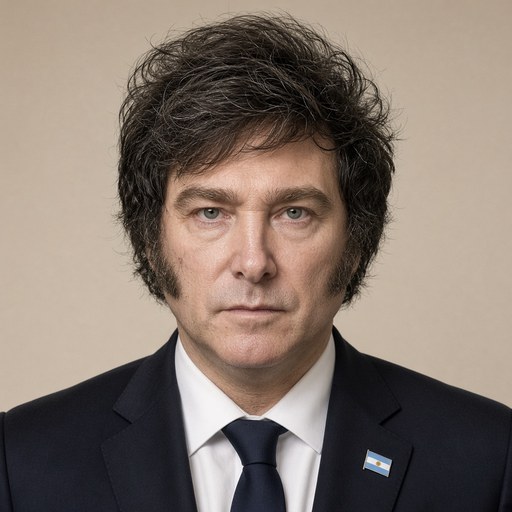
Words from the President of the Nation, Javier Milei, after receiving the award from the Hayek Society, in Germany.
 Javier Milei · President of Argentina
- Context
- Milei addressed the Hayek Society in Germany on June 22, 2024, upon receiving an award recognizing his advocacy for free-market liberalism.
- Main themes
- Austrian economics and liberalism, intellectual journey to free-market ideas, critique of Keynesianism, Friedrich Hayek and Ludwig von Mises, economic education in Argentina, microfoundations of macroeconomics, state intervention and regulation, libertarian political economy
- Duration
- ~53 min
- Words
- 6,357
- Sentences
- 306
- Readability
- 61
- Grade
- 9.9
- Syntax
- 3.14
- Vocabulary
- 2.04
Translated from Spanish
The broad sphere of national life a sentence belongs to. Every sentence has an Arena, so it is the denominator the other indices are read against.
Other306 sentences in 25 paragraphs
Good afternoon and, obviously, if I were at a typical event in Argentina, I would say "Hello everyone." First of all, I want to thank you for this recognition of this struggle that we started many years ago and that is yielding unexpected fruits. So, first, I want to thank you for this recognition of this task that we are carrying out. On the other hand, I would like to tell you about my experience of how I came to the ideas of freedom, because I was not a liberal from the very beginning.
In fact, I don't feel bad because Hayek, first of all, was a socialist. And as Mises rightly says, knowledge in economics leads to liberalism. And as Hayek said, if socialists knew about economics, they wouldn't be socialists. So, when I learned economics, I became a liberal. But more in the background, I was recounting how complicated it was for the ideas of freedom in academic circles. Surely, if you were to ask or ask any economist from a public university in Argentina or from a private university who Mises is, they would think he is the number 9 of the Dutch football team. In that hostile environment, those hostile environments in which Argentine economists are trained, basically the training I originally received was a training from what is called the post-Keynesian or late Keynesian school, which is a branch that has some almost Marxist tints. In that sense, I was contaminated by a lot of bad ideas, such as the necessity of state intervention, the necessity of regulation, entrepreneurs being villains, and inflation being multi-causal, the fault of anything but monetary emission. And it was in that context that I was formed. Moreover, when I took my first course in economic growth, basically the professor taught us little about economic growth and taught us a lot about development authors, who have little to do with what one understands by economic growth. But I was left with some marks from some isolated professors or from reading books and studying even the citations, or going to the Central Bank library, which at that time was the largest economics library in Argentina. I would go and lock myself in to read alternative things to what they taught me at the university, and there I began to get to know other authors. However, I had that training and I did my first master's degree in Keynesian economics. There I got to know the different strands of Keynesianism. I mean, I had not only studied Keynesians, post-Keynesians, those with Marxist tints, but I also went on to study what are called the Keynesians of the Ford T models; and also study the Keynesians a little improved, who are the neoclassical Keynesians, basically the type of Keynesianism that one knows today.
And with that ornament, I went out to look for work and to try to make a living as an economist. The truth is that it was quite frustrating. It was a concatenation of permanent frustrations, everything that happened to me, because although the things I said did not clash with what the rest of the professionals in Argentina said, I realized that I was a serial narrator, a serial blunderer, a machine for making mistakes. In reality, we had a whole series of tricks to hide all those mistakes, and the blame was always placed, for example, on expectations. But expectations cannot be more than the model itself. There is a reflection by Hayek on that, almost mocking the way the different neoclassical branches justify themselves. At the same time, I began to teach microeconomics and that, the truth, was a true blessing, because there I began to train myself, not so much in the format of conventional macroeconomics, but I began to work strongly with microfoundations.
When you analyze the structure of a microeconomics course, it at least opens a window for you to start, at least, sniffing the ideas of freedom. And since teaching microeconomics was a lot of fun for me and, in addition, it kept me actively occupied so that the course ended with general equilibrium, which is the same field of application of macroeconomics, but with microfoundations. These things today seem redundant, but 30 years ago it was not like that. The debate was different. Think that only in the 1990s did they start to work more commonly on a micro-founded intertemporal macroeconomics with solid foundations.
So, in this context, it was also very useful to work with microeconomics. That also opened other windows and there, I was perfecting my neoclassical thinking. In addition, mathematics was friendly to me and, therefore, I was advancing comfortably. Microeconomics gave me many tools to work with and allowed my work to be much more fun, as I continuously filled it with microfoundations. But there were also some problems. Basically, when part 1, in general, in a micro book, has what is the sector of consumer theory to derive the theory of demand. Then comes the theory of the firm to derive supply. Then it goes to market structures, goes to the case of perfect competition. Hayek has an excellent point about perfect competition; the perfect competition model is so ridiculous. The agents are all price-takers and behave as if nothing existed, so it is quite contradictory. And from there, market failures begin. Whether they are concentrated market structures, with their technical mathematical counterpart, which are basically defined as non-convexities, the problem of public goods appears, externalities, asymmetric information problems, coordination failure problems in games, and then one goes to the part of general equilibrium. But all that part of market failures is also a very important area and it is one of the things that I address directly in my recent book Capitalism, Socialism, and the Neoclassical Trap. But beyond that, in the face of the frustration that implied the work that could only be doing microeconomics. So, I decided to do a second master's degree, a master's degree, no longer so based on a single school of thought, but much more eclectic. There I got to know different versions for the approach, and I became more entrenched in my neoclassical thinking. At the same time, I felt a deep contempt for the State, but I had no way to channel it. That is, Argentina was suffering the final part of the convertibility program, and in that context, I was clear that the State was not the solution, that the State was the problem. But the tools I had were not the correct ones, and so I continued to accumulate frustrations with the training I had.
And when I started with this second master's degree, I encountered all the new literature on economic growth, there I encountered again some of my youthful errors. Because one of the things that happened to me when I only looked at the risk of economic growth, in many of the economic growth books, there was a wonderful quote from Robert Junior that says: "When one begins to analyze these types of issues of economic growth, the consequences for human well-being are so strong that one cannot think of anything else." As a young economics student, the first thing I thought was: "Well, another professor thinking that his subject is the most important of all." However, when I was already doing my second master's degree, that was very revealing, and that is how I began to get very actively involved with issues of economic growth. All of that led me not only to specialize in economic growth but also in how to manage money. That is to say, deep down, I was preparing to know how to lower inflation and how to grow an economy that, it must be said, by pure spontaneous order or the forces of heaven, placed me precisely in the country of inflation and decay as president. That would be a tribute to Adam Smith and Hayek, who taught us so much about how the price system works.
And in that logic, where I began to specialize in growth, where I read how many things about economic growth were going around, I became very actively involved in everything that is real business cycle theory. I liked the mathematics, I liked the structure. The State made noise, so in that sense, I felt very comfortable. I was having better explanations than before; they were a bit risky to take 100%, but one could always improve a little moderation to try to explain things. But there I already felt much calmer, more comfortable, more at ease. And then, the subprime crisis came at that moment, when the subprime crisis arrived and especially with the problems of global imbalance and everything related to the United States, China, and Europe, and how we were approaching a catastrophe similar to the Great Depression, that forced me to have to go back to reading authors like Keynes and Milton Friedman. Moreover, my reading of Keynes, in my case, was not limited to The General Theory; I have read several books about Keynes, but I confess that almost pathologically I have read The General Theory five times, to the point that I even wrote a book called Unmasking the Keynesian Lie. That also allowed me to reconnect with other parts of the debate, but I still felt frustrated. One of the things I said was: "Well, I will only dedicate myself to economic growth and that the things I say are valid in the long term. As for my work, I will use microfoundations and that's it, I won't worry anymore." And there I was, happy with economic growth. I stayed in that place, doing economic growth, without having to confront in the short term, because I had already realized that everywhere they were going around, available in all things, it did not work.
And like all good things, at some point they come to an end. At one point, I was invited to give a talk at the Boris Forum, not the one I messed up, but when it was more digestible for the rest of humanity. So, I was invited to talk about demography and growth, and there I had no better idea than to start reviewing the work of Angus Maddison. I came across his studies on millennial economies and there I discovered his estimates of population and GDP per capita over 2000 years, that is, from the year zero of the Christian era to the year 2000. And one of the things that struck me was what in growth theory is called the "hockey stick." When one looks at the series of GDP per capita from the year zero to the year 2000, it can be observed that GDP per capita practically remains constant between the year zero and 1800. In fact, it only increases by 40% in the 16th century, just after the discovery of America. But if one takes that series, GDP per capita grew at a rate of 0.02% per year, that is, to double GDP per capita it took 3500 years.
However, then the Industrial Revolution appeared and in the 19th century the growth rate multiplied by 33 times, jumping to 0.66%. Much of that explanation has to do with health improvements and also with improvements in the health and nutrition of people. When we reach the 20th century, a new acceleration of growth occurs: in the first half of the 20th century, growth accelerates to 1.1%; in the second half of the 20th century, to 2.1%. In addition, if we corrected for the underestimation of national accounts, economic growth could be around three or three and a half percent per capita. That is, in the last 200 years of that series, we did much more than in the first 1800. As I mentioned before, while in the first part growth was 40%, in the second part mentioned, GDP per capita multiplied practically by 10, to be exact, eight times. No, nine times, sorry. And at the same time, the population multiplied by eight times, that is, GDP in the last 200 years had multiplied by 72 times. Beyond the fact that one tells it as a story of progress and so on, that for economic theory is a huge problem. When you approach the neoclassical instrument, the existence of constant returns to scale or diminishing marginal returns is assumed. That is, as you add one unit of factor, the product grows, but grows less than proportionally. And that problem, when you looked at it, here the population multiplied by eight times and production by nine. So, clearly, that did not make sense. Now, the theoretical counterpart of this is that the existence of increasing returns implies concentrated market structures, and concentrated market structures, in the most extreme case, is that of monopoly. But any situation of concentrated market structure implies, from the point of view of Pareto efficiency, something that is bad.
So, we found ourselves with a series that told us that if one looked at the microfoundations, that was bad for well-being. And the question was: how could something that received the world's population with 95% of extreme poverty and had brought it at that moment to levels around 10% be considered bad by economic theory? That situation was truly very challenging. The truth is that it was a very strong shock on what I was thinking. That is to say, something that economic theory said was wrong, was fabulously pulling people out of poverty. The quality of life of human beings has never in the history of humanity been like the one we have now.
And in the face of that tremendous situation, with enormous intellectual frustration, I began to seek answers. Fortunately, a former student of mathematical economics who had worked very well and whom I had helped to get a formal job, had the habit of reading Austrian authors. Faced with the dilemma I had, he provided me with an article by Murray Newton Rothbard called "Monopoly and Competition." That was a truly wonderful experience because it is a 140-page article. After the 3 hours it took me to read it, I finished and said, "Everything I designed about market structures is wrong." That is, for 25 years I had been teaching market structures that were wrong. It was a farce. The effect of that reading was so strong that I asked this person where I could find books by these authors. I remembered that in academic circles, Mises was known as if he were the number 9 of the Dutch football team, which made it a bit complicated to find. So, I asked him to point me to where I could buy such books, and they were nowhere to be found. He recommended a bookstore that sold books from the Unión publishing house, where, for example, Professor Jesús Huerta de Soto, whom I admire so much, publishes, along with many other wonderful authors. I went and started buying all the books I saw and liked. Thus, I bought about 20 books and didn't buy more because I didn't have money; that is, I needed the money to take a taxi back home. Among those books I bought were Man, Economy, and State, volume one, volume two, and Power and Market, which is when Murray Rothbard becomes an anarcho-capitalist or creates anarcho-capitalism. I asked the bookstore owner if I could come back the next day, and he said yes. So, I calculated how much I needed for food, how much I needed for taxis, how much to get to work, and I spent all the money I had left. In those two days, I must have bought about 50 books. That’s how I started reading and immersing myself in the authors of the Austrian school. It was a wonderful experience; I was discovering a new world.
I have some wonderful anecdotes with some books. For example, one of those books I bought was Human Action. I remember sitting in front of a hardcover edition and reading it from cover to cover. I don't remember how long it took me to do it, but I think I was locked up for about two or three days until I finished reading it. I only got up to eat, go to the bathroom, and take Conan for a walk. I was dazzled by that book, but I had marked it. So, I went and bought it again to have a copy in good condition. I realized that I wanted to keep working with the book I had marked, so I said, "Well, I’m going to buy it again." I left the first marked one next to the new one, and I kept the latter for "emergencies," without breaking the cellophane. In addition, I bought another copy and took it to the office. Whenever I was bored in the office, what I did was randomly open any part of Mises's Human Action. I would read from where that chapter started and finish it. I repeated that process over several days. One day, I opened the book and it was underlined; I opened another page and it was underlined; I opened again and it was underlined. Then, I realized that I had read "Human Action" for the third time.
Therefore, Mises is an author who has had a huge impact on me. I also read Socialism, which is a work of art, and Banking Credit, a wonderful book that helps to understand many of the problems we liberals face. Another fundamental book is "The Anti-Capitalist Mentality," which explains why people hate free enterprise capitalism. I complemented these readings with Huerta de Soto's classes on YouTube and began attending liberal circles. When I started reading Hayek, I found it quite difficult, but over time I assimilated it. There are books that were easier for me, like "Production and Prices," and others that I enjoyed from the very first moment, like "The Road to Serfdom," which I frequently cite in its dynamic form. Or the topics related to The Fatal Conceit or the economic themes of freedom. There is one of the most imposing articles as well, which is "The Atavism of Social Justice." Many would benefit from reading that article. In that sense, I also got very involved reading Rothbard, and inevitably I ended up being an anarcho-capitalist. Once I started reading Rothbard, Jesús Huerta de Soto, Walter Block, Hans-Hermann Hoppe, it was a one-way street, and then I could no longer go back.
In the meantime, I started appearing on television. Argentina had a problem with rising inflation. Argentina, once the richest country in 1895, was falling sharply, ending up in 140th place in the ranking, and inflation was getting higher and higher. And I began to participate in television programs defending the ideas of freedom. And the truth is that, at the beginning, it was like the movie Gladiator: it was me against everyone. I found myself against 15 people who all defended the state, socialism, and all those things. And besides, the Kirchnerists were quite violent in debates. And that, like many on the left, is that they put four or five of them, and when you are trying to talk and give a reasoning, they start talking over you. So, one is forced to raise their voice to continue the reasoning. And then they accused me of shouting on the panels. The most interesting thing is that many of those who accused me were the cocktail liberals, who had made liberalism a disgrace. And let’s say, in meetings they couldn’t fill an elevator, I mean like the little one here. And well, I started to give those titanic battles on television, and that allowed me to gain popularity. And at one point, when the pandemic arrived, it was as if society began to click, because being locked up there was a revaluation of the ideas of freedom.
I will tell an anecdote. When I started discussing these things on television, one day I was teaching, and a student came in super upset because I had given him a zero, because everything he had done was wrong; I couldn’t even give him a one, it would be giving him a grade. So, the guy violently came to shout at me: "You are a liberal." In the face of that situation, I said, "Thank you, thank you very much."
But, without a doubt, with the arrival of the pandemic, COVID, and the caveman quarantines that were promoted by the World Health Organization and to which Argentina strongly adhered, there was a whole vindication of the ideas of freedom, and many interesting things happened. Because many of my followers were young people. And this is very interesting because those young people had so much affinity with what I was doing. That is because young people have less exposure time to the brainwashing that is public education, regardless of whether it is state-managed or private, because the content is usually set by the state. So, what that does is mark the field, and certain literature you cannot access because the state tries to block it, that is, no statist or political figure is going to like you reading Rothbard because, imagine, they are torpedoing their source of income, and in reality, since they have the power, the monopoly of violence, they exercise it so that you cannot access those ideas. So, young people in that sense are also rebellious against the status quo. The status quo in Argentina was socialist, therefore, the natural rebellion of young people was going to be towards liberalism, and for some reason, they found what I was doing pleasant. And so they started to follow us, and during the pandemic, being locked up with their parents and in some cases even with their grandparents, they began to talk to them about me and spoke about me. Now, if you are channels, you don’t like it and you can change the channel. Now, if your children said, "Look at Milei, look at Milei," then they started to watch Milei. So that situation began to spread, and they started to see videos in which I talked about the ideas of freedom or presented books. In addition, we presented the books in a format; we always thought of a format as if it were going to see a Rolling Stones concert, so that you would always want to go back to see it. In general, that situation.
That’s why you can see some presentation of one of my books about Keynes, and people shout, "Keynes, you are a thief, you are a thief, you are a thief!" And as one was advancing in this during the pandemic and with the arrival of the puppet government of Alberto Fernández, they began to implement all these savage, liberty-killing measures. And in that context, what began to be seen was an attempt at censorship. Today a deputy named Leandro Santoro, who at that time was almost like an unofficial spokesperson for Alberto Fernández, went to television channels and openly called for the censorship of liberals. In fact, there is an interview in which he tells the owner of a media outlet: "You are irresponsible. How can you allow a long-haired crazy person to appear during prime time saying that the Central Bank should be closed?" Then the host said to him, "Well, then tell me who it is." And Leandro Santoro is so cowardly that he says, "No, I’ll tell you off the air." And the same thing happened on another channel, also very Kirchnerist, in the same situation. There they were already fired up about what they were doing and said that libertarians were a problem, that we had to be banned, that we had to be taken off the air, that we could not be given space because we were dangerous. Dangerous because we study, we read, a truly impressive thing.
And in the face of the advance of censorship, that posed a problem for us. I always speak in the first person plural because I couldn’t have done all this without my sister, the boss. And at one point, what we saw was that if we reduced our exposure on television, we couldn’t sell conferences outside, and it complicated our income in dollars to spend. So, in the face of that situation where we saw the risk to our income, I mean, my entry into politics is not so romantic. That’s what I want to say. We didn’t realize that the only way to change things was to get involved and compete from within. Well, if you are going to see a football match in Argentina, it is very nice, let’s suppose the Argentine National Team, and you are going to see the flags, the chants, the ways that people express themselves. Now, the choripán. And of course, you have to get rid of the Peronists. Who said that choripanes belong to the Peronists? Who are the Peronists? The choripán belongs to the Argentines. And in that sense, I can put the ball on the field. And no matter how much I sing and do beautiful things, the ball doesn’t move; someone has to come in and kick it. Because if not, they come in and kick, and they don’t care that there is no one on the other side to save it. And that is why we decided to get into politics.
And one of the things that happened to us is that a person came and said, "Well, tell me if you have any skeletons in the closet." My sister and I looked at each other and said, "No." So, I don’t care what you tell me; I’m going to investigate you. So, after two months, that person came back and said, "I have good news and bad news." Well, since I’m a perfectionist, first we say the good news and then the bad news. So, he says to me, "The good news is that we didn’t find anything on you." "Oh, but that’s great." "No, that’s also bad because then they are going to invent something. And since you don’t know what they are going to invent, it’s a real problem. Because we don’t even know if you have a dead body in the closet; we’ll see when we take it out. Now you don’t have a dead body in the closet; they are going to invent one. You don’t know what they are going to invent, and it’s going to be complicated. And boy, did they invent a lot of dead bodies in the closet for me. I must have a cemetery going around me. And I remember that when we started that process, first they told us that we wouldn’t be able to form a party, and we formed a party. Then they told us that we wouldn’t be able to pass the primaries, which is a minimum of 2%, and we passed them. And they had told us that we couldn’t get more than 5% of the votes, that I would never be able to become a deputy, that we would lose against the blank vote, that we would lose against the left vote.
And the truth is that something interesting was happening at that moment. Doctor Patricia Bullrich, with whom I later competed in the presidential election, and today I am proud to have her as my Minister of Security, is bringing the damned criminals to their knees. While everyone underestimated me, she said something very interesting, and they will find the comment nice. Because she said: "Look, we should pay a little more attention, because someone who stands up to speak in front of 20,000 people about Hayek is not something normal." So, evidently, something was happening. And not only that, but also in our events, one of the most atypical things was that books and books from the Austrian school were being sold. But not only that, but also, as part of the campaign, my sister came up with the idea, if everyone valued me as a teacher, to go and give classes in the squares. So yes, we are going to give classes in the squares. And the truth is that, against all odds, we ended up getting 17% of the votes and achieved two seats in the national congress. My running mate, Victoria Villarruel, has been with me since that moment. We achieved five seats in the legislature, and when we took office, I remember that a very rude journalist from the Diputados TV channel told me: "But you are going to be two deputies out of 257? You won't be able to do anything because you are insignificant in the Chamber." And at that moment, just for that part of the year that turns around mid-December (the swearing-in is on December 10), it is the festival of Hanukkah in the Jewish calendar. And the festival of Hanukkah commemorates, remembers the feat of the Maccabees to recover the temple and says a very interesting phrase that says: "Victory in battle does not depend on the number of soldiers but on the forces that come from heaven." And that later became our slogan: "The forces of heaven," because we were going to fight against enormous adversities. So, the story of the Maccabees ignited us and gave us the desire to keep fighting. Moreover, as a man of faith, it was like a story of David and Goliath. But if you read Nietzsche, he says that in reality, one believes that David was the weak one and Goliath was the strong one. And what Nietzsche says is that they are mistaken. The strong one was David because he had the Creator on his side. So, with that faith, we began to advance strongly. And then my sister, the boss, came up with a wonderful idea again, because as a libertarian and anarcho-capitalist, I could not take my salary. Because that salary is taken from taxes that are paid coercively, therefore, for me, it represented a contradiction. I could not resolve that situation. I am not saying that everyone has to choose that, but I, as an anarcho-capitalist, could not do that.
So, it was fine to become a mole in the system, to collect, to break the system from the inside, but not to collect. So, my sister came up with the brilliant idea of raffling off the diet, because if we did it by hand, we were just any other politician doing populism. So this was determined by chance. And when we did that, we held that raffle in the city of Mar del Plata, which is a tourist city in Argentina. About 10,000 people were called, and in that context, we held the raffle for the diet. It was front-page news in more than 30 newspapers from very important countries in the world. And then we said: "There is something here." In other words, we discovered that there was an opportunity to go for something bigger and we got involved in the electoral race. I think it is already well-known history. We reached the runoff, won the second round by a wide margin, and found ourselves with an economy basically destroyed. But we never cried or lamented what we inherited, because we must also say that. That the conditions under which a libertarian with the characteristics I have and who was going to be president, it was obvious that he was not going to fit into Eden. And in that sense, when we arrived, we found wholesale inflation running at an annual rate of 17,000%. That today, let’s say, wholesale inflation has been decreasing to 50%, still a horrifically high number, but from 17,000 to 50 there is an enormous merit. At the same time, we found a fiscal deficit of 15 points of GDP, five in the Treasury and ten in the Central Bank. We talked about The Chainsaw, but they said it was impossible to make the adjustment we proposed. They said that at most an adjustment of one point of GDP could be made in the Treasury and that, well, the Central Bank would be fixed. I would like to know how it was going to be fixed if the previous government had also left us four monetary bases due on the day we took office, or with 50 billion dollars of debt against importers, 15 billion dollars of debts against dividends, 90 billion dollars expressed in pesos of debt maturities, 25 billion dollars of external debt maturities when the agreement with the International Monetary Fund had fallen through. And we decided to undertake an adjustment. Today I tell you that six months after taking office, we have made the largest fiscal adjustment in Argentine history. We have adjusted 15 points of GDP. And not only that, we are bending inflation. Monthly inflation has been running at an approximate rate of three and a half percent, but we have a system of currency devaluations of 2%. Therefore, true inflation has been running at one and a half percent. And this is very important too, because compared to other stabilization cases, we did not have to go to the previous hyperinflation for real wages to be liquidated. We did not spoil, there was no sort of Bonex plan where depositors were robbed and property rights were violated. We did not impose price controls, neither direct nor induced, and we did not set the exchange rate. In other words, we are achieving this in a context of full freedom and relative price positioning. And again, the numbers are truly impressive. Obviously, this was not going to be free of costs, but we always told the people this to their faces. We told them that there is no money, we told them it was going to be hard, that the beginning was going to be complicated, but that if we did it, good results would start to come.
And unlike what we believed, the truth is that the response is being much faster than we imagined. Although the first quarter was very tough, the decline was less severe than it was at the worst moment of 2002, which was 16%. The way we designed the program made it less than half of that decline. And what is starting to be seen in the first indicators related to the months of April and May is that recovery is beginning to happen. In other words, the data compared to the previous year is negative, but when one looks at the month-to-month seasonally adjusted, growth is starting to happen. There are already signs of recovery. In fact, the diffusion indices, which measure the number of sectors that are pushing positively, have already passed 50% for two consecutive months. And there have already been two consecutive months where the leading indicator, which anticipates what is going to happen with economic activity, is recovering.
Therefore, we have not only fought the cultural battle, but we are now carrying it out in practice. The reason why the socialists are so violent is that it is working and their lie is falling apart. And finally, I want to leave some reflections. One is to defend ideas with passion and believe in ideas because they work. It is not only that politics did not accompany us in these first months of management because no law was voted for us, no law was taken out, it was a machine to prevent all the time. In other words, it is not that they only did not help, but also, from the very first moment, they tried to stage a coup. Despite all the obstacles, all the attempts at destabilization, all the attacks we have received, we are moving forward, we are being successful in controlling inflation, and activity is recovering. In other words, the ideas are so strong that even against all the political caste, the worst practices, the most decadent part of Argentine politics, which has tried to prevent and has led different governments throughout history, we are winning thanks to the ideas of freedom.
And finally, before traveling, the so-called Law of Bases is about to be released. To give you an idea, the largest structural reform that was made in Argentina was in the 1990s, during Menem's government. And that Law of Bases, which has been partially mutilated by politics, as it is today, is five times larger than Menem's reform. If you take the decree of necessity and urgency that is still in force, the structural reforms we have made are eight times larger than those made by Menem. They could have come out in the first month, but well, they are coming out now. And why do I say this? Because this would imply that Argentina would make a leap in economic freedom in the economic freedom index of 90 places. In other words, Argentina would have levels of economic freedom very similar to those of, for example, Germany or France. But we want more economic freedom. So, a benchmark is, for example, today Ireland, which is the country with the most economic freedom in the world, despite now having setbacks. A country that, being the most miserable in Europe 35 years ago, today has a per capita GDP 50% higher than that of the United States. So, that would be a nice benchmark. But not only do we have these 800 structural reforms already on the table, but we also have 3,200 more to do. Therefore, we not only want to aspire to the economic freedom of Ireland.
So, it is not that we are aspiring to the economic freedom of Ireland, but we are aspiring to make the most free country on the planet, and that this be a source of prosperity for all Argentines and an excellent example for the world. And to let you know that the ideas of freedom work. So thank you very much and long live freedom, damn it!
The original Spanish. The tags above are read on the English translation's sentences.
Buenas tardes y, obviamente, si estuviera en un típico acto de Argentina, diría "Hola a todos". En primer lugar, deseo dar las gracias por este reconocimiento a esta lucha que hemos iniciado hace muchos años y que está dando frutos inesperados. Así que, primero, les deseo dar las gracias por este reconocimiento a esta tarea que estamos llevando a cabo. Por otra parte, me gustaría contarles acerca de mi experiencia de cómo llegué a las ideas de la libertad, porque no es que fui liberal desde el primer momento.
En rigor, igual no me siento mal porque Hayek, en primer lugar, era socialista. Y como bien dice Mises, que el conocimiento en la economía llevaba al liberalismo. Y como decía Hayek, si los socialistas supieran de economía, no serían socialistas. Así que, cuando aprendí economía, pasé a ser liberal. Pero más en la previa, yo contaba lo complicado que era para las ideas de la libertad en los ámbitos académicos. Seguramente, si ustedes le preguntaran o le preguntan a algún economista de alguna universidad pública argentina o de alguna universidad privada quién es Mises, creen que es el 9 de la selección de fútbol de Holanda. En ese ámbito hostil, esos ámbitos hostiles en los cuales los economistas argentinos nos formamos, básicamente la formación que yo recibí originalmente fue una formación de lo que se denomina la escuela postkeynesianos o keynesianos tardíos, que son una rama que tiene algunos tintes hasta cuasi marxistas. En ese sentido, fui contaminado por un montón de malas ideas, como que es necesaria la intervención del Estado, es necesaria la regulación, los empresarios son villanos y la inflación es multicausal, culpa de cualquier cosa menos de la emisión monetaria. Y en ese contexto fue en el que fui formado. Es más, cuando tomé mi primer curso de crecimiento económico, básicamente el profesor poco nos enseñó del crecimiento económico y nos enseñó mucho de los autores de desarrollo, que poco tienen que ver con lo que uno entiende por crecimiento económico. Pero me quedaron algunas marcas de algunos profesores aislados o de leer libros y estudiar hasta las citas, o irme a la biblioteca del Banco Central, que en aquel momento era la biblioteca de economía más grande de la Argentina. Me iba y me encerraba solo a leer cosas alternativas a las que me enseñaban en la universidad, y ahí fui conociendo a otros autores. Sin embargo, tuve esa formación y mi primera maestría la hice en economía keynesiana. Ahí fui conociendo las distintas vertientes del keynesianismo. O sea, ya no solo había estudiado los keynesianos, los postkeynesianos, estos con tintes marxistas, sino que ahí también pasé a estudiar lo que se denomina los keynesianos modelos Ford T; y también estudiar los keynesianos un poco ya mejorados, que son los keynesianos neoclásicos, básicamente el tipo de keynesianismo que uno conoce hoy.
Y con ese ornamento salí a buscar trabajo y a tratar de ganarme la vida como economista. La verdad es que fue bastante frustrante. Fue una concatenación de frustraciones permanentes, todo lo que me pasaba, porque si bien las cosas que decía no desentonaban con lo que decían el resto de los profesionales en Argentina, yo me daba cuenta de que era un narrador serial, un pifiador serial, una máquina de cometer errores. En realidad, teníamos toda una serie de artilugios para esconder todos esos errores, y siempre se les cargaba las tintas, por ejemplo, sobre las expectativas. Pero las expectativas no pueden ser más que el propio modelo. Hay una reflexión de Hayek sobre eso, casi mofándose de la forma en que las distintas ramas neoclásicas se van justificando. Al mismo tiempo, empecé a dar clases de microeconomía y eso, la verdad, fue una verdadera bendición, porque ahí empecé a formarme, no tanto en el formato de la macroeconomía convencional, sino que empecé a trabajar fuertemente con los microfundamentos.
Cuando ustedes analizan la estructura de un curso de microeconomía, les abre al menos una ventana para que empiecen a, por lo menos, olfatear las ideas de la libertad. Y como dar clases de microeconomía me divertía muchísimo y, además, me ocupaba activamente para que el curso finalizara con equilibrio general, que es el mismo campo de la aplicación de la macroeconomía, pero con microfundamentos. Estas cosas hoy parecen redundantes, pero hace 30 años atrás no era así. El debate era distinto. Piensen que recién en la década del 90 se empieza a trabajar de manera más común una macroeconomía microfundamentada intertemporal de bases sólidas.
Entonces, en este contexto, también fue de muchísima utilidad el hecho de trabajar con la microeconomía. Eso abría también otras ventanas y ahí, fui perfeccionando mi pensamiento neoclásico. Además, la matemática me resultaba amigable y, por lo tanto, iba avanzando de manera confortable. La microeconomía me daba muchas herramientas para trabajar y permitía que mi trabajo fuera muchísimo más divertido, ya que lo llenaba continuamente de microfundamentos. Pero también había algunos problemas. Básicamente, uno cuando la parte 1, en general, en un libro de micro, tiene lo que es el sector de la teoría del consumidor para derivar la teoría de la demanda. Después viene la teoría de la firma para derivar la oferta. Luego pasa a las estructuras de mercado, va al caso de la competencia perfecta. Hayek tiene un excelente punto sobre la competencia perfecta; es tan ridículo el modelo de competencia perfecta. Los agentes son todos precio-aceptantes y tienen un comportamiento como si no existiera nada, entonces es bastante contradictorio. Y a partir de ahí empiezan los fallos de mercado. Ya sean las estructuras de mercado concentradas, con su contrapartida técnica matemática, que básicamente se definen como no convexidades, aparece el problema de los bienes públicos, las externalidades, los problemas de información asimétrica, los problemas de falla de coordinación de los juegos y ya después uno va a la parte de equilibrio general. Pero toda esa parte de las fallas del mercado también es un terreno muy importante y es una de las cosas que yo, en mi reciente libro Capitalismo, socialismo y la trampa neoclásica, trato de manera directa. Pero más allá de eso, frente a la frustración que implicaba el trabajo que solamente podía estar haciendo cosas de microeconomía. Entonces, decidí hacer una segunda maestría, una maestría, ya no tan basada en una sola escuela de pensamiento, sino mucho más ecléctica. Ahí fui conociendo distintas versiones para el enfoque, y me recrudecí en mi pensamiento neoclásico. Al mismo tiempo, sentía un profundo desprecio por el Estado, pero no tenía la forma de canalizarlo. Es decir, Argentina estaba sufriendo la parte final del programa de convertibilidad, y en ese contexto tenía claro que el Estado no era la solución, que el Estado era el problema. Pero las herramientas que tenía no eran las correctas, y entonces seguía acumulando frustraciones con la formación que tenía.
Y cuando empecé con esta segunda maestría, me encontré con toda la literatura nueva del crecimiento económico, ahí me encontré de vuelta con algunas de mis errores de juventud. Porque una de las cosas que me pasó cuando miraba solo el riesgo de crecimiento económico, en muchos de los libros de crecimiento económico, había una cita maravillosa de Robert Junior que dice: "Cuando uno empieza a analizar este tipo de cuestiones de crecimiento económico, las consecuencias sobre el bienestar humano son tan fuertes que uno no puede pensar en ninguna otra cosa." Siendo un joven estudiante de economía, lo primero que pensé es: "bueno, otro profesor pensando que su materia es la más importante de todas". Sin embargo, cuando ya estaba haciendo mi segunda maestría, fue muy revelador eso, y es así que me empecé a involucrar de manera muy activa con los temas de crecimiento económico. Todo eso me llevó, no solo a especializarme en crecimiento económico, sino en cómo manejar el dinero. Es decir, en el fondo, me estaba preparando para saber cómo hacer para bajar la inflación y cómo hacer crecer a una economía que, dicho sea de paso, por orden espontáneo puro o las fuerzas del cielo, me pusieron justamente en el país de la inflación y la decadencia como presidente. Eso sería un canto a Adam Smith y a Hayek, que tanto nos enseñaron acerca de cómo funciona el sistema de precios.
Y en esa lógica, donde me empecé a especializar en crecimiento, donde leía cuántas cosas de crecimiento económico andaban dando vuelta, me involucré muy activamente en todo lo que es la teoría de los ciclos reales, o sea, el Real Business Cycle. Me gustaba la matemática, me gustaba la estructura. El Estado hacía ruido, por lo tanto, en ese sentido me sentía muy cómodo. Estaba teniendo mejores explicaciones que las de antes; eran un poco arriesgadas tomárselas al 100%, pero siempre uno podía mejorar un poco la moderación para tratar de explicar las cosas. Pero ahí ya me sentía muchísimo más tranquilo, más confortable, más cómodo. Y entonces, vino la crisis subprime en ese momento, al llegar la crisis subprime y en especial con los problemas del desequilibrio global y todo lo relacionado con Estados Unidos, China y Europa, y cómo nos aproximábamos a una catástrofe similar a la Gran Depresión, eso me obligó a tener que volver a leer autores como Keynes y a Milton Friedman. Es más, la lectura de Keynes, en mi caso, no solo se limitó a La teoría general, he leído varios libros sobre Keynes, pero confieso que casi patológicamente he leído La teoría general cinco veces, al punto tal que incluso escribí un libro que se llama Desenmascarando la mentira keynesiana. Eso me permitió también reconectar con otras partes del debate, pero igual me sentía frustrado. Una de las cosas que dije fue: "Bueno, solamente me voy a dedicar al crecimiento económico y que las cosas que diga sean válidas a largo plazo. En cuanto a mi trabajo, utilizaré los fundamentos micro y basta, no me haré más problema". Y ahí estaba, feliz con el crecimiento económico. Me quedé en ese lugar, haciendo crecimiento económico, sin tener que confrontar en el corto plazo, porque ya me había dado cuenta de que por todos lados que estaban dando vuelta, disponible en todas las cosas, no funcionaba.
Y como todas las cosas buenas, en algún momento terminan. En un momento, me invitan a dar una charla en el Boris Forum, no la que hice lío, sino cuando era más digerible para el resto de los humanos. Entonces, me invitan a hablar sobre demografía y crecimiento, y ahí no tuve mejor idea que empezar a revisar el trabajo de Angus Maddison. Me encontré con sus estudios sobre economías milenarias y ahí descubrí sus estimaciones de población y del PIB per cápita a lo largo de 2000 años, es decir, desde el año cero de la era cristiana hasta el año 2000. Y una de las cosas que me impactó fue lo que en la teoría del crecimiento se llama el "palo de hockey". Cuando uno mira la serie del PIB per cápita desde el año cero hasta el año 2000, se puede observar que el PIB per cápita prácticamente se mantiene constante entre el año cero y 1800. En rigor, solo aumenta un 40% en el siglo 16, justo después del descubrimiento de América. Pero si uno toma esa serie, el PIB per cápita crecía a una tasa del 0,02% anual, es decir, que para duplicar el PIB per cápita se necesitaban 3500 años.
Sin embargo, después apareció la Revolución Industrial y en el siglo XIX la tasa de crecimiento se multiplicó por 33 veces, saltando al 0,66%. Mucho de esa explicación tiene que ver con mejoras sanitarias y también con mejoras en la salud y alimentación de las personas. Cuando se llega al siglo XX, se produce una nueva aceleración del crecimiento: en la primera mitad del siglo XX, el crecimiento se acelera al 1,1%; en la segunda mitad del siglo XX, al 2,1%. Además, si corrigiéramos por la subestimación de las cuentas nacionales, el crecimiento económico podría estar en torno al tres o tres y medio por ciento per cápita. Es decir, en los últimos 200 años de esa serie, hicimos mucho más que en los primeros 1800. Como mencioné antes, mientras que en la primera parte el crecimiento fue del 40%, en la segunda parte mencionada el PIB per cápita se multiplicó prácticamente por 10, para ser exactos, ocho veces. No, nueve veces, perdón. Y al mismo tiempo, la población se multiplicó por ocho veces, es decir, que el PIB en los últimos 200 años se había multiplicado por 72 veces. Más allá de que uno lo cuente como una historia de progreso y demás, eso para la teoría económica es un problema enorme. Cuando ustedes abordan el instrumental neoclásico, se asume la existencia de rendimientos constantes a escala o rendimientos marginales decrecientes. Es decir, que en la medida que ustedes agregan una unidad de factor, el producto crece, pero crece menos que proporcionalmente. Y ese problema, cuando ustedes miraban, acá la población se multiplicó por ocho veces y la producción por nueve. Entonces, claramente, eso no tenía sentido. Ahora, la contraparte teórica de esto es que la existencia de rendimientos crecientes implica estructuras concentradas de mercado, y las estructuras concentradas de mercado, en el caso más extremo, es el del monopolio. Pero cualquier situación de estructura de mercado concentrada implica, desde el punto de vista de la eficiencia paretiana, algo que es malo.
Entonces, nos encontrábamos con una serie que nos decía que, si uno miraba los microfundamentos, eso era malo para el bienestar. Y la pregunta era: ¿cómo algo que recibió a la población del mundo con un 95% de pobreza extrema y la había llevado en ese momento a niveles en torno al 10% podía ser considerado malo por la teoría económica? Esa situación era verdaderamente muy desafiante. La verdad es que, era un shock muy fuerte sobre lo que yo estaba pensando. Es decir, algo que la teoría económica decía que estaba mal, sacaba a la gente de la pobreza de manera fabulosa. La calidad de vida de los seres humanos nunca en la historia de la humanidad fue como la que tenemos ahora.
Y frente a esa situación tremenda, con una frustración intelectual enorme, empecé a buscar respuestas. Afortunadamente, un exalumno de economía matemática que había trabajado muy bien y a quien yo había llevado a trabajar donde yo tenía un empleo formal, tenía la costumbre de leer autores austríacos. Frente al dilema que yo tenía, me facilitó un artículo de Murray Newton Rothbard que se llama "Monopolio y competencia". Esa fue una experiencia verdaderamente maravillosa, porque es un artículo de 140 páginas. Después de las 3 horas que tardé en leerlo, terminé y dije: "Todo lo que diseñé sobre estructuras de mercado está mal". Es decir, durante 25 años estuve dando clases de estructuras de mercado que estaban mal. Era una farsa. El efecto de esa lectura fue tan fuerte que le pregunté a esta persona dónde podía conseguir libros de estos autores. Recordé que en los ámbitos académicos, Mises era conocido como si fuera el 9 de la selección de fútbol de Holanda, lo que lo hacía un poco complicado de encontrar. Entonces, le pedí que me indicara dónde podía comprar ese tipo de libros y no estaban en ningún lado. Me recomendó una librería que vendía libros de la editorial Unión, donde publica, por ejemplo, el profesor Jesús Huerta de Soto, a quien tanto admiro, y otros tantos autores maravillosos. Fui y empecé a comprar todos los libros que veía y me gustaban. Así, me compré cerca de 20 libros y no compré más porque no tenía plata, es decir, necesitaba el dinero para volver en taxi a mi casa. Dentro de esos libros que compré, estaban El hombre, la economía y el Estado, el tomo uno, el tomo dos, y Poder y mercado, que es cuando Murray Rothbard se vuelve anarcocapitalista o crea el anarcocapitalismo. Le pregunté al dueño de la librería si al otro día volvía y me dijo que sí. Entonces, saqué la cuenta de cuánto necesitaba para comer, cuánto necesitaba para los taxis, cuánto para ir al trabajo, y todo el dinero que me quedaba me lo gasté. En esos dos días, me habré comprado como 50 libros. Así empecé a leer y a sumergirme en los autores de la escuela austríaca. Fue una experiencia maravillosa, estaba descubriendo un mundo nuevo.
Tengo algunas anécdotas con algunos libros que son maravillosas. Por ejemplo, uno de esos libros que me compré fue La acción humana. Recuerdo que me senté frente a una edición de tapa dura y me lo leí de punta a punta. No recuerdo cuánto tiempo tardé en hacerlo, pero creo que estuve encerrado como dos o tres días hasta que lo terminé de leer. Solamente me levantaba para comer, ir al baño y llevar a pasear a Conan. Quedé deslumbrado con ese libro, pero lo había dejado marcado. Entonces, fui y me lo compré de vuelta para tener una copia en buen estado. Me di cuenta de que quería seguir trabajando con el libro que había marcado, así que dije: "Bueno, lo voy a comprar otra vez". Dejé el primero marcado al lado del nuevo, y este último lo guardé para "emergencias", sin romper el celofán. Además, me compré otra copia y la llevé a la oficina. Cada vez que estaba aburrido en la oficina, lo que hacía era abrir aleatoriamente cualquier parte del libro La acción humana de Mises. Leía desde donde comenzaba ese capítulo y lo terminaba. Ese proceso lo fui repitiendo a lo largo de varios días. Un día, abro el libro y estaba subrayado; vuelvo a abrir otra página y estaba subrayado; vuelvo a abrir otra vez y estaba subrayado. Entonces, me di cuenta de que me había leído “La acción humana” por tercera vez.
Por lo tanto, Mises es un autor que ha tenido un impacto enorme sobre mí. También leí Socialismo, que es una obra de arte, y El crédito bancario, un libro maravilloso que sirve para entender muchos de los problemas que enfrentamos los liberales. Otro libro fundamental es “La mentalidad anticapitalista”, que explica por qué la gente odia al capitalismo de libre empresa. Complementaba estas lecturas con las clases de Huerta de Soto en YouTube y empecé a asistir a círculos de liberales. Cuando empecé a leer a Hayek, me resultaba bastante difícil, pero con el tiempo lo fui asimilando. Hay libros que me resultaron más fáciles, como “Producción y precios”, y otros que disfruté desde el primer momento, como “Camino de servidumbre”, al cual, en su forma dinámica, cito recurrentemente. O el tema de lo que tiene que ver con La fatal arrogancia o los temas económicos de la libertad. Ahí está uno de los artículos más imponentes también, que es “El atavismo de la justicia social”. Les vendría muy bien a muchos leer ese artículo. En ese sentido, también me involucré mucho leyendo a Rothbard, e inexorablemente terminé siendo anarcocapitalista. Una vez que empecé a leer a Rothbard, a Jesús Huerta de Soto, a Walter Block, a Hans- Hermann Hoppe, era un camino de ida, y entonces ya no podía volver más.
En el medio, empecé a aparecer en televisión. Argentina tenía un problema de inflación creciente. Argentina, de ser el país más rico en el año 1895, estaba cayendo de manera pronunciada, terminando en el lugar 140 en el ranking, y la inflación cada vez era más alta. Y yo empiezo a participar en programas de televisión defendiendo las ideas de la libertad. Y la verdad es que, al inicio, era como la película Gladiador: era yo contra todos. Me encontraba yo contra 15 personas que todas defendían el estado, el socialismo y todas esas cosas. Y además, los kirchneristas eran bastante violentos para debatir. Y eso, como que son mucho de las de izquierda, es como que ponen cuatro o cinco de ellos y cuando ustedes están tratando de hablar y de dar un razonamiento empiezan a hablar encima de uno. Entonces, uno se ve forzado a tener que levantar el tono para poder seguir el razonamiento. Y entonces después me acusaban de estar gritando en los paneles. Lo más interesante es que muchos de los que me acusaban eran los liberales de copetín, que habían hecho del liberalismo una vergüenza. Y digamos, en las reuniones no podían llenar un ascensor, digo como el chiquitito de acá. Y bueno, empecé a dar esas batallas titánicas en la televisión, y eso me permitió ir ganando popularidad. Y en un momento, cuando llegó la pandemia, ahí es como que la sociedad empezó a hacer un clic, porque al estar encerrados hubo una revalorización de las ideas de la libertad.
Voy a contar una anécdota. Cuando yo empecé a discutir estas cosas en televisión, un día yo estaba dando clases y un alumno viene súper ofuscado porque yo le había puesto un cero, porque estaba todo mal lo que había hecho, no podía ni siquiera ponerle un uno, era regalarle nota. Entonces, el muchacho de manera muy violenta viene a gritarme: "Usted es un liberal". Frente a esa situación, le dije: "Gracias, muchas gracias".
Pero, sin lugar a dudas, con la llegada de la pandemia, el COVID y las cuarentenas cavernícolas que se impulsaban desde la Organización Mundial de la Salud y a las cuales Argentina adhería fuertemente, hubo toda una reivindicación de las ideas de la libertad y pasaron muchas cosas interesantes. Porque muchos de mis seguidores eran personas jóvenes. Y esto es muy interesante porque esas personas jóvenes tenían tanta afinidad con lo que yo estaba haciendo. Eso es porque los jóvenes tienen menos tiempo de exposición al lavado de cerebro que es la educación pública, independientemente de que sea de gestión estatal o privada, porque los contenidos los suele fijar el Estado. Entonces, eso lo que hace es marcar la cancha y determinada literatura ustedes no pueden acceder porque el Estado trata de bloquearselos, es decir, a ningún estatista o digamos político le va a gustar que ustedes lean Rothbard, porque, imagínense, les están torpedeando la fuente de ingresos y en realidad, como ellos tienen el poder, el monopolio de la violencia, lo ejercen para que justamente no puedan acceder a esas ideas. Entonces, los jóvenes en ese sentido además son rebeldes frente al status quo. El status quo en Argentina era socialista, por lo tanto, la rebelión natural de los jóvenes iba a ser hacia el liberalismo y, por alguna cuestión, les resultaba agradable lo que yo hacía. Y entonces empezaron a seguirnos y durante la pandemia, al quedar esos jóvenes encerrados con sus padres y en algunos casos hasta con sus abuelos, ellos empezaron a hablarles de mí y le hablaban de mí. Ahora, si ustedes son canales, no les gusta y pueden hacer zapping. Ahora, si sus hijos les decían: "miren a Milei, miren a Milei", entonces empezaron a mirar a Milei. Entonces empezó a extenderse esa situación y empezaron a ver videos en los cuales yo hablaba de las ideas de la libertad o presentaba libros. Además, los libros nosotros los presentábamos con el formato, siempre pensábamos en un formato como si fuera ir a ver un recital de los Rolling Stone, de modo tal que ustedes siempre quisieran volver a verlo. En general, esa situación.
Por eso, ustedes pueden ver alguna presentación de un libro mío sobre Keynes y la gente grita "¡Keynes, sos ladrón, sos ladrón, sos ladrón!" Y cuando uno iba avanzando en esto de la pandemia y con la llegada del gobierno de Alberto títere Fernández, empiezan a implementar todas estas medidas salvajes liberticidas. Y en ese contexto, lo que empieza a verse es un intento de censura. Hoy un diputado que se llama Leandro Santoro, que era en ese momento casi como un vocero no oficial de Alberto Fernández, iba a los canales de televisión y pedía abiertamente por la censura de los liberales. De hecho, hay una entrevista en la cual le dice al dueño de un medio: "ustedes son unos irresponsables. ¿Cómo van a permitir que en el horario central aparezca un loco de pelos largos diciendo que hay que cerrar el Banco Central?". Entonces, el conductor le decía: "Bueno, entonces decime quién es. Y es tan cobarde Leandro Santoro que le dice: "No, te lo digo fuera del aire". Y lo mismo pasó en otro canal, también de corte muy kirchnerista, en la misma situación. Ahí directamente ya estaban cebados en lo que estaban haciendo y decían que los libertarios éramos un problema, que había que prohibirnos, que había que sacarnos del aire, que no se nos podía dar lugar porque éramos peligrosos. Peligrosos porque estudiamos, leemos, una cosa verdaderamente impresionante.
Y frente al avance de la censura, a nosotros eso nos planteaba un problema. Siempre hablo en primera persona del plural porque todo esto sin mi hermana, el jefe, no lo podía haber hecho. Y en un momento, lo que nosotros veíamos es que si bajábamos la exposición en la televisión, no podíamos vender conferencias afuera y se nos complicaba el ingreso de dólares para gastar. Entonces, frente a esa situación donde veíamos el riesgo de nuestros ingresos, o sea, no es tan romántico el ingreso mío en la política. Eso es lo que quiero decir. No nos dimos cuenta que la única forma de cambiar las cosas era meterse y disputar desde adentro. Bien, si ustedes van a ver un partido de fútbol de Argentina en Argentina, es muy lindo, supongamos la Selección Argentina, y ustedes van a ver las banderas, los cánticos, las formas que la gente se expresa. Ahora, el choripán. Y claro, hay que sacarse a los peronistas. ¿Quién dijo que son de los peronistas los choripanes? ¿Quiénes son los peronistas? El choripán es de los argentinos. Y en ese sentido, yo puedo poner el balón dentro de la cancha. Y por más que yo cante y haga cosas hermosas, la pelota no se mueve, tiene que entrar alguien y patear. Porque si no, ellos entran y patean y no les importa que no haya nadie del otro lado para atajar. Y es por eso que nos decidimos meter en política.
Y una de las cosas que nos pasó es que vino una persona y nos dijo: "Bueno, decime si tenés algún esqueleto en el placard". Con mi hermana nos miramos y dijimos: "No". Entonces, no me importa lo que me digas, te voy a investigar. Entonces, después de dos meses, esa persona vuelve y me dice: "Te tengo una noticia buena y una mala". Bueno, como soy un perfeccionista, primero decimos la buena y después la mala. Entonces me dice: "La buena es que no te encontramos nada". "Ah, pero eso es buenísimo". "No, eso también es malo, porque entonces te lo van a inventar. Y como no sabes lo que te van a inventar, es un verdadero problema. Porque ni siquiera sabemos si tenés un muerto en el placard, vemos cuando lo sacamos. Ahora no tenés muerto en el placard, te lo van a inventar. No sabés qué te van a inventar y va a estar complicado. Y vaya que me inventaron un montón de muertos en el placar. Debo tener un cementerio dando vueltas a mi alrededor. Y me acuerdo que cuando empezamos ese proceso, primero nos dijeron que no íbamos a poder formar partido, y formamos partido. Después nos dijeron que no íbamos a poder pasar las PASO, que es un mínimo del 2%, y las pasamos. Y nos habían dicho que no podíamos sacar más del 5% de los votos, que ni de casualidad iba a poder llegar a ser diputado, que íbamos a perder contra el voto en blanco, que íbamos a perder contra el voto de la izquierda.
Y la verdad es que estaba pasando algo interesante en ese momento. La doctora Patricia Bullrich, con quien después competí en la presidencial, y hoy estoy orgulloso de que sea mi ministra de Seguridad, está poniendo de rodillas a los malditos delincuentes. Mientras que todos me subestimaban, ella dijo algo muy interesante y les va a resultar lindo el comentario. Porque ella dice: "Miren, habría que prestarle un poco más de atención, porque alguien que se ponga a hablar frente a 20.000 personas de Hayek no es algo normal". Entonces, evidentemente, algo estaba pasando. Y no solo eso, sino que además en nuestros actos una de las cosas más atípicas era que se vendían libros y libros de la escuela austríaca. Pero no solo eso, sino que además, como parte de la campaña, a mi hermana se le ocurrió, si todos me valoraban como docente, ir y dar clases en las plazas. Entonces sí, vamos a dar clases en las plazas. Y la verdad es que, contra todo pronóstico, terminamos sacando el 17% de los votos y logramos dos bancas para diputados nacionales. Mi compañera de fórmula, Victoria Villarruel, está junto a mí desde ese momento. Logramos cinco bancas de legisladores y, cuando asumimos, recuerdo que un periodista muy grosero del canal de Diputados TV me dijo: "Pero ustedes van a ser dos diputados en 257? No van a poder hacer nada porque son insignificantes en la Cámara". Y en ese momento, justo para esa parte del año que se entorna a mediados de diciembre (las asunciones son el 10 de diciembre), es la fiesta de Janucá en el calendario judío. Y la fiesta de Janucá rememora, recuerda la proeza de los Macabeos para recuperar el templo y dice una frase muy interesante que dice: "La victoria en la batalla no depende de la cantidad de soldados sino de las fuerzas que vienen del cielo". Y eso después se convirtió en nuestro eslogan: "Las fuerzas del cielo", porque íbamos a pelear contra enormes adversidades. Entonces, la historia de los Macabeos nos encendía y nos daba ganas de seguir peleando. Es más, como hombre de fe, era como una historia de David y Goliat. Pero si ustedes leen a Nietzsche, dice que en realidad uno cree que David era el débil y Goliat era el fuerte. Y lo que dice Nietzsche es que están equivocados. El fuerte era David porque de su lado tenía al Creador. Así que, con esa fe, es que nosotros empezamos a avanzar fuertemente. Y ahí se le ocurre una idea maravillosa nuevamente a mi hermana, el jefe, porque como liberal libertario y anarcocapitalista no podía cobrar mi sueldo. Porque ese sueldo está tomado de impuestos que se pagan coactivamente, por lo tanto, para mí representaba una contradicción. No podía resolver esa situación. No estoy diciendo que todos tienen que elegir eso, pero yo, como anarcocapitalista, no podía hacer eso.
Entonces, estaba bien convertirme en topo del sistema, cobrar, romper el sistema desde adentro, pero no cobrar. Entonces, se le ocurrió a mi hermana la genial idea de sortear la dieta, porque si lo hacíamos a dedo, éramos cualquier otro político que hacía populismo. Entonces esto lo hacía determinadamente el azar. Y cuando nosotros hicimos eso, hicimos ese sorteo en la ciudad de Mar del Plata, que es una ciudad turística argentina. Se convocaron cerca de 10,000 personas, y en ese contexto hicimos el sorteo de la dieta. Fue tapa en más de 30 diarios de países muy importantes en el mundo. Y entonces ahí dijimos: "Acá hay algo". O sea, descubrimos que había una oportunidad de ir por algo más grande y nos involucramos en la carrera electoral. Creo que ya es historia conocida. Llegamos al balotaje, ganamos la segunda vuelta con una amplia diferencia y nos encontramos con una economía básicamente destruida. Pero nosotros, nunca lloramos ni lamentamos de lo que heredamos, porque también hay que decir eso. Que las condiciones por las cuales un liberal libertario con las características que yo tengo y que iba a ser presidente, era obvio que no iba a encajar en El Edén. Y en ese sentido, cuando llegamos, nos encontramos con la inflación mayorista corriendo a un ritmo anual del 17.000%. Que hoy, digamos, la inflación mayorista viene bajando al 50%, sigue siendo un número espantosamente alto, pero 17.000 a 50 hay un mérito enorme. Al mismo tiempo, nos encontramos con un déficit fiscal de 15 puntos del PBI, cinco en el Tesoro y diez en el Banco Central. Nosotros hablábamos de La Motosierra, pero decían que era imposible hacer el ajuste que nosotros planteábamos. Decían que como mucho se podía hacer un ajuste de un punto del PBI en el Tesoro y que bueno, lo del Banco Central se iba a arreglar. Yo quisiera saber cómo se iba a arreglar si el gobierno anterior además no se había dejado cuatro bases monetarias a vencer en un día al momento de asumir, o con 50.000 millones de dólares de deuda contra importadores, 15.000 millones de deudas contra dividendos, 90.000 millones de dólares expresados en pesos de vencimiento de deuda, 25.000 millones de dólares de vencimientos de deuda externa cuando se nos había caído el acuerdo con el Fondo Monetario Internacional. Y nosotros decidimos emprender un ajuste. Hoy les digo que a seis meses de haber asumido, hemos hecho el ajuste fiscal más grande de la historia argentina. Hemos ajustado 15 puntos del PBI. Y no solo eso, estamos doblegando la inflación. La inflación mensual viene viajando a un ritmo aproximado del tres y medio por ciento, pero nosotros tenemos un sistema de devaluaciones del tipo de cambio del 2%. Por lo tanto, la verdadera inflación viene corriendo al uno y medio por ciento. Y esto es muy importante también, porque frente a otros casos de estabilización, nosotros no tuvimos que ir a la hiperinflación previa para que se licuen los salarios reales. No estropeamos, no hubo una suerte de plan Bonex donde se robó a los depositantes y se violentó el derecho de propiedad. No hicimos controles de precios, ni directos ni inducidos, y tampoco fijamos el tipo de cambio. Es decir, lo estamos logrando en un contexto de plena libertad y de renglón posición de precios relativos. Y de vuelta, los números son verdaderamente impresionantes. Obviamente, esto no iba a ser libre de costos, pero nosotros se lo dijimos siempre en la cara a la gente. Les dijimos que no hay plata, les dijimos que iba a ser duro, que el inicio iba a ser complicado, pero que si lo hacíamos, iban a empezar a dar buenos resultados.
Y a diferencia de lo que nosotros creíamos, la verdad es que la respuesta está siendo mucho más rápida de lo que imaginábamos. Si bien el primer trimestre fue muy duro, la caída fue menos severa de lo que fue en el peor momento del 2002, que fue del 16%. La forma en la cual diseñamos el programa hizo que fuera menos de la mitad de esa caída. Y lo que se empieza a ver en los primeros indicadores que tienen que ver con los meses de abril y mayo es que empieza a haber recuperación. Es decir, los datos comparados con el año anterior son negativos, pero cuando uno mira el mes contra mes desestacionalizado, empieza a haber crecimiento. Ya hay signos de recuperación. De hecho, los índices de difusión, que miden la cantidad de sectores que están empujando positivamente, ya han pasado dos meses el 50%. Y ya van dos meses seguidos, donde el indicador líder, que anticipa lo que va a pasar con la actividad económica, está recuperándose.
Por lo tanto, no solo hemos dado la batalla cultural, sino que ahora la estamos llevando a cabo en los hechos. El motivo por el cual los socialistas están tan violentos es porque está funcionando y se les está cayendo la mentira. Y finalmente, quiero dejar algunas reflexiones. Una es que defiendan las ideas con pasión y crean en las ideas porque funcionan. Nosotros no solo es que la política no nos acompañó en estos primeros meses de gestión porque no nos votó ninguna ley, no nos sacó ninguna ley, fue una máquina de impedir todo el tiempo. Es decir, no es que no solo no ayudaron, sino que además, desde el primer momento intentaron hacer un golpe de Estado. A pesar de todas las trabas, todos los intentos de desestabilización, todos los ataques que hemos recibido, estamos saliendo adelante, estamos siendo exitosos en controlar la inflación, está la actividad recuperándose. Es decir, las ideas son tan fuertes, que aún frente a toda la casta política, la peor práctica, la parte más decadente de la política argentina, que ha tratado de impedir y que ha llevado a distintos gobiernos a lo largo de la historia, les estamos ganando gracias a las ideas de la libertad.
Y finalmente, previo a viajar, ya está por salir lo que se llama la Ley de Bases. Para que se den una idea, la reforma estructural más grande que se hizo en Argentina fue en la década de los 90, en el gobierno de Menem. Y esa Ley de Bases, que ha sido mutilada en parte por la política, así como está hoy, es cinco veces más grande que la reforma de Menem. Si ustedes toman el decreto de necesidad y urgencia que todavía está vigente, las reformas estructurales que hemos hecho son ocho veces más grandes que las que hizo Menem. Podrían haber salido en el primer mes, pero bueno, están saliendo ahora. ¿Y por qué digo esto? Porque esto implicaría que Argentina daría un salto en la libertad económica en el índice de libertad económica de 90 puestos. Es decir, que Argentina pasaría a tener niveles de libertad económica muy parecidos a los que tiene, por ejemplo, Alemania o Francia. Pero nosotros queremos más libertad económica. Entonces, un benchmark es, por ejemplo, hoy Irlanda, que es el país con más libertad económica del mundo, a pesar de que ahora está teniendo retrocesos. Un país que, siendo el más miserable de Europa hace 35 años, hoy tiene un PBI per cápita un 50% mayor que el de Estados Unidos. Entonces, ese sería un lindo benchmark. Pero no solo nosotros tenemos estas 800 reformas estructurales ya en la mesa, sino que además tenemos 3200 más por hacer. Por lo tanto, no solo queremos aspirar a la libertad económica de Irlanda.
Por lo tanto, no es que estemos aspirando a la libertad económica de Irlanda, sino que estamos aspirando a hacer el país más libre del planeta, y que eso sea una fuente de prosperidad para todos los argentinos y un excelente ejemplo para el mundo. Y para que sepan que las ideas de libertad funcionan. ¡Así que muchas gracias y viva la libertad, carajo!