




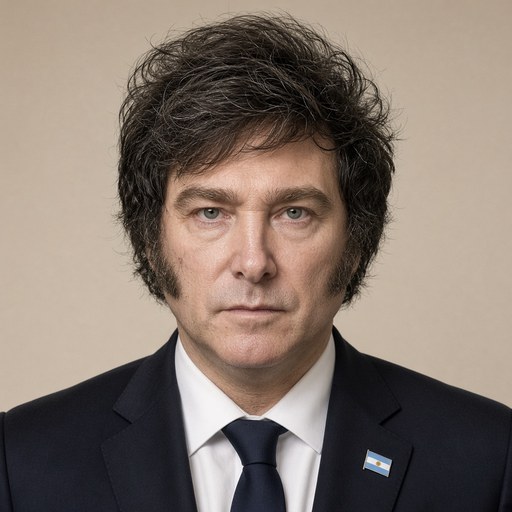
Words of the President of the Nation, Javier Milei, at the headquarters of the Jockey Club Buenos Aires.
 Javier Milei · President of Argentina
- Context
- Milei addressed the Jockey Club Buenos Aires in July 2025, celebrating the institution's founder Carlos Pellegrini while highlighting Argentina's economic recovery under his administration.
- Main themes
- Argentina's economic recovery, fiscal adjustment, Carlos Pellegrini as historical inspiration, poverty reduction, inflation reduction, GDP growth, Argentina's historical golden age, libertarian economic ideology, free-market reform, national reconstruction
- Duration
- ~24 min
- Words
- 2,903
- Sentences
- 106
- Readability
- 51
- Grade
- 12.7
- Syntax
- 3.36
- Vocabulary
- 2.11
Translated from Spanish
The broad sphere of national life a sentence belongs to. Every sentence has an Arena, so it is the denominator the other indices are read against.
Other106 sentences in 12 paragraphs
Hello everyone. It is a true pleasure for me to visit this centennial institution, founded by Carlos Pellegrini: that storm pilot who took charge in the midst of a crisis, did what he had to do without worrying about the political consequences, and balanced the public accounts of our country to bring us back to the path of growth we had become accustomed to by the end of the 19th century. From the very moment I got involved in the presidential race, I have always looked to Carlos Pellegrini as my guide. In fact, when we launched La Libertad Avanza in what was our campaign for the Chamber of Deputies, it was precisely when Doctor Carlos Pellegrini assumed the presidency in the midst of a crisis. And that day we said that the process of national reconstruction began, that it was the moment when we would start taking the first steps to make Argentina great again. And he has always been an inspiration, because Pellegrini did what had to be done.
And that, at that time, was much more complicated, because the speed at which information traveled made doing what needed to be done costlier. And, I remember that when Pellegrini left office, he decided to walk out through Congress - he lived a few blocks from Congress - and one of his assistants said to him: “Don Carlos, don’t go out this way, because there are people who are angry.” And Pellegrini decided to adjust his jacket, put on his top hat, took his cane, and walked out the way he had to walk out; and, obviously, in those few meters, they did not say very nice things to him.
However, history remembers him as the storm pilot. So, this means that we come to do what needs to be done, regardless of what is said in the short term. Fortunately, luck is bringing us better results, even in the short term. We have managed to make the largest fiscal adjustment in the history of humanity in a timely manner. Because if we consider the adjustment in the national treasury, which is a reduction of public spending by 30%, there are no records of such an adjustment in this period. There are 24 cases in the history of the world, but the other 23 occur after a war. Therefore, there is no record of anything like this. And, in addition, the adjustment of the Central Bank, which had a deficit of 10 points of GDP, in one year - basically in six months - we made that adjustment of 15 points of GDP. Moreover, the treasury adjustment, everyone said it was impossible to do: we did it in one month.
So, everyone predicted that not only would we not manage to lower inflation, which was traveling at interannual levels of 300, today it travels at levels of 20; but they also forecasted a mega hyper recession, and when we look at the monthly estimator of economic activity in seasonally adjusted terms, when we compared December 2024 with December 2023, not only did we not fall, but GDP also increased by 6%; the first quarter was at levels of 5.8 and now GDP is traveling in the second quarter at levels of 7.7. They also said that we would explode the number of poor people: when we took office, we clarified the numbers and obviously that meant knowing that poverty was around 57% and today it is around 31, meaning that the heartless and disheartened liberals have lifted 12 million human beings out of poverty; and, among those 12 million human beings we lifted, there are 2.5 million young people and children who came out of poverty. It is clear that the ideas of freedom are working. But well, it seems that for the status quo, everything is wrong, but we will remain stubborn in making Argentina great again.
In short, it is in honor of the founder of this club that I would like to take the opportunity to bring up the discussion we have had in recent weeks regarding whether Argentina was a power or not between the late 19th century and the early 20th century. To put it in context, at that time our country was among the top five countries with the highest GDP per capita in the world, source Angus Maddison. It is true that later recalibrations of this estimate were made. So, Argentina if it is not first, is third, but basically, that’s where we are. We reached a total gross domestic product higher than the sum of Brazil, Mexico, Paraguay, and Peru together and we even had a per capita GDP higher than that of the United States. Although we were a young country, our population was growing steadily. Between 1870 and 1914 our population practically quadrupled and our nation was a refuge for millions of people escaping hunger and war, who, seeking better living conditions, concluded that Argentina had everything necessary to prosper. During this process, we also developed much of the infrastructure that we still internalize to this day. In fact, we were the country in the region with the most kilometers of railway tracks. During that same period, we managed to go from levels of 80% illiteracy to eradicating it and we improved our life expectancy by 50%. Buenos Aires quickly became the first cosmopolitan capital of Latin America and Argentina became a protagonist in the concert of nations. We were a reference in international law, mediating in international conflicts and our public bonds were in demand in the main stock exchanges of Europe and the United States. And, to top it off, we still had vast virgin lands and resources to be exploited, just like now. That is to say, 100 years ago we had the same gold, the same oil, the same copper, and the same fertile land that we have today.
And why did this happen this way? Because we were embracing an elementary truth: that having a small state was the best way to have a thriving civil society. Imagine that it was estimated that, at that time, the participation of public spending in GDP was around 10%; and in recent years it has reached nearly 45% of GDP, a true aberration that we have started to correct and that today stands at 35%. Moreover, the latest data regarding the participation of the national public sector is at its lowest level since 2007. We certainly made a tremendous adjustment. An adjustment that is not accompanied by the provinces or municipalities, which continue to maintain the same levels in terms of GDP since we took office. That is to say, there has been a chainsaw in the Nation and it is not being accompanied by the provinces or municipalities. And, moreover, in some cases, some perverse individuals, in the face of the tax cuts we make — because it must also be mentioned: last year we eliminated taxes equivalent to more than two points of GDP — some perverse individuals take advantage of those cuts we make at the national level to raise taxes at the provincial or municipal level. That period was not only characterized by having a thriving civil society, but also especially by having a social and economic elite that was up to the times, which was at the forefront of national growth. Without going too far, both Pellegrini and the Jockey Club are a clear example of what I am saying. However, this virtuous growth path stopped when the model of freedom was replaced by the model of the present state. A model that did nothing but put the cart before the horse, draining our society of resources economically, while culturally it sought to replace private initiative with state initiative and failed miserably. This led to the creation of the famous caste, which year after year tried to replace society with the state; where before we had dreaming elites who invested and took risks to create innovative solutions, knowing that they could dispose of the fruits of their labor, we went to having friends of power entrenched in commercial models dependent on coercion and their hunting grounds. Where before we had a culture of effort in which study and work were protagonists, we went to having a culture of lethargy where school standards were systematically lowered to the point of eliminating repetition and where the word work was distorted into going to warm a chair at the municipality. Where before we had a high class capable of unprecedented philanthropic works, we went to having a state incapable of buying a CT scanner, and we can continue enumerating for days.
In fact, there is a wonderful book by our greatest reference in the stories of the ideas of freedom, which is Doctor Alberto Benegas Lynch (h) — along with another giant of the ideas of freedom, Martín Krause — which has a wonderful book called “In Defense of the Most Needy”; and one of the things it shows is how society self-organized to provide support to the most vulnerable. That, clearly, when that help was replaced by the state, it evidently led to clientelism and, as Professor Huerta de Soto often points out, state aid to the poor generates more poor people. That is to say, when the state does this, instead of contributing to lift them out of that situation, it sinks them deeper into it. That is why one of our policies focused on growth, from the very beginning, was the policy of human capital. In other words, we have a macro strategy that is built on the idea of fiscal balance, a fixed amount of money, and a flexible exchange rate — which we did by exiting the currency controls, and basically that was done prior to cleaning up the balance of the Central Bank —; and, on the other hand, a clear growth strategy that has to do with reintegration into the world, with economic freedom, with deregulation, and, obviously, with human capital. And in that sense, what changed was the philosophy: before, social policy sought to provide assistance, to give subsidies. That does not work. It is not a matter of giving fish to people, it is a matter of teaching them to fish. And that is what we are doing with Human Capital. And, with that logic, we have lifted 12 million people out of poverty, and we are at levels that had not been seen in Argentina for a long time; but restoring dignity to people, something that, clearly, many governments have not wanted to do.
Obviously, as a consequence of that defeatist mentality, today the political discourse is popular in denying that we were ever important. It is that precisely, it is basically denying that golden Argentina, that wonderful Argentina, it is also a way of denying the resounding failure of the statist model. In fact, there is an economist named Federico Domínguez, who published a very interesting book where he separates Argentina, but in long cycles, instead of looking at short cycles, that is, he looks at cycles around 80 to 90, 100 years and basically there is a moment he calls liberal Argentina, which is 90 years, between 1853, the moment of Alberdi's Constitution and say 1943 and he says, at that moment is when Argentina clearly took off and Argentina became, stopped being a country of mud and became a power. Clearly that history is a story that greatly discomforts miserable pigs who want to deny the decline that began after 1943 and ended collapsing in 2003. Because do not forget that we were on the brink of hyperinflation, we had remunerated liabilities in the Central Bank equivalent to four monetary bases, we had debt in pesos maturing within three months equivalent to 9 monetary bases, that is to say, we would have multiplied the amount of money by 14 in less than three months, and, in addition, we had a money overhang, that is, a monetary surplus, which was double what we had before the Rodrigazo. Remember that in the Rodrigazo inflation multiplied by six, therefore, if we had double we could multiply by 12. So, multiplying by 12, as a drop in the demand for money, multiplying by 14 for the expansion of the supply, clearly, in fact, Ariel Coremberg himself, the alternative calculation gave me 17 thousand and he gives it 18 thousand. So, basically, that was what we were facing and we have managed to tame inflation without expropriations, that is to say, we have respected property rights. All the cleaning that was done of the balance of the Central Bank, we did not do a Bonex plan, we cleaned it up in the market. We did it respecting property rights. Something that, basically, will remain in all the textbooks of history of such a task done. Not only for the enormous Minister of Economy I have, who is Toto Caputo, his deputy José Daza, but also for the joint work between the Central Bank of Santiago Bausili and Pablo Quirno from finance.
Moreover, we did it without price controls, we did it without fixing the exchange rate and we did it honestly. Because it is not that we made the adjustment of tariffs before and then started measuring the stabilization program, but we are doing it during. In fact, if you, for example, take the last retail inflation data of 1.6, if you look closely, it is already at 0.8. That is to say, today inflation is around 12%. And if you look at the issue of food baskets, or the baskets that have to do with the basket that determines poverty, we are at inflation levels around 7/8%. Is there still a long way to go? Without a doubt, because I will not rest until inflation is zero. But we have done a lot, that is also true.
So, imagine that this model would have left us not only with hyperinflation: it would have left us with at least 90% of the population in poverty. And they want to cover that up by denying the greatness we had during the 19th century and the early 20th century; it is a way of hiding the enormous failure. Especially when it is done by those worthless individuals with the title of historian, who want to conceal the failure of the ideology they hide, and for that reason, they manipulate the data. That is why I say: they always believe they have the right to rewrite history. But we respond to them as Mises said: “as long as they keep repeating their same lies, we will keep repeating our truths.”
Moreover, the problem does not simply arise because it is a vile lie constantly repeated to erase our historical memory, but the problem arises because it is a sad passion that seeks to paralyze society to convince it that we cannot achieve great things, as if our country were doomed to be insignificant for the rest of time. Because doing nothing, even when one believes we can do little, is the worst of neglects. Many times, even the criticism of whether we were indeed a power or not comes from people who, at the same time, oppose the exploitation of our resources under labels like “traitor” or “sellout.” The only possible conclusion from this is that, in reality, they are not really interested in whether we were a power or not, but they are interested in ensuring that we never are. That is why they focus their efforts on discussing the etymology of the word “power,” instead of joining us in the discussion of how to become one of the five most dynamic economies in the world again. This may seem like a superficial discussion or one for social media, but it is not: it is a discussion about the Argentine soul. And today, more than ever, it is especially important that we defend this epic legacy. Why? Because, as a country, we are going through a pivotal moment in our history. We are returning to the model of freedom, the model of abundance and wealth generation. We are setting aside the mentality of scarcity and redistribution that has done so much harm to this beautiful nation.
That is why it is time to reconnect with the spirit that characterizes Carlos Pellegrini. Because it is time for society, and especially the elites, to regain the courage to dream. That is why I can think of no better place than this to mention these topics, because you can be the spearhead of this new country. Now that it is time to take risks again, to invest and to create like our grandparents and great-grandparents did, you are the ones entrusted with carrying the torch that was bequeathed to you. You are the ones who have the capital, the time, the contacts, and the knowledge to begin to rebuild Argentina. If we do not dream on our own of a prosperous Argentina, the bad ones will dream for us. But they do not dream of the prosperous future that we envision: they only dream of nightmares of misery and subjugation, which is what the last 100 years have accustomed us to. In short: may God bless the Argentines, may the forces of heaven accompany us, and long live freedom, damn it! Thank you very much.
The original Spanish. The tags above are read on the English translation's sentences.
Hola a todos. Es un verdadero placer para mí estar de visita en esta institución centenaria, fundada por Carlos Pellegrini: aquel piloto de tormentas que asumió en medio de una crisis, hizo lo que tenía que hacer sin preocuparse por las consecuencias políticas y saneó las cuentas públicas de nuestro país para devolvernos a fines del siglo XIX al sendero de crecimiento al que nos habíamos acostumbrado. Yo, desde el mismo momento en que me involucré en la carrera presidencial, siempre puse como guía a Carlos Pellegrini. De hecho, cuando nosotros hicimos el lanzamiento de La Libertad Avanza en lo que fue nuestra carrera hacia la banca de diputados, fue cuando justamente asumía el Doctor Carlos Pellegrini como presidente en el medio de una crisis. Y aquel día dijimos que ese día comenzaba el proceso de la reconstrucción nacional, que era el momento en el cual íbamos a empezar a dar los primeros pasos para volver a la Argentina grande nuevamente. Y siempre fue una inspiración, porque Pellegrini hizo lo que había que hacer.
Y eso, en aquel momento, era bastante más complicado, porque los tiempos a los cuales viajaba la información hacía que hacer las cosas que había que hacerse, pagaran costos más altos. Y, yo recuerdo que cuando Pellegrini deja el cargo, decide salir por el Congreso -vivía a pocas cuadras del Congreso- y uno de sus asistentes le dice: “Don Carlos, no salga por acá, porque hay gente que está enojada”. Y, Pellegrini decide ajustarse su chaqueta, se pone la Galera, toma el bastón y sale caminando por donde tenía que salir caminando; y, obviamente, que en esos metros no le dijeron cosas muy simpáticas.
Sin embargo, la historia lo recuerda como el piloto de tormentas. Entonces, esto quiere decir que nosotros venimos a hacer lo que hay que hacer, independientemente de las cosas que se digan en el corto plazo. Afortunadamente, a nosotros la suerte nos está trayendo mejores resultados, aún de corto plazo. Nosotros hemos logrado hacer el ajuste fiscal más grande de la historia de la humanidad en tiempo y forma. Porque si consideramos el ajuste entre el tesoro nacional, que es una reducción del gasto público del 30%, no hay registros de semejante ajuste en el período. Son 24 casos en la historia del mundo, pero los otros 23 ocurren después de una guerra. Por lo tanto, no hay registro de algo así. Y, además, el ajuste del Banco Central, que eran 10 puntos del PBI el déficit, en un año -básicamente en seis meses- hicimos ese ajuste de 15 puntos del PBI. Es más, el del tesoro, todos decían que era imposible hacerlo: lo hicimos en un mes.
Entonces, ahí todos predijeron que no solo que no íbamos a lograr bajar la inflación, que de estar viajando a niveles interanuales del 300, hoy viaja a niveles del 20; sino que además nos pronosticaban una mega hiper recesión, y cuando miramos el estimador mensual de la actividad económica en términos desestacionalizados, cuando comparábamos diciembre del 24 con diciembre del 23, no solo que no habíamos caído, sino que además subió 6% el PBI; el primer trimestre viajó a niveles del 5,8 y ahora el PBI viene viajando el segundo trimestre a niveles del 7,7. También dijeron que íbamos a hacer explotar la cantidad de pobres: cuando asumimos sinceramos los números y obviamente eso implicó saber que la pobreza estaba en torno al 57% y hoy es entorno al 31, es decir que los desalmados y descorazonados liberales sacamos de la pobreza a 12 millones de seres humanos; y, dentro de esos 12 millones de seres humanos que sacamos, hay 2 millones y medio de jóvenes y niños que salieron de la pobreza. Vaya que están funcionando las ideas de la libertad. Pero bueno, parece que para el status quo está todo mal, pero nosotros vamos a seguir empecinados en seguir haciendo grande la Argentina nuevamente.
En definitiva, es en honor el fundador de este club que me gustaría aprovechar para traer a colación la discusión que vivimos las últimas semanas respecto de si Argentina fue potencia o no entre finales del siglo XIX y comienzos del siglo XX. Para poner en contexto, en aquel entonces nuestro país se encontraba entre los primeros cinco países con el PBI per cápita más alto del mundo, fuente Angus Maddison. Es cierto que después se fueron haciendo recalibraciones de esta estimación. Entonces, Argentina si no está primero, está tercero, pero digamos básicamente, por ahí estamos. Alcanzamos un producto bruto interno total superior a la suma de Brasil, México, Paraguay y Perú juntos y llegamos a tener un PBI per cápita incluso más alto que el de Estados Unidos. Si bien éramos un país joven nuestra población venía creciendo a paso sostenido. Entre 1870 y 1914 nuestra población prácticamente se cuadruplicó y nuestra nación fue refugio para millones de personas escapando del hambre y la guerra, quienes buscando mejores condiciones de vida concluyeron que Argentina tenía todo lo necesario para prosperar. Durante este proceso, también desarrollamos gran parte de la infraestructura que aún internalizamos al día de hoy. De hecho, éramos el país de la región con más kilómetros de vías de tren. Durante ese mismo periodo, logramos pasar de niveles del 80% del analfabetismo a erradicarlo y logramos mejorar en un 50% nuestra expectativa de vida. Buenos Aires se convirtió rápidamente en la primera capital cosmopolita de América Latina y Argentina se convirtió en protagonista en el concierto de las Naciones. Éramos referente en el derecho internacional, mediábamos en conflictos internacionales y nuestros títulos públicos eran demandados las principales bolsas de Europa y de Estados Unidos. Y, por si fuera poco, aún contábamos con vastas tierras vírgenes y recursos para ser explotados, al igual que ahora. Es decir, hace 100 años contábamos con el mismo oro, el mismo petróleo, el mismo cobre y el mismo campo fértil que hoy en día.
¿Y por qué sucedió esto de esta forma? Porque estábamos abrazados a una verdad elemental: que tener un Estado chico era lo mejor para tener una sociedad civil pujante. Imagínense que se estimaba que, por aquel entonces, la participación del gasto público sobre el PBI era en torno del 10%; y en los últimos años llegó a ser cerca del 45% sobre el PBI, una verdadera aberración que nosotros hemos empezado a corregir y que hoy está en 35%. Es más, el último dato de lo que tiene que ver con la participación del sector público nacional está en el nivel más bajo desde 2007. Vaya que hicimos un tremendo ajuste. Ajuste que no es acompañado ni por las provincias ni por los municipios, que siguen manteniendo los mismos niveles en términos del PBI desde el momento en que asumimos. Es decir, ha habido motosierra en Nación y no está siendo acompañado ni por las provincias ni por los municipios. Y, es más, en algunos casos, algunos perversos, frente a las bajas de impuestos que hacemos nosotros —porque también hay que contarlo: el año pasado eliminamos impuestos por el equivalente de más de dos puntos del PBI—, algunos perversos aprovechan esas bajas que nosotros hacemos a nivel nacional para subir los impuestos a nivel provincial o a nivel municipal. Ese periodo no solo se destacó por tener una sociedad civil pujante, sino también especialmente por tener un élite social y económica a la altura de la época, que era punta de lanza del crecimiento nacional. Sin ir muy lejos, tanto Pellegrini como el Jockey Club, son un claro ejemplo de esto que digo. Sin embargo, este sendero de crecimiento virtuoso se detuvo cuando se reemplazó al modelo de la libertad por el modelo del Estado presente. Un modelo que no hizo más que poner el carro adelante el caballo, drenando nuestra sociedad de recursos en lo económico, mientras que en lo cultural se propuso reemplazar a los hombres de iniciativa privada por la iniciativa estatal y fracasó estrepitosamente. Esto derivó la creación de la famosa casta, que fueron los que año a año intentaron reemplazar a la sociedad por el Estado; donde antes teníamos elites soñadoras que invertían y arriesgaban para crear soluciones innovadoras, sabiendo que podrían disponer del fruto de su trabajo, pasamos a tener amigos del poder enquistados en modelos comerciales dependientes de la coerción y sus cotos de caza. Donde antes teníamos una cultura del esfuerzo en la que el estudio y el trabajo eran protagonistas pasamos a tener una cultura del desgano donde se bajaron sistemáticamente los estándares escolares al punto de anular la repitencia y donde la palabra trabajo quedó tergiversada en ir a calentar una silla a la municipalidad. Donde antes teníamos una clase alta capaz de obras filantrópicas sin precedentes, pasamos a tener un Estado incapaz de comprar un tomógrafo y así podemos seguir enumerando por días.
De hecho, hay un libro maravilloso de nuestro máximo referente de las historias de las ideas de la libertad, que es el doctor Alberto Benegas Lynch (h) —junto a otro gigante de las ideas de la libertad, que es Martín Krause—, que tiene un libro maravilloso que se llama “En defensa de los más necesitados”; y, una de las cosas que muestra es cómo la sociedad se auto- organizaba para darle contención a los más vulnerables. Que, claramente, cuando esa ayuda fue reemplazada por el Estado, evidentemente derivó en clientelismo y, como suele señalar el Profesor Huerta de Soto, la ayuda a los pobres genera más pobres. Es decir, cuando esto lo hace el Estado, justamente en lugar de contribuir a sacarlos de esa situación, los hunde en esa situación. Por eso, una de nuestras políticas enfocadas al crecimiento, y desde el primer momento, fue la política del capital humano. O sea, nosotros tenemos una estrategia macro que se construye sobre la idea del equilibrio fiscal, la cantidad de dinero fija y el tipo de cambio flexible —cosa que hicimos saliendo del cepo, y básicamente eso se hizo previo a sanear el balance del Banco Central—; y, por otro lado, una estrategia clara de crecimiento que tiene que ver con la reinserción en el mundo, con la libertad económica, con la desregulación y, obviamente, con el capital humano. Y en ese sentido, lo que cambió fue la filosofía: antes, la política social procuraba dar asistencia, dar subsidios. Eso no funciona. No es cuestión de regalarle el pescado a la gente, es cuestión de enseñarle a pescar. Y eso es lo que estamos haciendo desde Capital Humano. Y, con esa lógica, hemos sacado 12 millones de personas de la pobreza, y estamos en niveles que hacía tiempo que en Argentina no se veían; pero devolviéndole la dignidad a la gente, algo que, claramente, muchos gobiernos no han querido.
Obviamente, como consecuencia de esa mentalidad derrotista, hoy es popular el discurso político en el negar que alguna vez fuimos importantes. Es que justamente, es básicamente negar esa Argentina dorada, esa Argentina maravillosa, es una forma también de negar el fracaso estrepitoso del modelo estatista. De hecho, hay un economista que se llama Federico Domínguez, sacó un libro muy interesante donde separa a la Argentina, pero en ciclos largos, en lugar de estar mirando ciclos cortos, o sea, mira ciclos en torno de 80 a 90, 100 años y básicamente hay un momento que lo llama la Argentina liberal, que son 90 años, entre 1853, el momento de la Constitución de Alberdi y digamos 1943 y dice, en ese momento es el momento en donde Argentina claramente hizo el despegue y Argentina se convirtió, dejó de ser de un país de barro y se convirtió en una potencia. Claramente esa historia es una historia que incomoda mucho a cerdos miserables que quieren negar la decadencia que empezó a partir de 1943 y que terminó colapsando en el año 2003. Porque no se olviden que estábamos al borde de una hiperinflación, teníamos pasivos remunerados en el Banco Central por el equivalente a cuatro bases monetarias, teníamos deuda en pesos venciendo en el lapso de tres meses por el equivalente a 9 bases monetarias, es decir, que hubiéramos multiplicado en menos de tres meses la cantidad de dinero por 14 y, además, teníamos un money overhang, o sea, un sobrante monetario, que era del doble del que teníamos en la previa al Rodrigazo. Recuerden que en el Rodrigazo la inflación se multiplicó por seis, por lo tanto, si teníamos el doble podíamos multiplicar por 12. Entonces, multiplicar por 12, como caída de la demanda de dinero, multiplicar por 14 por expansión de la oferta, claramente, de hecho, el propio Ariel Coremberg, el cálculo alternativo y al que a mí me daba 17 mil y a él le da 18 mil. Así es que, básicamente, eso era a lo que nos enfrentábamos y hemos logrado domar la inflación sin expropiaciones, es decir, hemos respetado el derecho de propiedad. Toda la limpieza que se hizo del balance del Banco Central, nosotros no hicimos un plan Bonex, nosotros lo limpiamos a mercado. Lo hicimos respetando el derecho de propiedad. Algo que, básicamente, va a quedar en todos los libros de texto de la historia de semejante tarea hecha. No solo por el enorme Ministro de Economía que tengo, que es Toto Caputo, su vice José Daza, sino también por el trabajo conjunto entre el Banco Central de Santiago Bausili y Pablo Quirno desde finanzas.
Además, lo hicimos sin controles de precios, lo hicimos sin fijar el tipo de cambio y lo hicimos de manera honesta. Porque no es que hicimos el ajuste de tarifas antes y después empezar a medir el programa de estabilización, sino que lo estamos haciendo durante. De hecho, si ustedes, por ejemplo, toman el último dato de inflación minorista de 1,6, si ustedes miran bien, ya vienen al 0,8. Es decir, que hoy la inflación viaja en torno al 12%. Y si miran el tema de las canastas de alimentos, o las canastas de lo que tiene que ver con la canasta que determina la pobreza, estamos en niveles de inflación en torno al 7/8%. ¿Qué falta mucho? Sin lugar a dudas, porque no voy a descansar hasta que la inflación sea cero. Pero que hicimos mucho, también es cierto.
Entonces, imagínense que ese modelo nos hubiera dejado no solo una hiperinflación: nos hubiera dejado, por lo menos, 90% de pobres. Y eso lo quieren tapar, negando la grandeza que tuvimos durante el siglo XIX e inicios del siglo XX, es una forma de ocultar el enorme fracaso. En especial cuando lo hacen esas basuras con título de historiador, que lo que quieren hacer es ocultar el fracaso de la ideología que esconden y, por eso, fuerzan los datos. Por eso digo: siempre creen que tienen el derecho de reescribir la historia. Pero nosotros les contestamos como decía Mises: “mientras ellos sigan repitiendo sus mismas mentiras, nosotros vamos a seguir repitiendo nuestras verdades”.
Y, además, el problema no pasa simplemente porque sea una mentira canalla repetida constantemente para borrar nuestra memoria histórica, sino que el problema pasa porque es una pasión triste, que pretende paralizar a la sociedad para convencerla de que no podemos lograr grandes cosas, como si nuestro país estuviera condenado a ser poca cosa por el resto de los tiempos. Porque no hacer nada, incluso cuando se crea que podemos hacer poco, es la peor de las desidias. Muchas veces, incluso, la crítica a si efectivamente fuimos una potencia o no viene dada por gente que, al mismo tiempo, se opone a la explotación de nuestros recursos bajo etiquetas como “cipayo” o “vende patria”. La única conclusión posible de ello es que, en realidad, no les interesa realmente si fuimos potencia o no, sino que les interesa que nunca lo seamos. Por eso centran sus esfuerzos en discutir la etimología de la palabra “potencia”, en lugar de acompañarnos en la discusión de cómo volver a ser una de las cinco economías más pujantes del mundo. Esto parece una discusión superficial o de redes sociales, pero no lo es: es una discusión acerca del alma argentina. Y, hoy, más que nunca, es especialmente importante que defendamos este legado épico. ¿Por qué? Porque, como país, estamos transitando un momento bisagra en nuestra historia. Estamos retornando al modelo de la libertad, el modelo de la abundancia y la generación de riqueza. Estamos dejando de lado la mentalidad de escasez y redistribución que tanto daño le ha hecho a esta bella nación.
Es por eso que es momento de reencontrarnos con el espíritu que caracteriza a Carlos Pellegrini. Porque es momento de que la sociedad, y especialmente las élites recuperen el coraje de soñar. Por eso, no se me ocurre mejor lugar que este para mencionar estos temas, porque ustedes pueden ser la punta de lanza de este nuevo país. Ahora que es momento de volver a arriesgar, invertir y crear como nuestros abuelos y bisabuelos, son ustedes los encargados de portar la antorcha que les fue legada. Son ustedes quienes cuentan con el capital, el tiempo, los contactos y el conocimiento para comenzar a reconstruir la Argentina. Si no soñamos por nuestra cuenta con una Argentina próspera, los malos van a soñar por nosotros. Pero no sueñan con el futuro próspero que nosotros imaginamos: solo sueñan pesadillas de miseria y sujeción, que es a lo que nos acostumbraron los últimos 100 años. En definitiva: que Dios bendiga a los argentinos, que las fuerzas del cielo nos acompañen y ¡viva la libertad, carajo! Muchas gracias.