




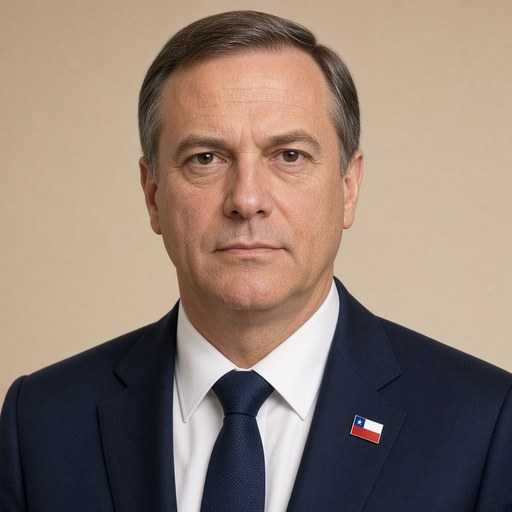
His Excellency the President of the Republic, José Antonio Kast Rist, witnesses an operational demonstration of border control in Arica.
 José Antonio Kast · Leader of the Republican Party (Chile)
- Context
- Kast addressed Chilean officials and military at the Chacalluta Border Crossing in Arica on March 16, 2026, to witness an Army-led border control operation against illegal immigration.
- Main themes
- Border security and control, illegal immigration, organized crime and drug trafficking, Chilean sovereignty, military deployment, social costs of irregular migration, international cooperation, rule of law, child exploitation, infrastructure barriers
- Duration
- ~11 min
- Words
- 1,288
- Sentences
- 74
- Readability
- 64
- Grade
- 8.6
- Syntax
- 2.91
- Vocabulary
- 2.03
Translated from Spanish
The broad sphere of national life a sentence belongs to. Every sentence has an Arena, so it is the denominator the other indices are read against.
Other74 sentences in 27 paragraphs
Good afternoon.
I thank you once again for joining us. For all of Chile, this is a milestone. Being here at the Chacalluta Border Crossing, in front of Landmark No. 11, watching our Armed Forces, our Army, work for Chile fills us with pride.
A few years ago, there was talk of backhoes, backhoes to oppose an economic model. We do not want to use backhoes to oppose an economic model or ideas; we want to use backhoes to build a sovereign Chile. That sovereign Chile that has been undermined by illegal immigration, drug trafficking, and organized crime.
This backhoe will not fail because this backhoe is being pushed by all Chileans. I am convinced that the Army, with this work, represents the vast majority of Chileans, far beyond those who have chosen a political position. Because—as I said this morning—drug trafficking, organized crime, and illegal immigration have no political color.
The children who are abused, who are used as passports, and you can see them there at the border center, are grateful that a government truly cares that they are not instrumentalized.
The backhoe—as I tell you—today will indeed build sovereignty.
We proposed this in the campaign, and today we can say that we have begun to curb that irregular immigration, which in recent years brought more than 180,000 people to Chile who entered through the back door. And this is the back door that was open, and we are closing it. Other possibilities have opened up for people to remain in their homeland because many of them were forced to come to Chile.
Today this is something that different nations are promoting, not just us. People were entering without backgrounds, without records, people who were—as I mentioned—abused by organized crime, enslaved in some cases. Many times, this was not talked about. How many people know what hot mattresses are in bus terminals? How many know about the people who have to suffer the harshness of the weather? Because yes, they seek a better destination. But why? Because in their nations there is no freedom.
We seek the freedom of Chile and also the freedom of other nations.
And what has been the cost for Chile? We all know it. Immigrants who have faced difficult situations know it, but our compatriots know it too. In terms of health, a health system that has been overwhelmed, despite the work of all the health workers, waiting lists. In terms of education, how many children have not had the opportunity to receive an education because there is no space for them? In terms of housing, beyond the disasters, the possibility of accessing a home of their own, of renting a house at a reasonable price has become almost impossible.
The municipalities, who are also with us, and I thank them, councilors, regional councilors, mayors, deputies, senators. I thank you because you were the driving force behind this beginning. We are with the Legislative Power. Thank you, senator, because the issue of irregular immigration has been a constant concern of yours. I saw how the senator made a video to communicate: “Look at what is happening here.” I saw the councilor, the mayor of General Lagos, and they said: “We want this up there too. We don’t want this to only happen here.” And I told him: “Well, we were up there a couple of months ago.” Seeing the reality of the situation of organized crime in Visviri, in Colchane, motivates us more to fulfill this. Not to mention, the governor, who is also with us, is here, the governor, with whom we have toured the area.
We were in Peru as well, stating that we were going to do this. Because for our Peruvian neighbors, what we are doing is not unknown. They also long for peace for their region.
I want to thank each of the ministers who have done an enormous job in these days to make this happen.
But the main thanks go to our Police. As I told you this morning, they have organized important operations. To our Armed Forces and, above all, to the Army. I want to thank the Army Chief for the promptness in responding to the decree I signed on my first day in office. There we asked him to provide an analysis of the Army's capacity to mobilize military means, what the availability was to reinforce the different sectors, and also how to provide us with physical barriers.
And they have delivered in four days. This demonstrates the capacity, the effectiveness of our Army, which was already deployed in the three northern regions in just a few days, because here we are only showing you a part. This also begins in the Tarapacá Region, it is also being done in the Antofagasta Region. And they have presented us with a phased plan to meet the goal of closing our borders to immigration, drug trafficking, and organized crime.
Chile thanks the management and willingness to collaborate when we have requested this possibility from the Army.
As I tell you, this is not just a trench; it is much more, it is a system.
Because some will say: “Will that trench stop everything?” No. If you look up, you will see observation posts. If you look towards the sea, you will see observation posts.
There is also a system that will be refined and that the Army is also developing with previous work, because we must also recognize that progress was made, not at the speed we estimated because this could have been complemented much earlier, but these are physical, technological, and human barriers. The trench alone is not enough, and we have seen that organized crime has the means to cover the trench and cross vehicles with contraband.
This requires a permanent future presence of the Police, today with the reinforcement of the Armed Forces, but this is an integral system that also requires international dialogue, cooperation with other nations.
This is just the beginning. Many kilometers will be blocked, but the most important thing is the people who collaborate with those physical barriers. It would not be possible to carry this out without the collaboration of the people. I personally thanked the soldier who is up on that machine and told him: “Today you are in the heart of all Chileans, today you represent millions of Chileans, you are not alone up there on that machinery, you are backed by thousands of Chileans who feel proud of the work being done.”
I thank once again all those who have collaborated, from the Police, from the Armed Forces, and I ask every Chilean to support us, first, by backing the work of our Carabineros, our Police Investigations, our prison guards, our Maritime Police, our Armed Forces—Army, Air Force, and Navy—who perform commendable work for each of us.
But they need us, from Arica and Parinacota to Magallanes and Chilean Antarctica, they need us to give them support. Every time you see a carabinero, a police officer, someone from the Armed Forces, thank them, because they are defending you, they are defending your family, they are defending the sovereignty of Chile.
We will safeguard Chile, we will recover Chile, and we will live in peace again. We will be, once again, what our national anthem says: “Happy Copy of Eden.” It will cost us, but we will achieve it.
So I want to thank you and now ask the ministers if they can join me, the Army Chief to also personally thank him for his work.
And both the Minister of Defense and the Minister of Public Works also want to communicate some of the measures we are taking.
Thank you very much.
The original Spanish. The tags above are read on the English translation's sentences.
Muy buenas tardes.
Les doy las gracias nuevamente por acompañarnos. Para Chile entero, este es un hito. Estar aquí, en el Paso Fronterizo de Chacalluta, frente al Hito N°11, viendo como nuestras Fuerzas Armadas, nuestro Ejército, trabaja por Chile, nos llena de orgullo.
Hace unos años atrás, se habló de retroexcavadoras, de retroexcavadoras para oponerse a un modelo económico. Nosotros no queremos usar las retroexcavadoras para oponernos a un modelo económico o a ideas, queremos usar las retroexcavadoras para construir un Chile soberano. Ese Chile soberano que ha sido vulnerado por la inmigración ilegal, por el narcotráfico, por el crimen organizado.
Esta retroexcavadora no va a fracasar, porque esta retroexcavadora la empujan todos los chilenos. Estoy convencido de que el Ejército, con este trabajo, representa a la inmensa mayoría de los chilenos, mucho más allá de quienes optaron por una posición política. Porque –como lo dije en la mañana– el narcotráfico, el crimen organizado, la inmigración ilegal no tienen color político.
Los niños que son abusados, que son usados como pasaporte, y ustedes lo pueden ver ahí en el centro fronterizo, están agradecidos de que un gobierno se preocupe de verdad de que ellos no sean instrumentalizados.
La retroexcavadora –como les digo– hoy día sí va a construir soberanía.
Lo planteamos en la campaña, y hoy día podemos decir que comenzamos a frenar esa inmigración irregular, que en los últimos años trajo más de 180 mil personas a Chile que entraron por la ventana. Y esta es la ventana que estaba abierta y la estamos cerrando. Se han abierto otras posibilidades para las personas que permanezcan en su patria, porque muchos de ellos venían forzadamente a Chile.
Hoy día esto es algo que distintas naciones están impulsando, no solamente nosotros. Entraban personas sin antecedentes, sin registros, personas que eran –como les decía– abusadas por el crimen organizado, esclavizadas en algunos casos. De eso, muchas veces, no se hablaba. ¿Cuántas personas conocen lo que son los colchones calientes en los terminales de buses? ¿Cuántos conocen las personas que tienen que sufrir la inclemencia del tiempo? Porque sí, buscan un destino mejor. ¿Pero por qué? Porque en sus naciones no hay libertad.
Nosotros procuramos la libertad de Chile y, también, la libertad de otras naciones.
¿Y cuál ha sido el costo para Chile? Todos lo conocemos. Lo conocen los inmigrantes que han tenido situaciones difíciles, pero también lo conocen nuestros compatriotas. En el tema de salud, una salud que fue sobrepasada, a pesar del trabajo que realizan todos los funcionarios que están en la salud, listas de espera. En temas de educación, cuántos niños no han tenido posibilidad de tener una educación porque no hay espacio para ellos. En el tema de la vivienda, más allá de las catástrofes, la posibilidad de acceder a una vivienda propia, de arrendar una casa a un valor razonable se ha vuelto casi un imposible.
Los municipios, aquí nos acompañan también y les doy las gracias, a concejales, a consejeros regionales, a alcaldes, a diputados, a senadores. Les doy las gracias porque ustedes fueron el motor de que esto comenzara. Estamos con el Poder Legislativo. Gracias, senador, porque ha sido una preocupación constante suya el tema de la inmigración irregular. Y veía cómo el senador hacía un video para comunicar: “Miren lo que está pasando acá”. Veía al concejal, al alcalde de General Lagos, y decían: “queremos esto también arriba. No queremos que esto solamente se haga acá”. Y yo le decía: “bueno, estuvimos hace un par de meses arriba”. Ver la realidad de la situación del crimen organizado en Visviri, en Colchane, motiva más para poder cumplir esto. Para qué decir, el gobernador, que también nos acompaña, está acá el gobernador, con quien hemos recorrido la zona.
Estuvimos en Perú también, planteando que íbamos a hacer esto. Porque para nuestros vecinos peruanos esto no es desconocido lo que estamos haciendo. Ellos también anhelan la paz para su región.
Darles las gracias a cada uno de los ministros, que han hecho un trabajo enorme en estos días para que esto se cumpla.
Pero el principal agradecimiento es para nuestras Policías. Como les dije en la mañana, han organizado operativos importantes. Para nuestras Fuerzas Armadas y, sobre todo, para el Ejército. Al comandante en jefe del Ejército le quiero agradecer la prontitud a la respuesta del decreto que firmé el primer día recién asumido el cargo. Ahí le planteamos que nos hiciera un análisis de la capacidad del Ejército de movilizar medios militares, cuál era la disponibilidad de reforzar los distintos sectores y, también, de cómo proveernos de barreras físicas.
Y han cumplido en cuatro días. Eso demuestra la capacidad, la efectividad de nuestro Ejército, que en pocos días ya estaba desplegado en las tres regiones del norte, porque aquí nosotros estamos mostrándoles solamente una parte. Esto también comienza en la Región de Tarapacá, también se hace en la Región de Antofagasta. Y nos han presentado un plan en etapas para cumplir la meta de cerrar nuestras fronteras a la inmigración, al narcotráfico y al crimen organizado.
Chile le agradece la gestión y la voluntad de colaborar cuando le hemos solicitado al Ejército esta posibilidad de colaborarnos.
Como les digo, esto no es solo una zanja, es mucho más, es un sistema.
Porque algunos dirán: “¿esa zanja va a detener todo?”. No. Si ustedes miran hacia arriba van a ver puestos de observación. Si ustedes miran hacia el mar van a ver puestos de observación.
Hay un sistema también que se va a ir perfeccionando y que también viene desarrollando el Ejército con el trabajo anterior, porque aquí también hay que reconocer que se fue avanzando, no a la velocidad que estimábamos porque esto podría haber sido complementado mucho antes, pero esto son barreras físicas, tecnológicas, humanas. La zanja sola no sirve y hemos visto que el crimen organizado tiene los medios para cubrir la zanja y cruzar igual los vehículos con contrabando.
Esto requiere una presencia permanente a futuro de las Policías, hoy día con el refuerzo de las Fuerzas Armadas, pero esto es un sistema integral que requiere también la conversación a nivel internacional, el trabajo con otras naciones.
Este es solo el comienzo. Serán muchos kilómetros los que se bloquearán, pero lo más importante son las personas que colaboran a esas barreras físicas. No sería posible realizar esto sin la colaboración de las personas. Le agradecí personalmente al soldado que está arriba de esa máquina y le dije: “Usted hoy día está en el corazón de todos los chilenos, usted hoy día representa a millones de chilenos, usted no está solo arriba de esa maquinaria, usted está respaldado por miles de chilenos que se sienten orgullosos por el trabajo que se está haciendo”.
Les doy una vez más las gracias a todas aquellas personas que han colaborado, de las Policías, de las Fuerzas Armadas, y pedirle a cada chileno que nos colabore, primero, respaldando la labor de nuestros Carabineros, de nuestra Policía de Investigaciones, de nuestros gendarmes, de nuestra Policía Marítima, de nuestras Fuerzas Armadas –Ejército, Fuerza Aérea y Armada– que realizan una labor encomiable por cada uno de nosotros.
Pero nos necesitan, de Arica y Parinacota hasta Magallanes y Antártica Chilena nos necesitan a nosotros, necesitan que les demos el respaldo. Cada vez que usted vea a un carabinero, a un policía, a alguien de las Fuerzas Armadas, dele las gracias, porque lo está defendiendo a usted, está defendiendo a su familia, está defendiendo la soberanía de Chile.
Vamos a resguardar Chile, vamos a recuperar Chile y vamos a volver a vivir en paz. Vamos a ser, una vez más, lo que dice nuestro himno nacional: “Copia Feliz del Edén”. Nos va a costar, pero lo vamos a lograr.
Así que les quiero dar las gracias y pedirles ahora a los ministros si me pueden acompañar, al comandante en jefe del Ejército para darle las gracias también, personalmente, por su labor.
Y tanto el ministro de Defensa como el ministro de Obras Públicas, también quieren comunicar algunas de las medidas que estamos tomando.
Muchas gracias.