




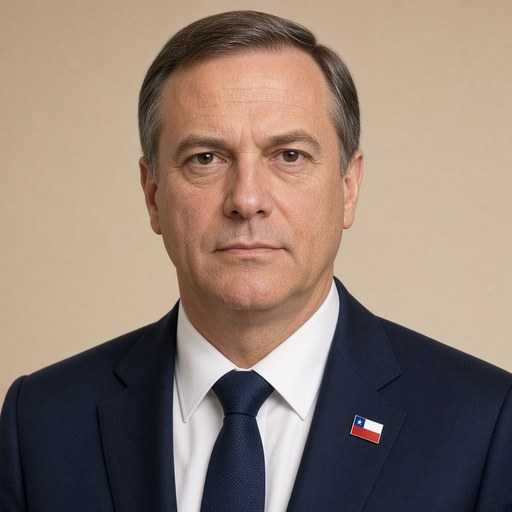
His Excellency the President of the Republic, José Antonio Kast, signs the National Reconstruction project that is being sent to Congress today.
 José Antonio Kast · Leader of the Republican Party (Chile)
- Context
- Kast addressed a signing ceremony in April 2026 to formally submit the National Reconstruction bill to Chile's Congress, outlining its economic and housing reform measures.
- Main themes
- National reconstruction legislation, economic growth and investment, unemployment and youth unemployment, tax reform, SME support, bureaucratic reform and permitting, housing and informal settlements, private sector role in development, coalition political support, Valparaíso reconstruction
- Duration
- ~13 min
- Words
- 1,554
- Sentences
- 66
- Readability
- 58
- Grade
- 10.8
- Syntax
- 3.02
- Vocabulary
- 1.99
Translated from Spanish
The broad sphere of national life a sentence belongs to. Every sentence has an Arena, so it is the denominator the other indices are read against.
Other66 sentences in 30 paragraphs
Good morning.
I want to thank, first of all, the media who are with us for the signing of this bill, and each of the ministers of the Political Committee who are also here.
First, I want to express my gratitude for the ongoing collaboration we have received from the various parties that have supported our Government coalition, such as the Democratic Party, the Christian Social Party, Evópoli, National Renewal, the UDI, and the Republican Party.
I also want to thank the willingness of several independent deputies who have been part of the dialogue we have had during these days. The good disposition of the Libertarian National Party, with whom we also had good meetings and exchanges of opinions. And the willingness to reach an agreement from the People’s Party, after also having conversations and reviewing point by point the project and seeing what things can be improved in the future.
This, while it is an important project for our Government, is much more relevant for the future of our nation. It is a project that, if approved, could mark a before and after in the development of our homeland.
Before talking about the project itself, which Ministers Poduje and Quiroz will also refer to, I want to give you some numbers. A relevant number is that more than 800,000 Chileans are currently looking for work and cannot find it. Within that number, there is a very significant percentage of young people who are unemployed, who do not see a certain future for their lives, to start their families, and that is almost 22% of the young people who are currently unemployed.
I should also mention that 2% is not just any figure; it is the growth figure that Chile has today, while our nation could be, like neighboring countries, growing at 3%, 3.5%, or 4%. The difference is enormous when one goes from 2% to 4% growth in the quality of life of our compatriots.
Additionally, I want to point out that there are more than 100,000 people today living in camps, families living in camps. These are not just numbers; they are people, they are families who see their opportunities to get ahead and improve the quality of life for their children thwarted.
The question everyone is asking is why we have reached this point. A country, as we all said, that was on the path of development. A country that wanted to eliminate temporary housing by the year 2000, and today, by the year 2026, they have not been eliminated but have increased.
Clearly, we have reached this point because many thought that the State alone could generate wealth. Not considering that without the complement of the private sector, of entrepreneurs, that is practically impossible, and we do not know of any State in the world that has been able to improve the quality of life of its citizens on its own.
We must also add that many worked hard to increase restrictions, regulations, and ultimately many also legislated only by looking at polls, the easy applause, applause that quickly fades when the reality we are living today is confirmed.
That result is reflected in the figures I mentioned regarding employment, also in more debt, because the State begins to incur debt to finance everything it promised, which leads to a very complex future, which has turned into a complex present for millions of Chileans.
This project changes the logic of what has been done in recent years. We propose to gradually lower the first category tax from 27% to 23% to generate more investment, and more investment means more jobs.
We propose to provide a tax credit that supports the formal work of thousands of Chileans, with nearly 1.4 billion dollars that will be allocated to benefit this formal work for 235,000 SMEs, 235,000 dreams of progress that are there, people who want to get ahead, who want to grow, who want to double their entrepreneurship, and today cannot.
We also seek to end or reduce the tax uncertainty that currently affects many people who want to invest. In recent years, as you know, there have been multiple tax reforms. What certainty can someone who wants to start a business have if they do not know how much tax they will pay a few years after starting their venture? One needs clear rules to invest and know over time how much they will have to pay in taxes.
We also propose to reduce bureaucratic timelines. In just a few years, the timelines to enable an investment project have almost doubled, and today a medium or large investment project can be stalled for a thousand days or more due to what has been termed in Chile as the permitting process.
Also, as everyone knows, we want to have resources to move quickly and effectively, efficiently, without having to demolish constructions that are built hastily to project a relative solution to a drama like the destruction of the homes of thousands of families.
Too much time has passed in which families in the Valparaíso Region have not seen real solutions, and there is much hope that we will act in a different, agile, and efficient manner in the regions of Ñuble and Biobío. This requires resources, and therefore it is very important that all legal modifications are approved so that these resources reach the treasury promptly.
Who benefits from this project? As I already said, the young people who today, in a majority percentage, are among the unemployment figures, have no jobs.
Families who want to acquire their first home, that first home that, for years, decades, was the dream of every Chilean, the own home, which has been moving further away due to the increase in housing prices, due to the increase in the credit they have to request.
The elderly, those who struggle to make ends meet and see that along with everything they have to pay, they have to pay the property taxes on a home they acquired with great effort, and that is already their own home, for which they have to pay a kind of rent.
It also benefits SMEs, all those entrepreneurs who, despite all the difficulties, dare to start a business, a job. A business can be a small store that wants to grow, or it can be a medium or large company.
What we seek here is to protect formal employment. We have reached unemployment figures rarely seen. More than 800,000 people are without work. If we do not return to grow at 3% or 4% by the end of our Government, it will be almost impossible to recover those jobs.
Today this project will be in the hands of Congress, and each parliamentarian will have to decide what they will do. Whether they will be on the side of employment or stagnation. The formulas that have been implemented so far have generated more unemployment. Parliamentarians will have to decide whether they will be with families or with a slogan. There are many slogans. They all say: Chile must grow, Chile must develop. The question is how is it done? By doing the same thing that has been done so far, which clearly has not led us to that result.
When one asks, or you, the media, ask someone who claims to be opposing even the idea of legislating, they say: no, there are different formulas, but curiously they do not mention any. Just saying no. And the worst way to legislate in this case is to not have known the bill and already say that one will oppose the idea of legislating.
That is why we are so grateful for the good disposition of parliamentarians who are not part of the coalition but who have opened themselves to dialogue. Dialogue takes place in the committees, and once the issues are raised in the committees, when it returns to the chamber, one clearly has the legitimate right to vote for or against the idea of legislating. But to say it in a project like this, which proposes growth, development, a better future for Chile, to say it even before the project enters Congress, before the first discussions take place in the committee where it will be, I believe is not appropriate. But each one, as I say, must make their own decision.
The Government is doing its part; serious studies have been conducted to present this project, and the concerns of various sectors have been gathered that will be reflected in this project and in discussions and projects that will come forward.
Years ago, former President Ricardo Lagos said the following phrase: the number one task is to grow; everything else is music. Today, I would like to complement that phrase and say: the number one task is to generate employment; the rest is music. This project proposes growth, it proposes the formulas for how to grow, and that will result in a greater number of jobs.
Chile can grow much more than the 2% annual growth we have today. Chile is not condemned to have 8% unemployment. Today, as I said, we take the first step on the right path, and we hope that Parliament will heed this proposal and decide in good conscience, in favor of all Chileans.
Thank you very much.
The original Spanish. The tags above are read on the English translation's sentences.
Muy buenos días.
Quiero agradecerles, en primer lugar, a los medios de comunicación que nos acompañan en la firma de este proyecto de ley, a cada uno de los ministros del Comité Político que nos acompañan también.
En primer lugar, agradecer la colaboración permanente que hemos tenido de los distintos partidos que nos han colaborado en la coalición de nuestro Gobierno, como es el Partido Demócrata, el Partido Social Cristiano, el Partido Evópoli, Renovación Nacional, la UDI, el Partido Republicano.
También, quiero agradecer la buena disposición de varios diputados independientes que han sido parte del diálogo que hemos tenido durante estos días. La buena disposición del Partido Nacional Libertario, con quien tuvimos también buenas reuniones e intercambio de opiniones. Y la disposición para llegar a un acuerdo del Partido De la Gente, después también de conversaciones y de revisar punto por punto el proyecto y de ver qué cosas hacia futuro se pueden ir mejorando.
Este, si bien es un proyecto importante para nuestro Gobierno, es mucho más relevante para el futuro de nuestra nación. Es un proyecto que, de aprobarse, puede marcar un antes y un después en el desarrollo de nuestra patria.
Antes de hablar del proyecto mismo, al cual también se van a referir los ministros Poduje y Quiroz, quiero darles algunos números. Un número relevante es el de más de 800 mil chilenos que hoy día están buscando trabajo y no lo encuentran. Dentro de ese número, hay un porcentaje muy relevante de jóvenes que están desempleados, que no ven un futuro cierto para su vida, para constituir su familia, y eso es casi un 22% de los jóvenes que hoy día están desempleados.
También decir que el 2% no es una cifra cualquiera, es la cifra de crecimiento que tiene hoy día Chile, pudiendo estar nuestra nación, al igual que naciones vecinas, creciendo al 3, 3,5 o 4%. La diferencia es enorme cuando uno pasa del 2 al 4% de crecimiento en la calidad de vida de nuestros compatriotas.
También, señalar que hay más de 100 mil personas hoy día viviendo en campamentos, familias viviendo en campamentos. Esos no son sólo números, son personas, son familias que ven truncadas las oportunidades de salir adelante, de mejorar la calidad de vida de sus hijos.
La pregunta que todos se hacen es ¿por qué llegamos hasta este punto? Un país, como decíamos todos, que estaba en vía del desarrollo. Un país que quería terminar con las mediaguas al año 2000, y hoy día al año 2026 no han terminado, sino que han aumentado.
Claramente hemos llegado a este punto, porque muchos pensaban que el Estado por sí mismo podía generar riqueza. No considerando que sin la complementación del mundo privado, de los emprendedores, eso es prácticamente imposible y no conocemos en el mundo un Estado que haya podido sacar adelante sólo la calidad de vida de sus ciudadanos.
También, a esto tenemos que agregarle que muchos se esforzaron por aumentar las restricciones, las regulaciones, y finalmente muchos también legislaron sólo mirando las encuestas, el aplauso fácil, aplauso que se va rápidamente cuando se constata la realidad como la que estamos viviendo hoy día.
Ese resultado se refleja en las cifras que les mencioné de empleo, también de más deuda, porque el Estado se empieza a endeudar para poder financiar todo lo que prometió, y redunda en un futuro muy complejo, que se transformó en un presente complejo para millones de chilenos.
Este proyecto cambia la lógica de lo que se venía realizando en los últimos años. Proponemos bajar el impuesto de primera categoría del 27 al 23% de una manera gradual para generar más inversión, y más inversión es más empleo.
Planteamos entregar un crédito tributario que colabora al trabajo formal de miles de chilenos, con cerca de 1.400 millones de dólares que serán entregados para beneficiar este trabajo formal a 235 mil pymes, 235 mil sueños de progreso que están ahí, personas que quieren salir adelante, que quieren crecer, que quieren duplicar el emprendimiento que tienen, y hoy día no pueden.
También, buscamos terminar o bajar la incertidumbre tributaria que hoy día afecta a muchas personas que quieren invertir. En los últimos años, ustedes lo saben, ha habido múltiples reformas tributarias. ¿Qué certeza puede tener alguien que quiere emprender si no sabe cuántos impuestos va a pagar a los pocos años de comenzar su emprendimiento? Uno necesita reglas claras para invertir y saber en el tiempo cuánto le va a tocar pagar de impuestos.
También planteamos reducir los plazos de la burocracia. En cortos años, los plazos para habilitar un proyecto de inversión se han casi duplicado, y hoy día un proyecto de inversión mediano o grande puede estar mil días o más de mil días detenido por lo que se ha denominado en Chile la permisología.
También, y como todos saben, queremos tener recursos para avanzar rápido y de manera eficaz, eficiente, sin tener que demoler construcciones que se construyen de manera apurada para proyectar una relativa solución a un drama como la destrucción de las viviendas de miles de familias.
Ha pasado demasiado tiempo en que las familias de la Región de Valparaíso no han visto soluciones reales, y hay mucha esperanza en que nosotros vamos a actuar de una manera distinta, ágil y eficiente en las regiones de Ñuble y Biobío. Eso requiere recursos, y por lo tanto es muy importante que se aprueben todas las modificaciones legales para que esos recursos lleguen de manera pronta a las arcas fiscales.
¿Quiénes ganan con este proyecto? Como ya lo dije, los jóvenes que hoy día, en un porcentaje mayoritario, están dentro de las cifras de desempleo, no tienen trabajo.
Las familias que quieren adquirir su primera vivienda, esa primera vivienda que, por años, décadas, fue el sueño de cada chileno, la casa propia, que se ha ido alejando por el aumento del valor de las viviendas, por el aumento del crédito que tienen que solicitar.
Los adultos mayores, aquellos que con dificultad llegan a fin de mes y ven que junto con todo lo que tienen que pagar, tienen que pagar las contribuciones de una vivienda que ellos adquirieron con mucho esfuerzo, y que ya es una vivienda propia, por la cual tienen que pagar una especie de arriendo.
También beneficia a las pymes, a todos aquellos emprendedores que desafiando todas las dificultades se atreven a iniciar una empresa, un trabajo. Una empresa puede ser un almacén de barro que quiere ir creciendo, o puede ser una mediana empresa o una gran empresa.
Aquí lo que buscamos es proteger el empleo formal. Hemos llegado a cifras pocas veces vistas de desempleo. Más de 800 mil personas están sin trabajo. Si no volvemos a crecer a un 3, a un 4% de aquí al término de nuestro Gobierno, va a ser casi imposible recuperar esas fuentes de trabajo.
Hoy este proyecto va a quedar en manos del Congreso, y cada parlamentario tendrá que decidir qué va a hacer. Si va a estar del lado del empleo o del estancamiento. Las fórmulas que se han llevado adelante hasta ahora han generado más desempleo. Los parlamentarios tendrán que decidir si van a estar con las familias o con un eslogan. Eslogan hay muchos. Todos dicen: Chile tiene que crecer, Chile tiene que desarrollarse. La pregunta es ¿cómo se hace? Haciendo lo mismo que se ha hecho hasta ahora, que claramente no nos ha llevado a ese resultado.
Cuando uno le consulta, o ustedes, los medios de comunicación, le consultan a alguien que dice estar oponiéndose incluso a la idea de legislar, dice: no, hay distintas fórmulas, pero curiosamente no menciona ninguna. Sólo decir no. Y la peor manera de legislar en este caso, es no haber conocido el proyecto de ley, y ya decir que uno se va a oponer a la idea de legislar.
Por eso agradecemos tanto la buena disposición de parlamentarios que no son parte de la coalición, pero que se han abierto al diálogo. El diálogo se realiza en las comisiones, y una vez planteados los temas en las comisiones, cuando vuelve a la sala, claramente uno tiene el legítimo derecho de votar a favor o en contra de la idea de legislar. Pero decirlo en un proyecto como este, que plantea el crecimiento, el desarrollo, un mejor futuro para Chile, decirlo incluso antes de que el proyecto ingrese al Congreso, se hagan las primeras discusiones en la comisión donde va a estar, creo que no corresponde. Pero cada uno, como les digo, tiene que tomar su propia resolución.
El Gobierno está haciendo su parte, se han hecho estudios serios para presentar este proyecto, se han recogido las inquietudes de distintos sectores que se van a haber plasmado en este proyecto y en discusiones y proyectos que vendrán hacia adelante.
Hace años, el expresidente Ricardo Lagos dijo la siguiente frase: la tarea número uno es crecer, todo lo demás es música. Esa frase hoy día me gustaría complementarla y decir: la tarea número uno es generar empleo, el resto es música. En este proyecto se plantea un crecimiento, se plantean las fórmulas de cómo crecer y eso va a redundar en mayor cantidad de empleo.
Chile puede crecer mucho más que el 2% anual que hoy día tenemos. Chile no está condenado a tener un 8% de desempleo. Hoy, como les digo, damos el primer paso en el camino correcto y esperamos que el Parlamento atienda esta propuesta y resuelva en conciencia, en favor de todos los chilenos.
Muchas gracias.