




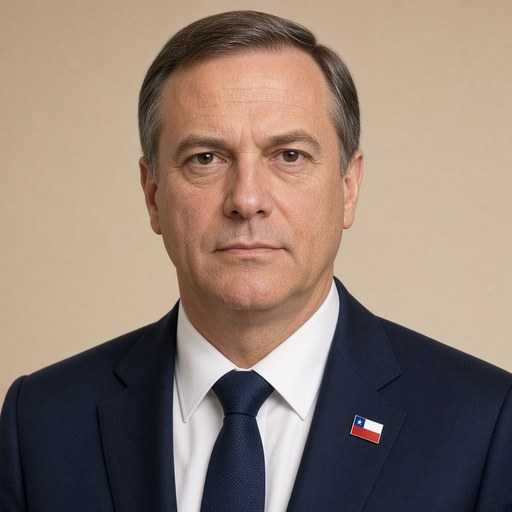
His Excellency the President of the Republic, José Antonio Kast, delivers his first National Address.
 José Antonio Kast · Leader of the Republican Party (Chile)
- Context
- Kast delivered his first national presidential address to Chilean citizens on April 15, 2026, outlining emergency priorities and his government's initial achievements.
- Main themes
- Economic growth and job creation, public safety and security, border control and irregular immigration, fiscal responsibility and public debt, investment attraction, social emergencies in health, education, and housing, state efficiency and anti-corruption, reconstruction after wildfires, cancer patient healthcare backlog, organized crime, government first-month achievements
- Duration
- ~20 min
- Words
- 2,381
- Sentences
- 112
- Readability
- 49
- Grade
- 11.6
- Syntax
- 2.89
- Vocabulary
- 2.26
Translated from Spanish
The broad sphere of national life a sentence belongs to. Every sentence has an Arena, so it is the denominator the other indices are read against.
Other112 sentences in 41 paragraphs
Dear compatriots, good evening.
In this, my first national address as President of the Republic, I am going to talk to you about the Chile we want to build, about what we have achieved in this first month, and about the project that we will send to Congress in the coming days so that together we can make our country grow again, create jobs, and regain hope.
We have a single objective: that Chile be a country where honest work is enough to live well, a safe country where a family can have their home, their children can study peacefully, and the elderly can rest with dignity. A nation where those who want to start a business find not obstacles but opportunities, and where the State fulfills its functions efficiently and does not waste or misuse the public resources that citizens entrust to it. In simple terms, we want more jobs, more economic and social progress, and more security so that Chileans can regain hope.
Upon taking office, we committed to working for the Chileans and for those emergencies that could not wait. A security emergency that threatens the daily freedom of families. An economic emergency that hinders employment and progress for all. A social emergency in areas such as education, health, and housing, but also a priority for the material reconstruction of homes for thousands of families who lost their homes in the fires in Ñuble, Biobío, and Valparaíso.
What are the first achievements of this month? First was the border. We were handed a country with over 300,000 foreigners in irregular situations, some of whom are linked to organized crime networks that have introduced levels of violence into Chile that we had not known before.
One of the first decrees we signed was the implementation of the Border Shield Plan to begin closing our borders through the installation of trenches, walls, surveillance technology, and a joint deployment of the Army, Carabineros, and the PDI in the Northern Macrozone.
The results are concrete. In the first month of government, there are significantly fewer irregular entries than in the last five years, a greater number of voluntary departures, and a greater number of foreigners expelled from national territory. Tomorrow, at first light, the first flight of many will take off, and buses will continuously remove all those irregular immigrants who should not remain in our country.
We have also acted firmly in matters of public safety. We have carried out operations that have led to the arrest of hundreds of fugitives from justice. We have provided clear political, legal, and financial support to Carabineros and the Police Investigations to enable them to carry out their work adequately. We have made homicide figures transparent and are implementing a concrete plan for greater staffing, greater intelligence, and greater commitment when facing the serious security crisis we are experiencing.
In health matters, as of today, the Oncological Health Alert is active to urgently address the delays in the care of cancer patients, a reality that currently affects hundreds of people on waiting lists.
In terms of integrity, we have launched a total audit of the State that we promised during the campaign and have activated the Government Auditors Network to fulfill its fundamental role of overseeing and ensuring the correct use of public resources for Chileans.
We are also curbing the growth of fiscal spending and have begun an adjustment of ministerial budgets to organize public finances, an urgent and necessary task.
There is one more piece of information from this first month that I want to share with you, because it is fundamental for the economic and social future of our country. In the first four weeks of our government, 32 investment projects worth nearly 20 billion dollars entered the Environmental Evaluation System. This is a historic record for the start of any government.
Chile had been sending signals of uncertainty to investors for years, making it very difficult to foresee the fate of investment initiatives. In one month, we have begun to show that things are changing and that all projects that, respecting the rules, allow for the generation of more jobs and economic progress for Chile are and will be welcome.
This is the emergency government we promised. It was not rhetoric; it is concrete actions that will change the lives of millions of Chileans.
But there is a larger task that cannot wait. Chile must return to strong growth and generate jobs. To understand why this is so urgent, we must honestly look at the heavy economic burden we have been handed. The data is harsh. In the last 12 years, Chile grew at an average of only 2% per year. At the rate we were growing between 1994 and 2014, the value of our product multiplied by 8. At the limited rate of the last decade, the value of our economy is barely doubling.
At the same time, public debt grew uncontrollably for almost 20 years, rising from 7.6 billion dollars in 2006 to over 155 billion dollars today. Just in interest, we pay 5% of the National Budget.
In 16 of the last 18 years, Chile had a structural deficit. The previous government failed to comply with its own fiscal rule for three consecutive years. Only in 2025 did the structural deficit reach 3.6% of GDP, the highest since that rule has existed in non-crisis periods. More than triple the target that had been promised. The Autonomous Fiscal Council warned that this year could be the fourth consecutive non-compliance and has seriously and substantively reported on the deplorable state of our fiscal accounts.
Why did we stop growing? Because bad decisions have consequences. While since the year 2000 the OECD was lowering its corporate taxes from 31% to 22%, Chile, in the same period, raised it from 15% to 27%. The timeframes for approving an environmental impact study increased by 90% in a decade, from 560 days to over 1,100 days. That is the State we received, spending more than it takes in and with a debt that has grown uninterruptedly for almost 20 years.
We do not say this to blame anyone; we say it so that Chileans, so that everyone understands why our Government must act urgently and cannot afford bad reforms that continue to make commitments that will not be fulfilled later.
Twelve years ago, a government announced a tax reform that promised to raise an additional 8.2 billion dollars a year. The rhetoric was impeccable, the results were not; the promised revenue never materialized. Growth fell from 5% to 2%, investments contracted, and public debt tripled. That was not an accident; it was the predictable consequence of believing that raising taxes generates wealth. It does not generate it; it displaces it or expels it from the country.
The previous government repeated the same logic under another name and left the highest structural deficit in recent history. Chile needs exactly the opposite. We did not come here to repeat the previous cycle; we came to break it. We are going to break with stagnation, we are going to break with structural unemployment, we are going to break with the State that spends more than it has, we are going to break the bureaucracy that paralyzes and suffocates investment, we are going to break everything bad to rebuild everything good.
Dear compatriots, in the coming days we will submit to Congress the Reconstruction and Economic and Social Development Bill. It contains more than 40 measures organized around five axes that are at the same time the five priorities that made Chile grow when it was truly growing.
The first is tax competitiveness. Chile today has the highest first-category tax in its history, and that gap costs the country investment, jobs, and future. Our project gradually lowers it to 23%, the most competitive level in the last two decades.
At the same time, we will gradually reintegrate the tax system. The tax paid by the company will again be fully deductible from the tax of its owners, eliminating double taxation, which encourages the reinvestment of profits and the creation of jobs. We will reinstate the Tax Stability Statute so that long-term investments that want to invest in Chile know how much they will pay in taxes over the next 25 years.
This reform will benefit 150,000 companies that provide jobs for more than 50% of the formal labor market and concentrate almost 90% of the investment in Chile.
The second axis is the strengthening of formal employment. We propose the creation of a tax credit for wage payments. Companies that pay salaries to their most vulnerable workers will receive a credit for those wages against their tax payments. This injects liquidity of 1.4 billion dollars a year into the productive sector and benefits 235,000 SMEs that represent 85% of the beneficiaries of this credit and protects more than four million workers. Hiring formally will no longer be a punishment; it will become an advantage. This project is for all employers, from the neighborhood store with one worker to the company with thousands of employees.
Everyone needs the same thing: a State that does not hinder them, a tax burden that does not suffocate them, and a legal framework that gives them the certainty to grow and create more jobs.
The third axis is regulatory facilitation so that investment in Chile can return with strength. The timeframes for approving an environmental impact study increased by 90% in a decade. That is not environmental protection; it is bureaucracy that kills jobs before they are born. This project gives the Environmental Evaluation Service real authority to filter observations from sectoral agencies. It also reduces the invalidation period for already granted permits from two years to six months and limits precautionary measures that can paralyze already approved projects to six months. It also establishes that if the State revokes a favorable environmental resolution, it will have to reimburse the expenses already incurred.
Along with the above, the temporary exemption from VAT on the sale of new homes helps, along with other housing measures, to recover the 180,000 jobs lost in the construction sector, which is the most labor-intensive sector in the country.
The fourth axis is legal and regulatory certainty. No country attracts investment without rules that maintain this certainty over time. That is why this project reinstalls tax invariability and opens a 12-month window to repatriate capital from abroad with the payment of a unique tax of 7% if those investments are maintained in the country.
The fifth axis is the containment of public spending. The State that spends poorly cannot ask citizens for more. This project, on the one hand, triples the slots for voluntary retirement incentives in the public sector to generate greater mobility.
It also establishes concrete measures to address abuses of medical leave and grants greater powers to the Internal Revenue Service to enforce the law.
Thanks to these measures, among others, we will have the necessary capacity to fulfill the campaign commitment to exempt those over 65 from paying property taxes on their first home, and we will do so by providing necessary contributions to compensate for the impact on the Municipal Common Fund.
Finally, a central commitment relates to material reconstruction. The fires in Valparaíso in 2024 and those in Ñuble and Biobío in January of this year destroyed thousands of homes. This project expands the Emergency Fire Fund by 400 billion pesos, incorporates the new affected regions, facilitates donations with tax reductions, eliminates judicial obstacles, and grants the Treasury the authority to offer payment agreements with forgiveness to those who lost everything. Families who lost their homes cannot and will not continue to wait.
To those who ask where we want to go, the answer is concrete. By 2030, we have the ambition to reduce the unemployment rate to 6.5%, for the economy to grow around 4% annually, and for fiscal accounts to be in structural balance.
This project is not an ideological agenda; it is a concrete response to three real urgencies. Growth is not an end in itself; it is the means for people to live better, for there to be more jobs, more security, and more hope. Without growth, there are no resources for health or quality education. Without growth, our grandchildren are left without resources, and without reconstruction, there are thousands of Chilean families who cannot look forward.
I know there will be voices that say this project favors those who have the most. That objection does not withstand the data. Employment can be created by any company that has the conditions to grow, as I have already said, the neighborhood store, the family business, the medium-sized company, and the large industry.
Economic growth is not a benefit for a few; it is the material basis for the well-being of all, and those who today say that we must first collect and then grow have been demonstrating for 12 years that this sequence does not work. This project does not ask everyone to think the same; it asks Chileans to recognize that there are things that the country urgently needs and that no sector can afford to block. In this, the right and the center do not compete, the Government and the Opposition do not compete; Chile competes against stagnation.
This project is an opportunity for Chileans to unite and change the course for future generations. We ask Congress to process this project urgently and with a broad perspective, for the families of Ñuble and Biobío who are waiting for their homes, for the young people and women who have been looking for jobs for months, for the entrepreneur who wants to hire but cannot, for all Chileans who deserve a country that grows.
One month of government is not enough to solve everything, but we are taking responsibility. We want to demonstrate that it is possible to govern differently, and while some decisions are difficult, in the future the country will thank us for the courage and responsibility we assume with seriousness, conviction, and the willingness to be accountable for the results. More jobs, more progress, more hope, that is what Chile needs, that is what this project delivers.
Thank you very much, and may God bless Chile.
The original Spanish. The tags above are read on the English translation's sentences.
Estimados compatriotas, muy buenas noches.
En esta, mi primera cadena nacional como Presidente de la República, les voy a hablar del Chile que queremos construir, de lo que hemos avanzado en este primer mes y del proyecto que enviaremos en los próximos días al Congreso para que juntos logremos que nuestro país vuelva a crecer, a crear empleo y a recuperar la esperanza.
Tenemos un solo objetivo, que Chile sea un país donde el trabajo honesto alcance para vivir bien, un país seguro donde una familia pueda tener su casa, sus hijos puedan estudiar tranquilos y los adultos mayores puedan descansar con dignidad. Una nación donde quien quiera emprender no encuentre obstáculos sino oportunidades y donde el Estado cumpla sus funciones con eficiencia y no derroche ni mal use los recursos públicos que los ciudadanos le confían. En simple, queremos más empleo, más progreso económico y social y más seguridad para que los chilenos puedan recuperar la esperanza.
Al asumir el Gobierno nos comprometimos a trabajar por los chilenos y por aquellas emergencias que no podían esperar. Una emergencia de seguridad que amenaza la libertad cotidiana de las familias. Una emergencia económica que frena el empleo y el progreso de todos. Una emergencia social en temas como educación, salud y vivienda, pero también prioritaria para la reconstrucción material de viviendas de miles de familias que perdieron sus hogares en los incendios de Ñuble, Biobío y Valparaíso.
¿Cuáles son los primeros logros de este mes? Primero fue la frontera. Nos entregaron un país con más de 300 mil extranjeros en situación irregular, algunos de ellos vinculados a redes de crimen organizado que introdujeron en Chile niveles de violencia que los chilenos no habíamos conocido.
Uno de los primeros decretos que firmamos fue la implementación del Plan Escudo Fronterizo para comenzar a cerrar nuestras fronteras mediante la instalación de zanjas, muros, tecnología de vigilancia y un despliegue conjunto del Ejército, Carabineros y la PDI en la Macrozona Norte.
Los resultados son concretos. En el primer mes de Gobierno se registran significativamente menos ingresos irregulares que en los últimos cinco años, un mayor número de salidas voluntarias y un mayor número de extranjeros expulsados del territorio nacional. Mañana, a primera hora, despegará el primer vuelo de muchos y buses que irán sacando de manera continua a todos aquellos inmigrantes irregulares que no deben continuar en nuestro país.
También hemos actuado con firmeza en materia de seguridad pública. Hemos realizado operativos que han permitido la detención de cientos de prófugos de la justicia. Hemos dado el respaldo político, jurídico y financiero claro a Carabineros y a la Policía de Investigaciones para que puedan desarrollar de manera adecuada su labor. Hemos transparentado las cifras de homicidio y estamos llevando a cabo un plan concreto de mayor dotación, mayor inteligencia y mayor compromiso a la hora de enfrentar la grave crisis de seguridad que vivimos.
En materia de salud, desde hoy se encuentra activa la Alerta Sanitaria Oncológica para enfrentar con urgencia el retraso en la atención de pacientes enfermos de cáncer, una realidad que hoy afecta a cientos de personas en listas de espera.
En materia de probidad, hemos puesto en marcha la auditoría total del Estado que prometimos en campaña y hemos activado la Red de Auditores de Gobierno para que cumplan con su rol que es fundamental de fiscalizar y aseguren a los chilenos el correcto uso de los recursos públicos.
Asimismo, estamos frenando el crecimiento del gasto fiscal y comenzamos un ajuste de los presupuestos ministeriales para ordenar las finanzas públicas, una tarea urgente y necesaria.
Hay un dato más de este primer mes que quiero compartir con ustedes, porque es fundamental para el futuro económico y social de nuestro país. En las primeras cuatro semanas de nuestro Gobierno ingresaron al Sistema de Evaluación Ambiental 32 proyectos de inversión por un total de casi 20 mil millones de dólares. Es un récord histórico para el inicio de cualquier gobierno.
Chile llevaba años dando señales de incerteza a los inversionistas que hacía muy difícil prever el destino de las iniciativas de inversión. En un mes hemos comenzado a mostrar que las cosas están cambiando y que todos los proyectos que, respetando las reglas, permitan generar más empleo y progreso económico para Chile son y serán bienvenidos.
Este es el gobierno de emergencia que prometimos. No era retórica, son hechos concretos que van a cambiarles la vida a millones de chilenos.
Pero hay una tarea más grande que no puede esperar. Chile tiene que volver a crecer con fuerza y generar empleos. Para entender por qué es tan urgente hay que mirar con honestidad la pesada carga económica que nos han entregado. Los datos son duros. En los últimos 12 años Chile creció en un promedio de apenas un 2% anual. Al ritmo que crecíamos entre el año 1994 y el 2014 el valor de nuestro producto se multiplicaba por 8. Al limitado ritmo de la última década apenas se está doblando el valor de nuestra economía.
Al mismo tiempo, la deuda pública creció sin control durante casi 20 años pasando de 7.600 millones de dólares en el año 2006 a más de 155 mil millones de dólares al día de hoy. Solo en intereses pagamos un 5% del Presupuesto de la Nación.
En 16 de los últimos 18 años Chile tuvo déficit estructural. El gobierno anterior incumplió su propia regla fiscal tres años seguidos. Solo en el año 2025 el déficit estructural llegó al 3,6% del PIB, el más alto desde que existe esa regla en periodos sin crisis. Más del triple de la meta que se había prometido. El Consejo Fiscal Autónomo advirtió que este año podría ser el cuarto incumplimiento consecutivo y ha dado cuenta de manera seria y fundada del deplorable estado de nuestras cuentas fiscales.
¿Por qué dejamos de crecer? Porque las malas decisiones tienen consecuencias. Mientras desde el año 2000 la OCDE fue bajando sus impuestos corporativos desde el 31% al 22%, Chile en el mismo periodo lo subió del 15 al 27%. Los plazos para aprobar un estudio de impacto ambiental aumentaron un 90% en una década, pasando de 560 días a más de 1.100 días. Ese es el Estado que recibimos, gastando más de lo que ingresa y con una deuda que creció sin interrupción por casi 20 años.
No lo decimos para echarle la culpa a nadie, lo decimos para que los chilenos, para que todos entiendan por qué nuestro Gobierno tiene que actuar con urgencia y no puede darse el lujo de malas reformas que sigan asumiendo compromisos que luego no se van a cumplir.
Hace 12 años un gobierno anunció una reforma tributaria que prometía recaudar 8.200 millones de dólares adicionales al año. El discurso era impecable, los resultados no, la recaudación prometida nunca llegó. El crecimiento cayó de 5% al 2%, las inversiones se contrajeron y la deuda pública se triplicó. Ese no fue un accidente, fue la consecuencia predecible de creer que subir los impuestos genera riqueza. No la genera, la desplaza o la expulsa del país.
El gobierno anterior repitió la misma lógica con otro nombre y dejó el déficit estructural más alto de la historia reciente. Chile necesita exactamente lo contrario. No llegamos aquí para repetir el ciclo anterior, llegamos para romperlo. Vamos a romper con el estancamiento, vamos a romper con la cesantía estructural, vamos a romper con el Estado que gasta más de lo que tiene, vamos a romper la burocracia que paraliza y ahoga la inversión, vamos a romper todo lo malo para reconstruir todo lo bueno.
Estimados compatriotas, en los próximos días ingresaremos al Congreso el proyecto de Ley de Reconstrucción y Desarrollo Económico y Social. Contiene más de 40 medidas organizadas en torno a cinco ejes que son al mismo tiempo las cinco prioridades que hicieron crecer a Chile cuando crecía de verdad.
El primero es la competitividad tributaria. Chile tiene hoy el impuesto de primera categoría más alto de su historia y esa brecha le cuesta al país inversión, empleo y futuro. Nuestro proyecto lo baja gradualmente al 23%, el nivel más competitivo de las últimas dos décadas.
Al mismo tiempo reintegraremos gradualmente el sistema tributario. El impuesto que paga la empresa vuelve a ser íntegramente descontado del impuesto de sus dueños, eliminando la doble tributación, lo que fomenta la reinversión de utilidades y la creación de empleos. Vamos a reinstaurar el Estatuto de Invariabilidad Tributaria para que inversiones de largo plazo que quieran invertir en Chile sepan cuánto pagarán de impuestos en los próximos 25 años.
Esta reforma va a beneficiar a 150 mil empresas que le dan trabajo a más del 50% del mercado laboral formal y concentran casi el 90% de la inversión en Chile.
El segundo eje es el fortalecimiento del empleo formal. Proponemos la creación de un crédito tributario por pago de remuneraciones. Las empresas que paguen sueldo a sus trabajadores más vulnerables recibirán un crédito de esas remuneraciones contra el pago de sus impuestos. Esto inyecta liquidez por 1.400 millones de dólares al año al sector productivo y beneficia a 235 mil pymes que representan el 85% de los beneficiarios de este crédito y protege a más de cuatro millones de trabajadores. Contratar formalmente dejará de ser un castigo y se convertirá en una ventaja. Este proyecto es para todos los empleadores desde el almacén de barrio con un trabajador hasta la empresa con miles de colaboradores.
Todos necesitan lo mismo, un Estado que no los trabe, una carga tributaria que no los asfixie y un marco legal que les dé la certeza para crecer y para dar más empleo.
El tercer eje es la facilitación regulatoria para que en Chile se vuelva a invertir con fuerza. Los plazos para aprobar un estudio de impacto ambiental aumentaron 90% en una década. Eso no es protección ambiental, es burocracia que mata el empleo antes de que nazca. Este proyecto le da al Servicio de Evaluación Ambiental autoridad real para filtrar observaciones de organismos sectoriales. Reduce también el plazo de invalidación de permisos ya otorgados de dos años a seis meses y limita a seis meses las medidas precautorias que pueden paralizar proyectos ya aprobados. También establece que si el Estado revoca una resolución ambiental favorable tendrá que reembolsar los gastos ya invertidos.
Junto con lo anterior, la exención transitoria de IVA a la venta de viviendas nuevas ayuda, junto a otras medidas en vivienda, a recuperar esos 180 mil empleos que se perdieron en el sector de la construcción, que es el sector más intensivo en mano de obra que tiene el país.
El cuarto eje es la certeza jurídica y regulatoria. Ningún país atrae inversión sin reglas que mantengan en el tiempo esta certeza. Por eso este proyecto reinstala la invariabilidad tributaria y abre una ventana de 12 meses para repatriar capitales desde el extranjero con el pago de un impuesto único del 7% en el caso de que esas inversiones se mantengan en el país.
El quinto eje es la contención del gasto público. El Estado que gasta mal no puede pedir a los ciudadanos más. Este proyecto, por un lado, triplica los cupos de incentivo al retiro voluntario del sector público para generar mayor movilidad.
También establece medidas concretas para enfrentar los abusos de licencias médicas y entregarle también mayores facultades al Servicio de Impuestos Internos para hacer cumplir la ley.
Gracias a estas medidas, entre otras, tendremos la capacidad necesaria para cumplir con el compromiso de campaña de eximir del pago de contribuciones a la primera vivienda para los mayores de 65 años y lo haremos entregando aportes necesarios para compensar el impacto en el Fondo Común Municipal.
Finalmente, un compromiso central tiene que ver con la reconstrucción material. Los incendios de Valparaíso en el año 2024 y los de Ñuble y Biobío en enero de este año destruyeron miles de hogares. Este proyecto amplía el Fondo de Emergencia por Incendios en 400 mil millones de pesos, incorpora a las nuevas regiones afectadas, facilita las donaciones con rebaja tributaria, elimina trabas judiciales y otorga a la Tesorería la facultad de ofrecer convenios de pago con condenación a quienes quedaron sin nada. Las familias que perdieron sus hogares no pueden ni van a seguir esperando.
A quienes pregunten a dónde queremos llegar, la respuesta es concreta. Al año 2030 tenemos la ambición de disminuir la tasa de desempleo a 6,5%, que la economía crezca alrededor del 4% anual y que las cuentas fiscales estén en equilibrio estructural.
Este proyecto no es una agenda ideológica, es una respuesta concreta a tres urgencias reales. El crecimiento no es un fin en sí mismo, es el medio para que las personas vivan mejor, para que haya más empleo, más seguridad y más esperanza. Sin crecimiento no hay recursos para la salud ni para la educación de calidad. Sin crecimiento nuestros nietos se quedan sin recursos y sin reconstrucción hay miles de familias chilenas que no pueden mirar hacia adelante.
Sé que habrá voces que digan que este proyecto favorece a los que más tienen. Esa objeción no resiste los datos. El empleo lo puede crear cualquier empresa que tenga condiciones para crecer, como ya lo dije, el almacén de barrio, la empresa familiar, la compañía mediana y la gran industria.
El crecimiento económico no es un beneficio para unos pocos, es la base material del bienestar de todos y quienes hoy dicen que primero hay que recaudar y después crecer llevan 12 años demostrando que esa secuencia no funciona. Este proyecto no pide que todos piensen igual, pide que los chilenos reconozcan que hay cosas que el país necesita urgentemente y que ningún sector puede darse el lujo de bloquear. En esto no compiten la derecha y el centro, no compite el Gobierno y la Oposición, compite Chile contra el estancamiento.
Este proyecto es una oportunidad para que los chilenos en unidad cambiemos el rumbo pensando en las futuras generaciones. Le pedimos al Congreso que tramite este proyecto con urgencia y con altura de miras, para las familias de Ñuble y Biobío que esperan su casa, para los jóvenes y mujeres que llevan meses buscando empleo, para el emprendedor que quiere contratar y no puede, para todos los chilenos que merecen un país que crece.
Un mes de gobierno no alcanza para resolverlo todo, pero estamos haciéndonos cargo. Queremos demostrar que es posible gobernar distinto y si bien algunas decisiones son difíciles, en el futuro el país nos agradecerá el coraje y la responsabilidad que asumimos con seriedad, convicción y la voluntad de rendir cuenta por los resultados. Más empleo, más progreso, más esperanza, eso es lo que Chile necesita, eso es lo que este proyecto entrega.
Muchas gracias y que Dios bendiga a Chile.