




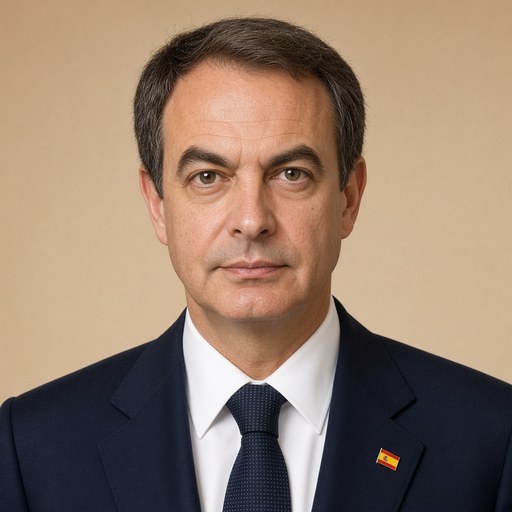
Press conference with the President of the Government after the Summit of Eurozone Heads of State and Government
 José Luis Rodríguez Zapatero · Prime Minister of Spain
- Context
- Zapatero addressed press after the July 2011 Eurozone summit in Brussels, reporting on a landmark agreement to stabilize Greece and the broader Eurozone.
- Main themes
- Greek debt bailout, Eurozone financial stability, private sector contribution, European Financial Stability Facility reform, sovereign debt sustainability, market confidence, interest rate relief, debt maturity extension, Eurogroup summit agreement, financial crisis management
- Duration
- ~26 min
- Words
- 3,107
- Sentences
- 123
- Readability
- 50
- Grade
- 12.5
- Syntax
- 3.15
- Vocabulary
- 1.96
This is an interview, press conference or exchange with other speakers. It is split into sentences and counted in the corpus, but its sentences are not tagged on the twelve indices.
123 sentences in 32 paragraphs
President of the Government .
I am here to report on this latest, extremely important, Summit of Eurozone leaders, leaders from the Eurogroup. We were facing a difficult challenge. We needed to reach an agreement that was capable of meeting the numerous expectations, an agreement to provide stability for the Eurozone and generate certainty in the markets. In short, an agreement that would be capable, as I believe will now happen, of relaxing tensions and generating confidence and calm.
As you are aware, the core issue was the future of the Greek bail-out and, generally-speaking, how Europe and the Eurozone in particular was going to tackle that future with all the instruments it has available to guarantee sustainability, convey credibility and take some essential decisions. This is the fourth time since the financial crisis that the Eurogroup leaders have met. All these meetings have been highly significant given the considerable stakes in play. However, this meeting was especially important because the levels of uncertainty were extreme and because there was a growing risk that the instability would spread among the Eurozone countries due to the lack of definition and the difficulties being experienced in terms of tackling the sustainability of the Greek debt, which in turn led to difficulty in conveying that message of confidence.
I believe that this was a decisive Summit, that we have reached a good agreement, a strong, sound and precise agreement, that will transmit confidence and credibility, an agreement that must, above all, enable the Eurozone countries to look forward to economic recovery. This latter aspect is particularly relevant to Greece, a country that played a major role in the Council, a country that is going through enormous difficulties, a country that holds an extraordinarily significant debt burden and that is now facing what must surely be some of the most serious challenges it has ever had to face.
I will now provide a summary of the agreement and offer an assessment.
The Eurogroup has decided on a new programme of support for Greece up to 2014; a new programme that will involve a certain amount of public support, of financing from the public sector - 110 billion euros - to tackle what Greece is going to need over this period. This new programme is going to have some very low interest rates and longer maturity deadlines on the commitments, the loans. These deadlines will actually be substantially longer, up to thirty years, and the interest rates will be set at around 3.5%. In addition, the private sector is going to contribute to this programme on a voluntary basis via a number of different options but with a total contribution up to 2020 of 54 billion euros and 12 billion more to refinance the process. This voluntary contribution from the private sector will be clear, precise and resounding, just as I announced the other day at Moncloa Palace during the press conference I held as a result of the visit by the President of the Council, Herman Van Rompuy. As you are aware, a meeting of the private sector took place today and an explicit commitment was made to these figures, a commitment to which a significant number of large banks and other entities that hold Greek debt have already joined. So, a clear and precise commitment has been made in terms of how much will be provided, over what period and how it will be done via the various formulae from the private sector. There is no doubt that this will be of great assistance to the sustainability of the Greek debt.
Furthermore, we have decided to increase the flexibility of the Financial Facility Crisis Resolution Mechanism. This is a decision of paramount importance because it is the first time that agreements are being adopted within the Eurozone to enable, for example, the purchase of debt on secondary markets, following an assessment by the European Central Bank, in difficult circumstances for the stability of the Eurozone markets - decisions that must be adopted by mutual agreement. This possibility will undoubtedly constitute a huge stabilising factor. Moreover, as part of that flexibility for the Financial Facility, approval was given for the option to finance the recapitalisation of financial institutions through loans to those Governments that need them. There would, of course, be conditions on those loans. It was also agreed to enable preventive action to be taken through lines of credit from the Facility itself, from the European Fund, in situations of risk for Eurozone countries.
So, these three new instruments, which together with what we have been working on until now (aid and loans to Greece, both bilateral and from the financial instrument and from the Commission), provide extraordinary strength to the ability to generate stability and confidence and respond to the tensions and uncertainty. Therefore, the Eurozone has provided itself with a powerful arsenal for responding to the difficulties. These are the three major agreements: the new programme, with a significant volume of European public support but also from the International Monetary Fund (the volume of which has yet to be defined); participation of the private sector, of a voluntary, precise and pre-established nature, which will generate certainty in the markets; and, thirdly, the new configuration of the Financial Facility, much more flexible, more useful and with a greater capacity to respond to situations of crisis, tension and uncertainty. In short, I believe that the response given today by the Summit of Eurogroup leaders will generate confidence, stability in the markets and, of course, certainty, while making it easier for us to reduce the excessive percentage that was being demanded from certain countries for financing. We should now be able to return to normal figures and, therefore, make it easier for us to meet the commitments that lay ahead.
Furthermore, the Eurogroup leaders have once again assessed and confirmed our willingness to continue applying the programmes of fiscal consolidation and reform that the Eurozone countries are implementing, Spain in particular. I think it was made public early this morning but I should reiterate that the resolutions from today's meeting of Eurogroup leaders confirm that, and I quote, "we welcome the laborious programme of reforms being carried out by Spain at a fiscal, financial and structural level". This must surely now enable us to meet the objectives we have set ourselves: to reduce the deficit, to generate financial stability, to gain confidence so that the public sector, the economy and our businesses can finance themselves at more reasonable rates and so that the structural reforms (including, of course, the financial system reform that is of paramount importance at this time) are able to consolidate the basis for sound economic recovery and the creation of jobs as soon as possible.
In short, satisfaction. There were many uncertainties, it was difficult, but today, today's meeting, the work we have done today, has produced some good results. I am confident of that; not only have we seen that already today in the markets but we will continue to see that in the future. Of course, once again, despite these difficulties, Europe is here, Europe stands with the Eurozone countries. Europe is strong, Europe is capable and there is no doubt whatsoever that Europe continues to be the framework in which every one of us, each one of the various countries, must wait for the most appropriate answers to their economic and financial difficulties.
Q. I would like to know whether you think this will be the last crisis Summit or cabinet meeting about Greece after a year and a half of constant instability , that the matter has perhaps been closed and that we can now look forward to Summits with somewhat more 'normal' agendas, if you'll pardon the expression.
A second question.
We have been told over the course of recent weeks that this was only a Greek problem, that this was a Greek problem causing contagion to other countries like Italy and Spain. But today we have seen the creation of what President Sarkozy has described as a European Monetary Fund - I don't know if you agree with that description - from which other countries can benefit. I wanted to ask whether Spain will make use of that fund and whether any of the options, such as intervention in the secondary or loans market, a line of credit, will be adopted by Spain.
And a third, very quick, question. President Sarkozy also said that new governance proposals will be debated at the Summit in October, which he intends to present with Chancellor Merkel next month. I would like to know what Spain is expecting, what the priorities are and whether a European risk ratings agency is among them.
President of the Government .
In response to your first question, I believe that today's Summit was particularly important. We were all aware of the situation in which events were taking place, especially in recent days, and of the uncertainty surrounding Greece - I refer, of course, to all the talk today about whether there would be defaults and whether it can leave the Eurozone. Today, Europe has provided far-reaching support to Greece, and I add emphasis to Greece because the situation, the volume of debt that Greek holds, and the years it will take for that percentage of debt over GDP to return to normal will be many. There has been talk of 2020 and commitments from the private sector… It is going to be hard for us all, that is a fact, but we must stand together. That is Europe. Know this: in spite of the greatest difficulty that one could imagine in terms of debt (there are few examples that could compare with the situation Greece is dealing with right now), despite how costly and difficult that may be, Europe is there, with all its unique characteristics and it is there committing itself and responding to the situation.
I am sure there will be more meetings in the future to assess the development of the Greek programme and the sustainability of its debt. We have a task at hand with Greece that will take years to finish and there will, of course, be Eurogroup meetings dealing with it.
I have had the opportunity to talk to President Sarkozy about governance of the Eurozone in particular because this fourth meeting has shown we need to establish a series of more perfect rules and procedures regarding governance and decisions in the Eurozone. When leaders of the Eurozone met for the first time on this issue, it was not part of the agenda because Eurogroup meetings have always been between economic affairs ministers. We have now held four of these meetings and I think we need to perfect this system and the decision-making process. That is what lies behind the meeting in October about which, I insist, I have had the opportunity to talk with President Sarkozy.
The new instruments being created, whatever you want to call it - the European Fund, the Facility… It is true that today's decisions have led to a new Fund in Europe and there is no doubt that the option to buy debt on the secondary markets is an option that generates relief for the entire Eurozone because it is a stabilising factor to counter the processes that are taking place in the markets and the possibility of having a line of aid via a preventive programme is something inspired by what the International Monetary Fund has. I suppose that President Sarkozy is absolutely right in that regard because we are creating similar instruments, with all the differences that exist between what the Eurozone is and the tools it has available and those available to the International Monetary Fund.
You should know that the International Monetary Fund has two lines of preventive aid available to it: one conditional and another unconditional. They can both be used as and when. Of course, making use of that option is not in the plans drawn up by Spain, as you well know. The Eurogroup must now develop and further specify its plans.
We must change the rules that govern the Fund and that will also involve some effort; but I think that today's meeting has been very useful, among the most useful, on a par with the meeting we held on 12 October 2008 at Elysée Palace, for providing a response to a difficult situation.
Q . You have spoken about the Eurozone in general. I would like to ask more specifically about Spain and whether you think that the measures adopted today, these agreements, will at least lessen the pressure from speculators on Spain and also lower the risk premium.
President of the Government . Yes. I think so, yes. In fact, we saw confidence levels rising today as the content of these agreements became known. Furthermore, that confidence must be accompanied by compliance with our commitments in terms of the deficit by both the Government of Spain and by the regional governments; it must be accompanied, and we have made great progress in recent days or recent weeks, by a process of financial restructuring and it must be accompanied by structural reforms. Final approval was given today for the Social Security Act reform, the reform of the Pensions Act. I think that is another reason for confidence to grow. Of course, at this point, as we have seen, or in recent times, that confidence has been generated by external factors because the lack of confidence has been generated by clearly external factors; hence the effects on Italy and Belgium. We must have confidence in that today's meeting, today's agreements, will restore confidence and credibility and, therefore, ease the difficulties that are resulting in the excessive hike to the risk premium in the markets.
Q . Some of the decisions made today have been on the table for several months. Given the situation in which you have been required to agree on them, I would like to know whether anyone has expressed any kind of "mea culpa" or whether you personally regret that it has taken so long.
President of the Government . It is true that there have been times in the past at which some of the proposals we have approved today were on the table or have been discussed; at the debate today and in recent days. But the debate has also included others.
There has been no more talk about a possible tax on the banking system, which certain voices were proposing as a possible alternative to participation by the private sector. There was also talk of Eurobonds at one point in the debate; we see it every day in the press. There are even some who think that the option of buying debt on the secondary market is something similar to the Eurobonds, although the two concepts clearly have their differences. This latter factor, option, that of Europe buying debt on the secondary market directly, the debt of Eurozone countries, that was a red line not very long ago. I have attended various Council debates where it was as if we were standing on this red line, and seriously, and here it is with guarantees for situations of difficulty. It must be implemented and be agreed by all, but here it is.
In short, what does the entire financial crisis experience tell us (I'm talking from a European perspective) at the moment? That the only way to generate confidence and credibility is to strengthen European resources and that the commitment from Member States is made stronger as a whole, with the common project. That is what we've done today, basically, besides the participation from the private sector that is obviously highly important and has been the subject of much debate. One of the reasons for the tension and the uncertainty is that we have been talking about participation by the private sector since October of last year without specifying, without defining and without quantifying - and that was also generating a certain amount of uncertainty. I think we have made ourselves clear today, we've put it in black and white, the main issues that were causing concern and restlessness in the markets, among investors, companies and the banks, i.e.: Is there support for Greece so it can make its debt sustainable, albeit costly? Yes, there is support and willingness. Is there clearly-defined participation from the private sector? Yes, there is. Are there new mechanisms to combat possible tensions and anticipate them? Yes, there are: lines of preventive aid and buying debt on the secondary markets. This is great progress.
The problem is that there are many voices, even from within each country, that would like to arrive at the Eurobond as soon as possible. In my opinion, that day will come. It will take some time, but we will see it.
Q . Mr President of the Government, you have said there was a meeting today of large banks about participating as the private sector in this bail-out. I would like to know if any Spanish banks were among them and whether the numbers from those Spanish banks are known. If you will allow me a question on domestic affairs, what do you think about the resignation of the President of the Regional Government of Valencia, Francisco Camps, and what do you think about the response from Mariano Rajoy in this regard?
President of the Government . I don't know what Mariano Rajoy has said, to tell you the truth. I think everything has already been said on that matter.
I'll move on to the question about the banks because you know I don't like talking about Mariano Rajoy outside of Spain and even less so after one of these Summits about which, as you know, I will be reporting next Wednesday in the Lower House of Parliament. Our banks, as you know, have very little exposure to Greek debt. However, they are in touch with the content of today's meeting and, of course, I have no doubt that they will contribute as much as they can in terms of their efforts, their credibility and their work, within the boundaries of that limited exposure. I have no doubt at all. I think there is a list, which has already been made public, of all the European banks - not just the European banks. There are European banks and banks from outside Europe that have taken part in that commitment. These banks already account for 90% of the portfolio, which is a very, very important fact.
It's been a long day. Thank you very much.