




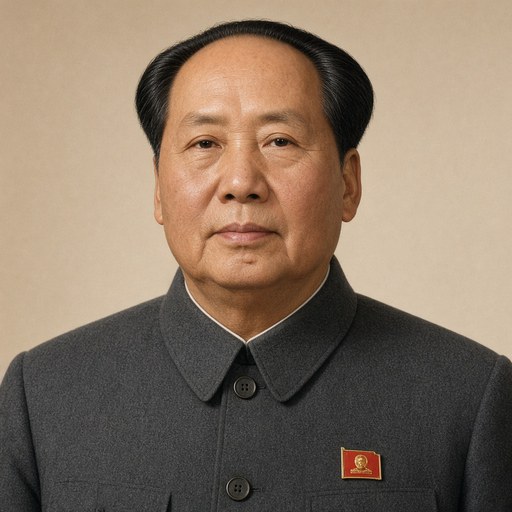
A Debate on the Co-operative Transformation of Agriculture and the Current Class Struggle
 Mao Zedong · Chairman of the Central Committee of the Communist Party of China
- Context
- Mao addressed a Central Committee plenary meeting of the Chinese Communist Party on October 11, 1955, summing up the debate on agricultural co-operation, criticising Deng Zihui's right deviation and setting a three-wave timetable for basic co-operativization by spring 1958.
- Main themes
- Agricultural co-operation, alliance of workers and peasants, transformation of capitalist industry and commerce, suppression of counter-revolutionaries, criticism of Deng Zihui's right deviation, overall planning of co-operative development in three waves, 'Left' and Right deviation, methods of leadership, Han chauvinism, treatment of well-to-do middle peasants and landlords, rest and consolidation between waves, quality over speed in co-operatives
- Duration
- ~78 min
- Words
- 9,416
- Sentences
- 457
- Readability
- 53
- Grade
- 11.0
- Syntax
- 2.98
- Vocabulary
- 2.18
Translated from Chinese Source: GitHub qinglee/maoxuan (毛泽东选集) ↗
The broad sphere of national life a sentence belongs to. Every sentence has an Arena, so it is the denominator the other indices are read against.
Other457 sentences in 68 paragraphs
This meeting of ours has been a very big debate. It is a big debate on the question of whether or not our Party's general line for the period of transition from capitalism to socialism is entirely correct. This Party-wide big debate was sparked by the question of the policy for agricultural co-operation, and the comrades' discussion has also centred on this question. But this debate touches on a very wide range of things: it touches on the work of agriculture, industry, communications, transport, finance, banking, trade, culture, education, science, public health and other departments; it touches on the transformation of handicrafts and of capitalist industry and commerce; it touches on the suppression of counter-revolutionaries; it also touches on the army, and on foreign affairs. In short, it touches on work in every field: Party, government, army and people. There ought to be a big debate like this. Because since the general line was issued, our Party has not yet had a debate like this. This debate must be unfolded in the countryside and also in the cities, so that work in every field, and the speed and quality of that work, can all be brought into line with the tasks laid down by the general line, and there must be overall planning in every field.
Now I will give some views on the following questions.
I. The relationship between agricultural co-operation and the transformation of capitalist industry and commerce
The question of the relationship between agricultural co-operation and the transformation of capitalist industry and commerce, that is, the question of the relationship between basically completing the socialist transformation of agriculture within roughly the period of three five-year plans and basically completing the socialist transformation of capitalist industry and commerce within the same period, is also the question of the relationship between agricultural co-operation and the bourgeoisie.
We hold that only when, in the course of thoroughly carrying out the socialist transformation of agriculture, the alliance of the working class and the peasantry is gradually consolidated on a new basis, that is, on a socialist basis, will it be possible to sever completely the ties between the urban bourgeoisie and the peasantry, to isolate the bourgeoisie completely, and to make it easier for us to transform capitalist industry and commerce completely. The aim of our socialist transformation of agriculture is to uproot the sources of capitalism on the countryside, this broadest of terrains.
At present we have not yet completed agricultural co-operation; the working class has not yet formed a consolidated alliance with the peasantry on a new basis, and the alliance of the working class and the peasantry is still unstable and unsettled. The peasants are no longer satisfied with the alliance we built with them in the past on the basis of the agrarian revolution. They have somewhat forgotten the benefits they received that time. Now they must be given new benefits, and that is socialism. At present the peasants have not yet become prosperous together, and grain and industrial raw materials are still very insufficient. In these circumstances, the bourgeoisie may well find fault with us on this question and attack us. In a few years we will see a completely new situation: the working class and the peasantry will form an alliance on a new basis that is more consolidated than before.
The earlier alliance, the one for opposing the landlords, overthrowing the local tyrants and dividing up the land, was a temporary alliance; it was consolidated for a while and then became unconsolidated again. After the land reform, the peasantry became differentiated. If we have nothing new to give the peasants, if we cannot help the peasants raise their productive forces, increase their incomes and become prosperous together, then the poor ones will not trust us. They will feel there is no point in following the Communist Party: they got land, and they are still poor, so why should they follow you? Those who are well-off, who have become rich peasants or very well-off, will not trust us either; they will feel that the Communist Party's policies never suit their taste. The result will be that neither side trusts us, the poor will not trust us and the rich will not trust us either, and then the worker-peasant alliance will be very unconsolidated. To consolidate the worker-peasant alliance, we must lead the peasants along the socialist road and make the peasant masses prosperous together; the poor must become prosperous, all the peasants must become prosperous, and the degree of prosperity must greatly exceed that of the present well-off peasants. Once co-operation is achieved, the entire rural population will become more prosperous year by year, and there will be more marketable grain and industrial raw materials. By then the bourgeoisie's mouth will be stopped, and the bourgeoisie will find itself in a position of complete isolation.
We now have two alliances: one is the alliance with the peasantry, the other is the alliance with the national bourgeoisie. Both alliances are very necessary to us; Comrade Enlai also spoke of this question. What is the benefit of the alliance with the bourgeoisie? We can obtain more industrial goods to exchange for agricultural products. For a period after the October Revolution, Lenin had this idea. Because the state had no industrial goods to exchange, the peasants would not bring out their grain, and they would not sell it for paper money alone; so Lenin planned to have the proletarian state power form an alliance with state capitalism, in order to increase industrial goods to deal with the spontaneous forces in the countryside. Our present alliance with the bourgeoisie, not confiscating capitalist enterprises for the time being and adopting towards them the policy of utilization, restriction and transformation, is likewise in order to obtain more industrial goods to meet the peasants' needs, so as to change the peasants' reluctance to sell grain and even some other industrial raw materials. This is using the alliance with the bourgeoisie to overcome the peasants' reluctance to sell. At the same time, relying on the alliance with the peasantry, we obtain grain and industrial raw materials with which to keep the bourgeoisie in check. The capitalists have no raw materials; the state has raw materials. If they want raw materials, they have to bring out their industrial goods and sell them to the state; they have to go in for state capitalism. If they refuse, we will not give them raw materials, and they are throttled either way. This blocks the capitalist road on which the bourgeoisie wants a free market, free access to raw materials and free sale of industrial goods, and it isolates the bourgeoisie politically. This is the interaction between these two alliances. Of these two alliances, the alliance with the peasantry is the main one, the basic one, the one that comes first; the alliance with the bourgeoisie is temporary and comes second. In an economically backward country like ours, both alliances are necessary at present.
The land reform enabled us to form an alliance with the peasantry on a democratic basis, and enabled the peasants to obtain land. The peasants' obtaining land is something bourgeois-democratic in character; it destroys only feudal ownership, not capitalist ownership or individual ownership. That alliance made the bourgeoisie feel isolated for the first time. In 1950, I said at the Third Plenary Session that we should not strike out in all directions. At that time land reform had not yet been carried out in large parts of the country and the peasants had not yet come over completely to our side; to open fire on the bourgeoisie then would not have worked. Once land reform had been carried out and the peasants had come over completely to our side, it became possible and necessary for us to launch the "Three Antis" and "Five Antis". Agricultural co-operation enables us to consolidate our alliance with the peasantry on a proletarian, socialist basis, not on a bourgeois-democratic basis. This will finally isolate the bourgeoisie and make it easier to finally eliminate capitalism. On this matter we are quite without conscience! Marxism is that ferocious, and has little conscience: its aim is precisely to make imperialism extinct, feudalism extinct, capitalism extinct, and small production extinct as well. In this respect, the less conscience the better. Some of our comrades are too kind-hearted, not tough enough, which is to say, not so Marxist. To make the bourgeoisie and capitalism extinct in China with its six hundred million people is a very good thing, a very meaningful good thing. Our aim is precisely to make capitalism extinct, to make it extinct on the face of the earth, to turn it into a thing of history. Everything that arises in history is bound to perish. There is nothing in the world that did not arise in history; whatever is born must die. Capitalism arose in history and it too will die; it has a very good place to go, which is to "sleep" in the earth.
The present international environment is favourable for us to complete the general task of the transition period. We are to take the time of three five-year plans to basically complete socialist industrialization and socialist transformation. We must strive to win this time for peaceful construction. Of the fifteen years, three have already passed; another twelve years will do. It looks as though it can be won, and we must strive hard to win it. We should step up our efforts in foreign affairs work and in national defence construction.
During these fifteen years, the class struggle at home and abroad will be very tense. We have already seen that it is very tense. In the class struggle we have already won many victories and will continue to win victories. Taking the domestic class struggle of the past year, we mainly did four things: one was the struggle against idealism, one was the suppression of counter-revolutionaries, one was solving the grain problem, and one was solving the problem of agricultural co-operation. The struggles on these four questions all had the character of struggle against the bourgeoisie, dealt the bourgeoisie heavy blows, and are continuing to deal them shattering blows.
The struggle against idealism began with the question of A Dream of Red Mansions; we also criticized Wenyi Bao, and later criticized Hu Shih and Liang Shu-ming; this has gone on for a year already. We must oppose idealism in earnest, in preparation for carrying out the three five-year plans. In the course of the struggle against idealism, we must build up a contingent of cadres versed in Marxist dialectical materialism, so that our broad ranks of cadres and the people can be armed with the basic theory of Marxism. As for the suppression of counter-revolutionaries, we plan to spend this year and next year carrying out the work of eliminating counter-revolutionaries among about twelve million people, including state-owned factories, state-owned commerce, co-operatives, and organizations at county, district and township level of every kind, and also including cadres of the army and workers in the factories. When you talk about counter-revolutionaries, it seems there aren't many of them, you can't see them, but once you investigate, they are indeed there; a batch has already been uncovered. We also fought a big battle on the grain question. The bourgeoisie used the grain question as a pretext to attack us, and within our Party too there was a gust of rumour-mongering, so we launched criticism. We have waged many struggles on the question of agricultural co-operation, and this meeting too has concentrated on discussing this question. On these four questions we have waged tremendous struggles, beaten back the resistance and attacks of the bourgeoisie, and seized the initiative.
The bourgeoisie is afraid of our waging struggle against them on these questions, especially afraid of the suppression of counter-revolutionaries. Our work of suppressing counter-revolutionaries has been done well. In this work we must pay attention to standards; without standards it is very dangerous. Only those who meet the criteria are counter-revolutionaries; that is, we must go after real counter-revolutionaries and not produce false ones. We must also reckon that false counter-revolutionaries may turn up; to say none will turn up would be hard. But we demand that as few as possible turn up, that as far as possible no false counter-revolutionaries turn up. They must fully meet the standards, be the genuine article, really and truly counter-revolutionaries; we must not wrong good people. At the same time, some real counter-revolutionaries may slip through. If you say this time we have cleaned things up so thoroughly, that is not necessarily so; it is unavoidable that some slip through, but we must let as few slip through as possible.
II. Summing up the debate on the question of co-operation
On the question of agricultural co-operation, the many inventions of the masses have broken down many superstitions and smashed many erroneous views. This discussion has resolved many questions which many people were still unclear about a few months ago.
First, the question of whether large-scale development or small-scale development is better. This is a major question, there was great controversy over it, and now it is resolved. The masses demand large-scale development, and the general task of the transition period requires that agriculture keep pace with industry, so the view advocating small-scale development is wrong.
Second, the question of whether co-operatives can be developed in the areas liberated later, and whether they can be developed in mountain areas, backward townships and disaster areas, has now been resolved: they can be developed everywhere.
Third, the question of whether co-operatives can be run in minority nationality areas. It has now been proved that wherever conditions are ripe, co-operatives can be run. In some places, such as Tibet and the Greater and Lesser Liangshan, conditions are not yet ripe, and we cannot go ahead there.
Fourth, the question of whether co-operatives can be run without funds, without carts, without oxen, and without the participation of well-to-do middle peasants. It has now been proved that they can be run.
Fifth, the superstition that "setting up co-operatives is easy, consolidating them is hard" has also been broken down. Setting up co-operatives is not all that easy, and consolidating them is not necessarily that difficult either. Insisting that setting up co-operatives is easy and consolidating them is hard actually amounts to advocating not setting them up, or setting up as few as possible.
Sixth, the question of whether co-operatives can be run without agricultural machinery. The atmosphere of insisting that there must be machinery before co-operatives can be run is not so strong now, but this view still exists. This superstition can also be completely broken down.
Seventh, the question of whether all badly run co-operatives must be dissolved. Of course a small number of co-operatives that really cannot go on may revert to mutual-aid teams, but generally the so-called bad co-operatives should not be dissolved; after rectification they can become good.
Eighth, the so-called "if we do not dismount quickly, we will undermine the worker-peasant alliance" — this is probably a "principle" passed down by the Rural Work Department of the Central Committee. The Rural Work Department of the Central Committee has not only produced a gust of rumour-mongering but has also produced many "principles". I think this sentence is by and large "correct"; we need only change one character, change "dismount" to "mount". You in the Rural Work Department need not be pessimistic either: you gave me so many characters and I have adopted them all, changing only one of yours. The difference is one character; our dispute is over just one character. You want to dismount, I want to mount. "If we do not mount quickly, we will undermine the worker-peasant alliance" — it would indeed undermine it.
Ninth, the so-called "the deaths of draught oxen are the fault of the co-operatives" — this claim does not fully accord with the actual situation. The main cause of the deaths of draught oxen does not lie in the co-operatives but is due to floods, the excessively high price of cowhide, insufficient fodder, and also some were old and ought to have been slaughtered.
Tenth, the so-called "the tension in the countryside is fundamentally due to too many co-operatives having been set up" — saying this is wrong. The tense situation in our countryside this spring was mainly caused by the grain problem. The so-called grain shortage was for the most part false; it was a clamour raised by landlords, rich peasants and well-to-do middle peasants. On this question we had not yet had time to educate the broad masses of peasants adequately, and at the same time our grain work also had shortcomings. Last year we did not yet have a clear picture of how much it was appropriate to purchase, and we purchased seven billion jin too much. Now we are making an adjustment and plan to reduce purchases by seven billion jin; together with the bumper harvest this year, the situation in the countryside can thereby ease.
Eleventh, there is also some saying that "co-operatives have superiority for only three years"; this is pessimism. I think the superiority of the co-operatives will by no means last only three years; socialism will continue for a very long time. When in the future socialism can no longer represent superiority, the superiority of communism will take its place.
Twelfth, should some advanced co-operatives be set up in the coming period? This question was not clear in the past; this time everyone raised it. A batch of advanced co-operatives should be set up. As to how many, you go and study it.
Thirteenth, the so-called "wooden sailing boats and animal-drawn carts cannot form co-operatives" — this is also wrong. As we see it today, the several million working people engaged in such transport as wooden sailing boats and animal-drawn carts should also be organized into co-operatives.
On the basis of everyone's discussion, we have resolved these many questions; this is a major achievement of this plenary session of the Central Committee.
III. On overall planning and strengthening leadership
Overall planning should include: first, planning of co-operatives; second, planning of agricultural production; third, planning of the economy as a whole. Planning of the entire rural economy includes side-occupations, handicrafts, diversified undertakings, comprehensive undertakings, reclamation of land over short distances and resettlement, supply and marketing co-operation, credit co-operation, banks, technical extension stations and so on, and also afforestation of barren hills and villages. I think the barren hills in the north especially should be afforested, and they can perfectly well be afforested. Do the comrades from the north have the courage for this? Many places in the south also still need afforestation. It would be good if within a certain number of years we could see the south and north greened. This is beneficial to agriculture, to industry, to every field.
What other planning is there? There is also planning for culture and education, including literacy and the elimination of illiteracy, running primary schools, running middle schools suited to rural needs, adding some agricultural courses in middle schools, publishing popular reading matter and books suited to the peasants' needs, developing rural broadcasting networks and film projection teams, organizing cultural recreation and so on. There is also Party rectification and Party building, Youth League rectification and Youth League building, women's work, and the suppression of counter-revolutionaries. These parts must all be in the overall plan.
There should be several kinds of plans: (1) Plans for the village co-operatives. Every co-operative should have a plan; even small ones should have a plan, so that they learn how to do this sort of thing. (2) Township plans. We have over 220,000 townships in the country, so we must make plans for over 220,000 townships. (3) County plans. We hope every county will make one. Some counties have already produced very good plans, which are very interesting to read. Their thinking is emancipated, they fear neither heaven nor earth, they are not bound by any shackles or handcuffs, and their plans are very lively. (4) Plans for the whole province (or autonomous region, or suburban districts of municipalities). Among these, the emphasis is on township plans and county plans. We must grasp these two links and quickly produce a batch of them, for example, plans for three or four counties in a province, and issue them for all localities to follow.
Planning for co-operation must set the speed of development separately for different areas. There are three kinds of areas. The first kind is the majority of areas, the second kind is a minority of areas, and the third kind is another minority of areas. The majority of areas should have three waves, three winters and springs. The three waves are: this winter and next spring, next winter and the spring after, plus one more winter and spring. Three winters and springs are three waves; before one wave has subsided another rises, and in between there must be a rest. Between two mountains there is a valley; between two waves there is a trough. Areas of this kind can basically complete semi-socialist co-operation by the spring of 1958. For the second kind of area, two winters and springs, two waves, will suffice: for example, North China, the Northeast, and also some suburban districts. A few individual areas among these can basically achieve co-operation by next spring; they will get there with only one wave. The third kind of area, which is another relatively small number of areas, will need four, five or even six winters and springs. Here we must also exclude some minority nationality areas, that is, the Greater and Lesser Liangshan, Tibet and some other minority nationality areas where conditions are not ripe; where conditions are not ripe we cannot go ahead. What is meant by basically completing semi-socialist co-operation? It means that 70 to 80 per cent of the rural population join semi-socialist co-operatives. There is leeway here: 70 per cent will do, 75 per cent will do, 80 per cent or a bit more will do; that is what is called basically completing semi-socialist co-operation. What remains is a matter for later. Too slow is not good, too hasty is not good either; both too slow and too hasty are opportunism. There are two kinds of opportunism: one is slow opportunism, the other is hasty opportunism. Put this way, ordinary people find it easier to understand.
The three levels, the provincial (municipal, regional) level, the prefectural level and the county level, must keep a constant grasp of how the movement is developing and solve problems as soon as they arise. Remember not to let problems pile up and only then make a summing-up, firing the cannon after the horse has bolted. Much of our work in the past was done like this: problems along the way were not solved but allowed to pile up, and then when it was all over there was a summing-up and a round of criticism. Some comrades made this mistake in the "Three Antis" and "Five Antis" movements. Do not be particularly fond of criticism after the event. Criticism after the event is also necessary, but it is best to criticize as soon as something shows its head. Being particularly fond of criticism after the event while lacking guidance that responds to circumstances as they arise is not good. What should be done if the situation goes wrong? If the situation goes wrong, brake immediately, or, as you might say, stop the car. Just like when we ride in a car and meet danger going down a steep slope, we brake at once. The province, prefecture and county all have the power to brake. We must take care to guard against "Left" deviation. Guarding against "Left" deviation is Marxism, not opportunism. Marxism never said we should be "Left"; "Left" opportunism is not Marxism.
In our work of developing co-operatives from now on, what shall we compete in? We shall compete in quality, in standards. As for quantity, or speed, the provisions just mentioned will suffice; the emphasis is on competing in quality. What is the criterion of quality? It is increasing production and not letting livestock die. How can production be increased, how can livestock be kept from dying? This requires observing the principles of voluntariness and mutual benefit, having overall planning, and having flexible guidance. With these points, I think the quality of the co-operatives can be made fairly good, production can be increased and livestock will not die. We must at all costs avoid the mistake once made in the Soviet Union of slaughtering livestock in large numbers. The key lies in the next two years, and mainly in the next five months, that is, this winter and next spring. From November this year to March next year, I ask all of you to take care that no big problems arise at all costs, that no batches of oxen die. Because we have very few tractors now, the ox is a treasure, the chief implement of agricultural production.
Within the next five months, the leading cadres at the five levels — province, prefecture, county, district and township — first of all the secretaries and deputy secretaries, must at all costs delve into the question of co-operatives and become familiar with all its problems. Is the time too short? I think five months of solid delving will do. It is of course very important for comrades at the provincial level to delve in seriously, but it is especially so for comrades at the county, district and township levels; if they do not delve in, and set up many co-operatives without understanding them themselves, that is very dangerous. What if someone simply cannot get into it? Then he should change his job. Five months from now, that is, after March next year, the Central Committee may convene another meeting like this one. At that time we will compete in quality, and the emphasis of everyone's speeches should not be a repetition of the speeches given this time; there must be something new, namely, talk about overall planning, about management, about methods of leadership. You must talk about what good methods there are for running co-operatives quickly, in large numbers and well. That is, you must talk about the question of quality.
Methods of leadership are very important. To avoid making mistakes, we must pay attention to methods of leadership and strengthen leadership. I have some suggestions on methods of leadership; let us see whether they are workable. This is something we are all doing: holding several meetings a year, large or small, to solve the problems that arise at the moment. If there are problems, we must discern the universal in the particular. Do not catch every single sparrow and dissect it before proving that "the sparrow may be small, but it has all the vital organs". No scientist has ever worked that way. As long as a few co-operatives have been thoroughly understood, appropriate conclusions can be drawn. Besides the method of holding meetings, there are also the methods of sending telegrams, making telephone calls and going out on inspection tours; these are also very important methods of leadership. In addition, every province should choose suitable people to run journals well, improve the journals, and exchange experience quickly. One more suggestion: perhaps you could try it. I spent eleven days reading over 120 reports, including revising the articles and writing editor's notes, and so I "travelled through the various states", farther than Confucius went; I "went" to Yunnan and Xinjiang and everywhere else. Could each of your provinces and autonomous regions compile a book once a year or every six months, with one article from each county, so that the counties' experience can be exchanged? This would help spread the co-operative movement quickly. Another method is issuing bulletins. The county Party committee to the prefectural committee, the prefectural committee to the provincial committee or regional Party committee, the provincial committee or regional Party committee to the Central Committee, all should have bulletins reporting on the progress of the co-operatives and what problems have arisen. When leaders at every level receive such bulletins, they will have a grasp of the situation, and when problems arise they will have the means to deal with them. These are suggestions on some methods of leadership; I ask you comrades to consider them.
IV. On ideological struggle
Past experience shows one thing: ideological struggle must hit the mark. There is now a saying that ideas must cross swords. It is like fighting a battle: you strike with your sword and I strike back with mine, and the two swords must meet; that is called crossing swords. If ideas do not cross swords, there will be a lack of clarity and thoroughness, and that is not good. At this meeting we have crossed swords ideologically; there has been clarity, there has been thoroughness. The first advantage of this method is that it helps the great majority of comrades get the questions clear; another advantage is that it helps comrades who have made mistakes to correct them.
As regards comrades who have made mistakes, I think there are only two points: first, the person himself is willing to make revolution; second, others must also allow him to continue making revolution. There are some who themselves are unwilling to continue making revolution; for example, Chen Duxiu was unwilling to continue, Zhang Guotao was unwilling to continue, Gao Gang and Rao Shushi were unwilling to continue, but they are a very small minority. The great majority are willing to continue making revolution. But there is also another point: others must be allowed to make revolution. We must not be like the Bogus Foreign Devil in The True Story of Ah Q, who would not allow Ah Q to make revolution; nor like Wang Lun, the White-Robed Scholar in Water Margin, who also would not allow others to make revolution. Not allowing others to make revolution is very dangerous. Wang Lun the White-Robed Scholar would not allow others to make revolution, and in the end he got his own life revolutionized away. Gao Gang would not allow others to make revolution, and didn't he too end up getting his own life revolutionized away?
Historical experience proves that the overwhelming majority of people who have made dogmatist errors and empiricist errors are able to correct them. This requires two things: on the one hand there must be serious criticism, on the other a lenient attitude. Without the latter it is not good, and relations will not be normal. Who does not make some mistakes? Everyone, whoever he is, is bound to make some mistakes, big or small. People who are incorrigible are always very few, such as Chen Duxiu, Zhang Guotao, Gao Gang, Rao Shushi, and also Chen Guang and Dai Jiying. Apart from a very small number like these, everyone else can be saved, everyone else can correct their mistakes with the help of their comrades. We should do this, we should have this confidence. Those who have made mistakes should also have this confidence themselves.
Some comrades of the Rural Work Department of the Central Committee, first of all Comrade Deng Zihui, have made mistakes. The mistake he made this time is right deviationist in nature, empiricist in nature. Comrade Deng Zihui has made a self-criticism; although some comrades at the group meetings felt that what he said was still not thorough enough, we comrades of the Political Bureau and some other comrades talked it over and felt that it was basically good. At this point in time, his having reached such an understanding is already good. Comrade Deng Zihui did a great deal of work during the long revolutionary struggle in the past and has achievements, which should be acknowledged. But one must not treat achievements as a burden. He himself said as much, saying that he had been somewhat putting on airs as a veteran. One should be a bit more modest. As long as he is modest and willing to accept help from his comrades, we believe his mistakes can be corrected.
In the past Comrade Deng Zihui put forward such programmatic formulations as relying on merchants (that is, relying on the bourgeoisie) and the "four big freedoms"; these were wrong. They were indeed a bourgeois programme, a capitalist programme, not a proletarian programme, and they ran counter to the decision of the Second Plenary Session of the Seventh Central Committee to restrict the bourgeoisie. We are now applying a policy of restriction towards the urban bourgeoisie and the rural bourgeoisie (the rich peasants). The "four big freedoms", which place no restrictions on hiring labour, trading, lending and renting land, are problematic. I call them the "four small freedoms". There is a distinction between big and small. Under restriction the bourgeoisie does have a bit of these freedoms, very small ones. We must prepare the conditions to do away with this small freedom of the bourgeoisie. Towards the urban bourgeoisie, our policy is called utilization, restriction and transformation. We must utilize it, but we must restrict those parts of it that are harmful to the national economy and the people's livelihood. Such a policy is neither "Left" nor Right. Not restricting them at all would be too Right. Restricting them to death, not allowing them to do anything at all, would be too "Left". Lenin said that if a political party, under conditions in which millions of small producers exist, wanted to do away with capitalism all at once, that would be not only foolish but suicidal. But Comrade Deng Zihui's formulation was wrong, because he did not mention restriction; it differed from the Central Committee's formulation, it differed from the formulation of the Second Plenary Session.
Some comrades virtually ignore the Party's resolutions and the policies the Party has advocated over a long period, as if they had never read them or heard of them, and do not know the reasoning behind them. Take the mutual-aid and co-operation movement, for example: for many years it was carried on in the Central Revolutionary Base Area, in Yan'an, in every base area, yet it is as though they never saw it, never heard of it. In the winter of 1951 the Central Committee adopted a resolution on mutual aid and co-operation in agricultural production, and they did not see that either. Right up to 1953 they were still "never speaking of what is right and fond of dispensing petty favours". "Never speaking of what is right" means never speaking of socialism; "fond of dispensing petty favours" means fond of dispensing the petty favours of the "four big freedoms". That is to say, some comrades simply ignore the Party's resolutions or certain policies and programmes it has long advocated, and go off and do things their own way. Nor do they check whether anyone has spoken before on questions of a similar nature, and what was said. Some historians go to the trouble of investigating tortoise shells, inscriptions on bronze and stone, and other old things dug up from the ground, yet these comrades simply ignore our things, which do not go back very long, and cannot be bothered to look them up. In short, they are deaf to what goes on outside the window; they write that way, they talk that way, for instance talking about things like the "four big freedoms", and the result — fine — they run into a brick wall.
There are also some comrades who are always very fond of decentralism, who strive for independence, even set up independent kingdoms, and feel that dictatorship is very enjoyable. At first they sought comfort, setting up a kingdom and proclaiming themselves king. What was the result? The result was very uncomfortable: they had to be criticized. Isn't there an opera called The Great Ascent to the Throne? Look how comfortable Xue Pinggui was once he became king; at that time he had no self-criticism. That is not good. Many people never like to consult others. Many comrades say they are for collective leadership but in practice are very fond of personal dictatorship, as if without dictatorship they would not look like leaders. Being a leader doesn't necessarily mean being a dictator, you know! The bourgeoisie has bourgeois democracy, and it practises class dictatorship. The proletariat and the Communist Party also practise class dictatorship, but if one practises personal dictatorship, that is not good. When there is something to be done, one should always consult others, pass it through a collective and pool the wisdom of the majority; that is better.
There is another situation that also needs to be mentioned. Many comrades are always burrowing into piles of official business and do not study problems. Should official business be handled? It must be handled. It won't do not to handle official business, but just handling official business without studying problems is dangerous. They do not come into contact with cadres, do not come into contact with the masses, or when they do, they are always lecturing people instead of consulting them and exchanging views: "Do you think what I have in mind is right or not? Please tell me your opinion." So they cannot sniff the political weather, their noses are very dull, and they catch political colds. Their noses are blocked and they cannot smell what weather is coming when. Today Comrade Chen Yi said that when something has just shown its head we should be able to catch it. If something already exists widely and in large quantities and one still does not see it, that is far too dull. This situation needs attention. Doing nothing but handling official business, paying no attention to studying problems, paying no attention to contact with the masses and cadres, and not adopting an attitude of consultation towards them, is very bad.
V. Some other questions
Most of the questions I will speak about below were raised by comrades.
First, replacing well-to-do middle peasants in leading positions in the co-operatives must be done step by step and with proper methods; do not pull them all down at once in a gust of wind. Although well-to-do middle peasants are not suitable as leaders, they are working people. We should distinguish between cases and see how they actually perform in their work. Some must be removed, because if they go on there it really won't do at all. But both the masses (for instance, the co-operative members) and the well-to-do middle peasant himself must be made to understand that he is indeed unsuited to continue as a leader. There is another condition: only when a fairly good successor has been prepared, when a fairly good person has been trained to replace him, should he be moved from his job. Some can make a self-criticism, correct their mistakes and stay in their original posts; some can be made deputies or committee members. As for those who were doing well in the first place, even though they are well-to-do middle peasants, they are of course not to be replaced. Do not treat well-to-do middle peasants as rich peasants; well-to-do middle peasants are not rich peasants. Do not replace them all at once. This question must be handled with care and must be resolved well. Whether the several methods mentioned above will do, let each province and locality study it.
Second, it must be explained in the Party branches and among the masses that our speaking this time of lower-middle peasants and upper-middle peasants as two different strata is not a reclassification of class status, but is because in fact the various strata differ in their attitude to co-operation, positive or passive, and individuals within one stratum also differ in this way. For instance, among the poor peasants there are also some who will not join the co-operatives for the time being. This point can be used to persuade the well-to-do middle peasants: look, some poor peasants and lower-middle peasants are also rather passive; if they don't want to come in, we won't make them; so if you well-to-do middle peasants don't want to come in now, you need not come in. We first bring in the enthusiastic ones, then carry out propaganda among the second group, and when they become enthusiastic they come in, and then we carry out propaganda among the third group. It is to be done in stages and in groups. Everyone will join the co-operatives eventually. So this is not any kind of reclassification of class status.
Third, on the question of landlords and rich peasants joining the co-operatives. Could it be done like this: taking the county and township as units (the county as a unit is not enough, because a county may have basically achieved co-operation while some townships may still have no co-operatives), once a county and a township have both basically achieved co-operation, that is, 70 to 80 per cent of the peasant households have joined co-operatives, then the consolidated co-operatives in that place can begin to deal with the landlords and rich peasants in groups and in stages according to how they have behaved. Those whose behaviour has always been good, who are honest and abide by the laws of the state, can be given the title of co-operative member. Some can work in the co-operative together with others and share in the remuneration, but not be called members; they are in fact candidate members, and if they do well they can become members too, so that they have something to strive for. The third group are not allowed to join for the time being; that will be discussed later and resolved case by case. None of these landlords and rich peasants who join the co-operatives should hold posts in the co-operatives. As for certain young intellectuals from landlord or rich-peasant families who have been examined, could some of them in the countryside be taken on to do work such as cultural teachers? In some places there are very few other intellectuals and there is such a need; let them work as cultural teachers under the leadership and supervision of the Party branch and the co-operative management committee. There are still quite a few such people among primary school teachers now. Young people from landlord or rich-peasant families, only seventeen or eighteen years old, who have finished higher primary school or junior middle school — to insist that they cannot even be cultural teachers, I think there is no need for that; we can use them to eliminate illiteracy, to teach the peasants to read. Whether this will do or not, please study it. As for having them serve as accountants and the like, that is rather dangerous.
Fourth, as for the conditions for advanced co-operatives and how many advanced co-operatives should be set up, I will not go into it today either. I ask everyone to study the question of conditions; we will discuss it next year, and each locality can go ahead in practice according to its circumstances. In short, where conditions are ripe they can be set up, where conditions are not ripe they should not be; start with a small number and increase gradually later.
Fifth, perhaps we can consider not necessarily concentrating the setting up of co-operatives in winter and spring each year; some co-operatives can also be set up in summer and autumn, and in fact some places are already doing this now. But one thing must be pointed out: between two waves there must be a period of rest and consolidation; after a batch has been developed there must be consolidation, and then further development, just as in war there must be rest and consolidation between two battles. To have no rest and consolidation, no pause, no breathing space, is completely wrong. There were once such opinions in the army, saying there should be no rest and consolidation, no breathing space, that we should just press forward and keep on fighting; in practice that is impossible, people have to sleep. If this meeting of ours today did not adjourn but just went on and on, everyone would object, myself included. People need one big rest and consolidation every day; they need to sleep seven or eight hours, at least five or six hours, not counting small rests in between. To say that a great undertaking like running co-operatives needs no rest and consolidation is very childish.
Sixth, the slogan "run co-operatives diligently and thriftily" is very good. It was put forward from below. We must practise strict economy and oppose waste. Now in the cities there is a big campaign against waste, and in the villages too waste is being opposed. We must advocate running households diligently and thriftily, running co-operatives diligently and thriftily, building the country diligently and thriftily. Our country must, first, be diligent and, second, be thrifty; it must not be lazy, it must not be extravagant. Laziness leads to decline; that is not good. To run co-operatives diligently and thriftily, we must raise labour productivity, practise strict economy, lower costs, practise economic accounting, and oppose extravagance and waste. Raising labour productivity and lowering costs are tasks every co-operative must undertake. As for economic accounting, that must come step by step. When a co-operative grows large, it won't do to have no economic accounting; they must gradually learn economic accounting.
Seventh, no one spoke about state farms this time; that is a shortcoming. I hope the Rural Work Department of the Central Committee and the Ministry of Agriculture will study the question of state farms. In future the proportion of state farms will grow larger year by year.
Eighth, we must continue to oppose Han chauvinism. Han chauvinism is a bourgeois ideology. With so many Han people, it is easy for them to look down on the minority nationalities and not help them sincerely, so Han chauvinism must be strictly opposed. Of course, narrow nationalism will arise among the minority nationalities, and that too must be opposed. But of these two things, the main one, the one to be opposed first, is Han chauvinism. As long as Han comrades have the correct attitude, treat the minority nationalities truly fairly, and are completely Marxist and not bourgeois in their standpoint on nationality policy and relations between nationalities, that is to say, as long as there is no Han chauvinism, then narrow nationalist views among the minority nationalities will be relatively easy to overcome. At present there is still a great deal of Han chauvinism, for example taking everything into one's own hands and doing things in place of others, not respecting their customs and habits, being opinionated, looking down on them, saying how backward they are, and so on. At the National Conference of the Party in March this year I said that China cannot do without the minority nationalities. China has dozens of nationalities. The areas inhabited by the minority nationalities are larger than those inhabited by the Han, and there are vast quantities of all kinds of material wealth stored there. Our national economy cannot do without the economy of the minority nationalities.
Ninth, the campaign to sweep away illiteracy — I think it should get sweeping. In some places the campaign to sweep away illiteracy has been swept away; that is not good. Illiteracy must be swept away in the course of co-operation; the campaign to sweep away illiteracy must not be swept away. It is not a matter of sweeping away the sweeping-away of illiteracy, but of sweeping away illiteracy.
Tenth, someone asked: what is meant by "Left" and Right deviation? We have said before that things move in space and time. Here we are speaking mainly of time: when people's observation of the movement of things does not accord with the actual situation, when the time has not yet come and they look too far ahead, that is called "Left" deviation; when they fall short, that is called Right deviation. Take the co-operative movement, for example: the ripe conditions — the enthusiasm of the masses, the widespread existence of mutual-aid teams and the leading strength of the Party — were already there, yet some comrades said they were not; the co-operative movement, at this time now (not a few years earlier, but now), could already develop on a large scale, yet they said it could not; both of these are called Right deviation. If the conditions — the level of the peasants' consciousness and the leading strength of the Party — are not yet ripe, and someone says the whole country should be 80 per cent co-operativized within a very short time, that is called "Left" deviation. There is an old Chinese saying: "When the melon is ripe it falls from the stem", "When water flows a channel is formed." We must act according to concrete conditions and achieve our goals naturally, not by forcing things. Take childbirth, for example: it takes nine months; if at seven months the doctor presses down and squeezes the baby out, that is not good, that is called "Left" deviation. If the baby is already nine months and really wants to come out by itself and you won't let it, that is called Right deviation. In short, things move in time; when the time comes for something to be done, it must be done, and if you won't allow it to be done, that is called Right deviation; when the time has not yet come and you insist on forcing it, that is called "Left" deviation.
Eleventh, someone asked: is it possible that "Left" errors will occur? Our answer: quite possible. As long as the leadership somewhere, whether the township branch, the district committee, the county committee, the prefectural committee or the provincial committee, pays no attention to the level of the masses' consciousness, pays no attention to how the mutual-aid teams have developed, has no planning and no control, does not proceed in stages and in groups but loves only quantity and does not care for quality, serious "Left" errors are bound to occur. When the masses' enthusiasm surges and everyone asks to join the co-operatives, we must envisage all kinds of difficulties and every possible unfavourable situation, explain them openly to the masses and let the masses consider them fully; if they are not afraid they can go ahead, if they are afraid they should not. Of course, we must not scare people off either. Today I reckon I will not scare you off, since we have already been meeting for so many days. At an appropriate moment it is necessary to compress people's brains a little, so that the brains do not swell too much.
We oppose endless worrying, we oppose countless taboos and commandments; does that mean there need be no worrying at all? Not a single taboo, not a single commandment? Of course not. Necessary worries, worries one ought to have — who does not worry? There must also be necessary taboos and commandments. How can we do without some taboos and some commandments? Necessary worries, necessary taboos and commandments, necessary halts, pauses, braking and closing of sluice gates, are entirely in order.
There is a method like this: just when people are about to become conceited, just when their tails are starting to stick up, give them a new task (for example, we are now proposing to compete in quality; next year we will compete in quality, and then the question of quantity will come second), so that they have no time to become conceited; they won't have the time. We have tried this method before. After the army had won a battle, just when some comrades were chatting away with relish to everyone around them, with their tails sticking up high, you gave them the new task of fighting the second battle. As soon as the new task is assigned, they immediately have to think about problems and make preparations, and the tail that stuck up comes down; they have no time to be conceited.
Twelfth, some comrades asked whether the county level could be allowed 10 per cent leeway? For example, in setting up co-operatives, it could be 10 per cent fewer or 10 per cent more. I think this suggestion can be adopted; this is a good one, we should not make things so rigid. Please consider it further.
Thirteenth, will anyone try to reverse the verdict? There are quite a few people who want to reverse the verdict. They think the co-operatives will come to nothing, that all this we are doing will be overturned in future, and they say we are not Marxists at all but opportunists. But as I see it, the general trend is such that this verdict cannot be reversed.
Fourteenth, someone asked: what is the trend for the future? The trend is this: within roughly the period of three five-year plans, to basically complete socialist industrialization and the socialist transformation of agriculture, handicrafts, and capitalist industry and commerce. As I see it, that is the trend. But one more thing can be added, which was also mentioned at the last Party conference: within about fifty to seventy-five years, that is, within the period of ten to fifteen five-year plans, it may be possible to build a powerful socialist country.
During this period of fifty to seventy-five years, many serious and complex conflicts and struggles are bound to occur internationally, domestically and within the Party, and we are bound to meet many difficulties. Going by our experience, how many conflicts we have had in our lifetime, armed and peaceful, bloody and bloodless — can you say there will be none in future? There are bound to be, and not a few but many. These include fighting a world war, having atom bombs dropped on our heads, the appearance of a Beria, of a Gao Gang, of a Zhang Guotao or Chen Duxiu. There are many things there is no way of foreseeing now. But as we Marxists see it, it can be affirmed that all difficulties can be overcome, and a powerful socialist China will certainly emerge. Is this certain? I think it is certain. According to Marxism, it is certain. The bourgeoisie has already produced its own gravediggers, the grave has already been dug; won't it die? If we are to speak of the trend, putting it rather broadly, that is the trend.
Fifteenth, you have many suggestions for revising the two documents, the resolution and the regulations; that is very good. Collect them and we will consider them. After they are adopted today, the resolution can be revised and published by the Political Bureau within a few days. The regulations will take a bit longer; we must consult the democratic personages and follow legislative procedures. Perhaps, as with the military service law, they will first be discussed by the Standing Committee of the National People's Congress and handed to the State Council to publish for comment; the localities can then try them out accordingly for a period, and next year they will be submitted to the National People's Congress for adoption.
Finally, I will say a little in passing to draw your attention to the question of writing. I hope all of you present will become "Chinese language teachers". Your writing is very good, though perhaps it has a few shortcomings. You should take care to help others and change the style of their writing. Among the writings of many comrades now, there are some full of empty talk, though comparatively few; the main shortcoming is too much classical language, with a strong flavour of half-classical, half-vernacular. Writing must observe logic. That is, attention must be paid to the structure of the whole article, the whole speech: the beginning, the middle and the end must bear a relationship, have an internal connection, and must not contradict one another. Grammar must also be observed. Many comrades omit subjects and objects that should not be omitted, or use adverbs as verbs, or even omit verbs; all these are ungrammatical. Attention must also be paid to rhetoric, to how to write more vividly. In short, being logical, being grammatical, and using fairly good rhetoric — I ask you to pay attention to these three points when you write.
The original Chinese. The tags above are read on the English translation's sentences.
我们这次会议,是一场很大的辩论。这是在由资本主义到社会主义过渡期间,关于我们党的总路线是不是完全正确这样一个问题的大辩论。这场全党性的大辩论,是从农业合作化的方针问题引起的,同志们的讨论也集中在这个问题上。但是,这场辩论牵涉的面很广,牵涉到农业、工业、交通、运输、财政、金融、贸易、文化、教育、科学、卫生等部门的工作,牵涉到手工业和资本主义工商业的改造,牵涉到镇压反革命,还牵涉到军队,牵涉到外交,总之,牵涉到党政军民各方面的工作。应当有这么一次大辩论。因为从总路线发布以来,我们的党还没有这样一次辩论。这个辩论,要在农村中间展开,也要在城市中间展开,使各方面的工作,工作的速度和质量,都能够和总路线规定的任务相适应,都要有全面规划。
现在我就下面几个问题讲一些意见。
一、农业合作化和资本主义工商业改造的关系
农业合作化和改造资本主义工商业的关系问题,即在大约三个五年计划时期内基本上完成农业的社会主义改造和在同一时期内基本上完成资本主义工商业的社会主义改造的关系问题,也就是农业合作化和资产阶级的关系问题。
我们认为,只有在农业彻底实行社会主义改造的过程中,工人阶级同农民的联盟在新的基础上,就是在社会主义的基础上,逐步地巩固起来,才能够彻底地割断城市资产阶级和农民的联系,才能够彻底地把资产阶级孤立起来,才便于我们彻底地改造资本主义工商业。我们对农业实行社会主义改造的目的,是要在农村这个最广阔的土地上根绝资本主义的来源。
现在,我们还没有完成农业合作化,工人阶级还没有同农民在新的基础上结成巩固的联盟,工人阶级同农民的联盟还是动荡不定的。过去我们同农民在土地革命基础上建立起来的那个联盟,现在农民不满足了。对那一次得到的利益,他们有些忘了。现在要有新的利益给他们,这就是社会主义。现在,农民还没有共同富裕起来,粮食和工业原料还很不充足。在这种情况下,资产阶级就可能在这个问题上找我们的岔子,向我们进攻。几年之后,我们会看到完全新的形势:工人阶级和农民在新的基础上结成比过去更加巩固的联盟。
以前那个反地主、打土豪、分田地的联盟是暂时的联盟,它巩固一下又不巩固了。在土地改革后,农民发生了分化。如果我们没有新东西给农民,不能帮助农民提高生产力,增加收入,共同富裕起来,那些穷的就不相信我们,他们会觉得跟共产党走没有意思,分了土地还是穷,他们为什么要跟你走呀?那些富裕的,变成富农的或很富裕的,他们也不相信我们,觉得共产党的政策总是不合自己的胃口。结果两下都不相信,穷的不相信,富的也不相信,那末工农联盟就很不巩固了。要巩固工农联盟,我们就得领导农民走社会主义道路,使农民群众共同富裕起来,穷的要富裕,所有农民都要富裕,并且富裕的程度要大大地超过现在的富裕农民。只要合作化了,全体农村人民会要一年一年地富裕起来,商品粮和工业原料就多了。那个时候,资产阶级的嘴巴就被堵住了,资产阶级将发现自己处于完全孤立的地位。
我们现在有两个联盟:一个是同农民的联盟,一个是同民族资产阶级的联盟。这两个联盟对我们都很必要,恩来同志也讲了这个问题。同资产阶级的联盟有什么好处呢?我们可以得到更多的工业品来换得农产品。十月革命后有一个时期,列宁就打这个主意。因为国家没有工业品去交换,农民就不拿粮食出来,单用票子去买他不干,所以列宁打算让无产阶级国家政权和国家资本主义结成联盟,为的是增加工业品来对付农村中的自发势力。我们现在搞一个同资产阶级的联盟,暂时不没收资本主义企业,对它采取利用、限制、改造的方针,也就是为了搞到更多的工业品去满足农民的需要,以便改变农民对于粮食甚至一些别的工业原料的惜售行为。这是利用同资产阶级的联盟,来克服农民的惜售。同时,我们依靠同农民的联盟,取得粮食和工业原料去制资产阶级。资本家没有原料,国家有原料。他们要原料,就得把工业品拿出来卖给国家,就得搞国家资本主义。他们不干,我们就不给原料,横直卡死了。这就把资产阶级要搞自由市场、自由取得原料、自由销售工业品这一条资本主义道路制住了,并且在政治上使资产阶级孤立起来。这是讲这两个联盟的相互作用。这两个联盟,同农民的联盟是主要的,基本的,第一位的;同资产阶级的联盟是暂时的,第二位的。这两个联盟,在我们这样经济落后的国家,现在都是必要的。
土地改革,使我们在民主主义的基础上同农民结成了联盟,使农民得到了土地。农民得土地这件事,是属于资产阶级民主革命的性质,它只破坏封建所有制,不破坏资本主义所有制和个体所有制。这一次联盟使资产阶级第一次感到了孤立。一九五0年,我在三中全会上说过,不要四面出击。那时,全国大片地方还没有实行土地改革,农民还没有完全到我们这边来,如果就向资产阶级开火,这是不行的。等到实行土地改革之后,农民完全到我们这边来了,我们就有可能和必要来一个“三反”“五反”。农业合作化使我们在无产阶级社会主义的基础上,而不是在资产阶级民主主义的基础上,巩固了同农民的联盟。这就会使资产阶级最后地孤立起来,便于最后地消灭资本主义。在这件事情上,我们是很没有良心哩!马克思主义是有那么凶哩,良心是不多哩,就是要使帝国主义绝种,封建主义绝种,资本主义绝种,小生产也绝种。在这方面,良心少一点好。我们有些同志太仁慈,不厉害,就是说,不那么马克思主义。使资产阶级、资本主义在六亿人口的中国绝种,这是一个很好的事,很有意义的好事。我们的目的就是要使资本主义绝种,要使它在地球上绝种,变成历史的东西。凡是历史上发生的东西,总是要消灭的。世界上的事物没有不是历史上发生的,既有生就有死。资本主义这个东西是历史上发生的,也是要死亡的,它有一个很好的地方去,就是“睡”到那个土里头去。
现在的国际环境有利于我们完成过渡时期的总任务。我们要用三个五年计划的时间,基本上完成社会主义工业化和社会主义改造。我们一定要争取这个和平建设的时间。十五年已经过了三年,再有十二年就行了。看样子是可能争取的,要努力争取。我们应当在外事工作方面、国防建设方面加强努力。
在这个十五年的期间内,国际国内的阶级斗争会是很紧张的。我们已经看见是很紧张的。在阶级斗争中,我们已经取得了许多的胜利,并且将要继续取得胜利。拿过去一年国内的阶级斗争来说,我们主要做了四件事:一个是进行反唯心论的斗争,一个是镇压反革命,一个是解决粮食的问题,一个是解决农业合作化的问题。在这四个问题上的斗争,都带着对资产阶级作斗争的性质,给了资产阶级严重的打击,并且在继续给他们以粉碎性的打击。
反唯心论的斗争,从《红楼梦》那个问题上开始,还批评了《文艺报》,以后又批判胡适,批判梁漱溟,已经搞了一年。我们要把唯心论切实地反一下,准备搞三个五年计划。在反唯心论的斗争中间,要建立马克思主义的辩证唯物论的干部队伍,使我们广大干部同人民能够用马克思主义的基本理论武装起来。镇压反革命,准备今年和明年一年,在包括国营工厂、国营商业、合作社、县、区、乡各种组织,还包括军队的干部、工厂的工人在内,大概共一千二百万人的范围内,进行肃反工作。讲起反革命来,好象没有好多,看也看不见,一查,确实有,现在就已经查出来一批。粮食问题上也打了一大仗。资产阶级借口粮食问题向我们进攻,我们党内也有一股谣风,因此我们就展开了批评。农业合作化问题上我们进行过许多斗争,这次会议也是集中讨论这个问题。在这四个问题上,我们展开了巨大的斗争,打击了资产阶级的反抗和进攻,取得了主动。
资产阶级怕我们在这几个问题上对他们展开斗争,特别是怕镇压反革命。我们的镇反工作搞得好。这个工作要注意讲规格,没有规格那是很危险的。要合乎标准才叫反革命,就是要搞真反革命,不要搞出假反革命来。也要估计到,可能会出假反革命,说不出,那很难。但是,我们要求出少一点,尽可能不出假反革命。要完全合乎规格,货真价实,硬是真反革命,不要冤枉好人。同时,也可能漏掉一些真反革命。你说这次搞得那么干净,也不见得,漏掉是难免的,但是要尽可能少漏掉一些。
二、在合作化问题上争论的总结
在农业合作化问题上,群众的许多发明,破除了许多迷信,打破了许多错误观点。这次讨论,解决了在几个月以前很多人还是不明了的许多问题。
首先,是大发展好还是小发展好的问题。这是一个主要问题,争论很大,现在解决了。群众要求大发展,过渡时期的总任务要求农业适应工业,所以那种主张小发展的观点是错误的。
其次,是晚解放区能不能发展的问题,山区、落后乡、灾区能不能发展的问题,现在解决了,都能发展。
第三,少数民族地区能不能办社的问题。现在证明,凡是条件成熟了的地方,都可以办合作社。有一部分地方,比如西藏、大小凉山那些地方,现在条件还不成熟,就不能去搞。
第四,没有资金,没有大车,没有牛,没有富裕中农参加,能不能办社的问题。现在证明也是可以办的。
第五,“办社容易巩固难”,这一条迷信也破除了。办社也不是那么十分容易,巩固也不是那么一定困难。一定要讲办社就容易巩固就难,这实际上是主张不要办社,或者少办为好。
第六,没有农业机器能不能办社的问题。一定要有机器才可以办社的空气现在不大了,可是也还有这个观点。这一条迷信也是能够完全破除的。
第七,办得坏的社是不是都要解散的问题。当然有某些少数确实不能办下去的社,可以退到互助组,但一般的所谓坏社,是不应当解散的,经过整顿是可以变好的。
第八,所谓“如不赶快下马,就要破坏工农联盟”,这大概是中央农村工作部传下去的一个“道理”。中央农村工作部不仅出谣风,还出了许多“道理”咧。我看这一句话大体“正确”,只改一个字,把“下”字改为“上”字就行了。你们农村工作部也不要悲观,你们给我这么多字都采用了,只改了你一个字。一字之差,我们的争论就是一个字,你要下马,我要上马。“如不赶快上马,就要破坏工农联盟”,的确是要破坏的。
第九,所谓“耕牛死亡,罪在合作社”,这种说法是不完全合乎实际情况的。耕牛死亡主要原因不在合作社,而是由于水灾,牛皮价格过高,饲料不够,还有一些是老了,应当杀了。
第十,所谓“农村紧张根本由于合作社办得太多了”,这么讲是错误的。我们今年春季农村的紧张情况,主要是由于粮食问题引起的。所谓缺粮,大部分是虚假的,是地主、富农以及富裕中农的叫嚣。在这个问题上,我们对广大农民还没有来得及进行充分的教育,同时我们的粮食工作也有缺点。去年究竟购多少适当,那个时候我们还不摸底,多购了七十亿斤。现在我们就来一个调整,准备减购七十亿斤,加上今年又丰收,这样,农村情况也就可以缓和下来。
第十一,还有一种什么“合作社只有三年优越性”的说法,这是悲观主义。我看合作社的优越性决不止三年,社会主义会继续一个很长的时间。到了将来社会主义不能代表优越性的时候,又有共产主义的优越性来代替它。
第十二,应不应当在最近一个时期办一些高级社?这个问题在过去是不清楚的,这次大家提出来了。应当办一批高级社。至于办多少,你们去研究。
第十三,所谓“木帆船、兽力车不能办合作社”,这也不对。今天看起来,从事木帆船、兽力车这类运输业的几百万劳动者,也应当组织合作社。
根据大家的讨论,我们解决了这许多问题,这是这次中央全会的重大收获。
三、关于全面规划、加强领导的问题
全面规划应当包括:第一,合作社的规划;第二,农业生产的规划;第三,全部的经济规划。农村全部的经济规划包括副业,手工业,多种经营,综合经营,短距离的开荒和移民,供销合作,信用合作,银行,技术推广站等等,还有绿化荒山和村庄。我看特别是北方的荒山应当绿化,也完全可以绿化。北方的同志有这个勇气没有?南方的许多地方也还要绿化。南北各地在多少年以内,我们能够看到绿化就好。这件事情对农业,对工业,对各方面都有利。
还有什么规划呢?还有文化教育规划,包括识字扫盲,办小学,办适合农村需要的中学,中学里面增加一点农业课程,出版适合农民需要的通俗读物和书籍,发展农村广播网、电影放映队,组织文化娱乐等等。还有整党建党、整团建团、妇女工作,还有镇压反革命。在整个规划里面都要有这些部分。
规划应当有这么几种:(一)乡村合作社的规划。每个合作社应当有个规划,虽然小也应当有规划,让他们学会搞这一套。(二)全乡的规划。我们全国有二十二万多个乡,搞二十二万多个乡的规划。(三)全县的规划。我们希望每一个县搞一个。现在,有的县已经搞出了很好的规划,看了很有味道。他们思想解放,天不怕地不怕,没有什么脚镣手铐的束缚,规划搞得很生动。(四)全省(或自治区、各市郊区)的规划。这里面着重全乡的规划,全县的规划。要抓住这两个环节,迅速作出一批,比如一个省里面搞三、四个县的规划,发出来要各地仿照办理。
合作化的规划,要分别不同地区规定发展的速度。分三种地区。第一种多数地区,第二种一部分少数地区,第三种又一部分少数地区。多数地区要有三个浪潮,三个冬春。三个浪潮是:今冬明春,明冬后春,再加一个冬春。三个冬春就是三个浪潮,一波未平一波又起,中间要歇一歇。两山之间有一谷,西波之间有一伏。这种地区到一九五八年春就可以基本上完成半社会主义的合作化。第二种地区有两个冬春、两个浪潮就够了。比如在华北,东北,还有一些郊区。这一部分地区中有个别地区到明年春季就可以基本合作化了,只有一个浪潮就到了。第三种地区,就是另外一些比较少数的地区,需要有四个五个甚至六个冬春。这里还要除开一部分少数民族地区,即大小凉山、西藏以及其它一些条件不成熟的少数民族地区,条件不成熟的不能搞。什么叫基本上完成半社会主义合作化呢?这就是百分之七十到百分之八十的农村人口加入半社会主义的合作社。这里面有一个回旋的余地,百分之七十也可以,百分之七十五也可以,百分之八十或者超过一点也可以,这样就叫作基本上完成半社会主义的合作化。剩下一点那是以后的事了。太慢了不好,太急了也不好,太慢太急都是机会主义。机会主义有两种,一种是慢机会主义,一种是急机会主义。这样讲老百姓比较容易懂。
省(市、区)一级,地区一级,县一级,这三级必须时刻掌握运动发展的情况,一有问题就去解决。切记不要使问题成了堆,才来一个总结,放马后炮。过去我们许多工作是这样搞的,中间有问题不去解决,让它去成堆,然后到完了的时候来一个总结,来一个批评。有些同志在“三反”“五反”运动中是犯过这个错误的。,不要专门喜欢事后批评。事后也必须批评,最好是刚露头就批评。专门喜欢事后批评,缺乏临机应变的指导,这是不好的。如果遇到情况不对,怎么办呢?情况不对,立即煞车,或者叫停车。象我们坐车子一样,下陡坡遇到危险,马上把车煞住。省、地、县都有煞车的权力。必须注意防“左”。防“左”是马克思主义,不是机会主义。马克思主义并没有说要“左”倾,“左”倾机会主义不是马克思主义。
以后在发展合作社的工作上,我们要比什么呢?要比质量,比规格。数量,或者速度,有前面所说的那个规定就行了,重点是比质量。质量的标准是什么呢?就是要增加生产和不死牲口。怎样才会增加生产,怎样才会不死牲口?这就要遵守自愿互利的原则,要有全面规划,要有灵活的指导。有这几条,我看就可以使合作社的质量比较好,就可以增加生产和不死牲口。我们务必避免苏联曾经犯过的大批杀掉牲口的那个错误。关键在今后两年,主要在今后五个月,就是今冬明春。从今年十一月到明年三月,请你们各位注意,务必不要出大问题,不要发生死一批牛的事。因为我们现在拖拉机还很少,牛是个宝贝,是农业生产的主要工具。
在今后五个月之内,省一级,地区一级,县一级,区一级,乡一级,这五级的主要干部,首先是书记、副书记,务必要钻到合作社问题里面去,熟悉合作社的各种问题。时间是不是太短?我看有五个月切实钻一下也可以。省级同志认真地钻一下,当然很要紧,特别是县区乡的同志,如果他们不钻,搞起许多合作社,自己又不懂,那很危险。如果老钻不进去,那怎么办呢?就应当改换工作。五个月以后,即明年三月以后,中央也许再召集一次现在这样的会。到那个时候我们要比质量,大家发言的重点,就不要重复这次的讲演稿,要有新东西,就是要讲全面规划的问题,经营管理的问题,领导方法的问题。要讲有些什么好办法,可以使合作社办得又快又多又好。就是说,要讲质量问题。
领导方法很重要。要不犯错误,就要注意领导方法,加强领导。有几项关于领导方法的建议,看是不是可行。这就是我们大家都在做的,一年开几次会,或者大会或者小会,解决当前发生的问题。如果有问题,就要从个别中看出普遍性。不要把所有的麻雀统统提来解剖,然后才证明“麻雀虽小,肝胆俱全”。从来的科学家都不是这么干的。只要有几个合作社搞清楚了,就可以作出适当的结论。除了开会的方法以外,还有打电报、打电话、出去巡视这些方法,也是很重要的领导方法。另外,各省要选择恰当的人,办好刊物,改善刊物,迅速交流经验。再一点建议,是不是请你们试试看。我用十一天工夫,看了一百二十几篇报告,包括改文章写按语在内,我就“周游列国”,比孔夫子走得宽,云南、新疆一概“走”到了。你们每个省、每个自治区是不是可以一年或者半年编一本书,每个县搞一篇,使得各县的经验能够交流,这对迅速推广合作化运动有好处。还有一个方法就是发简报。县委对地委,地委对省委、区党委,省委、区党委对中央,都要有简报,报告合作社进度如何,发生了什么问题。各级领导接到这样的简报,掌握了情况,有问题就有办法处置了。这是关于几个领导方法的建议,请各位同志考虑。
四、关于思想斗争
历来的经验说明一条:思想斗争必须中肯。现在有一句话,就是要思想交锋。好比打仗,你一刀杀来,我一刀杀去,两把刀子要打中,这叫交锋。思想不交锋,就缺乏明确性和彻底性,这个不好。在这一次会议上,我们就在思想上交锋了,有明确性了,有彻底性了。这个办法,首先一个好处是帮助大多数同志把问题弄清楚,再一个好处是帮助犯错误的同志改正错误。
关于犯错误的同志,我想只有两条:一条,他本人愿意革命;再一条,别人也要准许他继续革命。本人也有不愿意继续革命的,比如陈独秀不愿意继续了,张国焘不愿意继续了,高岗、饶漱石不愿意继续了,那是极少数的。大多数人是愿意继续革命的。但是还有一条,要准许别人革命。我们不要当《阿Q正传》上的假洋鬼子,他不准阿Q革命;也不要当《水浒传》上的白衣秀士王伦,他也是不准人家革命。凡是不准人家革命,那是很危险的。白衣秀士王伦不准人家革命,结果把自己的命革掉了。高岗不准人家革命,结果还不是把自己的命革掉了?
历史的经验证明:犯教条主义错误和经验主义错误的人,绝大多数是能够改正的。这要两条:一方面要有严肃的批评,一方面要有宽大的态度。没有后一条是不好的,关系就不正常。谁不犯一点错误呢?无论是谁,总要犯一些错误的,有大有小。不可救药的人总是很少的,比如陈独秀、张国焘、高岗、饶漱石,还有陈光、戴季英。除了这样极少数人之外,其它的人都是能够挽救的,都是能够经过同志们的帮助去改正错误的。我们应当这样做,应当有这种信心。犯错误的本人也应当有这种信心。
中央农村工作部的一部分同志,首先是邓子恢同志犯了错误。他这一次所犯的错误,性质属于右倾的错误,属于经验主义性质的错误。邓子恢同志作了自我批评,虽然各小组会上有些同志觉得他讲得还不彻底,但是我们政治局的同志,还有一些同志,谈了一下,觉得基本上是好的。在现在这个时候,他有了这样的认识,已经是好的了。邓子恢同志在过去长期革命斗争中做过许多工作,有成绩,应当承认。但不要以成绩当包袱。这一点他自己说了,说是有点摆老资格。人要虚心一点。只要虚心,愿意接受同志们的帮助,我们相信他的错误是能够改正的。
过去邓子恢同志有过依靠商人(就是依靠资产阶级)和“四大自由”这种纲领性的提法,那是错误的,确实是资产阶级性质的纲领,资本主义性质的纲领,不是无产阶级性质的纲领,是违背七届二中全会限制资产阶级的决定的。我们现在对于城市的资产阶级、农村的资产阶级(富农)是用限制的政策。那种对于雇工、贸易、借贷、租地不加限制的“四大自由”,就有问题了。我说是“四小自由”。这有大小之分。在限制之下,资产阶级这些自由是有那么一点,小得很。我们要准备条件,把资产阶级这个小自由搞掉。对于城市资产阶级,我们叫做利用、限制、改造。要利用,但是它那个不利于国计民生的部分,我们就要限制。这样的政策是又不“左”,又不右。根本不限制,那就太右了。限制死了,根本不准他们搞什么东西,那就太“左”了。列宁说过,一个政党如果在千百万小生产者存在的条件下,就想把资本主义一下子统统搞掉,那不仅是愚蠢,而且是自杀。但是邓子恢同志的提法是不对的,因为他不提限制,跟中央的提法不同,跟二中全会的提法不同。
有些同志,对于党的决议和党在长时期中提倡的政策,差不多根本不理,似乎没有看过,也没有听过,不晓得什么道理。比如互助合作运动这件事,多少年以来,在中央革命根据地,在延安,在那一个根据地都搞过,却等于没有看见,没有听见。一九五一年冬季中央就有关于农业生产互助合作的决议,也是没有看见。一直到一九五三年还是言不及义,好行小惠。言不及义者,言不及社会主义;好行小惠者,好行“四大自由”之小惠。就是讲,有些同志对于党的决议或者长期提倡的一些政策,一些纲领,根本不理,自己单另搞一套。他们也不去查一查,同类性质的问题到底过去有人讲过没有,怎么讲的。有些历史学家对乌龟壳、金石文和地下挖出来的其它古东西还要去考,而这些同志对我们的时间不长的东西,却根本不理,也懒得去查。总而言之,两耳不闻窗外事,就是那样写,就是那样讲,例如讲些什么“四大自由”呀这类东西,结果好,碰了壁。
还有些同志老是很喜欢分散主义,闹独立性,甚至闹独立王国,觉得独裁很有味道。原先是图舒服,立起一个王国来,自己称王。结果怎样呢?结果搞得很不舒服,要受批评。不是有个《大登殿》的戏吗?看那个薛平贵做起王来很舒服,他那个时候没有自我批评。这一点不好。有许多人总是不爱跟人家商量一下。许多同志口里赞成集体领导,实际上十分爱好个人独裁,好象不独裁就不象一个领导者的样子。当一个领导者不一定要独裁,你晓得!资产阶级有个资产阶级民主,它讲究阶级独裁。无产阶级、共产党也要搞阶级独裁,如果搞个人独裁,那就不好。有事情总是应当跟人家商量一下,在一个集体中间通过,集中多数人的智慧,这比较好。
还有一种情况也需要讲一讲。有许多同志老是钻到公事堆里头,不研究问题。公事要不要办呢?那是必须要办的。不办公事不行,但是,单是办公事,不研究问题,那是危险的。不去接触干部,不去接触群众,或者接触他们的时候老是教训人,而不是跟他们商量,交换意见:“你看究竟我想的对不对,请你谈一谈你的意见。”这样,就嗅不到政治气候,鼻子很迟钝,害政治感冒。鼻子塞了,什么时候有什么气候,闻不到。今天陈毅同志说了,事物冒了一些头就要能够抓到。事物已经大量地普遍存在,还看不见,那就太迟钝了。这种情况需要注意。这种专门办公事,而不注意研究问题,不注意接触群众和干部,对他们不采取商量的态度,是很不好的。
五、若干其它问题
下面讲的一些问题,大多数是同志们提出来的。
第一,改换富裕中农在合作社中间的领导地位这样一件事,要讲究步骤,讲究方法,不要一阵风把他们同时拉下来。虽然富裕中农做领导者不适宜,可是他们是劳动者。应当分别情况,看他们在工作中的表现究竟怎样。有些人是必须要撤下来的,因为他在那里继续搞,实在是很不行了。但也要使得群众(比如合作社的社员)和富裕中农本人都了解,他确实不适于继续当领导者。还有一个条件,就是准备了较好的接替的人,培养了比较好的人去代替他,才去改换他的工作。有的可以经过他作自我批评,改正错误,继续任原职,有些可以改为副职或者委员。至于本来于得好的,虽然是富裕中农,那当然不在撤换之列。不要把富裕中农当成富农看待,富裕中农不是富农。不要一下于统统撤换。对待这个问题要小心,必须好好地解决。上面说的几种办法,是不是可以,各省各地去研究一下。
第二,要在支部和群众中间说明,这一回我们讲下中农和上中农是两个不同的阶层,不是重新划一次阶级,而是因为事实上各阶层对于合作化的态度有积极消极的区别,在一个阶层的内部的个人也有这种区别。比如贫农中间就有暂时不入合作社的。这一点是可以去说服这些富裕中农的:你看,贫农、下中农也有比较消极的,他不愿意来,也就不要他入,那末你富裕中农现在不愿意来,也就可以不来。我们先把热心的人搞进来,然后向第二部分人宣传,热心了又进来,再向第三部分人宣传。要分期分批。一切的人将来都要入社的。所以,不是什么重划阶级。
第三,关于地主、富农入社的问题。是不是可以这样:以县和乡为单位(县为单位还不够,因为一个县基本上合作化了,但是也可能有些乡还没有合作社),一个县,一个乡都基本上合作化了,就是百分之七十到八十的农户入社了,那个地方已经巩固了的合作社就可以开始分批分期地按照地主富农的表现怎么样来处理。有一些表现历来都好,老实,归附国法,可以给以社员的称号。有一些可以在社里头一起劳动,也分取报酬,但是不叫作社员,实际上是候补社员;如果他们搞得好,也可以变成社员,让他们有个奔头。第三部分人,暂时不许入社,等到将来再讲,分别解决。所有这些地主富农入社后不要担任合作社的职务。至于某些经过考察的地主富农家庭出身的青年知识分子,在农村里头,是不是可以吸收一些担任文化教员之类的工作?有些地方别的知识分子很少,有这么一种需要,让他们在党支部、合作社管理委员会的领导和监督之下担任文化教员的工作。现在小学教员还有不少这样的人。地主富农家庭出身的青年,只有十七、八岁,高小毕业,或者初中毕业,硬是文化教员都不能当,我看也不必,我们可以用他们来扫盲,教会农民识字。究竟是不是可以,请你们加以研究。至于担任会计这样的事情就比较危险了。
第四,关于高级社的条件和应办多少高级社,今天我也不说,条件问题还是请大家加以研究,明年再讲,各地方可以按照情形,实际去办。总而言之,条件成熟了的就可以办,条件不成熟的不要办,开头办少数,以后逐步增加。
第五,合作社建社的时间是不是可以考虑不要一定集中在每年的冬季和春季,夏季、秋季也可以建一些社,现在有些地方实际上是这么搞的。但是,必须指出一点;在两个浪潮之间,必须要有一个休整的时间,发展一批之后必须要整顿,然后再发展,同打仗一样,两仗之间要有休整。不要休整,不要间歇,不要喘一口气,这是完全错误的。在军队里曾经有过这样一些意见,说是不要休整,不要喘气,就是要一往无前,要尽打,那事实上不可能,人是要睡觉的。今天我们这个会,如果不散会,尽这么开下去,所有的人都反对,包括我自己在内。人每天要大休整一次,要睡七、八个钟头,至少要睡五、六个钟头,中间小休整那还不算。搞合作社这样的大事不要休整,那种说法是很幼稚的。
第六,“勤俭办社”这个口号很好。这是下面提出来的。要严格地节约,反浪费。现在城市里头大反浪费,乡村里头也反浪费。要提倡勤俭持家,勤俭办社,勤俭建国。我们的国家一要勤,二要俭,不要懒,不要豪华。懒则衰,就不好。要勤俭办社,就要提高劳动生产率,严格节约,降低成本,实行经济核算,反对铺张浪费。提高劳动生产率,降低成本,是任何一个合作社都必须做的工作。至于经济核算,那就要逐步来。合作社办大了,没有经济核算那是不行的,要逐步学会经济核算。
第七,这一次没有人讲国营农场的问题,是个缺点。希望中央农村工作部和农业部研究国营农场的问题。将来国营农场的比重会一年一年大起来。
第八,要继续反对大汉族主义。大汉族主义是一种资产阶级思想。汉族这么多人,容易看不起少数民族,不是真心诚意地帮助他们,所以必须严格地反对大汉族主义。当然,少数民族中间会要发生狭隘民族主义的,那也要反对。但是,这两个东西,主要的、首先要反对的是大汉族主义。只要汉族同志态度正确,对待少数民族确实公道,在民族政策上、民族关系的立场上完全是马克思主义的,不是资产阶级的观点,就是说,没有大汉族主义,那末,少数民族中间的狭隘民族主义观点是比较容易克服的。现在大汉族主义还是很不少的,例如包办代替,不尊重人家的风俗习惯,自以为是,看不起人家,说人家怎么样落后等等。在今年三月间全国党代表会议上我曾经讲过,中国没有少数民族是不行的。中国有几十种民族。少数民族居住的地方比汉族居住的地方面积要宽,那里蕴藏着的各种物质财富多得很。我们国民经济没有少数民族的经济是不行的。
第九,扫盲运动,我看要扫起来才好。有些地方把扫盲运动扫掉了,这不好。要在合作化中间把文盲扫掉,不是把扫盲运动扫掉,不是扫扫盲,而是扫盲。
第十,有人问:什么叫“左”右倾?过去我们讲过,事物在空间、时间中运动。这里主要讲时间,人们对事物的运动观察得不合实际状况,时间还没有到,他看过头了,就叫“左”倾,不及,就叫右倾。比如讲合作化运动,本来有群众的积极性、互助组的普遍存在和党的领导力量这些成熟的条件,可是有些同志说还没有;合作化运动这个事物在现在这个时候(不是早几年,而是现在)已经可以大发展了,他们说还不能,这都叫右倾。如果农民的觉悟程度和党的领导力量这些条件还不成熟,就说要在一个很短的时间内,全国来个百分之八十合作化,这叫“左”倾。中国有句老话:“瓜熟蒂落”,“水到渠成”。我们要根据具体的条件办事,是自然地而不是勉强地达到我们的目的。比如生小孩子,要有九个月,七个月的时候医生就一压,把他压出来了,那不好,那个叫“左”倾。如果他已经有了九个月,小孩子自己实在想出来,你不准他出来,那就叫右倾。总而言之,事物在时间中运动,到那个时候该办了,就要办,你不准办,就叫右倾;还没有到时候,你要勉强办,就叫“左”倾。
第十一,有人问:是不是有发生“左”倾错误的可能?我们回答:完全可能。只要某个地方的领导方面,不管是乡支部、区委、县委、地委、省委,不去注意群众的觉悟程度,不去注意互助组的发展情况,又没有规划,又没有控制,不是分期分批,而是专喜欢数量,不爱好质量,就一定会出现严重的“左”倾错误。在群众热潮起来,大家要求入合作社的时候,必须设想各种困难和一切可能的不利情况,向群众公开说明,让群众去充分考虑,不怕就可以干,如果怕就不要干。当然,也不要把人们吓倒了。今天我是估计不会把你们吓倒的,因为我们已经开了这么多天会。在适当的时机压缩一下人们的脑筋,使这个脑筋不过于膨胀,是必要的。
我们反对无穷的忧虑,反对数不清的清规戒律,那末是不是可以根本不要忧虑了?清规一条也不要,戒律一条也不要?那当然不是的。必要的忧虑,应当有的忧虑,谁人不忧虑呀?也要有必要的清规戒律。没有点清规,没有点戒律,那怎么行呢?必要的忧虑,必要的清规戒律,必要的停顿、间歇、煞车、关闸,是完全应当有的。
有这样一个办法:当着人们刚刚想要骄傲的时候,那个尾巴刚刚翘起来的时候,就给他提出新的任务(比如现在我们提出比质量,明年来就要比质量,那时数量问题是第二位的了),使他来不及骄傲,他没有时间。这个办法,过去我们是试过的。在军队打了一个胜仗之后,有的同志刚刚同那些左右前后的人谈得津津有味的时候,尾巴翘得那么高的时候,你就给他提出打第二仗的新任务。把新的任务一提出去,他马上就要想问题,就要做准备工作,那个翘起来的尾巴就下去了,他来不及骄傲。
第十二,有的同志提出,可以不可以允许县一级有百分之十的机动权?比如讲办合作社,可以少百分之十,也可以多百分之十。我看这个建议是可以采纳的,这一条好,不要搞得那么死。请你们再去考虑。
第十三,会不会有人翻案?想翻案的人不少。他们认为合作社搞不成器,我们搞的这一套将来统统要翻,说我们并非马克思主义,而是机会主义。但是,据我看,大势所趋,这个案是翻不了的。
第十四,有人问,将来的趋势如何?趋势就是:大约在三个五年计划的时期内,基本上完成社会主义工业化和对农业、手工业、资本主义工商业的社会主义改造。据我看,就是这么个趋势。不过还可以加一点,在上一次党的代表会议上也讲过了,大约在五十年到七十五年的时间内,就是十个五年计划到十五个五年计划的时间内,可能建成一个强大的社会主义国家。
在五十年到七十五年这个期间内,国际、国内、党内一定会发生许多严重的复杂的冲突和斗争,我们一定会遇到许多困难。按照我们的经验,我们这一辈子有过多少冲突,武装的,和平的,流血的,不流血的,你能说以后就没有?一定会有,不是很少,而是许多。这里面包括打世界大战,在我们头上甩原子弹,出贝利亚,出高岗,出张国焘、陈独秀。有许多事现在是没有法子料到的。但是,我们马克思主义者看来,可以肯定,一切困难是能够克服的,一定会出现一个强大的社会主义中国。这是不是一定呢?我看是一定的。按照马克思主义,这是一定的。那个资产阶级已经给自己造好了掘墓的人,那个坟墓都挖好了,它不死呀?要讲趋势,比较粗枝大叶一点说,就是这么一种趋势。
第十五,你们对决议、章程这两个文件有许多修改的意见,很好,搜集起来我们考虑一下。今天通过以后,决议在几天内就可以由政治局加以修改公布。章程还要慢一点,要跟民主人士商量,要采取立法的手续,也许和兵役法一样,先由人民代表大会常务委员会讨论一下,交给国务院公布征求意见,各地方就可以照那样试办一个时期,到了明年,再交人民代表大会通过。
最后,我顺便讲一点请你们注意写文章的问题。我希望在座的都变成“国文教员”。你们的文章写得很不错,也许略有缺点。你们要注意帮助人家,把文章的作风改一改。现在许多同志的文章,空话连篇的也有,但比较少;主要的缺点就是古文多,半文半白的味道很大。写文章要讲逻辑。就是要注意整篇文章、整篇说话的结构,开头、中间、尾巴要有一种关系,要有一种内部的联系,不要互相冲突。还要讲文法。许多同志省掉了不应当省掉的主词、宾词,或者把副词当动词用,甚至于省掉动词,这些都是不合文法的。还要注意修辞,怎样写得生动一点。总之,一个合逻辑,一个合文法,一个较好的修辞,这三点请你们在写文章的时候注意。