




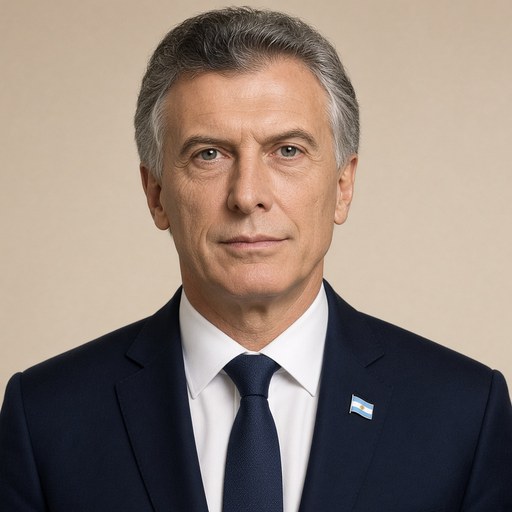
President Mauricio Macri during the meeting of South American presidents in Santiago, Chile.
 Mauricio Macri · President of Argentina
- Context
- Macri addressed a meeting of South American presidents in Santiago, Chile on March 22, 2019, hosted by Chilean President Sebastián Piñera, to discuss regional integration.
- Main themes
- South American regional integration, UNASUR failures and lessons, Venezuela crisis, border crossing efficiency, trade and phytosanitary standards, Mercosur reform, Pacific Alliance partnership, climate change cooperation, fight against drug trafficking, roaming agreements, bureaucracy reduction, political and economic stability
- Duration
- ~6 min
- Words
- 713
- Sentences
- 15
- Readability
- 28
- Grade
- 21.0
- Syntax
- 3.64
- Vocabulary
- 2.16
Translated from Spanish
The broad sphere of national life a sentence belongs to. Every sentence has an Arena, so it is the denominator the other indices are read against.
Other15 sentences in 3 paragraphs
First of all, dear Sebastián: I want to say that I quickly accepted your invitation because I felt that there was a need for a space where we can speak openly, and in your presentation, as well as those of my predecessors – both Iván, Mario, and Jahir – what I want to highlight first is that I do not know how far back in the history of our beloved South America we need to go to see such a level of coincidences and what is happening in the world. This is something that we clearly need to take advantage of and transform into something concrete. And also this coincidence that we have all had in learning from the mistakes made, not to stumble over the same stone again, and clearly UNASUR is the last mistake, in terms of the fact that ideology and prejudices prevailed over the needs of the people and – above all – in terms of not having set a limit in time to what the Venezuelan people are suffering today, which is something truly serious and is not only causing serious harm to the Venezuelan people but already to the entire region.
And it also reaffirms that with the challenges of the 21st century, isolated we will find ourselves much weaker, which is why this is an era of interdependence and we must be ready to do so, but with efficient solutions, while also being respectful of the values that have been mentioned, and always thinking about how we connect with the people. But now we already have these coincidences and the important thing is how to achieve it because behind us there is history, there are bureaucracies to change, so we need to have innovative integration schemes.
We were just talking this morning – with Sebastián – about something as simple as integrating border crossings and one finds enormous internal resistances in their structures, and well, we have to overcome them because this is like the basics. If we are going for integration, we cannot spend and lose hours crossing trucks, hours crossing tourists, and there we have to overcome our customs systems, phytosanitary and sanitary controls, which is why we also raised this issue in Mercosur in the meeting with Jair to try to unify sanitary and phytosanitary standards so that trade can grow without traps. This issue of roaming – as Iván mentioned – we are already achieving with Sebastián in our Integration Agreement and we celebrate it as something that applies, which precisely goes to a central element in the lives of all people today, which is communication through cell phones. And the other two issues that must be on the table are clearly how we face climate change together, the gigantic works that need to be done to truly be more resilient in the face of this situation that has already come to stay, and the fight against drug trafficking and organized crime that affects us all so much and that today migrates and must be acted upon together. And when we talk about without bureaucracy, I just had the example of the G-20, where we had the opportunity to preside for the first time in South America over the G-20 and there we see a structure that really lowers and guides lines on crucial issues, without having built bureaucracies. There in Mercosur we made a mistake again, I believe that having gone towards appointing specific deputies from Parlasur is an additional expense at a time when part of the citizenry criticizes a lot, that we should be careful with political expenses. So I hope that we can also retrace that and that the deputies and senators we have prioritize all integration agendas, not only Mercosur but – as Mario said – also the union of Mercosur with the Pacific Alliance, among other things that we are proposing and with future agreements. So it is about flexibilizing, opening up, being efficient and under the premise that we are all convinced that greater integration will lead to greater political stability in the region, and if there is more political stability, we will clearly have greater economic stability. So I believe that the challenge is clear, we have to make it happen. Thank you, Sebastián.
The original Spanish. The tags above are read on the English translation's sentences.
Ante todo, querido Sebastián: quiero decir que adherí rápidamente a tu invitación, porque sentía que hacía falta un ámbito para que hablemos así sin vueltas y a tu presentación, más las de las que me precedieron – tanto Iván, como Mario, como Jahir – lo que primero quiero resaltar es que no sé cuánto hay que ir hacia atrás en la historia de nuestra querida América del Sur para ver semejante nivel de coincidencias y qué es lo que está pasando en el mundo. Eso es algo, que claramente, tenemos que aprovechar y transformar en algo concreto. Y también esta coincidencia que todos hemos tenido en aprender de los errores cometidos, no volver a tropezar con la misma piedra y claramente UNASUR es el último error, en términos de que prevaleció la ideología, los prejuicios en vez de las necesidades de la gente y – sobre todo- en términos de no haber puesto un límite a tiempo a lo que, hoy, está sufriendo el pueblo venezolano, que es algo realmente grave y no sólo ya está ocasionándole serio daño al pueblo venezolano, sino ya a todo la región.
Y también reafirma que con los desafíos, del siglo XXI, aislados nos van a encontrar muchísimo más débiles, con lo cual es una época de la interdependencia y que tenemos que estar listos para hacerlo, pero con soluciones eficientes, a la vez que tienen que ser respetuosas de los valores, que se han mencionado, y siempre pensando en cómo nos conectamos con la gente. Pero ahora ya tenemos estas coincidencias y lo importante es cómo lograrlo porque detrás nuestro hay historia, hay burocracias a los cambios, entonces tenemos que tener esquemas innovadores de integración.
Recién hablábamos algo a la mañana - con Sebastián - acerca de algo tan simple como integrar los pasos fronterizos y uno encuentra unas resistencias internas en sus estructuras enormes y bueno hay que vencerlas porque esto es como lo elemental. Si vamos a la integración no se pueden pasar y perderse horas para cruzar camiones, horas para cruzar turistas y ahí tenemos que vencer nuestros sistemas de aduanas, de controles fitosanitarios y sanitarios, por eso también en el Mercosur lo planteamos en la reunión con Jair de tratar de unificar las normas sanitarias y fitosanitarias para que el comercio pueda crecer sin trampas. Este tema de roaming - que decía Iván - ya lo estamos logrando con Sebastián en nuestro Acuerdo de Integración y lo festejamos como algo que aplica, que justamente va a un elemento central en la vida de toda la gente que hoy es la comunicación a partir de los celulares. Y los dos otros dos temas que tienen que estar en la mesa claramente es cómo hacemos frente juntos al cambio climática, a las obras gigantescas que hay que hacer para realmente estar con mayor resiliencia frente a esta situación que ya vino para quedarse, y la lucha contra el narcotráfico y el crimen organizado que tanto nos afecta a todos y que hoy migra y hay que actuarlo en conjunto. Y cuando hablamos de sin burocracia, yo acabo de tener el ejemplo del G-20, donde nos tocó presidir por primera vez en Sudamérica el G-20 y ahí vemos una estructura que realmente baja y orienta líneas sobre temas cruciales, sin haber construido burocracias. Ahí en el Mercosur nosotros nos equivocamos nuevamente, creo que el haber ido hacia nombrar diputados específicos del Parlasur es un gasto adicional en un momento donde se critica mucho parte de la ciudadanía, el que tengamos cuidado con las gastos de la política. Con lo cual espero que también todos podamos desandar de eso y que los propios diputados y senadores que tenemos se ocupen prioritariamente de todas las agendas de integración, no solo Mercosur sino -como Mario decía- también unión de Mercosur con Alianza del Pacífico, entre otras cosas que estamos planteando y con futuros acuerdos. Entonces es flexibilizar, abrir, ser eficientes y bajo la premisa de que estamos todos convencidos, que a mayor integración vamos a tener mayor estabilidad política en la región, y si hay más estabilidad política vamos a tener claramente mayor estabilidad económica. Entonces creo que el desafío es claro, tenemos que lograr que suceda. Gracias, Sebastián.