




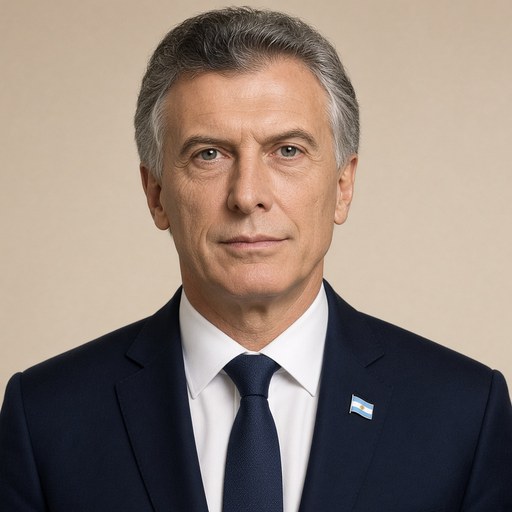
President Mauricio Macri at the launch of the Spotlight initiative.
 Mauricio Macri · President of Argentina
- Context
- Macri addressed the launch of the EU-UN Spotlight Initiative in Argentina on March 22, 2019, reaffirming his government's commitment to ending gender-based violence.
- Main themes
- Violence against women, femicide, gender equality, Spotlight initiative, cultural change, women's rights, education and prevention, international cooperation, Argentine government policy, legislative agenda, reducing inequalities
- Duration
- ~5 min
- Words
- 578
- Sentences
- 20
- Readability
- 47
- Grade
- 13.8
- Syntax
- 3.47
- Vocabulary
- 2.00
Translated from Spanish
The broad sphere of national life a sentence belongs to. Every sentence has an Arena, so it is the denominator the other indices are read against.
Other20 sentences in 8 paragraphs
Good afternoon: the truth is that it is a joy to be here to share the launch of Spotlight in Argentina. I want to especially thank the European Union and the United Nations system for this decision to bring the initiative to our country, a decision that also represents a recognition of our progress, challenges, and commitments to end violence against women.
It is also a decision that acknowledges our vocation to engage in dialogue with the world, to create new bridges to share experiences and tackle common challenges together. We are convinced that deep changes are achieved in this way: by sharing experiences, understanding each other, and collaborating with one another; that is the way to address the pending challenges in humanity. And violence against women is – without a doubt – one of the most urgent.
Today, thanks to the work of the United Nations, we know that 1 in 3 women is a victim of physical or sexual violence at least once in her lifetime. And in our country, every 32 hours – yes, you heard correctly – every 32 hours a woman dies, a victim of femicide.
Just as we know this, we know that this is a reality that must change, and in that sense, we are working. That is why, two and a half years ago – as was said in the video we just watched – we launched the Plan to Prevent and Eradicate Gender Violence, with which – among other things – we expanded the capacity of the 144 hotline so that more women can receive support and advice. But it is not just about women being able to escape dangerous situations; it is about ending violence forever, and for that, we must start with the education we give to our children.
The revolution of women is one of the key themes of this century, and I am truly glad to be an enthusiast in that regard; it is one of our great challenges as a society. This must be about doubling down on the work for equality, both inside and outside our homes, in our schools, on the streets, in everything we do. We all have to set an example because we are talking about a cross-cutting issue that affects all of society, and we no longer want to, nor can we, nor will we look the other way. We need to move forward together towards a profound cultural change, a change that demands we act to reduce gaps and inequalities. This reduction of gaps and inequalities in every area where they exist.
To that end, we launched the Plan for Equal Opportunities and Rights, a roadmap to organize all the actions we have been promoting and also to develop new initiatives with a gender perspective. We are also carrying out an ambitious legislative agenda, which resulted in the enactment of the Brisa and Micaela Laws, which are a way to respond to victims, especially when the State was not there at the time to protect them.
Today, we are proud to launch, in our country, the Spotlight initiative, which means: “to highlight,” to bring light to the main violation of human rights of the 21st century.
We face violence against women together, and I have no doubt that we are making progress, and most importantly, that we are making progress and there is no turning back. Thank you very much for being here, and let’s continue working together.
The original Spanish. The tags above are read on the English translation's sentences.
Buenas tardes: la verdad que es una alegría estar acá, para compartir el lanzamiento de Spotlight, en Argentina. Quiero especialmente agradecerle a la Unión Europea y al sistema de Naciones Unidas por esta decisión de traer la iniciativa a nuestro país, decisión que también representa un reconocimiento a nuestros avances, desafíos y compromisos para poner fin a la violencia contra las mujeres.
Es también una decisión que reconoce nuestra vocación de dialogar con el mundo, de generar nuevos puentes para compartir experiencias y abordar juntos desafíos comunes. Estamos convencidos de que los cambios profundos se logran de esa manera: compartiendo experiencias, entendiéndonos y colaborando unos con otros, esa es la manera de abordar los desafíos pendientes en la humanidad. Y la violencia contra las mujeres es – sin dudas – uno de los más urgentes.
Hoy, gracias al trabajo de las Naciones Unidas, sabemos que 1 de cada 3 mujeres es víctima de violencia física o sexual, al menos, una vez en su vida. Y en nuestro país cada 32 horas – sí escucharon bien – cada 32 horas muere una mujer, víctima de femicidio.
Así como sabemos esto, sabemos que esta es una realidad que tiene que cambiar, y en ese sentido estamos trabajando. Por eso, hace dos año y medio – como decía, acá, el vídeo que vimos – lanzamos el Plan para Prevenir y Erradicar la Violencia de Género, con el que – entre otras cosas – ampliamos la capacidad de atención de la línea 144 y más mujeres pueden recibir contención y asesoramiento. Pero no se trata sólo de que las mujeres puedan salir de la situación peligrosa; se trata de terminar con la violencia para siempre y para eso tenemos que empezar con la educación, que le damos a nuestros hijos.
La revolución de las mujeres es uno de los ejes de este siglo y la verdad que me alegro de ser el entusiasta en ese sentido y es uno de nuestros grandes desafíos como sociedad. Ese tiene que ser el de redoblar la apuesta por el trabajo por la igualdad, dentro y fuera de nuestras casas, en nuestras escuelas, en la calle, en cada cosa que hacemos. Todos tenemos que dar ejemplo, porque estamos hablando de un asunto transversal, que atraviesa a toda la sociedad y ya no queremos ni podemos ni vamos a mirar para el costado. Necesitamos avanzar juntos hacia un profundo cambio cultural, un cambio que nos exija actuar para reducir brechas y desigualdades. Esta reducción de brechas y desigualdades en cada ámbito donde estás existan.
Para eso lanzamos el Plan de Igualdad de Oportunidades y Derechos, una hoja de ruta para ordenar todas las acciones, que veníamos impulsando y también para desarrollar nuevas iniciativas con perspectiva de género. También llevamos adelante una ambiciosa agenda legislativa, que resultó en la sanción de las Leyes Brisa y Micaela, que son una manera de darles respuesta a las víctimas, especialmente cuando el Estado no estuvo, en su momento, para protegerlas.
Hoy, estamos orgullosos de poner en marcha, en nuestro país, a la iniciativa Spotlight, que quiere decir: “destacar”, llevar luz a la principal violación de los derechos humanos, del siglo XXI.
A la violencia contra las mujeres le hacemos frentes juntos y no tengo dudas que estamos avanzando y lo más importante, que estamos avanzando y no hay marcha atrás. Muchas gracias por estar acá y a seguir trabajando juntos. (APLAUSOS).