




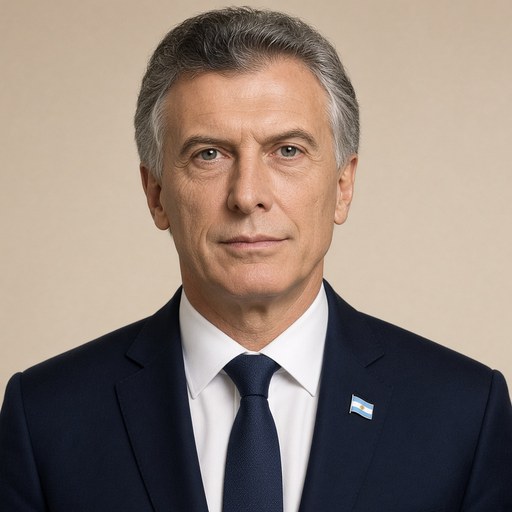
President Mauricio Macri during the meeting of the "Argentina Exporta" program.
 Mauricio Macri · President of Argentina
- Context
- Macri addressed entrepreneurs and officials at the 'Argentina Exporta' program meeting in Río Cuarto, Córdoba, on November 1, 2018, to promote export growth.
- Main themes
- Export promotion, entrepreneurship, economic reform, public-private partnership, trade bureaucracy reduction, export growth targets, energy development, productive diversification, Argentina's global competitiveness, regional development in Córdoba
- Duration
- ~18 min
- Words
- 2,151
- Sentences
- 45
- Readability
- 34
- Grade
- 20.4
- Syntax
- 3.82
- Vocabulary
- 1.91
Translated from Spanish
The broad sphere of national life a sentence belongs to. Every sentence has an Arena, so it is the denominator the other indices are read against.
Other45 sentences in 15 paragraphs
Thank you, Governor, Mayor, team from the province of Córdoba, for receiving me once again: this is the 16th time I have come to Córdoba as President. It is easy to come to one's own province, so I am happy to always return, and this is the second time we have come to Río Cuarto. Just as I was moved – I just came from Coronel Baigorria – and the reception from the people was incredible, the enthusiasm knowing all the moments we have lived through in the past months, but being sure that this time it is serious, that we are doing the things we need to do on solid foundations for what we project to happen, we feel that we have been able to get through all that we have lived without changing the rules, without even changing an economic team, reaffirming to ourselves that this time, by telling the truth, we will set a course for the Argentina we want.
This same joy that I feel from always being in contact with Córdoba gives me the same enthusiasm, as a core, to be in touch with this entrepreneurial spirit that exists in Argentina, and especially in Córdoba. I always say it is one of the places where the entrepreneurial spirit is most felt. And what is an entrepreneur? It is someone who does not give up, it is someone who is always looking for something to develop, an idea to perfect, to transform into a reality that includes more people because it needs more people to develop, it means someone who is open to acquiring more knowledge, to innovate, and we need them.
Because entrepreneurship is what will give us access to that 21st-century job, which is so in demand today and is, let’s say, present in a technological revolution. So I think it is very good that we all agree that this is the axis, this is a huge advance: having seen the Minister of the Nation say what the line is; this video that is so well made, which shows that we have what it takes; the Governor who agrees and says: “we have to go down this path.” And this path has a fundamental first part, that we are a single team: public sector and private sector, which cannot be – as we have lived in the past – that those who wanted to export had to go through an obstacle course. And there were all kinds of registrations and authorizations and in-person procedures and months that were lost and agents who would come to your office and say: “I’ll take care of it for you.” And we have even normalized that, perhaps, one had to pay a little something at Customs to be able to leave, to be able to bring in the parts we need to export our equipment, things that really left us out of the world.
And we saw how our exports have been declining over the last decade, and fewer exports mean less Argentine work reaching the world. And what we are agreeing on today among all of us is that we want our work to reach every corner of the planet. And as we saw in that video, it is already happening, there are already Argentines from different regions of the country exporting their work to the world. The challenge is for this to grow; the challenge we have set for ourselves is to triple the amount of exports by 2030 and quadruple the number of companies. 9,000 companies export from Argentina to the world, that is many but very few, because we can really aspire – from now until 2030 – for there to be 36,000 companies exporting to the world, tripling the value of what we export. And it is not just sorghum, or wheat, or peanuts, it is also medical equipment, which we are already exporting; it is the gearboxes that come from here very close, so it is clear that we have the capacity and diversity of products to do it.
And if we keep perfecting this every day, which we are already doing, which we have shown here in terms of simplification, of the VUCE, every day we will be closer to that place, closer, we have already started this task with productivity tables that have truly been a wonderful space, many of you have already participated, and now in a little while we have another one with the export of value-added services. And there we sit down the national, provincial, and municipal government in many cases as well, together with the unions and the companies to see what we were doing wrong, what rules were hindering our own development, our own growth, and we had been removing. There are still many left, I would say we are at 20 percent of having eliminated these restrictions, and just that when it is finished, and we hope to finish them in the next year, year and a half, it will be a point of GDP that we will reduce in costs for what is produced in Argentina and that we want to export to the world, and that will also benefit Argentina, of course, as a local market.
So there we have a truly functioning axis and the first table was precisely that of Vaca Muerta, and it was not a coincidence, in a country that does not have energy it will be very difficult to add value to its raw materials and thus be able to export. Today we have a clear energy development model that will allow us, in 5 years or less, I hope, to be one of the six most important exporters of oil and gas in the world, in the world, and that alone will generate half a million jobs, not only in the Vaca Muerta field but in the entire system of SMEs and medium-sized companies very linked to metalworking, which are already supplying Vaca Muerta, and many are in Córdoba. This is part of the model that - as the Governor said - will allow us to have cheaper gas, we already have gas that is much cheaper than what a Brazilian, Uruguayan, or Chilean SME or company has access to, but as production increases, that will continue to decrease.
Now we have to transport it and distribute it, which will also create jobs for our entire local development and employment system, because in general, everything that is called midstream to get the gas out will also be a great opportunity for the development of local companies. So there we have that great challenge of continuing to sit down, recovering a fundamental tool which is the tool of dialogue, which is so key for a society, in which we can say at a table freely this does not add to me, this does not serve me, cancel this registration, put it at a distance. The national government transformed to distance, we have more than 1,200 procedures, which three years ago were all manual, in-person, today are at a distance, digital, and that is a lot of time which is the most important thing you need, time to be able to innovate more, develop more, and build better.
So two challenges that I want to leave you today that we have to work on together: the first, a central part of this cost reduction, is the tax cost that Argentina has, we all know it, the Governor knows it, the mayors know it, Argentina has a very expensive tax system, one of the most expensive in the world, and we have distorting national taxes, distorting provincial taxes, and distorting municipal taxes. So what we all have to work on, that we have started to put a national budget on the table, the same has to be done with provincial and municipal budgets, so that we are all sure that from politics we will also manage the scarce resources we have as a society in the correct way, and that it is not like a feat that the roads are built after 30 or 40 years as can be the case with Route 19 that is expected, and there are millions of examples, right? So we have to achieve that we all advocate for the discussion of the national budget, which is a fundamental law in the democratic functioning of a society, to be something in which we all participate, to be sure that in time we will return to having taxes as we had in the past, which were much lower, not in a very distant past. Fifteen years ago, Argentina had much more competitive taxes compared to Brazil, Chile, Uruguay, Colombia, and today unfortunately it burdens activity.
And that means that we cannot access with all the power, the capacity, and the innovation that we have as Argentines with our products to the rest of the world.
And for the other thing we have to fight together, with the governors, with the mayors, is also with the cost of logistics, because we have a very large country, and not everyone is close to the ports, not everyone has access to the freight railway which is very little, even though we are investing as we have not invested since the railroads were created. So we really need to work on all steps of logistics, so that we have logistics that also has a competitive cost with the rest of the world, today unfortunately Argentine logistics costs double that of the rest of the region: double or more!
We have already made a lot of progress on ports, we have been able to reduce a lot of costs at the ports, there is still more to do, we have to continue; we are trying to enhance the waterway; as I said before, we are building new routes to bring the north closer to the Argentine ports. But we need to work much more on reducing especially all the cost of lighter logistics, which is really very expensive, and it is not only expensive to export, it is expensive and affects the domestic cost of all the things we consume, from a Coca-Cola to cheese, everything is crossed by a really expensive logistical cost. There we all have to work together, with provincial and municipal governments, to see how we can all make our best effort, which means productivity, and as General Perón said, “the polar star of a country must be productivity.”
And that means that each one at the end of the day says “I do my job a little better every day, and if I do it a little better that radiates something better for the one next to me,” because I insist, we are a single team, a single team that this time understood that to build that Argentina that we dream of and deserve we have to do it on solid foundations, on foundations that transcend a government, with transparent mechanisms, like the VUCE, that transcends a government because it starts to connect us all in a visible, rapid, dynamic way. Not only does the internet allow us access to knowledge, it allows us access to information and to know what each of us does and in that way be able to complement each other better.
So I am convinced that the goals we have set in terms of exports are truly possible, because you have convinced me that they are possible, every time I visit you show me the things you are capable of doing, the creativity we have in our country. And the good thing is that the world has a good opinion of the quality things that we Argentines have made, and so it has opened doors for us, we are opening markets every day, we are generating new opportunities. Let us hope that with the political change that has occurred in Brazil we can confirm this idea of advancing in free trade agreements of MERCOSUR with the rest of the world, because through that integration is where the future lies, isolation Argentina has already tried, we have already tried it, and all it brought us was more poverty and more exclusion. So what we have to do is an intelligent insertion into the world, which is what we are trying to do, bringing our capacity, our talent, and of course inviting everyone in the world to invest with us in our country, to visit us hand in hand with tourism which is also proving to be a great tool of enormous potential in terms of job generation for the coming decade.
So thank you all for being here, hoping that we continue to find spaces for dialogue and teamwork, because I am sure that through this path, on this road, Argentines have a great future ahead.
Thank you very much to all.
The original Spanish. The tags above are read on the English translation's sentences.
Gracias Gobernador, Intendente, equipo de la provincia de Córdoba, por recibirme una vez más: es la vez 16 que vengo a Córdoba como Presidente. Es fácil venir a la provincia de uno, así que estoy contento de volver siempre y aparte es la segunda vez que venimos a Río Cuarto y así como me moviliza – recién venía de Coronel Baigorria – y realmente la recepción de la gente fue increíble, las ganas sabiendo todos los momentos , que hemos vivido en los meses pasados, pero estando seguro que esta vez va en serio, que estamos haciendo las cosas que tenemos que hacer sobre bases sólidas lo que proyectamos se dé, sentimos que pudimos pasar todo esto que vivimos sin cambiar las reglas, sin siquiera cambiar un equipo económico, reafirmándonos, en que esta vez diciéndonos la verdad vamos a poner rumbo a la Argentina que queremos.
Esta misma alegría que me provoca estar siempre en contacto con Córdoba me provoca el mismo entusiasmo, como eje, estar en contacto con este espíritu emprendedor que hay, en la Argentina, y especialmente en Córdoba. Siempre lo digo es uno de los lugares, donde más se siente el espíritu emprendedor. ¿Y qué es un emprendedor? Es alguien que no se rinde, es alguien que siempre está buscando algo que desarrollar, una idea que se perfeccione, que se transforme en una realidad que incluye a más gente porque necesita más gente para desarrollarse, significa alguien que está abierto a adquirir más conocimientos, a innovar y los necesitamos.
Porque el emprendedorismo es el que nos va a dar el acceso a ese trabajo, del siglo XXI, que hoy está tan demandado y tan, digamos, presente en una revolución tecnológica. Entonces creo que está muy bueno que ya coincidamos todos en que este es el eje, esto es un avance enorme: haber visto al ministro de la Nación que dijo cuál es la línea; este video que tan bien realizado está, que demuestra que tenemos con qué; el Gobernador que acuerda y dice: “tenemos que ir por este camino”. Y este camino tiene una primer parte fundamental, que somos un único equipo: sector público y sector privado, que no puede ser – como hemos vivido en el pasado – que aquel que quería exportar tenía que recorrer una carrera de obstáculos. Y todos eran registros y autorizaciones y trámites presenciales y meses que se perdían y gestores, que llegaban a tu ofician y te decían: “yo te lo saco”. Y hasta hemos naturalizado que, tal vez, había que pagar unos manguitos en la Aduana para poder salir, para poder entrar las partes que necesitamos para exportar nuestro equipo, cosas que realmente nos dejaron fuera del mundo.
Y vimos como nuestras exportaciones fueron bajando, en la última década, y menos exportaciones es menos trabajo argentino, que llega al mundo. Y lo que hoy estamos acordando entre todos es que queremos que nuestro trabajo llegue a cada rincón del planeta. Y como vimos, en ese vídeo, ya está sucediendo, ya hay argentinos de distintas regiones del país, que exportan al mundo su trabajo. El desafío es que esto crezca; el desafío que nos hemos puestos es que al 2030 triplicar la cantidad de las exportaciones y cuadruplicar la cantidad de empresas. 9.000 empresas exportan, desde la Argentina al mundo, son muchas pero son muy pocas, porque realmente podemos aspirar – de acá al 2030 – que sean 36.000 las empresas que exporten al mundo, triplicando el valor de lo que exportamos. Y no es solamente el sorgo, o el trigo, o el maní, es también equipamiento médico, que ya estamos exportándolo; son las cajas de cambios que salen de acá muy cerca, o sea se ve que tenemos capacidad y diversidad de productos para hacerlo.
Y si vamos todos los días perfeccionando esto, que ya estamos haciendo, que hemos mostrado acá en términos de simplificación, del VUCE cada día vamos a estar más cerca de ese lugar, más cerca, ya arrancamos en esta tarea con mesas de productividad que la verdad han sido un espacio maravilloso, muchos de ustedes ya han participado, ahora dentro de un rato tenemos otra con la exportación de servicios con valor agregado. Y ahí nos sentamos el Gobierno nacional, provincial, municipal en muchos casos también, juntos con los gremios y las empresas y ver qué estábamos haciendo mal, qué reglas impedían nuestro propio desarrollo, nuestro propio crecimiento y habíamos ido removiendo. Todavía faltan muchísimas, diría que estamos al 20 por ciento de haber eliminado estas restricciones, y ya solamente eso cuando se termine y esperamos terminarlos en el próxima año, año y medio, va a ser un punto del PBI, que vamos a reducir de costos a lo que se produce en Argentina y que queremos exportarle al mundo, y que también se va a beneficiar por supuesto el argentina al consumirlo como mercado local.
Entonces ahí tenemos un eje realmente que ha funcionado y la primera mesa justamente fue la de Vaca Muerte, y no fue casualidad, en un país que no tiene energía se le va a hacer muy difícil poder agregarle valor a sus materias primas y así poder exportar. Hoy tenemos un claro modelo de desarrollo energético que nos a permitir además en 5 años o menos, espero, ser uno de los seis exportadores más importantes de petróleo y de gas del mundo, del mundo, y eso solo, y eso solo va a generar medio millón de puestos de trabajo, no solo en el yacimiento de Vaca Muerta sino en todo el sistema de pymes y medianas empresas muy ligadas con la metal mecánica, que están proveyéndole ya a Vaca Muerta, y muchas hay en Córdoba. Esto es parte del modelo que -como decía el Gobernador- nos va a permitir tener un gas cada vez más barato, ya tenemos un gas que es mucho más barato que el que tienen acceso una Pyme o una empresa brasileña, uruguaya o chilena, pero al aumentar la producción eso va a seguir bajando.
Ahora tenemos que transportarlo y distribuir lo que también va a dar trabajo a todo nuestro sistema de desarrollo y empleo local, porque en general todo lo que se llama midstream para sacar el gas va a ser también una gran oportunidad para desarrollo de empresas locales. Entonces ahí tenemos ese gran desafío de seguirnos sentando, recuperando una herramienta fundamental que es la herramienta del diálogo, que es tan clave para una sociedad, en la cual podamos decir en una mesa libremente esto no me suma, esto no me sirve, anúlame este registro, ponémelo a distancia. El Gobierno nacional transformó a distancia, tenemos más de 1200 trámites, que hace tres años eran todos manuales, presenciales, hoy son a distancia, digitales y eso es muchísimo tiempo que es lo más importante que ustedes necesitan, tiempo para poder innovar más, desarrollar más y construir mejor.
Entonces dos desafíos que les quiero dejar hoy que por los cuales tenemos que trabajar también juntos: el primero, parte central de esta reducción de costos, es el costo impositivo que tiene la Argentina, todos lo sabemos, también el Gobernador lo sabe, los intendentes lo saben, la Argentina tiene un sistema impositivo muy caro, de los más caros del mundo, y tenemos impuestos nacionales distorsivos, impuestos provinciales distorsivos e impuestos municipales distorsivos. Entonces lo que tenemos que todos trabajar, que hemos empezado a poner de verdad un presupuesto nacional sobre la mesa, lo mismo hay que hacer con los presupuestos provinciales y municipales, para que todos estemos seguros de que desde la política también vamos a administrar los recursos escasos que tenemos como sociedad de la manera correcta, y que no sea como una hazaña que las rutas se construyan después 30 o 40 años como puede ser La 19 que se espera, y así hay millones de ejemplos, ¿no? Entonces tenemos que lograr que todos militemos para que las discusión del Presupuesto nacional, que es una ley fundamental en el funcionamiento democrático de una sociedad, sea algo que en el cual todos participamos, para estar seguros que en el tiempo vamos a volver a tener impuestos como tuvimos en el pasado, que eran muchos más bajos, no en un pasado tan lejano. Hace 15 años la Argentina tenía impuestos mucho más competitivos, respecto de Brasil, de Chile, de Uruguay, de Colombia, y hoy lamentablemente grava la actividad.
Y eso hace que no podamos acceder con toda la potencia, la capacidad y la innovación que tenemos los argentinos con nuestros productos al resto del mundo.
Y por lo otro que tenemos que pelear juntos, con los gobernadores, con los intendentes, es también con el costo de la logística, porque tenemos un país muy grande, y no todos están cerca de los puertos, no todos tienen acceso al ferrocarril de carga que es muy poco, por más que estamos invirtiendo como no se invertía desde que se crearon los ferrocarriles. Entonces que realmente trabajar en todos los pasos de la logística, para que tengamos una logística que también tenga un costo competitivo con el resto del mundo, hoy lamentablemente la logística argentina vale el doble del resto de la región: ¡El doble o más!
Ya hemos avanzado mucho en tema puertos, hemos podido reducir un montón de costos en los puertos, todavía falta, tenemos que seguir; estamos intentando poner en valor la hidrovía; como dije anteriormente, estamos construyendo vía nueva para acercar el norte hacia los puertos argentinos. Pero necesitamos trabajar muchísimo más en reducir especialmente todo el costo de la logística más ligera, que es realmente carísima, y no solo es cara para exportar, es cara y afecta al costo doméstico de todas las cosas que consumimos, desde una Coca Cola a un queso, está todo cruzado por un costo logístico realmente muy caro. Ahí también tenemos todos que trabajar juntos, con los gobiernos provinciales, municipales, para ver cómo logramos que todos vayamos haciendo nuestro mejor esfuerzo, que significa productividad, y como decía el General Perón, “la estrella polar de un país tiene que ser la productividad”.
Y eso significa que cada uno al final del día diga “yo hago mi trabajo cada día un poco mejor, y si yo lo hago un poco mejor eso irradia algo mejor para el que tengo al lado”, porque insisto, somos un único equipo, un único equipo que esta vez entendió que para construir esa Argentina que tanto soñamos y merecemos tenemos que hacerlo sobre bases sólidas, sobre bases que trasciendan un gobierno, con mecanismos transparentes, como la VUCE, que trasciende a un gobierno porque empieza a conectarnos a todos de una manera visible, rápida, dinámica. No solo internet nos permite el acceso al conocimiento, nos permite el acceso a la información y saber qué es lo que hacemos cada uno y de esa manera poder complementarnos mejor.
Así que convencido de que las metas que nos hemos puesto en términos de exportación son realmente posibles, porque ustedes me han convencido que son posibles, cada vez que los visito me muestran las cosas que son capaces de hacer, la creatividad que tenemos en nuestro país. Y lo bueno es que el mundo tiene una buena opinión de las cosas de calidad que hemos hecho los argentinos, y entonces nos ha abierto las puertas, estamos abriendo mercados todos los días, estamos generando nuevas oportunidades. Esperemos con el cambio político que ha habido en Brasil confirmar esta idea de avanzar en tratados de libre comercio del MERCOSUR con el resto del mundo, porque a través de esa integración es que está el futuro, el aislamiento ya la Argentina lo probó, ya lo probamos, y lo único que nos trajo fue más pobreza y más exclusión. Entonces lo que tenemos que hacer es una inserción inteligente al mundo, que es lo que estamos intentando, llevando nuestra capacidad, nuestro talento, y por supuesto invitándolos a todos en el mundo a que inviertan con nosotros en nuestro país, a que nos visiten de la mano del turismo que también se está demostrando como una gran herramienta de enorme potencia en términos de generación de empleo para la década que viene.
Así que gracias a todos por estar acá, esperando que sigamos encontrando espacios de diálogo y de trabajo en equipo, porque estoy seguro de que por esa vía, por este camino los argentinos tenemos un gran futuro por delante.
Muchas gracias a todos. (APLAUSOS)