




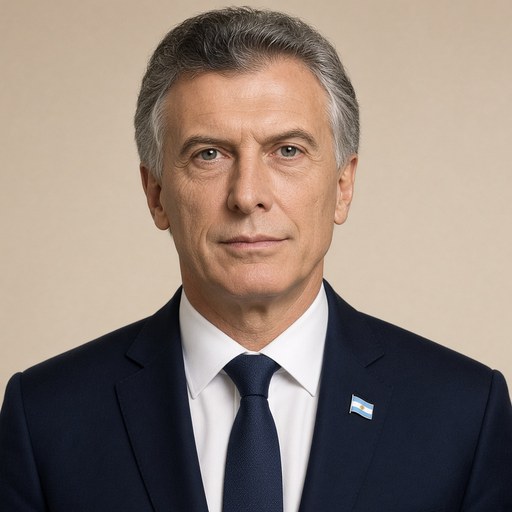
President Mauricio Macri presented the program "National System for Academic Recognition of Higher Education."
 Mauricio Macri · President of Argentina
- Context
- Macri addressed Argentine education officials in September 2016 to launch the National System for Academic Recognition of Higher Education, aimed at easing credit transfers.
- Main themes
- Academic credit recognition system, higher education reform, educational opportunity and access, zero poverty goal, Argentina's new chapter, federal education coordination, innovation and job creation, Purmamarca agreement, bureaucratic flexibility in universities, economic development and investment
- Duration
- ~7 min
- Words
- 790
- Sentences
- 15
- Readability
- 26
- Grade
- 22.2
- Syntax
- 3.71
- Vocabulary
- 1.98
Translated from Spanish
The broad sphere of national life a sentence belongs to. Every sentence has an Arena, so it is the denominator the other indices are read against.
Other15 sentences in 10 paragraphs
Good morning. Thank you for allowing me to interrupt your meeting.
I believe that this new tool we are launching seeks what we have always believed is wonderful about education, which is to generate new opportunities, to facilitate, to bring closer the dreams of so many Argentinians, in this case, or of any inhabitant of this planet.
It is precisely dreams, hopes, opportunities, where education and politics coincide; politics must try to help us all realize our dreams, so that we can all truly navigate a life of progress, evolution, and growth.
Right now, a Forum is finishing up nearby, at the Cultural Center, which has been a huge success, where everyone who attended was breathing - I hope some of you were there - the feeling and the vibrancy of what is happening in Argentina, an Argentina that has opened a new chapter in its history, where a majority of us have decided to be part of a change, and in seeking that, opportunities for progress, investment, and development that generate quality jobs, which, alongside education, is the true solution towards a country that reduces its levels of poverty and, through a time, a period of much work, we achieve an Argentina with zero poverty.
And in that, of course, as we know that not everyone, but that more and more Argentinians can complete their tertiary education, would truly be a beautiful dream, a dream that has driven many decades in Argentina, right?, when all the immigrants, among whom were my grandfather and my father, said “my son the doctor,” incorrectly because they should have said “my son the engineer.” But I really believe that we all feel that this is the tool, this is the place where we need to put in a lot of effort.
I truly feel very proud that the first long-term agreement achieved in this new phase of Argentina, which Esteban achieved with his constant willingness to dialogue and collaborate, was the Purmamarca agreement, where we committed to work with all the education ministers of Argentina side by side, as we are doing with the governors, in this educational revolution that means commitment to quality, to innovation, to improving infrastructure, also with education at the level of kindergartens, which are so lacking in many places and that we need.
And one chapter was also this, that this rigidity of our system was causing the blockage, the bureaucracy, the process, which ended up frustrating many Argentinians who really wanted to acquire a university education, like Cintia who wrote to you, right? You confirmed to me that she wrote to you that she was in her third year of Psychology, her husband moved to Buenos Aires for work and she is still looking for how to achieve approval and has not succeeded, and she even had to redo the CBC, or subjects from the CBC; the truth is that in the 21st century, where we see that the countries with which we compete, more than wanting to get along with everyone, we have to compete for the best jobs, and they have already found flexible systems that allow those who decide to change their field of study to easily have part of what they have already acquired recognized as knowledge. And not to mention that the system should function federally, not that we are airtight compartments where if you studied in Córdoba it doesn’t count in Buenos Aires, an absolute madness in the 21st century.
So I believe that it is one more tool we are putting at the service of ensuring that more Argentinians have the capabilities we all need to create and innovate because, as Esteban always says, we are educating kids for jobs that do not exist today, that will be created; that is, the great challenge is to ensure that our kids are capable of creating those jobs themselves, because if they create them, we have many more possibilities that those jobs will stay here.
There are many challenges ahead of us, but fortunately, we are all committed, there is a lot of enthusiasm in Argentina, and I trust that by working this way, all together, applying more and more effort in investment and not in spending, in the things that reproduce and will generate a better future, we will achieve it. In the university world, there is so much to do, as there is in all sectors of Argentina.
Thank you for being here, congratulations Esteban and your team for this new initiative, and I hope it truly serves to prepare many more to be ready at the starting line to help build that Argentina we dream of, that we deserve, and that this time we are convinced we will achieve.
The original Spanish. The tags above are read on the English translation's sentences.
Buenos días. Gracias por dejarme interrumpir su reunión.
Creo que esta nueva herramienta que estamos poniendo en marcha busca lo que siempre creemos que tiene como maravilloso la educación, que es generar nuevas oportunidades, facilitar, poner más al alcance los sueños de tantos argentinos, en este caso, o de cualquier habitante de este planeta.
Justamente sueños, esperanzas, oportunidades, es ahí es donde coinciden la educación y la política, la política tiene que tratar de ayudar a que todos podamos realizar nuestros sueños, que todos podamos realmente transitar una vida de progreso, de evolución, de crecimiento.
Justo en estas horas está terminando ya un Foro acá cerquita, en el Centro Cultural, que ha sido un éxito enorme, donde todos los que fueron respiraban -espero que hayan algunos de ustedes ir- el sentir y el vibrar de lo que está sucediendo en la Argentina, una Argentina que abrió una nueva etapa en su historia, donde una mayoría hemos decidido ser parte de un cambio, y buscando eso, oportunidades de progreso, de inversión, de desarrollo, que generen empleos de calidad que, de la mano de la educación, es la verdadera solución hacia un país que reduzca sus niveles de pobreza y que un tiempo, un período de mucho trabajo, logremos llegar a una Argentina con pobreza cero.
Y en eso, por supuesto, en la medida que sabemos que no todos, pero que cada día más argentinos puedan lograr completar su educación terciaria, sería realmente un sueño muy lindo, sueño que movió muchas décadas de la Argentina, ¿no?, cuando todos los inmigrantes, entre los cuales estuvieron mi abuelo y mi padre, decían “mi hijo el doctor”, mal dicho porque tendrían que haber dicho “mi hijo el ingeniero”. Pero realmente creo que todos sentimos que esa es la herramienta, ese es el lugar donde tenemos que poner muchos esfuerzos.
La verdad que me siento muy orgulloso que el primer acuerdo de largo plazo que se logró en esta nueva etapa de la Argentina, que lo logró Esteban con su permanente vocación de dialogar y sumar, fue el acuerdo de Purmamarca, donde nos comprometimos a trabajar con todos los ministros de educación de la Argentina codo a codo, como lo estamos haciendo con los gobernadores, en esta revolución educativa que significa compromiso con la calidad, con la innovación, con la mejora en la infraestructura, también con la educación a nivel de Jardines, que tantos lugares faltan y necesitamos.
Y un capítulo también era esto, que esta rigidez de nuestro sistema hacia que la traba, la burocracia, el trámite, terminaba frustrando a muchos argentinos que querían realmente adquirir una educación a nivel universitario, como Cintia que te escribió, ¿no? Me constaste que te escribió que ella estaba en tercer año de Psicología, su marido por trabajo se mudó a Buenos Aires y todavía sigue buscando cómo lograr la aprobación y no la logró, y tuvo que hacer hasta el CBC de vuelta, o materias del CBC, la verdad que en el siglo XXI donde vemos que los países con los cuales competimos, más de que queramos llevarnos bien con todos, nos dejamos de tener que competir por los mejores trabajos, y ellos ya han encontrado sistemas flexibles que le permiten a aquel que en ese camino de estudiar decide cambiar de orientación, se le reconozca fácilmente parte de lo que ya adquirió como conocimiento. Y ni que hablar qué funcione el sistema en forma federal, no que seamos compartimentos estancos donde si estudiaste en Córdoba no vale en Buenos Aires, una locura absoluta en el siglo XXI.
Así que creo que es una herramienta más que estamos poniendo al servicio de lograr que más argentinos tengan las capacidades que necesitamos todos de crear e innovar porque, como también Esteban dice siempre, estamos educando a chicos para trabajos que hoy no existen, que se van a crear, es decir, el gran desafío es lograr que nuestros chicos sean capaces de crear ellos esos trabajos, porque si los crean ellos tenemos muchas más posibilidades que esos trabajos se queden acá.
Son muchos los desafíos los que nos tocan, pero por suerte estamos todos comprometidos, hay mucho entusiasmo en la Argentina y confío que trabajando de esta manera, todos juntos, aplicando cada día más el esfuerzo en la inversión y no en el gasto, en las cosas que se reproducen y van a generar un mejor futuro, lo vamos a lograr. En el mundo universitario hay muchísimo para hacer, como lo hay en todos los sectores de la Argentina.
Gracias por estar acá, felicitaciones Esteban y a tu equipo por esta nueva iniciativa, y espero que realmente sirva para que muchos más estén listos en la línea de largada para ayudar a construir esa Argentina que soñamos, que merecemos y que esta vez estamos convencidos que lo vamos a lograr. (APLAUSOS)