




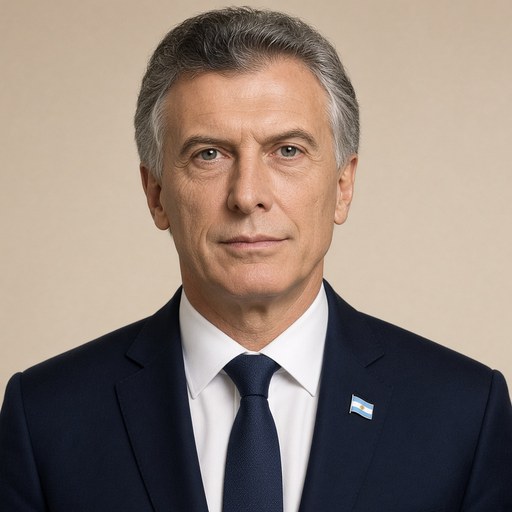
Words of President Mauricio Macri at the inauguration of the San Martín railway viaduct.
 Mauricio Macri · President of Argentina
- Context
- Macri spoke at the inauguration of the San Martín railway viaduct in Buenos Aires on July 11, 2019, celebrating infrastructure progress and broader national development.
- Main themes
- Infrastructure development, railway viaducts and underpasses, urban mobility and transportation, removal of barriers to progress, public service and good governance, anti-corruption values, Argentina's economic opening, digital innovation in trade and transit, long-term planning, Buenos Aires city transformation
- Duration
- ~11 min
- Words
- 1,325
- Sentences
- 43
- Readability
- 38
- Grade
- 15.4
- Syntax
- 3.35
- Vocabulary
- 2.08
Translated from Spanish
The broad sphere of national life a sentence belongs to. Every sentence has an Arena, so it is the denominator the other indices are read against.
Other43 sentences in 8 paragraphs
Good morning, good morning, at the beginning of this short week, what better way to start it than by valuing what we are capable of doing, as Horacio said? Congratulations Horacio, Franco, the whole team, Guillo. This is truly a work of international quality.
But I cannot also fail to remember, it’s not that I’m getting a little older and nostalgic, but it was about 13, 11, 12 years ago when we sat down to make the first government plans for the City of Buenos Aires, where we became aware of something very emblematic, which paradoxically, I would say, is full in the country, but in this case, there were physical barriers, obstacles in the streets throughout the City. More than 100 barriers. And we saw that in 100 years only four underpasses had been built. We said, “what a task.” It was truly overwhelming to think if we would be able to remove so many barriers. It was an immense job, but, as was said, it was worth it because it was to change the lives not only of the neighbors of the City of Buenos Aires but also of hundreds of thousands of residents of Buenos Aires who enter the City every day by train. So we set out to plan, to explain, because it had been so long since it had been done that the neighbors, when you went to the neighborhood to tell them “we want to build an underpass,” would immediately say “no, just in case, no.” As it usually happens, just in case, we say no and then we start to listen. And there we built, in eight years, 24. And suddenly, in three and a half years, a revolution thanks to the Mitre viaduct inaugurated today, the San Martín, plus the Belgrano Sur will be more than 27, plus all the streets that are being unlocked. They are really dozens. And one asks why, if in eight years they built 24, now, in such a short time, they are doing so much more? Is it a coincidence? Is it an act of magic? No, this is causality. This has to do with having laid the foundations, which in this case is a learning curve, planning, teamwork, and thinking in the medium and long term, not always thinking about tomorrow because the conflicts we do not resolve accumulate. And this work in the City of Buenos Aires is a change in circulation that will continue, because now we have the capacity, we already know what it’s about, we already know what we want, and we already know that we can, this does not stop. Horacio and his team, combined with the national Transport team, will continue, as it continues in the province, as María Eugenia says. And now, we are doing it in the province.
And, precisely, when we think about the country, Argentina has not grown as it should for decades because it has been filled with barriers, it has been filled with obstacles, and in these three and a half years the most important thing we have done is to tackle the first barrier, which is the one of the things and the values on which we want to live, and the things we never want again. What we said three and a half years ago was that we never want lies again, never scams again, never corruption again, never tricks again, never shortcuts again, never the misunderstood criollo culture, the misunderstood viveza criolla. And, having decided that, and having already changed that, is that we began to remove the physical barriers and that is why these viaducts are transforming into routes, into highways throughout the country, into trains that begin to transport not only Argentinians better but also the work of Argentinians, into ports, into airports, into energy that had become a new barrier because we had run out of energy.
And all of this is based on understanding that being a public servant, being in politics is to make the right effort, and the right effort involves helping another Argentine to be able to develop, to be able to progress. And a society full of obstacles and barriers cannot progress, a society that decides to reconnect with the world again, which was another barrier, the isolation we had with the world, if it wants to sell its work it has to have a mechanism in which it can develop it. And there, we developed the VUCE, the Single Window for Foreign Trade so that any Argentine, anywhere in Argentina, without leaving their small factory, their small plant, their home, their office, or wherever they work, can digitally make their work reach another part of the world. Or, like this development we have made, which I congratulate you Guillo, “When do I board?” is wonderful. Did you see, María Eugenia, what that is? For the people in the province who have to take buses every day to come, and the people in the capital, that is 15, 20 minutes that one loses to be able to take a little better care that their child has everything they need to go to school, or to tidy up their house, or to sleep a little more, and not even have the uncertainty of being at a bus stop for 20 minutes waiting for it to come, on cold days like we had last week, and not to mention the insecurity. With this development, we have not only made the right effort taking care of Argentinians, but we have really returned millions of hours, from now on, to hundreds of thousands of Argentinians.
And this is so valuable, so valuable, and if all of us who are in politics, and we all should at some point in our history, dedicate ourselves to helping others, through doing good politics, if we all understand this, this is something that is contagious, and that every day leads us to do more things. Like this highway that we have also generated in the European Union-Mercosur agreement, first, having recovered good relations with our neighbors that when we came to government were all in short circuit, starting with the Uruguayans. And today, together, we made this agreement with the Europeans where many of our families came from. And this is also a highway of growth because it is an agreement that allows us to commit reciprocally to comply, to have clear rules of the game and that will allow us to have more Argentine work in order to provide services to this entire European Union, this block of countries in Europe.
So, each of these things is demonstrating that we can, that of course we can, that resignation is not something that can be accepted, that Argentinians deserve to live much better than we have lived. And I insist, our life, our habits, are generated in the day-to-day and that generates customs in this that began in Argentina three and a half years ago, which is the commitment to do, to create, to innovate, this is becoming contagious. And this that we have done and that has cost us so much these three and a half years, and I also know all that it has cost us, this has generated a foundation on which we project greater and faster growth for the next 20 years. Because, I insist, this is contagious, and when one sees that the person next to them has the will to do, and is not afraid to innovate, to change, to bet, that infects the other, and that is starting to happen in every corner of Argentina.
That is why, today, more than ever, I want to thank the whole team for what they have done in this work, once again demonstrating what we are capable of doing, and inviting Argentinians to continue, to continue together because together we are unstoppable, gentlemen, we are unstoppable.
Thank you all. Congratulations. Congratulations.
The original Spanish. The tags above are read on the English translation's sentences.
Buenos días, buenos días, en el comienzo de esta semana corta ¿qué mejor manera de empezarla poniendo que en valor lo que somos capaces de hacer, como decía Horacio? Felicitaciones Horacio, Franco, todo el equipo, Guillo. Esta es una obra realmente de calidad internacional.
Pero, no puedo, también, dejar de recordar, no es que me estoy poniendo un poquito más viejo y nostálgico, pero fueron como 13, 11, 12 años atrás cuando nos sentamos a hacer los primeros planes de gobierno para la Ciudad de Buenos Aires, donde tomamos conciencia, algo muy emblemático, que paradójicamente, diría yo, que está lleno el país, pero en este caso eran barreras físicas, trabas en calles por toda la Ciudad. Más de 100 barreras. Y vimos que en 100 años se habían hecho nada más que cuatro pasos bajo nivel. Nosotros dijimos “qué tarea”. Realmente, era apabullante pensar si íbamos a poder llegar a remover tantas barreras. Era un trabajo inmenso, pero, también, como se dijo, valía la pena porque era para cambiarle la vida no sólo a los vecinos de la Ciudad de Buenos Aires, sino a cientos de miles de bonaerenses que ingresan todos los días por el ferrocarril a la Ciudad de Buenos Aires. Así que nos pusimos en marcha a planificar, a explicar, porque hace tanto que no se hacía que los vecinos, cuando ibas al barrio a decirles “queremos hacer un paso bajo nivel”, de entrada, decían “no, por las dudas, no”. Como pasa generalmente que, por las dudas, decimos que no y después empezamos a escuchar. Y ahí hicimos, en ocho años, 24. Y, de golpe, en tres años y medio, una revolución gracias al viaducto del Mitre inaugurado, el de hoy, el San Martín, más el del Belgrano Sur van a ser más de 27, más todas las calles que se destraban. Son realmente decenas. Y uno dice ¿por qué, si en ocho hicieron 24, ahora, en tan poco tiempo, hacen tanto más? ¿Es una casualidad? ¿Es un acto de magia? No, esto es causalidad. Esto tiene que ver con haber hecho las bases, que en este caso es una curva de aprendizaje, una planificación, un trabajo en equipo, y el pensar en el mediano y largo plazo, no estar pensando siempre en mañana porque los conflictos que no resolvemos se nos acumulan. Y, este trabajo en la Ciudad de Buenos Aires es recambio en la circulación que seguirá, porque como ya tenemos la capacidad, ya sabemos de qué se trata, ya sabemos lo que queremos, y ya sabemos que podemos, esto no para. Horacio y su equipo, combinado con el equipo de Transporte nacional, seguirán, como sigue en la provincia, como dice María Eugenia. Y, ahora, estamos haciéndolo en la provincia.
Y, justamente, cuando pensamos en el país, la Argentina hace décadas que dejó de crecer como debía porque se llenó de barreras, se llenó de trabas, y en estos tres años y medio lo más importante que hemos hecho es encarar la primera barrera, que es la de las cosas y los valores sobre los cuales queremos vivir, y las cosas que no queremos nunca más. Lo que dijimos hace tres años y medio fue que no queremos nunca más mentiras, nunca más estafas, nunca más corrupción, nunca más trampas, nunca más atajos, nunca más la cultura criolla mal entendida, la viveza criolla mal entendida. Y, habiendo decidido eso, y habiendo cambiado eso ya, es que comenzamos a remover las barreras físicas y por eso estos viaductos se transforman en rutas, en autopistas por todo el país, en trenes que empiezan a transportar no sólo mejor a los argentinos, sino el trabajo de los argentinos, en puertos, en aeropuertos, en energía que se había transformado en una nueva barrera porque nos habíamos quedado sin energía.
Y, todo eso, basado en entender que ser servidor público, estar en política es para hacer el esfuerzo correcto, y el esfuerzo correcto pasa por ayudar a otro argentino a poder desarrollarse, a poder progresar. Y una sociedad llena de trabas y de barreras no puede progresar, una sociedad que se decide a vincularse nuevamente con el mundo, que era otra barrera el aislamiento que tuvimos con el mundo, si quiere vender su trabajo tiene que tener un mecanismo en el cual lo pueda desarrollar. Y, ahí, desarrollamos la VUCE, la Ventanilla Única de Comercio Exterior para que cualquier argentino, en cualquier lugar de la Argentina, sin moverse de su pequeña fábrica, de su pequeña planta, de su casa, su oficina, o de donde trabaje, pueda hacer de forma digital que su trabajo llegue a otra parte del mundo. O, como este desarrollo que hemos hecho, que te felicito Guillo, de “¿Cuándo subo?” es maravilloso. ¿Vos viste, María Eugenia, lo que es eso? Para que la gente de la provincia que tiene que tomar los colectivos todos los días para venir, y la gente en la capital, eso es 15, 20 minutos que uno pierde de poder ocuparse un poquito mejor de que su hijo tenga todo lo que necesita para ir al colegio, o de emprolijar su casa, o de dormir un poco más, y ni siquiera tener la incertidumbre de estar en una parada de colectivo 20 minutos esperando que venga, en días de frío como lo que tuvimos la semana pasada, y ni que hablar de la inseguridad. Con este desarrollo, no sólo hemos hecho el esfuerzo correcto ocupándonos de los argentinos, sino que realmente le hemos devuelto millones de horas, a partir de ahora, a cientos de miles de argentinos.
Y esto es tan valioso, tan valioso, y si todos los que estamos en política, y todos deberíamos en algún momento, en nuestra historia, dedicarnos a ayudar al otro, a través de hacer buena política, si todos entendemos esto, esto es algo que se contagia, y que todos los días nos lleva a hacer más cosas. Como es esta autopista también que hemos generado en el acuerdo Unión Europea-Mercosur, primero, habiendo recuperado las buenas relaciones con nuestros vecinos que cuando llegamos al gobierno estaban todas en corto circuito, empezando por los uruguayos. Y, hoy, juntos, hicimos este acuerdo con los europeos donde muchas de nuestras familias de ahí vinieron. Y ésta es una autopista también de crecimiento porque es un convenio que nos permite comprometernos recíprocamente a cumplir, a tener reglas de juego claras y eso nos va a permitir tener más trabajo argentino en función de brindarle servicios a toda esta Unión Europea, este bloque de países de Europa.
Entonces, cada una de estas cosas lo que está demostrando es que podemos, que claro que podemos, que la resignación no es algo que pueda aceptarse, que los argentinos merecemos vivir mucho mejor de lo que hemos vivido. Y que, insisto, nuestra vida, nuestros hábitos, se generan en el día a día y eso genera costumbres en esto que comenzó en la Argentina hace tres años y medio, que es el compromiso por el hacer, por el crear, por el innovar, esto se va contagiando. Y esto que hemos hecho y que nos costó tanto estos tres años y medio, y yo sé también todo lo que nos ha costado, esto ha generado unas bases sobre las cuales proyectamos un crecimiento mayor y más rápido para los próximos 20 años. Porque, insisto, esto se contagia, y cuando uno ve que el de al lado tiene voluntad de hacer, y no tiene miedo a innovar, a cambiar, a apostar, eso contagia al otro, y eso está empezando a pasar en cada rincón de la Argentina.
Por eso, hoy, más que nunca, quiero agradecerle a todo el equipo lo que ha hecho en esta obra, una vez más, demostrando lo que somos capaces de hacer, e invitar a los argentinos a que sigamos, a que sigamos juntos porque juntos somos imparables, señores, somos imparables.
Gracias a todos. Felicitaciones. Felicitaciones.