




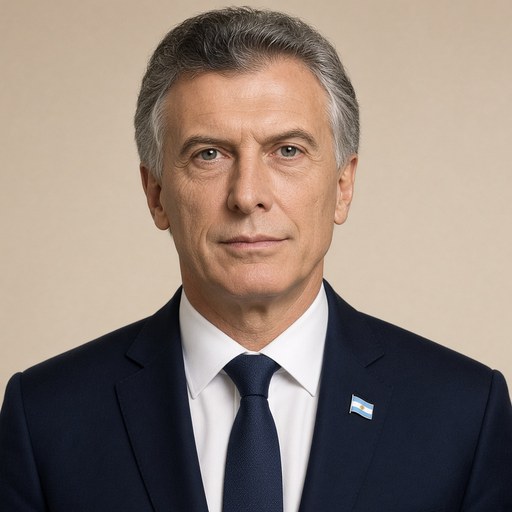
Words of President Macri at the meeting of the Montevideo Circle Foundation, in Buenos Aires.
 Mauricio Macri · President of Argentina
- Context
- Macri addressed the Montevideo Circle Foundation in Buenos Aires in May 2017, speaking alongside former heads of government about Latin America's regional challenges and opportunities.
- Main themes
- Regional opportunities for Latin America, institutional strengthening, globalization and technology disruption, education reform, economic development, regional integration, artificial intelligence and robotics, youth and change, political leadership, food and energy security, expectations revolution
- Duration
- ~18 min
- Words
- 2,133
- Sentences
- 43
- Readability
- 30
- Grade
- 20.9
- Syntax
- 3.82
- Vocabulary
- 1.95
Translated from Spanish
The broad sphere of national life a sentence belongs to. Every sentence has an Arena, so it is the denominator the other indices are read against.
Other43 sentences in 9 paragraphs
PRESIDENT.- Good morning everyone, thank you to the Montevideo Circle for inviting me to share with four masters – I would say – the kids today would say: “four bosses,” because they have already governed, they did it well, they did a lot of good for their societies. I personally learned a lot from you; the world always surprises you, I found it funny – Julio – that you all gathered to say: “the world and the future are changing” and it changes more and more, and that is a wonderful challenge, and the things that were bad or disadvantages can today be advantages. Being far from the center of the world now seems like an advantage; before it was that Argentina was out of sync with the world, with Chile, with Uruguay, with Paraguay, we were all in the other world. And now the other world presents itself almost as the only region of peace, which can offer something as valuable as that, that we really do not have deep conflicts, neither cultural, nor religious, nor historical. Really, when you see, for example, how close we were to a war with Chile, a few decades ago, and today the relationship we have, it’s as if now we are all thinking about integrating. And that changed rapidly as it changed in the previous century, with Brazil.
So, I say that we are facing a very complex world, where the central countries have many more doubts than certainties and we have more certainties, because as we come from behind we know that there is a time that is almost obvious that already gives us a task, which is to improve institutions, improve infrastructure, improve education levels, which there is – perhaps – another great opportunity because we stayed – like Argentina and I cannot comment on other countries because you have improved a lot and it shows in the PISA Tests, from being the leaders in education in Latin America, to being at the back of the pack, but now the entire education system is in crisis, so it’s not that we have to catch up, but rather to dare to revolutionize. And that is where we all find our limits, because beyond the fact that there is a group that resists prioritizing their personal interest, their small niche of power, even – sometimes – exercised in a mafia-like manner, the majority what happens is that they are afraid of change, they are afraid to let go of the known for something different. That is where there is a very deep debate, but where the young people force us, because young people have another boldness, which is typical of age, typical of this device that has revolutionized everything, which is the cell phone and that connects them instantly with the content they want. So, I believe that the world presents itself as something very challenging, but I feel that for our region it is a moment of opportunities, it is not a defensive moment, but rather an expansive moment: food security, energy security, a refuge of peace. I believe we have many tools to capitalize on this moment, we really have to seriously strengthen institutions, there we are uneven. I feel that Chile has taken an advantage, a serious work of more than 20 years; Uruguay, in its own way too, even though they are very self-critical internally, for some things that have happened in recent years and I feel that Brazil and Argentina are, in different ways, trying to strengthen them.
That is the great challenge, because moving away from discretion, from unipersonal leadership is what – ultimately – gives you solidity, when there is a thinking group that reaffirms values, ideas, objectives. That is what we need to consolidate in Argentina.
-Second intervention of the PRESIDENT.- Engineer, you have made a very global and accurate reasoning, where you raise on one hand what Chile is experiencing that we talked about the other day with Felipe, in another “parents and children” meeting, which is the revolution of expectations. When one empowers, which is what one wants, the individual, that human being discovers, begins to become aware that they can, that they must, that they deserve and begins this issue of there being a kind of dissatisfaction. It is an important issue, really. The other that intersects in your reasoning is that some of those who are already in a position of discomfort ask to be defended in that position and believe that the isolation of their country will guarantee that. I do not believe that the problem is globalization, the problem is technology, which revolutionizes everything one knows. So, no matter how much one closes off, how much the United States closes off, technology is inside, Silicon Valley, so they have to close Silicon Valley, because Silicon Valley is the one that drives artificial intelligence, robotics, synthetic food, from there it can come out that (inaudible) they end up without harvesting what they harvest; so, I believe that the challenge is wrong to pose it in those terms. And I would say that, going to the heart of the matter and what I really believe, is that at the end of the road we are here, in this world, to try to be happy; so the question we should all bring to the debate permanently, what is it that truly makes us happy? Is it happy to know that we preserve a right and without any obligation? Which is almost like saying a right without any challenge? Does a life without challenges, a life without surpassing ourselves make us happy? I say, that is where we have to have the discussion, because it is difficult… I see with my children when I talk, they do not envision a life of gaining securities, it’s as if they want to live each moment, they are not thinking about how to save for the next step, if they want to get married, it’s like a freer thing; but they have to preserve, even in that freedom, not the spirit of sacrifice, but that effort to surpass oneself is what will allow you to be well with yourself, and that is what at the end of the day ensures you have a state of mind that moves you every morning, without an alarm clock, that you leave your house to do what you have to do because you are engaged with your task. I believe that is the fundamental challenge and I think the most important thing that as governors we have to do, and that is at the center of our agenda, is to achieve that people communicate, to achieve that they can relate, because in that dynamic things happen, and today they are the roads, the airports, the ports, the bridges, but it is also, of course, the internet. Yesterday I went to Malargüe, in the middle of the mountains, to a small town, Barbas Blancas, with less than 100 inhabitants, because we brought them fiber and today they have internet at the speed they need. There are 140 people and the revolution they felt to be connected with Argentina, connected with the world for the first time, to think that they can study remotely without having to move or leave their place, that they like that place in the world, one goes there and says “how many lives are there in this world” because in the middle of nowhere one does not understand why that little town is there, why someone once made that little town. And the truth is it’s wonderful, maybe we complicate those people’s lives because now they are going to connect and start having demands they didn’t have before, that can happen, but they wanted to be connected, and it was very good, and on top of that it resolved a strange symmetry because 30 kilometers away is this European space satellite station that has this antenna that is about to connect with Mercury and Jupiter, and they couldn’t connect with the capital of Mendoza, well, now things have evened out. I believe that the center of the issue for me is to understand how one reaches happiness and that can vindicate the fact that there must be obligations, without obligations it is difficult for there to be happiness.
-Third intervention of the President.- You know, Felipe, that I cannot agree more with everything you have said, I started to say it as Mayor, as Head of Government, of the City of Buenos Aires, when the problems started with Antonio Ledesma, who was my colleague in Venezuela, in the city of Caracas, then they continued with Leopoldo López, and Lilian Tintori was at all our campaign events, she was on stage with us, because I wanted to show Venezuelans that we are with them, we owe them that. Let us remember that it was one of the countries that received the most Argentines during the dictatorship, who had to go into exile. Venezuela was a place that welcomed many and it was really very important, but – unfortunately – I still do not see the exits, because this issue that there is always one more step to Hell with the issue of Venezuela has been verified, because three years ago I heard: “they cannot be worse” and how much worse they are, how much worse will they be in a month, and in two months, because the food situation, the situation in health is catastrophic. Today I saw numbers of all the things that can exist, that have already been banished in the 21st century and there they have returned as pandemics and epidemics, in Venezuela and the truth is that it is very concerning.
But it also serves to understand the importance of what happened in Argentina, the importance of what we lived in Argentina, the decision that Argentines made because we were walking in that direction, there is no doubt, because denying reality, destroying and combating institutional balances, freedom of the press – as Julio said at the beginning – what they sought was to fabricate their own movie, – which is what Chávez did first, and Maduro, later - denying the systematic deterioration that we were living in Argentina and an example of what could have happened in our country, if we continued in that policy, is what is being lived in Santa Cruz, which is where it was governed in that way, for more than 20 years, not for 12 years.
So, I want to thank you again for this opportunity, to tell you that Argentina is living this moment with a lot of intensity; there is a lot of internal debate still, there are many fears, there is a lot of clinging to the idea that things were better and why change, and this means committing personal effort; there are fears of integrating into the world and, the truth is, that isolating ourselves from the world has brought us a consolidated 30 percent poverty.
That is why I celebrate this more dynamic beginning of going to a new level of Mercosur, because Mercosur is full of holes, there is a political thing that worked very well, but that we did not consolidate afterwards and now the world that should associate with Mercosur will find that they have a single currency, absolute macroeconomic coordination and we still have things to improve and we have to converge with the Pacific Alliance, because we have to be a unit. So there are many challenges to face, but for me they are all challenges, that if we dare, will allow us to reinvent ourselves which is the most beautiful thing that can happen to you in life, to build a new life within the same life. And that is also where the courage of the business community is needed, that does not want to defend their little corner and that understands that if they have entrepreneurial capacity, have access to financing, as Argentina has today, they will be able to re-equip themselves, reinvent themselves and expand their offer to the world, taking into account that we have two things, which are wonderful: invaluable human resources and abundant natural resources. So what needs to be done is to combine them with a government that facilitates, that simplifies and does not put obstacles all the time and is like wanting to take from you before you can fly. Here we need to generate wealth to be able to distribute it, a State that does it fairly, that clearly combats all types of exclusion, starting from the improvement in education, access to training and work, which is the true solution to poverty.
So thank you for the invitation, thank you very much.
The original Spanish. The tags above are read on the English translation's sentences.
PRESIDENTE.- Buenos días a todos, gracias al Círculo de Montevideo, por invitarme a compartir con cuatro maestros – diría yo- los chicos hoy en día dirían: “cuatro capos”, porque ellos ya gobernaron, lo hicieron bien, le hicieron mucho bien a sus sociedades. Yo particularmente aprendí mucho de ustedes; siempre el mundo te sorprende, me causó gracias – Julio – que ustedes se reunieron para decir: “el mundo y el futuro está cambiando” y cada vez cambia más y eso es una maravilloso desafío y las cosas que eran malas o desventajas, pueden ser, hoy ventajas. Estar lejos del centro del mundo, hoy parece una ventaja; y antes era que la Argentina está desfasada del mundo, de Chile, de Uruguay, de Paraguay, todos estábamos en el otro mundo. Y ahora el otro mundo se presenta casi como la única región de paz, que puede ofrecer algo que es tan valioso como eso, que no tenemos realmente profundos conflictos ni culturales, ni religiosos, ni históricos. Realmente cuando uno ve, por ejemplo, lo cerca que estuvimos de una guerra con Chile, hace algunas décadas, y hoy la relación que tenemos, es como que ahora estamos pensando todos en integrarnos. Y eso cambió vertiginosamente como cambió en el siglo anterior, con Brasil.
Entonces, yo digo que estamos ante un mundo muy complejo, donde los países centrales tienen muchas más dudas que certezas y nosotros tenemos más certezas, porque como nosotros venimos atrás sabemos que hay un tiempo que es como obvio que ya nos da una tarea, que es mejorar las instituciones, mejorar la infraestructura, mejorar los niveles de educación, que ahí es – tal vez – otra gran oportunidad porque nosotros nos quedamos – como Argentina y no puedo opinar como otros países porque ustedes han mejorado mucho y lo muestran las Pruebas Pisas, de ser el liderazgo de la educación, en América latina, a ocupar el pelotón de atrás, pero ahora está todo el sistema de educación en crisis, con lo cual no es que tenemos que alcanzar, sino a animarnos a revolucionar. Y ahí es donde todos encontramos nuestros límites, porque más allá de que hay un grupo que se resiste al privilegiar su interés personal, su pequeño nicho de poder, hasta – a veces – ejercido en forma mafiosa, a la mayoría lo que le pasa es que le da miedo el cambio, le da miedo soltar lo conocido por algo diferente. Ahí es donde hay un debate muy profundo, pero donde los jóvenes obligan, porque los jóvenes tienen otra audacia, que es propio de la edad, propio de este aparato que ha revolucionado todo, que es el celular y que los hace conectarse instantáneamente con los contenidos que ellos quieren. Entonces, creo que se presenta el mundo como algo muy desafiante, pero yo siento que para nuestra región es un momento de oportunidades, no es un momento defensivo, sino es un momento expansivo: seguridad alimentaria, seguridad energética, refugio de zona de paz. Creo que tenemos muchas herramientas para capitalizar este momento, tenemos que realmente, en serio, fortalecer las instituciones, ahí estamos desparejos. Siento que en Chile tomó una ventaja, un trabajo serio de más de 20 años; Uruguay, a su manera también, por más que están con mucha autocrítica interna, por algunas cosas, que han pasado en los últimos años y siento que por ahí Brasil y Argentina estamos, de distintas maneras, intentando fortalecerlas.
Ese es el gran desafío, porque salir de la discrecionalidad, del liderazgo unipersonal es lo que – finalmente – te da la solidez, cuando hay un conjunto pensante que reafirma valores, ideas, objetivos. Eso es lo que necesitamos consolidar en la Argentina.
-Segunda intervención del PRESIDENTE.- Ingeniero, usted ha hecho un razonamiento muy global y acertado, donde plantea por un parte lo que vive Chile que lo hablábamos el otro día con Felipe, en otra reunión de “padres e hijos”, que es la revolución de las expectativas. Cuando uno empodera, que es lo que uno quiere, al individuo, ese ser humano descubre, empieza a tomar conciencia de que puede, que debe, que merece y empieza este tema de que hay una cosa como de insatisfacción. Es un tema, ese es un tema importante, realmente. El otro que se cruza en su razonamiento es que algunos de los que ya están en posición de incomodidad piden que se les defienda esa posición y creen que el aislamiento de su país les va a garantizar eso. Yo no creo que el problema sea la globalización, el problema es la tecnología, que revoluciona todo lo que uno conoce. Entonces, por más que uno se cierre, que Estados Unidos se cierre, la tecnología la tiene adentro, Sillicon Valley, entonces tiene que cerrar Sillicon Valley, porque Sillicon Valley es el que impulsa inteligencia artificial, robótica, alimentación sintética, de ahí puede llegar a salir que (inaudible) se queden sin cosechar lo que cosechan; entonces, creo que el desafío es equivocado plantearlo en esos términos. Y yo diría que, yendo al centro de la cuestión y lo que yo realmente creo, es que al final del camino estamos acá, en este mundo, para intentar ser felices; entonces la pregunta que deberíamos todos llevar al debate permanentemente, ¿qué es lo que verdaderamente nos hace felices? ¿Feliz es saber que conservamos un derecho y sin ninguna obligación?, que es casi como decir ¿un derecho sin ningún desafío?, ¿nos hace felices una vida sin desafíos, una vida sin superarnos? Yo digo, ahí es donde tenemos que dar la discusión, porque es difícil… Yo veo con mis hijos cuando hablo, ellos no se plantean una vida de ganar seguridades, es como que quieren vivir cada momento, no están pensando cómo ahorrar para el siguiente paso, si se quieren casar, es como una cosa más libre; pero tienen que conservar, aún en esa libertad, no el espíritu del sacrificio, sino que ese esfuerzo por superarte es el que te va a permitir estar bien con vos mismo, y eso es lo que al final del día te asegura tener un estado de ánimo que te movilice todas las mañanas, sin despertador, que salgas de tu casa a hacer lo que tengas que hacer porque estás enganchado con tu tarea. Yo creo que ahí es el desafío de fondo y creo que lo más importante que como gobernantes tenemos que hacer, y que está en el centro de nuestra agenda, es lograr que la gente se comunique, lograr que se pueda relacionar, porque en esa dinámica se producen cosas, y hoy son las rutas, los aeropuertos, los puertos, los puentes, pero también es, por supuesto, internet. Ayer me fui a Malargüe, en el medio de las montañas, a una pequeña población, Barbas Blancas, menos de 100 habitantes, porque les llevamos la fibra y hoy tienen internet a la velocidad que necesiten. Son 140 personas y la revolución que sentían ellos de verse conectados con la Argentina, conectados con el mundo por primera vez, de pensar que pueden estudiar a distancia sin tener que moverse ni abandonar su lugar, que a ellos les gusta ese lugar en el mundo, uno va ahí y dice “qué cantidad de vidas hay en este mundo” porque en medio de nada uno no entiende por qué está ese pueblito ahí, por qué alguna vez alguien hizo ese pueblito. Y la verdad es maravilloso, tal vez le compliquemos la vida a esa gente porque ahora se va a conectar y va a empezar a tener demandas que no tenía antes, puede pasar, pero ellos querían estar conectados, y estaba muy bueno, y encima resolvió una simetría extraña porque a 30 kilómetros está esta estación satelital espacial europea que tiene esta antena que está por conectar ya también con Mercurio y con Júpiter, y ellos no se podían conectar con la capital de Mendoza, bueno, ahora se emparejó la cosa. Yo creo que, el centro del tema para mí es entender de qué manera uno llega a la felicidad y eso puede reivindicar el hecho de que hay que tener obligaciones, sin obligaciones es difícil que haya felicidad
-Tercera intervención Presidente.- Sabés, Felipe, que no puedo estar más de acuerdo con todos lo que has dicho, lo empecé a decir como Alcalde, como Jefe de Gobierno, de la Ciudad de Buenos Aires, cuando empezaron los problemas con Antonio Ledesma, que era mi colega en Venezuela, en la ciudad de Caracas, después siguieron con Leopoldo López, y Lilian Tintori estuvo en todos los actos nuestros de campaña, estuvo en el escenario con nosotros, porque yo quería mostrarle a los venezolanos que estamos con ellos, se lo debemos. Recordemos que fue uno de los países que más argentinos recibió, durante la dictadura, que tuvieron que ir al exilio. Venezuela fue un lugar que los acogió a muchos y realmente fue muy importante, pero – lamentablemente – sigo sin ver las salidas, porque este tema de que siempre hay un escalón más al Infierno con el tema de Venezuela se ha verificado, porque ya hace tres años escuchaba: “peor no pueden estar” y cuánto peor están, cuánto peor van a estar dentro de un mes, y dentro de dos meses, porque la situación alimentaria, la situación en el tema de salud es catastrófica. Hoy veía números de todas las cosas que pueden haber, que ya en el siglo XXI, se han desterrado y allí han vuelto como pandemias y epidemias, en Venezuela y la verdad es que es muy preocupante.
Pero también vale para entender lo importante de lo que pasó, en la Argentina, lo importante que vivimos en la Argentina, la decisión que tomaron los argentinos porque nosotros caminábamos en esa dirección, no hay dudas, porque negando la realidad, destruyendo y combatiendo los equilibrios institucionales, la libertad de prensa – como dijo Julio, al principio – lo que buscaban era fabricarse su propia película,- que es lo que ha hecho Chávez, primero, y Maduro, después - negando el deterioro sistemático que estábamos viviendo en la Argentina y un ejemplo de lo que podía haber pasado en nuestro país, si continuábamos en esa política, es lo que se está viviendo en Santa Cruz, que es donde se lo gobernó de esa manera, por más de 20 años, no por 12 años.
Entonces, creo agradecerles nuevamente esta oportunidad, decirles que la Argentina vive con mucha intensidad, este momento; hay mucho debate interno todavía, hay muchos miedos, hay mucho aferrarse a que se estaba mejor y por qué cambiar, y esto significa comprometer un esfuerzo personal; hay miedos a integrarse al mundo y, la verdad, que aislarnos del mundo nos trajo 30 por ciento consolidado de pobreza.
Por eso festejo este comienzo más dinámico de ir a un nuevo escalón del Mercosur, porque el Mercosur está lleno de agujeros, hay una cosa política que funcionó muy bien, pero que después no consolidamos y ahora el mundo que debería asociarse con el Mercosur se va a encontrar con que ellos tienen moneda única, coordinación absoluta macroeconómica y nosotros todavía tenemos cosas que mejorar y tenemos que converger con la Alianza para el Pacífico, porque tenemos que ser una unidad. Entonces son muchos desafíos a encarar, pero para mí son todos desafíos, que si nos animamos, nos van a permitir reinventarnos que es lo más lindo que te puede pasar en la vida, construir una nueva vida dentro de la misma vida. Y ahí también es donde hace falta el coraje del empresariado, que no quiera defender también su rinconcito y que entienda que si tiene capacidad emprendedora, tiene acceso al financiamiento, como hoy tiene la Argentina, va a poder reequiparse, reinventarse y ampliar su oferta hacia el mundo, teniendo en cuenta que tenemos dos cosas, que son maravillosas: valiosísimos recursos humanos y cuantiosos recursos naturales. Así que lo que hay que hacer es combinarlos con un gobierno que facilite, que simplifique y no que te ponga trabas todo el tiempo y esté como queriéndote antes de que puedas volar a ver qué te puedo sacar. Aquí hay que generar riquezas para poderla distribuir, un Estado que lo haga de forma justa, que claramente combata todo tipo de exclusión, a partir de la mejora en la educación, un acceso a la capacitación y al trabajo, que es la verdadera solución a la pobreza.
Así que gracias por la invitación, muchas gracias.