




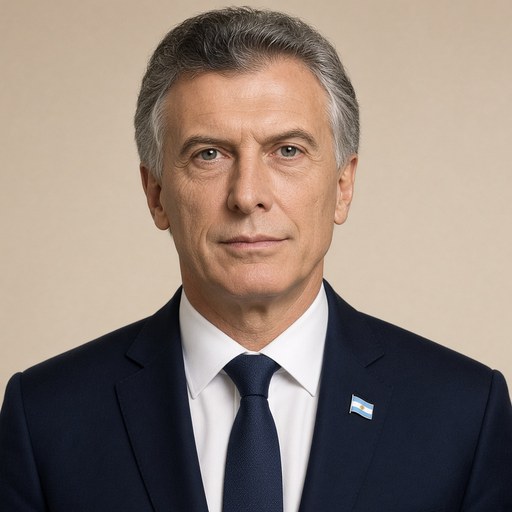
Words of President Macri at the presentation of the National Disability Plan, at the CCK.
 Mauricio Macri · President of Argentina
- Context
- Macri addressed attendees at the CCK cultural center in Buenos Aires on May 11, 2017, to launch Argentina's National Disability Plan.
- Main themes
- National disability plan, inclusion of people with disabilities, dignity and rights of persons with disabilities, zero poverty goal, truth and correct diagnosis, community maturity and growth, personal fulfillment and choice, overcoming fear and prejudice, family and social impact of disability
- Duration
- ~5 min
- Words
- 659
- Sentences
- 16
- Readability
- 43
- Grade
- 17.5
- Syntax
- 3.72
- Vocabulary
- 1.75
Translated from Spanish
The broad sphere of national life a sentence belongs to. Every sentence has an Arena, so it is the denominator the other indices are read against.
Other16 sentences in 11 paragraphs
Good morning everyone, thank you for being here, thank you for believing that we can build a better Argentina.
And thank you Gabi, today perhaps more than ever it is difficult to add anything to all the beautiful things you said.
But I want to say that I have learned a lot alongside Gabi, it has been many years that she has put up with me, and I have learned from what she is as a woman, as a person, the attitude, the strength she has in life, the conviction with which she has faced the issue of her disability.
And listening to this video, listening to her words, what it leads us to is something that is one of the most beautiful exercises one can do in life as a person, which is to put oneself in the place of the other, to try to see things as other people see them, because it is always easy to put oneself in what one sees, to believe that one is right and that what one does is correct, that exercise is difficult, and this is one of those moments in which we have to think about what the other needs.
I believe it is wonderful that we start as a focus by telling each other the truth, as we are doing in all fields of Argentina. Here we have an issue that we have wanted to ignore, that we have wanted to hide, and we need to know what is happening to Argentina regarding disability. That is why the first fundamental step is to reach the correct diagnosis and to do it together, as Gabi said and emphasized many times, we have to do it together, understand, evaluate, and learn to find the best solutions that lead us to inclusion, which is really the issue. Understanding also that one is surprised when we say that there are more than five million people with disabilities, that if we multiply by family and friends, half of Argentines are related to disability.
And the underlying issue, also what Gabriela said, is the dignity of each person having their own life, because when you say: What are the rights of people with disabilities? The same as everyone else's: to work, to study, to play sports, to nourish themselves with culture; all things that lead to personal fulfillment.
And we are here committed precisely to generating the possibility of choice, and if we understand that the key is inclusion, if we understand that to include is, I insist, for someone to be able to choose what they can work on, what they can study, where they can live, there we have a huge field of things to do together.
I really want to commit all of you once again, I know we are all committed, that we all believe in that Argentina that walks every day taking a small step forward towards "zero poverty," which is what we want, even though it is a long journey, but the important thing, and I emphasize it time and again, is that each day we are a little better, that is the challenge.
And here we have so much to do, because if we really manage to promote a National Disability Plan we will demonstrate a maturity, a growth as a community that overcomes the means. I also learned to lose those fears, I also had them, it is very human, do not punish yourselves for that, but we have to understand that we should not have fears or prejudices, and from that place, we have so much to build.
So I am happy to be here, happy that Gabriela has taken this baton, which was a decision she also measured and evaluated before taking it, and I believe it will be very important for Argentina, it will be a before and after for all Argentines.
So let’s work together and thank you all for joining us.
The original Spanish. The tags above are read on the English translation's sentences.
Buenos días a todos, gracias por estar acá, gracias por creer que podemos construir una Argentina mejor.
Y gracias Gabi, hoy tal vez más que nunca es difícil agregar algo a todas las cosas tan lindas que dijiste.
Pero quiero decir que yo aprendí mucho al lado de Gabi, son muchos años ya que me aguanta, y aprendí de lo que es ella como mujer, como persona, la actitud, la fuerza que tiene en la vida, la convicción con que encaró el tema de su discapacidad.
Y escuchando este video, escuchando sus palabras, a lo que nos lleva es a algo que es uno de los ejercicios más lindos que uno puede hacer en la vida como persona, que es ponerse en el lugar del otro, tratar de ver las cosas como las ven las otras personas, porque siempre es fácil ponerse en lo que uno ve, creer que uno tiene razón y que lo que uno hace es lo correcto, cuesta ese ejercicio, y este es un momento de esos en los cuales tenemos que pensar en qué es lo que necesita el otro.
Yo creo que es maravilloso esto de que arranquemos como eje diciéndonos la verdad, como lo estamos haciendo en todos los campos de la Argentina. Acá tenemos un tema que lo hemos querido ignorar, que lo hemos querido esconder, y tenemos que saber qué es lo que le pasa a la Argentina con discapacidad. Por eso el primer paso fundamental es llegar al diagnóstico correcto y hacerlo entre todos, como lo dijo Gabi y lo recalcó muchas veces, tenemos que hacerlo juntos, entender, evaluar y aprender para encontrar las mejores soluciones que nos lleven a la inclusión, que es realmente el tema. Entendiendo además que uno se sorprende cuando decimos que hay más de cinco millones de personas con discapacidad, que si multiplicamos por la familia y por los amigos, la mitad de los argentinos estamos en relación con la discapacidad.
Y el tema de fondo, también lo que dijo Gabriela, es la dignidad de tener cada uno su vida propia, porque cuando decís: ¿Cuáles son los derechos de las personas con discapacidad? Los mismos que los de todos: a trabajar, a estudiar, a hacer deporte, a nutrirse de la cultura; todas cosas que te llevan a la realización personal.
Y estamos acá comprometidos justamente en generar la posibilidad de elegir, y si entendemos que la clave es la inclusión, si entendemos que incluir es, insisto, que alguien pueda elegir en qué puede trabajar, qué puede estudiar, dónde puede vivir, ahí tenemos un campo enorme de cosas a hacer en conjunto.
Yo quiero realmente comprometerlos a todos una vez más, sé que estamos todos comprometidos, que todos creemos en esa Argentina que camina todos los días dando un pequeño paso adelante hacia “pobreza cero”, que es lo que queremos, por más que sea un largo recorrido, pero lo importante, y lo rescato una y otra vez, es que cada día estemos un poco mejor, ese es el desafío.
Y acá tenemos muchísimo para hacer, porque si nosotros realmente logramos impulsar un Plan Nacional de Discapacidad vamos a demostrar una madurez, un crecimiento como comunidad que vence los medios. Yo también aprendí a perder esos miedos, yo también los tenía, es muy humano, tampoco se castiguen por eso, pero tenemos que entender que no tenemos que tener miedos ni prejuicios, y tenemos desde ese lugar muchísimo para construir.
Así que feliz de estar acá, feliz de que Gabriela haya tomado esta posta, que fue una decisión también que ella la mensuró y la evaluó hasta tomarla, y creo que va a ser muy importante para la Argentina, va a ser un antes y un después para todos los argentinos.
Así que a trabajar juntos y muchas gracias a todos por acompañarnos. (APLAUSOS)