




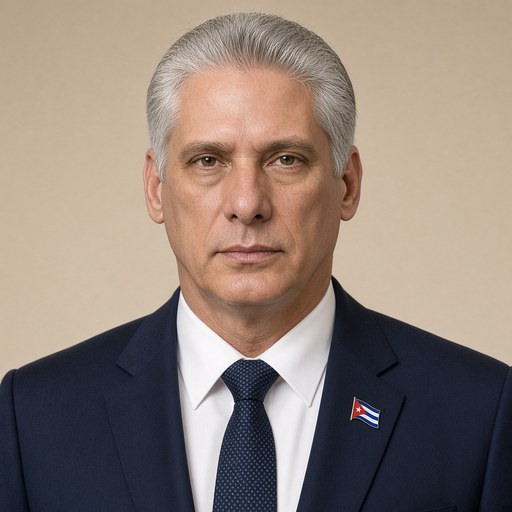
Intervention of the President of the Republic, at the Second Extraordinary Session of the National Assembly of People's Power.
 Miguel Díaz-Canel · President of Cuba
- Context
- Díaz-Canel addressed the National Assembly of People's Power at its Second Extraordinary Session on May 26, 2023, to advocate for Cuba's new Social Communication Law.
- Main themes
- Social Communication Law, socialist construction, digital communication, media literacy, information and knowledge society, U.S. confrontation policy, community and organizational communication, digital platforms and transnationals, role of citizens in communication, regulatory framework, media independence
- Duration
- ~13 min
- Words
- 1,510
- Sentences
- 47
- Readability
- 20
- Grade
- 18.2
- Syntax
- 3.25
- Vocabulary
- 2.29
Translated from Spanish
The broad sphere of national life a sentence belongs to. Every sentence has an Arena, so it is the denominator the other indices are read against.
Other47 sentences in 31 paragraphs
Dear Army General Raúl Castro Ruz, leader of the Cuban Revolution;
Dear President Lazo;
Dear deputies;
Distinguished members of the Drafting Commission of the Social Communication Law:
I want to share some considerations about the content of the law, especially regarding the challenges we face with its implementation and the importance of social communication for our country and for our process of socialist construction.
But first, I would like to express, influenced by what we have been experiencing in this debate, that I feel a deep admiration for the young deputies who have offered us here today comprehensive, forceful, cultured, just, moving, and committed arguments regarding this Law.
The Law, as has been expressed here, represents a first step in the process of regulation and organization of the social communication system in Cuba, and it should be understood as such, even though it is the result of a long process of debate and review. It is not set in stone, as nothing related to social communication can be in the fast-paced era we live in, precisely as a consequence of the development of the so-called information and knowledge society. Although the declared objectives and the wording of the articles of this Law have a necessarily regulatory approach, its greatest value lies in the recognition of the potentialities and benefits of social communication for the development of the country.
The long period of confrontation and the aggressiveness that characterizes the criminal policy of the U.S. government impacts all areas of Cuban society and, in particular, in communication; but it is not, by any means, the reason for this Law. What we are called to approve today is fundamentally the design of a framework of possibilities that point to the development of the social communication system in Cuba, which we have also conceived as one of the pillars of government management.
If the norm has limits, and it does, it is because it recognizes and expresses the current state in the areas of knowledge and professional practice associated with communication in Cuba, which means that it must necessarily continue to be articulated and developed.
Including aspects related to organizational and community communication and not only media or specifically press-related communication provides a more comprehensive view of what communication is. One of the great challenges that the new Law imposes on us right now derives from the conceptions, missions, and interpretation of communication in the digital realm and its integration with the rest of the system due to the complexity of a scenario that evolves at an unprecedented speed, as we had discussed earlier.
I would like to emphasize the importance of recognizing and including the role and place of people in organizational, media, and community spheres, as all those who participate in communication processes influence, interact, relate, have levels of influence, and, in sum, act directly or indirectly in their functioning logics and decide to some degree the effectiveness of communication.
On the other hand, these spheres only make sense in their interrelation with people, from the actions designed for them, with them, or taking into account their characteristics and/or needs.
It is fundamental and necessary that alongside this Law and in favor of its more effective implementation, education for communication and media and information literacy for people in our country, that is, for our people, is promoted and encouraged. I speak of the urgent need to equip the population with knowledge, skills, and tools for a critical understanding and valuation of the functioning logics of the media, in addition to enhancing and facilitating access to them and to information and communication technologies.
Recognizing and valuing education for communication is crucial to embrace the new communication processes that are manifesting today, especially in the digital space, including those that exist and those we wish to create or strengthen as a socialist society.
It is essential to understand how much the development of information and communication technologies has impacted the role of the subjects involved in those processes. It is no longer a simple sender-message-receiver formula; today, a single user on any digital platform can have more impact than traditional media, even those with a presence on social networks. Presence does not guarantee visibility.
More than two-thirds of the global population accesses the Internet regularly today, but this space is increasingly dominated by a small group of transnationals that, through platforms, services, and systems, have managed to capture the traffic and attention of practically all users. This level of concentration of consumption on platforms that are not publicly owned and that impose restrictions on user practices based on their interests, even if they claim otherwise in discourse, as well as the mechanisms for filtering information based on algorithms, make access to information and communication possibilities, in short, increasingly less public and democratic.
As the Law is a norm of high strategic impact for regulating one of the areas most attacked against Cuba, some of the main debates in intellectual and professional sectors have focused on specific aspects of the norm that could favor or legitimize certain manifestations of subversion and impact on national security, in a context of intense media warfare.
The main elements of debate have had a preventive focus against subversion and mainly point to the nature of the media and their ownership, the regulation surrounding the figure of sponsorship, and, within this, patronage.
In light of those concerns, adjustments were made to its articles and statements, seeking to eliminate ambiguities and avoid future interpretations that could contradict the spirit and letter of the Constitution. In fact, the Law refers to the Constitution at least twenty times, and it is expressly mentioned 14 times that they must be governed in accordance with the laws and other normative provisions in force.
The Law recognizes that the information supporting communication processes must be truthful, objective, timely, updated, verified, and comprehensible. These are basic principles.
Regarding communication in the organizational realm, the Law we have just discussed must become a permanent working tool to fully understand that the goal is not the message conveyed, but the essential utility of communication management in relation to the strategic objectives of the entity.
This legislation should allow us to overcome gaps and overcome institutional inertia. In the face of a specific situation that is negatively impacting the population, the responsible public servants are obliged to inform immediately from all possible spaces. For its part, it is up to the press to responsibly report every sensitive piece of information for the people first.
It is time to understand and employ all the resources of social communication to promote participation, transparency, accountability, to share, that is, to unite all our knowledge in order to extract the best ideas, articulate ourselves, and generate consensus.
We live in a structured and organized country where much work is done to resist the onslaught of a hostile and suffocating harassment, always with the effort to move forward, towards greater social well-being.
It fundamentally falls to social communication to contribute to the construction of the country’s image in accordance with the attributes that identify the nation and the reality we live in. That strategic project may be designed by experts, but we build it together every single day. That truth, of which the people are the fundamental protagonists, must be made known and must be told every day. Let us do it without grandiloquence – as I expressed on one occasion – or boasting, from responsibility, ethics, and virtue, from firmness and coherence, from elegance and moderation; without rhetoric that provokes overwhelm and rejection; with arguments and feelings, from sensitivity.
The Revolution is true dialogue that places truth and ethics above indecency and perversity, that does not negotiate its existence, does not legitimize mercenaries, and acts with security and firmness. In front of us, we have more than one space taken by extremists, fundamentalists, where anti-Cuban forces, generators of hate, act in a permanent disposition for lynching based on lies, manipulation, distortions, incitement to violence, and even military aggression.
One of the most popular musical groups inside and outside of Cuba, Buena Fe, is currently suffering the attack of professional haters encouraged from toxic platforms, with a single objective: to provoke the end of the Revolution.
Anyone who defends the truth today is exposed not only to paying the price for their ideas but also to personal disqualification, censorship, and hatred.
We are not afraid of the challenge; we take it on with pride and dignity, but that defense is only part of our sense of nation, which has been shaped by the sum of the individualities that we are, united essentially in the efforts to overcome our shortcomings and in the communion of dreams to be achieved.
One of the experts who has contributed the most to the legal text, Dr. Hilda Saladrigas, has summarized a fundamental essence of this Law in a phrase with which I would like to conclude: Cuba, in its particularity, can and must carry out all social communication practices differently, in a revolutionary way.
Thank you very much.
The original Spanish. The tags above are read on the English translation's sentences.
Querido General de Ejército Raúl Castro Ruz, líder de la Revolución Cubana;
Querido Presidente Lazo;
Queridas diputadas y diputados;
Distinguidos miembros de la Comisión Redactora de la Ley de Comunicación Social:
Quiero compartir algunas consideraciones sobre el contenido de la misma, sobre todo, de los retos que tenemos con su implementación y la importancia de la comunicación social para nuestro país y para nuestro proceso de construcción socialista.
Pero antes quisiera expresar, bajo la influencia de lo que hemos estado viviendo en este debate, que siento una admiración profunda por las jóvenes diputadas y jóvenes diputados que nos han ofrecido hoy aquí integrales, contundentes, cultos, justos, conmovedores y comprometidos argumentos con relación a esta Ley (Aplausos).
La Ley, como aquí se ha expresado, representa un primer paso en el proceso de regulación y organización del sistema de comunicación social en Cuba, y así debe ser entendida aun cuando sea fruto de un largo proceso de debate y de revisión. No está escrita en piedra, como no puede estarlo nada relacionado con la comunicación social en la veloz época en que vivimos, justamente como consecuencia del desarrollo de la llamada sociedad de la información y el conocimiento. Aunque los objetivos declarados y la redacción de los artículos de esta Ley tienen un enfoque necesariamente regulatorio, su mayor valor radica en el reconocimiento de las potencialidades y beneficios de la comunicación social para el desarrollo del país.
El largo periodo de confrontación y la agresividad que caracteriza la criminal política del Gobierno estadounidense impacta en todos los ámbitos de la sociedad cubana y, de manera particular, en lo comunicacional; pero no es, ni de lejos, la razón de esta Ley. Lo que estamos convocados a aprobar hoy es fundamentalmente el diseño de un marco de posibilidades que apunten al desarrollo del sistema de comunicación social en Cuba, que, además, hemos concebido como uno de los pilares de la gestión del Gobierno.
Si la norma tiene límites, y los tiene, es porque reconoce y expresa el estado actual en las áreas del conocimiento y la práctica profesional asociada a la comunicación en Cuba, eso significa que necesariamente deberá seguir articulándose y desarrollándose.
Incluir aspectos relacionados con la comunicación organizacional y comunitaria y no solo mediática o asociada específicamente a la prensa, aporta una visión más integral de lo que es la comunicación. Uno de los grandes desafíos que nos impone ahora mismo la nueva Ley se deriva de las concepciones, misiones e interpretación de la comunicación en el ámbito digital y su integración con el resto del sistema por la complejidad de un escenario que evoluciona a una velocidad sin precedentes, tal como habíamos comentado antes.
Quisiera resaltar la importancia de reconocer e incluir el papel y lugar de las personas en los ámbitos organizacional, mediático y comunitario, pues todos los que participan en los procesos comunicacionales inciden, interactúan, se relacionan, tienen niveles de influencia y, en suma, actúan de forma directa o indirecta en sus lógicas de funcionamiento y deciden en algún grado la eficacia de la comunicación.
Por otra parte, estos ámbitos solo cobran sentido en su interrelación con las personas, desde las acciones que se diseñan para ellas, con ellas o teniendo en cuenta sus características y/o necesidades.
Es fundamental y necesario que junto con esta Ley y a favor de su implementación más efectiva se promueva e impulse la educación para la comunicación y la alfabetización mediática e informacional de las personas en nuestro país, o sea, de nuestro pueblo. Hablo de la necesidad imperiosa de dotar a la población de conocimientos, capacidades y herramientas para una comprensión y valoración crítica de las lógicas de funcionamiento de los medios, además de potenciar y facilitar el acceso a ellos y a las tecnologías de la información y la comunicación.
Reconocer y ponderar la educación para la comunicación es crucial para asumir los nuevos procesos comunicacionales que hoy se manifiestan, sobre todo, en el espacio digital, incluyendo los que existen y los que deseamos crear o fortalecer como sociedad socialista.
Es imprescindible comprender cuánto ha impactado el desarrollo de las tecnologías de la información y la comunicación en el rol de los sujetos que intervienen en esos procesos. Ya no se trata de la simple fórmula emisor-mensaje-receptor, hoy puede tener más impacto un solo usuario en cualquier plataforma digital, que los tradicionales medios de comunicación, incluso aquellos con presencia en las redes. Presencia no garantiza visibilidad.
Más de dos tercios de la población global accede hoy con cierta regularidad a Internet, pero este espacio está cada vez más dominado por un grupo reducido de transnacionales que a través de plataformas, servicios y sistemas ha logrado captar el tráfico y la atención de prácticamente todos los usuarios. Este nivel de concentración del consumo en plataformas que no son de propiedad pública y que establecen restricciones a las prácticas de los usuarios en función de sus intereses, aunque en el discurso digan lo contrario, así como los mecanismos de filtrado de la información a partir de algoritmos hacen que el acceso a la información y las posibilidades de comunicación sean, en apretada síntesis, cada vez menos de dominio y uso público, cada vez menos democráticos.
Como la Ley es una norma de alto impacto estratégico por regular uno de los ámbitos de mayor ataque contra Cuba, algunos de los debates principales en sectores intelectuales y profesionales se han centrado en aspectos puntuales de la norma que pudieran favorecer o legitimar determinadas manifestaciones de subversión e impacto para la seguridad nacional, en un contexto de intensa guerra mediática.
Los principales elementos de debate han tenido un enfoque preventivo ante la subversión y apuntan principalmente hacia el carácter de los medios y su propiedad, la regulación en torno a la figura del patrocinio y, dentro de esta, el mecenazgo.
En función de esas preocupaciones se hicieron ajustes en su articulado y enunciados, buscando eliminar ambigüedades y evitar futuras interpretaciones que pudieran contradecir el espíritu y la letra de la Constitución. De hecho, la Ley se refiere –y esta cuenta la hizo Rosa Miriam, no yo– a la Constitución al menos veinte veces, y se recuerda en 14 menciones expresas que deben regirse conforme a las leyes y otras disposiciones normativas vigentes.
La Ley reconoce que la información que soporta los procesos comunicacionales ha de ser veraz, objetiva, oportuna, actualizada, verificada y comprensible. Estos son principios básicos.
En cuanto a la comunicación en el ámbito organizacional, la Ley que hoy terminamos de discutir debe convertirse en un instrumento de trabajo permanente para terminar de entender que el fin no es el mensaje que traslade, sino la utilidad imprescindible de la gestión comunicacional en función de los objetivos estratégicos de la entidad.
Esta legislación debe permitirnos superar los vacíos y vencer las inercias institucionales. Ante una situación determinada que esté impactando negativamente en la población, los servidores públicos responsables están obligados a informar de inmediato desde todos los espacios posibles. Por su parte, toca a la prensa contar primero y responsablemente cada información sensible para el pueblo.
Es hora de comprender y emplear todos los recursos de la comunicación social para favorecer la participación, la transparencia, la rendición de cuentas, para poner en común, es decir, unir todos nuestros conocimientos en función de extraer las mejores ideas, articularnos y generar consensos.
Vivimos en un país estructurado y organizado donde se trabaja mucho para resistir el embate de un acoso hostil y asfixiante, siempre con el empeño de seguir adelante, hacia un mayor bienestar social.
Compete fundamentalmente a la comunicación social contribuir a la construcción de la imagen país en correspondencia con los atributos que identifican a la nación y la realidad que vivimos. Ese proyecto estratégico podrá ser diseñado por expertos, pero lo construimos todos cada uno de los días. Esa verdad, de la que el pueblo es protagonista fundamental, hay que hacerla notar y hay que contarla todos los días. Hagámoslo sin altisonancia –como expresé en una ocasión– ni alardes, desde la responsabilidad, la ética y la virtud, desde la firmeza y la coherencia, desde la elegancia y la mesura; sin retóricas que provoquen agobio y rechazo; con argumentos y sentimientos, desde la sensibilidad.
La Revolución es diálogo verdadero que antepone la verdad y la ética a la indecencia y la perversidad, que no negocia su existencia, no legitima mercenarios y actúa con seguridad y firmeza. Enfrente tenemos más de un espacio tomado por extremistas, fundamentalistas, donde las fuerzas anticubanas, generadoras de odio, actúan en permanente disposición para el linchamiento basadas en mentiras, manipulación, tergiversaciones, incitación a la violencia e, incluso, a la agresión militar.
Una de las agrupaciones musicales más populares dentro y fuera de Cuba, Buena Fe, está sufriendo ahora mismo el ataque de odiadores profesionales alentados desde plataformas tóxicas, con un solo objetivo: provocar el fin de la Revolución.
Cualquiera que hoy defiende la verdad está expuesto no solo a pagar el precio por sus ideas, sino a sufrir la descalificación personal, la censura y el odio.
No nos asusta el desafío, lo asumimos con orgullo y dignidad, pero esa defensa es solo una parte de nuestro sentido de nación, que se ha conformado con la suma de las individualidades que somos, unidas esencialmente en los esfuerzos por superar nuestras insuficiencias y en la comunión de sueños por alcanzar.
Una de las expertas que más ha contribuido al texto legal, la doctora Hilda Saladrigas, ha resumido una esencia fundamental de esta Ley en una frase con la que quisiera concluir: Cuba, en su particularidad, puede y debe hacer las prácticas todas y las comunicativas sociales de modo diferente, de modo revolucionario.
Muchas gracias (Aplausos prolongados).