




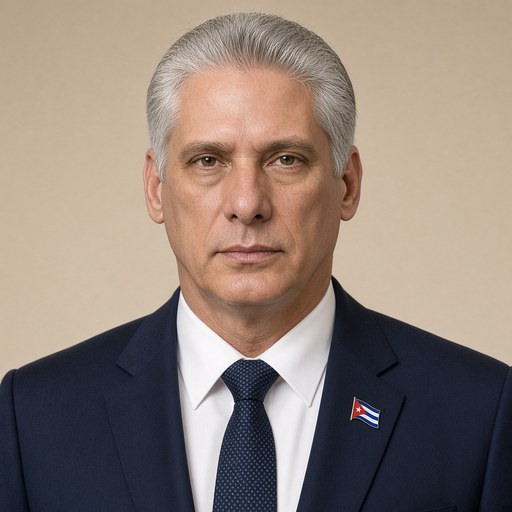
Speech delivered by President Díaz-Canel at the closing of the VI International Conference for the Balance of the World.
 Miguel Díaz-Canel · President of Cuba
- Context
- Díaz-Canel addressed the closing session of the VI International Conference for the Balance of the World in Havana on January 31, 2025, honoring José Martí's 172nd birth anniversary.
- Main themes
- José Martí's legacy and eternal relevance, Cuban resistance and sovereignty, international solidarity with Cuba, Palestinian cause, U.S. blockade and Guantánamo, human dignity and anti-imperialism, balance of the world, migration and deportation, optimism and virtue, ideas as weapons of emancipation
- Duration
- ~30 min
- Words
- 3,607
- Sentences
- 115
- Readability
- 36
- Grade
- 15.9
- Syntax
- 3.30
- Vocabulary
- 2.37
Translated from Spanish
The broad sphere of national life a sentence belongs to. Every sentence has an Arena, so it is the denominator the other indices are read against.
Other115 sentences in 63 paragraphs
Dear friends, dear comrades, Martians and Martians who fight for the balance of the world with the weapons of ideas, the only ones capable of saving and emancipating human beings:
I want to start by thanking you for your enthusiastic and contributory participation in this event that calls upon a man of 172 years who, however, is not an old man: José Martí is an eternal man, something that does not need to be explained in Cuba, because we feel it everywhere.
And it needs even less explanation before an audience like this, because it is precisely from that eternity that makes José Martí a contemporary of ours, but also of the girls and boys yet to be born, that you have spoken the most during these Martian days in Havana.
I always like to start by thanking the visitors for the audacity of making their solidarity with Cuba effective in person, because they not only do so by assuming the costs of travel and stay, but they also face threats and punishments, specially designed to condemn us to solitude, since no other weapon has worked in the attempt to subdue the rebellious and dignified people of Fidel and Raúl Castro, leaders of the generation that did not let Martí die in the year of his centenary.
The massive attendance at this conference, with more than a thousand people from 98 countries, including more than 400 Cuban delegates, is also a tremendous encouragement to the people of Cuba, because it is a recognition of their heroic resistance in the context of a world in threatening imbalance for the human species, where even dignity is negotiated.
Cuba knows this very well, as it has been paying for 66 years the high price of having no price. Because, as the eternal man who calls us and brings us together said, “poverty passes: what does not pass is the dishonor that, under the pretext of poverty, men often cast upon themselves.”
Martí was perfectly defined by the Cuban poet José Lezama Lima as “the mystery that accompanies us,” an expression that could be interpreted as the depths of knowledge and love that, being so immense, never fully get deciphered.
And it is very true: for Cubans, Martí accompanies us incessantly. His presence ranges from a simple bust dedicated to him in a school, a workshop, a factory, or a hospital, to the dazzling that continues to assail us as we read his verses or his definitions that seem written for the 21st century. And that discovery occurs while we traverse total admiration for the coherences of his thought and his way of acting.
But Martí accompanies not only Cubans, but all citizens of the world who firmly believe in the possibility of improving and balancing this world, and who do so against the current of the barbarism now visible in the height of greed and in the infinite pains caused by the greedy due to their absolute contempt for human suffering.
I speak first of the Palestinian holocaust at the hands of the Government of Israel and of those who feed that desire to kill, but also of the brutal persecution and humiliating deportation, handcuffed and chained, of thousands of migrants who have broken their backs under the whip of the economic imbalance that forced them to emigrate. From here we demand that Palestine be free!
And I speak, of course, of Cuba, hundreds of times a victim of terrorism, whose noble name has been included and re-included in an infamous list of supposed sponsors of terrorism, so that obedient international banks close their doors to any commercial or financial management that contributes to meeting the basic needs of the Cuban people.
I speak of Cuba, from which the United States stole a piece of land in the name of a friendship that it never honored by using that territory, illegally occupied for more than a century, as a military base and prison where people declared enemies and guilty by the empire are tortured and locked in a legal limbo, most of the time without a single piece of evidence of their crime.
As if that infamy, which has been condemned hundreds of times by international courts, were not enough, they now tell us that they will send 30,000 deportees to the U.S. Naval Base in Guantánamo. Again the illegality, the disregard for international treaties, and the unacceptable idea that there are countries and people superior to the rest of humanity.
Despite the odds, as we say here, and the presidential orders of the masters of the world, we will not be silent in the face of infamy nor will we lose confidence and faith in human improvement, future life, and the utility of virtue.
Martí also accompanies us in optimism, because in him we have the hopeful being for whom Pope Francis cries out, and we have the fighter who came to express that “Human honor is imperishable and irreducible, and nothing disintegrates or diminishes it, and when it is managed to be oppressed and faded from one side, it leaps inflamed and powerful from another.”
For affirmations like that, he becomes a reference for us and someone indispensable to undertake the daily battle for justice on a planet about to agonize under the empire of greed. We do not give up! We learned with Martí that from pain and the need to put an end to it, the forces and the will to face and overcome the greatest challenges are born.
The great poetess and devoted Martian Fina García Marruz, tirelessly studying the work of the Apostle, pointed to some keys to understanding the routes of the radicalization of his political thought.
Fina, the companion of the also teacher and very Martian Cintio Vitier, has said the following about Martí: “The revolutionary organizer is born in the Presidio. There he understood that it was unfeasible to build, with hatred, a triumphant revolution. He thought that our battle obeyed justice, not revenge. With his fiery speeches, he turned the worst of enemies into a friend. He ignited the flame of love.”
And Martí is the same human being who – perhaps because of his poetic essence, his extreme sensitivity, and his analytical capacity that allowed him to see where others remained blind – radicalizes to such an extent that in an unfinished letter to his dearest brother, Manuel Mercado, he leaves written a central paragraph for the destiny of Cuba, which almost all Cubans know by heart.
Martí says: “I am already in danger every day of giving my life for my country and for my duty – since I understand it and I have the spirit to fulfill it – to prevent in time, with the independence of Cuba, the United States from extending through the Antilles and falling, with that force, upon our lands of America. Everything I have done until today, and will do, is for that.”
It seems he said it all and for all times, as if he had no barriers of time. Martí is read and his ideas remain of inexhaustible utility, even though he was not a witness to the discoveries that humanity has experienced after he heroically fell in combat.
Few like him could foresee, at the very hour of his birth, this danger that now overflows before our eyes, of a modern empire that disrespects rights in the name of a divine mandate, willing to raze the very balances of civilization.
It seems he expressed himself for these hours by predicting that “when empires reach the peak of their prosperity, they are on the edge of the precipice that devours them.”
He defined like no one else the “greedy neighbor, who openly wishes us ill” and asked to be alert “to the possible greed of a strong and unequal neighbor”; and in the case of Cuba, he spoke about “the independence of the happy archipelago that nature placed at the knot of the world.”
He knew that, for reasons of origin, while those from the North bought, those from the South cried, and it is then that he emphasized the need to understand that essential difference, so that only a bridge of mutual respect between two cultural universes would be viable.
He never promoted animosity against the good and talented children of the continental North, but his reflection was of utmost clarity regarding the risks of accepting that the newly liberated nations from the decaying Spanish empire fell subordinated in an unequal relationship with the new empire in gestation.
This can be verified in his essential essay “Nuestra América,” where he states: “We can no longer be the people of leaves, who live in the air, with the crown loaded with flowers, crackling or buzzing, depending on whether the whim of light caresses it, or the tempests thunder and cut it down; the trees must line up, so that the giant of the seven leagues does not pass! It is the hour of reckoning and of united march, and we must walk in a tight square, like silver in the roots of the Andes.”
That Martian alert serves today for the whole world and not only for our America, all of us, in some way, facing the appetites of the Rome of the 21st century that has shown itself capable of arrogantly trampling over human diversity.
Surely many of us, even in this Martian audience, have wondered why Martí emphasized the centrality of Cuba and by extension of the Antilles in the balance of the world.
Doctor Armando Hart Dávalos, father of these events For the Balance of the World, answered the question in more than one text or conference. I quote one of his articles:
“The question we must ask ourselves is why Martí wanted a free Cuba, free Antilles, and a free America. He expressed it in such a clear way that it should leave no room for doubts or confusions. In his article on the commemoration of the second anniversary of the Cuban Revolutionary Party, published in 1894, he pointed out:
On the scale of America are the Antilles, which would be, if enslaved, a mere pontoon for the war of an imperial republic against the jealous and superior world that is already preparing to deny it power, –a mere fort of American Rome; –and if free –and worthy of being so by the order of equitable and working freedom –they would be in the continent the guarantee of balance, that of independence for the Spanish America still threatened and that of honor for the great republic of the North, which in the development of its territory –unfortunately, already feudal, and divided into hostile sections –will find more secure greatness than in the ignoble conquest of its smaller neighbors, and in the inhumane fight that with the possession of them it would open against the powers of the globe for the predominance of the world.”
Another indispensable Martian when it comes to understanding the fulfilled predictions of the Apostle is Doctor Pedro Pablo Rodríguez, who is here, patient and diligent director of the Critical Edition of the Complete Works of the Master. His substantial essay “José Martí and his concept of the balance of the world” cannot be overlooked to get to the bottom of Martí’s anxieties about the balance of the world. And here I will read more from the author Pedro Pablo, because I find the following fragment fundamental:
“A thinker of aphoristic and polysemic style, from the very beginning of his stay in New York, he systematically alerted about the expansionist danger represented by the emerging monopolies in the United States, which increasingly controlled the government elites and dedicated themselves to exercising politics through the corruption of democracy, imposing a foreign policy that controlled the Latin American markets supplying raw materials and food, and consumers of the northern industry. For those plutocratic interests, which Martí considered harmful also for the popular majorities of the United States, there were, in his view, no commercial or geographical borders to prevent, with the territorial, the consolidation of economic dominance over Latin America.
“Proof that these were not assumptions or dreams of a poet, but a brilliant analysis of the realities of his time and a lucid look at the immediate future is that between 1898 and 1930, the United States intervened militarily, and even governed directly in some cases, in Cuba, Puerto Rico, Panama, Colombia, the Dominican Republic, Haiti, Mexico, and Nicaragua.”
Later, Pedro Pablo explains something that is very present today, in our days, and Pedro Pablo says: “Obviously, the foreseeable proximity of the opening of the Panama Canal coincided with Martí and many observers of the time in the perception that with that route the importance of the Antillean and Central American zone for the geopolitics of the then hegemonic states would increase. So convinced was he of the importance of a balance between the great powers that in the Manifesto he wrote in the Dominican city of Montecristi to explain why the last War of Independence of Cuba began in February 1895, he states: ‘The war of independence of Cuba, the knot of the bundle of islands where the commerce of the continents will cross in a few years, is an event of great human reach, and an opportune service that the judicious heroism of the Antilles provides to the firmness and fair treatment of the American nations, and to the still wavering balance of the world.’”
Up to here the essential fragment of the essay by our dear Pedro Pablo. Surely you will find in several moments of what has been read, how much José Martí foresaw, and with how much reason, the serious dangers that are now looming over us today, when we are not even the united America that can face them.
Let us say it with absolute clarity. The conduct and aggressive pretensions of the United States, which manifest with the newly established government, threaten the very population of that country, especially the most humble and dispossessed segments. They also threaten international peace, including that of our region of Latin America and the Caribbean. It is not possible to ignore that reality.
In the political landscape of that country, the political, economic, and social forces that have gained the most influence embrace xenophobic, racist, discriminatory, and supremacist ideas that humanity has strived to overcome since the end of World War II and the defeat of Nazism and fascism 80 years ago.
It is a worrying phenomenon that is observed in several countries across various regions. Reactionary political parties and figures have been gaining ground. It is even manifested with the frequent and dangerous support of poor, humble, and working-class sectors, who identify with the politicians and programs that are representatives of these currents. It is a phenomenon often reflecting desperation, impotence, and pessimism in the face of growing injustice.
These currents are inherent to and a product of capitalism, with its selfish, predatory, and exclusionary nature. They have gained strength as a consequence of the expansion of neoliberal policies over the last 40 years and the resounding failure of these to respond to the interests and needs of the majority, to guarantee better living standards, and to promote social justice.
The most palpable result of these policies is the growth of inequalities, social polarization, exclusion, distrust towards others, and cultural, ethnic, and religious frictions. Their results also include disordered emigration, the growth of illegality, drug trafficking, and corruption.
They have largely contributed to the erosion of the sovereign power of several countries, to the loss of true self-determination, and to the rise of governments clearly subordinated to the will of imperialism and the large transnational corporations that sustain it.
Unfortunately, even when progressive or leftist forces have governed, they have, at certain times, lacked the time, strength, will, or sufficient independence to confront the neoliberal economic programs that are at the root of many of the political and social problems currently faced by developing countries.
The international order that emerged from the end of World War II, which largely prevails today, is an heir to colonialism, to the history of exploitation, plunder, and slavery that enriched a specific set of colonial powers and their societies, at the cost of suffering, uprooting, destruction, submission, and underdevelopment of the formerly colonized territories.
Imperialism as a system of domination is not a new phenomenon. However, the era of neoliberal globalization has taken on more sophisticated and less visible forms. It is no longer merely about direct territorial occupation, although this remains a current practice, as the heroic Palestinian brothers suffer firsthand. It is also manifested in the control of markets, natural resources, supply chains, and, above all, technology and information.
The oligarchies that dominate the world today not only accumulate wealth but also concentrate political, cultural, and social power, perpetuating a benefit that favors a few at the expense of many. Large industrial corporations, financial conglomerates, and tech giants have woven a web of influence that transcends borders. Their decisions affect the lives of millions of people, from access to medications to the privacy of our data. These elites seek not only to maximize their profits but also to consolidate their hegemony, imposing standards and norms that perpetuate the dependency of what is increasingly recognized as the Global South.
While colonialism was almost entirely abolished in the second half of the 20th century, its conditions and remnants have persisted in new modalities.
That is the essence of the current international order and explains the unacceptable reality that the gap between developed and underdeveloped countries tends to widen, rather than narrow, with no prospects for that trend to change.
There is no shortage of documents, declarations, speeches, and resolutions from the United Nations and its agencies that describe this scenario. The proposals on how to respond and what to do have a history that dates back at least to the 1960s. It is well known that the possibility of change and the prospect of a more just and sustainable international order have faced fierce resistance from the great economic and military powers, which are largely representative of the former colonial powers.
Developing nations, and especially their peoples, have the right to dream that a better world is possible, and they have the right and the duty to fight for it!
That will not be possible if significant progress is not made towards an international order different from the current one. It must be a truly democratic order, in which all nations have the opportunity to contribute and be genuinely represented on equal terms. It must be a sustainable order that promotes peace, the security of all, social justice, equitable prosperity, respect for cultural, ethnic, and religious plurality; that promotes democratic access to science and technology, and human rights for all, not just for privileged elites; that is based on solidarity, cooperation, and respect for the right of each country to choose its political, economic, and social system without foreign interference.
In that new order, the fundamental aspect is its content and the commitment we are capable of mobilizing to achieve it.
The challenges to achieve it or even to get closer to it are immense. How to do it is a difficult question to answer. But there is no doubt that unity, strategy, and a clear vision of what we want to achieve are required. And, as Fidel said: "Sow ideas! Sow ideas! Sow ideas! And sow consciousness!"
After reviewing José Martí and assessing the current moment, all doubts are cleared. It is he who warns us and is also the antidote against all imbalances, because he helps us understand the only possible language, by common: the human.
His spirit leads us to defend our ancestral roots, our identities that the new colonizers dream of dismantling, our dignity, our creative potential, the much-needed unity, the self-esteem of being the natural women and men that we are, courage, stoicism, sensitivity, that powerful force about which Martí said: "Through love, one sees. With love, one sees. Love is who sees."
From this platform we have erected in his memory, I want to share with you the fervent desire that Martí continues to summon us, that his optimism, raised like a sword, even in the most adverse scenarios, be our horizon and our guide, and that, sheltered in him, we are never abandoned by the certainty that, as he firmly stated: "Honor can be tarnished. Justice can be sold. Everything can be torn apart. But the notion of good floats above all, and never sinks."
Let us have as a legitimate aspiration to become, with daily effort and the best dreams, true disciples of José Martí, just as Fidel did and with him the Generation of the Centenary of Martí, as so many dignified men and women did who brought the Apostle to our time.
On those paths, I am sure we will find, day by day, meaning in his tremendous assertion that "Happiness exists on earth; and it is conquered with the prudent exercise of reason, the knowledge of the harmony of the universe, and the constant practice of generosity."
From free and sovereign Cuba, which resists and creates tirelessly, carrying in its heart "the doctrines of the Master," as Fidel did before those who judged him in 1953, we reaffirm to the Martians from all over who have accompanied us in these days, that we will continue to fight for the balance of the world, as a contribution to the preservation of the human species!
Long live Martí!
Long live his ideas!
Until Victory Always!
The original Spanish. The tags above are read on the English translation's sentences.
Queridas amigas, queridos amigos, martianas y martianos que batallan por el equilibrio del mundo con las armas de las ideas, las únicas capaces de salvar y emancipar a los seres humanos:
Quiero empezar por agradecerles su participación, entusiasta y aportadora, en este evento que convoca un hombre de 172 años que, sin embargo, no es un hombre viejo: José Martí es un hombre eterno, algo que no necesita explicarse en Cuba, porque lo sentimos por todas partes.
Y necesita explicarse menos ante un auditorio como este, porque justamente de esa eternidad que convierte a José Martí en un contemporáneo nuestro, pero también de las niñas y los niños que están por nacer, es de lo que más han hablado ustedes en estos días martianos en La Habana.
Siempre me gusta empezar por agradecer a los visitantes la osadía de hacer efectiva su solidaridad con Cuba de manera presencial, porque no solo lo hacen asumiendo costos de pasaje y estadía, sino que se enfrentan a amenazas y castigos, especialmente concebidos para condenarnos a la soledad, ya que ninguna otra arma ha funcionado en el intento de rendir al pueblo rebelde y digno de Fidel y Raúl Castro, líderes de la generación que no dejó morir a Martí en el año de su centenario.
La masiva asistencia a esta conferencia, con más de mil personas de 98 países, incluyendo más de 400 delegados cubanos es, además, un estímulo tremendo al pueblo de Cuba, porque es un reconocimiento a su heroica resistencia en el contexto de un mundo en amenazante desequilibrio para la especie humana, donde hasta la dignidad se negocia.
Lo sabe muy bien Cuba, que está pagando hace 66 años el altísimo precio de no tener precio. Porque, como dijo el hombre eterno que nos convoca y nos junta “la pobreza pasa: lo que no pasa es la deshonra que con pretexto de la pobreza suelen echar los hombres sobre sí”.
Martí fue perfectamente definido por el poeta cubano José Lezama Lima como “el misterio que nos acompaña”, una expresión que podría interpretarse como las honduras del saber y del amor que, de tan inmensas, nunca llegan a descifrarse del todo.
Y es muy cierto: a los cubanos, Martí nos acompaña de modo incesante. Su presencia va desde un sencillo busto dedicado a él en una escuela, un taller, una fábrica o un hospital, hasta el deslumbramiento que nos sigue asaltando mientras leemos sus versos o sus definiciones que parecen escritas para el siglo XXI. Y ese descubrimiento se da mientras transitamos por la admiración total ante las coherencias de su pensamiento y su forma de actuar.
Pero Martí acompaña no solo a los cubanos, sino a todos los ciudadanos del mundo que creen con firmeza en la posibilidad de mejorar y equilibrar este mundo, y que lo hacen a contracorriente de la barbarie hoy visible en el apogeo de la codicia y en los dolores infinitos que provocan los codiciosos por su desprecio absoluto al sufrimiento humano.
Hablo en primer lugar del holocausto palestino a manos del Gobierno de Israel y de quienes alimentan esas ganas de matar, pero también de la persecución brutal y la humillante deportación, esposados y encadenados, de miles de migrantes que se han quebrado las espaldas bajo el látigo del desequilibrio económico que los obligó a emigrar. ¡Desde aquí pedimos que Palestina sea libre! (Aplausos.)
Y hablo, por supuesto, de Cuba, cientos de veces víctima del terrorismo, cuyo noble nombre han incluido y vuelto a incluir en una lista infame de supuestos patrocinadores del terrorismo, para que los obedientes bancos internacionales le cierren las puertas a cualquier gestión comercial o financiera que tribute a solventar las necesidades básicas del pueblo cubano.
Hablo de Cuba, a la que Estados Unidos le robó un pedazo de tierra en nombre de una amistad que jamás honró al usar ese territorio, ilegalmente ocupado por más de un siglo, como base militar y prisión donde se tortura y se encierra en un limbo legal a personas que el imperio declara enemigas y culpables, la mayoría de las veces sin una sola evidencia de su crimen.
Como si no bastara esa infamia que ha sido condenada cientos de veces por tribunales internacionales, ahora nos dicen que a la Base Naval norteamericana en Guantánamo mandarán 30 000 deportados. Otra vez la ilegalidad, el desconocimiento de los tratados internacionales, y la idea inaceptable de que hay países y personas superiores al resto de la humanidad.
A pesar de los pesares, como decimos aquí, y de las órdenes presidenciales de los amos del mundo, no vamos a callar frente a la infamia ni vamos a perder la confianza y la fe en el mejoramiento humano, la vida futura y la utilidad de la virtud (Aplausos).
Martí nos acompaña también en el optimismo, porque en él tenemos al ser esperanzado por el que clama el Papa Francisco, y tenemos al luchador que llegó a expresar que “El honor humano es imperecedero e irreductible, y nada lo desintegra ni amengua, y cuando de un lado se logra oprimirlo y desvanecerlo, salta inflamado y poderoso de otro”.
Por afirmaciones como esa, él se nos convierte en referente y en alguien imprescindible para emprender la batalla cotidiana por la justicia en un planeta a punto de agonizar bajo el imperio de la codicia. ¡No nos rendimos! Aprendimos con Martí que del dolor y de la necesidad de ponerle fin, nacen las fuerzas y la voluntad para enfrentar y vencer los mayores desafíos.
La gran poetisa y martiana devota Fina García Marruz, estudiando sin descanso la obra del Apóstol, apuntaba a algunas claves para entender las rutas de la radicalización de su pensamiento político.
Ha dicho Fina, la compañera del también maestro y muy martiano Cintio Vitier, sobre Martí lo siguiente: “El organizador revolucionario nace en el Presidio. Allí comprendió que era irrealizable construir, con odio, una revolución triunfante. Pensaba que nuestra batalla obedecía a la justicia, no a la venganza. Con sus encendidos discursos, convirtió en amigo al peor de los enemigos. Prendió la llama del amor”.
Y es Martí el mismo ser humano que –tal vez por su esencia poética, por su sensibilidad extrema y su capacidad de análisis que le permitían ver donde otros permanecían ciegos– se va radicalizando a tal punto que en carta inconclusa a su hermano queridísimo, Manuel Mercado, deja escrito un párrafo medular para el destino de Cuba, que casi todos los cubanos sabemos de memoria.
Dice Martí: “ya estoy todos los días en peligro de dar mi vida por mi país y por mi deber –puesto que lo entiendo y tengo ánimos con que realizarlo– de impedir a tiempo con la independencia de Cuba que se extiendan por las Antillas los Estados Unidos y caigan, con esa fuerza más, sobre nuestras tierras de América. Cuanto hice hasta hoy, y haré, es para eso”.
Pareciera que lo dijo todo y para todos los tiempos, como si no hubiese tenido barreras de época. A Martí se le lee y sus ideas siguen siendo de una utilidad inagotable, aunque no haya sido testigo de descubrimientos que la humanidad ha vivido después que él cayera heroicamente en combate.
Pocos como él pudieron avizorar, en la hora misma de su nacimiento, este peligro que ahora se desborda ante nuestros ojos, de un imperio moderno que irrespeta derechos en nombre de un mandato divino, dispuesto a arrasar con los equilibrios mismos de la civilización.
Es que parece haberse expresado para estas horas al vaticinar que “cuando los imperios llegan a la cumbre de su prosperidad, están al borde del precipicio que los devora”.
Él definió como nadie al “vecino codicioso, que confesamente nos desea” y pidió estar alertas “frente a la codicia posible de un vecino fuerte y desigual”; y en el caso de Cuba, habló sobre “la independencia del archipiélago feliz que la naturaleza puso en el nudo del mundo”.
Sabía él que, por razones de origen, mientras los del Norte compraban, los del Sur llorábamos, y es entonces que puso énfasis en la necesidad de entender esa diferencia esencial, para que solo fuese viable un puente de respeto mutuo entre dos universos culturales.
Nunca promovió la animadversión contra los hijos buenos y talentosos de la masa continental del Norte, pero sí fue su reflexión de suma claridad en cuanto a los riesgos de aceptar que las naciones recién liberadas del decadente imperio español cayeran subordinadas en una relación desigual con el nuevo imperio en gestación.
Se puede verificar en su imprescindible ensayo “Nuestra América”, donde enuncia: “Ya no podemos ser el pueblo de hojas, que vive en el aire, con la copa cargada de flor, restallando o zumbando, según la acaricie el capricho de la luz, o la tundan y talen las tempestades; ¡los árboles se han de poner en fila, para que no pase el gigante de las siete leguas! Es la hora del recuento y de la marcha unida, y hemos de andar en cuadro apretado, como la plata en las raíces de los Andes”.
Esa alerta martiana sirve hoy para el mundo entero y no solo para nuestra América, enfrentados todos, de algún modo, a las apetencias de la Roma del siglo XXI que se ha mostrado capaz de pasar, prepotente, por sobre la diversidad humana.
Seguramente somos muchos, incluso en este auditorio martiano, los que nos hemos preguntado por qué el énfasis de Martí en la centralidad de Cuba y por extensión de las Antillas en el equilibrio del mundo.
El doctor Armando Hart Dávalos, padre de estos eventos Por el Equilibrio del Mundo, respondió la interrogante en más de un texto o conferencia. Cito uno de sus artículos:
“La pregunta que debemos hacernos es por qué Martí quería una Cuba libre, unas Antillas libres y una América libre. Lo expresó de una manera tan diáfana que no debería dar lugar a dudas o confusiones. En su artículo con motivo de la conmemoración del segundo aniversario del Partido Revolucionario Cubano, publicado en 1894, señaló:
En el fiel de América están las Antillas, que serían, si esclavas, mero pontón de la guerra de una república imperial contra el mundo celoso y superior que se prepara ya a negarle el poder, –mero fortín de la Roma americana; –y si libres– y dignas de serlo por el orden de la libertad equitativa y trabajadora –serían en el continente la garantía del equilibrio, la de la independencia para la América española aún amenazada y la del honor para la gran república del Norte, que en el desarrollo de su territorio– por desdicha, feudal ya, y repartido en secciones hostiles –hallará más segura grandeza que en la innoble conquista de sus vecinos menores, y en la pelea inhumana que con la posesión de ellas abriría contra las potencias del orbe por el predominio del mundo.”
Otro martiano indispensable a la hora de entender las cumplidas predicciones del Apóstol es el doctor Pedro Pablo Rodríguez, que está aquí, paciente y acucioso director de la Edición Crítica de las Obras Completas del Maestro. De su enjundioso ensayo “José Martí y su concepto del equilibrio del mundo” no se puede prescindir para llegar al fondo de las angustias martianas sobre el equilibrio del mundo. Y aquí será más largo lo que leo del autor Pedro Pablo, porque me parece fundamental el fragmento siguiente:
“Pensador de estilo aforístico y polisémico, desde los inicios de su estadía en Nueva York alertó sistemáticamente acerca del peligro expansionista que representaban los nacientes monopolios en Estados Unidos, que controlaban cada vez más las cúpulas gubernamentales y se dedicaban al ejercicio de la política mediante la corrupción de la democracia, e imponían una política exterior controladora de los mercados latinoamericanos abastecedores de materias primas y alimentos, y consumidores de la industria norteña. Para esos intereses plutocráticos, que Martí estimaba lesivos también para las mayorías populares de Estados Unidos, no había, a su juicio, fronteras mercantiles ni geográficas para impedir, con el territorial, la consolidación del dominio económico sobre Latinoamérica.
“Prueba de que no eran suposiciones ni ensoñaciones de poeta, sino un brillante análisis de las realidades de su tiempo y una lúcida mirada al futuro inmediato es que entre 1898 y 1930 Estados Unidos intervino militarmente, y hasta gobernó de manera directa en algunos casos, en Cuba, Puerto Rico, Panamá, Colombia, República Dominicana, Haití, México y Nicaragua”.
Más adelante explica Pedro Pablo algo que está muy presente hoy, en nuestros días, y dice Pedro Pablo: “Obviamente la previsible cercanía de la apertura del Canal de Panamá hizo coincidir a Martí con muchos observadores de entonces en la percepción de que con esa vía se aumentaría la importancia de la zona antillana y centroamericana para la geopolítica de los Estados hegemónicos entonces. Tan convencido estaba de la importancia de un equilibrio entre las grandes potencias que en el Manifiesto que escribiera en la ciudad dominicana de Montecristi para explicar por qué se había iniciado en febrero de 1895 la última Guerra de Independencia de Cuba, señala: ‘La guerra de independencia de Cuba, nudo del haz de islas donde se ha de cruzar, en el plazo de pocos años, el comercio de los continentes, es suceso de gran alcance humano, y servicio oportuno que el heroísmo juicioso de las Antillas presta a la firmeza y trato justo de las naciones americanas, y al equilibrio aún vacilante del mundo’”.
Hasta aquí el imprescindible fragmento del ensayo de nuestro querido Pedro Pablo. Seguramente encontrarán ustedes en varios momentos de lo leído, cuánto avizoró, y con cuánta razón José Martí, de los graves peligros que se nos vienen encima hoy, cuando todavía no somos siquiera la América unida que pueda enfrentarlos.
Digámoslo con absoluta claridad. La conducta y las pretensiones agresivas de Estados Unidos, que se manifiestan con el gobierno recién instaurado, amenazan a la propia población de ese país, sobre todo a los segmentos más humildes y desposeídos. Amenazan también la paz internacional, incluyendo la de nuestra región de América Latina y el Caribe. No es posible ignorar esa realidad.
En el escenario político de ese país, las fuerzas políticas, económicas y sociales que más influencia han cobrado, abrazan ideas xenófobas, racistas, discriminatorias y de supremacía que la humanidad se esforzó por superar tras el fin de la Segunda Guerra Mundial y la derrota del nazifascismo hace 80 años.
Es un fenómeno preocupante que se observa en varios países de diversas regiones. Partidos políticos y figuras políticas reaccionarias han ido ganando terreno. Se manifiesta incluso con el respaldo frecuente y peligroso de sectores pobres, humildes y de la clase trabajadora, que se identifican con los políticos y programas que son exponentes de esas corrientes. Es un fenómeno muchas veces reflejo de la desesperación, la impotencia y el pesimismo ante la creciente injusticia.
Estas corrientes son propias y fruto del capitalismo, de su naturaleza egoísta, depredadora y excluyente. Han tomado fuerza como consecuencia de la expansión de las políticas neoliberales en los últimos 40 años y del rotundo fracaso de estas en responder a los intereses y necesidades de la mayoría, garantizar mejores niveles de vida y promover la justicia social.
Son políticas cuyo resultado más palpable es el crecimiento de las desigualdades, la polarización social, la exclusión, la desconfianza hacia el prójimo y las fricciones culturales, étnicas y religiosas. Sus resultados son también la emigración desordenada, el crecimiento de la ilegalidad, el narcotráfico y la corrupción.
En gran medida han contribuido a la erosión del poder soberano de varios países, a la pérdida de la verdadera libre determinación y a la llegada al poder de gobiernos claramente subordinados a la voluntad del imperialismo y de las grandes transnacionales y corporaciones que lo alimentan.
Desafortunadamente, incluso cuando han gobernado fuerzas progresistas o de izquierda, estas, en determinadas oportunidades, han carecido del tiempo, la fuerza, la voluntad o la suficiente independencia para enfrentar los programas económicos neoliberales que están en la base de muchos de los problemas políticos y sociales que hoy padecen los países en desarrollo.
El orden internacional nacido del fin de la Segunda Guerra Mundial, que en buena medida es el que hoy prevalece, es heredero del colonialismo, de la historia de explotación, saqueo y esclavitud que enriqueció a un conjunto específico de potencias coloniales y sus sociedades, a costa del sufrimiento, el desarraigo, la destrucción, la sumisión y el subdesarrollo de los antiguos territorios colonizados.
El imperialismo como sistema de dominación no es un fenómeno nuevo. Sin embargo, la era de la globalización neoliberal ha tomado formas más sofisticadas y menos visibles. Ya no se trata únicamente de la ocupación territorial directa, aunque esta sigue como práctica vigente, como sufren en carne propia los heroicos hermanos palestinos. Se manifiesta también en el control de mercados, recursos naturales, cadenas de suministro y, sobre todo, de la tecnología y la información.
Las oligarquías que hoy dominan el mundo no solo acumulan riqueza, sino que concentran poder político, cultural y social, perpetuando un beneficio que favorece a unos pocos a expensas de muchos. Las grandes corporaciones industriales, los conglomerados financieros y los gigantes tecnológicos han tejido una red de influencia que trasciende fronteras. Sus decisiones afectan la vida de millones de personas, desde el acceso a medicamentos hasta la privacidad de nuestros datos. Estas élites no solo buscan maximizar su ganancia, sino también consolidar su hegemonía, imponiendo estándares y normas que perpetúan la dependencia de lo que crecientemente se reconoce como el Sur Global.
Si bien se abolió el colonialismo casi absolutamente en la segunda mitad del siglo XX, sus condiciones y rezagos han prevalecido con nuevas modalidades.
Esa es la esencia del orden internacional actual y explica la realidad inaceptable de que la brecha entre los países desarrollados y los subdesarrollados tiende a ensancharse, lejos de estrecharse, sin perspectivas de que cambie esa tendencia.
Sobran los documentos, declaraciones, discursos y resoluciones de las Naciones Unidas y sus agencias que describen ese escenario. Las propuestas de cómo responder y qué hacer tienen ya una historia que data por lo menos de la década de 1960 del siglo pasado. Se conoce bien que la posibilidad de un cambio y la perspectiva de un orden internacional más justo y sostenible han encontrado la férrea resistencia de las grandes potencias económicas y militares, representativas en gran medida de las antiguas potencias coloniales.
Las naciones en desarrollo, y en especial sus pueblos, ¡tienen derecho a soñar que un mundo mejor es posible!, ¡y tienen el derecho y el deber de luchar por él! (Aplausos.)
Eso no será posible si no se avanza significativamente a favor de un orden internacional distinto al actual. Ha de ser un orden verdaderamente democrático, en el que todas las naciones tengan la oportunidad de aportar y estar realmente representadas en igualdad de condiciones. Debe ser un orden sostenible, que promueva la paz, la seguridad de todos, la justicia social, la prosperidad equitativa, el respeto a la pluralidad cultural, étnica y religiosa; que promueva el acceso democrático a la ciencia y la tecnología, y los derechos humanos para todos, no solo para élites privilegiadas; que se base en la solidaridad, la cooperación y el respeto al derecho de cada país a escoger su sistema político, económico y social sin injerencia extranjera.
En ese nuevo orden lo fundamental es su contenido y el compromiso que seamos capaces de movilizar para alcanzarlo.
Los desafíos para lograrlo o incluso acercarnos a él son inmensos. Cómo hacerlo es una pregunta difícil de responder. Pero no cabe duda de que se requiere unidad, estrategia y una visión clara de lo que queremos lograr. Y, como dijo Fidel: ¡Sembrar ideas!, ¡sembrar ideas!, ¡sembrar ideas!; ¡y sembrar conciencia! (Aplausos.)
Después de repasar a José Martí y evaluar el momento actual, se despejan todas las dudas. Es él quien nos avisa y también es el antídoto contra todos los desequilibrios, porque nos ayuda a entender el único lenguaje posible, por común: el humano.
Su espíritu nos lleva a la defensa de las raíces ancestrales, de nuestras identidades que los nuevos colonizadores sueñan con desmantelar, de nuestra dignidad, de nuestra posibilidad creadora, de la unidad tan necesaria, de la autoestima por ser estas mujeres y hombres naturales que somos, del coraje, del estoicismo, de la sensibilidad, de esa fuerza poderosa sobre la cual dijo Martí: “Por el amor se ve. Con el amor se ve. El amor es quien ve” (Aplausos).
Desde esta tribuna que le erigimos a su memoria, quiero compartir con ustedes el ferviente deseo de que Martí nos siga convocando, que su optimismo, levantado como una espada, incluso en los escenarios más adversos, sea horizonte y magisterio y que, amparados en él, jamás nos abandone la certeza de que, como él dijo con toda firmeza: “La honra puede ser mancillada. La justicia puede ser vendida. Todo puede ser desgarrado. Pero la noción del bien flota sobre todo, y no naufraga jamás” (Aplausos).
Tengamos como anhelo legítimo convertirnos, con el esfuerzo diario y los mejores sueños, en verdaderos discípulos de José Martí, así como lo hizo Fidel y con él la Generación del Centenario de Martí, como lo hicieron tantos hombres y mujeres dignos que trajeron al Apóstol hasta nuestra época.
Por esos caminos estoy seguro de que encontraremos, día a día, sentido a su afirmación tremenda de que “La felicidad existe sobre la tierra; y se la conquista con el ejercicio prudente de la razón, el conocimiento de la armonía del universo, y la práctica constante de la generosidad”.
Desde Cuba libre y soberana, que resiste y crea sin cansarse, llevando en el pecho “las doctrinas del Maestro”, como Fidel ante los que le juzgaban en 1953, les ratificamos a los martianos de todas partes que nos han acompañado en estos días, ¡que seguiremos luchando por el equilibrio del mundo, como contribución a la preservación de la especie humana!
¡Viva Martí! (Exclamaciones de: “¡Viva!”)
¡Vivan sus ideas! (Exclamaciones de: “¡Viva!”)
¡Hasta la Victoria Siempre! (Exclamaciones de: “¡Venceremos!”)
(Aplausos prolongados.)