





- Context
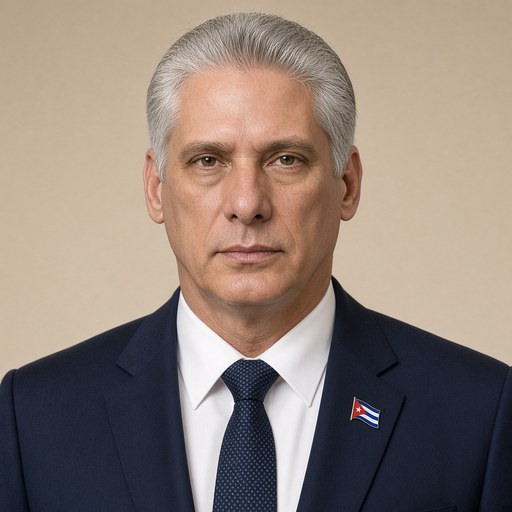
- Díaz-Canel addressed Cuban press workers on Press Day, March 14, 2025, commemorating the founding of Martí's newspaper Patria and calling for journalistic renewal.
- Main themes
- Cuban press and journalism, José Martí's legacy, revolutionary ethics and truth, disinformation and digital media, resistance to imperialism, youth in journalism, Palestinian solidarity, media independence, self-criticism and press reform, technology and transformation
- Duration
- ~9 min
- Words
- 1,136
- Sentences
- 39
- Readability
- 43
- Grade
- 14.4
- Syntax
- 3.23
- Vocabulary
- 2.31
Translated from Spanish
The broad sphere of national life a sentence belongs to. Every sentence has an Arena, so it is the denominator the other indices are read against.
Other39 sentences in 22 paragraphs
To all the workers of the Cuban press and particularly to the young people who are starting in the profession:
As we celebrate this March 14th the Day of the Cuban Press, we are motivated, first and foremost, by the duty and the emotion of commemorating the birth of the newspaper Patria, founded by José Martí on this day in 1892, “to unite and love, and to live in the passion of truth.”
I do not believe that more beautiful and precise words have been said, before or after, to describe the mission of journalism that the Revolution needs in its tireless search for a more just and supportive society. Or as Martí invoked it: “With all and for the good of all.”
That is why we feel the constant need to return to the reasons of Patria, every time a celebratory day calls us to the essential reflection on the role of the press in our society.
Because, while it is a day of rightful homage to those who, with their dedication and commitment, take on the daily challenge of documenting what we are and what we do, in the midst of the fiercest imperial siege, it is also our responsibility to point out, highlight, and if possible, rectify everything that hinders and weakens communication between the people and those of us who today assume the responsibility of representing them from the most diverse tasks in the Party, the Government, the National Assembly, and the political and mass organizations.
While we are a small archipelago navigating in a world mostly characterized by the use and abuse of information as a weapon of power controlled by a few media conglomerates, which are part of or associated with national and global oligarchies, we are a society free from the subjugation imposed by modern merchants on journalistic practice.
However, the Cuban press, with all that it has advanced and grown in recent years, continues to suffer the burden of obsolete practices in language, forms, and timing, as a logical consequence of years of practice in the trenches.
And because the hour of danger has not passed, those burdens still weigh heavily. But for that very reason, today our press is aggressively challenged by technology and the wonderful originality of our people, to transform itself, creatively, viralizing the “passion for truth” in the face of the obscene invasion of lies and manipulations that assault audiences from digital networks driven by hatred.
Recently, we have called for a new “Vindication of Cuba,” like that exemplary struggle waged by José Martí, from a North American newspaper, against those who sought to denigrate our people. It is not about returning hatred for hatred, as the Apostle did not do in his time. It is about opposing the truth of a nation engaged in the search for ways out of imperial harassment, with exemplary dignity that includes the essential self-criticism.
This does not deny, nor can it deny, the irrefutable fact that the Cuban press, the authentic Cuban press, has been and continues to be a bastion of resistance. And that Cuban journalism, above discontent and demands, has known how to act with the ethics and passion of genuine revolutionaries, deeply committed to the people from which it was born, to the Revolution that formed it, and to the values that define us as a nation.
We are all aware of how much the so-called social networks and new technologies have transformed the media landscape, through disinformation actions, fake news, and manipulation of public opinion. In this context, Cuban journalism has the responsibility to surpass itself, as a beacon of truth and ethics. We must use digital tools not to follow trends, but to educate, to raise awareness, and to defend the truth.
In Cuba, the revolutionary press is truly independent, because it is not at the service of capital or foreign interests. It is at the service of the people, and that service must be assumed as an obligation to reflect more and better, more comprehensively, the concerns, achievements, and challenges of our society.
At the same time, our press has the freedom that in other places is punished or marginalized, to give voice to solidarity with the peoples who fight for their liberation, like the Palestinian people, victims of a war of persecution and extermination and of a media war that seeks to justify the unjustifiable. From Cuba, we will continue to denounce these injustices and amplify the voices of those who fight for the peace and dignity of all peoples, and we count on the Cuban press at the forefront for this.
Today, the Cuban press is in the hands of young people. It is up to you to carry forward the legacy of Martí, of Fidel, of so many journalists who made their work and gave their lives for the Revolution. That legacy is fundamental in the formation of new generations, not only in the techniques of journalism but in the values of ethics, honesty, and social commitment, as protagonists of an innovative, critical, and revolutionary press.
We believe with Fidel that "without a revolutionary press, no Revolution is possible" and that the press must be a bastion in the defense of truth and justice, and an instrument for the mobilization and awareness of our people. Raúl has also reminded us that the press must be a space for debate and reflection, at the service of the people.
In defense of these ideas, we have emphasized the need to modernize and transform our system of political, public, and press communication, urging you to be innovative and make the most of new technologies. The Social Communication Law, which came into effect in October 2024, is a vital component in the political, economic, social, and cultural advancement of our nation.
We are convinced that political and digital communication can and must be a tool for accelerating the construction of a more just and supportive world. We commit to continue working together, to strengthen our networks, and to carry forward the principles and values we have shared.
Comrades,
On this Day of the Press, we reaffirm our commitment to truth, to justice, and to the Revolution. The Cuban press is not a business; it is a service. It is not an instrument of domination; it is a tool of liberation.
Let us continue to be faithful to the legacy of Martí, who said: "The press is not kind approval or insulting anger; it is proposition, study, examination, and advice."
May our press continue to be a beacon of light filled with truth in the darkness of ideas of the times the world is living. May it continue to be, as it has always been, an instrument at the service of the homeland, of the people, of Humanity.
Long live the Cuban press!
The original Spanish. The tags above are read on the English translation's sentences.
A todos los trabajadores de la prensa cubana y particularmente a los jóvenes que se estrenan en el oficio:
Al celebrar este 14 de Marzo el Día de la Prensa Cubana, nos anima, en primer lugar, el deber y la emoción de conmemorar el nacimiento del periódico Patria, fundado por José Martí este día de 1892, “para juntar y amar, y para vivir en la pasión de la verdad”.
No creo que se hayan dicho, antes o después, palabras más bellas y exactas para describir la misión del periodismo que necesita la Revolución en su infatigable búsqueda de una sociedad más justa y solidaria. O como la invocara Martí: “Con todos y para el bien de todos”.
Por eso sentimos la necesidad constante de volver a las razones de Patria, cada vez que una jornada celebratoria nos convoca a la reflexión imprescindible sobre el rol de la prensa en nuestra sociedad.
Porque, si bien es día de justo homenaje a aquellos que, con su dedicación y compromiso, asumen el reto cotidiano de dejar constancia de lo que somos y hacemos, en medio del cerco imperial más feroz, también nos corresponde apuntar, señalar y si es posible, rectificar, todo cuanto entorpece y debilita la comunicación entre el pueblo y aquellos que hoy asumimos la responsabilidad de representarlo desde las más disímiles tareas en el Partido, el Gobierno, la Asamblea Nacional y las organizaciones políticas y de masas.
Si bien somos un pequeño archipiélago navegando en un mundo, mayormente caracterizado por el uso y abuso de la información como arma de poder que controlan unos pocos conglomerados mediáticos, los cuales son parte o están asociados a oligarquías nacionales y globales, somos una sociedad libre del sometimiento que han impuesto los mercaderes modernos, al ejercicio periodístico.
Pero, la prensa cubana, con todo lo que ha avanzado y crecido en los últimos años, sigue sufriendo el lastre de prácticas obsoletas en el lenguaje, las formas y los tiempos, como lógica consecuencia de años de ejercicio en la trinchera.
Y porque la hora del peligro no ha pasado, pesan y mucho aún esos lastres. Pero por esa misma razón, hoy está nuestra prensa agresivamente retada por la tecnología y la maravillosa originalidad de nuestro pueblo, a transformarse, creativamente, viralizando la “pasión por la verdad” frente a la obscena invasión de mentiras y manipulaciones que asaltan a las audiencias desde las redes digitales manejadas por el odio.
Hace poco hemos pedido una nueva “Vindicación de Cuba”, como aquel ejemplar combate que libró José Martí, desde un periódico norteamericano, frente a quienes intentaban denigrar a nuestro pueblo. No se trata de devolver odio al odio, como no lo hizo el Apóstol en su momento. Se trata de oponer la verdad de una nación enfrascada en la búsqueda de salidas al acoso imperial, con ejemplar dignidad que incluye la imprescindible autocrítica.
Ello no niega, ni puede negar, el hecho irrefutable de que la prensa cubana, la auténtica prensa cubana, ha sido y sigue siendo un baluarte de resistencia. Y que el periodismo cubano, por encima de inconformidades y demandas, ha sabido actuar con la ética y la pasión de los genuinos revolucionarios, profundamente comprometido con el pueblo del que nació, con la Revolución que lo formó y con los valores que nos definen como nación.
Todos somos conscientes de cuánto las llamadas redes sociales y las nuevas tecnologías han transformado el panorama mediático, a fuerza de acciones de desinformación, noticias falsas y manipulación de la opinión pública. En este contexto, el periodismo cubano tiene la responsabilidad de superarse a sí mismo, como un faro de veracidad y ética. Debemos utilizar las herramientas digitales no para seguir tendencias, sino para educar, para formar conciencia y para defender la verdad.
En Cuba, la prensa revolucionaria es realmente independiente, porque no está al servicio de capitales ni de intereses extranjeros. Está al servicio del pueblo y ese servicio debe asumirse como una obligación de reflejar más y mejor, más integralmente, las inquietudes, los logros y los desafíos de nuestra sociedad.
Paralelamente, tiene nuestra prensa la libertad que en otros lugares se castiga o se margina, de dar voz a la solidaridad con los pueblos que luchan por su liberación, como el pueblo palestino, víctima de una guerra de persecución y exterminio y de una guerra mediática que busca justificar lo injustificable. Desde Cuba, seguiremos denunciando estas injusticias y amplificando las voces de los que luchan por la paz y la dignidad de todos los pueblos y contamos para ello con la prensa cubana en la vanguardia.
Hoy, la prensa cubana está en manos jóvenes. A ustedes les corresponde llevar adelante el legado de Martí, de Fidel, de tantos periodistas que hicieron su obra y dieron su vida por la Revolución. Ese legado es fundamental en la formación de las nuevas generaciones, no sólo en las técnicas del periodismo, sino en los valores de la ética, la honestidad y el compromiso social, como protagonistas de una prensa innovadora, crítica y revolucionaria.
Creemos con Fidel, que "sin una prensa revolucionaria, no hay Revolución posible" y que la prensa debe ser un baluarte en la defensa de la verdad y la justicia, y un instrumento para la movilización y la concienciación de nuestro pueblo. Raúl también nos ha recordado que la prensa debe ser un espacio para el debate y la reflexión, al servicio del pueblo.
En defensa de esas ideas, hemos subrayado la necesidad de modernizar y transformar nuestro sistema de comunicación política, pública y de prensa, instándolos a ser innovadores y sacar el mayor provecho a las nuevas tecnologías. La Ley de Comunicación Social, que entró en vigor en octubre de 2024, es un componente vital en el avance político, económico, social y cultural de nuestra nación.
Tenemos la convicción de que la comunicación política y digital puede y debe ser una herramienta de aceleración para la construcción de un mundo más justo y solidario. Nos comprometemos a seguir trabajando juntos, a fortalecer nuestras redes y a llevar adelante los principios y valores que hemos compartido.
Compañeras y compañeros,
En este Día de la Prensa, reafirmamos nuestro compromiso con la verdad, con la justicia y con la Revolución. La prensa cubana no es un negocio; es un servicio. No es un instrumento de dominación; es una herramienta de liberación.
Sigamos siendo fieles al legado de Martí, quien dijo: "La prensa no es aprobación bondadosa o ira insultante; es proposición, estudio, examen y consejo".
Que nuestra prensa siga siendo un faro de luz cargado de verdad en la oscuridad de ideas de los tiempos que vive el mundo. Que siga siendo, como lo ha sido siempre, un instrumento al servicio de la patria, del pueblo, de la Humanidad.
¡Viva la prensa cubana!