




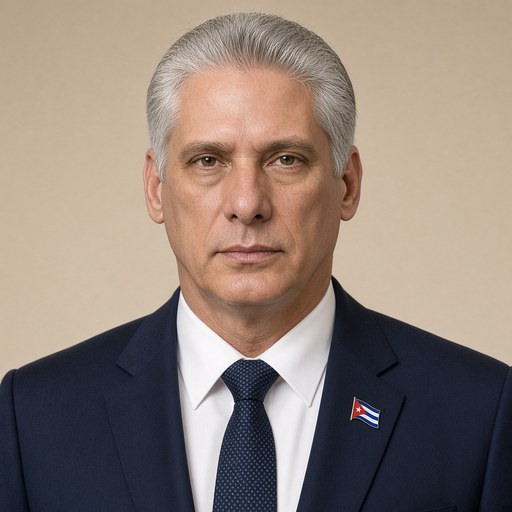
Díaz-Canel: The well-being of the country must be built together by all.
 Miguel Díaz-Canel · President of Cuba
- Context
- Díaz-Canel addressed Cuban officials in July 2022, outlining priorities for municipal strengthening, economic efficiency, and resistance to cultural colonization and the U.S. blockade.
- Main themes
- Municipal autonomy and decentralization, national well-being and social justice, business inefficiency and state budget, cultural colonization and decolonization, U.S. blockade and imperialism, socialist construction, local development, popular participation, abusive prices and economic distortions, Cuban identity and revolutionary values, global economic crisis, social programs and vulnerable populations
- Duration
- ~11 min
- Words
- 1,264
- Sentences
- 37
- Readability
- 17
- Grade
- 19.0
- Syntax
- 3.57
- Vocabulary
- 2.51
Translated from Spanish
The broad sphere of national life a sentence belongs to. Every sentence has an Arena, so it is the denominator the other indices are read against.
Other37 sentences in 29 paragraphs
He emphasized, in this regard, that we are not going to develop the country by applying the same things everywhere, because each territory has particularities that must be taken into account; what we need to achieve is for the municipalities, with their powers or potential granted by their autonomy, to be able to resolve a significant group of problems. If the municipality is strengthened, the province is strengthened, and so is the country, he stated.
The leader highlighted the need to move towards a process of business resizing in two directions: the subordination of companies to achieve autonomy in the municipalities, and business structure, in which it is necessary to reduce the administrative and bureaucratic apparatus.
Díaz-Canel also drew attention to the formation of cost and expense sheets, the existence of business inefficiencies that are later supported by the State Budget, thus generating impacts on social spending, and the role that territories play in acting at the grassroots level and effectively regulating the issue of abusive prices.
There are entities, including state ones, that allocate all salary expenses to the leading product of the company, and when opportunities are poorly exploited, distortions appear; there are those who want to have profits without doing more, without being efficient and distributing at all costs, he commented.
So, in the end – he said – the people are harmed by high prices and the Budget; since the variant is to compensate for those inefficiencies in profitability with the Budget, and resources are no longer available for social programs, to better attend to those in vulnerable situations, and to make more transformations in the neighborhoods.
The well-being of the country must be built by all of us, and those who have more, consequently, must contribute more, since the benefits and achievements of the Revolution are equal for all, without establishing differences whether it is a state worker or a worker belonging to the private sector, he maintained.
The first thing to understand is that an imperial logic, led by the U.S. government, seeks to dominate the world, and one of its tools is a platform of cultural colonization, affirmed the Head of State. "Through various means, the entertainment industry and social networks are seeking for peoples to deny their identity, to see their culture as obsolete, in its most universal dimension."
If the Cuban people have been able to resist, it is because they are faithful to their roots, because they have ideas and convictions, because they know how the nation was formed; and for wanting to be socialists, we have faced a permanent aggression, he emphasized. This is evidenced by the intensification of the blockade and a disinformation campaign woven from social networks, which magnifies situations, always seeking to discredit the government's management and portray us as a failed state, he added.
He stated that our representatives are elected for their honesty, decency, culture, willingness to work for the people, and for their human and revolutionary qualities.
He also pointed out that cultural colonization must be confronted with a program of cultural decolonization, which links various institutions and reinforces our essences, our history.
"How do we confront economic suffocation and the strategy of ideological subversion?" he reflected. With the logic of socialist construction, of achieving the greatest possible social justice and popular democracy, and with total conviction that to achieve this, a greater revolutionary articulation is essential and strengthening the elements of popular participation and debate, he specified. We must also continue studying and proposing measures.
He recalled that the world is experiencing an economic crisis and Cuba is affected by this context, which, combined with the blockade and the increase in freight costs, complicates access to imports such as food and fuel, and raises operational costs.
Everything we are going to do, he said, will always be to save socialism, not to sell or privatize the country; we may have deprivations and shortages now, but we have human dignity and security to live, as well as social achievements that allow free access to health and education for all, without distinctions.
He stressed that development must occur at the local level, because in the end, strategies, even if they are national, are concretized in the territory, and we must better assume that logic, and under that essence continue working, and one example is the preparation of the Budget, which must continue to be refined and be more participatory.
Our concept of well-being – he warned – cannot be in consumerism, but in human relationships as a society. That our children grow up happy, that the rights of all families are respected, that a problem can be resolved with the participation of all, with solidarity; that must be the basis of our well-being, he specified.
We have had to live through a stage of great complexity, but we will overcome the problems, and we will do so by building socialism and preserving the Revolution, he concluded.
Photo: José Manuel Correa
REDUCING THE BUDGET DEFICIT AND BOOSTING REVENUES
When presenting to the deputies of the Economic Affairs Commission details about the Settlement of the State Budget in 2021, Meisi Bolaños Weiss, Minister of Finance and Prices, recalled that 2021 was marked by the impact of COVID-19, the international economic crisis, and an unprecedented intensification of the U.S. economic blockade, and despite this, the vitality of basic services to the population was maintained.
Within the analysis presented, in which Alejandro Gil Fernández, Deputy Prime Minister and Minister of Economy and Planning, also participated, it was highlighted that 504 entities reported business losses, and of these, 320 had planned profits; meanwhile, 182 taxpayers did not settle within the year.
Specifically, regarding tax management, the Minister pointed out that various facilities have been opened from the National Office of Tax Administration Portal that allow compliance with obligations, download the fiscal vector and forms, request suspensions of self-employment, in addition to the implementation of digital signatures in all offices.
Photo: José Manuel Correa
However, we have non-compliance and taxpayers who underdeclare, and this affects, in general, all citizens, because the revenues generated by any of the economic actors that are not received are resources that do not reach the Budget to finance any public service of which we are all beneficiaries, she argued.
She stated that one of the main challenges of the Cuban economy is to achieve the reduction of the budget deficit and the growth of revenues.
The Minister of Finance and Prices assured that, for the transformation, attention, and social and material problems, actions were supported in 600 neighborhoods, in 91 municipalities of the country, benefiting 175,000 people.
She pointed out that the State Budget is not there to finance losses to companies and organizations, as the country's leadership has indicated. However, until we transition to that subsidy to people and not to products, which is ideal, it is sometimes necessary to finance those companies that provide vital services and have centralized prices, but which are lower than the real cost. Examples of these are the electricity tariff, controlled medications, and medical diets, among others.
Regarding the persistent irregularities, she mentioned entities that overdraw current expenses; the poor planning of salary expenditure in the provinces; subsidized retail prices that present under-executions, which causes irregularities in accounting records and reconciliations; and that 412 budgeted units ended the year with resource demands, compromising payments without availability.
Teresa González, a deputy from the municipality of Puerto Padre, Las Tunas, insisted on the need for control and strengthening of accounting, and the requirement in the preparation of cost and expense sheets.
(Cubaminrex - Granma)
The original Spanish. The tags above are read on the English translation's sentences.
Subrayó, al respecto, que no vamos a desarrollar al país aplicando las mismas cosas en todos los lugares, porque cada territorio tiene particularidades que deben ser tomadas en cuenta; lo que hay que lograr es que los municipios, con sus facultades o potencialidades que le da su autonomía, puedan ir resolviendo un grupo importantes de problemas. Si el municipio se fortalece, se fortalece la provincia y también el país, afirmó.
El mandatario resaltó la necesidad de ir a un proceso de redimensionamiento empresarial en dos direcciones: subordinación de las empresas para lograr autonomía en los municipios, y estructura empresarial, en la que es necesario reducir el aparato administrativo y burocrático.
Díaz-Canel también llamó la atención sobre la conformación de las fichas de costos y gastos, la existencia de ineficiencias empresariales que después se respaldan con el Presupuesto del Estado, generándose así afectaciones al gasto social, y al papel que desempeñan los territorios para actuar en la base y regular, efectivamente el tema de los precios abusivos.
Hay entidades, incluidas las estatales, que al producto líder de la empresa le ponen todos los gastos del salario, y cuando se aprovechan mal las oportunidades, aparecen las distorsiones; hay quienes quieren tener utilidades sin hacer más, sin ser eficientes y repartir a toda costa, comentó.
Entonces, al final –dijo– se perjudica el pueblo con los precios altos y el Presupuesto; ya que la variante es compensar con el Presupuesto esas ineficiencias en la rentabilidad y se deja de disponer de recursos para los programas sociales, atender mejor a los que se encuentran en situación de vulnerabilidad y hacer más transformaciones en los barrios.
El bienestar del país tenemos que construirlo entre todos, y los que más tienen, consecuentemente, deben aportar más, pues los beneficios y las conquistas de la Revolución son iguales para todos, sin establecer diferencias si se trata de un trabajador estatal o un trabajador que pertenece al sector privado, sostuvo.
Lo primero que hay que entender es que una lógica imperial, liderada por el Gobierno de ee.uu., busca dominar al mundo, y una de sus herramientas es una plataforma de colonización cultural, afirmó el Jefe de Estado. «Por diferentes vías, la industria del entretenimiento y las redes sociales están buscando que los pueblos nieguen su identidad, que vean como obsoleta su cultura, en su dimensión más universal».
Si el pueblo cubano ha podido resistir es porque es fiel a sus raíces, porque tiene ideas y convicciones, porque sabe cómo se formó la nación; y por querer ser socialistas hemos tenido una agresión permanente, enfatizó. Ello se evidencia con el recrudecimiento del bloqueo y una campaña de desinformación que se teje desde las redes sociales, que magnifica las situaciones, buscando siempre desacreditar la gestión del Gobierno y mostrarnos como un Estado fallido, agregó.
Manifestó que nuestros representantes se eligen por su honradez, decencia, cultura, disposición de trabajar para la gente, y por sus cualidades humanas y revolucionarias.
Señaló, además, que la colonización cultural hay que enfrentarla con un programa de descolonización cultural, que vincule varias instituciones y refuerce nuestras esencias, nuestra historia.
¿Cómo enfrentar la asfixia económica y la estrategia de subversión ideológica?, reflexionó. Con la lógica de la construcción socialista, de alcanzar la mayor justicia social posible y democracia popular, y con total convencimiento de que para lograrlo es imprescindible una mayor articulación revolucionaria y fortalecer los elementos de participación popular y el debate, precisó. También hay que seguir estudiando, y proponer medidas.
Recordó que el mundo vive una crisis económica y Cuba se ve afectada por ese contexto, lo que, unido al bloqueo y el aumento de los fletes, complejiza el acceso a importaciones como alimentos y combustible, y encarece las operaciones.
Todo lo que vayamos a hacer, dijo, será siempre salvando al socialismo, no vendiendo ni privatizando al país; podemos tener ahora privaciones y carencias, pero tenemos dignidad humana y seguridad para vivir, así como conquistas sociales que permiten un acceso gratuito a la salud y a la educación para todos, sin distinciones.
Recalcó que el desarrollo tiene que darse a nivel local, pues al final, las estrategias, aunque sean nacionales, se concretan en el territorio, y tenemos que asumir mejor esa lógica, y bajo esa esencia seguir trabajando, y un ejemplo es la elaboración del Presupuesto, que debe continuar perfeccionándose y ser más participativo.
Nuestro concepto de bienestar –alertó– no puede estar en el consumismo, sino en las relaciones humanas como sociedad. Que nuestros niños crezcan felices, que se respete el derecho de todas las familias, que un problema pueda resolverse con la participación de todos, con la solidaridad; ahí debe radicar nuestro bienestar, precisó.
Nos ha tocado vivir una etapa de gran complejidad, pero iremos saliendo de los problemas, y lo haremos construyendo el socialismo y preservando la Revolución, concluyó.
Foto: José Manuel Correa
REDUCIR EL DÉFICIT PRESUPUESTARIO Y POTENCIAR LOS INGRESOS
Al presentar a los diputados de la Comisión de Asuntos Económicos detalles sobre la Liquidación del Presupuesto del Estado en 2021, Meisi Bolaños Weiss, ministra de Finanzas y Precios (mfp), recordó que 2021 estuvo marcado por el impacto de la covid-19, la crisis económica internacional y un recrudecimiento sin precedentes del bloqueo económico estadounidense y, pese a ello, se mantuvo la vitalidad de los servicios básicos a la población.
Dentro del análisis presentado, en el que también participó Alejandro Gil Fernández, vice primer ministro y titular de Economía y Planificación, y se destaca que 504 entidades reportan pérdidas empresariales y, de ellas, 320 habían planificado utilidades; en tanto, 182 contribuyentes no liquidaron dentro del año.
Precisamente, sobre la gestión tributaria, la Ministra señaló que desde el Portal de la Oficina Nacional de Administración Tributaria se han abierto diversas facilidades que permiten cumplir las obligaciones, descargar el vector fiscal y formularios, solicitar suspensiones del ejercicio de trabajo por cuenta propia, además de la implementación de la firma digital en todas las oficinas.
Foto: José Manuel Correa
Sin embargo, tenemos incumplimientos y contribuyentes que subdeclaran, y ello afecta, en sentido general, a toda la ciudadanía, porque los ingresos que se generan por cualquiera de los actores económicos y que no se reciben, son recursos que no llegan al Presupuesto para financiar algún servicio público del cual todos somos beneficiarios, argumentó.
Sostuvo que uno de los principales retos de la economía cubana es lograr la reducción del déficit presupuestario y el crecimiento de los ingresos.
La Ministra del mfp aseguró que, para la transformación, atención y problemáticas sociales y materiales, se respaldaron acciones en 600 barrios, de 91 municipios del país, y se beneficiaron 175 000 personas.
Apuntó que el Presupuesto del Estado no está para financiar pérdidas a las empresas y organismos, tal como nos ha indicado la dirección del país. No obstante, hasta que no transitemos a ese subsidio a personas y no a productos, que es lo ideal, en ocasiones sí resulta necesario financiar a aquellas empresas que ofrecen servicios vitales y que tienen precios centralizados, pero que son inferiores al costo real. Ejemplo de ellos son la tarifa eléctrica, los medicamentos controlados y las dietas médicas, entre otros.
Sobre las irregularidades que persisten, mencionó las entidades que sobregiran los gastos corrientes; la deficiente planificación del gasto del salario en las provincias; precios minoristas subsidiados que presentan inejecuciones, lo que provoca irregularidades en los registros contables y las conciliaciones; y que 412 unidades presupuestadas terminaron el año con demandas de recursos, comprometiendo pagos sin disponibilidad.
Teresa González, diputada por el municipio de Puerto Padre, Las Tunas, insistió en la necesidad del control y fortalecimiento de la contabilidad, y de la exigencia en la elaboración de las fichas de costos y gastos.
(Cubaminrex - Granma)