




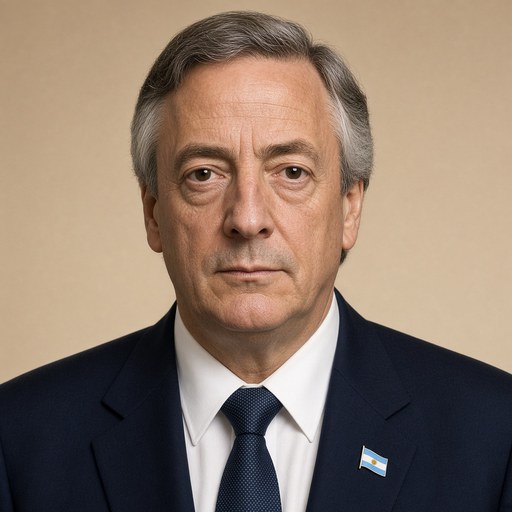
Bill on compensation and reparation for the children of the disappeared
 Néstor Kirchner · President of Argentina
- Context
- Kirchner addressed a ceremony at the Casa Rosada marking the introduction of a bill to compensate children of Argentina's disappeared, on March 12, 2004.
- Main themes
- Reparations for children of the disappeared, justice for victims of the dictatorship, human rights accountability, impunity laws opposition, Argentina's military dictatorship legacy, democratic responsibility, truth and memory, grandmothers and mothers of the Plaza de Mayo, national identity and shame, transitional justice
- Duration
- ~11 min
- Words
- 1,282
- Sentences
- 36
- Readability
- 43
- Grade
- 16.0
- Syntax
- 3.52
- Vocabulary
- 1.99
Translated from Spanish
The broad sphere of national life a sentence belongs to. Every sentence has an Arena, so it is the denominator the other indices are read against.
Other36 sentences in 10 paragraphs
Ladies and gentlemen, ministers of the National Executive Power; national and provincial authorities; members of the diplomatic corps; representatives of non-governmental human rights organizations; representatives of different faiths; children, young people: one truly wishes that this type of event did not exist. The ideal, as she just clearly stated, is that this is not even a reparative hand, because repairing the damage caused is impossible. Neither this type of recognition nor full justice will be able to repair such an aberration that we Argentines had to live through. But we must try to move forward with the elements we have; we must try to take the steps that are within our reach.
While what happened with the genocidal dictatorship in Argentina is extremely grave, what occurred during the democratic period has also been very serious. Without wanting to point fingers at anyone, I say this honestly, but for many years, thousands and thousands of men and women who participated in Argentine political life accepted the framework of concrete impunity as a method of coexistence, and we did so as a necessity for democracy to survive. In one way or another, with more or less shame, with more or less feelings, with more or less burden of conscience, the reality, when the history of these times is written, I know will be very harsh in this respect, despite the historical justifications that may be sought, for these 20 years of democracy in this sense.
I do not exclude the strength, courage, and decision to deepen very good steps that had begun to be taken, such as in 1985, in the trial of the commanders and others, which could have ended, had we advanced strongly and not had to carry on our backs the unwillingness to look aside or to the past for days, months, and years.
But there is something even more serious; when we advance on these issues, we encounter important media, with important scribes of the institutional and political life of Argentina who say that we should not disturb the past. I can assure you that I do not like to practice hatred or disturb the past; I do not know what they mean by disturbing the past. If disturbing the past for some means covering up, burying that painful truth that must be clarified and brought to the surface to know the truth of everything definitively. But here we are talking about justice; justice has no past, future, or present; it is justice; there are constitutional norms, rules, and laws that exist. I wonder, should we let time pass so that justice is not applied later, and when it wants to be applied, it is past? In Argentina, we are not trying to look back; we are trying to resolve the strongly pending issue that the Argentine Nation, the Argentine State, and all Argentines have, which is to apply justice. We must apply justice, not resentment, not revenge, not theories that equate situations.
I have always spoken out against the pardon, against the Law of Due Obedience and Full Stop, so I speak with absolute moral authority on the subject. But do not come to me with the equality issue; when one exercises the right to represent the State and exercises the applicability of the State and the functioning and norms of the State and so on, there is nothing that can be equated with things that supposedly may have happened on the other side. Let us also put an end to that absolutely unacceptable discourse that tries to confuse things.
That is why I believe that what will happen in Argentine society, apart from resolving the pending issues we have, I know that together we will continue to advance. Many of the things she just said we will all turn into a clear and concrete reality. We should feel shame, pain.
Today here, thank God, after all the things that have happened to us, the things that have been heard in this Hall, today a daughter of the detained and disappeared was here, in this Hall, surely with the spirit of her father, her mother, and so many Argentines who from this Government House felt that they were advancing over their own lives. Today they can be in this House, which must be the House of democracy, of justice, of dignity, where we can all express ourselves with full plurality. I believe that this event is a historic turning point; she was here, and what she said is truly profound, because that in this Argentina the things that happened happened, that we still have more than 500 children whose whereabouts we do not know, although the efforts of the Mothers and Grandmothers allowed for the recovery of 77 children, there are more than 500 children whose whereabouts we do not know. That there were mothers of children thrown at the mercy of the imperative voice of murderers who supposedly represented Argentinian identity. That we coexist with such things should also make us seriously reflect as Argentines, on this issue and on other issues, because when we talk about justice, we also talk about justice today; we do not want impunity today, we do not want violations of human rights today. Let us put an end to this story that human rights are a leftist issue; they are human rights; every human being who inhabits the world, in Argentine land, has the right to full respect for human rights and justice, which they try in any way to seek that they have parameters of determined profiles.
That is why I believe that today is as if the hand of the father, the mother of them has arrived. We are helping them to live, to realize themselves so that they fight hard to make a great Argentina. It is as if society were truly becoming aware of this situation, to make it flesh, so that such things never happen again, because all Argentines want full coexistence; we never want such things to happen again. That we never look aside again, that we think that a country can recover economically, socially, and that to avoid conflicts we cover this up, we cover that up, we cover so many things in Argentina that later… it covered us all, we had to live through the things that made us suffer and that have happened in this country.
That is why, children, I apologize; we cannot say anything more than sorry, but we are sure that with you, with the clear conscience you have, and with many Argentines, what we must sow in the new generations, the spirit and dignity of the Mothers, of the Grandmothers of Plaza de Mayo, and of different organizations that have fought, we will build an identity of coexistence, of peace, of love, of plurality, of tolerance, where we will know how to endure even the most different thoughts in full coexistence. That the imperative task of imposition never again goes through the channels that we had to go through, that such cultures and such methodologies never return.
I believe that you have sown very strongly, you, the Grandmothers, the Mothers, and this will be strongly reflected in the Argentina to come. Count on us permanently, and let us continue to advance, let us continue to recover memory, let us continue to consolidate justice, always without resentments and without hatred, but with much depth to find the path of truth and dreams, so that if someone looks at us, they realize that we were cowards, but that we reacted, although a little late, but at least to lay the foundation for the future of future generations. Thank you very much.
The original Spanish. The tags above are read on the English translation's sentences.
Señores ministros del Poder Ejecutivo Nacional; autoridades nacionales, provinciales; miembros del cuerpo diplomático; señores representantes de organizaciones de derechos humanos no gubernamentales; señores representantes de los diferentes cultos; hijos, chicos: realmente uno desearía que este tipo de actos no existan. Lo ideal, bien lo decía con toda claridad ella recién, que esto no es siquiera una mano reparadora, porque reparar el daño causado es imposible. Ni este tipo de reconocimientos, ni la Justicia plena van a poder reparar semejante aberración que nos tocó vivir a los argentinos. Pero tenemos que tratar de avanzar con los elementos que tenemos, tenemos que tratar de dar los pasos que están a nuestro alcance.
Si bien es gravísimo, tremendamente grave lo que pasó con la dictadura genocida en la Argentina, también ha sido muy grave lo que pasó en la etapa democrática. Sin querer apuntar a nadie, honestamente se los digo, pero durante muchos años miles y miles de hombres y mujeres que participamos de la vida política argentina, aceptamos como método de convivencia, y lo hicimos como una necesidad para que la democracia pueda sobrevivir, el marco de la impunidad concreta. De una forma o de otra, con más vergüenza, con menos verguenza, con más o menos sentimientos, con más o con menos carga de conciencia, la realidad, cuando se escriba la historia de estos tiempos, sé que va a ser muy dura en este aspecto, por más justificaciones históricas que se quieran buscar, por estos 20 años de democracia en este sentido.
No exceptúo la fuerza, la valentía y la decisión de profundizar pasos muy buenos que se habían comenzado a dar como en 1985, en el juicio a los comandantes y demás, que podían haber terminado, de haber avanzado fuertemente y no tener que pasar días, meses y años cargando sobre nuestras espaldas el no querer mirar al costado ni al pasado.
Pero hay algo más grave también, cuando avanzamos sobre estos temas nos encontramos con medios importantes, con escribas importantes de la vida institucional y política de la Argentina que dicen que no hay que remover el pasado. Les puedo asegurar que no me gusta practicar el odio ni remover el pasado, no sé a que llaman remover el pasado. Si remover el pasado para algunos es tapar, es enterrar esa verdad hiriente que debe ser esclarecida y puesta sobre la superficie para saber la verdad de todo definitivamente. Pero acá estamos hablando de justicia, la justicia no tiene pasado, futuro, presente, es justicia, hay normas constitucionales, normas y leyes que existen. Me pregunto, ¿hay que dejar que pase el tiempo para que la Justicia después no se aplique y cuando se quiere aplicar es pasado? En la Argentina no estamos tratando de buscar mirando hacia el pasado, estamos tratando de resolver la asignatura fuertemente pendiente que tiene la Nación argentina, el Estado argentino y todos los argentinos que es aplicar justicia. Tenemos que aplicar justicia, no rencor, no venganza, no teorías donde igualan situaciones.
Siempre me pronuncié frente al indulto, contra la Ley de Obediencia Debida y Punto Final, así que hablo con absoluta autoridad moral sobre el tema. Pero que no me vengan con el tema igualitario, cuando uno ejerce el derecho de representar el Estado y ejerce la aplicabilidad del Estado y el funcionamiento y normas del Estado y demás, no hay nada que se pueda equiparar con cosas que supuestamente puedan haber pasado del otro lado. Terminemos también con ese discurso absolutamente inaceptable que trata de confundir las cosas.
Por eso creo que se va a dar en la sociedad argentina, aparte de resolver los temas pendientes que tenemos, yo sé que entre todos vamos a seguir avanzando. Muchas de las cosas que dijo ella recién las vamos a ir convirtiendo entre todos en una realidad clara y concreta. Vergüenza debiéramos sentir, dolor.
Hoy aquí, gracias a Dios, después de todas las cosas que nos pasaron, las cosas que se habrán escuchado en este Salón, hoy una hija de detenidos, desaparecidos, estuvo acá, en este Salón, seguramente con el espíritu del padre, la madre y de tantos argentinos, que desde esta Casa de Gobierno sentían que se avanlanzaban sobre sus propias vidas. Hoy pueden estar en esta Casa que debe ser la Casa de la democracia, de la justicia, de la dignidad, donde nos podemos expresar todos con plena pluralidad. Yo creo que este hecho es un punto de inflexión histórico, ella estuvo acá, y lo que dijo es realmente muy profundo, porque que en esta Argentina hayan pasado las cosas que pasaron, que tengamos todavía más de 500 chicos que no sabemos dónde están, si bien el esfuerzo de las Madres y de las Abuelas permitieron recuperar 77 chicos, hay más de 500 chicos que no sabemos dónde están. Que haya habido madres de chicos y chicas tiradas al arbitrio de la voz imperativa de asesinos que supuestamente representaban la argentinidad. Que nosotros convivdo con ese tipo de cosas también nos tiene que hacer reflexionar seriamente a los argentinos, en este tema y en otros temas, porque cuando hablamos de justicia también hablamos de justicia hoy, no queremos impunidad hoy, no queremos violaciones a los derechos humanos hoy. Que terminen con esta historia de que los derechos humanos son una cuestión de izquierda, son derechos humanos, todo ser humano que habita en el mundo, en la tierra argentina tiene derecho al pleno respeto a los derechos humanos y a la justicia, que intentan de cualquier manera buscar que tienen parámetros de perfiles determinados.
Por eso creo que lo de hoy es como si llegara la mano del padre, de la madre de ellos. Los estamos ayudando a vivir, a realizarse para que peleen mucho para hacer una gran Argentina. Es como si realmente la sociedad estuviera tomando clara conciencia de esta situación, de hacerse carne, para que nunca más se repitan este tipo de cosas, porque todos los argentinos queremos la plena convivencia, nunca más queremos que pasen este tipo de cosas. Que nunca más miremos al costado, que vayamos a pensar que un país se puede recuperare económicamente, socialmente, y que para evitar conflictos tapemos esto, tapemos aquello, tapamos tantas coas en la Argentina que después…, nos tapó a todos, nos tocó vivir las cosas que nos hicieron sufrir y que han pasado en este país.
Por eso chicos, perdón, no podemos decirles nada más que perdón, pero estamos seguros que con ustedes, con la conciencia clara que tienen, y con muchísimos argentinos, lo que tenemos que sembrar en las nuevas generaciones, el espíritu y la dignidad de las Madres, de las Abuelas de Plaza de Mayo, y de distintas organizaciones que han luchado, vamos a construir una identidad de convivencia, de paz, de amor, de pluralidad, de tolerancia, donde sabremos soportar aún los pensamientos más diferentes en plena convivencia. Que nunca más la tarea imperativa de la imposición pase por los carriles que nos tocó pasar, que nunca más vuelvan ese tipo de culturas y ese tipo de metodología.
Creo que han sembrado muy fuerte, ustedes, las Abuelas, las Madres, y esto en la Argentina que viene se va a reflejar fuertemente. Cuenten con nosotros permanentemente y sigamos avanzando, sigamos recuperando la memoria, sigamos consolidando la justicia, siempre sin rencores y sin odios, pero con mucha profundidad para encontrar el camino de la verdad y de los sueños, para que si de algún lado nos miran se den cuenta de que fuimos cobardes, pero que reaccionamos, aunque un poco tarde, pero por lo menos para cimentar el futuro de las futuras generaciones. Muchísimas gracias.