




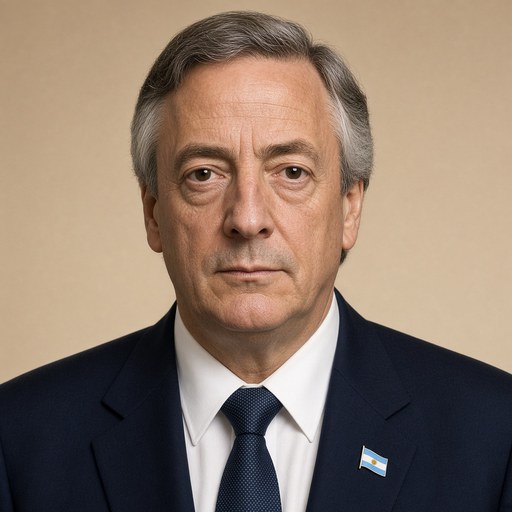
Debt relief: Néstor Kirchner at the Council of the Americas, New York, 2004
 Néstor Kirchner · President of Argentina
- Context
- Kirchner addressed the Council of the Americas in New York in September 2004, outlining Argentina's debt restructuring offer and economic recovery prospects.
- Main themes
- Argentina's debt restructuring, economic recovery, social inequality and poverty reduction, institutional quality, investment opportunities, internal sustainability, education reform, emerging markets integration, democratic stability
- Duration
- ~20 min
- Words
- 2,385
- Sentences
- 101
- Readability
- 36
- Grade
- 13.6
- Syntax
- 3.06
- Vocabulary
- 2.16
Translated from Spanish
The broad sphere of national life a sentence belongs to. Every sentence has an Arena, so it is the denominator the other indices are read against.
Other101 sentences in 72 paragraphs
I thank the organizers of this meeting for the opportunity they provide us to discuss the situation of my country and its prospects.
It is important to inform you about the advances in the social, institutional, and economic situation in Argentina. It is also a pleasant opportunity to highlight the virtues and potential of the country to ensure its sustained growth and integration into the world.
Of course, we also have problems and issues to resolve. These are internal issues, such as excessive poverty and inequality, the need to improve education, health, and to secure new and significant investments in infrastructure.
We are also troubled by external issues, such as the restructuring of our inherited debt in default, to ensure full integration into international financial markets.
We are interested in demonstrating the policies that are being implemented to address both types of problems and to show you that it is our intention to move forward with seriousness, realism, and will in the shortest possible time.
Allow me to take advantage of this visit to the financial center of the world, New York, to provide, as far as I can, some conceptual clarity regarding the restructuring of Argentina's debt.
As you know, the details of the operation and the explanation to the market are currently restricted, and will only be disclosed through specialized channels once the approval process currently underway at the SEC is completed.
I assure you that this offer is the only one we will make. We know that there are those who think, and tell the market, that this is not the final offer, and that we will make another one in a few months.
Those who say that are mistaken, as the offer is the one that will go to the market and will be unique. There has been a lot of distorting noise in the market. Some individuals have had and continue to have the intention to distort the facts.
I want to provide clarity and express to you that our country will not commit to anything it cannot fulfill and that it will strictly comply with what it commits to.
The Argentine people did not suffer what they suffered to repeat history and to promise what they cannot fulfill. We are not here to make an unrealistic offer and quickly return to a new default.
No Argentine is happy with the default, but we are going to turn the page on this sad and regrettable chapter of Argentine history.
We trust in a successful exchange, that investors will support us in pursuit of a prosperous Argentina that, starting from the regularization of the debt, will once again offer greater opportunities for all investors and for the better functioning of emerging markets in general.
Regarding internal issues, it is important to take into account, in order to assess the various degrees of progress, the seriousness of the situation created by the deep crisis we have been overcoming.
Of course, there is still a long way to go, but although some problems requiring more time to resolve persist, the willingness of the Argentine people and government is to take responsibility for facing them and to focus energies on finding practical means to solve them.
With the ideal of being a land of opportunities, we want to be a predictable country, with increasing institutional quality, top-level human resources, and enormous growth prospects.
We know that the challenge is to achieve internal sustainability to build upon it a positive integration into the world.
To achieve internal sustainability, it is imperative to drastically reduce the levels of exclusion and inequality to which our society has been subjected by the application of inadequate recipes that led to a catastrophic situation without remedy.
Improving the living conditions of our population by eradicating the most urgent hunger and extreme poverty, reducing unemployment rates, and addressing extreme inequality will help to provide political stability to the new model.
There can be no sustainable democracy with social exclusion; therefore, we must not allow inequality to win the battle, and as long as it persists, sustainable economic development will be impossible.
It is not a matter of overcoming the crisis brought about by the recipes of the nineties by going back in time to dust off old schemes. It is about finding, with modernity and realism based on our relative situation and our effective possibilities, the keys to a future that encompasses us.
We place education at the center of our new perspectives as the axis of development for our society. A high-quality public education must give us the capacity to assimilate new technologies and use them in new products and new processes, and it must become a factor of economic development.
Despite not yet being reflected in an improvement in international reputation, our economy is on a clear recovery path, and we have made progress in reducing levels of poverty and unemployment, so that Argentina today offers significant business opportunities for those willing to invest in productive activities.
Without international support and sometimes contrary to the recipes that multilateral credit organizations seek to impose mechanically, our country is recovering in a way that paradoxically transforms that lack of support or misunderstanding found today among those who welcomed the data that foreshadowed the fall.
Argentina is on the right path toward a horizon that suggests it will emerge from its crisis with a better state, a better market, and a better society.
A better state in that it rapidly increases institutional quality, transparency, and respect for the most basic human rights, recovering its basic roles and taking a proactive attitude in favor of sustainable growth.
A better market, in that it has clear rules of the game, reduces concentration, expands its consumption capacity, its internal and international integration, and improves its competitiveness.
A better society in that it increases levels of inclusion and equity, improves education, health, combats impunity, and increases the participation and decision-making of its citizens.
Meanwhile, the economy is providing positive and promising signals. It is not about rhetoric; it is about statistics and data.
Responsible fiscal management, a correct monetary policy with a monetary plan fulfilled for 15 months, increased revenue and reserve levels, low inflation, low-interest rates, and a realistic and flexible exchange rate have accompanied sustained economic growth.
The national public accounts show unprecedented surplus results that have reached 4.1 percent of the Gross Domestic Product, which, replicated at the provincial level, projected in consolidated terms to 5 percent of GDP.
Tax revenue has surpassed historical record levels, rising 39 percent year-on-year in the first half. VAT increased by 53 percent and profits by 67 percent.
The recovery of reserves, in a context of declining interest rates, places them at a level similar to that of 2001 despite the net reduction in indebtedness with multilateral organizations.
The Consumer Price Index shows price variations consistent with a low-inflation regime, evidencing a year-on-year variation of 5.3 percent for August, while average real wages are already at levels similar to those of 2001, achieving a recomposition without inflationary pressures.
The peso continues to be competitive in historical terms, exhibiting a stable trajectory and contributing to stabilizing a favorable scenario that has been sustainable in recent months.
With the drain of deposits halted, without requiring assistance, financial institutions have continued a process of capitalization following the crisis, showing profits of 400 million in the second quarter based on the decline in delinquency (from 40 percent to 25 percent), the recovery of efficiency levels with restructuring, cost control, expansion of the product base, and reduction of financial costs.
Active interest rates have experienced sharp declines, reaching real levels lower than those observed during the convertibility. Deposits have accumulated a growth of 72 percent compared to July 2002 and are at a level higher than that prior to the crisis: 109.5 billion. Credit has not yet recovered.
In this context, after an unexpected growth of 8.8 percent in 2003, the Gross Domestic Product this year has grown strongly, by 11 percent, in the first quarter.
That growth was driven by private consumption and investment, which grew by 11 percent and 55 percent, respectively.
The recovery of durable production equipment was remarkable, which in the first quarter soared by 80 percent year-on-year. The import of capital goods showed significant dynamism in this component of investment in the following months.
Transitory factors marked a certain deceleration in the second quarter, so provisional estimates place it at 7 percent growth, but all indications are that in the third quarter our economy has resumed the growth path at a rate only slightly lower than that recorded at the exit from the crisis and sustainable in the long term.
However, the provisional variation of the seasonally adjusted Gross Domestic Product for the second quarter of 2004 compared to the first shows an increase of 0.5 percent and a year-on-year increase of 11.3 percent compared to the same quarter of the previous year.
The accumulated figure for the first half showed an increase of 9 percent compared to the previous year.
This has led public and private growth forecasts for the entire year 2004 to be in the range of 7 to 8 percent, a figure well above the average for countries like ours.
The sectors producing goods saw an increase of 6.9 percent in the second quarter, mainly based on a 13.2 percent increase in manufacturing activity and a 32.4 percent increase in construction.
The service-producing sectors recorded a year-on-year increase of 5.2 percent based on an 11.8 percent increase in commerce and a 10.1 percent increase in the transport, storage, and communications sector.
Up to July, industrial production and construction activity lead that growth. In the first seven months of the year, they grew at a rate of 12 percent and 27 percent year-on-year. Industrial activity is reaching its highest historical level, recording a 15.8 percent increase compared to the previous year.
The macroeconomic evolution evidences the continuity of a positive variation in global supply and global demand. Gross fixed investment recorded an increase of 50.3 percent as a result of increases in the construction sector (37.6 percent) and durable production equipment (78.2 percent) for the first quarter.
With those figures, employment continues to grow at high rates, and formal employment has accumulated a year-on-year increase of 7.6 percent in the first seven months of this year, and the outlook remains favorable as economic growth continues to be very intensive in labor use.
The unemployment rate has decreased by approximately 7 points in the last three semesters, nearly 10 percentage points since the peak reached in May 2002, the largest decrease in our history.
The combination of high growth rates with price stability has resulted in a strong reduction in poverty: 2.5 million fewer poor people and 3 million fewer indigent people in 2003, with the trend continuing into 2004.
We have adopted a new paradigm regarding exports, operating on two simultaneous fronts consisting of market opening and commercial development, with efforts directed at identifying the best opportunities for our products.
The figures for external sales show the increasing effectiveness of this strategy. Argentina has never exported so much.
Contrary to many claims from commentators, the 13 percent growth is not explained by the increase in soybean sales but by the strong increase in manufacturing sales, which was 24 percent, while primary products fell by 16 percent in the first half due mainly to bad weather.
Exports of agro-industrial manufactured goods increased by 31 percent in the first half, and industrial goods by 14 percent.
The number of exporters increased by 21 percent (there are 1,550 more firms now exporting), reaching 9,000 companies that exported this year.
Moreover, we are exporting to more countries, integrating new markets into our destinations, so we are exporting more to traditional destinations and to new ones. From the combination of both data, it is estimated that this year we will reach export figures of 33.5 billion dollars, which will represent a historical record.
The result will have to be a quantitative and qualitative improvement in Argentina's external insertion.
In this context, employment policies are placed at the center of social policy to overcome poverty and promote integration.
The state allocates significant sums to improve education, health, undertakes basic infrastructure works, and implements plans that, seeking to break paternalistic logics, establish the pursuit of satisfying needs from a culture of work and the promotion of human development.
One fact is central. As a result of the policies I have outlined, we have reduced the percentage of the population living below the poverty line by ten points. Our historical records had never seen such a pronounced decrease in such a short period of time.
We are not only overcoming the crisis. We are laying the foundations for a new country. A new country that is more inclusive, with more equity and social justice.
Argentina needs investments that are directed towards productive activities. We want to build a serious capitalism, where monopolies do not prevail and concentration does not stifle the initiative of small and medium-sized entrepreneurs.
Serious capitalism where the investor feels respected just like the consumer. A capitalism with clear and explicit rules where regulatory bodies fulfill their role.
Serious capitalism that has an intelligent State that can be present to correct the ills that the market does not repair by itself. Capitalism where social inclusion is valued.
We are making Argentina a serious country. A normal country. Productive investments will help in that collective construction.
These are incontrovertible statistical data. These are the numbers of our recovery, the result of our daily efforts.
When everything indicated that we were heading towards a deep crisis, we were considered an exemplary student in the application of the recipes of multilateral credit organizations.
It is now clear that we are heading in the opposite direction, that we foresee the end of a long tunnel and are gradually improving. We do not seek to be taken as an example, we only require an objective, dispassionate, and balanced assessment.
Our reputation as a country must go hand in hand with these numbers of our economy, with the reality of the achievements of our program, far beyond any rhetoric.
I thank you very much for the attention you have given me.
Thank you very much.
The original Spanish. The tags above are read on the English translation's sentences.
Agradezco a los organizadores de este encuentro por la oportunidad que nos brindan de dialogar respecto de la situación de mi país y sus perspectivas.
Es importante poder hacerles conocer los avances de la situación social, institucional y económica argentina. Es también una grata oportunidad para señalar las virtudes y potencialidades del país como para asegurar su crecimiento sostenido e integrado al mundo.
Por supuesto, tenemos también problemas y cuestiones por resolver. Se trata de cuestiones de índole interna, como la excesiva pobreza y desigualdad, la necesidad de mejorar la educación, la salud y concretar nuevas e importantes inversiones en infraestructura.
Nos aquejan también cuestiones de índole externa, como la reestructuración de nuestra deuda heredada en default, para asegurar una plena integración en los mercados financieros internacionales.
Nos interesa evidenciar las políticas que conducen a resolver ambos tipos de problemas que están en curso y demostrarles que es nuestro interés avanzar con seriedad, realismo y voluntad en el menor tiempo posible.
Permítanme que aproveche esta visita al centro financiero mundial que es Nueva York para dar, hasta donde me es posible, alguna precisión conceptual respecto de la reestructuración de la deuda argentina.
Como ustedes conocen, los detalles de la operación y la explicación al mercado nos están vedadas en estos momentos y sólo se darán a conocer por los canales especializados una vez que culmine la aprobación del trámite en curso avanzado en la SEC.
Les aseguro que esta oferta es la única que vamos a hacer. Sabemos que hay quienes piensan, y le dicen al mercado, que ésta no es la oferta definitiva, que haremos otra en pocos meses más.
Quienes dicen eso están equivocados, pues la oferta es la que saldrá al mercado y será única. Hubo mucho ruido distorsivo en el mercado. En algunos individuos hubo y hay la intención de distorsionar los hechos.
Quiero dar claridad y expresarles que nuestro país no se comprometerá a nada que no pueda cumplir y que cumplirá estrictamente con lo que se comprometa a cumplir.
El pueblo argentino no sufrió lo que sufrió para repetir la historia y para prometer lo que no puede cumplir. No estamos para hacer una oferta irreal y volver rápidamente a un nuevo default.
Ningún argentino está contento con el default, pero vamos a dar vuelta esta página triste y lamentable de la historia argentina.
Confiamos en un canje exitoso, en que los inversores nos apoyen en pos de una Argentina próspera que a partir de la regularización de la deuda vuelva a ofrecer mayores oportunidades para todos los inversores y para el mejor funcionamiento de los mercados emergentes en general.
En cuanto a las cuestiones de índole interna, es importante tener en cuenta, para valorar los diversos grados de avance, la gravedad de la situación creada por la profunda crisis que venimos superando.
Por supuesto, falta camino por recorrer, pero aunque persistan algunos problemas de resolución más dilatada, la predisposición del pueblo y del gobierno argentino es asumir la responsabilidad de enfrentarlos y poner las energías en procurar los medios prácticos de solucionarlos.
Con el ideal de ser una tierra de oportunidades queremos ser un país previsible, con creciente calidad institucional, recursos humanos de primer nivel y enormes perspectivas de crecimiento.
Sabemos que el desafío es lograr sustentabilidad interna para construir sobre ella una positiva integración al mundo.
Para obtener la sustentabilidad interna es imperioso disminuir drásticamente los niveles de exclusión y desigualdad a que nuestra sociedad se vio sometida por la aplicación de inadecuadas recetas que llevaron a la catástrofe sin remedio.
El mejoramiento de las condiciones de vida de nuestra población erradicando el hambre más urgente y la pobreza extrema, la disminución de los índices de desempleo y las situaciones de extrema desigualdad ayudará a dar firmeza política al nuevo modelo.
No puede haber democracia sostenible con exclusión social, por eso no debemos dejar que la desigualdad gane la batalla y mientras ella persista será imposible un desarrollo económico sustentable.
No se trata, para superar la crisis que aparejaron las recetas de los noventa, volver atrás en el tiempo para desempolvar viejos esquemas. Se trata de encontrar, con modernidad y realismo que parta de nuestra situación relativa y de nuestras efectivas posibilidades, las claves de un futuro que nos contenga.
Ponemos en el centro de nuestras nuevas perspectivas a la educación como eje de desarrollo de nuestra sociedad. Una educación pública de alta calidad tiene que darnos capacidad para asimilar las nuevas tecnologías y utilizarlas en nuevos productos y nuevos procesos y debe constituirse en un factor de desarrollo económico.
A pesar de no verse reflejada todavía en una mejora de la reputación internacional, nuestra economía sigue un curso de franca recuperación y hemos avanzado en cuanto a la reducción de los niveles de pobreza y desempleo, de modo que Argentina ofrece hoy importantes oportunidades de negocios para quienes estén dispuestos a invertir en actividades productivas.
Sin apoyo internacional y contrariando a veces las recetas que los organismos multilaterales de crédito buscan imponer mecánicamente, nuestro país se recupera de un modo que transforma en paradojal aquella falta de apoyo o incomprensión que hoy encuentra en quienes saludaban los datos que preanunciaban la caída.
Argentina marcha por el buen camino hacia un horizonte que preanuncia que surgirá de su crisis con un mejor Estado, un mejor mercado y más sociedad.
Un mejor Estado en cuanto incrementa aceleradamente la calidad institucional, la transparencia y el respeto por los más elementales derechos de los seres humanos, recuperando sus roles básicos y toma una actitud proactiva a favor del crecimiento sustentable.
Un mejor mercado, en cuanto cuenta con claras reglas de juego, disminuye la concentración, amplía su capacidad de consumo, su integración interna e internacional y mejora su competitividad.
Una mejor sociedad por cuanto incrementa los niveles de inclusión y equidad, mejora la educación, la salud, combate la impunidad e incrementa la participación y decisión de sus ciudadanos.
La economía, mientras tanto, otorga señales positivas y auspiciosas. No se trata de discurso, se trata de estadísticas y datos.
Un manejo fiscal responsable, una correcta política monetaria con un plan monetario cumplido durante ya 15 meses, incremento de la recaudación y del nivel de las reservas, baja inflación, bajas tasas de interés y un tipo de cambio realista y flexible fueron acompañando un crecimiento sostenido de la economía.
Las cuentas públicas nacionales presentan resultados superavitarios sin precedentes que han alcanzado el 4,1 del Producto Interno Bruto que, replicado en el orden provincial se proyectó en términos consolidados a un 5 por ciento del PIB.
La recaudación tributaria supera niveles históricos récord y subió un 39 por ciento interanual en el primer semestre. El IVA subió un 53 por ciento y el 67 por ciento ganancias.
La recuperación de las reservas, en un contexto de baja de las tasas de interés, las ubica ya a un nivel similar al 2001 a pesar de la reducción en términos netos del endeudamiento con organismos multilaterales.
El Índice de Precios al Consumidor observa variaciones de precios consistentes con un régimen de baja inflación, evidenciando para agosto una variación interanual del 5,3 por ciento, mientras los salarios reales promedio se encuentran ya a niveles similares a los de 2001, logrando una recomposición sin presiones inflacionarias.
El peso continúa siendo competitivo en términos históricos exhibe una trayectoria estable y contribuye a estabilizar un escenario favorable sostenible en los últimos meses.
Detenido el drenaje de depósitos, sin requerir asistencia, las entidades financieras han continuado un proceso de capitalización con posterioridad a la crisis, mostrando en el segundo trimestre ganancias por 400 millones en base a la caída de la morosidad (de un 40 por ciento a un 25 por ciento), la recuperación de niveles de eficiencia con reacomodamiento de estructuras, control de gastos, ampliación de la base de productos y baja de los costos financieros.
Las tasas de interés activas experimentaron fuertes descensos alcanzando niveles reales inferiores a los observados durante la convertibilidad. Los depósitos acumulan un crecimiento del 72 por ciento respecto de julio de 2002 y se ubican en un nivel superior a los anteriores a la crisis: 109.500 millones. El crédito aún no se ha recuperado.
En ese marco, luego de crecer un no vaticinado 8,8 por ciento en el 2.003, el Producto Interno Bruto de este año ha crecido fuertemente, a un 11 por ciento, en el primer trimestre.
Aquel crecimiento encontró impulso en el consumo privado y la inversión que crecieron un 11 por ciento y un 55 por ciento respectivamente.
Fue destacable la recuperación del rubro equipo durable de producción que en el primer trimestre trepó 80 por ciento interanual. La importación de bienes de capital mostraba un importante dinamismo de este componente de la inversión en los meses que siguieron.
Factores transitorios marcaron una cierta desaceleración en el segundo trimestre de modo que estimaciones provisorias lo ubican en un 7 por ciento de crecimiento, más todo indica que en el tercer trimestre nuestra economía ha retomado la senda del crecimiento a un ritmo sólo algo menor al registrado a la salida de la crisis y sostenible en el largo plazo.
Sin embargo, la variación provisoria del Producto Interno Bruto desestacionalizado del segundo trimestre de 2004 con respecto al primero arroja una suba del 0,5 por ciento y muestra una suba del 11,3 por ciento respecto de igual trimestre del año anterior.
El acumulado del primer semestre arrojó un incremento del 9 por ciento respecto del año anterior.
Ello ha ocasionado que los pronósticos públicos y privados de crecimiento para el total del año 2004 se ubiquen en el orden del 7 o el 8 por ciento, una cifra muy superior a la media para países como el nuestro.
Los sectores productores de bienes tuvieron en el segundo trimestre un incremento del 6,9 en base principalmente al aumento del 13,2 por ciento de la actividad de la industria manufacturera y del 32,4 por ciento en la construcción.
Los sectores productores de servicios registraron un aumento interanual del 5,2 sobre la base de un 11,8 por ciento de incremento del comercio y un 10,1 del sector transporte, almacenamiento y comunicaciones.
Hasta julio, la producción industrial y la actividad de la construcción lideran ese crecimiento. En los primeros siete meses del año crecieron a un ritmo de 12 por ciento y 27 por ciento interanual. La actividad industrial está alcanzando su máximo nivel histórico, registrando un 15,8 de incremento respecto del año anterior.
La evolución macroeconómica evidencia la continuidad de una variación positiva de la oferta global y de la demanda global. La inversión bruta fija registró un aumento del 50,3 por ciento como resultado de incrementos en el rubro construcción (37,6%) y equipo durable de producción (78,2%), para el primer trimestre.
Con aquellos datos, el empleo continúa creciendo a tasas elevadas y el empleo formal acumula un incremento del 7,6 por ciento interanual en los primeros siete meses de este año y la expectativa sigue siendo favorable pues el crecimiento económico sigue siendo muy intensivo en el uso de mano de obra.
La tasa de desempleo se redujo aproximadamente 7 puntos en los últimos 3 semestres, casi 10 puntos porcentuales desde el máximo alcanzado en mayo de 2002, la mayor disminución de nuestra historia.
La conjunción de elevados índices de crecimiento con estabilidad de precios dio como resultado una fuerte reducción de la pobreza: 2,5 millones de pobres menos y 3 millones de indigentes menos en 2003, manteniéndose la tendencia para el 2004.
Hemos adoptado, en materia de exportaciones, un nuevo paradigma operando en dos frentes simultáneos constituidos por la apertura de mercados y el desarrollo comercial, con lo que los esfuerzos se dirigen a detectar las mejores oportunidades para nuestros productos.
Las cifras de ventas externas muestran la creciente efectividad de esta estrategia. Argentina nunca exportó tanto.
A contrario de muchas afirmaciones de opinadores, el crecimiento de un 13 por ciento no se explica por el incremento de ventas de soja sino al fuerte incremento de las ventas de manufacturas que fue del 24 por ciento mientras los productos primarios caían un 16 por ciento en el primer semestre debido básicamente al mal clima.
Se han incrementado las exportaciones de manufacturas de origen agropecuario, aumentaron este primer semestre en un 31 por ciento y las de origen industrial un 14 por ciento.
El número de exportadores aumentó un 21 por ciento (hay 1550 firmas más que ahora exportan) llegando a 9,000 las empresas que este año exportaron.
Además estamos exportando a más países, integrando nuevos mercados a nuestros destinos, de modo que exportamos más a los destinos tradicionales y en nuevos destinos. De la conjunción de ambos datos se estima que para este año alcanzaremos una cifra de exportaciones de 33.500 millones de dólares, lo que significará un récord histórico.
El resultado tendrá que ser una mejora cuantitativa y cualitativa de la inserción externa de Argentina.
En ese marco, se coloca a las políticas de empleo como eje de la política social para superar la pobreza y favorecer la integración.
El Estado destina importantes sumas para mejorar la educación, la salud, encara obras de infraestructura básica y pone en ejecución planes que buscando quebrar lógicas paternalistas instalan la búsqueda de la satisfacción de las necesidades desde la cultura del trabajo y la promoción del desarrollo humano.
Un dato resulta central. Resultado de las políticas que reseño, hemos disminuido en diez puntos el porcentaje de la población bajo la línea de pobreza. Nuestros registros históricos no habían conocido un fenómeno de tan pronunciada baja en tan corto lapso de tiempo.
No sólo estamos superando la crisis. Estamos echando las bases de un nuevo país. Un nuevo país más inclusivo, con más equidad y justicia social.
Argentina necesita inversiones que se destinen a lo productivo. Queremos construir un capitalismo serio, donde los monopolios no imperen y la concentración no ahogue la iniciativa de los pequeños y medianos empresarios.
Capitalismo serio donde el inversor se sienta respetado al igual que el consumidor. Un capitalismo con reglas claras y explícitas donde los organismos de control cumplan su rol.
Capitalismo serio que cuente con un Estado inteligente que pueda estar presente para corregir los males que el mercado por sí no repara. Capitalismo donde se valore la inclusión social.
Estamos haciendo de Argentina un país serio. Un país normal. Las inversiones productivas ayudarán a esa construcción colectiva.
Se trata de datos estadísticos incontrastables. Esos son los números de nuestra recuperación, el resultado de nuestros cotidianos esfuerzos.
Cuando todo indicaba que marchábamos a una profunda crisis, éramos considerados como país alumno ejemplar de la aplicación de las recetas de los organismos multilaterales de crédito.
Resulta claro ahora que marchamos en rumbo contrario, que avizoramos el final de un largo túnel y vamos mejorando gradualmente. No pretendemos ser tomados como ejemplo, sólo requerimos un examen objetivo, desapasionado y equilibrado.
Nuestra reputación como país tiene que ir de la mano de estos números de nuestra economía, de la realidad de los logros de nuestro programa, mucho más allá de cualquier retórica.
Les agradezco mucho la atención que me han dispensado.
Muchas gracias.