




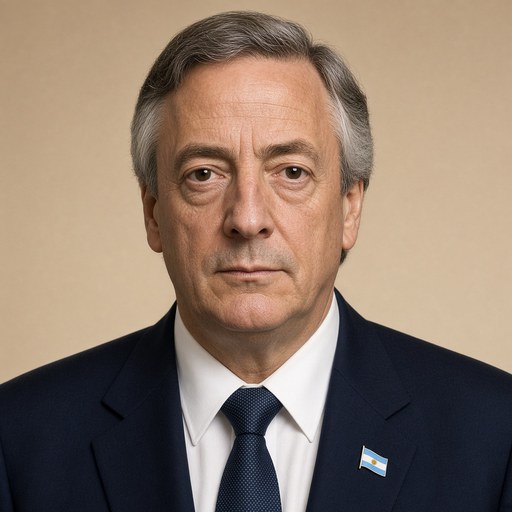
Nestor Kirchner presents the Educational Financing Law, 2005.
 Néstor Kirchner · President of Argentina
- Context
- Kirchner addressed legislators, governors, and educators at the presentation of Argentina's Educational Financing Law on September 9, 2005, in Buenos Aires.
- Main themes
- Educational financing law, public education reform, teachers and schools, memory and justice, institutional independence, Argentine national recovery, impunity and human rights, technical education, income distribution, cultural transformation, political responsibility
- Duration
- ~16 min
- Words
- 1,961
- Sentences
- 51
- Readability
- 37
- Grade
- 17.5
- Syntax
- 3.57
- Vocabulary
- 2.00
Translated from Spanish
The broad sphere of national life a sentence belongs to. Every sentence has an Arena, so it is the denominator the other indices are read against.
Other51 sentences in 21 paragraphs
Mr. Vice President of the Nation; governors; ministers of the National and Provincial Executive Powers; legislators; union representatives; teachers and members of educational institutions; various figures of Argentine life, Argentine culture, Argentine thought: we are truly realizing the beginning of a dream. I always say that we must dare to dream and to think that we can find ways to solve problems that seem unsolvable, in a country that has experienced what ours has, not by chance. Because the things that have happened to us at certain moments - and it is good to speak without hypocrisy to feel good, to build the new time, which we must do - happened because many times, as part of this society, we preferred to look the other way when the problem appeared or when the problem was worsening. Raising our voices or bringing up discussions on basic and structural issues for the Nation brings with it a series of inconveniences, because if we have reached where we are, many things have happened to us because we, the leaders of successive generations in this Argentina, even the democratic ones, have also had much responsibility.
And this reminds me of when we started the idea of definitively building an independent Justice, a fundamental and central task to dream of the State and the country that all Argentines aspire to, regardless of political affiliations or parties. I believe we are making progress; I believe that today Argentines can no longer just dream but see clearly that there is a Court that marks a clear independence of Justice, a clear independence of powers, which begins to generate another type of guarantees and safeguards.
In this same hall, we said - here where so many things have happened, some so disastrous for Argentina - that in Argentina, memory, justice, truth, the end of impunity, and the unconstitutionality of the laws of Obedience Due and Final Point were central, and for this, all Argentines and all sectors must put an end to this issue. I believe it is underway, it has been achieved, and now we hope that the courts proceed with the corresponding guarantees, without revenge, without hatred, without resentment, but with justice and memory to resolve another issue that was fundamental, that broke and caused fundamental and structural damage to Argentina and also to the problems we are living today. Because that lack of memory, lack of justice, and that impunity led to the right to think, to dissent, to investigate, to create, the right to think differently, being absolutely curtailed. There is no doubt that this was one of the central pillars that destroyed the Argentine educational system.
With Daniel Filmus, with all the ministers and governors, with the union leaders, we began to think from the very first minute we had to start governing this Argentina that had exploded, how we could find the channel to provide the answers that the Argentine people need with an educational project that contains us and is the axis of the transformation of this country.
But of course, there were teachers who could not get paid, teachers who were not getting paid over there, schools halted, without teaching materials, without possibilities to improve pedagogical quality, with arms down, with almost absolute resignation in almost everyone, except for those who continued to persist and fight even in solitude; the loss of self-esteem of the Argentines themselves accepting that it seemed we were the worst in the world, and there was a ruling class in this country that took care of instilling that, that it did not suit Argentines to work, it did not suit us to study, we did not like to investigate; rewarding - and let us have a good memory on this issue - that the best leader was the one who was the most cunning, the most unscrupulous, or the one who could make a personal fortune the fastest, that was the best leader. The one who studied, investigated, was honest, decent, and so on was a fool. This was established over a long decade in Argentina, it bore its fruits, it broke many wills, and that is reflected in many things that are happening to us today in Argentina.
That is why yesterday, when we promulgated the Technical Education Law, I can assure you that I felt a deep satisfaction that once again, as when we were children, the school of arts and trades, the technical school, would again be the instrument that enables Argentines to qualify for a decent job, a job that every Argentine deserves and that is compensated as it should be.
Because I agree with the business community that it is necessary to have skills and quality, but it is also essential that the business sectors become aware that it is fundamental to have successful entrepreneurs who have high profitability, but they must have the vision to know how to share the profits, improve, and help improve income distribution as other ways to achieve educational opportunities.
We can make many laws, but if we do not change culturally ourselves, if we do not understand the country we want to build, with equity, with solidarity, with social inclusion… and for this, the scenario we have today is very important, if all sectors participate clearly in this issue. The reconstruction of the national business community, the reconstruction of the middle class with upward mobility - which is fundamental for quality and transformative capacity - and the recovery of the working class must be the basis for the structuring of the country we dream of.
The Educational Financing Law brings with it another new discussion, another new issue, and we must not look the other way. We said when we were solving other issues in various conversations with union leaders that now we had to see how we structured the educational financing project that will go to Congress. Towards the Bicentennial, 6 points of the Gross Domestic Product, in this Argentina that will continue to grow and that will not be 2 points more than the 4 we have today, because Argentina will grow and that growth of 2 points will be much stronger by 2010 than many think if Argentina continues to grow.
But we said that from there comes another issue that we must face, and I hope that in 2006 we can do it with all the strength of debate and ideas. From the Government, I want to encourage and start that great discussion that Argentines deserve, which is once and for all to have a true Education Law, which is what the country centrally needs.
Once educational financing is achieved, once we all achieve the implementation, functioning, and normality of the entire system, it is essential to determine, because we talk about qualification, we talk about training, and we talk about what country we want, then we must have an Education Law to see how we will train, for what country and what country we will build. We do not want just any Education Law; we want an Education Law that helps us build a country where all Argentines feel included, that it is a homeland for all, an Education Law that revalues society in all its aspects.
This is not a minor discussion. I know it will be a very important discussion, with a relative truth from many sectors that will absolutely determine the profile of Argentines, the profile of the country that we Argentines want. Educational financing, educational law, which is fundamental, and also the definitive construction of a country with work, with the consolidation of the business system, the elimination of corruption, the reward for research. We must strengthen, and we are trying to do so as much as we can, but we must make much more effort so that researchers in Argentina have the support, promotion, and social respect they deserve. Without research, there will be no added value or growth in the quality technological products we need to compete in the world.
We have grown strongly in primary exports, but we need to give those primary exports added value to definitively consolidate a production and distribution economy that Argentina needs.
These are very important issues that we have ahead of us and that we must discuss among all Argentines as we are achieving today. With open debate, not corporate agreement. Hugo said it very clearly: corporate agreement is a political construction of the past that has done us a lot of harm. Corporations think they agree among themselves and that all Argentines are in agreement, but the majority of Argentines are outside those corporations.
That is to say, God willing, that the free organizations of the people flourish to enrich this debate that is fundamental and central.
Thank you very much, Mr. Ernesto; thank you to so many important figures who are here, thank you Teresa, León, Víctor, Alejandro; how many times we have talked about all our dreams.
We are living in a stage where we are trying to get out of hell; we are still in hell. I hope that when my term ends, I can tell the Argentine people that we are at the door of purgatory, and God willing, also that with these state policies, the consolidation of independent justice, the definitive consolidation of human rights policy in Argentina, the consolidation and deepening of a transformative and liberating educational system that helps build a sovereign, independent country, with qualified individuals, with thought, with competence, plurality, and consensus; with national investment that definitively consolidates national entrepreneurs, that Argentine entrepreneurs feel proud to be national entrepreneurs, that our entrepreneurs - with all affection I say this - have a truly national discourse. Let us stop buying the discourse that comes from elsewhere that is not meant to build the Argentina we need.
We want an Argentina that manages well, has a good surplus, a good level of growth, a fair distribution of income, and that we can definitively say that we are building an Argentina in which we can look at ourselves.
I say it everywhere, and I will say it in the White Room; I do not know if it is very academic what I am going to say, but it is what I feel. Walking the country, when I was in that march, in that madness that had come over me for being president, I went to events where they looked at me and laughed. I told them, you are right, the truth is that I am a bit crazy, but if one does not have a bit of madness, one cannot… But I saw parents and grandparents crying because their children had no future, because they were going to be worse off than them, they were all crammed into the grandfather's house, and I felt ashamed, I did not know what to say to them. That is the Argentina we had built, the Argentina of shrinkage, the Argentina of exclusion, the Argentina of lost hope. God willing, in the coming years we can return to what our pioneers had, to those things that happened 50 years ago in this country, where the old men and women looked at the children happily because they knew their children would be better off than they were.
If we succeed in this idea of transforming education, I have no doubt that that photograph that seems like a photograph from the past will become the photograph of the present and the future that Argentines want.
Thank you very much, you are at home, thank you for everything, thank you Hugo, thank you governors, thank you organizations, thank you teachers, Argentina awaits us. I hope we are up to the task of history. Thank you very much.
The original Spanish. The tags above are read on the English translation's sentences.
Señor vicepresidente de la Nación; señores gobernadores; señores ministros de los Poderes Ejecutivos Nacional y Provinciales; señores legisladores; representantes gremiales; docentes y miembros de instituciones educativas; distintas figuras del quehacer argentino, de la cultura argentina, del pensamiento argentino: realmente estamos concretando el inicio de un sueño. Siempre digo que hay que atreverse a soñar y a pensar que se pueden encontrar caminos para solucionar problemas que parecen sin solución, en un país al que le ha pasado lo que le ha ocurrido al nuestro, no de casualidad. Porque las cosas que nos han sucedido en determinado momento -y es bueno hablar sin hipocresías para sentirnos bien, para construir el nuevo tiempo, que debemos hacerlo- sucedieron porque muchas veces como parte de esta sociedad preferimos mirar al costado cuando aparecía el problema o se iba agudizando el problema. Levantar la voz o plantear la discusión en temas básicos y estructurales para la Nación, trae en sí mismos una serie de inconvenientes, porque si hemos llegado donde hemos llegado muchas cosas nos han sucedido porque también mucha responsabilidad hemos tenido los dirigentes de las sucesivas camadas de esta Argentina, aún las democráticas.
Y esto me hace recordar cuando iniciamos la idea de construir definitivamente una Justicia independiente, tarea fundamental y central para soñar con el Estado y el país que todos los argentinos pretendemos sin distinción de banderías o partidos. Creo que se está avanzando, creo que los argentinos hoy podemos ya no soñar sino ver con claridad que hay una Corte que marca una independencia clara de la Justicia, una independencia clara de los poderes, que empieza a generar otro tipo de garantías y resguardos.
En este mismo salón dijimos -aquí que se han vivido tantas cosas, algunas tan nefastas para la Argentina- que definitivamente en la Argentina la memoria, la justicia, la verdad, el fin de la impunidad y la inconstitucionalidad de las leyes de Obediencia Debida y Punto Final era central y para ello debíamos todos los argentinos y todos los sectores ponerle fin a este tema, creo que está en marcha, se ha logrado y ahora esperamos que los tribunales procedan con las garantías correspondientes, sin venganzas, sin odios, sin rencores pero con justicia y memoria para resolver otro tema que fue básico, que quebró e hizo un daño fundamental y estructural a la Argentina y también a la problemática que hoy estamos viviendo. Porque esa falta de memoria, falta de justicia y esa impunidad, llegó a que el derecho a pensar, a disentir, a investigar, a crear, el derecho a pensar distinto, fuera absolutamente cercenado. Eso no tengan ninguna duda fue uno de los pilares centrales que destruyó el sistema educativo argentino.
Con Daniel Filmus, con todos los ministros y gobernadores, con los dirigentes gremiales empezamos a pensar desde el minuto uno en que nos tocó empezar a gobernar esta Argentina que había explotado, cómo encontramos el canal para dar las respuestas que el pueblo argentino necesita con un proyecto educativo que nos contenga y sea el eje de la transformación de este país.
Pero claro, docentes que no podían cobrar, docentes que no cobraban por allá, escuelas paradas, sin material didáctico, sin posibilidades de mejorar la calidad pedagógica, con los brazos caídos, con una resignación casi absoluta en casi todos, salvo aquellos que seguían persistiendo y luchando aún en la soledad; la pérdida de la autoestima de los propios argentinos aceptando que parecía que éramos los peores del mundo y había una clase dirigente en este país que se encargó de instalar eso, que a los argentinos no nos sentaba trabajar, no nos sentaba estudiar, no nos gustaba investigar; el premiar –y tengamos buena memoria en este tema- que el mejor dirigente era aquel que más pícaro era, más sinvergüenza o más rápido podía hacer fortuna personal, ése era el mejor dirigente. Aquel que estudiaba, investigaba, era honesto, decente y demás era un tonto. Esto se fue instalando durante una larga década en la Argentina, fue rindiendo sus frutos, fue quebrando muchas voluntades y eso se vio y se ve reflejado en muchas cosas que nos pasan hoy en la Argentina.
Por eso ayer cuando promulgamos la Ley de Educación Técnica, les puedo asegurar que sentí una profunda satisfacción de que nuevamente, como cuando éramos chicos, la escuela de arte y oficios, la escuela técnica, vuelva a ser el instrumento que posibilite calificar a los argentinos para tener un trabajo digno, un trabajo como cada argentino se merece y que sea remunerado como corresponde.
Porque estoy de acuerdo con los empresarios en que es necesario tener el oficio y la calidad, pero también es fundamental que definitivamente los sectores empresarios tomen conciencia de que es fundamental tener empresarios que les vaya muy bien y que tengan mucha rentabilidad, pero deben que tener la visión de saber compartir la renta, mejorar y ayudar a mejorar la distribución del ingreso como otras formas de alcanzar las posibilidades de la educación.
Podemos hacer muchas leyes pero si no cambiamos culturalmente nosotros, si no entendemos el país que queremos construir, con equidad, con solidaridad, con inclusión social… , y para ello es muy importante el escenario que tenemos hoy, si todos los sectores participan con claridad de este tema. La reconstrucción del empresariado nacional, la reconstrucción de la clase media con movilidad ascendente -que es fundamental por la calidad y la capacidad transformadora- y la recuperación de la clase trabajadora, deben ser la base de la estructuración del país que soñamos.
Le Ley de Financiamiento Educativo trae aparejada otra nueva discusión, otro nuevo tema y no tenemos que mirar el costado. Decíamos cuando estábamos solucionando otros temas en diversas conversaciones con dirigentes gremiales, que ahora venía ver cómo estructurábamos el proyecto de financiamiento educativo que va a ir al Congreso. Hacia el Bicentenario 6 puntos del Producto Bruto Interno, en esta Argentina que va a seguir creciendo y que no va a ser 2 puntos más de los 4 que tenemos hoy, porque la Argentina va a crecer y ese crecimiento de 2 puntos va a ser hacia el 2010 muchísimo más fuerte de lo que muchos pensamos si la Argentina sigue creciendo.
Pero decíamos que a partir de allí viene otro tema, que tenemos que afrontarlo y espero que en el 2006 lo podamos hacer con todas las fuerzas de la capacidad del debate y la idea. Desde el Gobierno yo quiero incentivar y empezar a dar esa gran discusión que los argentinos nos merecemos, que es de una vez por todas tener una verdadera Ley de Educación que es lo que está necesitando el país centralmente.
Logrado el financiamiento educativo, logrando entre todos la puesta en marcha, el funcionamiento y la normalidad de todo el sistema, es fundamental determinar, porque hablamos de cualificación, hablamos de capacitación y hablamos de qué país queremos, entonces tenemos que tener una ley de Educación para ver cómo nos vamos a capacitar, para qué país y qué país vamos a construir. No queremos cualquier ley de Educación, queremos una ley de Educación que nos ayude a construir un país donde los argentinos nos sintamos todos contenidos, que sea una patria para todos, una ley de Educación que vuelva a revalorizar a la sociedad en todos sus aspectos.
No es una discusión menor. Yo sé que va a ser una discusión muy importante, con una verdad relativa de muchos sectores que nos va a determinar con absoluta claridad el perfil de los argentinos, el perfil de país que queremos los argentinos. Financiamiento educativo, ley educativa, que es fundamental, y también la construcción definitiva de un país con trabajo, con la consolidación del sistema empresario, la eliminación de la corrupción, el premio a la investigación. Hay que fortalecer y lo estamos tratando de hacer hasta donde podemos pero tenemos que hacer muchísimo más esfuerzo para que definitivamente los investigadores en la Argentina tengan el apoyo, la promoción y el respeto social que se merecen. Sin investigación no va a haber valor agregado ni crecimiento en los productos de calidad tecnológica que necesitamos para competir en el mundo.
Hemos crecido fuertemente en las exportaciones primarias, pero necesitamos darles a esas exportaciones primarias valor agregado para consolidar definitivamente una economía de producción y de distribución que la Argentina necesita.
Son temas muy importantes que tenemos por delante y que debemos discutir entre todos los argentinos como lo estamos logrando hoy. Con debate abierto, no el acuerdo corporativo. Bien dijo Hugo con toda claridad: el acuerdo corporativo es una construcción política del pasado que nos ha hecho muchísimo daño. Las corporaciones creen que se ponen de acuerdo entre ellos y estamos de acuerdo todos los argentinos, pero la mayoría de los argentinos estamos fuera de esas corporaciones.
Es decir, Dios quiera que florezcan las organizaciones libres del pueblo para enriquecer este debate que es fundamental y central.
Muchas gracias don Ernesto; muchas gracias a tantas figuras importantes que se encuentran aquí, gracias Teresa, León, Víctor, Alejandro; cuántas veces hemos conversado de todos nuestros sueños.
Estamos viviendo una etapa en la que estamos tratando de salir del infierno; estamos en el infierno todavía. Espero que cuando me toque terminar mi mandato, le pueda decir al pueblo argentino que estamos en la puerta del purgatorio y Dios quiera también que con estas políticas de Estado, la consolidación de la justicia independiente, la consolidación definitiva de la política de los Derechos Humanos en la Argentina, la consolidación y profundización de un sistema educativo trasformador y liberador que ayude a construir un país soberano, independiente, con cuadros, con pensamientos, con idoneidad, pluralidad y consenso; con inversión nacional que consolide a los empresarios nacionales definitivamente, que los empresarios argentinos se sientan orgullosos de ser empresarios nacionales, que nuestros empresarios –con todo cariño se los digo- tengan definitivamente un discurso nacional. Dejemos de comprar el discurso que nos traen desde otro lado que no es para construir la Argentina que nosotros necesitamos.
Queremos una Argentina que administre bien, tenga un buen superávit, un buen nivel de crecimiento, un justa distribución del ingreso y que definitivamente podamos decir que estamos construyendo una Argentina en la cual nos podamos mirar.
Yo lo digo en todos lados y lo voy a decir en el Salón Blanco; no sé si es muy académico lo que voy a decir pero es lo que siento. Caminando el país, cuando estaba en esa marcha, en esa locura que se me había dado por ser presidente, iba a actos que me miraban y se reían. Yo les decía, tienen razón, la verdad es que estoy un poco loco, pero si uno no tiene un poco de locura tampoco puede… Pero veía a los padres y abuelos llorar porque sus hijos no tenían destino, porque iban a estar peor que ellos, estaban todos amontonados en la casa del abuelo y sentí vergüenza, no sabía qué decirles. Esa es la Argentina que habíamos construido, la Argentina del achique, la Argentina de la exclusión, la Argentina de la pérdida de la esperanza. Dios quiera que en los años que vienen podamos volver a aquello que tenían nuestros pioneros, a esas cosas que pasaban hace 50 años en este país, donde las viejas y los viejos miraban a los chicos felices porque sabían que sus hijos iban a estar mejor que ellos.
Si nosotros triunfamos en esta idea de transformar la educación, no tengo ninguna duda de que esa fotografía que parece una fotografía del pasado, se va a convertir en la fotografía del presente y del futuro que los argentinos queremos.
Muchísimas gracias, están en su casa, gracias por todo, gracias Hugo, gracias señores gobernadores, gracias entidades, gracias docentes, la Argentina nos espera. Espero que estemos a la altura de la historia. Muchísimas gracias.