




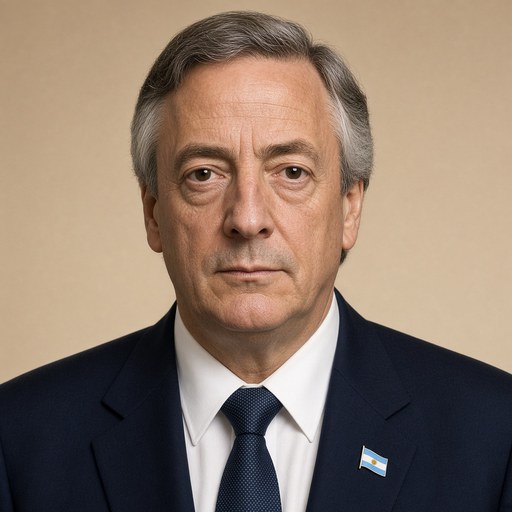
Speech by President Néstor Kirchner announcing the early payment to the IMF.
 Néstor Kirchner · President of Argentina
- Context
- Kirchner addressed Argentina announcing the full early repayment of $9.81 billion owed to the IMF, marking a major step toward economic independence in December 2005.
- Main themes
- Early IMF debt repayment, Argentine economic sovereignty, fiscal surplus and reserve accumulation, debt reduction strategy, national autonomy, economic transformation, IMF conditionality criticism, sustainable growth with social inclusion, monetary policy, collective political change
- Duration
- ~20 min
- Words
- 2,356
- Sentences
- 72
- Readability
- 29
- Grade
- 17.0
- Syntax
- 3.56
- Vocabulary
- 2.27
Translated from Spanish
The broad sphere of national life a sentence belongs to. Every sentence has an Arena, so it is the denominator the other indices are read against.
Other72 sentences in 43 paragraphs
We are firmly convinced that we can overcome Argentina's old and recurring problems.
By popular mandate, by historical understanding, and by political decision, we know that this is the opportunity for change, for profound transformation. The change that can be consolidated does not depend on one person, nor on a group of chosen or enlightened ones; it is a collective, diverse, plural task.
We are aware that we are going through a fundamental historical moment and we are determined to be protagonists of this change of era. We have been educated for a long time for impotence, for the "it cannot be done," they want us to believe that what is ours is worthless, that we do not have the capacity or the perseverance to stand on our own as a country.
They wanted to instill in our souls the certainty that reality is untouchable, they want to convince us that the difficulties are so great that it is better for nothing to change. They want us to believe that doing nothing new is the only realistic option.
We believe, however, that our future will be the offspring of our ability to articulate collective and supportive responses, of our commitment to the defense of the common interest. In trying to overcome the hell we have fallen into, we know that we are regaining hope and that we must take ownership of the tools to build our autonomy.
To continue the change, we must root out the underlying problems, creating the conditions for a long-term development strategy. A central and conditioning underlying problem is our debt.
On this day, we have made the institutional decisions that will allow us to allocate our freely available reserves to pay the total debt to the International Monetary Fund. For 50 years, it has been a source of our sleepless nights.
The Argentine Republic will pay in advance to the International Monetary Fund, by the end of the year, the total amount owed of 9.81 billion dollars. Our maturities for 2006 amounted to 5.082 billion dollars; in 2007 they rose to 4.635 billion dollars, to complement in 2008 about 432 million, in the same currency, thus anticipating our payments for total cancellation, achieving a savings in interest of almost one billion dollars.
As the cost of financing with the organization exceeds the return obtained from the placement of reserves, the difference is included in that direct saving. By allocating the payment of freely available reserves, a neutral monetary effect is guaranteed.
The measure can be adopted based on the solidity that the model of production, work, and sustainable growth, with social inclusion, that we have been applying is acquiring. Without any support from the International Monetary Fund and based on the sustainability of the fiscal and external surplus that we maintain, as well as the economic solvency achieved.
At the same time, the magnitude of this strong debt reduction, along with the new profile of the debt that we have already restructured, will contribute to strengthening and ensuring the predictability of the recovery, expansion, and transformation process that we Argentines are leading.
Based on fiscal solvency, external sustainability, exchange rate flexibility, a prudent, predictable, and transparent monetary policy, and a solid and counter-cyclical financial policy, we can take this step that will also help reaffirm a predictable economic environment.
We can do it because of the continuity of the remarkable effort in fiscal matters, which allows us to ensure successive surpluses, as well as the growing export dynamism, which allows us to have a trade surplus and a current account in the balance of payments, contributing to the generation of a stable macroeconomic environment. We can do it because we have accumulated reserves that reach almost or are already reaching 27 billion dollars and that we have multiplied more than three times, from the minimum of 8.25 billion recorded at the beginning of 2003, which support a flexible change and a prudent monetary policy that we will not abandon.
With this measure, we are concretizing our debt reduction strategy to a level compatible with our growth and payment capabilities, gaining, in addition, degrees of freedom for national decision-making.
The debt we are canceling with the International Monetary Fund, similar to the amount that this organization lent to sustain a convertibility regime, condemned to failure, has proven to be by far the most conditioning, even though, unlike other countries that experienced critical situations, we did not receive help from the Fund to overcome the difficult situation we faced.
This debt has been a constant vehicle for interference, as it is subject to periodic reviews and has been a source of demands and more demands, which are contradictory to each other and opposed to the goal of sustainable growth.
Moreover, as the International Monetary Fund has become distorted in its purposes, it has acted, regarding our country, as a promoter and vehicle of policies that caused poverty and pain in the Argentine people, alongside governments that were proclaimed exemplary students of permanent adjustment. Our people corroborate this. In the last 30 years, we have seen the continuous dependence on programs that Argentina agreed upon with the International Monetary Fund. We are part of the sad reality of being among the group of countries in which that institution has applied and monitored many of its 150 adjustment plans. The result has been exclusion, poverty, indigence, and the destruction of the productive apparatus.
In the shadow of those programs, we have seen income concentration in a few and have collided with the impossibility of combining macroeconomic growth with social development and full employment.
Today we can say that every time we went into debt, we not only weakened ourselves before the world, but we also lost our ability to resolve. This logic, always defended by local champions of models that do not take into account either the needs or the realities of the peoples, led to the consolidation of a true addiction to indebtedness, in which our creditors increasingly raised their interest rates, tightened their audits, their control, and their demands.
The most recent Argentine experience has provided sufficient proof that this international organization first supported true political failures and then did not contribute a single coin of help for overcoming the crisis or for the restructuring of the debt, which we achieved with market acceptance.
On the contrary, we had to pay 6.484 billion dollars to the organization, without them lending us any amount, while they disbursed 3 billion dollars, two months after the fall of Dr. De la Rúa's government. That same experience highlighted the error of unnecessary structural conditionalities and exaggerated demands for a country in our situation.
This advance payment, then, which implies settling a debt, cannot be interpreted as an obstacle in the relationship with the Fund, and will give us more strength and authority to continue demanding a profound restructuring of that organization.
Our demand that this institution fulfill a counter-cyclical role, which is nothing more than demanding compliance with the purpose for which it was created, avoid the system of cross conditionalities, increase the degree of transparency of its operations, reduce the cost of its functioning, and improve its lending capacity, will gain even greater strength.
The Argentine Republic has successfully completed this year the most gigantic debt swap in default in world history, and it has done so within the framework of the largest write-off in its history, exceeding 67 billion dollars. Due to its complexity, in terms of the number of titles, currencies, and jurisdictions involved, due to its amount, due to the particularities of the global situation that determined the absence of credit assistance, and due to being carried out within the framework of a net reduction of debt with international multilateral credit organizations, the process has been unique and exceptional.
For the first time in Argentine history, a debt restructuring process has culminated in a drastic reduction of the country's indebtedness.
The step we take today is of the same magnitude; two and a half years ago, when we took office, both achievements seemed impossible to reach, even in our wildest dreams. However, together, all Argentines have achieved it.
The Argentine people are gradually achieving it; we are demonstrating to ourselves what we are capable of doing together: a more dignified and smarter integration into the world, based on the solidity that our country is acquiring, leaving behind a model of irresponsible indebtedness that isolated us.
With macroeconomic balance, based on fiscal solvency, seriousness, and transparency in the management of public accounts, we will strengthen that integration.
The Ministry of Economy and Production and the Central Bank of the Argentine Republic will be responsible for the detailed execution of the operations that will carry out the advance payment to the International Monetary Fund.
With this payment, we are burying a good part of an ominous past, that of infinite indebtedness and eternal adjustment.
As we said at the beginning of the year before the Legislative Assembly, we have taken upon ourselves, with determination and conviction, the responsibilities that the present demands of those of us who have political initiative at this historical moment, reaffirmed, for which we are deeply grateful, resoundingly at the polls, on October 23.
We want to overcome the terrible wounds caused by the misguided policies applied in the past; we want to overcome together the frustration that our crisis has plunged us into. We dream of leaving a better country for those who come after us, where the next government can focus on consolidating, imagining, creating, and growing with dignity.
Our recurrent crises have hindered the permanence of correct policies; our mistakes have prevented the same course from being continued. We do not want to return to that past; we want to build the foundations of a solid future with memory, truth, and justice.
That is why we tirelessly work with the goal of achieving, by the end of our term, that unemployment, which in October is around 10 percent, is in a single digit; that indigence, which has already fallen to half, is also in a single digit; that poverty, which has significantly decreased, when our term ends, can be at half of what we had when we began our management, at the moment we took office, on May 25, 2003.
We are achieving this after having grown almost a third of the Gross Domestic Product, with annual figures between 8 and 9 percent; we will achieve it if next year, as we trust and have budgeted, we can grow again by 4 percent.
At the center of building that future is the recovery of national dignity, the revaluation of the self-esteem of the Argentine people, and the overcoming of empty criticism, constant bad omens, and refuge in skepticism. We want to leave behind the time of self-fulfilling prophecy, which always bets on the failure of others and always announces that everything will go wrong.
This is a step that has been long discussed with the presidents of MERCOSUR in general, and especially with President Lula Da Silva, to whom we are grateful, as we also take into account our gratitude for the permanent help received from the Bolivarian Republic of Venezuela.
We want to take this step; it is a transcendental step that will allow us to look without impositions, with autonomy and tranquility, without imposed urgencies, without undue pressures at the course of our future. A step that, with all responsibility, helps us build a fairer, more inclusive, and equitable future, with greater flexibility in the design and execution of economic policy, a step that will free up resources to face the struggle for growth, employment, and social inclusion with better tools. A step that puts an end to an era, a step that we must all take together.
Knowing that by managing responsibly, with seriousness, believing in the future of this homeland, with the successes and mistakes that we all human beings have, knowing that starting January 1, Argentine work will no longer go to pay the debt or the Fund permanently.
When we raise our glasses on December 31, we will know that Argentine work will be returning to Argentines, and that the great challenge will be to find the paths, not to cross each other, not to try to make the other fail, but to imagine, to create, to show the world that we are capable of having a solidarity Argentina with the world, internally supportive, with capacity, with determination, and that we can develop all that potential we have.
Since we began our administration, many things seemed impossible, from an institutional point of view, from an economic perspective, from the standpoint of truth, memory, and justice. Of course, there is still a long way to go; from here, we make a permanent call for us to think that Argentina can achieve many things in diversity, in plurality, and in consensus. But not with the machine of obstruction and the "it can't be done," but by trying to overcome and evaluating each proposal that each of us has. The evaluation of the proposal, preparing ourselves, and knowing that no one is the owner of absolute truth, understanding that each of us has relative truth.
Argentinians, to those who accompany us here and to those who watch us from their homes: in this timeframe that we are called to exercise political initiative in Argentina, we are giving our all, trying to do things as best as possible. I ask you to help us, because success will not belong to one government; it will belong to all Argentinians.
A country that has fallen apart due to false accusations, imputations, and disqualifications, a country that has all its potential in the business sector, in labor unions, in the free entities of the people, in social organizations, to create a different destiny. I believe that together we can do it, yes, from our differences, with plurality and consensus. All of us know, the businesspeople, the workers, the leaders, the social organizations, that starting January 1, at least we know that we are beginning to recover the Argentine effort.
The original Spanish. The tags above are read on the English translation's sentences.
Tenemos la firme convicción de superar la Argentina de los viejos y recurrentes problemas.
Por mandato popular, por comprensión histórica y por decisión política sabemos que esta es la oportunidad del cambio, de la transformación profunda.El cambio que puede consolidarse no depende de una persona, ni de un grupo de elegidos o iluminados; es tarea colectiva, diversa, plural.
Somos conscientes de estar transitando un momento histórico fundamental y estamos decididos a ser protagonistas de este cambio de época.Nos han educado durante mucho tiempo para la impotencia, para el no se puede, nos quieren hacer creer que lo nuestro nada vale, que no tenemos la capacidad o la constancia para valernos como nosotros, como país.
Nos quisieron meter en el alma la certeza de que la realidad es intocable, nos quieren convencer que son tan grandes las dificultades que es mejor que nada cambie. Quieren hacernos creer que no hacer nada nuevo es la única opción realista.
Creemos, sin embargo, que nuestro futuro será hijo de nuestra capacidad para articular respuestas colectivas y solidarias de nuestro compromiso con la defensa del interés conjunto. Intentando superar el infierno en que caímos, sabemos que estamos recuperando la esperanza y que debemos adueñarnos de las herramientas para construir nuestra autonomía.
Para dar continuidad al cambio se deben superar de raíz los problemas de arrastre, creando las condiciones para una estrategia de desarrollo a largo plazo.Un problema de arrastre central y condicionante, es nuestra deuda.
En el día de la fecha, hemos tomado las decisiones institucionales, que nos permitirán destinar nuestras reservas de libre disponibilidad al pago de la deuda total con el Fondo Monetario Internacional. (Aplausos). Hace 50 años que viene siendo motivo de nuestros desvelos.
La República Argentina abonará anticipadamente al Fondo Monetario Internacional, a fin de año, la suma total adeudada de capital de 9.810 millones de dólares.Nuestros vencimientos para el 2006 sumaban 5.082 millones de dólares; en el 2007 ascendían a 4635 millones de dólares, para complementar en el 2008 unos 432 millones, de igual moneda, anticipando de este modo nuestros pagos para la cancelación total, concretamos un ahorro en intereses de casi mil millones de dólares.
Como el costo de financiamiento con el organismo supera el rendimiento obtenido por colocación de las reservas, la diferencia se incluye en aquel ahorro directo.Al destinarse el pago de reservas de libre disponibilidad se garantiza un efecto monetario neutro.
La medida puede adoptarse en función de la solidez que el modelo de producción, trabajo y crecimiento sustentable, con inclusión social, que venimos aplicando va adquiriendo.Sin apoyo alguno del Fondo Monetario Internacional y sobre la base de la sustentabilidad del superávit fiscal y externo que mantenemos, así como la solvencia económica lograda.
A su vez la magnitud de este fuerte desendeudamiento, junto con el nuevo perfil de la deuda que ya hemos reestructurado, contribuirá al fortalecimiento y la previsibilidad del proceso de recuperación, expansión y transformación, que venimos protagonizando los argentinos.
Sobre la base de la solvencia fiscal, la sustentabilidad externa, la flexibilidad cambiaría, una política monetaria prudente, predecible y transparente y una política financiera sólida y anticíclica, podemos dar este paso que contribuirá a su vez a reafirmar un ambiente económico previsible.
Podemos hacerlo por la continuidad del notable esfuerzo en materia fiscal, que permite dar consistencia a sucesivos superávit, como por el dinamismo exportador creciente, que permite contar con superávit comercial y dar cuenta corriente de la balanza de pagos, que contribuya a la generación de un ambiente macroeconómico estable. Podemos hacerlo porque hemos acumulado reservas que llegan casi o ya están llegando a los 27.000 millones de dólares y que hemos multiplicado más de tres veces, desde el mínimo de 8.250 millones, registrados a comienzo de 2003 y que respaldan un cambio flexible y una política monetaria prudente, que no abandonaremos.
Concretamos, con esta medida, nuestra estrategia de reducción de deuda, a un nivel compatible con nuestras posibilidades de crecimiento y pago, ganando, además, grados de libertad para la decisión nacional.
La deuda que cancelamos con el Fondo Monetario Internacional, similar a la suma que ese organismo prestó para sostener un régimen de convertibilidad, condenado al fracaso, ha resultado lejos la más condicionante, aún cuando a diferencias de otros países que experimentaron situaciones críticas no recibimos ayuda del Fondo para superar la difícil situación que enfrentamos.
Esta deuda ha sido constante vehículo de intromisiones, porque está sujeta a revisiones periódicas y ha sido fuente de exigencias y más exigencias, que resultan contradictorias entre sí y opuestas al objetivo del crecimiento sustentable.
Además, desnaturalizado como está en sus fines el Fondo Monetario Internacional ha actuado, respecto de nuestro país, como promotor y vehículo de políticas que provocaron pobreza y dolor en el pueblo argentino, de la mano de gobiernos que eran proclamados alumnos ejemplares del ajuste permanente. Nuestro pueblo lo corrobora. En los últimos 30 años hemos visto avanzar la continua dependencia de programas que Argentina acordó con el Fondo Monetario Internacional.Formamos parte de la triste realidad de integrar el grupo de países en los que esa institución ha aplicado y monitoreado mucho de sus 150 planes de ajuste.El resultado ha sido exclusión, pobreza, indigencia, la destrucción de aparato productivo.
A la sombra de esos programas hemos visto concentración de ingreso en unos pocos y chocado contra la imposibilidad de combinar crecimiento macroeconómico con desarrollo social y pleno empleo.
Hoy podemos decir que cada vez que nos endeudábamos, no sólo nos debilitábamos ante el mundo, sino que fuimos perdiendo nuestra capacidad de resolver.Esta lógica siempre defendida por adalides locales de modelos que no tienen en cuenta ni las necesidades ni las realidades de los pueblos, llevó a consolidar una verdadera adicción al endeudamiento, en la que cada vez más nuestros acreedores encarecieron sus intereses, endurecieron su auditoria, su control y sus exigencias.
La más reciente experiencia argentina ha dado prueba suficiente de que ese organismo internacional respaldó, primero, verdaderos fracasos políticos y luego no aportó ni una moneda de ayuda para la superación de la crisis ni para la reestructuración de la deuda, que concretamos con la aceptación del mercado.
Antes bien, nosotros debimos abonar 6.484 millones de dólares al organismo, sin que nos prestaran suma alguna, mientras desembolsaron 3.000 millones de dólares, a dos meses de la caída del Gobierno del Doctor De la Rúa.Esa misma experiencia puso en evidencia el desacierto de condicionalidades estructurales innecesarias y exigencias exageradas para un país en nuestra situación.
Este pago anticipado entonces, que implica saldar una deuda no podrá ser interpretado como un obstáculo en la relación con el Fondo, y nos dará más fuerza y autoridad para seguir reclamando una profunda reestructuración de ese organismo.
Nuestro reclamo de que esa institución cumpla un rol contracíclico, que no es más que exigir el cumplimiento de la finalidad para la que fue creado, evite el sistema de condicionalidades cruzadas, aumente el grado de transparencia de sus operaciones, reduzca el costo de su funcionamiento y mejore su capacidad de préstamo, adquirirá aún mayor fuerza.
La República Argentina ha podido concretar exitosamente este año el más gigantesco canje de deuda en cesación de pagos de la historia mundial, y lo ha hecho en el marco de la concreción de la quita más grande de su historia, que supera los 67 mil millones de dólares. Por su complejidad, en cuanto a número de títulos, monedas y jurisdicciones involucradas, por su monto, por las particularidades de la situación mundial que determinaron la ausencia de ayuda crediticia, por haberse realizado en el marco de una reducción neta de la deuda con los organismos multilaterales de crédito internacional, el proceso ha resultado único y excepcional.
Por primera vez en la historia argentina un proceso de reestructuración de deuda ha culminado con una drástica disminución del endeudamiento del país.
El paso que damos hoy es de idéntica magnitud; hace dos años y medio, al tiempo de asumir, ambos logros parecían imposibles de alcanzar ni en el más temerario de nuestros sueños. Sin embargo, entre todos los argentinos lo hemos logrado.
El pueblo argentino, paulatinamente, lo está logrando, nos estamos demostrando lo que somos capaces de hacer juntos: una integración más digna al mundo, y más inteligente, sobre la base de la solidez que está adquiriendo nuestro país, dejando atrás un modelo de irresponsable endeudamiento que nos aislaba.
Con equilibrio macroeconómico, en base a solvencia fiscal, seriedad y transparencia en el manejo de las cuentas públicas, fortaleceremos esa integración.
El Ministerio de Economía y Producción y el Banco Central de la República Argentina tendrán a su cargo la ejecución en detalle de las operaciones que concretarán el pago anticipado ante el Fondo Monetario Internacional.
Estamos con este pago sepultando buena parte de un ominoso pasado, el del endeudamiento infinito y el ajuste eterno.
Como dijimos a comienzo del año ante la Asamblea Legislativa, tomamos sobre nuestras espaldas, con decisión y convicciones, las responsabilidades que el ahora reclama a quienes contamos en este momento histórico con iniciativa política, ratificada, lo que agradecemos profundamente, rotundamente en las urnas, el pasado 23 de octubre.
Queremos superar las terribles heridas que produjeron las políticas herradas aplicadas en el pasado, queremos superar entre todos con la frustración que nuestra crisis nos sumiera. Soñamos con dejar a quienes nos sucedan un país mejor, donde el próximo gobierno pueda dedicarse a consolidar, a imaginar, a crear, a crecer con dignidad.
Nuestras crisis recurrentes han obstaculizado la permanencia de las políticas correctas, nuestros errores han impedido que se continúe el mismo rumbo. No queremos volver a ese pasado, queremos con memoria, verdad y justicia construir las bases de un sólido futuro.
Por eso incansablemente trabajamos con el objetivo de lograr, para el final de nuestro mandato, que la desocupación, que ya en octubre ronda el 10 por ciento, se ubique en un dígito; que la indigencia que ya ha caído a la mitad, también se ubique en un dígito; que la pobreza, que ha bajado significativamente, cuando esté terminando nuestro mandato pueda estar en la mitad de la que tuvimos cuando nos tocó empezar nuestra gestión, en el momento en que asumimos, el 25 de mayo del 2003.
Lo estamos logrando después de haber crecido casi un tercio del Producto Bruto Interno, con cifras anuales entre el 8 y el 9 por ciento, lo lograremos, si el año que viene, como confiamos y lo hemos enviado presupuestariamente, podemos volver a crecer al 4 por ciento.
En el centro de la construcción de aquel futuro está recuperación de la dignidad nacional, la revalorización de la autoestima del pueblo argentino y la superación de la crítica vacía, el mal augurio constante y el refugio en el escepticismo. Queremos dejar atrás el tiempo de la profecía autocumplida, que apuesta siempre al fracaso de los demás y anuncia siempre que todo va a salir mal.
Se trata de un paso largamente conversado con los señores presidentes del MERCOSUR en general, y especialmente con el presidente Lula Da Silva, a quienes agradecemos, como también tenemos en cuenta el agradecimiento a la ayuda permanente a la ayuda permanente recibida de la República Bolivariana de Venezuela.
Queremos dar este paso, se trata de un paso trascendental, que nos permitirá mirar sin imposiciones, con autonomía y tranquilidad, sin urgencias impuestas, sin presiones indebidas la marcha de nuestro futuro. Un paso que con toda responsabilidad nos ayuda a construir un futuro más justo, inclusivo y equitativo, con una mayor flexibilidad en el diseño y la ejecución de la política económica, un paso que liberará recursos para afrontar con mejores herramientas la lucha por el crecimiento, el empleo y la inclusión social. Un paso que es ponerle fin a una época, un paso que debemos dar todos juntos.
El saber que administrando con responsabilidad, con seriedad, creyendo en el futuro de esta Patria, con los aciertos y errores que tenemos todos los seres humanos, saber que a partir del 1 de enero el trabajo argentino ya no va a ir más para pagar la deuda o al Fondo en forma permanente.
Cuando estemos levantando las copas el 31 de diciembre sabremos que el trabajo argentino estará volviendo a los argentinos, y que el gran desafío será encontrar los caminos, no de cruzarnos, no de tratar que el otro fracase, sino de imaginar, de crear, de demostrarle al mundo que somos capaces de tener una Argentina solidaria con el mundo, solidaria internamente, con capacidad, con decisión, y que toda esa potencialidad que tiene la podamos desarrollar.
Desde que empezamos nuestra gestión muchas cosas parecían imposibles, desde el punto de vista institucional, económico, desde el punto de vista de la verdad, de la memoria, de la justicia. Claro que falta muchísimo, desde acá hacemos un llamado permanente a que en la diversidad, en la pluralidad, en el consenso, pensemos que la Argentina puede lograr muchas cosas. Pero no con la máquina de impedir y el no se puede, sino tratando de superar y calificando cada propuesta que cada uno de nosotros tenga. La calificación de la propuesta, prepararse y saber que nadie es el dueño de la verdad absoluta, entender que cada uno de nosotros tiene la verdad relativa.
Argentinos y argentinas, a quienes nos acompañan acá y a quienes nos miran desde su casa: en esta temporalidad que nos toca ejercer la iniciativa política en la Argentina estamos dejando todo, tratando de hacer las cosas lo mejor posible. Les pido que nos ayuden, porque el éxito no va a ser de un gobierno, va a ser de todos los argentinos.
Un país que se desbarrancó por la acusación, la imputación falsa y la descalificación, un país que tiene toda su potencialidad en el campo empresario, sindical, en las entidades libres del pueblo, en las organizaciones sociales, para crear un destino distinto. Creo que entre todos lo podemos hacer, sí, desde la diferencia, con pluralidad y con consenso. Todos nosotros sabemos, los empresarios, los trabajadores, los gobernantes, las organizaciones sociales, que a partir del 1 de enero ya por lo menos sabemos que empezamos a recuperar el esfuerzo argentino».