




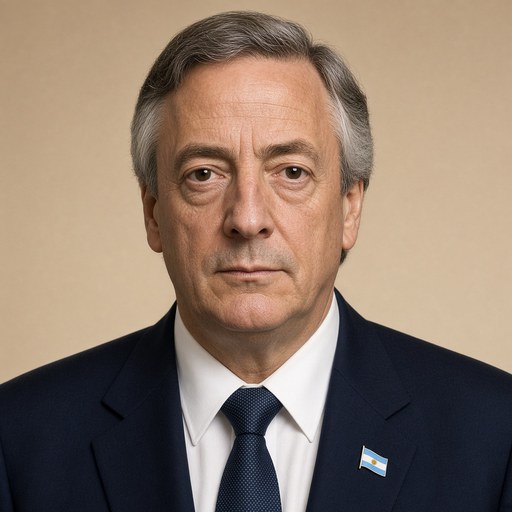
Speech by Néstor Kirchner at the "Latin America Rising" conference.
 Néstor Kirchner · President of Argentina
- Context
- Kirchner addressed the 'Latin America Rising' conference on September 27, 2010, speaking on South American integration, democracy, and the role of Unasur.
- Main themes
- Latin American regional integration, Unasur, democratic pluralism, human rights, Colombia-Venezuela relations, Mercosur, Bolivia secessionist crisis, single currency debate, political inclusion, sovereignty, regional parliament
- Duration
- ~11 min
- Words
- 1,372
- Sentences
- 64
- Readability
- 36
- Grade
- 13.7
- Syntax
- 3.18
- Vocabulary
- 2.26
Translated from Spanish
The broad sphere of national life a sentence belongs to. Every sentence has an Arena, so it is the denominator the other indices are read against.
Other64 sentences in 15 paragraphs
About the region
The region has experienced deep, serious problems, but it is undergoing very particular political processes. In Bolivia, there is a very important indigenous process taking place. The processes in Uruguay and Brazil are also truly interesting: both are experiencing significant growth, which is key for the region. And evidently, we are managing to coexist, from different ideological and philosophical viewpoints, within the same framework. We need to integrate the region in order to be able to converse with emerging blocs, with the European Economic Community, with Arab countries. That is to say, to be able to converse with the whole world from a vision, from a position.
Mercosur does not solve this problem because, no matter how much it tries to advance politically, it is fundamentally an economic functioning agreement. Only now, with the economic normalization of the region, can we start to think about how to combat asymmetries. We began, back in 2006, when I was still president, to discuss how we could seek a framework for political integration in the region, how we could start to coordinate state policies that would tend to unite us with justice, equality, and inclusion; policies that deeply respect freedom of expression and the expression of the different sectors of society; policies that deeply respect human rights and democracy, which are substantial.
Regional construction
In the early moments, when we began to build in the region, we tried to reconcile different situations and histories. It was not easy. But the first success, under the presidency of Unasur by Michelle Bachelet, was achieved when the problem of Bolivia (the secessionist crisis of the eastern departments, in 2008) was resolved, and Unasur fulfilled its first central and fundamental role. Unasur has managed to reconcile, without renouncing any objective, political and institutional situations of different ideologies. And what about coexistence? We have had to live through different situations where Unasur always reacted firmly in defense of democracy, as in the case of Honduras.
The main philosophy of Unasur is full respect for democratic plurality, for the sovereign will of the peoples, for human rights and for freedom of expression, joint support for solidarity policies that tend to social inclusion, permanent solidarity among peoples, and an attitude of integration towards the world. This is a central and essential task that Unasur must carry out, and we are absolutely willing to carry it out.
Colombia-Venezuela crisis
Colombia and Venezuela are two peoples that may have governments of different ideological currents, but that, in synthesis, know that alternation and democratic plurality is an instance that should not alter the integration processes in any aspect. If these integration processes, or their governments, do not relate to the reality of their peoples, evidently the situation becomes complicated and is a difficult situation. But when we say and believe that both countries are willing to work for their commercial integration, for full respect for human rights, for full respect for democratic institutionalism, for full respect for freedom of expression and so on, taking all the necessary steps to do so, it seems absolutely important to us to embark on that change, because that path is undoubtedly the path of peace, growth, and the construction of a different Latin America.
Defense of democracy
We are very zealous in defending democratic interests in the region because we have had to live through very difficult situations. This is why Unasur's position regarding the situation in Honduras was taken, and it is the same that should be taken in any situation. The experience of Unasur is an initial experience, which does not attempt, under any aspect, to block economic agreements and economic developments that peoples like Mercosur or the Andean Pact may carry out. It will try to build a great political synthesis; we will attempt to create a single great parliament. We do not want to have three parliaments: one parliament for Mercosur, one Andean parliament, and one for Unasur. We must reach the great parliament of Latin America, and I believe we should also bring Mexico closer to the region, because its presence would be very important to consolidate an important framework of stability, which is closely related to many issues in Latin America.
Questions
Is it possible that in the future there will be a single currency in Unasur to strengthen economic integration? If so, would it use an existing currency from one of the member countries or would a new currency be created?
Let us analyze the crisis of the EEC. The issue of the single currency. I believe it is very difficult to manage an international crisis, or a crisis of the European Community, as occurred, with the case of a single currency, when countries do not have the same systems and the same functioning structures. I think it is very difficult if there is not an equal structure of functioning, of costs, of policies, of pensions, of health, of minimum wages, and of global wages and integration policies. And, besides, how do you manage a single central bank? I experienced the crisis in Argentina. The difference between that crisis and Greece's is that we could manage our currency and our economic policy. Now, if you, from the central bank, do not have an instrument to manage your own economic policy, as is the case with Greece, the situation is difficult. I believe the issue of the single currency leads to many discussions, but to apply it, the same rules would have to be in place. And, at the same time, we need to see how to solve the global management of economic and monetary policies and instruments, because otherwise it is absolutely difficult.
What preventive mechanisms would Unasur have to ensure that historical events like the coup in Honduras do not happen again in the future? With absolute sincerity, as always, I believe that the deepening of democratic culture, the non-endorsement of such procedures is essential. I believe that, looking at what happened in Honduras, seeing the death of ten journalists, the path that has been followed has been horrendous. The region's reaction was very good. There are some differences. There are countries that have made recognitions, although the majority have not. We hope that Honduras, in its own sovereignty, can resolve democratically, giving equal rights to everyone so that there can be a democratic process where everyone can participate, those who think alike and those who think differently. And in the region, we must create a culture and a defense of democracy without conditions. Democracy is not negotiable. It is a central issue. Those who change and establish governments are the peoples. But the way to consolidate democracy is to have institutional systems that have corporations well organized, monopolies well organized, whether they are media or not. Because the quality of democracy is not only about voting, but also about being able to exercise it and live fully in democracy, and that there cannot be governments that are conditioned by strong corporations or strong monopolies, as unfortunately still happens in most places in the region.
What can you say about the dismissal of Piedad Córdoba by the Colombian Prosecutor's Office, about the FARC, and about President Santos? Piedad Córdoba's work is excellent. How can we help Colombia to get closer to the region and so on? By sitting down to talk. At first, and probably if you ask President Santos, he would say the same, it seemed impossible to me that we could converse with people who have different views. We must work hard, we must contribute to consolidating democracy in Colombia, we must contribute to deepening human rights in Colombia, we hope that this internal confrontation can be ended, so that the people can express themselves with more freedom and fullness. I believe that the attitude of the FARC does not contribute to the democratization of Colombia because it radicalizes, sharpens contradictions, and closes the space for progressive forces in Colombia, which could be working and building much more with a much larger electoral growth… and yet that contradiction generated by the actions of the FARC reduces their space and capacity for development, generating fears and actions that should not be taken. It is a complicated issue.
The original Spanish. The tags above are read on the English translation's sentences.
Sobre la región
La región ha vivido problemas profundos, graves, pero se están viviendo procesos políticos muy particulares. En Bolivia se está viviendo un proceso indigenista muy importante. Los de Uruguay y Brasil son procesos realmente interesantes también: ambos están viviendo un crecimiento importante, clave para la región. Y evidentemente estamos logrando convivir, desde puntos de vista ideológicos y filosóficos diferentes, en el mismo marco. Nosotros necesitamos integrar a la región para poder conversar con los bloques emergentes, con la Comunidad Económica Europea, con los países árabes. Es decir, poder conversar con el conjunto del mundo desde una visión, desde una posición.
El Mercosur no soluciona este problema porque, por más que intente avanzar desde el punto de vista político, fundamentalmente es un acuerdo de funcionamiento económico. Recién ahora, con la normalización económica de la región, podemos empezar a pensar cómo combatir las asimetrías. Empezamos, allá por el año 2006, cuando a mí todavía me tocaba ser presidente, a conversar de qué forma podíamos buscar un marco de integración política en la región, cómo podíamos empezar a coordinar políticas de estado que nos tendieran a unir con justicia, igualdad e inclusión; políticas de profundo respeto a la libertad de expresión y a la expresión de los distintos sectores de la sociedad; políticas de profundo respeto a los derechos humanos y a la democracia, sustanciales.
Construcción regional
En los primeros momentos, cuando empezamos a construir en la región, tratamos de compatibilizar situaciones e historias diferentes. No fue fácil. Pero el primer éxito, bajo la presidencia de la Unasur de Michelle Bachelet, se logró cuando se solucionó el problema de Bolivia (crisis secesionista de los departamentos orientales, en 2008) y la Unasur cumplió su primer rol central y fundamental. La Unasur que ha logrado compatibilizar, sin renunciar a ningún objetivo, situaciones políticas e institucionales de ideologías distintas. ¿Y la convivencia? Nos ha tocado vivir situaciones diferentes donde siempre Unasur reaccionó férreamente en defensa de la democracia, como el caso de Honduras.
La filosofía principal de Unasur es el respeto pleno a la pluralidad democrática, a la voluntad soberana de los pueblos, a los derechos humanos y a la libertad de expresión, el apoyo en forma conjunta a políticas solidarias que tiendan a la inclusión social, la solidaridad permanente entre los pueblos y la actitud de integración hacia el mundo. Esto es una tarea central y esencial que la Unasur tiene que llevar adelante y que estamos absolutamente dispuestos a llevar adelante.
Crisis Colombia-Venezuela
Colombia y Venezuela son dos pueblos que pueden tener gobiernos de distinta corriente ideológica, pero que, en la síntesis, saben que la alternancia y la pluralidad democrática es una instancia que no debe alterar los procesos de integración bajo ningún aspecto. Si estos procesos de integración, o sus gobiernos, no tienen que ver con la realidad de sus pueblos, evidentemente la situación se complica y es una situación difícil. Pero cuando nosotros decimos y creemos que ambos países están dispuestos a trabajar por su integración comercial, por el respeto pleno a los derechos humanos, por el respeto pleno a la institucionalidad democrática, por el respeto pleno a la libertad de expresión y demás, dando todos los pasos necesarios para hacerlo, nos parece absolutamente importante transitar ese cambio, porque ese camino indudablemente es el camino de la paz, del crecimiento y de la construcción de una América Latina diferente.
Defensa de la democracia
Nosotros somos muy celosos defendiendo los intereses democráticos en la región porque nos tocó vivir situaciones muy difíciles. A eso se debe la postura que tuvo Unasur con respecto a la situación de Honduras, y es la misma que debe tener ante cualquier situación. La experiencia de Unasur es una experiencia inicial, que no intenta, bajo ningún aspecto, bloquear los acuerdos económicos y los desarrollos económicos que puedan llevar adelante pueblos como el Mercosur o el Pacto Andino. Va a intentar construir una gran síntesis política, vamos a intentar un solo gran parlamento. No queremos tener tres parlamentos: un parlamento del Mercosur, un parlamento andino y uno de la Unasur. Tenemos que llegar al gran parlamento de América Latina y creo que hay que acercar a México también a la región, porque su presencia sería muy importante para consolidar un marco de estabilidad importante, que tiene mucho que ver con muchas cuestiones de América Latina.
Preguntas
¿Es posible que a futuro exista una moneda única en Unasur para fortalecer la integración económica? Si así fuera, ¿se utilizaría alguna moneda ya existente en alguno de los países miembros o se crearía una moneda nueva?
Analicemos la crisis de la CEE. El tema de la moneda única. Creo que es muy difícil manejar una crisis internacional, o una crisis de la Comunidad Europea, como se dio, con el caso de una moneda única, cuando lo países no tienen los mismos sistemas y las mismas estructuras de funcionamiento. Creo que es muy difícil si no hay una estructura igual de funcionamiento, de costos, de políticas, de jubilaciones, de salud, de salarios mínimos y de salarios globales y de políticas de integración. Y, aparte, ¿cómo se hace para manejar un solo banco central? A mí me tocó la crisis de la Argentina. La diferencia de la crisis con la de Grecia, a favor de la Argentina, es que nosotros podíamos manejar nuestra moneda y nuestra política económica. Ahora si usted desde el banco central no tiene un instrumento para manejar su propia política económica, como le pasa a Grecia, la situación es difícil. Creo que el tema de la moneda única da para muchísimas discusiones, pero para poder aplicarlo habría que tener las mismas normas. Y, a la vez, ver cómo se soluciona también el manejo global de la política y los instrumentos económicos y monetarios, porque si no es absolutamente difícil.
¿Qué mecanismos de prevención tendría la Unasur para que sucesos históricos como el golpe de Honduras no se repitan en el futuro? Con absoluta sinceridad, como siempre, creo que la profundización de la cultura democrática, el no aval a este tipo de procedimientos. Yo creo que, viendo lo que pasó en Honduras, viendo la muerte de diez periodistas, evidentemente el camino que se ha seguido ha sido horrendo. La reacción de la región fue muy buena. Hay algunas diferencias. Hay países que han hecho reconocimientos, aunque la mayoría no lo han hecho. Esperemos que Honduras, en su propia soberanía, pueda resolver democráticamente, dando igualdad de derechos a todo el mundo para que pueda haber un proceso democrático donde puedan estar todos, los que piensan igual y los que piensan diferente. Y en la región tenemos que hacer una cultura y una defensa de la democracia sin condicionamientos. La democracia no se negocia. Es una cuestión central. Los que cambian y ponen gobiernos son los pueblos. Pero la forma de consolidar la democracia es tener sistemas institucionales que tengan bien ordenadas a las corporaciones, bien ordenados los monopolios, sean mediáticos o no sean mediáticos. Porque la calidad de la democracia no sólo es votar, sino que se pueda ejercer y que se pueda vivir plenamente en democracia, y que no pueda haber gobiernos que estén condicionados por fuertes corporaciones o fuertes monopolios, como lamentablemente pasa todavía en la mayoría de los lugares de la región.
¿Qué puede decir sobre la destitución de Piedad Córdoba por la Procuraduría colombiana, sobre las FARC y sobre el presidente Santos? La tarea de Piedad Córdoba es excelente. ¿Cómo se puede ayudar a Colombia a que cada vez pueda acercarse más a la región y demás? Sentándonos a conversar. A mí, en un primer momento, y probablemente si le preguntan al presidente Santos les dice lo mismo, me parecía imposible que pudiéramos conversar personas que tenemos visiones distintas. Hay que trabajar fuertemente, hay que contribuir a consolidar la democracia en Colombia, hay que contribuir a profundizar los derechos humanos en Colombia, esperemos que se pueda terminar con esta confrontación interna que hay, para que el pueblo se pueda expresar cada vez con más libertad y con más plenitud. Yo creo que la actitud que tienen las FARC no contribuye a la democratización de Colombia porque radicaliza, agudiza las contradicciones y les cierra el espacio a las fuerzas progresistas en Colombia, que podrían estar trabajando y construyendo mucho más con un crecimiento electoral muchísimo más grande… y sin embargo esa contradicción que genera la acción de las FARC les reduce el espacio y la capacidad de desarrollo generando temores y acciones que no debieran hacerse. Es un tema complicado.