




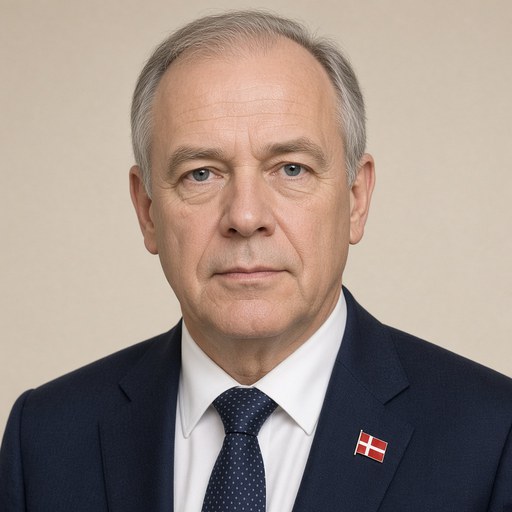
Prime Minister Poul Nyrup Rasmussen's constitutional speech at Christiansborg Ridebane in Copenhagen on June 5, 1999.
 Poul Nyrup Rasmussen · Prime Minister of Denmark
- Context
- Rasmussen addressed a constitutional ceremony at Christiansborg Ridebane on June 5, 1999, marking the 150th anniversary of Denmark's 1849 constitution.
- Main themes
- Danish constitution, democracy, freedom and equality, national identity, civic responsibility, community and solidarity, Kosovo crisis and refugees, historical memory, constitutional history of Denmark, participation in democracy
- Duration
- ~8 min
- Words
- 1,016
- Sentences
- 72
- Readability
- 58
- Grade
- 8.7
- Syntax
- 2.73
- Vocabulary
- 1.98
Translated from Danish
The broad sphere of national life a sentence belongs to. Every sentence has an Arena, so it is the denominator the other indices are read against.
Other72 sentences in 24 paragraphs
Your Majesty, Your Royal Highnesses, dear guests, dear everyone.
The Constitution of the Kingdom of Denmark is not just a collection of paragraphs.
It is a story about who we are and how we want to live in our country. A story about why the Constitution became what it became. And a story about a Constitution that came about in a very Danish way and not through bloody revolutions.
It is no coincidence that people say about Danes abroad: It is rare to see a Dane with a knife in one hand without a fork in the other. I do not necessarily think we should be ashamed of that - perhaps just apart from the Minister of Health!
Still, it all tells us something about ourselves. Our ability to talk things through. Our ability to discuss matters. Our perseverance. Our ability to - in everyday life - not forget what it is all about. For the Constitution did not come about by itself. It came from a good conversation between the king and the people. And it came at a time when it was crucial for the people to begin participating in decisions.
On June 5, 1849, King Frederik VII signed the Constitution. At a time when war raged in Jutland. At a time when we did not know for certain if we could survive as a people and as a nation.
And yet democracy began to develop - despite great difficulties. June 5 was the first and decisive step on the path of democracy and freedom. The first step is, as we know, always the biggest - even though it did not include 'women, the poor, and other unpropertied good people' - that came later. And that was just as important!
Today we celebrate the Constitution and thus also a society. A Danish society where all are born equal. Where every vote carries the same weight and significance. Where everyone has freedom, in spirit, in writing, and in speech. Where all are equal before the law and have the assurance of being treated properly - without oppression.
It has been half a century since the war - in peace and in progress for Denmark. The principles of the Constitution stand as firmly as ever. But that does not mean that the Constitution is superfluous! Even though we see it as something self-evident, it does not mean that we should not be conscious of democracy - every day.
The Constitution is a law that stands above all others, and whose power is so strong that it cannot be changed lightly, but only with a very strong will of the people. And fortunately for that - it should be so.
-oOo-
The Constitution fits us Danes quite well, and we fit the Constitution well. Just take the section on freedom of association: If two Danes agree, they immediately form an association. If they disagree, they immediately form a discussion club.
Equality, freedom, justice, community, rights and duties - the responsibility for one another and for the community.
Democracy must be won all the time, we say. But what does that really mean? Yes, it means that it depends on us. It means that we must participate. The older generation, who experienced the five dark years under occupation, knows what it means. And the new Danes who come to us, and who have lived in societies with unfreedom and dictatorship, fully understand what it means.
But what about the rest of us? Do we understand it completely? We, who have been given democracy as a cradle gift. Have we forgotten something? Do we appreciate it enough? Do we value the noble collection of democratic thoughts that generations before us have fought to achieve?
Have we forgotten a bit of our community?
We hardly remember it all. And then suddenly events from outside remind us of it. For it is not everywhere that democracy and freedom - and the ability to gather freely, are a given. It was not so in South Africa a few years ago. It is not so in Kosovo close to our country's borders.
It is thought-provoking that such a great misfortune for an entire people has stirred emotions in the Danish population - feelings and strong desires to help. A sense of community that we almost thought was forgotten. I am sure that many Danes right now, when they see an old woman on television, using her last strength to cross the mountain and enter another country where she can live in safety, think of her when they see their own elderly the next day. And I am sure that when we look at our own children in Denmark, we connect that with the many little girls we see on the television screen not far from here - in the refugee camps, who have such a strong hope of returning.
Then we see the Danish population's sense of responsibility and sense of community again. And the democratic fundamental attitude, which is fundamentally the most beautiful one can have: We strongly wish to help others. Because we are aware that our democracy is so precious.
And because we perhaps deep down realize that helping others is, in fact, also helping ourselves! Helping us to rediscover our own sense of community.
Our country is a small haven in a troubled world. A country we must take good care of and a constitution we must take very good care of. It only gains its innermost value when we understand that our democracy is also a duty to help one another, to have responsibility for one another, and to take responsibility for all those outside our country's borders who have not received the values we have achieved.
I am confident that this century will end with humanism and human rights in Kosovo and in other countries once again showing that those values are the strongest. That when people are given a voice, humanity comes forth, and democracy follows.
Therefore, I wish everyone - all of us - a heartfelt congratulations on our Constitution.
Congratulations - and thank you.
The original Danish. The tags above are read on the English translation's sentences.
Deres Majestæt, Deres kongelige Højheder, kære gæster, kære allesammen.
Danmarks Riges Grundlov er ikke alene en samling af paragraffer.
Det er en fortælling om, hvem vi er, og hvordan vi vil leve i vores land. En fortælling om, hvorfor Grundloven blev til det den blev. Og en fortælling om en Grundlov der kom på en meget dansk måde og ikke ved blodige revolutioner.
Det er jo ikke noget tilfælde, at man siger om danskere ude omkring i udlandet: Det er sjældent man ser en dansker med en kniv i den ene hånd, uden der er en gaffel i den anden. Det mener jeg ikke nødvendigvis, at vi skal være kede af - måske lige bortset fra sundhedsministeren!
Det fortæller alligevel alt sammen noget om os. Vores evne til at tale os til rette. Vores evne til at tale om tingene. Vores vedholdenhed. Vores evne til - i dagligdagen - alligevel ikke at glemme hvad det hele handler om. For Grundloven kom ikke af sig selv. Den kom i en god samtale mellem kongen og folket. Og den kom på det tidspunkt, hvor det var helt afgørende, at folket kunne begynde at deltage i beslutningerne.
Den 5. juni 1849 underskrev Kong Frederik den 7. Grundloven. På et tidspunkt, hvor krigen rasede i Jylland. På et tidspunkt hvor vi ikke med sikkerhed vidste, om vi kunne overleve som folk og som land.
Og så begyndte demokratiet alligevel - på trods af store vanskeligheder - at udvikle sig. Den 5. juni var det første og afgørende skridt på demokratiets og frihedens vej. Det første skridt er som bekendt altid det største - selvom det ikke omfattede 'fruentimmere, fattigfolk og andre uformuende gode folk' - det kom senere. Og nok så vigtigt var også det!
I dag fejrer vi Grundloven og dermed også et samfund. Et dansk samfund, hvor alle er født lige. Hvor hver stemme har samme vægt og samme betydning. Hvor alle har frihed, i ånd, i skrift og i tale. Hvor alle er lige for loven og har sikkerhed for at blive behandlet ordentligt - uden undertrykkelse.
Et halvt århundrede har vi haft siden krigen - i fred og i fremgang for Danmark. Grundlovens principper står så sikkert som nogensinde. Men det betyder jo ikke, at Grundloven er overflødig! Selvom vi ser den som noget selvindlysende, betyder det ikke, at vi ikke skal være bevidste om demokratiet -hver dag.
Grundloven er en lov, der står over alle andre, og hvis kraft er så stærk, at den ikke uden videre lader sig ændre, men kun med en meget stærk folkevilje. Og heldigvis for det - sådan skal det være.
-oOo-
Grundloven passer ret godt til os danske, og vi passer godt til Grundloven. Tag bare afsnittet om foreningsfrihed: Hvis to danskere er enige, danner de øjeblikkelig en forening. Hvis de er uenige, danner de øjeblikkelig en diskussionsklub.
Lighed, frihed, retfærdighed, fællesskab, rettigheder og pligter - ansvaret for hinanden og for fællesskabet.
Demokrati skal vindes hele tiden, siger vi. Men hvad betyder det egentlig? Ja, det betyder, at det beror på os selv. Det betyder, at vi skal deltage. Den ældre generation, som har oplevet de fem mørke år under besættelsen ved, hvad det betyder. Og de nye danskere, der kommer til os, og som har levet i samfund med ufrihed og diktatur, forstår til fulde, hvad det betyder.
Men hvad med os andre? Forstår vi det helt og fuldt? Vi, der har fået demokratiet i vuggegave. Har vi glemt noget? Sætter vi tilstrækkelig pris på det? Værdsætter vi den fornemme samling af demokratiske tanker, som generationer før os har kæmpet sig frem til?
Har vi glemt lidt af vores fællesskab?
Vi husker næppe det altsammen. Og så lige pludselig kommer der begivenheder udefra, som minder os om det. For det er jo ikke overalt, hvor demokrati og frihed - og det at kunne samles frit, er en selvfølge. Det var det ikke i Sydafrika for få år siden. Det er det ikke i Kosovo tæt på vores lands grænser.
Det er tankevækkende, at en så stor ulykke for et helt folk, har sat følelser i gang i den danske befolkning - følelser og stærke ønsker om at hjælpe. En fællesskabsfølelse, som vi næsten havde troet var glemt. Jeg er sikker på, at mange danskere lige nu, når man ser en gammel kone i fjernsynet, med de sidste af hendes kræfter komme over bjerget og ind i et andet land, hvor man kan leve i tryghed, tænker på hende, når man ser sine egne ældre dagen efter. Og jeg er sikker på, at når vi ser på vores egne børn i Danmark, kombinerer vi det med de mange små piger, vi ser på fjernsynsskærmen ikke ret langt herfra - i flygtningelejrene, som har så stærkt et håb om at komme tilbage.
Så ser vi den danske befolknings ansvarsfølelse og fællesskabsfølelse igen. Og den demokratiske grundholdning, som dybest set er det smukkeste man kan have: Vi ønsker stærkt at hjælpe andre. Fordi vi er klar over, at vores demokrati er så dyrebart.
Og fordi vi måske inderst inde er klar over, at det at hjælpe andre, i virkeligheden også er at hjælpe os selv! Hjælpe os til at genfinde vor egen fællesskabsfølelse.
Et lille smørhul i en urolig verden er vores land jo. Et land, vi skal passe godt på og en forfatning, vi skal passe rigtigt godt på. Det får først sin inderste værdi, når vi forstår, at vores demokrati også er en pligt til at hjælpe hinanden, have ansvar for hinanden og have ansvaret for alle dem uden for vort lands grænser, der ikke har fået de værdier, vi har opnået.
Jeg er sikker på, at dette århundrede vil slutte med, at humanismen og menneskerettighederne i Kosovo og i andre lande, endnu en gang vil vise, at de værdier er de stærkeste. At når folk får røst, så kommer menneskelighed, så kommer demokrati.
Derfor ønsker jeg alle - os alle - rigtig hjertelig tillykke med vores Grundlov.
Tillykke - og tak.