




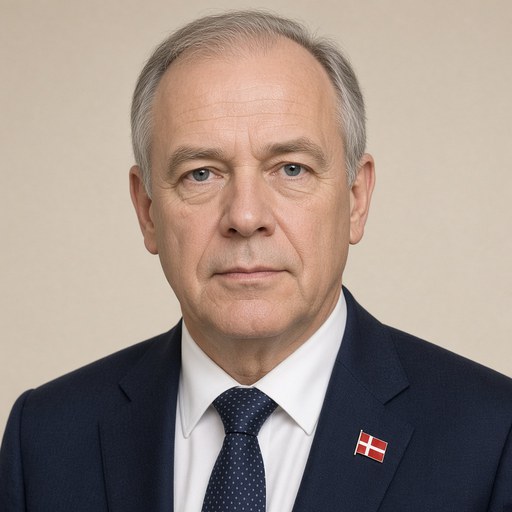
Prime Minister Poul Nyrup Rasmussen's New Year's Speech
 Poul Nyrup Rasmussen · Prime Minister of Denmark
- Context
- Rasmussen addressed the Danish nation on New Year's Day 1998, outlining key challenges including the Amsterdam Treaty referendum and immigration policy ahead of a pivotal election year.
- Main themes
- Amsterdam Treaty referendum, Danish EU membership, Danish national identity, human rights and democracy, refugee and immigration policy, international cooperation, environmental policy, Kyoto climate summit, NATO and Baltic states, welfare state, development aid and peacekeeping, parliamentary election 1998
- Duration
- ~17 min
- Words
- 2,030
- Sentences
- 143
- Readability
- 61
- Grade
- 7.8
- Syntax
- 2.61
- Vocabulary
- 1.89
Translated from Danish
The broad sphere of national life a sentence belongs to. Every sentence has an Arena, so it is the denominator the other indices are read against.
Other143 sentences in 88 paragraphs
Good evening.
1998 will be a pivotal year for Denmark. For it is a year in which the Danes will go to the polls twice.
The referendum on the EU and the parliamentary election. Both votes are crucial for Denmark's future.
As a nation, we have shown that we can assert ourselves. Not only with formidable sports achievements. With a new Nobel laureate in chemistry. We can also make our mark - through determined participation in international cooperation. By expressing our opinions - on human rights, peace efforts, and democracy.
When the presidents of Estonia, Latvia, and Lithuania say: Thank you, Denmark, for not forgetting us - neither in NATO nor in the EU.
It is because others count on us as a country, as a people. It is because other countries expect something from us - also in the future.
We must not isolate ourselves. We must be involved. For doing something for others is to be something. Especially when you do a little more than you need to do.
* * *
On May 28, we will vote on the new Amsterdam Treaty and thus on Denmark's future position in Europe.
I have listened and learned from the referendums in 1992 and 1993.
We Danes are an independent people. And we want to be ourselves. But that is not the same as being enough in ourselves. The Danes want to be part of Europe - Europe can also be part of Denmark - but only as a part.
Therefore, it was crucial to reach a result in Amsterdam, where the Danish population could recognize the values we build on in Danish society.
We actually succeeded, but not by lying flat for others - not by following the French or the German path, but by following the Danish path.
The four Danish reservations have been maintained, as I promised.
At the same time, the new treaty is a clear advance for Danish priorities and values: Human rights, democracy, and greater openness, better cooperation on the environment and employment. It was hard-fought negotiations - but it succeeded.
The Amsterdam Treaty is simply far better than the one we have. It focuses on the problems we have in common. Neither more nor less.
But most importantly, we can now finally begin the construction of an undivided, democratic, and peaceful Europe.
A cooperation where the consideration for our children and grandchildren is at the center. Because it is about securing peace, the environment, and stable progress.
We and others in the EU stood together at the UN Climate Summit in Kyoto in the fight for a better environment. It was others who dragged their feet.
I can see a European cooperation emerging that is better at handling conflicts and refugee flows. A cooperation that also more effectively combats international crime.
A Europe where a clear line has been drawn between our own national self-determination and what we want the EU to unite around.
But also a cooperation where things do not move faster than the population can keep up with.
We must be part of that cooperation. We must not put ourselves on the sidelines. It is not a pleasant place to be.
Therefore: Let us stay and assert ourselves with full strength. With our Danish views on what constitutes a good society.
We have something to offer.
* * *
We Danes have always been ready to help people in need.
That is why we are a leading country in the world when it comes to development aid and international peacekeeping efforts.
We can do even more to help, prevent, and alleviate refugee problems in the world, where oppression and conflicts rage.
But we must also continue to be ready to help personally persecuted individuals who come here.
I will not be part of compromising the fundamental humanitarian attitude towards refugees - even though there have been alarmingly many voices in the past year demanding it.
The truth is that the vast majority of immigrants and refugees who have settled in Denmark make a very positive contribution to our society.
The truth is that we in Denmark receive a very small portion of this world's many millions of people on the run.
Some claim that when we take on any responsibility and accept refugees who are personally persecuted, it means that we cannot afford to take proper care of the sick and the elderly here at home.
But that is not how things are connected. That is not the case, and it will not be.
That said, I must also say that if people are not personally persecuted but still come here to take advantage of our welfare system, then we must also say stop.
Denmark cannot solve the world's problems alone. Therefore, we neither can nor will allow foreigners to settle in Denmark solely because we have a better economy and higher benefits than the country they come from.
With the new immigration law, we are tightening our efforts against fraud, human smuggling, and illegal immigration.
I feel a great responsibility to address where there are real problems and where many people feel insecure and angry.
I know that the Danes have not become racists.
But I also know that, for example, there are significant problems in residential areas where many unemployed foreigners live under ghetto-like conditions.
We must break this pattern.
There must be an extraordinary effort to ensure that foreigners who will be allowed to stay in Denmark quickly learn Danish and have the right and duty to education and work.
Everyone who settles here must learn our norms and rules and respect our culture and social order.
During a recent visit to a Danish high school, a small group of Turkish boys and girls came up to me and said: Promise us to implement stricter legislation so that action is taken against fraud and so that everyone learns to speak Danish. Promise us that it will be possible for us to get jobs in Denmark - Otherwise, the Danes will shout at us in the street.
'Otherwise, the Danes will shout at us in the street.' - That must not happen, and it does not have to happen in Denmark.
I also want us, with the new legislation, to help these young people avoid being pressured into arranged marriages with relatives from the old country, whom they do not know personally.
With the new immigration legislation, we will create calm around these issues and ensure that newcomers to Denmark can each, in their own way, contribute to a positive development.
* * *
The time has come to create frameworks for a labor market that allows for more consideration for the family.
Far too many families with children today live a hectic life, some perhaps more hectic than is good for them.
We have all seen young parents - often it is the mother - cycling to the daycare center in the early morning darkness, with the little sleepy ones on the back of the bike.
Can we not do it a little better? Can we not make it a little less stressful in the next great phase of societal development? - I believe we can. Putting families with children at the center is about more than whether the child benefit should be raised or lowered by 500 kroner.
It is about the family having more time to be together. It is important that both father and mother have equal opportunities to spend time with their children. But it is also important that especially women can do so without it affecting their job opportunities afterwards.
There is a need for a change in attitudes.
It is also about each individual choosing from and to.
And it is about the labor market's parties and businesses showing greater responsiveness. We can design new ways to organize work.
It will take time, I know that. But the decisions must be made now.
* * *
We humans belong to nature and not the other way around!
Every day we see new examples of insecurity in the daily lives of ordinary people.
It is completely unacceptable that our drinking water is being polluted.
It cannot be right in our modern society that there should be a risk of getting sick from what you eat. The media can far too often report on new bacteria that are circulating in our food.
The modern production conditions have also shown to have a downside. It is probably not a coincidence that our modern society is also called a risk society.
Therefore, it is time to stop and focus on the environment, on modern production methods, and on animal welfare. I have placed decisive emphasis on the fact that we must now also do something - that we must act.
Just before Christmas, we agreed on the principles of a new water environment plan. Nitrogen emissions must be significantly reduced, and pesticide use must be decreased. This must now be followed up in practice.
We must find out what conditions are best for animal welfare and for the health of animals. It is no secret that the use of much medicine in animals is often related to their living conditions. There is a need for tightening. That will come soon.
We must ensure - what should be self-evident - that high-quality food is produced. We should also be a leading country in this area.
* * *
1997 was a good year for us in Denmark. In five years, Denmark has changed completely.
Just think back five years. Back then, we had a completely different Denmark than today. Despair, forced auctions, business closures, and rising unemployment month after month.
That is no longer the case.
We must go back more than 15 years to find unemployment as low as it is now.
In particular, there is a scramble for the young. Those who have been away from work for a long time have been given new chances. Unemployment for those over 50 is also beginning to fall. After many years of deficits, there is now a surplus in the finances, and we are paying down the debt.
Therefore, it is unreasonable when we simultaneously have to listen to the eternal attacks on the welfare state and the constant demands for severe cuts. It is both unsympathetic and unnecessary. Denmark's healthy economy and good employment are proof of the opposite.
High employment and a good welfare state go hand in hand. I have never believed that you bring out the best in people through greater insecurity and uncertainty.
With Denmark progressing, we have all the opportunities to tackle everything we have not been able to before. If we hold on to the responsible economic line, we can again take a big step towards better quality of life for everyone in our country.
For we must not forget that there are still some people who are struggling in Denmark.
With Denmark progressing, we can make an extra effort for the vulnerable, the sick, the unemployed, the elderly, and the disabled. I therefore completely disagree with those who do not want to use the progress to do something for this group of Danes.
Even though a lot has happened in these areas over the last five years. For example, we have created more childcare options, gradually expanded home care, increased treatments in hospitals, and made a special effort for the mentally ill - it is still not enough.
More can and must be done.
I do not think we should have a society where some are left out.
Taking care of each other is not about taking the initiative away from each other.
We must focus on precisely this: To create a community where personal care, humanity, duties, and rights are united, without personal responsibility disappearing.
In other words, we must again show that economic competition and humanity are values that can be reconciled.
Then Denmark can become a leading country. Then we can give Denmark a good start in the 21st century.
Let us now pull ourselves together. Let us continue the work together. And take the next big step forward for Denmark's future.
Happy New Year.
The original Danish. The tags above are read on the English translation's sentences.
Godaften.
1998 bliver et skelsættende år for Danmark. For det er jo et år, hvor danskerne to gange skal til stemmeboxene.
Folkeafstemningen om EU og Folketingsvalget. Begge afstemninger er afgørende for Danmarks fremtid.
Som nation har vi vist, at vi godt kan gøre os gældende. Ikke alene med formidable sportspræstationer. Med en ny nobelpristager i kemi. Vi kan også sætte spor - ved beslutsom deltagelse i det internationale samarbejde. Ved at sige vores mening - om menneskerettigheder, fredsarbejde og demokrati.
Når Estlands, Letlands og Litauens præsidenter siger: Tak Danmark, fordi vi ikke blev glemt - hverken i NATO eller i EU.
Så er det fordi de andre regner med os som land, som folk. Så er det fordi de andre lande forventer noget af os - også i fremtiden.
Vi skal ikke isolere os. Vi skal være med. For at gøre noget for andre, er at være noget. Især når man gør lidt mere, end man behøver at gøre.
* * *
Den 28. maj skal vi stemme om den ny Amsterdam-traktat og dermed om Danmarks fremtidige placering i Europa.
Jeg har lyttet og lært af folkeafstemningerne i 1992 og 1993.
Vi danske er et selvstændigt folk. Og vi ønsker at være os selv. Men det er ikke det samme som at have nok i sig selv. Danskerne vil godt være en del af Europa - Europa må også godt være en del af Danmark - men også kun en del.
Derfor var det afgørende at nå et resultat i Amsterdam, hvor den danske befolkning kunne genkende de værdier, vi bygger på i det danske samfund.
Det lykkedes faktisk, men ikke ved at lægge os fladt ned for de andre - ikke ved at følge den franske eller den tyske vej, men ved at følge den danske vej.
De fire danske forbehold er fastholdt, som jeg lovede.
Samtidig er den ny traktat et klart fremskridt for de danske mærkesager og værdier: Menneskerettighederne, demokrati og større åbenhed, bedre samarbejde om miljø og beskæftigelse. Det var benhårdt forhandlingsarbejde - men det lykkedes.
Amsterdam-traktaten er ganske enkelt langt bedre end den vi har. Den koncentrerer sig om de problemer vi har fælles. Hverken mere eller mindre.
Men allervigtigst er, at vi nu omsider kan begynde opbygningen af et udelt, demokratisk og fredeligt Europa.
Et samarbejde, hvor hensynet til vore børn og børnebørn er i centrum. Fordi det gælder sikringen af freden, miljøet og en stabil fremgang.
Vi og andre i EU stod jo sammen til FN's klimatopmøde i Kyoto i kampen for et bedre miljø. Det var andre, der slæbte med fødderne.
Jeg kan se et europæisk samarbejde tone frem, der er bedre til at håndtere konflikter og flygtningestrømme. Et samarbejde, der også mere effektivt bekæmper international kriminalitet.
Et Europa, hvor der er trukket en klar streg mellem vores egen nationale selvbestemmelse og det, vi ønsker, EU skal samle sig om.
Men også et samarbejde, hvor tingene ikke går stærkere, end at befolkningen kan følge med.
Vi skal være med i det samarbejde. Vi må ikke sætte os selv ud på sidelinien. Der er ikke rart at være.
Derfor: Lad os blive og gøre os gældende med fuld styrke. Med vore danske holdninger til, hvad der er et godt samfund.
Vi har noget at byde på.
* * *
Vi danskere har altid været parate til at hjælpe mennesker i nød.
Derfor er vi foregangsland i verden, når det gælder u-landsbistand og international fredsbevarende indsats.
Vi kan gøre endnu mere for at hjælpe, forebygge og afbøde flygtningeproblemer ude i verden, hvor undertrykkelse og konflikter raser.
Men vi skal også fortsat være parate til at hjælpe personligt forfulgte mennesker, der kommer hertil.
Jeg vil ikke være med til at give køb på den grundlæggende medmenneskelige holdning til flygtninge - selv om der i det forløbne år har været uhyggeligt mange røster, der har krævet det.
Sandheden er jo, at de allerfleste indvandrere og flygtninge, der har fået bopæl i Danmark, yder et meget positivt bidrag til vores samfund.
Sandheden er, at vi i Danmark modtager en meget lille del af denne verdens mange millioner mennesker på flugt.
Der er nogen, der påstår, at når vi overhovedet påtager os et ansvar, og tager imod flygtninge, som er personligt forfulgte, så betyder det, at vi ikke har råd til at tage os ordentligt af de syge og de gamle herhjemme.
Men sådan hænger tingene jo ikke sammen. Sådan er det ikke og sådan bliver det ikke.
Når det er sagt, må jeg også sige, at hvis mennesker ikke er personligt forfulgte, men alligevel kommer hertil for at gøre brug af vores velfærdssystem, så må vi også sige stop.
Danmark kan ikke løse verdens problemer alene. Derfor hverken kan eller vil vi give udlændinge lov til at bosætte sig i Danmark, alene fordi vi har bedre økonomi og højere ydelser end det land, de kommer fra.
Med den nye udlændingelov skærper vi vores indsats mod svindel, menneskesmugling og illegal indvandring.
Jeg føler i det hele taget et stort ansvar for at hanke op, der hvor der er reelle problemer og hvor mange mennesker er utrygge og vrede.
Jeg ved, at danskerne ikke er blevet racister.
Men jeg ved også, at der f.eks. er store problemer i boligkvarterer, hvor mange udlændinge uden arbejde lever under ghettolignende forhold.
Vi må bryde dette mønster.
Der skal især gøres en ekstraordinær indsats for, at udlændinge, der fremover får ret til at opholde sig i Danmark, hurtigt lærer dansk og får ret og pligt til uddannelse og arbejde.
Alle, der slår sig ned her, skal lære vore normer og regler at kende og respektere vor kultur og samfundsorden.
Under et besøg for nylig på et dansk gymnasium kom en lille gruppe tyrkiske drenge og piger hen til mig og sagde: Lov os at gennemføre en strammere lovgivning, så der gribes ind over for snyd og så alle lærer at tale dansk. Lov os, at det bliver muligt for os at få arbejde i Danmark - Ellers råber danskerne efter os på gaden.
'Ellers råber danskerne efter os på gaden'. - Sådan må det ikke blive, og sådan behøver det ikke at blive i Danmark.
Jeg vil også gerne, at vi med den ny lovgivning kan hjælpe disse unge til at undgå at blive presset til arrangerede ægteskaber med slægtninge fra det gamle land, som de ikke kender personligt.
Med den ny udlændingelovgivning får vi ro om tingene og sikrer, at de nye i Danmark hver på deres måde kan bidrage til en positiv udvikling.
* * *
Tiden er kommet til, at skabe rammer for et arbejdsmarked, der giver mere plads og rum for hensyn til familien.
Alt for mange børnefamilier lever i dag et hektisk liv, nogen måske mere hektisk end godt er.
Vi har alle set unge forældre - oftest er det jo moderen - komme cyklende til daginstitutionen i det tidlige morgenmørke, med de små søvndrukne bag på cyklen.
Kan vi ikke gøre det lidt bedre? Kan vi ikke gøre det lidt mindre stresset i den næste store etape af samfundets udvikling? - Jeg tror det. At sætte børnefamilierne i centrum handler jo om andet og mere, end om børnechecken skal hæves eller sænkes med 500 kr.
Det handler om, at familien får mere tid til at være sammen. Det er vigtigt, at både far og mor får lige muligheder for at tilbringe tid med deres børn. Men det er også vigtigt, at især kvinder kan gøre det, uden at det går ud over deres jobmuligheder bagefter.
Der er brug for holdningsændringer.
Det handler også om, at hver enkelt vælger fra og til.
Og det handler om, at arbejdsmarkedets parter og virksomhederne viser større lydhørhed. Vi kan godt udforme nye måder at tilrettelægge arbejdet på.
Det vil tage tid, det ved jeg godt. Men beslutningerne skal træffes nu.
* * *
Vi mennesker tilhører naturen og ikke omvendt!
Hver dag ser vi nye eksempler på usikkerhed i almindelige menneskers dagligdag.
Det er helt uacceptabelt, at der sker forurening af vores drikkevand.
Det kan ikke være rigtigt i vort moderne samfund, at der skal være risiko for at blive syg af det, man spiser. Medierne kan alt for ofte berette om nye bakterier, der florerer i vores mad.
De moderne produktionsforhold har vist sig også at have en bagside. Det er nok ikke tilfældigt, at vores moderne samfund også bliver kaldt for et risikosamfund.
Derfor er det på tide at stoppe op og stille skarpt på miljøet, på de moderne produktionsmetoder og på dyrenes velfærd. Jeg har lagt afgørende vægt på, at vi nu også gør noget - at vi handler.
Umiddelbart før jul fik vi aftalt principperne i en ny vandmiljøplan. Kvælstofudledningen skal begrænses mærkbart, pesticidforbruget nedbringes. Det skal nu følges op i praksis.
Vi må finde frem til, hvilke forhold der er bedst for dyrevelfærden og for dyrenes sundhed. Det er jo ikke nogen hemmelighed, at brugen af den megen medicin i dyr ofte hænger sammen med levevilkårerne. Der er brug for en opstramning. Den vil komme snarest.
Vi skal sikre - hvad der turde være selvindlysende - at der bliver produceret fødevarer af høj kvalitet. Vi skal også her være foregangsland.
* * *
1997 var et godt år for os i Danmark. På fem år er Danmark som forandret.
Prøv bare at tænke fem år tilbage. Dengang havde vi et helt andet Danmark end i dag. Mismod, tvangsauktioner, virksomhedslukninger og stigende arbejdsløshed måned for måned.
Sådan er det ikke længere.
Vi skal mere end 15 år tilbage, for at finde en arbejdsløshed så lav som nu.
Navnlig er der rift om de unge. Dem, der har været længe væk fra job, har fået nye chancer. Arbejdsløsheden for de over 50-årige begynder nu også at falde. Efter mange år med underskud er der nu overskud på finanserne, og vi betaler af på gælden.
Derfor er det urimeligt, når vi samtidig skal høre på de evige angreb på velfærdssamfundet og de stadige krav om voldsomme nedskæringer. Det er både usympatisk og unødvendigt. Danmarks sunde økonomi og gode beskæftigelse er jo beviset på det modsatte.
Høj beskæftigelse og et godt velfærdssamfund går hånd i hånd. Jeg har aldrig troet, at man fik det bedste frem i mennesker gennem større utryghed og usikkerhed.
Med Danmark i fremgang har vi alle muligheder for at tage fat på alt det, vi ikke har kunnet før. Holder vi fast i den ansvarlige økonomiske linie, kan vi igen tage et nyt stort skridt mod bedre livskvalitet for alle i vores land.
For vi må selvfølgelig ikke glemme, at der jo stadig er nogen mennesker, der har det skidt i Danmark.
Med Danmark i fremgang kan vi gøre en ekstra indsats overfor de udsatte, de syge, de arbejdsløse, de ældre og de handicappede. Jeg er derfor helt uenig med dem, der ikke vil bruge fremgangen til at gøre noget for netop denne gruppe af danskere.
Selvom der de sidste fem år er sket meget på disse områder. F.eks. har vi skabt flere pasningstilbud til børn, gradvist udvidet hjemmehjælpen, fået flere behandlinger på sygehusene og gjort en særlig indsats for de psykisk syge - så er det ikke tilstrækkeligt.
Der kan og der skal gøres mere.
Jeg synes ikke, at vi skal have et samfund, hvor nogen er sat udenfor.
At tage sig lidt af hinanden handler jo ikke om at tage initiativet fra hinanden.
Vi skal koncentrere os om netop dette: At skabe et fællesskab, hvor den personlige omsorg, medmenneskelighed, pligter og rettigheder forenes, uden at det personlige ansvar forsvinder.
Vi skal med andre ord igen vise, at økonomisk konkurrence og medmenneskelighed er værdier, der kan forenes.
Så kan Danmark blive et foregangsland. Så kan vi give Danmark en god start i det 21. århundrede.
Lad os nu tage os sammen. Lad os fortsætte arbejdet i fællesskab. Og tage det næste store skridt fremad for Danmarks fremtid.
Godt Nytår.
***
Se nytårstalen
hér