




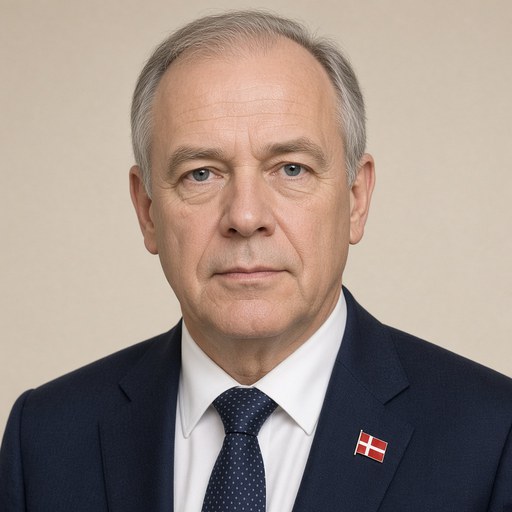
Prime Minister Poul Nyrup Rasmussen's opening speech at the official opening of the Danish Center for Holocaust and Genocide Studies on August 31, 2000.
 Poul Nyrup Rasmussen · Prime Minister of Denmark
- Context
- Rasmussen delivered the opening speech at the inauguration of the Danish Center for Holocaust and Genocide Studies in Copenhagen on August 31, 2000.
- Main themes
- Holocaust remembrance, genocide studies, historical memory, Danish Holocaust and Genocide Studies Center inauguration, moral responsibility, human rights, Danish history and refugees, foreign policy, prevention of future atrocities, Primo Levi, Pastor Niemöller, good versus evil
- Duration
- ~14 min
- Words
- 1,726
- Sentences
- 91
- Readability
- 62
- Grade
- 9.3
- Syntax
- 2.94
- Vocabulary
- 2.06
Translated from Danish
The broad sphere of national life a sentence belongs to. Every sentence has an Arena, so it is the denominator the other indices are read against.
Other91 sentences in 28 paragraphs
'We will never forget'
Dear Uffe Østergaard. Dear chairman, dear everyone. We will never forget. It was painted on the walls of Auschwitz. I thought I could prepare myself for it when we were on an official visit to Poland a few years ago. But one cannot prepare for Auschwitz.
The author Primo Levi has said:
'You who live in safety, in your warm houses, you who find, when you come home in the evening, warm food and friendly faces: Think about whether this is a human being Who works in the mud Who knows no peace Who fights for a piece of bread Who dies because of a yes or a no. (…) Think about that this has happened. I entrust you these words. Let them be carved into your hearts, at home as well as outside. When you go to bed, when you get up. Repeat them to your children. Or may your houses collapse Illness strike you, And the children turn away from you.'
The author Primo Levi was one of the millions of people who experienced one of the darkest chapters of our time in his own body and soul. That chapter, which will forever stand as hell on earth.
Here, almost 60 years later, we must still ask ourselves how it could happen.
The Holocaust must forever remind us of humanity's Janus face. Of the struggle between good and evil. Of the worst sides of humanity, which thrive and therefore must be restrained. We owe it to the victims, we owe it to ourselves, we owe it to the future.
I must say, it is therefore with a strange feeling that I stand here today. On the one hand, it is an incredible joy for me to be empowered and enriched to inaugurate the Center for Holocaust and Genocide Studies on an ordinary Thursday in Nørre Søgade and to open the new Danish center under the leadership of Uffe Østergaard and the chairmanship.
On the other hand, I must also say that the very condition for our being here, as mentioned, is part of the tragic side of our world. But I would like to emphasize that the new center is a manifestation of a growing recognition that the struggle against the phenomena and forces that led to the Holocaust, to the Armenian genocide, to Cambodia and Rwanda, to Vukovar and Kosovo, that struggle is not over. I also feel that Chechnya should be added.
The opening of the Center marks a growing understanding that evil is something we must face, and something we must necessarily take co-responsibility for.
The first prerequisite for us to endure and think about and overcome the threat of future genocides is that we are willing to face history. Use the historical insight, dare to look it in the eye, dare to talk about it, dare to use it in relation to the future and the present. Dare to use history to speak out when it is necessary to speak out. There are many who have been scolded for this and have had difficulties with it. But I am completely sure that history dares to say to those who spoke out, where it was necessary to speak out, that it was good and right that they did so.
We must remember the words of the Protestant pastor Niemöller in Germany: 'First they came for the communists, but I was not a communist, so I did not protest. Then they came for the Jews, but I was not a Jew, so I did not protest. Then they came for the trade unionists, but I was not a trade unionist, so I did not protest. Then they came for the Catholics, but as I was a Protestant, I did not protest either, and then they came for me and there was no one left to protest.'
One has their present to speak out with the historical awareness one has. And the Holocaust gives us a basis to remind us of the past and help us find our way into the future.
This center has at once a precisely defined, but at the same time also a very ambitious mandate. It must conduct independent research of international quality in collaboration with other relevant institutions. We have already defined tasks for the Danish aspects of the studies and research. The way we treated refugees who sought to come to Denmark in the 1930s is one of the stains in our historical chapter, which certainly does not take away from the other: The bright sides of our history. The Jewish refugees to Sweden. The way we ensured that. Although history is complex and multifaceted, I am sure that the ambulance driver did not know the underlying maneuvers back then. Just as little as the nurse or the porter down in the corridors, who led our Jews safely to Sweden.
Regardless of the chapter that we are proud of and which many in the wider world think of and respect Denmark for, we must also contribute to telling about the dark spots in our history. The center must also contribute to actively developing a more systematic method, so that the conceptual insight can be used concretely and operationally in Danish foreign policy.
In other words, the center is both a place where we uncover history to become wiser and more resilient to future temptations, but also forms the basis for shaping our own forward-looking foreign policy. For example, it would be obvious in relation to our political and aid efforts in the field of human rights or in organizing peacekeeping and conflict prevention efforts, that we have the center to support us with the knowledge that is illuminated.
The public information and educational work is the last, but nonetheless perhaps the most important main area for the center's work.
I see Peter Duetoft is here today and I would like to say that Peter and I have had many good discussions about the process and the lead-up to the establishment of the center. I thank again for CD's initiative and of course also for the fact that we have been able to solve this task together, which could not have been carried out without the contributions of many idealistic people.
It is absolutely crucial that we convey the historical knowledge and the human insight that is necessary to see the warning signs of the times and understand that passivity is never enough. In general, passivity is not my temperament, I would like to say to the ladies and gentlemen. A well-functioning democracy with respect for minorities and human rights rests on a well-informed and historically conscious population. It is fundamental - but not sufficient - to remember the victims. We must ask ourselves what we can do to avoid repetitions. Especially for the new generation, it is so immensely important. I actually share many of the voices in the choir that speak about our public school, which is the foundational pillar of democracy and all that we stand for, must not forget history education. This also applies further up in our education. I also believe that we here can contribute to the public school and to the general education, which also includes historical awareness of where we come from, what we must take care of, and how we move forward from here.
Our democratic and human values must never be taken for granted. It is a common cause. Not just for the center, but for all of us. It requires active actions to create an active society for all of us, and we must never passively accept the state of affairs.
It was the same recognition that brought heads of state and government from 46 countries together in Stockholm a little over half a year ago for a conference, where the central message was that we must do everything in our power to ensure that the bitter lesson from the Holocaust is never forgotten. I see a clear connection between the Stockholm conference and the Danish society's obligations and decisions and practical manifestation here today.
We must never be tempted to believe that the world is good enough as it is. That what we see is the whole truth. I clearly remember the situation where Boris Yeltsin stood on the tank and declared the country free, where the CNN reporter suddenly says: 'Now I can't see anymore because people have turned the corner.' Even CNN cannot provide us with the complete picture of reality.
We must provide the complete picture ourselves. With wisdom and with historical awareness, and thus get the guidance we need. That part of reality which is sometimes so harsh that one is tempted to repress the world of reality.
Let me just repeat here at the end: We must and shall never forget our victims of the world's horrors.
There are great expectations for Uffe Østergaard and the chairmanship and for the significance that the center will be able to have in solving the tasks that we have an obligation to participate in.
I should of course send greetings from my foreign minister, who unfortunately is unable to be here today. I must naturally also, with all that lies in the duties, wish you and all the people who will work here congratulations on the establishment of the new center. I was led through the corridors, and it looks nice and sensible. There seems to be space and light, so one can discuss things and present them.
For my part, I would like to conclude by saying, and I understood that Uffe Østergaard had said something about Austria, and therefore I will not go into the theme too much, but perhaps still assure one thing for my own part, and that is: They can shout, and they can shout. If I feel the urge to speak out, I do so. I feel a great obligation to do so. This applies both in the current referendum debate. Regardless of what I may encounter. One must speak out when it is necessary to speak out, and one must remember the past when it is necessary to remember it. Whether it is popular or less popular. That is how we Danes best deal with it.
Congratulations on that, a good future, we look forward to the first results and thank you.
The original Danish. The tags above are read on the English translation's sentences.
'Vi vil aldrig glemme'
Kære Uffe Østergaard. Kære formand, kære alle sammen. Vi vil aldrig glemme. Det stod der malet på Auschwitz’ vægge. Jeg troede, jeg kunne forberede mig på det, da vi var på officielt besøg i Polen for en del år siden. Men man kan ikke forberede sig på Auschwitz.
Forfatteren Primo Levi har sagt:
'I som lever i sikkerhed, i jeres varme huse, I der finder, når I kommer hjem om aftenen, varm mad og venlige ansigter: Tænk over om dette er et menneske Som arbejder i mudder Som ikke kender til fred Som slås for en bid brød Som dør på grund af et ja eller et nej. (…) Tænk over at dette er sket. Jeg overantvorder jer disse ord. Lad dem mejsle sig ind i jeres hjerter, hjemme såvel som ude. Når I går i seng, når I står op. Gentag dem for jeres børn. Eller måtte jeres huse falde sammen Sygdom ramme jer, Og børnene vende sig fra jer'
Forfatteren Primo Levi var en af de millioner af mennesker, der på sin egen krop og sjæl gennemlevede et af vor tids histories mørkeste kapitler. Det kapitel, der for evigt vil stå som helvede her på jorden.
Her næsten 60 år efter, må vi stadig spørge os selv, hvordan det kunne ske.
Holocaust skal til evig tid påminde os om menneskelighedens Janus ansigt. Om kampen mellem det gode og det onde. Om de værste sider i mennesket, der trives og derfor må tøjles. Det skylder vi ofrene, det skylder vi os selv, det skylder vi fremtiden.
Jeg må sige, det er derfor også med en mærkelig fornemmelse, jeg står her i dag. På den ene side er det en utrolig stor glæde for mig at være bemyndiget til og beriget med at skulle indvie centret for Holocaust- og Folkedrabsstudier på en helt almindelig torsdag i Nørre Søgade og åbne det nye danske center under ledelse af Uffe Østergaard og formandsskabet.
På den anden side må jeg også sige, at selve betingelsen for, at vi står her, som sagt er en del af den tragiske side af vores verden. Men jeg vil gerne understrege, at det nye center er en manifestation af en voksende erkendelse af, at kampen mod de fænomener og kræfter, der førte til Holocaust, til det armenske folkedrab, til Cambodia og Rwanda, til Vulkorvar og Kosovo, den kamp er ikke forbi. Jeg føler også, at Tjetjenien bør lægges til.
Åbningen af Centret markerer en voksende forståelse for, at ondskaben er noget, vi er nødt til at se i øjnene, og noget vi nødvendigvis må tage et medansvar for.
Den første forudsætning for at vi kan holde det ud og tænke på og overvinde truslen om fremtidige folkedrab er, at vi er villige til se historien i øjnene. Bruge den historiske indsigt, turde se den i øjnene, turde tale om den, turde bruge den i forhold til fremtiden og nutiden. Turde bruge historien til at sige fra, når der skal siges fra. Det er der flere, der har fået skæld ud for og besværligheder med. Men jeg er fuldstændig sikker på, at historien tør sige til dem, der sagde fra, der hvor der skulle siges fra, at et var godt og rigtigt de gjorde det.
Vi skal jo huske ordene fra den protestantiske præst Niemöller i Tyskland: 'Først kom de efter kommunisterne, men jeg var jo ikke kommunist, så jeg protesterede ikke. Så kom de efter jøderne, men jeg var jo ikke jøde, så jeg protesterede ikke. Så kom de efter fagforeningsmedlemmerne, men jeg var jo ikke fagforeningsmedlem. Så jeg protesterede ikke. Så kom de efter katolikkerne, men da jeg var protestant, så protesterede jeg jo heller ikke, og så kom de efter mig og så var der ikke længere nogen til at protestere.'
Man har sin nutid til at sige fra med den historiske erkendelse, man har. Og Holocaust giver os et grundlag til at minde os om fortiden og hjælpe os til at finde vej i fremtiden.
Centret her har på én gang et præcist afgrænset, men samtidig også et vældigt ambitiøst mandat. Man skal drive uafhængig forskning af international kvalitet i samarbejde med andre relevante institutioner. Danske aspekter af studierne og forskningen har vi jo allerede fået defineret opgaver for. Måden vi behandlede flygtninge, der søgte til Danmark i 1930 ́erne, er en af de pletter i vores historiske kapitel, som selvfølgelig ikke fratager os det andet: De lyse sider af vores historie. De jødiske flygtninge til Sverige. Måden vi sikrede det på. Selvom historien er kompleks og sammensat, så er jeg sikker på, at ambulancechaufføren ikke kendte de bagvedliggende manøvrer dengang. Ligeså lidt som sygeplejersken eller portøren nede i gangene, der førte vores jøder frelst til Sverige.
Uanset det kapitel som vi er stolte af og som mange ude i den store verden tænker på og har respekt for Danmark omkring, så skal vi også bidrage til at fortælle om de sorte pletter i vores historie. Centret skal også bidrage til at aktivt at udvikle en mere systematiske metode, så den forestillingsmæssige indsigt kan benyttes konkret og operativt i dansk udenrigspolitik.
Centret er med andre ord både et sted, hvor vi afdækker historien for at blive klogere og visere og mere modstandsdygtige på fremtidige fristelser, men danner også basis for at forme vores egen fremadrettede udenrigspolitik. For eksempel vil det være oplagt i relation til vores politiske og bistandsmæssige indsats på menneskerettighedsområdet eller ved tilrettelæggelse af fredsbevarende og konfliktforebyggende indsatser, at vi har centret til at støtte os til med den viden, der er oplyst.
Den folkelige informations- og oplysningsvirksomhed er det sidste, men ikke desto mindre måske mest vigtige hovedområde for centrets arbejde.
Jeg ser Peter Duetoft er her i dag og jeg vil gerne sige, at Peter og jeg har haft mange gode drøftelser om forløbet og optakten til etableringen af centret. Jeg takker igen både for CD ́s initiativkraft og naturligvis da også for, at vi har været istand til at løse denne her opgave i fællesskab, som ikke kunne være gennemført uden mange idealistiske menneskers bidrag.
Det er helt afgørende, at vi får formidlet den historiske viden og den menneskelige indsigt, som er nødvendig for at se faresignalerne i tiden og forstå, at passivitet aldrig er nok. I det hele taget er passivitet ikke mit temperament, vil jeg gerne sige til de damer og herrer. Et velfungerende demokrati med respekt for minoriteter og menneskerettigheder hviler på en veloplyst og historisk bevidst befolkning. Det er fundamentalt - men ikke tilstrækkeligt - at huske ofrene. Vi skal spørge os selv, hvad vi kan gøre for at undgå gentagelser. Især for den nye generation er det så kolossalt vigtigt. Jeg deler i virkeligheden meget de stemmer i koret, som taler om, at vores folkeskole, som er det bærende fundament for demokratiet og alt det vi står for, ikke må glemme historieundervisningen. Det gælder også videre op i vores uddannelser. Jeg tror også, at vi her, selv kan bidrage til folkeskolen og til den almene dannelse, som jo også indbefatter historisk bevidsthed om, hvor er vi kommet fra, hvad skal vi passe på, og hvordan kommer vi videre herfra.
Vores demokratiske og menneskelige værdier må aldrig blive taget for givet. Det er en fælles sag. Ikke bare for centret, men for os alle. Det kræver aktive handlinger at skabe et aktivt samfund for os alle sammen, og vi må aldrig passivt acceptere tingenes tilstand.
Det var den samme erkendelse som for godt et halvt år siden bragte stats- og regeringscheferne for 46 lande sammen i Stockholm til en konference, hvor det centrale budskab var, at vi skal gøre alt, hvad der står i vores magt for at sikre, at den bitre lære fra Holocaust aldrig bliver glemt. Jeg ser en klar forbindelse mellem Stockholm-konferencen og det danske samfunds forpligtelser og beslutning og praktiske manifestation her i dag.
Vi må aldrig fristes til at tro, at verden er god nok som den er. At det, vi ser, er hele sandheden. Jeg husker tydeligt den situation, hvor Boris Jeltsin stod oppe på tanken og erklærede landet friheden, hvor CNN-reporteren pludselig siger: 'Nu kan jeg ikke se mere, fordi folk er drejet om hjørnet.' Selv CNN kan ikke levere os det komplette billede af virkeligheden.
Det komplette billede skal vi selv levere. Med klogskab og med historisk bevidsthed, og dermed få den vejledning, vi har brug for. Den del af virkeligheden som nogle gange er så barsk, at man fristes til at fortrænge virkelighedens verden.
Lad mig blot gentage her til slut: Vi må og skal aldrig glemme vores ofre for verdens rædsler.
Der knytter sig store forventninger til Uffe Østergaard og formandskabet og til den betydning, som centret vil kunne få ved løsning af de opgaver, som vi har en pligt til også at deltage i.
Jeg skulle selvfølgelig hilse fra min udenrigsminister, som desværre er forhindret i at være her i dag. Jeg skal naturligvis også med alt det der ligger i pligterne ønske dig og alle de mennesker som kommer til at arbejde her, tillykke med etableringen af det nye center. Jeg blev ført gennem gangene, og det ser flot og fornuftigt ud. Der ser ud til at være plads og lys, så man kan diskutere tingene og få dem fremlagt.
For mit eget vedkommende vil jeg gerne slutte med at sige, og jeg forstod, at Uffe Østergaard havde sagt noget om Østrig, og jeg skal derfor ikke komme så meget ind på temaet, men måske alligevel forsikre en eneste ting for mit eget vedkommende, og det er: De kan råbe, og de kan råbe. Hvis jeg føler trang til at sige fra, så gør jeg det. Det føler jeg en stor pligt til. Det gælder både i den aktuelle folkeafstemningsdebat. Uanset hvad jeg måtte komme ud for. Man skal sige fra, når det er nødvendigt at sige fra, og man skal mindes fortiden, når det er nødvendigt at mindes den. Uanset om det er populært eller mindre populært. Det har vi danskere det nu engang bedst med.
Tillykke med det, god fremtid, vi venter spændt på de første resultater og tak.