




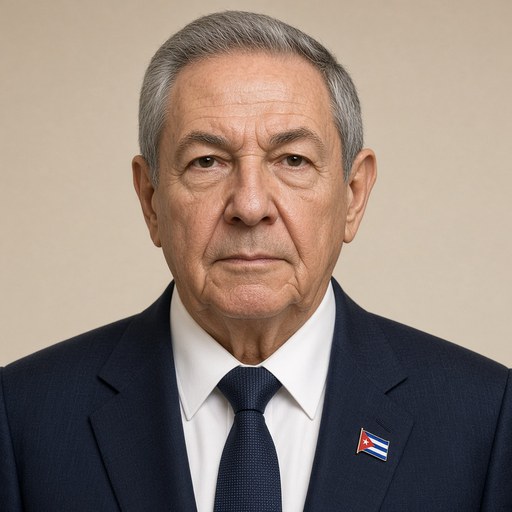
Three mambises of our times: Speech delivered by Raúl Castro at the decoration ceremony.
 Raúl Castro · President of Cuba
- Context
- Castro addressed a decoration ceremony on February 24, 2018, commemorating Cuba's War of Independence anniversary while honoring three longtime revolutionary leaders with the Hero of Labor title.
- Main themes
- Cuban independence and revolutionary history, decoration ceremony for Heroes of Labor, José Martí and the War of Independence, José Ramón Machado Ventura, Ramiro Valdés Menéndez, Guillermo García Frías, Cuban Revolutionary Party, Rebel Army and Sierra Maestra, revolutionary sacrifice and national unity, communist Party of Cuba leadership
- Duration
- ~14 min
- Words
- 1,733
- Sentences
- 59
- Readability
- 41
- Grade
- 14.8
- Syntax
- 3.23
- Vocabulary
- 2.47
Translated from Spanish
The broad sphere of national life a sentence belongs to. Every sentence has an Arena, so it is the denominator the other indices are read against.
Other59 sentences in 32 paragraphs
February 25, 2018 08:02:05
(Transcripts - State Council)
Comrades:
Today, February 24, we commemorate the 123rd anniversary of the resumption of the War of Independence called by José Martí.
The profound significance of this date marked the point of maturity and crystallization of the project developed by Martí, who founded the Cuban Revolutionary Party to lead it and make it a reality.
When everything seemed lost, his ability to find an alternative and to overcome any setback led him to call the people to a definitive effort: the war he deemed necessary when he considered it inevitable. At all times, he appealed to national unity, articulating the best traditions of the past, without omitting any of those who were willing to sacrifice and give their lives for the higher cause.
A month later, on March 25, 1895, in Montecristi, Dominican Republic, Martí signed the Manifesto with Major General Máximo Gómez that established the scope and purposes of the struggle. Together they set out for Cuba to join the liberating effort, landing at Playitas de Cajobabo on April 11. A few days earlier, Major General Antonio Maceo had landed at Duaba.
As Fidel pointed out when commemorating a century of the Ten Years' War, “Martí picked up the flags of Céspedes, of Agramonte, and of the heroes who fell in that struggle and brought the revolutionary ideas of Cuba in that period to their highest expression.”
There is no better occasion than this to bestow the honorary title of Hero of Labor of the Republic of Cuba, as a just recognition of a lifetime dedicated to the Revolution, to three valuable comrades who already hold the honorable status of Heroes of the Republic of Cuba. I refer to José Ramón Machado Ventura and the commanders of the Revolution Ramiro Valdés Menéndez and Guillermo García Frías.
Of Machado Ventura, I could highlight that he began his activities against the tyranny while studying Medicine at the University of Havana. Sixty-five years ago, he participated in the first March of the Torches, in January 1953.
In 1957, he joined the Rebel Army in the Sierra Maestra, participating in several battles as a doctor and guerrilla fighter. He was a founder of the Second Front; there he organized and directed the Military Health Department until the end of the struggle, where he was wounded in combat actions. He developed an extensive network of hospitals and field dispensaries that served not only the combatants but also, and fundamentally, the local population, who in many places saw a doctor in person for the first time.
Upon the triumph of the Revolution, he was appointed head of the Medical Services of Havana and of the FAR and later Minister of Public Health.
He is a founder of the Communist Party of Cuba and in 1975 was elected a member of its Political Bureau. He was First Secretary of the Party in several provinces.
Since 2011, he has served as Second Secretary of the Central Committee. He is Vice President of the Councils of State and Ministers.
Ramiro Valdés Menéndez joined the revolutionary struggle at a very young age. He participated in the March of the Torches in January 1953 and in July of that same year in the assault on the Moncada barracks, where he was wounded. He served time in Isla de Pinos and was exiled in Mexico, joining the Granma yacht expedition.
In the Sierra Maestra, he participated in multiple battles. He fought alongside Che in the invasion of the West as the second chief of Column No. 8 Ciro Redondo.
Since the revolutionary triumph, he has held important positions, including Minister of the Interior on two occasions and Vice President of the Councils of State and Ministers, a responsibility he holds today. He is a member of the Political Bureau of the Party.
Many things can be added about each of them on this occasion, but in Ramiro's case, I have always admired that he is the only one among us who, in addition to those steps a few months before Moncada when under Fidel's direction we marched in the first March of the Torches — which recently turned 65 years — was wounded in the taking of the main post during the attack on Moncada with a bullet that entered through his heel and lodged in the sole of his foot. When we joined or were joined in the Vivac of Santiago de Cuba, he showed me the blood on his socks, but he did not know where the bullet was. Years passed, and he began to limp in the Sierra Maestra due to a callus he had on the sole of one foot, and on more than one occasion, he could not keep pace with the initial group of the liberation war, until one day, with his own campaign knife, he began to scrape the supposed callus and the bullet from the attack on Moncada appeared, shot by an enemy who, mortally wounded, pulled the trigger.
Dozens or hundreds of heroic feats or important events can be recounted about all of them that, naturally, were not recorded in the few campaign diaries that were written. Furthermore, in the liberation war, he had the merit and honor that the rest of us did not have of being the second chief of the column that Che led to reach Las Villas.
Guillermo García Frías, who turned 90 just a few days ago, organized a network of peasants to help the Granma expeditionaries and take them to the Sierra Maestra. His shrewdness allowed him to personally lead Fidel and other combatants to Cinco Palmas and recover several rifles.
He was the first peasant to join the Rebel Army, with a prominent role, first as a combatant and then as the second chief of the Third Front when it was established, in early March 1958, under the command of then Commander Juan Almeida.
Hundreds of anecdotes can also be told about Guillermo; from those early days, after the landing, we only lightly mention some aspects. He was the one who led Fidel and two other comrades, Faustino Pérez, a doctor, and Universo Sánchez, one of them unarmed since he left his rifle to treat the wounded from the first combat, that of Alegría de Pío. In other words, Fidel arrived in the Sierra Maestra with two more combatants and only one armed. Guillermo García was the one who got him out of the encirclement that was on the old road from the Pilón sugar mill to the municipal seat of Niquero; he was the one who, fulfilling other immediate missions that the Commander in Chief assigned him, from the Purial de Vicana, that is, Cinco Palmas de Vicana, the place where they set up the first camp, gathered almost all of us who originally joined, including Ramiro himself, Almeida, Che, Camilo, and thus the initial group of three, then five more: eight; that group of such important comrades began to form.
Among the first steps he took to support the nascent guerrilla, is the number of rifles he collected in the days following these events I am narrating, between 15 and 18, with which, along with the few we had, we could not even form a platoon, but enough to carry out the first attack, and although it may not have been the most opportune moment to do so due to the relentless pursuit behind us by hundreds of soldiers, Fidel said that the people needed to know with a first combat that the guerrilla was holding on and that the war would continue. Hence the battle of La Plata, just a few weeks after this initial group was formed, with Guillermo García's help. Other tasks would follow.
As the first peasant to join the Rebel Army, he was also the first to be promoted. He had a prominent role, first as a combatant, and then as the second chief of the Third Front, under Almeida's command.
Upon the triumph of the Revolution, he held various positions in the Revolutionary Armed Forces. Subsequently, he has held, among others, the responsibilities of Delegate of the Political Bureau in the former province of Oriente, Vice President of the Councils of State and Ministers, Minister of Transport, and President of the Business Group of Flora and Fauna, where he has performed commendable work.
He was a member of the Political Bureau of the Party from 1965 to 1986; he is currently a member of the Central Committee and the Council of State.
As a common characteristic of these three mambises of our times, I can cite their fidelity to the Revolution and to Fidel, their dedication to work, the modesty and simplicity that have made them worthy of the recognition and respect of Cubans.
It is no coincidence that we remember this date in the Capitol, whose restoration work, carried out with tenacity, has allowed us to exalt the values of one of the most important buildings in the country, in whose crypt the ashes of an unknown mambí have been placed, before which the flame burns as a tribute from the people to their founding fathers and to the glorious Liberating Army, and is surrounded by the flags of the nations of the continent.
This building is today the seat of the National Assembly of People's Power. It is also the irrefutable proof of the care and interest that must always be placed in the preservation of the cultural heritage of the nation.
Let this solemn moment serve to extend a well-deserved congratulations to the Historian of Havana, Eusebio Leal, and also to his collaborators who have been closest to the grand work of restoring the Capitol. Among them, architect Perla Rosales; engineers Mariela Mulet, Yohanna Aedo, and Tatiana Fernández; restorer Patricia Coma; professor Juan Carlos Botello and his students from the Workshop School; historian Lesbia Méndez; director of the Construction Company of the Historian's Office, Conrado Hechavarría; and German technician Michael Diegmann.
On a day like this, when we honor those dignified Cubans who in 1895 returned to the battlefield to liberate Cuba, I recall the words spoken by Fidel in 1965: “We would then have been like them, they today would have been like us!” That is the commitment we have maintained and will also guide current and future generations, so that the Homeland remains free.
Thank you very much.
The original Spanish. The tags above are read on the English translation's sentences.
25 de febrero de 2018 08:02:05
(Versiones Taquigráficas - Consejo de Estado)
Compañeras y compañeros:
Conmemoramos hoy, 24 de febrero, el aniversario123 del reinicio de la Guerra de Independencia convocada por José Martí.
El profundo significado de esta fecha marcó el punto de madurez y cristalización del proyecto elaborado por Martí, quien para conducirlo y hacerlo realidad fundó el Partido Revolucionario Cubano.
Cuando todo parecía perdido, su capacidad de hallar una alternativa y sobreponerse ante cualquier revés, lo llevó a convocar al pueblo a un esfuerzo definitivo: la guerra que creyó necesaria cuando la consideró inevitable. En todo momento apeló a la unidad nacional, articulando las mejores tradiciones del pasado, sin omitir a ninguno de los que estuvieron dispuestos al sacrificio y a dar la vida por la causa superior.
Un mes después, el 25 de marzo de 1895, en Montecristi, República Dominicana, Martí suscribió con el Mayor General Máximo Gómez el Manifiesto que estableció el alcance y los propósitos de la lucha. Juntos partieron hacia Cuba para sumarse al empeño libertador, desembarcando por Playitas de Cajobabo el 11 de abril. Pocos días antes lo había hecho el Mayor General Antonio Maceo por Duaba.
Como señalara Fidel al conmemorarse un siglo de la Guerra de los Diez Años, “Martí recogió las banderas de Céspedes, de Agramonte y de los héroes que cayeron en aquella lucha y llevó las ideas revolucionarias de Cuba en aquel período a su más alta expresión”.
Ninguna mejor ocasión que esta para otorgar el título honorífico de Héroe del Trabajo de la República de Cuba, como justo reconocimiento a la obra de una vida entera consagrada a la Revolución, a tres valiosos compañeros que ya atesoran la honrosa condición de Héroes de la República de Cuba. Me refiero a José Ramón Machado Ventura y a los comandantes de la Revolución Ramiro Valdés Menéndez y Guillermo García Frías.
De Machado Ventura podría destacar que inició sus actividades contra la tiranía cuando estudiaba Medicina en la Universidad de La Habana. Hace 65 años participó en la primera Marcha de las Antorchas, en enero de 1953.
En 1957 se unió al Ejército Rebelde en la Sierra Maestra, participó en varios combates como médico y guerrillero. Fue fundador del II Frente; allí organizó y dirigió el Departamento de Sanidad Militar hasta el final de la lucha, donde fue herido en acciones combativas. Desarrolló una amplia red de hospitales y dispensarios de campaña que prestaron servicio no solo a los combatientes, sino también, y fundamentalmente, a la población de la zona, que en muchos lugares veían por primera vez un médico en persona.
Al triunfar la Revolución fue nombrado jefe de los Servicios Médicos de La Habana y de las FAR y luego Ministro de Salud Pública.
Es fundador del Partido Comunista de Cuba y en 1975 fue elegido miembro de su Buró Político. Fue Primer Secretario del Partido en varias provincias.
Desde el 2011 se desempeña como Segundo Secretario del Comité Central. Es Vicepresidente de los Consejos de Estado y de Ministros.
Ramiro Valdés Menéndez se incorporó desde muy joven a la lucha revolucionaria. Participó en la Marcha de las Antorchas en enero de 1953 y en julio del propio año en el asalto al cuartel Moncada, donde resultó herido. Cumplió prisión en Isla de Pinos y exilio en México, integrándose a la expedición del yate Granma .
En la Sierra Maestra intervino en múltiples combates. Participó junto al Che en la invasión a Occidente como segundo jefe de la Columna No. 8 Ciro Redondo.
Desde el triunfo revolucionario ha ocupado importantes cargos, entre los que destacan el de Ministro del Interior en dos ocasiones y Vicepresidente de los Consejos de Estado y de Ministros, responsabilidad que hoy ocupa. Es miembro del Buró Político del Partido.
Pueden añadirse muchas cosas de cada uno de ellos en esta ocasión, pero en el caso de Ramiro siempre le he admirado que es el único de todos nosotros que, además de aquellos pasos unos meses antes del Moncada en que bajo la dirección de Fidel desfilamos en la primera Marcha de las Antorchas —hizo recientemente 65 años—, fue herido en la toma de la posta principal del ataque al Moncada con un plomazo que le entró por el talón y se le alojó en la planta del pie. Cuando nos unimos o nos unieron en el Vivac de Santiago de Cuba, me mostró la sangre de los calcetines, pero no sabía dónde estaba el plomo. Pasaron los años y empezó a cojear en la Sierra Maestra por un callo que tenía en la planta de un pie, y en más de una ocasión no pudo seguir la marcha junto con el grupo inicial de la guerra de liberación, hasta que un día, con su propio cuchillo de campaña, empezó a rasparse el supuesto callo y le apareció el plomo del ataque al Moncada, disparado por un enemigo que cayendo mortalmente herido apretó el gatillo.
De todos se pueden hacer decenas o centenares de heroicas hazañas o de hechos importantes que, naturalmente, no se recogían ni en los pocos diarios de campaña que se escribieron. Además, en la guerra de liberación tuvo el mérito y el honor que no tuvimos los demás de ser el segundo jefe de la columna que dirigió el Che para llegar hasta Las Villas.
Guillermo García Frías, quien cumplió 90 años hace unos pocos días, organizó una red de campesinos para ayudar a los expedicionarios del Granma y llevarlos a la Sierra Maestra. Su sagacidad le permitió conducir personalmente a Fidel y a otros combatientes hasta Cinco Palmas y recuperar varios fusiles.
Fue el primer campesino incorporado al Ejército Rebelde, con una destacada participación, primero como combatiente y luego como segundo jefe del III Frente, cuando se constituyó, a principios de marzo de 1958, bajo la dirección del entonces Comandante Juan Almeida.
De Guillermo también se pueden hacer cientos de anécdotas; de esos primeros días, después del desembarco, solo mencionamos ligeramente algunos aspectos. Fue el que condujo a Fidel y a dos compañeros más, a Faustino Pérez, médico, y a Universo Sánchez, uno de ellos desarmado ya que por curar los heridos del primer combate, el de Alegría de Pío, dejó el fusil. O sea, que Fidel llegó a la Sierra Maestra con dos combatientes más y uno solo armado. Guillermo García fue el que lo sacó del cerco que estaba en el viejo camino del central Pilón a la cabecera municipal de Niquero; fue el que cumpliendo otras misiones inmediatas que le planteó el Comandante en Jefe, desde el Purial de Vicana, o sea, Cinco Palmas de Vicana, el lugar donde hicieron el primer campamento, recogió a casi todos los que nos unimos originalmente, entre ellos al propio Ramiro, a Almeida, al Che, a Camilo, y así al grupo inicial de tres, luego cinco más: ocho; se fue uniendo ese grupo de tan importantes compañeros.
Entre los primeros pasos que dio de apoyo a la naciente guerrilla, está la cantidad de fusiles que recogió en los días próximos a estos hechos que les estoy narrando, entre 15 y 18, con los cuales, junto a los pocos que teníamos, no pudimos hacer ni siquiera un pelotón, pero suficientes para llevar a cabo el primer ataque, y aunque no era tal vez el momento más oportuno para hacerlo por la persecución tenaz que había detrás de nosotros por cientos de soldados, Fidel decía que había que darle a conocer al pueblo con un primer combate que la guerrilla se mantenía y que continuaría la guerra. De ahí el combate de La Plata, apenas unas pocas semanas después de que se reunió, con la ayuda de Guillermo García, este grupo inicial. Después vendrían otras tareas.
Al ser el primer campesino que se incorporó al Ejército Rebelde, fue el primero, además, en ser ascendido. Tuvo una destacada participación, primero como combatiente, y luego como segundo jefe del III Frente, bajo el mando de Almeida .
Al triunfar la Revolución ocupó diversos cargos en las Fuerzas Armadas Revolucionarias. Posteriormente ha desempeñado, entre otras, las responsabilidades de Delegado del Buró Político en la antigua provincia de Oriente, Vicepresidente de los Consejos de Estado y de Ministros, Ministro del Transporte y Presidente del Grupo Empresarial de Flora y Fauna, donde ha realizado una meritoria labor.
Integró el Buró Político del Partido desde 1965 hasta 1986 ; actualmente es miembro del Comité Central y del Consejo de Estado.
Como característica común de estos tres mambises de nuestros tiempos puedo citar su fidelidad a la Revolución y a Fidel, su consagración al trabajo, la modestia y sencillez, que los han hecho merecedores del reconocimiento y el respeto de los cubanos.
No es casual que rememoremos esta fecha en el Capitolio, cuya obra de restauración, llevada adelante con tenacidad, ha permitido exaltar los valores de uno de los edificios más importantes del país, en cuya cripta han sido colocadas las cenizas de un mambí desconocido, ante el cual arde la llama como tributo del pueblo a sus padres fundadores y al glorioso Ejército Libertador, y está rodeado de las banderas de las naciones del continente.
Este edificio es hoy sede de la Asamblea Nacional del Poder Popular. Es también la prueba fehaciente del cuidado e interés que ha de ponerse siempre en la preservación del patrimonio cultural de la nación.
Sirva este solemne momento para extender una bien merecida felicitación al Historiador de La Habana, Eusebio Leal, y también a sus colaboradores que más cerca han estado en la magna obra de restauración del Capitolio. Entre ellos, la arquitecta Perla Rosales; las ingenieras Mariela Mulet, Yohanna Aedo y Tatiana Fernández; la restauradora Patricia Coma; el profesor Juan Carlos Botello y sus alumnos de la Escuela Taller; la historiadora Lesbia Méndez; el director de la Empresa Constructora de la Oficina del Historiador, Conrado Hechavarría; y el técnico alemán Michael Diegmann.
En un día como este, en el que honramos a aquellos cubanos dignos que en 1895 volvieron al campo de batalla para liberar a Cuba, retomo las palabras pronunciadas por Fidel en 1965: “¡Nosotros entonces habríamos sido como ellos, ellos hoy habrían sido como nosotros!” Ese es el compromiso que hemos mantenido y será también el que guíe a las actuales y futuras generaciones, para que la Patria siga siendo libre.
Muchas gracias (Aplausos).
COMPARTIR facebook twitter google +